
Underwriting delays remain one of the biggest operational bottlenecks in banking. While the actual credit or risk assessment may take only a few hours, most applications spend days or even weeks stuck between document collection, verification checks, compliance reviews and approval queues. Traditional underwriting workflows still depend heavily on manual coordination, sequential processing and fragmented systems, making turnaround time (TAT) a major challenge for lenders and insurers.
This is where AI agents are fundamentally changing underwriting operations. Instead of waiting for one stage to finish before the next begins, AI-powered underwriting systems use multiple intelligent agents that work in parallel across document processing, verification, risk analysis, compliance checks and decision routing. The result is faster approvals, lower operational overhead, reduced manual errors and significantly improved borrower experience.
Modern AI underwriting agents go beyond basic automation. They can process unstructured documents, retrieve third-party verification data in real time, detect fraud patterns, evaluate borrower risk dynamically and generate audit-ready compliance outputs without constant human intervention. What traditionally took 10 to 27 days can now be compressed into hours for standard applications, allowing banks and insurers to scale underwriting capacity without proportional headcount growth.
In this blog, we will break down how AI agents reduce underwriting delays in banking and insurance, where bottlenecks actually occur in the underwriting pipeline and how multi-agent architectures are helping financial institutions improve speed, accuracy, compliance and underwriting efficiency at enterprise scale. So, let’s begin the guide!
Traditional vs. AI-Powered Underwriting: What Actually Changes
The main difference between traditional vs. AI-powered underwriting is that traditional underwriting relies heavily on human review, while credit underwriting AI continuously evaluates borrower risk using real-time data and adaptive models.

How Traditional Underwriting Works
Traditional underwriting is sequential and entirely human-dependent. Every stage requires manual data gathering, verification, risk scoring, compliance checks and decision issuance before the next stage begins. The underwriting process in traditional banking is also format-dependent. Documents arrive as PDFs, scanned images, handwritten forms and faxed pages.
Each requires manual input: a human opens it, reads it, extracts relevant figures from income statements and financial statements and re-enters them into the loan origination system. Human error rates of 6.5 to 10% in manual processing propagate through every downstream stage, triggering rework loops that extend timelines further.
What AI Automation Changes
AI-powered underwriting utilizes multiple agents that work simultaneously to extract documents, score risks, detect fraud and perform regulatory checks, resulting in increased speed and reliability compared to traditional methods.
The shift is architectural. Traditional basic automation handles structured data in rule-based workflows. AI agents in finance process unstructured data, reading and extracting relevant information from various document formats that traditional automation and automated underwriting systems of the prior generation could not handle.
AI agents utilize natural language processing to process unstructured documents, turning hours of manual review into seconds of structured output. The practical difference: traditional automation can validate that a field is populated.
An AI agent reads a Schedule C, determines that reported net income reflects a seasonal business, cross-references it against three years of borrower data and flags the discrepancy for human review, all without human intervention in the assembly step.
Where Underwriting Delays Actually Occur: The 5-Stage Pipeline
Underwriting delays occur across five sequential pipeline stages: application intake, document verification, credit and risk analysis, compliance review and decision routing. Most of the time loss sits in the stages surrounding credit analysis, not in the credit judgment itself. For better understanding, let me walk you through each stage.
| S. No. | Pipeline Stage | What Happens | Where Time Is Lost | Typical Delay |
| 1. | Application Intake and Data Gathering | The applicant submits their application and the bank begins collecting supporting documents: pay stubs, tax returns, bank statements, property appraisals and business financials for commercial deals. | Documents arrive in inconsistent formats, including PDF, scanned images and handwritten submissions. When something is missing, the process stalls while the team chases the applicant for resubmission.Every document that does arrive still requires someone to manually extract figures and re-enter them into the LOS, which introduces both delay and error at the very first stage. | 2 to 5 days |
| 2. | Document Verification | The bank authenticates each document and cross-references the data against third-party sources: IRS for tax transcripts, employers for income confirmation and property records for appraisals. | Verification requests are sent out one at a time and processed in batches rather than in real time. Every provider runs on its own response timeline and because verifications run sequentially, the slowest provider holds up every subsequent stage. A process that could complete in hours instead stretches across days simply because nothing runs at the same time. | 3 to 7 days |
| 3. | Credit and Risk Analysis | The underwriter evaluates credit history, debt-to-income ratio, collateral value and repayment capacity, running stress tests and comparing the applicant’s profile against internal credit policies and risk thresholds. | The underwriter must manually pull data from four to six separate systems, including the credit bureau, LOS, core banking platform, property valuation tool, income verification service and collateral management system. Each requires a separate login and a separate data extraction step. By the time the analyst has assembled everything they need to make a judgment, a significant portion of the day is already gone. | 2 to 5 days |
| 4. | Compliance and Regulatory Check | The compliance team runs KYC, AML/BSA, fair lending checks under ECOA and HMDA, flood zone determination and OFAC screening. | These checks happen after credit analysis completes, which means compliance adds a full sequential stage to an already long pipeline. Most of these verifications could run at the same time as credit analysis, but because the workflow is designed as a linear handoff, they wait their turn instead. | 1 to 3 days |
| 5. | Decision and Conditions | The senior underwriter or credit committee issues a final decision. For conditional approvals, stipulations are listed and the applicant must satisfy each one before the loan can close. | Decision queues build up because senior underwriters are handling complex cases while straightforward approvals sit waiting. Without automated stip tracking, underwriters manage each condition manually and every outstanding requirement creates another loop back through the pipeline. Even borrowers who are clearly qualified end up stuck in queues that exist not because of their risk profile but because of how the workflow is structured. | 2 to 7 days |
| Total sequential delay | 10 to 27 days |
That is 10 to 27 days for a process where the actual analytical work, meaning the risk assessment and credit decision, takes perhaps 2 to 4 hours. The remaining time is entirely administrative which includes document gathering, verifying, formatting, waiting, re-gathering and routing. AI agents target the administrative time, not the analytical time, making turnaround time (TAT) reduction the primary operational gain.
The core reason how AI agents reduce underwriting delays in banking and insurance is that they eliminate sequential waiting between underwriting stages.
Multi-Agent Architecture for Underwriting: How AI Agents Break the Sequential Chain
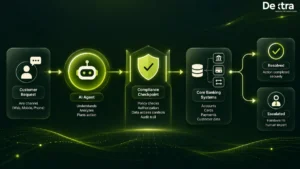
Multi-agent architecture for underwriting represents a fundamental shift in how the pipeline operates. Traditional underwriting is a pipeline where Stage 1 finishes before Stage 2 begins. A multi-agent underwriting system replaces linear handoffs with coordinated parallel execution across all underwriting stages, coordinated by an orchestrator that assembles their outputs into a decision-ready package.
Scientific and Academic Publishing‘s research published on agentic AI in underwriting demonstrates that this architecture significantly enhances the efficiency of loan processing, reduces bias and improves the precision of risk assessments, with substantial advancements in processing speed, cost efficiency and consistency in decision-making compared to conventional methods.
Let’s go through the multi-agent architecture for underwriting.
Agent 1: Document Intelligence Agent
The Document Intelligence Agent ingests all application documents regardless of format such as, PDFs, scanned images, handwritten forms and e-filed documents. It uses computer vision combined with LLM-based document understanding to extract structured borrower data: income figures from income statements, employer details, property values, tax liabilities and asset declarations from financial statements.
This agent does not simply OCR the document. It interprets context, understanding that gross income on a W-2 differs from gross income on a Schedule C and that automating data collection from these varied sources is where the first 2 to 5 days of delay are recovered. The agent populates LOS fields automatically, flags missing or expired documents and initiates requests to the applicant without any underwriter involvement. In implementations using Encompass, Blend, or MeridianLink, loan origination system (LOS) integration allows extracted borrower data to flow directly into underwriting workflows to the LOS data model, eliminating manual input entirely.
Agent 2: Verification Agent
The verification agent fires all third-party verification requests simultaneously. IRS income verification, employer confirmation, property valuation data retrieval, title search and flood zone determination all initiate at the same moment.
The agent monitors response SLAs across all providers, escalates overdue verifications automatically and cross-references returned borrower data against application data to flag discrepancies instantly.
This single architectural change eliminates the most common cause of the 3 to 7 day delay in Stage 2. Total wait time drops from the sum of all provider SLAs to the duration of the slowest single provider.
Income verification AI operating in parallel rather than in sequence is where much of the TAT reduction in modern underwriting originates. For property-heavy applications, the agent also retrieves property valuation data and integrates satellite imagery for collateral assessment in commercial real estate and agricultural lending.

Agent 3: Credit Risk Agent
The credit risk agent automates debt-to-income ratio calculation alongside collateral adequacy and liquidity analysis, runs stress-test scenarios against underwriting guidelines, evaluates collateral adequacy and generates a real-time risk scoring output with full explainability.
Credit risk scoring AI updates borrower risk models continuously as new verification data arrives, improving pricing accuracy and supporting better loss ratio outcomes compared to static scores.
Borrower financial analysis at this stage goes beyond credit history. The agent conducts a full credit assessment, incorporating income statements, financial statements, asset data and where applicable, alternative data sources, including bank transaction analysis and rent payment history.
For thin-file applicants, this alternative data integration has demonstrated a 10 to 15% reduction in default rates compared to traditional scoring methods, expanding access to qualified applicants while improving portfolio quality.
The explainability output is not a black-box score. It documents which underwriting guidelines were evaluated, where the applicant’s risk profile falls relative to each threshold and what the key risk factors are, producing an audit-ready package that satisfies fair lending examination requirements without separate compliance memo preparation.
Agent 4: Compliance Agent
The Compliance Agent runs KYC, AML/BSA, ECOA, HMDA, OFAC and flood zone checks in parallel with credit analysis rather than after it. In a standard pipeline, regulatory compliance review adds 1 to 3 days after credit analysis is complete. In a multi-agent architecture, compliance runs simultaneously and its output is ready when credit analysis finishes.
AI based fraud detection in banking is increasingly embedded directly into AML and KYC workflows rather than handled as a separate downstream review. AI agents can be configured to enforce compliance rules in real time, checking that every decision aligns with applicable frameworks, including NAIC guidelines, GDPR, the EU AI Act and internal audit protocols.
The NAIC’s 2024 Model Bulletin on AI Systems requires insurers to develop written programs to mitigate adverse consumer outcomes, including governance, risk management controls and internal audit functions – requirements that a properly configured compliance agent satisfies by design.
Properly configured agents maintain a full audit trail of every data point accessed and every decision step taken, making compliance reviews faster rather than a separate manual process. Each regulatory flag includes a specific citation: which regulation, which provision and precisely why the flag was raised.
Agent 5: The Orchestrator
The Orchestrator Agent coordinates Agents 1 through 4 and tracks the completion status of all parallel workflows in real time. When all four agents have completed their work, the orchestrator assembles the complete package required for an automated underwriting decision: applicant summary, verified borrower data, risk profile with explainability, compliance clearance and a recommended decision with regulatory-compliant reasoning for approval, conditional approval, or decline.
Human oversight at this stage is applied to a completed package rather than an assembly task. For the 70% of applications that are straightforward, human review and approval takes minutes. For the 30% involving genuine complexity, the underwriter’s full cognitive capacity is available because all administrative work is already done.

Build AI Underwriting Agents for Your Lending Workflow
From mortgage lending to commercial credit, Dextra Labs designs AI agents tailored to your LOS, policies, and compliance requirements.
? Talk to Our AI Agent ExpertsAI Agents in Insurance Underwriting
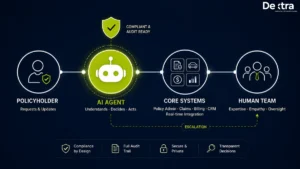
The multi-agent orchestration pattern applies equally to the insurance industry, including life insurance underwriting, health insurance and property and casualty lines, with agent configuration adapted to each product’s data inputs and risk factors.
In life insurance underwriting, AI agents accelerate the process from 15 days to just 2 days by automating data retrieval and processing unstructured documents, including attending physician statements, lab results and prescription histories.
The document intelligence agent handles structured and unstructured data from these sources. The risk agent evaluates mortality risk factors against actuarial tables. The compliance agent verifies that accelerated underwriting guidelines are correctly applied without constant human intervention.
For health insurance, agents pull structured risk profiles from medical history databases, cross-reference against third-party risk databases and apply underwriting guidelines automatically for eligible applicants.
Property risk agents retrieve environmental data, flood zone determinations, satellite imagery and claims processing history from multiple sources. sources simultaneously, the same parallel architecture that eliminates sequential delays in mortgage underwriting.
Many insurers now deploy AI agents for fraud detection alongside underwriting workflows to identify suspicious claims and synthetic identities earlier.
Implementation Challenges: What CROs and CTOs Must Plan For
AI underwriting delivers documented ROI, but institutions that deploy it successfully treat implementation challenges as engineering requirements. Four challenges most commonly affect deployment timelines are mentioned below.
1. Data quality and Availability
AI agents can face significant challenges related to data quality, which can hinder underwriting accuracy. Agents configured on incomplete or inconsistently formatted historical data propagate those issues into automated decisions. Institutions must audit loan origination data for completeness, normalize applicant data fields across source systems and establish ongoing data quality monitoring before deployment.
2. Legacy System Integration
Integrating AI agents with existing systems creates difficulties because many financial institutions still rely on outdated technology that may not support advanced AI technologies.
Core banking systems often lack the APIs required for real-time data exchange with agent orchestration layers. Middleware integration, data normalization and phased rollout strategies are standard requirements in any deployment touching a legacy LOS.
The same orchestration principles are increasingly being extended into workflows like AI agent for accounts payable automation inside banking operations.
3. Regulatory Compliance Architecture
Organizations must ensure that AI systems adhere to applicable laws and maintain a full audit trail of decisions made. The compliance agent must be configured against the institution’s specific regulatory environment, not a generic ruleset and that configuration requires legal review before production deployment.
4. Explainability as a Technical Requirement
The explainability of AI decisions is a major concern because stakeholders need to understand how AI models arrive at conclusions to ensure trust and compliance with regulatory standards. For credit decisions, explainability is a legal requirement.
Adverse action notices under ECOA require specific, articulable reasons. Fair lending examinations require demonstration that similarly situated applicants received similar treatment. The credit risk agent’s explainability output must satisfy these requirements from the first deployment.
ROI of AI Agent-Based Underwriting: Real Data from Banking Deployments
The ROI of AI agent-based underwriting is not theoretical. It is documented across institutions that have moved from pilot to production and the numbers reflect something more significant than speed improvements. They reflect a fundamental reallocation of how lending operations work and what underwriters actually spend their time on.
| Metric | Before AI Agents | After AI Agents | Source |
| Mortgage closing time | Most mortgage applications spend 38 to 58 days sitting in manual queues, with borrowers following up repeatedly while competing lenders make faster decisions and close the deal first. | Standard applications now receive same-day decisioning, while complex cases are resolved within 3 to 5 days instead of stretching into weeks. | ICE Mortgage Technology, Origination Insight Report |
| Underwriting TAT | A fully manual pipeline runs 5 to 15 days end to end, with each stage sitting idle until the previous one finishes and hands off its work. | With all five pipeline stages running in parallel, most applications move through in hours to a single day rather than waiting in sequential queues. | Intellectyx/Industry benchmarks |
| Underwriter time on admin | Senior underwriters spend 40% of their working day on document chasing, data re-entry and verification coordination, leaving only 30% for the actual risk analysis they were hired to do. | Administrative work drops to near zero once agents handle the coordination layer, freeing 80% or more of underwriter time for risk analysis and exception handling. | Accenture |
| Manual workload reduction | Every application, regardless of how straightforward, requires human touchpoints across intake, verification, compliance review and decisioning before it can move forward. | Agents handle the execution layer across standard applications, resulting in a 50 to 70% reduction in overall manual processing volume across the lending operation. | Intellectyx / Skan AI |
| Application abandonment | Between 20 and 30% of applicants abandon their applications while waiting for a decision and accept faster offers from competing lenders who move more quickly. | Application abandonment drops by 35% as decisioning timelines compress from weeks to hours for standard applications, keeping qualified borrowers in the pipeline. | Kore.ai / research |
| Revenue impact | Revenue lost to application abandonment is rarely tracked or attributed directly to underwriting delay, making it an invisible cost that compounds quietly over time. | Improving application completion rates from 70% to 80% generates $1.23M in additional gross revenue per 10,000 application starts. | MBA research |
| Default rates | Traditional credit scoring relies on bureau data alone, missing the behavioral and alternative signals that would more accurately predict how a borrower will actually repay. | Incorporating alternative data alongside bureau inputs through AI-based credit scoring delivers a 10 to 15% reduction in default rates while expanding access to qualified borrowers. | McKinsey |
| Error rates | Manual document processing carries a 6.5 to 10% error rate, with each mistake creating rework loops that extend timelines and pull underwriter attention away from higher-value work. | Agent-based validation catches discrepancies at the point of data extraction rather than after decisions are made, bringing error rates to near zero across the pipeline. | Skan AI |
| Post-disbursement defaults | Once funds are disbursed, there is typically no active monitoring between disbursement and default, meaning early warning signals go undetected until losses have already materialized. | Monitoring agents that continuously track behavioral signals after funds are released deliver a 15% reduction in post-disbursement defaults by catching deterioration before it becomes a loss. | FluxForce |
For a CTO, the numbers tell a clear story. Manual processing workload drops by 50 to 70% as agents handle the document extraction, verification coordination and compliance assembly that currently consumes most of the pipeline. Underwriting TAT compresses from days to hours for standard applications.
And because agents handle the 70% of applications that are straightforward, meaning clean documents, standard income and clear collateral, senior underwriters focus entirely on the 30% that genuinely require human judgment: commercial deals with complex structures, borderline credit profiles and unusual collateral types. The same team handles significantly more volume without proportional headcount growth. That is the operating model shift that makes this more than a speed improvement.
But the number that ties all three together is the underwriter capacity reallocation. According to Financial Reporter, when agents handle the 70% of applications that are straightforward, meaning clean documents, standard income and clear collateral, your senior underwriters focus entirely on the 30% that genuinely require human judgment: commercial deals with complex structures, borderline credit profiles and unusual collateral types.
The same team handles significantly more volume without proportional headcount growth. That is the operating model shift that makes this more than a speed improvement.
| See this architecture in production: How a US lending platform replaced a 14-person underwriting queue with autonomous AI agents, processing 3x the application volume with the same team. Read the Case Study |
What Agents Don’t Replace: The Human-in-the-Loop Decision Layer
AI agents handle execution exceptionally well when the decision criteria are documentable and the workflow is repeatable. The three situations below are where they should not operate autonomously and understanding why matters as much as knowing what they are.

1. Credit Policy Exceptions Still Need Human Judgment
Imagine an applicant whose debt-to-income ratio sits at 43% against an internal policy threshold of 45%. On paper, that looks like a near-miss rejection. But the same applicant has 18 months of liquid reserves and has worked at the same employer for 15 years without a single late payment. The numbers say one thing. The full picture says another thing.
An agent can assemble everything: the DTI calculation, the reserve balance, the employment tenure and the payment history. What it cannot do is weigh those compensating factors against each other the way an experienced underwriter does. That weighing is judgment and judgment requires a human.
2. Relationship-Based Lending Decisions Require Human Context
A commercial client who has banked with the institution for twelve years comes in for a new facility to fund a business expansion. The financials are stretched. A model evaluating the numbers alone might flag it as high risk. But the relationship manager knows this client survived two downturns without missing a payment, understands where the industry is heading, and knows what it would cost the institution strategically to lose this relationship.
None of that context lives in a database. Agents prepare everything an underwriter needs to make an informed decision. The decision itself, in cases like this, belongs to a person who understands what the numbers do not capture.
3. Regulatory Accountability Stays With The Institution
When a lending decision results in a fair lending complaint, the regulator’s question is not what the AI recommended. It is what the institution decided, why it decided that, and whether similarly situated applicants received consistent treatment.
This means every agent-assisted decision needs a complete, legible record of which factors drove the outcome and how the decision logic was applied. That documentation is not something you build after the fact when a complaint arrives. It has to be part of the architecture from the first deployment, built into the system the same way the risk scoring is built in.
Conclusion
The underwriting pipeline still relies on the same sequential stages: documents, verification, analysis, compliance, and decisioning. This parallel architecture is ultimately how AI agents reduce underwriting delays in banking and insurance at enterprise scale. The broader shift toward AI agents in finance is fundamentally changing how banks process risk, compliance, and customer operations
The banks deploying this architecture now are capturing the borrowers that competitors lose to abandonment. The ones that wait will compete for a shrinking pool of applicants willing to tolerate weeks-long decisioning. Dextra Labs builds multi-agent underwriting systems for banks and lending institutions, from document intelligence through decisioning, integrated with your specific LOS and credit policies.
If you’re looking to bring this kind of architecture into your own lending workflow, our AI Agent Development Services can help you design and deploy custom agents around your data, systems, credit policies, and compliance requirements. Talk to our lending automation team.