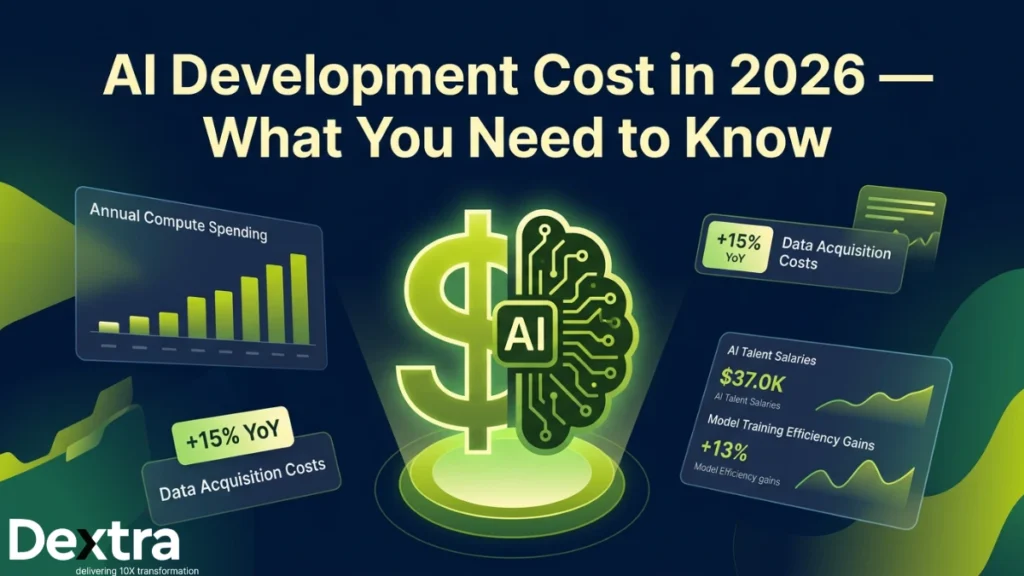
Artificial Intelligence has moved way beyond experimentation and become a core aspect of business technology. According to a recent McKinsey survey, 88% of organizations currently use AI in at least one business function. With increasing AI adoption, one of the most common questions businesses ask is about AI Development Cost.
In 2026, the cost of building an AI solution can range from $5,000 for a simple chatbot MVP to over $500,000 for an enterprise-grade platform. The real value depends on factors like data readiness, model complexity, integration depth, and whether you’re fine-tuning an existing model or training one from scratch.
Without a clear cost framework, even well-funded teams end up burning through budgets on scattered pilots that never reach production. So in this guide, we break down what AI development actually costs in 2026, the key factors that drive pricing up or down, and how to structure your investment so it delivers measurable ROI instead of becoming another expensive experiment. Let’s dive in!
AI Development Cost Breakdown at a Glance in 2026
Before going deep on any single factor, here is a clear reference table covering the major AI development types and their typical cost ranges in 2026:
| AI Solution Type | Cost Range | Timeline |
| Rule-based chatbot | $5,000 – $30,000 | 2–6 weeks |
| AI-powered chatbot (NLP) | $25,000 – $150,000 | 1–4 months |
| Generative AI chatbot | $75,000 – $500,000+ | 3–9 months |
| Custom AI agent (single-task) | $40,000 – $120,000 | 2–5 months |
| RAG-based knowledge agent | $80,000 – $180,000 | 3–6 months |
| Multi-agent orchestration system | $150,000 – $400,000+ | 6–12 months |
| AI-powered mobile/web app | $20,000 – $150,000+ | 2–8 months |
| Custom LLM fine-tuning | $50,000 – $300,000+ | 3–9 months |
| Enterprise AI platform | $300,000 – $1,000,000+ | 9–18 months |
| Proof of Concept (PoC) | $10,000 – $25,000 | 3–6 weeks |
Basic AI solutions, such as chatbots, recommendation systems, and simple analytics, are cost-effective entry points for organizations. These pre-built tools leverage existing models or APIs, making them easy to integrate and reducing overall development costs.
For AI-powered mobile/web app projects, ai app development plays a key role in automating business processes and creating tailored AI solutions for different industries. Proper testing, validation, and ongoing maintenance are essential to ensure efficiency and long-term performance.
Virtual assistants and third party ai software are also popular, lower-cost options for many businesses, offering automation and enhanced support services with minimal integration effort.
Monthly operational costs post-deployment typically add $3,200–$13,000 per month, covering API usage, vector database hosting, monitoring, and maintenance. Annual maintenance usually runs 15–25% of the original development cost.
Leveraging pre trained models can significantly reduce both development time and costs, as these models provide a customizable foundation instead of requiring a solution to be built from scratch.
A well-structured development process is essential for managing costs and ensuring project success, from initial model design and data preparation to deployment and ongoing optimization.
What Factors Drive the Cost of AI Development in 2026?
Understanding what drives AI development cost is more useful than any price list, because the same project can cost two or three times more depending on how these factors stack up. Data acquisition and data collection are foundational cost drivers, as sourcing, collecting, and preparing high-quality data is essential for building effective AI systems and can significantly impact both budget and project success.
1. Project Complexity and Type
The single biggest cost driver is what you are actually building. A rule-based chatbot answering 20 preset questions is a fundamentally different engineering problem from a RAG-based agent that queries your internal knowledge base, reasons over the result, and triggers actions in your CRM. More advanced systems, such as those leveraging deep learning or predictive analytics, require longer development timelines, greater technical coordination, and significantly higher costs due to their complexity. Large language models (LLMs) are a prime example of advanced AI solutions; while they offer powerful capabilities for generative AI, chatbot development, and enterprise automation, they also drive up costs because of their high resource and integration requirements. Custom model development from scratch is typically the most expensive approach, demanding substantial resources and investment. In fact, the complexity of the AI model alone can account for 30-40% of the total project cost, with large-scale models requiring significant data and computing resources. Complexity multiplies across every other cost line.
2. Data Readiness
This is where most budgets go wrong. Data acquisition and data collection are critical steps in AI development, as sourcing, collecting, and preparing the right data directly impacts project success and costs. A study found that 70% of AI projects fail due to data quality issues rather than algorithmic limitations. AI systems need clean, structured, accessible, and high-quality data to build reliable and accurate models. Data scientists play a key role in ensuring data quality through cleaning, annotation, and validation processes. If your data is in spreadsheets, disconnected systems, or paper records, you will spend significantly before the AI development itself begins. Industry research indicates that approximately 96% of businesses begin AI projects without sufficient high-quality training data, requiring unplanned investments of $10,000–$90,000 to acquire or label datasets. Implementing a robust data management strategy from the start can help avoid bloated costs associated with data quality issues, which can account for a significant portion of AI development expenses. Data preparation typically consumes 60–80% of project time and resources.
3. Team Location and Model
Where your development team is based directly affects the cost of AI development:
| Region | Typical AI Developer Hourly Rate |
| USA / Canada | $100 – $250/hr |
| UK / Western Europe | $80 – $180/hr |
| Singapore | $70 – $150/hr |
| Eastern Europe | $40 – $90/hr |
| India | $25 – $60/hr |
| Southeast Asia | $25 – $55/hr |
Choosing the right development model, in-house versus outsourced, can reduce overall AI development cost by 30–50% without sacrificing quality. When building an in-house team for AI development, organizations gain greater control, security, and the ability to rapidly adapt to changing requirements, but must also consider the higher long-term costs and commitment involved. Having experienced AI developers and AI engineers on your team is crucial for ensuring project success, as their expertise helps prevent costly errors, improves model accuracy, and supports ongoing system optimization.
4. Integrations
Connecting AI to your existing systems — CRMs, ERPs, databases, ticketing platforms, is one of the most underestimated cost areas. Integration effort can add 20–50% to the overall budget. Developing APIs for each system connection typically costs between $5,000 and $25,000 per integration.
5. Compliance and Security Requirements
In regulated industries, healthcare, finance, legal, compliance is not optional and it is not cheap. Safety and governance requirements typically add 20–35% to total AI project costs. Healthcare and Financial Services AI agents cost the most for this reason, often ranging from $120,000 to $400,000+ even for focused deployments.
6. Ongoing Operational Costs
Deploying an AI system is the beginning, not the end. Once live, models need monitoring, retraining, prompt tuning, and infrastructure management. These ongoing costs typically account for 15–25% of the original development cost annually. Most organisations underestimate this completely, budgeting for development but not for what happens when 10,000 customers start using the system daily.
Assessing Project Requirements for AI Development
A successful AI development project starts with a clear and thorough assessment of project requirements. This foundational step is essential for defining the scope, estimating the cost of AI, and ensuring that the final AI solution aligns with your business objectives. During this phase, organizations should work closely with stakeholders to identify the specific business needs the AI system will address, outline the desired outcomes, and determine the level of customization required.
The development costs for AI initiatives can vary dramatically based on these requirements. Custom AI solutions, which are tailored to unique business processes or industry-specific challenges, typically involve higher costs than leveraging pre-built or pre-trained AI models. Key factors influencing the overall cost include data availability—having access to high-quality, relevant data can significantly reduce both development time and infrastructure costs. Conversely, if data is fragmented or unstructured, additional investment in data engineering and preparation will be necessary.
Model complexity is another significant cost driver. More advanced AI systems, such as those involving deep learning or multi-agent orchestration, require greater computational resources and specialized expertise, increasing both upfront and ongoing costs. Infrastructure costs, including cloud services, storage, and compute power, must also be factored in from the outset.
By carefully assessing project requirements at the start, businesses can better manage AI development costs, avoid scope creep, and ensure that their AI initiatives remain cost-effective. This disciplined approach not only helps control the cost of AI development but also maximizes the likelihood of delivering a solution that generates real business value.
AI Development Cost by Project Type:
Type 1. AI Proof of Concept (PoC)
Cost: $10,000 – $25,000 | Timeline: 3–6 weeks
A PoC validates whether your idea works before you commit significant resources to building it. It covers a defined use case, limited data scope, and basic integration. For SMEs evaluating AI for the first time, this is the right starting point. It surfaces data problems early, confirms feasibility, and gives you a concrete output to build a business case from.
Type 2: AI Chatbot Development
Basic (rule-based): $5,000 – $30,000 Scripted, decision-tree responses. These are examples of basic ai solutions, offering cost-effective, pre-built tools for FAQs, basic routing, and simple order tracking. No machine learning involved. Fast to build, limited in flexibility.
AI-powered (NLP): $25,000 – $150,000 Understands natural language using natural language processing to interpret and respond to human language, maintains context across a conversation, integrates with CRMs and databases. Virtual assistants are a common application of AI chatbots in this category, automating customer interactions and support. This is the category most businesses mean when they say they want a chatbot. Custom build in the USA or Europe starts around $50,000; offshore development brings this to $25,000–$60,000 for comparable quality.
Generative AI chatbot: $75,000 – $500,000+ Powered by LLMs, capable of open-ended conversation, content generation, and complex reasoning. Enterprise-grade implementations with compliance requirements can exceed $1 million.
Type 3: AI Agent Development Cost
AI agent development cost is one of the most-searched questions in 2026, and for good reason — agents represent the most commercially significant AI category, with the global AI agents market valued at $7.6 billion in 2025 and projected to reach $47.1 billion by 2030. AI engineers play a crucial role in building, implementing, and maintaining these AI agents, ensuring they are tailored to client needs and optimized for ongoing performance.
The AI agent development cost breakdown by type:
| Agent Type | Cost Range | What It Does |
| Simple task agent | $10,000 – $50,000 | Single-function automation (FAQ, form filling) |
| LLM task agent | $50,000 – $120,000 | Multi-step reasoning, API calls, conditional logic |
| RAG-based knowledge agent | $80,000 – $180,000 | Queries internal docs/databases, generates sourced answers |
| Multi-agent orchestration | $150,000 – $400,000+ | Multiple agents collaborating on complex workflows |
After launch, expect $3,200–$13,000 per month in operational spend covering LLM API tokens, vector database hosting, monitoring, prompt tuning, and security upkeep. Investing in robust AI infrastructure is essential for scalable and secure deployment, supporting complex models and ensuring long-term reliability.
Type 4: Custom AI Application Development
Cost: $20,000 – $200,000+ | Timeline: 2–8 months
AI app development facilitates efficiency and accuracy across industries by automating business processes and delivering tailored AI solutions. AI apps that embed machine learning or LLM capabilities into a product, recommendation engines, document processing tools, AI-powered analytics dashboards, range widely based on the complexity of the underlying model and the depth of integration with existing systems. Many AI development projects in this category can leverage pre-trained models from open-source libraries, which helps reduce costs and accelerate delivery.
Type 5: Custom LLM / Generative AI Development
Cost: $50,000 – $500,000+ (fine-tuning); $600,000 – $1,500,000+ (building from scratch)
Large language models (LLMs) are a key driver of generative AI development costs, as they require significant computational resources and specialized expertise for deployment and integration. Fine-tuning an existing model on your proprietary data is significantly cheaper than training from scratch. More advanced systems, such as custom LLMs or solutions involving deep learning and predictive analytics, require longer development timelines, greater technical coordination, and substantial investment. Building a foundation model from the ground up with custom training data, infrastructure, and engineering talent is the most expensive approach, sitting in the $600,000–$1,500,000 range for the initial development phase alone, with ongoing annual costs from $350,000–$820,000. For most businesses, fine-tuning existing models or building RAG systems on top of commercial LLMs delivers 90% of the value at 10% of the cost.
Industry-Specific AI Model Development Cost
AI model development cost varies significantly by industry, primarily because of compliance requirements, data sensitivity, and integration. As AI adoption accelerates across sectors, it is transforming industries and driving new cost structures, making AI development more accessible for organizations of all sizes.
| Industry | Typical Cost Range | Key Cost Drivers |
| Healthcare | $50,000 – $400,000+ | HIPAA compliance, clinical validation, patient data security |
| Financial Services | $80,000 – $400,000+ | Regulatory compliance, audit trails, fraud detection accuracy |
| Legal | $40,000 – $200,000 | Document processing, accuracy requirements, liability |
| Retail / E-commerce | $20,000 – $150,000 | Recommendation engines, inventory, personalisation |
| Manufacturing | $40,000 – $250,000 | Predictive maintenance, quality control, IoT integration, cost savings from AI-driven maintenance |
| HR / Recruitment | $25,000 – $120,000 | Resume parsing, candidate matching, compliance |
| Customer Support | $15,000 – $100,000 | Chatbots, ticket routing, sentiment analysis |
shows the highest AI ROI — 3.3x on generative AI initiatives — but also the most complex implementation, with timelines of 18–36 months to full production deployment. 2024 research estimated predictive maintenance AI can cut maintenance costs by 20–30% and reduce breakdowns by nearly 70% in manufacturing contexts, highlighting significant cost savings achieved through effective AI implementation.
What Is the Difference Between Generative AI vs Traditional AI Development Cost?
The choice between generative AI and traditional AI is not just a technical one — it directly affects your cost of AI development, both upfront and over time.
Traditional AI covers machine learning models built for specific, well-defined tasks: fraud detection, demand forecasting, image classification, sentiment analysis. These systems are trained on historical data, optimised for a defined output, and tend to have more predictable cost structures. Once deployed, they are relatively stable and inexpensive to run.
Generative AI (LLMs, diffusion models, multimodal systems) is designed for flexible, open-ended tasks: conversation, content generation, code assistance, document analysis. It is significantly more expensive to run because every interaction consumes compute — costs scale with usage volume in ways traditional ML does not.
| Dimension | Traditional AI | Generative AI |
| Initial build cost | $10,000 – $200,000 | $50,000 – $1,500,000+ |
| Operational cost model | Relatively fixed once deployed | Usage-based, scales with volume |
| Data requirements | Structured, labelled historical data | Large datasets or fine-tuning on proprietary data |
| Predictability | High — output is defined | Variable — outputs need monitoring |
| Best fit | Classification, prediction, automation | Conversation, generation, reasoning |
| Long-term cost trend | Stable | Increases as usage scales |
IBM found that the average cost of computing is expected to climb 89% between 2023 and 2025, driven significantly by generative AI workloads. 70% of executives they surveyed cite generative AI as a critical driver of this increase.
The practical guidance: if your use case does not require flexible generation or reasoning, traditional ML often delivers strong ROI at a fraction of the cost. If you need conversational capability, document understanding, or content generation, generative AI is the right choice, but budget for the operational costs, not just the build.
Hidden and Ongoing AI Development Costs You Should Not Miss
Initial development budgets typically capture only 40–60% of true AI costs. Hidden costs in years two and three frequently double initial investment estimates. For SMEs in particular, these surprises derail projects that were working perfectly well technically.
Data infrastructure is the single largest hidden cost. Data preparation typically consumes 60–80% of project time and resources, before a single model is trained. A McKinsey study found that 44% of companies implementing AI underestimated the costs associated with data infrastructure and training.
Model retraining and drift management. AI models degrade over time as business data evolves. Without regular retraining, performance can drop 20–40% annually. Retraining and fine-tuning typically adds $5,000–$12,000 per year for standard deployments.
Integration maintenance. Systems change. APIs update. New tools get added. Every change in your underlying technology stack can require updates to the AI integration. This is not a one-time cost — it is an ongoing one.
Monitoring and observability. You cannot trust an AI system you cannot see into. Logging outputs, tracking accuracy, catching hallucinations, and managing anomalies require dedicated tooling. This adds to both infrastructure cost and team time.
Compliance and audit requirements. For regulated industries, compliance is not a one-time setup. As regulations evolve — particularly with emerging AI-specific regulations in the EU, USA, UAE, and Singapore — compliance obligations expand. These costs are non-optional and non-negotiable.
Scaling costs. A customer support bot that costs a few hundred dollars in beta can cost tens of thousands per month if 10,000 customers are using it daily. Many organisations budget for development and discover they have not budgeted for production at scale.
For SMEs specifically, research estimates that 60% of total AI costs occur in years 2–5, covering maintenance, scaling, and optimisation — rather than initial development. Year-three scaling costs often exceed year-one development expenses.
Testing, Validation, and Maintenance Costs in AI Development
Testing, validation, and ongoing maintenance are often underestimated components of the AI development lifecycle, yet they are critical to the long-term success and reliability of any AI model. These phases ensure that your AI system performs accurately, remains compliant, and adapts to evolving business needs.
The cost of testing and validation typically accounts for 10% to 30% of the total cost of AI development, depending on the complexity of the AI model and the level of accuracy required. Rigorous validation is especially important for advanced AI solutions, where errors or biases can have significant business or regulatory consequences. This process involves not only technical testing but also user acceptance testing and, in some cases, external audits for compliance.
Ongoing maintenance is another significant cost consideration. As business data and requirements change, AI models require regular updates, retraining, and fine-tuning to maintain optimal performance. These ongoing maintenance costs can add up to 20% to 50% of the initial development cost per year, especially for AI initiatives that operate in dynamic environments or handle sensitive data.
To manage these costs effectively, businesses can leverage pre-trained AI models and cloud-based AI platforms, which often include built-in tools for monitoring, retraining, and scaling. Efficient data management practices—such as automated data pipelines and robust data quality controls—can further reduce the time and expense associated with model maintenance.
By proactively budgeting for testing, validation, and maintenance, organizations gain a more accurate picture of the total cost of AI ownership. This approach not only protects the initial investment but also ensures that AI systems continue to deliver value and remain aligned with business goals over time.
How to Evaluate AI Development Cost in 2026?

Evaluating AI development cost estimation properly requires asking the right questions before you request quotes or review proposals.
Start with the use case, not the technology. The clearest cost signals come from a specific, well-defined problem: “We want to reduce time spent on manual invoice processing” is a better starting point than “We want to build an AI system.” A focused use case makes scope definition tractable, which makes cost estimation reliable.
Assess your data readiness honestly. Before getting any AI development quotes, audit your data. What exists? Where is it stored? Is it clean and consistent? What would it cost to make it usable? Businesses that factor data remediation costs into AI implementation planning project 29% higher ROI than those focusing solely on the technology.
Request phased proposals. Any reputable AI development firm should be able to quote a PoC separately from full implementation. A $10,000–$25,000 PoC that validates the approach is worth far more than a $200,000 commitment made without evidence the system will work.
Factor in the full 3-year cost. Add development, infrastructure, maintenance (15–25% annually), retraining, and team time for monitoring and oversight. The number that comes back will be higher than the initial quote — but it is the real number.
Compare in-house versus outsourced. For most SMEs, outsourcing to a specialist firm is more cost-efficient than building internal AI capability from scratch. Recruiting a single senior AI engineer in the USA costs $130,000–$200,000 annually. A project-based engagement with an experienced offshore team can deliver comparable results at 30–50% of that cost. When choosing a development partner, prioritize providers with a proven track record in AI development to ensure successful delivery and industry expertise.
Understand pricing models. In addition to traditional time-and-materials or fixed-fee models, some firms offer outcome-based pricing, which directly links the cost of AI development to the achievement of specific, predefined goals and focuses on measurable results rather than just time or resources used.
McKinsey’s research is blunt on this point: organisations that deploy a “spray and pray” approach, launching multiple AI pilots simultaneously without defined use cases and measured outcomes, achieve 3x lower ROI than those with a focused, measurable, phased strategy.
In-House vs Offshore AI Development: Cost Comparison
The cost of custom AI development shifts significantly depending on whether you build in-house or partner with an offshore or nearshore team. Having an in-house team provides full control over the development process, ensures data security, and allows for rapid adaptability to changing business needs. In both models, collaborating with experienced AI developers is crucial to improve project efficiency, prevent costly errors, and enhance the accuracy of AI models.
| Factor | In-House | Offshore / Nearshore |
| Senior AI engineer salary | $130,000 – $200,000/yr (USA) | $25,000 – $70,000/yr equivalent |
| Recruitment timeline | 3–6 months | 2–4 weeks (via established firms) |
| Infrastructure | Your responsibility | Often managed by vendor |
| IP control | Full | Contractual — NDAs required |
| Scalability | Slow — headcount dependent | Fast — team scales with project |
| Cost reduction vs in-house | Baseline | 30–50% lower |
Tech companies including IBM and Microsoft regularly offshore AI talent to countries like India and Eastern Europe, achieving 40–60% lower costs compared to domestic rates while maintaining quality standards.
For SMEs evaluating outsourcing, the key differentiator is not the hourly rate, it is the vendor’s domain expertise and project management capability. A poorly scoped offshore engagement will cost more in rework than a well-scoped local one. The right question is not “who is cheapest?” but “who has the most relevant experience for this exact type of project?”
Dextra Labs’ Strategies to Optimise AI Development Cost
At Dextra Labs, we have worked with SMEs across the USA, Singapore, and India who came to us with two specific problems: either they had received quotes they could not evaluate, or they had commissioned AI development that had not been delivered. Both problems come from the same place — not enough discipline before the first line of code gets written. A structured development process is essential for successful AI development projects, as it ensures clarity, efficiency, and cost control from planning through execution.
Here is how we approach AI development cost optimisation in practice:
Start with a fixed-scope diagnostic. Before any development, we map your use cases, audit your data, and assess your integration landscape. This produces a prioritised list of two to three AI opportunities with realistic effort and cost estimates. This phase costs a fraction of full development — and it is where most projects are saved or stopped before they become expensive mistakes.
Build the minimum that validates the hypothesis. A $15,000 PoC that tells you definitively whether a use case works is worth more than a $100,000 project that runs for five months before discovering the data is not usable. We structure all initial engagements around the shortest path to a confident decision.
Use cost-efficient model choices. Not every task requires GPT-4o or Claude Opus. Many enterprise-quality applications can be built on smaller, task-specific models at a fraction of the inference cost. We also leverage pre-trained models where appropriate to further reduce development time and expenses. We evaluate the right model for each use case, not the most impressive one.
Design for operational cost from day one. Scaling AI is where budgets collapse if the architecture has not been designed with production usage in mind. We factor in API token usage, database hosting, and monitoring requirements before the first line is written, so there are no infrastructure surprises six months after deployment.
Phase the work. Rather than committing to a full-scale deployment upfront, we work in validated phases. Pilot proves the concept. Production build adds robustness and integration. Expansion adds use cases once the first one is returning value. This approach keeps total spend in control and ensures each investment is justified by evidence.
How Dextra Labs Can Help Build Right and Scalable AI Solutions Under Your Budget?
Dextra Labs is an AI consulting firm working with SMEs and growing businesses across the USA, Singapore, and India. We are not an AI vendor selling a platform. We are a specialist implementation partner that helps businesses identify where AI delivers real value, build it properly, and operate it responsibly.
Our services are built around the complete AI development lifecycle, led by experienced AI engineers with deep technical expertise in building tailored solutions for diverse industries.
AI App Development & Agent Development — We design and build AI applications and autonomous agents that automate business processes, handle multi-step workflows such as customer query handling, sales process automation, internal operations, and more. Our AI app development services emphasize efficiency, accuracy, and long-term performance, with production-grade solutions from the first deployment, not prototypes that become liabilities. Rigorous testing, validation, and ongoing maintenance are integral to our approach.
LLM Development and Deployment — We select, fine-tune, and deploy the right large language model for your specific context — whether that is a customer-facing assistant, an internal knowledge tool, or a document processing system. We make the model choice based on your use case and budget, not on what is trendy.
RAG Solutions — We build Retrieval-Augmented Generation systems that let your teams query internal documents, manuals, contracts, and databases through natural language. These are one of the highest-ROI AI applications for SMEs and one of our most requested services.
AI Strategy and Consulting — For businesses at the beginning of their AI journey, we provide structured guidance: where to start, what to build first, what will cost what, and what the realistic timeline to value looks like.
Dextra Labs has a proven track record in delivering successful AI projects for clients across multiple sectors, ensuring reliable outcomes and industry-leading expertise.
Our pricing is designed for SME budgets, not enterprise retainers. We offer fixed-scope diagnostic engagements, phased pilot builds, and ongoing advisory retainers, all structured around the financial realities of businesses that need results, not experiments.
If you want a clear, honest assessment of what AI development would cost for your specific business and use case, the right first step is a direct conversation with our team.
Frequently Asked Questions (FAQs):
How much does AI development cost for a startup?
For a startup, the realistic starting point is a Proof of Concept at $10,000–$25,000, followed by a pilot build in the $25,000–$75,000 range depending on use case. AI development projects for startups typically range from simple chatbots and recommendation engines to more complex predictive analytics or computer vision systems, with the cost of developing each type varying based on complexity, data requirements, and industry needs. Most startups in their first AI project spend between $15,000 and $60,000 for something production-ready. Offshore development partnerships reduce this meaningfully — the same quality of work that costs $80,000 with a US team can often be delivered for $35,000–$45,000 through a well-managed India-based team with relevant expertise.
How much does it cost to develop an AI?
The cost of AI development ranges from $5,000 for a basic rule-based chatbot to over $1 million for enterprise-grade generative AI systems. The cost of developing different types of AI development projects can vary significantly depending on project complexity, industry requirements, and long-term maintenance needs. For most businesses asking this question in practical terms, a custom AI solution with meaningful capability — NLP-based chatbot, single AI agent, or document processing tool — falls in the $25,000–$150,000 range for initial development, with $3,000–$8,000 per month in ongoing operational costs.
How much does it cost to develop an AI application?
Building an AI-powered application, a mobile or web app with embedded AI features, typically starts at $20,000–$50,000 for basic AI integration and can reach $150,000–$300,000+ for complex features involving custom model training, multimodal inputs, or large-scale data processing. The application layer itself is separate from the AI model cost, and integration complexity is often the largest variable.
AI app development not only automates business processes and enhances efficiency, but also impacts overall development cost due to the need for thorough testing, validation, and ongoing maintenance to ensure long-term performance across different industries.
How much does it cost to develop an AI chatbot?
AI chatbot development cost in 2026:
– Rule-based (examples of basic ai solutions): $5,000 – $30,000
– NLP-powered AI chatbot (leveraging natural language processing): $25,000 – $150,000
– Generative AI chatbot: $75,000 – $500,000+
– Enterprise-grade with compliance: $200,000 – $1,000,000+
Rule-based chatbots are considered basic ai solutions, offering cost-effective and straightforward automation for common queries. NLP-powered chatbots use natural language processing to understand and interpret human language, enabling more sophisticated interactions. Virtual assistants are a common use case for AI chatbots, automating customer interactions and enhancing business efficiency across industries.
Ongoing operational costs add $500–$5,000/month depending on conversation volume. McKinsey has estimated that conversational AI could cut contact centre costs by $80 billion globally by 2026 — which explains why despite high development costs, the ROI on customer support chatbots is typically very strong.
How much does it cost to develop AI software?
AI software development cost depends on the type of software and the depth of AI integration. At the simpler end, AI features added to existing software — recommendation engines, smart search, predictive analytics — range from $20,000–$80,000. Leveraging pre-trained models from open-source libraries like TensorFlow or GPT can significantly reduce development time and costs by providing a strong foundation that can be fine-tuned for specific needs. Additionally, using third-party AI software, such as external virtual assistants or automation tools, is a cost-effective option that can further influence overall AI project expenses and streamline integration. Full custom AI software platforms with proprietary model training, enterprise integrations, and deployment infrastructure range from $150,000 to several million depending on scope.
How much does it cost to develop an AI model?
AI development cost depends on whether you are fine-tuning an existing model or building from scratch:
Fine-tuning a commercial LLM on proprietary data: $15,000 – $100,000
Custom model training on your dataset: $100,000 – $500,000+
Building a foundation model from scratch (the most expensive approach): $600,000 – $1,500,000+ initial, with $350,000–$820,000 in annual ongoing costs
Leveraging pre-trained models from open-source libraries like TensorFlow or GPT can significantly reduce both time and resource requirements, as these models can be fine-tuned or integrated into various AI applications to accelerate development and lower costs.
For most businesses, fine-tuning or building RAG systems on top of existing models delivers the capability they need at 10–20% of the cost of training from scratch.
How much does agentic AI development cost at Dextra Labs?
At Dextra Labs, our AI agent development cost is scoped specifically to each project and business context. Our experienced AI engineers play a crucial role in designing, implementing, and optimizing agentic AI solutions tailored to your needs, ensuring technical excellence at every stage. As a general guide:
– Diagnostic and scoping: $2,500 – $6,000
– Single-task AI agent (pilot): $15,000 – $40,000
– Production-grade AI agent with integrations: $40,000 – $100,000
– Multi-agent workflow systems: $80,000 – $200,000+
– Ongoing advisory retainer: $2,500 – $5,000/month
A robust AI infrastructure is essential for supporting scalable, secure, and efficient agentic AI systems, and our team ensures your solution is built on the right foundation for long-term success.
These figures reflect our commitment to SME-appropriate pricing, not enterprise overhead applied to businesses that do not need it. Every engagement starts with a scoping conversation to confirm whether the use case is viable at your budget before any development begins. We will tell you if it is not.