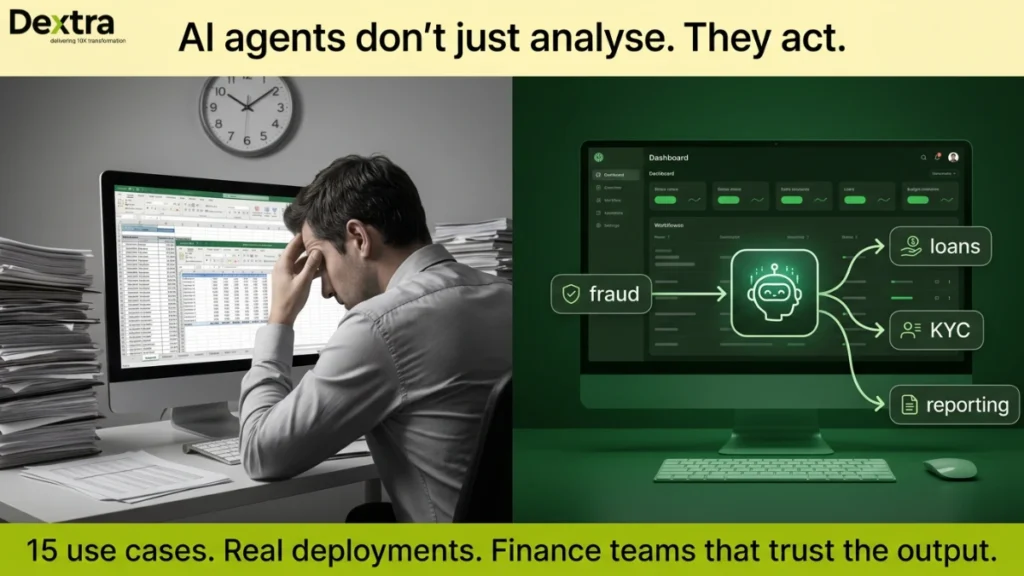
Finance teams aren’t just experimenting with AI anymore, they’re actively deploying AI agents in finance to handle real work. From fraud monitoring to portfolio insights, agentic AI enables faster, autonomous and scalable decision-making by not just analyzing, but acting across workflows.
Financial institutions are investing heavily in AI, with spending projected to reach $97B by 2027 and a growing share allocated towards AI agents for finance industry.
At Dextralabs, we work with financial institutions across the UAE, USA and Singapore to design and deploy AI agents for finance that operate within regulatory and operational constraints, not outside them. As an AI agent development company, we see more organizations exploring the best use cases for agentic AI and real-world implementation strategies. In this guide, we’ll look at the top 15 real-world use cases of agentic AI that are actually driving impact in finance today.

What is Artificial Intelligence (AI) in Finance?
AI in finance uses machine learning and advanced algorithms to automate financial processes, analyze large datasets and improve decision-making. It helps identify patterns, generate insights and execute tasks across operations like risk, compliance and customer service.
Today, AI agents in finance sector go beyond automation as they enable faster, more accurate and scalable financial workflows, making them a key part of modern AI use cases in finance.

Build AI Agents That Finance Teams Can Trust
From compliance-safe architecture to production deployment, Dextralabs helps financial institutions implement AI agents that are scalable, secure and audit-ready.
? Book a 30-min AI Strategy CallWhy AI Agents Matter in the Finance Industry
Financial institutions have long struggled to automate core processes due to system complexity, regulatory requirements and fragmented dependencies. As a result, many critical workflows still rely on manual effort which leads to slower decision-making, operational inefficiencies as well as increased pressure on risk and compliance teams.

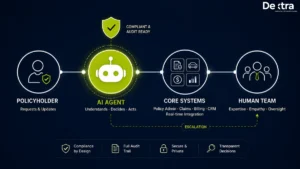
The real issue is not a lack of tools, but fragmentation. This is where AI agents in finance make a difference. Instead of handling isolated tasks, AI agents for finance manage entire workflows, connecting systems, executing decisions and ensuring processes move forward without delays.
From onboarding to fraud detection, agentic AI in finance reduces manual effort, speeds up operations as well as improves accuracy.
Top 15 AI Agent Use Cases in Finance Sector:
1. Fraud Detection and Prevention
Fraud is constantly evolving and traditional systems often flag too many transactions while missing new types of fraud. AI agents monitor transactions in real time and learn from patterns to detect suspicious activity automatically. They can freeze accounts when necessary and create detailed reports as well.
For example, if a customer logs in from a new device but behaves normally, the agent allows access. If something seems unusual, the account is frozen and an alert is sent automatically.
2. Billing & Payment Reconciliation
Manually matching invoices and payments takes a lot of time and is prone to mistakes. AI agents can automatically match payments to invoices and flag only the discrepancies. This makes reconciliation a lot faster and reduces errors.
For example, if a payment is made twice by mistake, the agent spots it immediately and suggests the correction so the team does not have to check everything manually.
3. Loan Operations & Document Processing
Loan applications involve a lot of paperwork and multiple verification steps, which slows down approvals. AI agents can read and verify documents, cross-check internal and external records and identify missing information. They also perform compliance checks automatically and escalate only complex cases.
For example, a scanned ID is verified instantly, supporting documents are checked automatically and low-risk applications move forward without manual review.
4. Customer Risk Profiling & KYC Refresh
Customer risk changes over time but annual KYC reviews can leave gaps. AI agents monitor accounts continuously, watch for unusual patterns and alert teams when something suspicious occurs.
For example, if a customer suddenly makes a large purchase that is unusual for their account, the agent sends a contextual alert to the compliance team.
5. Financial Reporting & Regulatory Filing
Preparing reports and filings manually is slow and can also lead to errors. AI agents gather and validate data across systems, reconcile it and prepare regulatory documents automatically. This allows teams to focus on insights instead of number-crunching.
For example, quarterly reports can be compiled automatically and the system maintains a full audit trail without any human intervention.
6. Portfolio Management & Advisory Productivity
Advisors spend a lot of time on administrative work instead of helping clients. AI agents monitor portfolios continuously, flag deviations and generate summaries for advisors. This lets them focus on strategy and client engagement.
For example, if a client’s investments shift unexpectedly, the agent can highlight it and provide context so the advisor can reach out proactively.
7. Creditworthiness Assessment & Underwriting Assist
Assessing a borrower’s credit involves reviewing documents, checking policies and calculating risk all of which can take really long time. AI agents extract and verify financial data, cross-check internal rules and generate structured summaries for underwriters. Low-risk applications are processed automatically, while complex cases are escalated.
For example, an applicant’s financial statements are analyzed instantly and ratios are calculated to speed up underwriting decisions.
8. Customer Onboarding & Account Opening
Onboarding can be slow and frustrating for customers. AI agents validate documents, perform compliance checks and approve low-risk accounts automatically. Complex cases are escalated with all relevant information.
For example, a customer uploads an ID and supporting documents. The agent verifies them and opens the account instantly, while unusual cases go to a human reviewer.
9. Credit Card Dispute Resolution
Handling disputes manually wastes a lot of time and slows down resolution. AI agents can classify disputes, resolve simple ones automatically and escalate complex cases with supporting evidence.
For example, if a duplicate charge occurs, the agent reverses it immediately, while unusual disputes are flagged with all necessary details for the analyst.
10. Personal Financial Guidance
Customers want advice in real time, but advisors have limited availability. AI agents monitor transactions and provide personalized recommendations based on financial behavior.
For example, if a customer is saving consistently, the agent may suggest a new investment opportunity and can also communicate it through their preferred channel.
11. Loan or Transaction Exception Handling
Manual checks for loan exceptions or payment errors slow down operations. AI agents identify anomalies, verify supporting information and route only unusual cases for human review.
For example, if a customer submits an unusually large loan repayment, the agent flags it for review while processing normal repayments automatically.
12. Automated Credit Policy & Lending Rules Evaluation
Manual credit assessments are quite inconsistent and slow. AI agents evaluate applications against internal policies and regulations, progressing low-risk cases automatically and flagging exceptions.
For example, a loan application that meets all criteria moves forward instantly, while borderline cases are highlighted with relevant context for review.
13. Predictive Liquidity & Cash Flow Management
Cash flow forecasting is often reactive, which can lead to missed opportunities. AI agents analyze historical transactions, upcoming obligations and market trends to predict shortfalls and recommend actions.
For example, if a system predicts a temporary cash shortage, it suggests short-term funding options to prevent liquidity issues.
14. Dynamic Risk Scenario Simulation
Stress testing and scenario analysis are time-consuming when done manually. AI agents can run thousands of simulations in real time to see how portfolios might be affected by market changes.
For example, an agent can model the impact of sudden interest rate shifts and provide insights immediately, allowing teams to respond faster.
15. Customer Lifetime Value & Product Personalization
Traditional segmentation often misses individual customer behavior, thereby reducing engagement. AI agents analyze transaction history, product usage and behavior to suggest personalized offerings.
For example, if a customer frequently uses certain banking products, the agent can recommend complementary services in real time, thus improving engagement and loyalty.
What are the benefits of AI in Finance?
AI in finance offers a wide range of advantages for financial institutions:
1. Boosts Efficiency: AI takes over routine, repetitive tasks so finance teams can focus on more strategic work like forecasting, planning and analysis.
2. Improves Accuracy: It improves accuracy by reducing errors in account reconciliation and transaction tracking for better decision-making.
3. Reduces Costs: Automation minimizes costs by reducing manual work in invoice processing, purchase orders and other repetitive tasks.
4. Scales Easily: AI scales easily to handle spikes in transaction volumes without needing extra resources.
5. Strengthens Risk Management: It strengthens risk management by detecting anomalies and potential compliance issues before they become problems.
For a breakdown of how these benefits translate into measurable returns by use case, see our ROI of AI agents in finance analysis.
What is the Difference Between AI Agent vs Generative AI vs RPA in Finance?
| Feature | AI Agents | Generative AI | RPA |
| Purpose | AI agents automate entire workflows across systems and functions. | Generative AI creates content, insights and analytical outputs based on input data. | RPA handles repetitive, rule-based tasks with predefined instructions. |
| Decision-making | AI agents make context-aware decisions using real-time data and evolving inputs. | Generative AI generates outputs based on learned patterns and without true decision-making ability. | RPA follows fixed rules only and does not make decisions beyond programmed logic. |
| Scope | AI agents manage end-to-end processes across multiple systems and workflows as well. | Generative AI is mainly used for reports, drafts and analytical support tasks. | RPA is limited to executing specific, narrowly defined tasks. |
| Human Intervention | AI agents require minimal human intervention once it is deployed in production. | Generative AI typically requires human validation to ensure accuracy and relevance. | RPA often needs human oversight to handle exceptions and errors. |
| Finance Impact | AI agents enable faster, scalable and compliant financial workflows. | Generative AI improves the quality of insights, reporting and decision support. | RPA increases efficiency by saving time and reducing manual errors. |
How Dextralabs Helps Financial Institutions Deploy AI Agents?
Financial institutions often have AI ideas but struggle to turn them into production-ready systems. Experiments frequently stall at the pilot stage without clear pathways to scale, fragmented toolsets create integration challenges across teams and systems and the lack of alignment with core workflows makes deployment difficult in real-world operations which can lead to delays in making decisions and increasing their overall risk of regulatory compliance.
At Dextralabs, we transform these challenges into results. We design AI agents in finance that operate inside regulatory and operational constraints, integrating workflows across risk, compliance, operations and customer experience. Using agentic AI in finance, we move from isolated tools to coordinated, auditable and enterprise-grade systems that act and not just analyze.
Our structured approach ensures measurable impact: we prioritize high-ROI use cases, design multi-agent architectures, run controlled pilots, deploy at scale with governance and continuously optimize. AI agents handle KYC/AML monitoring, loan processing, claims, reconciliation, customer support, advisory, forecasting and financial reporting all while maintaining compliance, auditability and secure infrastructure.
What are the future of AI Agents in Finance?
AI agents in finance are moving beyond simple automation and can now handle entire processes on their own, including risk management, compliance, operations and customer service, while still meeting regulations and audit requirements. This helps financial institutions work faster, reduce risks and let humans focus on more important decisions as well.
In the future, these AI systems are likely to become a core part of financial infrastructure rather than just experimental tools. By working with existing systems and real-time data, they will deliver smarter, more proactive services, offer more personalized customer experiences and make banking, insurance and investment operations more efficient as well as more reliable.
Final Insight
Dextralabs is not just an AI vendor; it is a trusted AI execution partner for regulated financial environments. We help institutions move beyond experimentation, turning AI ideas into production-ready, compliant and auditable systems. From risk and compliance workflows to customer experience and operations, our approach ensures AI agents deliver measurable business impact while staying within regulatory boundaries.
Financial institutions looking to implement AI agents at scale can use custom AI agent development services from Dextralabs. We design and deploy solutions that are secure, governance-ready and fully integrated with existing systems, helping teams achieve faster decision cycles, lower operational risk and enhanced efficiency.
FAQs:
Q1. How do AI agents differ from traditional AI or RPA?
Unlike traditional AI or RPA, AI agents can act autonomously, coordinate tasks and make workflow decisions in real time.
Q2. What are common use cases for AI agents in finance?
Common use cases include fraud detection, loan processing, KYC/AML monitoring, portfolio management and customer support.
Q3. How does Dextralabs ensure compliance and security in AI deployments?
Dextralabs designs governance-first, audit-ready architectures with role-based access, encrypted pipelines and regulatory alignment.
Q4. Can AI agents integrate with legacy financial systems?
Yes, Dextralabs builds multi-agent workflows that seamlessly integrate with core banking, CRM, ERP and other financial systems.