You’ve seen the pitch deck. Revenue is compressed but “recoverable.” The market opportunity is real. The team, what’s left of it, knows the product. The price looks right for a distressed deal.
So you wire the capital.
Then you open the codebase.
What you find inside isn’t a technology platform. It’s a liability wrapped in technical debt, held together by workarounds, and dependent on people who’ve already left. The “12–18 month turnaround” your operating partner projected? It’s now a 36-month rebuild. The ROI model that justified the acquisition? It’s dead on arrival.
This isn’t an edge case. Technology M&A has the highest failure rate of any sector, research puts it at 85–90%. McKinsey found that technical debt accounts for up to 40% of a company’s entire technology estate. The CISQ’s Cost of Poor Software Quality report pegged the annual cost of technical debt in the US alone at $1.52 trillion. And a separate industry survey found that 69% of IT leaders say technical debt fundamentally limits their ability to innovate.
For PE, VC, and strategic acquirers evaluating distressed tech companies, whether in New York, London, Singapore, Dubai, or Mumbai, the codebase isn’t a footnote in due diligence. It’s the deal itself.
Here are the five red flags that should make you pause before you sign.
Red Flag #1: The Monolith That Everyone’s Afraid to Touch
You know the type. A single, massive application where everything, user authentication, payment processing, reporting, integrations, lives in one giant, tangled codebase. No modular architecture. No clear service boundaries. Every change to one feature risks breaking three others.
In a healthy company, monoliths can work. Plenty of successful products run on monolithic architectures. But in a distressed company, a monolith is almost always a sign that the architecture was never properly evolved as the product grew. Features were bolted on under pressure. Shortcuts were taken. And now nobody, literally nobody who’s still at the company, fully understands how the pieces connect.
Why It Kills Your ROI?
- Feature velocity collapses: Developers spend more time navigating the codebase than writing new features. That “rapid product iteration” your turnaround plan depends on? It’s not happening with a monolith that takes 45 minutes to compile and breaks on every deployment.
- You can’t scale selectively: If one part of the application gets heavy traffic, say, the API layer, you can’t scale just that component. You have to scale the entire monolith, which means your cloud infrastructure costs balloon.
- Talent won’t touch it: Good engineers don’t want to work on a codebase that feels like archaeology. In a competitive talent market, from Austin to Bangalore to London, this is a hiring handicap you can’t afford.
| What to Look For During Technology Due Diligence? Ask for the deployment frequency. If the team deploys less than once a week, dig into why.Check the average build time. Anything over 15–20 minutes signals a bloated, tightly coupled system.Ask how many developers can independently deploy a feature without coordinating with others. If the answer is “none,” you’re looking at a monolith with deep coupling. |
Red Flag #2: Zombie Dependencies and Unpatched Vulnerabilities
Every software product relies on third-party libraries and frameworks. That’s normal. What’s not normal is a dependency list where half the libraries haven’t been updated in two years, a third are end-of-life, and several have known critical security vulnerabilities that were never patched.
In distressed companies, dependency management is one of the first things to go. When you’re laying off engineers and scrambling to keep the lights on, nobody is reviewing Dependabot alerts. Nobody is testing whether the next major version of React or Spring Boot will break the application. The dependency tree becomes a minefield of outdated, unsupported, and potentially compromised components.
Why It Kills Your ROI?
- Security exposure is immediate: Known vulnerabilities in unpatched dependencies are the lowest-hanging fruit for attackers. If the company processes payments, stores personal data, or operates in regulated industries, you’re inheriting compliance violations from day one, whether that’s GDPR in the UK and EU, CCPA in California, PDPA in Singapore, the DPDP Act in India, or DIFC/ADGM data protection regulations in the UAE.
- Upgrade debt compounds: The longer dependencies go unupdated, the harder and more expensive it becomes to upgrade them. A library that’s two major versions behind might require rewriting significant portions of the application to make it compatible.
- Insurance and liability exposure: If a data breach occurs because of a known, unpatched vulnerability, cyber insurance may not cover it. And the regulatory fines in jurisdictions like the UK (up to 4% of global turnover under GDPR) or Singapore (up to SGD 1 million under PDPA) are real.
| What to Look For During Tech Due Diligence? Request a Software Composition Analysis (SCA) report. If the company can’t produce one, that’s already a red flag.Count the number of dependencies with known CVEs (Common Vulnerabilities and Exposures) rated “Critical” or “High.” More than a handful? That’s remediation cost you need to factor into your bid.Check the age of the core framework (e.g., Rails, Django, .NET, Node.js). If it’s more than 2 major versions behind current, the upgrade cost alone could be six figures. |
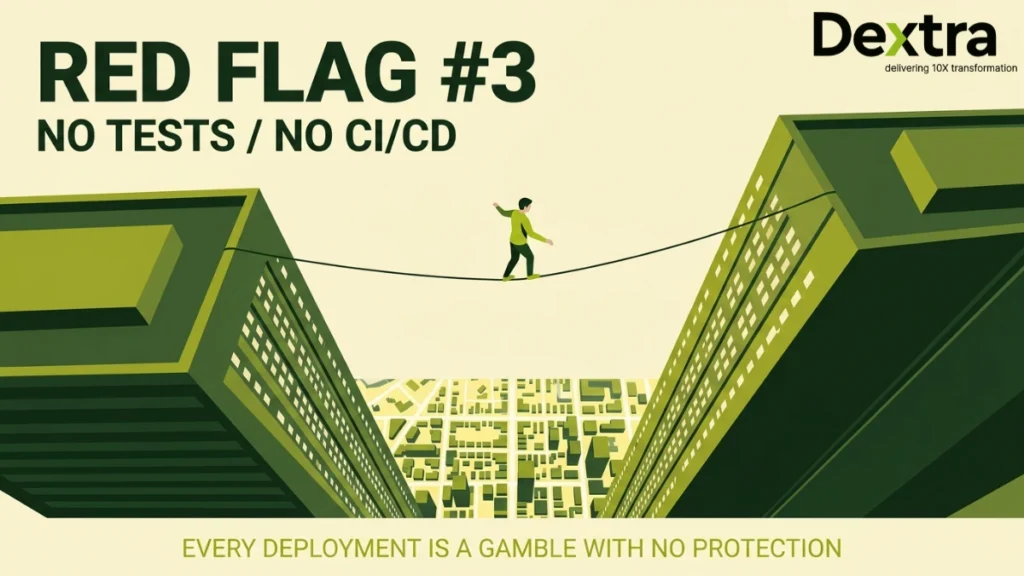
Red Flag #3: No Tests, No CI/CD, No Safety Net
Here’s a question that will tell you everything about a codebase’s health: what’s the test coverage?
If the answer is “we don’t really have automated tests” or “there are some tests but they’re mostly broken,” you’re looking at a codebase where every change is a gamble. No automated test suite means developers are deploying changes without any systematic way to verify that they haven’t broken existing functionality. In a distressed company, this is incredibly common. Tests are the first thing to be deprioritised when headcount shrinks and deadlines tighten.
Equally concerning is the absence of a CI/CD (Continuous Integration/Continuous Deployment) pipeline. Without CI/CD, deployments are manual, error-prone, and slow. They require someone who “knows the steps” and if that person has left, you might not be able to deploy at all.
Why It Kills Your ROI?
- You can’t move fast without breaking things: The entire premise of acquiring a distressed tech company is that you’ll inject capital and talent to accelerate the product. Without a test suite and CI/CD pipeline, every “acceleration” introduces risk. Your team spends more time debugging regressions than building features.
- Onboarding takes months, not weeks: New developers joining a codebase with no tests have no documentation of how the system is supposed to behave. Every feature is a black box. Learning the codebase becomes a manual, trial-and-error process that stretches onboarding from weeks to months.
- Deployment becomes a production incident: Without CI/CD, deployments are high-risk events. Teams start deploying less frequently to reduce risk, which means features take longer to ship, customer feedback cycles lengthen, and the product falls further behind competitors.
| What to Look For During Technical Due Diligence? Ask for the test coverage percentage. Below 30% is a warning sign. Below 10% is a red flag. Zero is a crisis.Ask when the last successful automated deployment happened. If it’s been more than two weeks, something is broken.Check whether there’s a staging environment. If the team tests in production, you’re inheriting a reliability problem. |
Red Flag #4: Single-Point-of-Failure Architecture (a.k.a. “The Bus Factor”)
This one shows up in two forms, both equally dangerous.
The technical version: the system architecture has critical components with no redundancy. A single database server. One API gateway with no failover. A cron job running on a developer’s personal machine. If any one of these goes down, the entire product goes down with it.
The human version: there’s one person who understands the core system, and they’re either already gone or on their way out. The “bus factor” the number of people who could get hit by a bus before the project grinds to a halt, is one. In distressed companies, it’s often zero, because that person already left during the financial crisis.
Why It Kills Your ROI?
- Operational fragility becomes your problem: Every minute of downtime is lost revenue, lost customers, and reputational damage. If the architecture has no redundancy, you’re one hardware failure or cloud outage away from a full production incident—with no documented recovery procedure.
- Knowledge reconstruction is expensive: When the only person who understood the system is gone, you’re essentially reverse-engineering the product from scratch. That’s consultant-rate work, often $200–$400/hour, for months. Factor that into your post-acquisition budget.
- Acqui-hire logic falls apart: If part of your deal thesis was “we’re buying the team along with the product,” check whether the critical team members are actually staying. In distressed companies, the best engineers leave first. By the time you close, the team you thought you were buying may no longer exist.
| What to Look For During Due Diligence? Map the “bus factor” for every critical system component. If any component has a bus factor of one, it’s a risk.Ask for the architecture diagram. If one doesn’t exist, that’s a red flag in itself, it means the system’s design lives in someone’s head.Review the incident history. How many production outages occurred in the last 12 months? How long did they take to resolve? Who resolved them, and are those people still at the company? |
Red Flag #5: Hard-Coded Secrets and Compliance Land Mines
Open any distressed company’s codebase and search for strings like API_KEY, password, or secret. What you find will probably keep you up at night.
Hard-coded credentials, API keys, database passwords, third-party service tokens embedded directly in the source code, are one of the most common and most dangerous patterns in codebases built under pressure. In a well-run company, secrets are managed through dedicated tools (HashiCorp Vault, AWS Secrets Manager, Azure Key Vault). In a distressed company, they’re sitting in plain text in configuration files that were committed to Git three years ago.
And the compliance implications are severe. Depending on what data the application handles and where it operates, you could be inheriting violations of GDPR (UK/EU), CCPA/CPRA (US), PDPA (Singapore), the DPDP Act (India), or DIFC Data Protection Law (UAE)—potentially all at once if the product serves customers across these jurisdictions.
Why It Kills Your ROI?
- Data breach liability transfers to you: If hard-coded credentials are exploited post-acquisition, it’s the acquiring entity that faces regulatory enforcement, customer lawsuits, and reputational damage. The seller’s distressed status means there’s no one to claw back from.
- Credential rotation becomes a crisis project: When secrets are hard-coded across multiple services and environments, rotating them means touching every affected file, testing every integration, and redeploying everything. In a codebase with no tests and no CI/CD (see Red Flag #3), this becomes a weeks-long emergency project.
- Compliance remediation costs are front-loaded: You can’t operate in regulated markets with known security vulnerabilities. The cost of implementing proper secrets management, encryption at rest, and access control auditing comes out of your first-year budget—eating directly into the ROI your model projected.
| What to Look For During Due Diligence? Run a secrets scanner (e.g., GitLeaks, TruffleHog) against the full Git history, not just the current codebase. Secrets deleted from code are still in the commit history.Ask whether the company uses a secrets management tool. If the answer is “environment variables in the server config,” that’s a partial solution at best.Request the data processing map. Where is personal data stored? How is it encrypted? Who has access? If nobody can answer these questions clearly, you’re inheriting a compliance problem. |
The Compound Effect: When Red Flags Stack?
Here’s the thing that seasoned PE and VC investors in distressed tech already know: these red flags rarely appear in isolation. A codebase with a monolithic architecture almost always has poor test coverage. A team with no CI/CD pipeline almost certainly isn’t managing dependencies. And a company that hard-codes secrets probably doesn’t have an architecture diagram either.
The red flags compound. And when they compound, the remediation cost isn’t additive, it’s multiplicative.
| Red Flags Present | Typical Remediation Timeline | Estimated Cost Impact | ROI Risk Level |
| 1–2 isolated flags | 3–6 months | 10–20% of acquisition price | Manageable with proper planning |
| 3–4 compounding flags | 9–18 months | 30–50% of acquisition price | Requires significant turnaround investment |
| All 5 flags present | 18–36 months (or full rebuild) | 50–100%+ of acquisition price | Deal thesis likely unsalvageable at offered price |
This doesn’t mean you should walk away from every distressed tech deal. It means you should walk in with your eyes open. The acquirers who succeed in distressed tech aren’t the ones who ignore the codebase. They’re the ones who audit it rigorously, price the remediation accurately, and build the cleanup cost into their turnaround model from day one.
How Dextra Labs Helps Investors See What’s Really in the Codebase?
At Dextra Labs, we run technical due diligence for PE firms, VCs, strategic acquirers, and resolution applicants evaluating tech assets across the US, UK, Singapore, UAE, and India. Our practice is specifically designed for investors who need to understand the real state of a codebase, not the polished version in the data room.
What we deliver:
- Automated codebase analysis: We scan for every red flag in this article, dependency health, test coverage, architecture coupling, secrets exposure, and open source licence risk—using industry-standard tooling combined with manual expert review.
- RCOI-mapped risk register: Every finding is mapped against our RCOI framework (Risk, Complexity, Opportunity, Investment), so you see exactly how each technical issue translates into deal economics. Not just “this is a problem”, but “this problem will cost you $X over Y months to fix.”
- Actionable remediation roadmap: We don’t hand you a 200-page report and walk away. We deliver a prioritised, phased remediation plan that your operating partner can execute from Day 1 post-acquisition.
- Deal-ready outputs: Our tech audit reports are designed for investment committees, not engineering teams. Clear risk ratings, financial impact estimates, and go/no-go recommendations your dealmakers can act on.
The best distressed deals are made by investors who know exactly what they’re buying. If you’re evaluating a tech asset and want to know what’s really in the codebase before you commit capital, let’s talk.

Don’t Let a Codebase Kill Your Deal
Dextra Labs’ Technical Due Diligence gives PE, VC, and strategic investors a clear picture of codebase health, before you sign. We work across the US, UK, Singapore, UAE and India.
Explore our Tech DD Services to start your assessmentFAQs:
Q. What are the biggest codebase risks when acquiring a distressed tech company?
The five most common risks are: tightly coupled monolithic architecture, outdated and vulnerable dependencies, absent test coverage and CI/CD pipelines, single-point-of-failure systems with key-person dependency, and hard-coded secrets with compliance violations.
Q. How much does technical debt cost in an acquisition?
Remediation costs vary widely based on severity. Isolated issues may cost 10–20% of the acquisition price to fix, while a codebase with compounding red flags can require investment equal to or exceeding the original purchase price.
Q. What is a Software Composition Analysis (SCA)?
SCA is an automated scan of a codebase’s third-party dependencies to identify outdated libraries, known security vulnerabilities, and open source licence compliance issues.
Q. Why does test coverage matter in tech M&A?
Low or absent test coverage means the acquiring team can’t make changes to the product with confidence. Every feature addition or bug fix becomes a high-risk activity that slows down the post-acquisition turnaround.
Q. How long does a technical due diligence take?
A thorough tech DD engagement typically takes 2–4 weeks for a standard SaaS product. Distressed assets may require additional time for dependency audits, secrets scanning, and architecture review.