
Most AI tools can only do one task at a time. They need people to guide them at every step. This makes it hard to use them for complex or long tasks. As a result, teams spend more time managing AI instead of focusing on important work. A 2023 McKinsey report found that over 70% of companies struggle because their AI tools can’t adapt or understand tasks fully.
Agentic AI builds are advanced systems that extend generative AI (gen AI) by enabling autonomous decision-making and task execution in dynamic environments.
At Dextralabs, we’ve seen many teams face this issue. They want AI that can think and act on its own. That’s where Agentic AI comes in. Agentic AI uses generative AI outputs as part of its workflow, leveraging large language models to perform complex, goal-oriented actions. It can understand a goal, plan steps, make decisions, and learn from experience. Agentic AI’s ability to operate independently allows it to set its own goals, adapt to changing environments, and execute tasks without constant human input. It works more like a smart teammate or agentic system than a basic tool. This form of AI can help teams save time, work better, and get more done.
Artificial intelligence that can set objectives, decide, and act on its own without continual human guidance is known as Agentic AI. It may proactively manage multi-step activities, adjust to changes, and function more like a virtual assistant or agent that completes tasks on its own, in comparison to traditional or generative AI that reacts to particular commands. Generative AI (gen AI) creates outputs directly in response to a prompt, while agentic AI independently plans and executes multi-step tasks to meet a high-level objective. Agentic AI builds on generative AI techniques by using large language models to function in dynamic environments, extending the capabilities of generative AI by applying generative outputs toward specific goals.

How Agentic AI Delivers 10x Growth for Scaling Teams?
Transform Your Dev Team with Agentic AI
Let’s Talk StrategyWhat are the key Characteristics of Agentic AI?
Agentic AI systems stand out for their ability to operate with minimal human intervention, making them a game-changer for organizations seeking to automate complex tasks. At the heart of these systems are AI agents—autonomous entities powered by large language models and advanced machine learning. Unlike traditional AI, which typically requires explicit instructions and constant oversight, agentic AI extends beyond generative AI by focusing on achieving specific goals and executing multi-step processes independently.
What truly defines agentic AI is its autonomy and goal-directed behavior. These AI systems can perceive their environment, reason through options, and act on their own, all while learning from experience to improve over time. They are designed to interact seamlessly with external tools and systems, enabling them to handle a wide range of business processes—from managing workflows to integrating with enterprise software. This ability to adapt and self-improve allows agentic AI to tackle increasingly complex tasks, freeing up human teams to focus on strategic initiatives rather than routine management.
By leveraging agentic AI, organizations can unlock new levels of productivity and innovation, as these systems take on roles that previously required significant human intervention.
How does Agentic AI work?
Agentic AI is different from regular AI or AI agents. It doesn’t just wait for instructions. It takes the lead, just like a human teammate would. Agentic AI systems operate through a structured pathway that includes Perceive, Reason, Act, and Learn—enabling them to process vast streams of data in real-time and make informed decisions.
1. Perceive: First, Agentic AI gathers information by collecting real-time data from diverse data sources, including APIs and user interactions. It uses natural language processing to interpret unstructured information such as documents, emails, and scanned files. Agentic AI can process data from multiple sources to identify relevant details for its tasks. For example, if it’s managing your schedule, it will check your calendar, time zones, and even traffic updates. It sees the big picture before doing anything.
2. Reason: Next, it thinks about the information it has. The reasoning stage is powered by large language models (LLMs), which help interpret context and develop action plans. It breaks down tasks, sets priorities, and makes a plan. It doesn’t just follow a script. It recognizes the objective and determines the most effective path to achieve it. If the objective is to schedule a work trip, for instance, it will take into account your meetings, travel schedule, financial constraints, and personal preferences.
3. Act: Then, Agentic AI takes action. It can execute tasks by interacting with external systems and other systems, such as APIs, databases, or third-party software, to perform actions or retrieve information. Agentic AI evaluates multiple possible actions and chooses the optimal one based on efficiency and predicted outcomes. It can send emails, fill out forms, book tickets, or update systems. It can use tools like CRMs, spreadsheets, or design software—whatever is needed for the job. It does many steps on its own without needing approval at every point.
4. Learn: Finally, after executing an action, Agentic AI gathers feedback to improve future decisions through learning and adaptation. If something goes wrong, it adjusts. If it notices a better way to do something, it improves. It can also take feedback from users and use it to perform better next time. Over time, it becomes smarter and more helpful.
Together, these four steps allow Agentic AI to work with very little supervision. It doesn’t just react, it takes initiative. That’s what makes it a powerful tool for businesses and teams who want to save time and increase productivity.
Real-World Applications of Agentic AI:
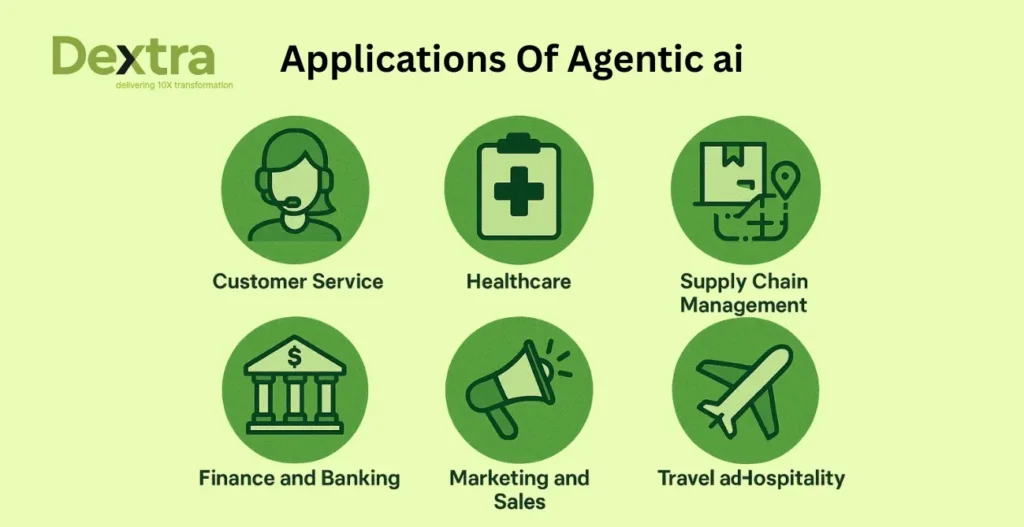
Agentic AI is making a real difference in various industries by taking on complex tasks that used to require significant human involvement. By using agentic AI, businesses can automate complex, multi-step workflows, enhancing operational efficiency and reducing the need for human supervision. Agentic AI makes decisions and takes actions by integrating with existing systems and external systems, streamlining operations and driving effective workflow automation. With its ability to perceive, reason, act, and learn, it is transforming the way businesses operate. Here are some key areas where Agentic AI is already being applied:
1. Customer Service
- Handles customer inquiries, troubleshooting, and complaint resolution without human help.
- Multiple agents can collaborate within a multi-agent system to handle customer inquiries more efficiently, sharing context and coordinating tasks with other agents to optimize workflow and problem-solving.
- Agentic AI can manage support tickets from start to finish, improving response times and customer satisfaction.
- Agentic AI can provide deep personalization at scale, enhancing customer interactions based on past preferences and behaviors.
- Analyze past customer interactions to determine the best course of action.
- Escalates complex issues to human agents when needed.
- Enables 24/7 support and faster response times.
- As per SQ Magazine, 24% of consumers, and notably 32% of Gen Z, are open to AI agents managing their shopping needs, indicating a generational shift toward AI adoption.
2. Healthcare
- Diagnoses illnesses and recommends treatments.
- Tracks patient data and analyzes medical records, test results, and research.
- Assists with administrative tasks like scheduling appointments and virtual consultations.
- Helps doctors make more informed decisions.
3. Supply Chain Management
- Monitors inventory, forecasts demand, and places orders automatically.
- Makes real-time decisions based on weather, market trends, and customer behavior.
- Increases efficiency and reduces waste by aligning stock with demand.
4. Finance and Banking
- Predicts financial trends and manages operations like fraud detection and credit scoring.
- Automates routine tasks such as account monitoring and customer inquiries.
- Improves decision-making with real-time data analysis.
5. Marketing and Sales
- Automates tasks like email campaigns, content creation, and customer segmentation.
- Analyzes customer data to personalize ads and offers.
- Follows up with leads and supports sales funnel navigation.
- As per eMarketer, by 2028, 33% of enterprise software applications are expected to incorporate agentic AI, a sharp rise from less than 1% in 2024.
6. Travel and Hospitality
- Assists in planning trips, booking flights, and managing reservations.
- Handles cancellations, changes, and customer support throughout the travel experience.
- Enhances convenience and efficiency for travelers.
Implications for the Workforce:
The workforce will probably be greatly impacted by the development of agentic AI. Agentic AI can enhance decision-making by processing vast streams of data in real-time, providing actionable insights for businesses. It enables human-like decision making, allowing AI agents to operate autonomously and adapt to complex, dynamic situations. Additionally, agentic AI can improve user experience by allowing users to interact with systems using natural language, simplifying complex workflows. The integration of agentic AI with existing systems is crucial for creating personalized user experiences and enhancing operational efficiency. On the one hand, it presents fantastic chances to boost efficiency and productivity. However, it also brings up issues of job displacement and shifting skill needs.
1. Job Automation and Transformation
- Automation of Routine Tasks: Agentic AI can automate repetitive, time-consuming tasks like scheduling, data entry, customer support, and financial processing.
- Reduced Human Involvement in Basic Tasks: Tasks that require minimal human judgment will be fully handled by AI, reducing the need for manual intervention.
- Job Transformation: Many jobs will evolve. Human workers will transition from handling routine tasks to overseeing AI systems, handling complex decision-making, and providing strategic input.
2. New Job Opportunities
- Creation of AI-related Roles: New job categories will emerge, such as AI system managers, data scientists, machine learning specialists, and AI ethics consultants.
- Human-AI Collaboration Roles: Positions focused on ensuring smooth collaboration between humans and AI will become more important.
- Skills Training and Development: There will be a growing demand for professionals who can integrate, manage, and fine-tune AI solutions within businesses.
3. The Shift in Skill Sets
- Technical Skills: Workers will need to understand AI and how to interact with it. Skills in programming, data analysis, and machine learning will become essential.
- Soft Skills: Critical thinking, emotional intelligence, and creative problem-solving will remain in high demand, as AI cannot replicate these abilities.
- AI Management Skills: Professionals will need to know how to manage and optimize AI systems for business goals, ensuring they align with human objectives.
What are the Challenges and Considerations of Agentic AI?
Despite the significant potential of Agentic AI, there are several challenges and considerations that need to be addressed for successful integration into the workforce and society. Agentic AI systems can act independently, which introduces risks of unpredictable actions or errors if not properly designed or monitored. The autonomous nature of agentic AI can magnify traditional AI risks, making governance and constant human oversight critical. Agentic AI systems require clear rules and boundaries to ensure safe and responsible operation.
1. Ethical Concerns and Bias
- Bias in AI Decision-making: If AI systems are educated on biased data, they may reinforce or magnify preconceptions. Discriminatory results may result from this in fields like law enforcement, lending, and employment.
- Accountability for AI Errors: If an AI system makes a mistake or causes harm, who is responsible? Clear accountability frameworks will be necessary for businesses to manage risk.
- Ethical AI Guidelines: AI systems must abide by ethical rules and be subject to frequent audits to guard against bias and mistakes in order to guarantee justice, fairness, and transparency.
2. Security Risks
- Vulnerability to Cyber Attacks: AI systems can execute complex tasks and have access to sensitive data, hackers and cybercriminals may target them.
- AI Exploitation in Cybercrime: AI itself may be used as a weapon for malevolent intent, such as producing deepfakes or launching increasingly complex cyberattacks.
- Data Privacy and Security: To safeguard users and organizations, it will be crucial to make sure AI systems adhere to data privacy regulations and uphold strict security standards.
3. Job Displacement and Retraining
- Risk of Job Loss: Automation may result in employment losses in sectors that rely significantly on regular work, even while new positions will arise. While agentic AI systems can operate with minimal human supervision, regular human supervision remains necessary to ensure safe and responsible operation.
- Need for Retraining Programs: To assist employees in adjusting to jobs that are compatible with AI, governments, and corporations must fund upskilling and reskilling initiatives.
- Focus on Soft Skills Development: Employees must acquire abilities like creativity, critical thinking, and human judgment that AI cannot duplicate in addition to technical skills.
Measuring the ROI of Agentic AI
Measuring the return on investment (ROI) of agentic AI systems involves looking beyond just the initial cost savings. The benefits of agentic AI are both direct and indirect, ranging from increased operational efficiency and reduced costs to improved customer support and satisfaction. When implementing agentic AI, organizations should track key metrics such as time saved on repetitive tasks, reductions in operational expenses, and revenue growth resulting from streamlined processes.
Adopting agentic AI allows businesses to automate repetitive tasks, enabling human teams to focus on higher-value, strategic work that drives innovation and growth. In addition to quantifiable gains, agentic AI brings intangible benefits like enhanced competitiveness and better customer experiences. To accurately measure ROI, it’s essential to set clear goals, define success metrics, and regularly monitor the performance of your agentic AI systems. Continuous evaluation ensures that these AI systems are delivering on their promise and contributing to long-term business success.
Ensuring Transparency and Accountability
Transparency and accountability are essential for building trust in agentic AI systems. As these AI systems become more autonomous, organizations must ensure that their decision-making processes are explainable and interpretable. This means designing agentic AI with built-in mechanisms that provide clear insights into how decisions are made, allowing stakeholders to understand and trust the outcomes.
Human oversight remains a critical component, even as agentic AI operates with minimal supervision. Regular reviews and monitoring help detect and correct potential biases or errors, ensuring that AI systems act in alignment with organizational values and ethical standards. Establishing clear guidelines and regulatory frameworks for the development and deployment of agentic AI further reinforces accountability. By prioritizing transparency and human oversight, businesses can mitigate risks, foster trust, and ensure that their agentic AI systems operate reliably and ethically.
Integrating AI Agent into Existing Software
Successfully integrating AI agents into existing software environments requires a thoughtful approach that prioritizes compatibility, scalability, and security. Agentic AI systems can be embedded within a variety of enterprise systems, such as customer relationship management (CRM) and enterprise resource planning (ERP) platforms, to enhance business processes and customer interactions.
To enable seamless integration, organizations should leverage standardized APIs and data formats, allowing AI agents to access and process relevant information from multiple sources. This integration empowers agentic AI systems to operate independently, making real-time decisions and taking actions based on up-to-date data and analytics. As a result, businesses can automate tasks, improve the efficiency of customer interactions, and unlock new insights from their data. By strategically integrating agentic AI into existing software, organizations can maximize the value of their technology investments and drive continuous improvement across their operations.
Future of Agentic AI
The future of agentic AI is poised to transform industries ranging from software development and customer service to supply chain management. As AI models become more sophisticated, agentic AI systems will be capable of handling even more complex tasks and making decisions that closely resemble human judgment. Advanced techniques like retrieval augmented generation (RAG) will enable these systems to access and process vast amounts of information, delivering highly accurate and context-aware responses.
By adopting agentic AI, businesses can optimize supply chains, strengthen customer relationships, and gain a significant competitive edge. The ability of agentic AI systems to learn, adapt, and operate autonomously will drive innovation and efficiency across all areas of enterprise operations. As these technologies become more widespread, it will be crucial to prioritize responsible AI development, ensuring that agentic AI aligns with human values and contributes to a more productive and ethical future for all.
Why Should You Care About Agentic AI?
- Enhanced Productivity: By automating difficult jobs, agentic AI frees up human resources for more strategic endeavors.
- Business Efficiency: From supply chain management to customer service, agentic AI simplifies operations in a variety of industries.
- Personal Assistance: Agentic AI provides sophisticated assistance with everyday tasks like scheduling and travel planning.
- Innovation Catalyst: By managing complex processes on its own, agentic AI propels the creation of new goods and services.
How Dextralabs Integrates Agentic AI to Accelerate 10x Growth for Tech & Dev Teams?
At Dextralabs, we don’t just consult, we collaborate, design, and deploy Agentic AI solutions that think, act, and adapt with purpose. For companies in the USA, UAE, and Singapore aiming to scale rapidly, Agentic AI isn’t a futuristic concept, it’s your next competitive edge.
Whether you’re building a product, automating operations, or innovating customer experiences, our team integrates Agentic AI frameworks directly into your tech or development environment. From autonomous code agents and intelligent dev tools to proactive system optimizers, we empower your teams to:
- Automate complex workflows with self-directed AI agents
- Boost engineering velocity through AI copilots and agentic task handling
- Unlock real-time decision-making with context-aware systems
- Scale efficiently while reducing operational overhead
Want 10x growth with Agentic AI?
Book your free Agentic AI strategy session with Dextralabs now!
Let’s build it together.Our approach ensures that Agentic AI is not a bolt-on feature, but a core part of your tech DNA, tailored to your goals, infrastructure, and growth vision.
Final Thoughts
Our working methods are changing as a result of agentic AI, which presents chances for enhanced output and new skills. Businesses must invest in AI education, retraining programs, and ethical norms to guarantee AI is utilized responsibly if they want to prosper. To adapt, workers will need to pick up new skills, particularly those related to working with AI. Cooperation between humans and AI will be crucial for problem-solving and productivity gains.
To create a workforce that is both productive and well-rounded, implementing this shift will require constant learning, flexibility, and a focus on ethical AI practices. Our mission at Dextralabs is to support innovation, help businesses realize the potential of agentic AI, and ensure a seamless transition to this new workplace era.
FAQs on Agentic AI:
Q. What is the difference between generative and agentic AI?
In response, Agentic AI is capable of autonomously planning, deciding, and finishing tasks without continual human assistance. On the other hand, Generative AI concentrates on creating code, text, or graphics in response to prompts.
Q. What makes agentic AI crucial for modern businesses?
Businesses may increase efficiency, automate processes, and decrease manual decision-making with the use of Agentic AI. Employee concentration on higher-value and more strategic activities is facilitated, which increases innovation.
Q. How quickly are industries adopting agentic AI?
By 2034, the market for agentic AI is expected to grow to $196.6 billion, according to SQ Magazine. By 2027, it is anticipated that the number of businesses implementing agentic AI algorithms will be doubled.