How modern AI agents sense, reason, and act— and why enterprises are moving toward agentic workflows faster than anyone predicted.
Artificial intelligence has shifted from conversation systems to decision-making systems. For years, organizations relied on chat interfaces that responded to questions but lacked initiative. Now, a new class of systems has taken shape—AI agents—software that operates with a degree of autonomy, interprets signals from multiple sources, and executes tasks that previously required teams of people.
Companies across industries are already experimenting with these models. Some are deploying internal research agents, others are automating operations, and several are constructing multi-agent ecosystems that coordinate decisions across departments.
Dextralabs works closely with such organizations, helping them design, deploy, and scale production-grade agentic systems. The shift is not theoretical; it is happening in real workflows with measurable operational lift.
This article breaks down how AI agents function, why enterprises are accelerating their adoption, and what it takes to make them reliable at scale.

Ready to Move Beyond AI Experiments?
Design and deploy production-grade AI agents that automate real workflows and deliver measurable impact.
Build and scale production-ready agentic systems with Dextralabs.What Makes an AI Agent Different From an LLM or a Chatbot?
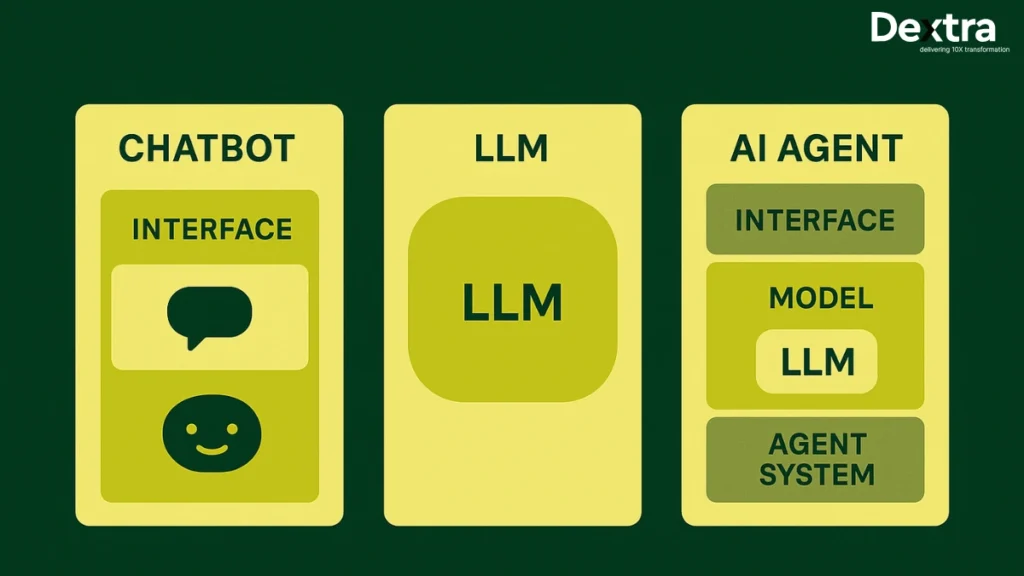
LLMs are powerful reasoning engines. Chatbots are interfaces for structured interaction.
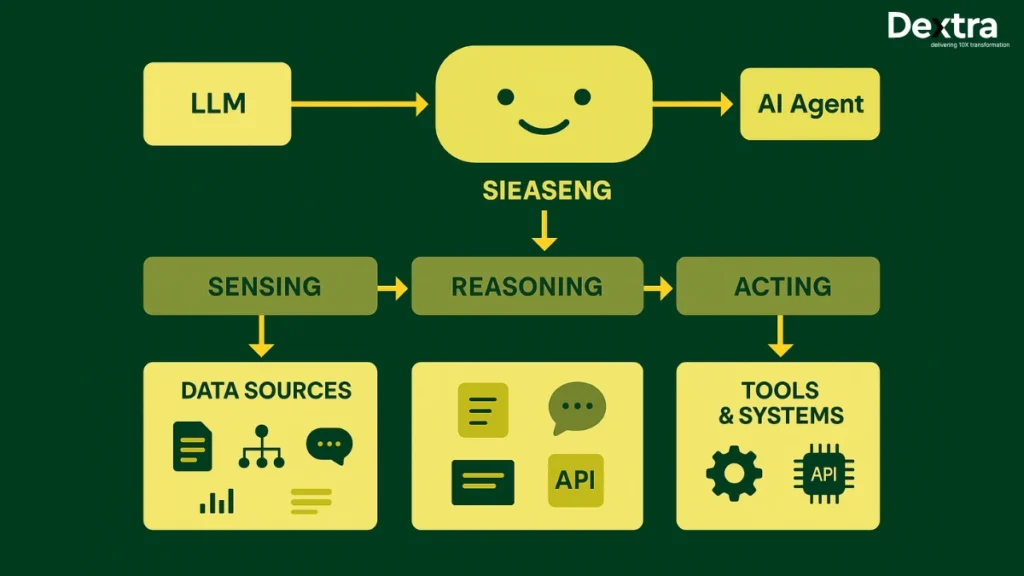
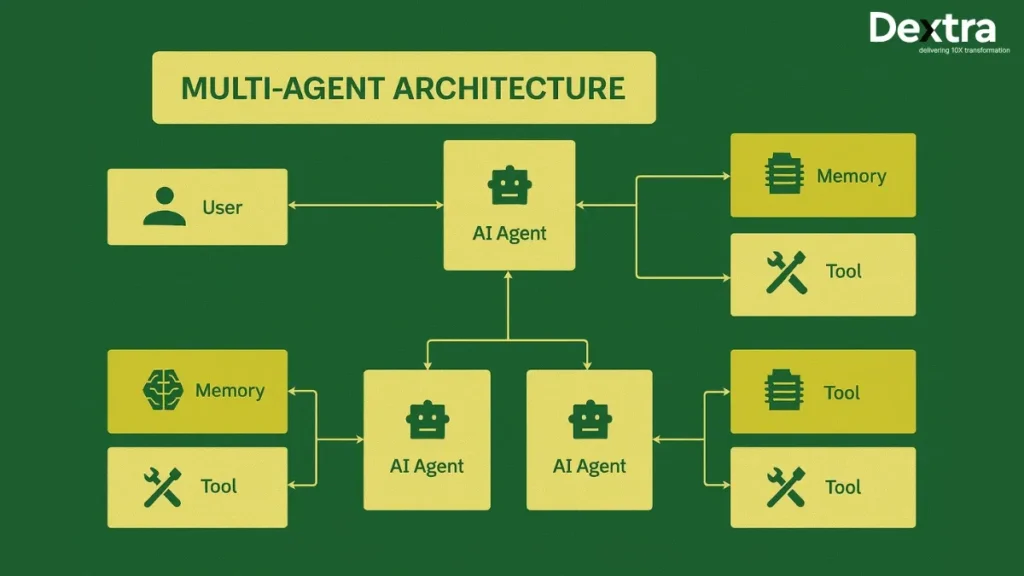
AI agents, however, are purpose-built systems with four responsibilities:
sensing → thinking → acting → self-correcting
An agent is expected to:
- gather signals from multiple sources
- interpret context
- compare options
- apply business rules
- execute actions through tools or APIs
- evaluate the quality of its decisions
This creates a system that behaves less like a conversational assistant and more like an autonomous operations engine.
Enterprises don’t want yet another interface. They want software that performs work: resolving support cases, preparing reports, booking logistics, validating compliance steps, generating code, monitoring processes, and coordinating actions across systems.
Also Read: The Agentic AI Maturity Model 2026
Sensing: How AI Agents Collect Input From the Real World?
An effective agent starts by absorbing information from various channels, not just a user’s prompt. The sensing layer may include:
a. Textual Inputs
Chats, emails, CRM entries, product descriptions, customer logs, internal notes—anything expressed in language.
LLMs excel here, but the agent must classify and prioritize what matters.
b. API Signals & Webhooks
Events coming from ERP systems, billing systems, monitoring tools, HR platforms, or proprietary applications.
For example:
- a new invoice enters the system
- a ticket gets escalated
- a lead status changes
- a compliance threshold triggers an alert
Agents must react immediately, not wait for a human message.
c. Document Retrieval Pipelines
SOPs, training guides, contracts, historical tickets, internal policies, FAQs, and manuals.
This is where Retrieval-Augmented Generation (RAG) enables grounded reasoning.
d. Speech & Audio Inputs
Recorded calls, support conversations, meeting transcripts, voice commands—useful for service and field workflows.
e. Data Feeds & Metrics
Dashboards, sensor data, analytics outputs, warehouse metrics.
The engineering challenge is not collecting data but shaping it into a context window the agent can actually use. Dextralabs often builds an intermediate signal-processing layer—cleaning inputs, filtering noise, and attaching metadata so that reasoning becomes accurate and stable.
When sensing works well, the agent enters decisions with clarity instead of guesswork.
Thinking: The Cognitive Engine Behind Every AI Agent
Once data arrives, the agent must decide what it means. This is the heart of agentic design.
a. Knowledge Base as the Foundation
An agent draws from structured and unstructured knowledge sources:
- factual data
- policies
- rules
- reference manuals
- pricing sheets
- enterprise-specific procedures
- database queries
- vectorized documents retrieved through RAG
This knowledge base becomes the agent’s worldview. Without it, even the best LLM generates answers that are imaginative instead of compliant.
b. Goals, Preferences & Policy Constraints
LLMs do not naturally follow business rules. Agents must be instructed with:
- organizational constraints
- approval thresholds
- compliance guidelines
- preferred tools or vendors
- cost caps
- role-based permissions
- user-specific preferences
The goals define what “good output” means. Policy constraints define what is not acceptable.
Together they create the decision boundaries that make the agent safe and reliable.
c. Reasoning, Planning & Task Decomposition
This is where AI starts to perform work instead of simply explaining ideas.
Agents leverage:
- multi-step logical reasoning
- chain-of-thought decision sequences
- conditional logic
- branching workflows
- planning frameworks
- scoring and ranking heuristics
- prioritization based on objectives
- decomposition of tasks into executable steps
LLMs provide the cognitive horsepower, but Dextralabs adds deterministic scaffolding around them—ensuring repeatability, safety, and compliance.
Without a stable planning layer, an agent may respond fluently but fail operationally.
Reliability is engineered, not assumed.
Acting: How Agents Execute Real Work Across Systems?
After reasoning comes execution. This is where agents deliver measurable business value.
Actions may include:
a. Generative Actions
- composing emails
- summarizing documents
- drafting proposals
- preparing reports
- generating SQL queries
- writing code snippets
b. System-Level Actions
- updating CRM fields
- modifying ERP entries
- filing tickets
- posting comments
- adjusting inventory records
- submitting forms
c. Workflow Orchestration
Agents can coordinate multi-step processes:
- classify a customer issue
- pull the correct SOP
- apply entitlement rules
- respond to the customer
- escalate if required
- close the case
All without human supervision.
d. Decision + Execution Loops
A well-designed agent not only executes tasks but also evaluates if the action:
- aligns with goals
- satisfies constraints
- matches historical patterns
- produces downstream obligations
This ability to “check its own work” differentiates a true agent from a script-driven automation tool.
Dextralabs focuses heavily on this execution layer, integrating agents deeply with existing systems so they move from suggestions to outcomes.
The Feedback Loop: The Signature Feature of Agentic Systems
Human teams improve through feedback—AI agents must do the same. A feedback loop helps the agent learn what constitutes a better decision.
Sources include:
- user approvals or corrections
- system evaluations
- policy compliance signals
- reinforcement scoring
- alternative scenario testing
- post-action audits
This ongoing process enables:
- refinement of preferences
- corrections to misinterpretations
- improved task planning
- better compliance adherence
Agents that remain static do not scale well in enterprise environments. Agents that evolve maintain relevance and reliability as conditions shift.
A Real-World Analogy: The Travel-Booking Agent
To illustrate how sensing, thinking, acting, and feedback work together, consider a travel-booking agent.
Inputs:
- requested travel dates
- meeting location
- calendar schedule
Knowledge Base:
- preferred airlines
- loyalty preferences
- company travel policies
- limits on hotel budgets
- maps and distance information
Reasoning:
- evaluate routes
- compare prices
- filter options based on rules
- prioritize user preferences
- identify the most practical combination
Action:
- book tickets
- reserve hotel
- update the calendar
- send the itinerary
- log the expense details
Feedback:
- user confirms or rejects selections
- preferences update
- policy logic refines for future trips
This mirrors hundreds of workflows inside enterprises: procurement, support, onboarding, research, compliance checks, and more.
Where AI Agents Deliver Immediate Value in Enterprises?
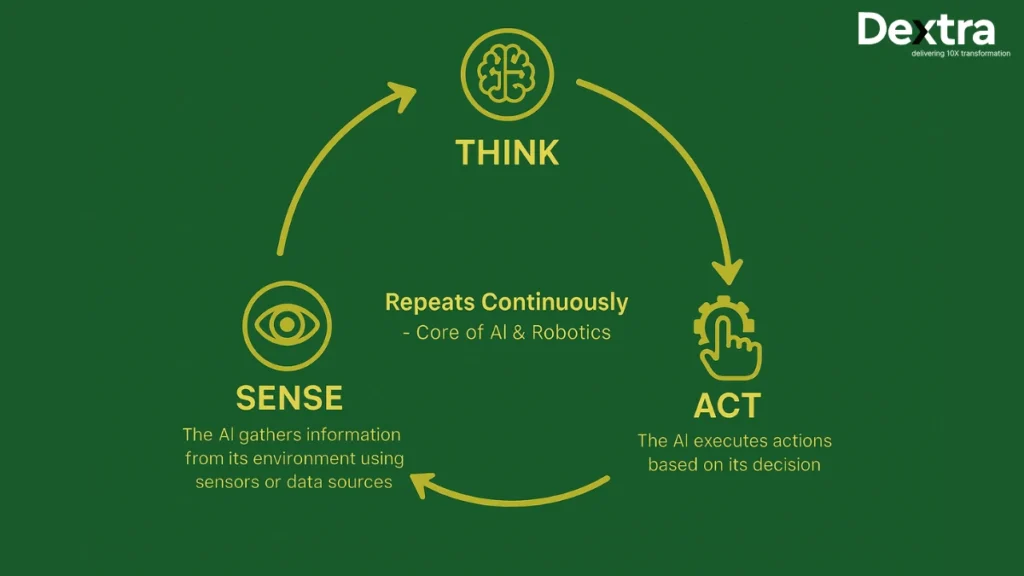
The strongest use cases emerging today include:
a. Customer Support Automation
Agents can interpret user queries, pull the right information, apply policies, respond, and close cases.
b. Sales Operations & CRM Hygiene
Updating fields, enriching leads, generating follow-ups, preparing summaries, qualifying opportunities.
c. Internal Knowledge Assistants
Document retrieval, policy interpretation, SOP-guided task completion.
d. Procurement & Finance
Quote comparison, vendor validation, contract drafting, compliance checks.
e. DevOps & IT Automation
Ticket triage, alert interpretation, automated remediation steps.
f. Compliance & Risk Review
Document scanning, rule checks, reporting, and flagging anomalies.
In each category, the value is the same: fewer manual tasks, faster throughput, higher accuracy, and consistent execution.
Why Agentic AI Fails When Implemented Poorly?
Not all agent deployments succeed. Common challenges include:
- weak RAG pipelines producing irrelevant context
- missing policy definitions
- unstructured workflows
- lack of observability
- unclear boundaries for the agent’s authority
- insufficient tool access
- overreliance on raw LLM reasoning
- fragmented data signals
- no safety or fallback mechanisms
Enterprises often attempt agent deployments using simple prompt engineering. That approach collapses quickly under real-world load.
Dextralabs approaches agentization as an engineering discipline—planning systematic workflows, integrating tools, building guardrails, and ensuring traceability at each step.
What a Production-Ready Agent Requires?
A stable, compliant agentic system needs:
- a well-defined knowledge architecture
- structured memory modules
- deterministic logic layers
- policy enforcement
- auditing and versioning
- robust security
- fallback behaviors
- rigorous testing under multiple scenarios
- a monitoring and observability framework
Without these, an agent may appear smart during demos but fail in production.
Dextralabs has developed a repeatable architecture that balances LLM flexibility with deterministic reliability, ensuring agents remain aligned with business rules.
The Business Impact: Why Leaders Are Accelerating Agent Adoption
Once deployed, agents transform operations in several ways:
- Productivity Gains: Tasks that consumed hours now complete in minutes.
- Error Reduction: Policies and rules are applied consistently.
- Cost Efficiency: Departments handle higher workloads without scaling headcount.
- Speed: Agents operate continuously without fatigue or delays.
- Institutional Memory: Knowledge no longer disappears with turnover.
- Operational Predictability: Workflows become more stable and measurable.
For mid-market and enterprise teams, this shift creates meaningful competitive advantage. The conversation is no longer about “AI adoption” but about workflow redesign led by intelligent agents.
Conclusion: Agentic Systems Are Becoming the New Operational Backbone
Organizations no longer want AI that merely responds—they want systems that complete work autonomously, follow rules, integrate with tools, and adapt over time. The shift toward agentic AI is not driven by hype but by measurable improvements in operational efficiency.
Dextralabs partners with enterprises to architect these systems from the ground up—ensuring they are reliable, compliant, explainable, and production-ready.
If your organization is evaluating where AI agents can deliver immediate, tangible value, our engineering team can help you design a roadmap and deploy your first production-grade agent.
Turn AI Into an Operational Asset.
Deploy autonomous, production-ready AI agents that execute real work. Talk to Dextralabs’s AI expert to build your first agentic system.
Get AI Agent Development ServicesFAQs:
1. What is an AI agent in practical terms?
An AI agent is a software system that can collect data, apply reasoning, make decisions, and execute tasks without constant human intervention. It does not stop at generating responses—it performs actions such as updating systems, triggering workflows, drafting documents, or coordinating multi-step processes.
2. How are AI agents different from traditional chatbots?
Chatbots respond; agents operate. Chatbots rely solely on user inputs, while agents work with multiple signals—APIs, documents, databases, logs, and real-time events. Agents maintain goals, apply business policies, and access tools to complete work end-to-end, not just hold a conversation.
3. What role do LLMs play inside an AI agent?
LLMs handle reasoning, planning, interpretation, and text-based tasks. They evaluate context, break complex instructions into smaller steps, choose methods to achieve objectives, and generate structured actions. In enterprise systems, LLMs are paired with guardrails, rules, policy layers, and tool access to ensure reliable outcomes.
4. How does RAG improve an AI agent’s performance?
RAG (Retrieval-Augmented Generation) supplies the agent with current, verifiable information pulled from enterprise data: documents, SOPs, product catalogs, CRM notes, historical cases, and more. This ensures the agent operates with accurate context instead of relying on model memory or assumptions.
5. What kinds of tasks can AI agents automate for enterprises?
Common implementations include:
customer support resolution
sales operations coordination
lead research and enrichment
procurement workflows
compliance checks
operational reporting
IT service desk automation
data cleanup, classification, and document handling
Anything that follows rules, depends on structured knowledge, or requires multi-step logic is a strong candidate for agentic automation.
6. What makes an AI agent reliable enough for production?
Reliable agents require:
clear goals and constraints
deterministic policy layers
strong RAG pipelines
system-level observability
error-handling and fallback paths
secure tool access
versioning and traceability
compliance-aware execution logic
Dextralabs specializes in building agents with these foundations so outputs remain consistent, traceable, and aligned with business rules.
7. Can AI agents integrate with legacy systems?
Yes. Modern agents use an orchestration layer that communicates with APIs, databases, automation tools, and legacy systems through connectors or custom bridges. Enterprises adopting hybrid IT stacks can still deploy agentic workflows without replacing existing systems.
8. How does the feedback loop improve an AI agent over time?
Agents receive input from users, system evaluations, policy checks, and internal scoring. This feedback helps refine decision-making, correct unwanted patterns, improve preference models, and increase the accuracy of recommendations. Over time, the agent becomes more aligned with business expectations.
9. Are AI agents secure for handling sensitive business data?
Yes—when deployed correctly.
Dextralabs builds agents that operate within private environments such as VPCs or on-prem infrastructure. Data never leaves the enterprise boundary, and the agent follows permissioning rules, access controls, and audit trails. Security is engineered into the architecture, not treated as an afterthought.
10. How can an organization decide where to start with agentic AI?
The best starting point is identifying high-volume, rule-driven, or repetitive workflows where delays or errors create friction. Examples include support queues, procurement approvals, reporting cycles, or document-heavy tasks. Dextralabs conducts structured assessments to map opportunities and define which processes can benefit first.
11. Does an AI agent replace human roles?
It replaces repetitive execution, not judgment.
Humans remain responsible for strategy, exception handling, and oversight. Agents remove manual load so teams can focus on decisions that require experience, creativity, or negotiation.
12. How long does it take to deploy a production-grade AI agent?
Depending on the complexity of workflows and integrations, deployment can range from a few weeks to a few months. Critical factors include data quality, tool access, compliance rules, and approval cycles. Dextralabs provides both rapid pilots and full-scale enterprise implementations.