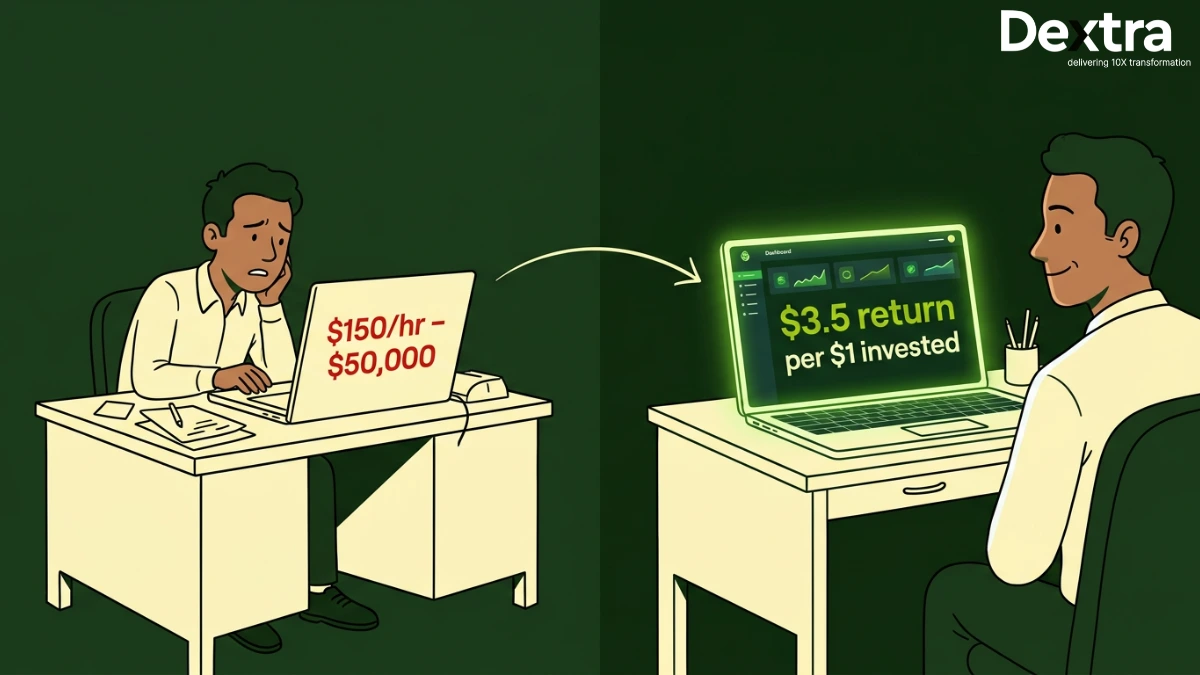
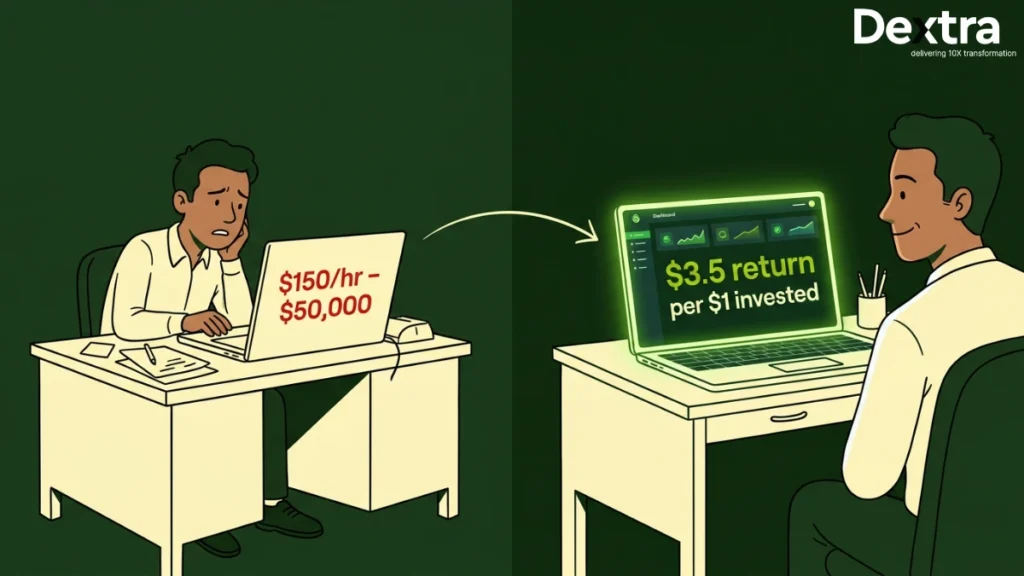
There is a version of this conversation that costs small businesses money before it even begins. An owner types “AI consultant” into Google, sees figures that range from $150 an hour to $50,000 for a project and closes the tab assuming it is for companies with bigger budgets. That assumption is wrong and it is increasingly expensive to hold.
AI consulting costs are genuinely variable, but not arbitrarily so. They are structured, explainable and for small and medium businesses far more accessible. This blog breaks down exactly how AI consulting is priced, what small businesses in the USA, Singapore and India are actually spending, what they are getting for that spend and how Dextra Labs has built a framework specifically designed for the SME budget reality.
91% of SMBs Using AI Are Growing. Is Your Business Next?
Dextra Labs works with small and medium businesses in the USA, Singapore, and India to deliver working AI implementations, scoped to your budget, built in 60–90 days.
Start With a Free AI ConsultationThe Business Case First: Why This Cost Conversation Matters Now?
Before pricing, context. Because one of the most common mistakes small business owners make is treating AI consulting as a cost rather than a capital decision.
Salesforce survey of 3,350 SMB leaders across 26 countries found that 91% of SMBs using AI say it directly boosts their revenue. Among growing SMBs, 83% are using AI, compared to just 55% of businesses experiencing revenue declines. The gap between those two numbers is not luck. It is a deliberate technology investment decision.
The same survey found that 87% of AI-using SMBs report it helps them scale operations and 86% report improved profit margins. For Singapore specifically, 87% of SMBs using AI reported revenue growth, with 94% of SMBs in Singapore already using or experimenting with AI. For India, 93% of SMBs using AI grew their revenue.
IBM’s research puts the average return on AI investment at $3.5 for every $1 invested. McKinsey’s data shows that 78% of organizations globally now use AI in at least one business function, up sharply from 55% the year before. Small businesses that are not asking the consulting cost question are not avoiding a cost. They are deferring a competitive disadvantage.
What AI Consulting Actually Costs?
Let us get into the specifics that most guides obscure. AI consulting costs are determined by a small number of variables: the experience level of the consultant or firm, the pricing model, the scope of the engagement and the geography. Here is what each looks like in practice.
1. By Experience Level
The market in 2025 follows a relatively consistent tiered structure:
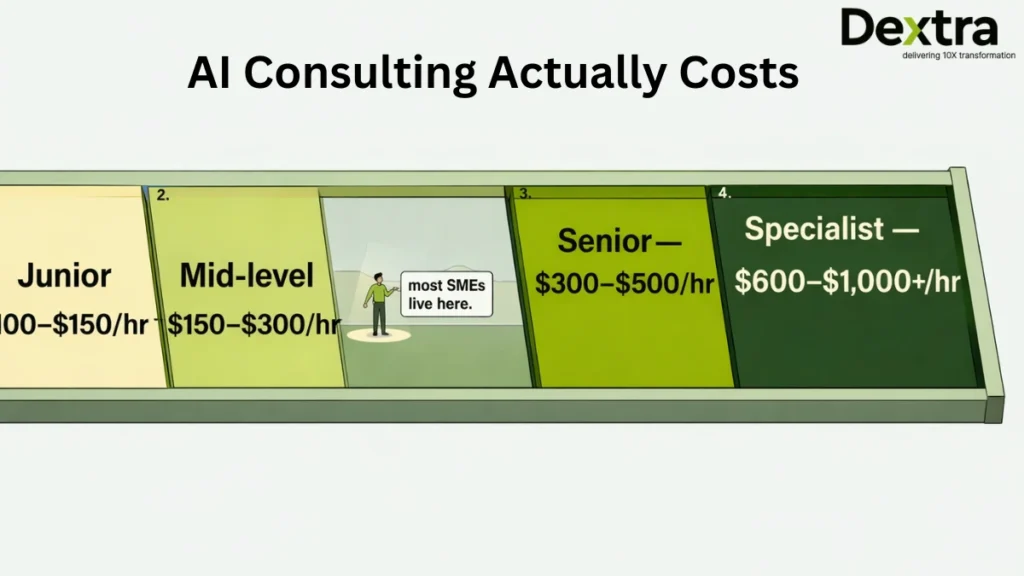
Junior consultants (0–3 years of experience): $100–$150 per hour. Useful for defined, lower-complexity tasks, basic data work, initial literature review, supporting senior-led projects.
Mid-level consultants (3–7 years): $150–$300 per hour. Able to independently design and implement AI models, manage smaller projects and contribute meaningfully to business strategy.
Senior experts: $300–$500+ per hour. These are consultants with deep domain expertise, a track record of enterprise implementations and the strategic judgment that saves businesses from costly detours.
Top-tier specialists: $600–$1,000+ per hour. Rare and genuinely only relevant for specialized needs, auditing high-stakes systems, advising at board level on AI strategy in heavily regulated industries.
For most small businesses, the relevant range is $100–$300 per hour depending on what they need done, with the mid-range covering the majority of practical implementation work.
2. By Pricing Model
The pricing model matters as much as the hourly rate. There are three main structures:
Hourly billing is where most engagements begin, particularly for discovery phases where scope is unclear. It is transparent and easy to budget in the short term, but it caps value, a faster, more experienced consultant earns less under hourly billing, which creates misaligned incentives.
Project-based (fixed fee) is now the most common model for defined AI consulting engagements. It gives small businesses certainty: you know what you are getting, how long it takes and what it costs. For SME budgets, this predictability matters.
Retainer models are typically $2,000–$10,000 per month and are appropriate for ongoing advisory relationships, where a business wants continued access to expertise as they scale their AI capabilities rather than a one-time implementation.
3. By Project Scope
This is where AI consulting costs for small businesses look most different from enterprise pricing. A useful breakdown for SME-scale engagements:
AI Readiness Assessment ($2,000–$8,000): An evaluation of current operations, technology infrastructure and opportunity identification. Delivers a prioritised list of use cases with estimated return and implementation requirements. This is the right starting point for most small businesses that are not yet sure where AI fits.
Pilot or Proof-of-Concept ($10,000–$25,000): A focused first implementation, one use case, defined in scope, designed to deliver a measurable result within 60–90 days. This is where most SMEs start their AI journey properly.
Full Implementation ($25,000–$75,000): A production-ready AI deployment, integrating with existing systems, trained on business-specific data, with staff training and monitoring built in. For small businesses, this typically covers one to two core workflows.
Ongoing managed implementation (retainer): $3,000–$10,000 per month for continued development, monitoring and expansion. Appropriate once a business has validated its first implementation and wants to scale systematically.
Most SMBs in the USA, Singapore and India spend $10,000–$50,000 on their initial AI consulting engagement. That figure covers a well-scoped implementation with measurable outcomes, not an open-ended exploration.
What Drives Cost Up?
Understanding cost drivers lets you make smarter decisions about where to spend and where to hold back.
Experience level: The most direct cost driver. The decision to hire senior vs mid-level expertise should be driven by what the project actually requires, not by default. Many SME projects do not need $400/hour strategic judgment, they need solid mid-level implementation.
Specialisation premium: Consultants with deep domain knowledge in healthcare, financial services, or legal command 25–40% more than generalists, according to industry research. If your business operates in a regulated sector, that premium is usually worth it. If not, it is not.
Scope clarity: Vague briefs produce vague and expensive engagements. The single most effective thing a small business can do to control AI consulting costs is to arrive at the first conversation with a clear answer to: what problem are we trying to solve and how will we know if we have solved it?
Geographic arbitrage: This is relevant and legitimate. US-based consultants command the highest rates. India’s AI consulting market combines high technical depth with significantly lower cost structures, a primary reason why India’s AI consulting sector is projected to grow at 30.2% CAGR from 2025–2035. Singapore sits between the two, a mature AI ecosystem with rates reflecting its position as Asia-Pacific’s technology hub.
DIY trap costs: Many small businesses attempt AI implementation without consulting support, underestimating the integration challenge. Connecting AI tools to existing data sources, ensuring consistent output quality and building workflows that teams actually use requires expertise that most small businesses do not have internally. The cost of a failed DIY implementation, in wasted time, bad decisions made on bad AI outputs and the work required to undo it, frequently exceeds what professional consulting would have cost.
Why Most Small Businesses Overpay or Undershoot?
There are two failure modes in AI consulting for small businesses and they mirror each other.
Overpaying happens when a small business hires enterprise-grade consultants for SME-scale problems. Big consulting firms with Fortune 500 clients, high overhead and prestige pricing are genuinely not the right fit for a 50-person business that needs one workflow automated. The result is an expensive engagement that produces recommendations the business cannot implement, because no one sized the project to the actual organisation.
Undershooting happens when a business hires the cheapest option available and gets exactly what they paid for: generic recommendations that do not account for the specific business context, AI tools that do not integrate with existing systems and no ongoing support when things go wrong after deployment.
The right approach for SMEs is neither. It is a consulting engagement that is scoped to the business’s actual size and complexity, priced at mid-market rates and built around implementation rather than advice-only delivery.
The Dextra Labs Framework for SME AI Consulting
At Dextra Labs, we built our engagement model specifically for small and medium businesses in the USA, Singapore and India, not as a scaled-down version of enterprise consulting, but as a purpose-built framework for how SMEs actually work, budget and make decisions.
The framework has five phases and every engagement moves through them:
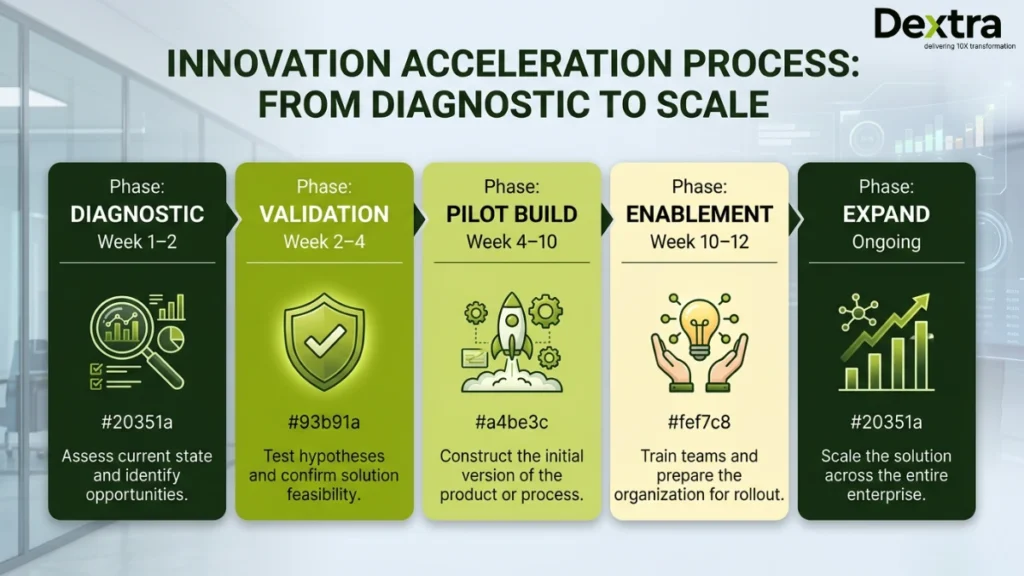
Phase 1: Diagnostic (Week 1–2)
As an AI Consulting Company in Singapore, USA & India, we do not start with tools. We start with your business. What are the three to five workflows that consume the most time or carry the most risk of error? Where are the bottlenecks that a human is solving today that a well-configured AI could handle tomorrow? What does your data look like and is it in a usable state?
This phase is deliberately short. The goal is to arrive at a prioritised list of two to three AI use cases, not twenty, ranked by implementation feasibility and expected return. Many SMEs have previously paid for AI readiness assessments that produced extensive reports they could not action. Our diagnostic is designed to produce a decision, not a document.
Phase 2: Use Case Validation (Week 2–4)
Before building anything, we validate the top priority use case against your actual data and existing systems. This is where many AI projects silently fail, the use case sounds sensible in theory, but the data required to power it does not exist, or the integration with existing software is more complex than anticipated.
Validation is where we surface these problems cheaply, before they become expensive. If a use case cannot be viably implemented at your budget and data maturity level, we say so here, not three months into a build.
Phase 3: Pilot Build (Weeks 4–10)
We implement the validated use case to production-ready standards. This is not a prototype. It is a working AI deployment, integrated with your existing systems, configured to your business context and tested against real-world inputs before handoff.
We focus on 60–90 day delivery cycles because SMEs cannot wait 18 months for results. Short cycles also build the organisational confidence that sustains AI adoption, a team that sees a working AI tool in two months is far more likely to support the next phase than one still waiting for a theoretical transformation.
Phase 4: Staff Enablement and Handoff (Weeks 10–12)
AI tools fail most often not because they are technically wrong, but because the people using them do not trust them or understand how to use them well. We build structured onboarding for your team, not generic AI training, but specific guidance on the tool we built for your workflows.
We also establish monitoring: output quality checks, usage tracking and an escalation process for when the system produces something unexpected. This is the governance layer that most small business AI deployments skip entirely.
Phase 5: Expand or Optimise (Ongoing)
Once the first use case is delivering measurable results, we have a clean decision point: expand to the next use case, or optimise the existing one before scaling. We offer a monthly advisory retainer for businesses that want continued access without committing to a new project scope and project-based pricing for defined expansion work.
The Questions to Ask Any AI Consultant Before You Pay
Regardless of which consulting firm you evaluate, these are the questions that separate good options from expensive ones:
Can you show me the ROI from a comparable previous engagement? Not case studies written by the marketing team. Actual numbers from a business of similar size and sector.
What happens if the use case we identify cannot be implemented at this budget? The answer tells you whether you are working with someone who will tell you the truth or someone who will start the project anyway.
Is the project scoped around our data as it currently exists, or as you wish it existed? Many AI implementations fail because they are designed for clean, structured data that the client does not actually have. A good consultant works with what you have, or tells you what you need to fix first.
Who is doing the work? In larger firms, the senior consultant who sells the engagement is often not the person who builds it. Know who will be on your project.
What does success look like at 90 days? If the answer is vague, the engagement will be too.
An Honest Word on What AI Consulting Cannot Do?
No consulting engagement can overcome a business that is not ready to implement. The most common reasons AI consulting fails for small businesses have nothing to do with the technology or the consultant:
Data that is not usable. AI systems need data to learn from and operate on. If your business runs on spreadsheets with inconsistent formats, paper records, or disconnected systems, the first investment is data infrastructure, not AI.
Leadership that is not committed. A Deloitte report on AI in the enterprise found that organisations where senior leadership actively shapes AI strategy achieve significantly greater business value than those that delegate AI decisions to the technology team. The same applies at SME scale.
Expecting transformation from a single project. The businesses achieving the strongest AI results, the ones behind the 91% revenue growth statistic, are not doing it with one chatbot. They are making AI a continuous capability, building on each implementation to create compounding returns.
A consulting engagement is the beginning of that process, not the end of it.
Conclusion
The data is settled. 91% of SMBs using AI report direct revenue growth. The gap between AI-adopting and non-adopting businesses is already showing up in revenue lines, customer retention and operational efficiency and it compounds every quarter.
What holds most small business owners back is not budget. There is uncertainty about what they are buying and whether they can trust the firm delivering it. That uncertainty is legitimate. The AI consulting market has no shortage of firms that overpromise and underdeliver.
Dextra Labs works differently. We scope every engagement to your actual constraints (budget, data maturity, internal capacity) and we build things that work before we talk about what comes next. No transformation theatre. No open-ended retainers before you have seen a result.
If you are a small or medium business in the USA, Singapore, or India ready to make your first AI investment count, the right next step is a straight conversation about what your situation actually requires.
FAQs:
Q1. How much does AI consulting cost for a small business?
Most small and medium businesses spend between $10,000–$50,000 on an initial AI consulting engagement. Entry-level assessments start at $2,000–$8,000, while a full production-ready implementation typically ranges from $25,000–$75,000 depending on scope and complexity.
Q2. Is AI consulting worth it for small businesses?
Yes, a Salesforce survey of 3,350 SMB leaders found that 91% of small businesses using AI report direct revenue growth. IBM’s research pegs the average ROI at $3.50 for every $1 invested in AI.
Q3. What is the difference between hourly and project-based AI consulting pricing?
Hourly billing ($100–$500/hr) suits early discovery phases where scope is unclear. Project-based or fixed-fee pricing is more predictable and now the most common model for defined engagements, better suited to SME budgets that need cost certainty upfront.
Q4. How long does an AI consulting project take for a small business?
A well-scoped pilot or proof-of-concept typically delivers results within 60–90 days. Dextra Labs structures its engagements around 10–12 week delivery cycles so businesses see working results quickly rather than waiting months for a theoretical outcome.
Q5. What should I ask an AI consultant before hiring them?
Key questions include: Can you show real ROI from a comparable client? Who will actually do the work on my project? What does success look like at 90 days? What happens if the proposed use case can’t be implemented within my budget?
Q6. Why do small businesses overpay for AI consulting?
Overpaying typically happens when SMEs hire enterprise-grade firms built for Fortune 500 clients, bringing high overhead, prestige pricing, and recommendations too complex for the business to actually implement. The right fit for most SMEs is a mid-market firm that scopes work to the business’s actual size and data maturity.
Q7. What AI consulting services does Dextra Labs offer for small businesses?
Dextra Labs offers a five-phase engagement model covering diagnostic assessment, use case validation, pilot build, staff enablement, and ongoing optimisation, purpose-built for SMEs in the USA, Singapore, and India, with pricing structured around SME budget realities.