Software development teams currently face more work than ever in history. This is because codebases have never been this complicated and dynamic. When codebases are large and evolving every moment by the minute, traditional code review workflows stop being as effective. This is where AI-powered code review solutions come in. Code review with AI assistance is not meant to replace human intelligence but to assist it.
At Dextralabs, the focus is on making engineering teams more empowered through the execution of AI-driven code reviews that are clear, fast, and consistent. Smart prompt strategies help guide large language models to deliver high-value feedback. This guide breaks down why prompt design matters, how to create effective prompts, and how Dextralabs helps build reliable systems that integrate seamlessly with real‑world workflows.
What is Prompt‑Based AI Code Review?
Before delving deep into how to make review prompts effective, it’s important to understand what prompt‑based AI code review actually is.
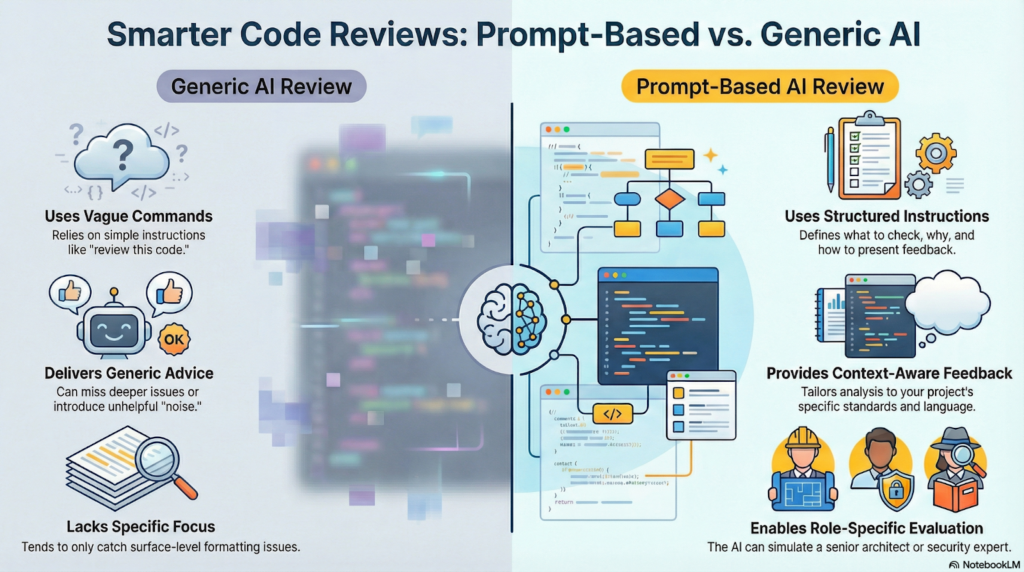
At a basic level, prompt-based AI code review is all about giving structured and detailed instructions to LLMs like GPT, Claude, Gemini, or Mistral on how they will analyze code and give meaningful feedback. This replaces the generic commands such as “review this code” with what it checks and why, including how the feedback should be presented.
This approach differs from simple, out‑of‑the‑box AI use in several ways:
- It produces actionable, context‑aware feedback tailored to your project standards and language.
- It supports security‑focused instructions, not just surface‑level formatting issues.
- It enables role-specific evaluation. For example, the model can be asked to behave like a senior architect or a security expert.
Prompt‑based reviews help teams get consistent, high‑value insights rather than generic advice that can miss deeper issues or introduce noise.
Core Principles of High‑Quality AI Prompts for Code Review
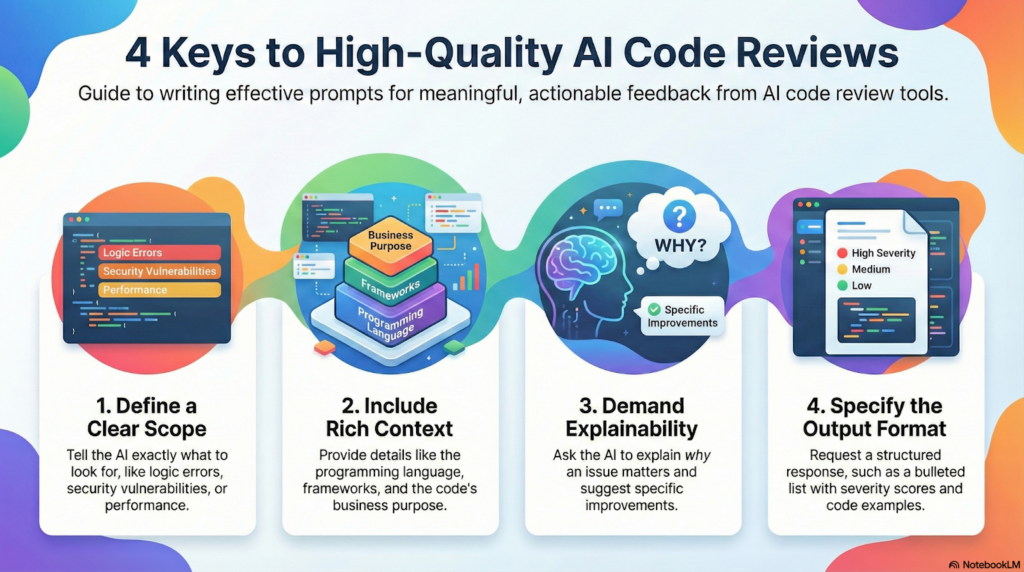
In order to obtain meaningful results from an AI model, there must be clear and focused inputs designed for a specific outcome. Here are the key principles for creating effective inputs, which greatly influence the quality and efficiency of the results.
1. Clarity & Scope
A good prompt clearly defines what to evaluate. This includes things like:
- Logic errors
- Edge cases
- Security vulnerabilities
- Performance bottlenecks
- Maintainability issues
Without clarity, AI can interpret the task broadly and provide vague feedback that lacks depth.
Example:
“Review this pull request for logic correctness, edge case handling, and security issues related to authentication and input validation.”
This tells the AI exactly what matters most, reducing irrelevant or low‑value suggestions.
2. Context Inclusion
Context is crucial. Including details like language, frameworks, dependencies, and business logic constraints helps the AI tailor its review to your real codebase.
Example:
“This is a Node.js API using Express and MongoDB. The goal of this code is to handle user login requests with JWT authentication.”
Such context allows the model to assess not just syntax, but whether the code fits into the system’s architecture and meets expected behavior.
3. Explainability & Rationale
AI reviews become far more valuable when they explain why something matters and offer a rationale behind the feedback.
A good prompt can ask the model to include:
- A reasoning behind each issue found
- Why the issue matters in a real‑world setting
- Suggested improvements or refactoring ideas
4. Output Format Requirements
To make AI feedback easier to act on, prompt for a structured output.
Ask for:
- Bullet lists of issues found
- Severity scores
- Suggested fixes
- Code examples
Structured outputs save time and help developers quickly decide what needs action.
Expert Prompt Templates for Real‑World Code Review
Here are practical prompt templates that teams can start using today. These examples are tailored for common review scenarios.
1. General Review Prompt (Senior Engineer Lens)
“As a senior engineer, analyze this pull request for logic errors, edge cases, and maintainability issues. Provide severity‑rated findings with clear explanations and suggested fixes.”
This type of prompt encourages the AI to review code as an experienced human would, focusing on substance over style.
2. Security‑Centered Prompt
“Review this code with a focus on OWASP risks, authentication flaws, injection vulnerabilities, and potential data leaks. Recommend concrete mitigations.”
Security and explainability are central to Dextralabs’ AI code review approach. Prompts are crafted to assess vulnerabilities while providing clear, structured explanations of each finding. This ensures teams understand why an issue matters, how to address it safely, and that AI suggestions adhere to best practices for safe and responsible AI usage.
3. Performance & Scalability Focus
“Detect bottlenecks, memory concerns, and non‑idiomatic constructs that could affect runtime performance. Suggest optimized patterns.”
Performance issues often hide deep within complex logic flows. Specific instructions help expose these risks early.
4. Iterative Improvement Cycle Prompt
“Based on your last feedback and code changes, verify unresolved issues and confirm no new risks were introduced.”
This prompt is useful for second‑pass reviews that confirm fixes have been applied correctly.
You can also extend these templates for specific language requirements (such as Python, Java, JavaScript) or frameworks (like React, Django, Spring), based on your tech stack.
How Dextralabs Supports AI Code Reviews from Strategy to Deployment?
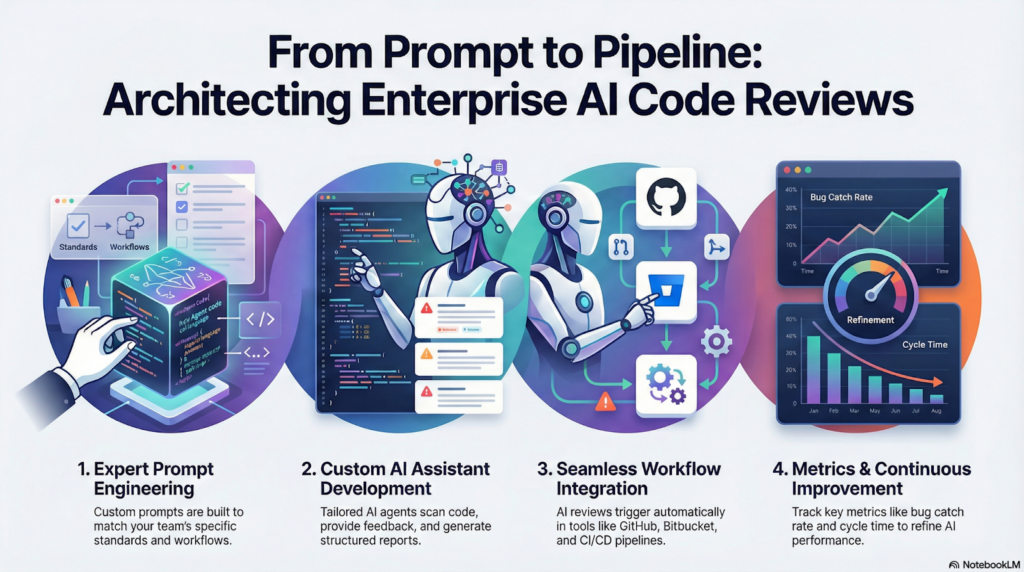
At Dextralabs, the goal is to make AI reviews powerful, repeatable, and integrated into real software workflows. Here is how Dextralabs helps teams move from basic prompts to optimized, scalable systems.
Prompt Engineering Services
Effective prompt engineering goes beyond writing a few lines. Dextralabs builds prompts tailored to your team’s standards and workflows across major models like GPT, Claude, Gemini, and Mistral. These services include:
- Custom system messages
- Multi‑turn workflows
- Role‑based behaviors for different types of reviews
- Templates that evolve with your project
The result is higher‑quality feedback that fits your needs, not generic advice.
AI Assistant & Agent Development
A key advantage of working with Dextralabs is their ability to design, deploy, and integrate AI code review solutions tailored to client workflows. These custom solutions can:
- Scan code changes and provide actionable feedback
- Run tailored prompts that align with team standards
- Generate structured review reports with severity ratings
- Offer insights directly within developer tools
This makes sure that each team gets personalized AI systems, and it’s definitely not a one-size-fits-all solution, which allows developers to focus on innovation rather than repetitive tasks.
Integration with Dev Workflows
Dextralabs integrates AI review capabilities into everyday development tools, including CI/CD pipelines, GitHub, Bitbucket, and enterprise chat platforms. Their solutions are designed for secure, enterprise-ready deployment, whether on private cloud or on-premise. This ensures:
- AI review triggers automatically on every pull request
- Feedback is delivered where teams already collaborate
- Review cycles remain fast, consistent, and compliant with governance standards
With Dextralabs, AI reviews become a trusted, secure, and enterprise-grade part of the developer workflow.”
Metrics & Continuous Improvement
Measuring success matters. Dextralabs helps teams track:
- Bug catch rate
- Review cycle time
- Developer satisfaction
- Quality improvements over time
This data drives prompt refinement and makes AI feedback more accurate, leading to stronger code over time.
Best Practices for Teams Using AI Code Review
Using AI effectively requires a strategy. Here are practical tips for teams who want the best results.
1. Combine AI with Human Intelligence
While the AI is quick and reliable, it lacks the capacity to think. Use AI as:
- First‑pass reviewer
- Risk assessor
- The assistant highlights problem areas
Then let human reviewers confirm and prioritize issues.
2. Iterative Review Cycles
Treat AI review as part of a cycle:
Review → Improve → Review again
This confirms that issues were resolved and no new problems appeared.
3. Feedback Should Align with Team Standards
Teams also maintain their own style guides, naming conventions, security policies, or performance requirements. You should incorporate these into your questions to get more relevant answers from an AI tool.
4. Security‑First Prompts
Rather than waiting to check for vulnerabilities later, include security evaluation as part of every prompt. This ensures safer releases and fewer surprises.
Case Studies and Success Stories
Organizations that have implemented AI-driven code review workflows with tailored prompts have seen strong improvements in development speed, code quality, and security. Embedding AI into existing review pipelines in a structured manner means supporting teams without disrupting their normal processes.
Faster Reviews and Fewer Bugs
Teams report that structured AI prompts help catch common logic errors and edge cases before human reviewers step in. This reduces repeated review comments and shortens the overall pull request cycle.
Key improvements include:
- Faster pull request approvals due to early issue detection
- Fewer defects reaching production environments
- Reduced need for emergency fixes and rollbacks
- Cleaner, more stable releases over time
Improved Quality Across Experience Levels
AI-based feedback supports developers at different skill levels by providing clear explanations and suggested fixes. This helps teams improve code consistency and developer confidence.
Common benefits include:
- Instant guidance for junior developers with learning-focused explanations
- More consistent adherence to coding standards
- Reduced repetitive review tasks for senior engineers
- More time for senior staff to focus on architecture and system design
Stronger Security Outcomes
Security-related prompts help to identify vulnerabilities early in the development phase, much before the deployment or penetration test phases.
Teams have observed:
- Early detection of authentication and authorization issues
- Identification of unsafe data handling and injection risks
- More adherence to secure coding practices
- Enhanced security posture and compliance readiness
These success patterns show that when AI reviews are guided by expert prompts and aligned with development workflows, teams can improve productivity while delivering safer, higher-quality software.
Conclusion
AI‑assisted code review is not just about automating tasks; it’s about enhancing quality, speed, and developer confidence. Teams that succeed with AI do not rely on default tools alone. They master effective prompt engineering to guide LLMs and produce feedback developers can trust.
At Dextralabs, the focus is on helping teams transition from basic AI usage to strategic, prompt‑driven workflows that fit real development needs. As AI systems evolve, the teams that write great prompts will identify bugs faster, ship features with confidence, and maintain higher code quality.
Ready to transform your code review process? Partner with Dextralabs to create prompt strategies and AI agents that take your code from pull requests to perfection.
Contact Dextralabs today to unlock AI‑driven code quality at scale!
FAQs:
Q. What is prompt-based AI code review and how is it different from standard AI tools?
Prompt-based AI code review uses structured, role-specific instructions to guide LLMs on what to analyze, why it matters, and how to present feedback. Unlike generic AI reviews, this approach delivers context-aware, security-focused, and actionable insights aligned with your project standards, tech stack, and workflow.
Q. Can AI code reviews replace human code reviewers?
No. AI code review is designed to augment, not replace, human reviewers. AI works best as a first-pass reviewer that identifies logic issues, security risks, edge cases, and maintainability concerns. Human reviewers then validate findings, make architectural decisions, and apply domain-specific judgment.
Q. How do prompts improve the accuracy of AI-driven code reviews?
Well-designed prompts clearly define scope, context, constraints, and output format, which significantly improves the quality of AI feedback. By specifying evaluation criteria (security, performance, logic), expected explanations, and severity ratings, teams reduce noise and receive feedback that developers can trust and act on.
Q. How does Dextralabs integrate AI code reviews into existing workflows?
Dextralabs embeds AI code reviews directly into CI/CD pipelines, pull request workflows, and developer tools such as GitHub, Bitbucket, and enterprise chat platforms. Reviews trigger automatically on code changes and deliver structured feedback within existing collaboration tools, without disrupting team velocity or governance.
Q. Are AI-driven code reviews secure for enterprise and production environments?
Yes, when implemented correctly. Dextralabs designs security-first AI review systems with controlled prompts, role-based analysis, and enterprise-grade deployment options (private cloud or on-prem). Prompts include OWASP-focused security checks, and systems are built to meet compliance, auditability, and data governance requirements.