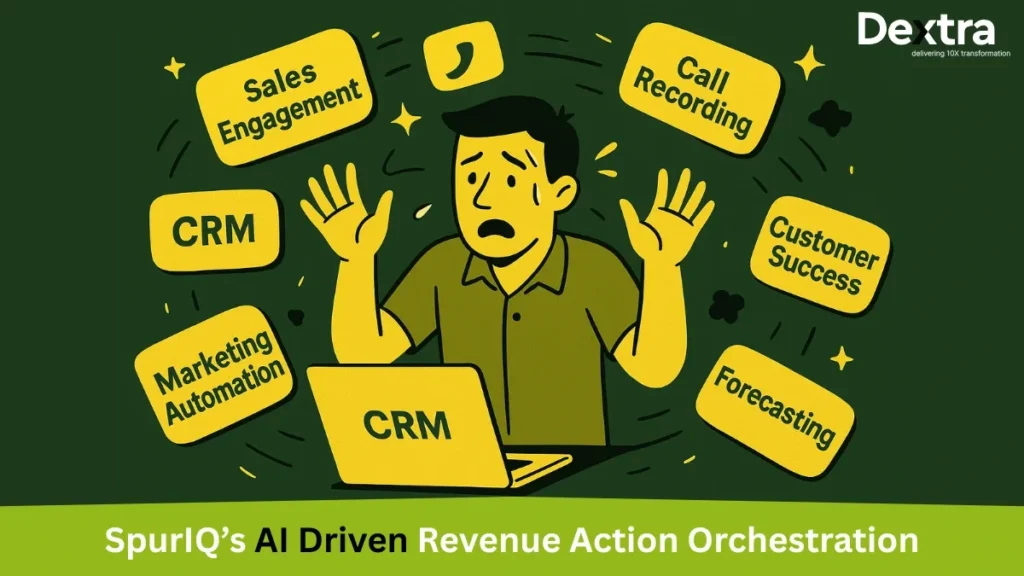
For years, revenue teams have relied on an ever-growing stack of tools — Salesforce, HubSpot, Gong, Outreach, Apollo, Zendesk, and more. Yet despite using seven or more platforms, most organizations still operate with slow, fragmented, and human-coordinated RevOps processes. CRMs remain incomplete, forecasts continue to be unreliable, and sales teams still draft emails manually while juggling follow-ups and data entry they despise.
The result? Tool bloat, operational drag, data chaos, and a growing frustration among CROs, sales leaders, and RevOps teams who know their systems should be smarter — but aren’t.
This breakdown isn’t caused by lack of software. It’s caused by the absence of a unified execution layer connecting those systems. Dashboards tell you what is broken, but they don’t fix the broken workflows slowing revenue teams every day.
This is where AI driven Revenue Action Orchestration redefine the future of GTM operations. Instead of relying on manual inputs and human interpretation, AI connects your entire GTM stack, understands context across systems, and takes intelligent actions at scale.
SpurIQ positions itself at the center of this transformation — not as another tool, but as the consulting-first partner that builds autonomous, self-improving revenue systems tailored to your GTM motion.
In this guide, you’ll learn what Revenue Action Orchestration truly means, the core problems it solves, and how SpurIQ is helping SaaS companies transition from human-coordinated RevOps to intelligent, agentic revenue engines.
What are the Core Revenue Action Orchestration Problems?
Before embracing Revenue Action Orchestration, every SaaS company must first confront the real operational failures happening inside its GTM engine. Today’s revenue systems look advanced on paper — multiple tools, dashboards, automation, enrichment, and analytics — but the execution layer is still overwhelmingly manual.
According to the latest Gartner Market Guide for Revenue Operations & Intelligence (RO&I), many organizations continue to struggle with fragmented GTM execution—highlighting the growing need for an autonomous, AI-driven orchestration layer.
Despite millions spent on CRM and enablement platforms, RevOps teams remain the human glue that holds the GTM system together. They manually update pipelines, interpret deal health, log activities, manage handoffs, check SLAs, fix data inconsistencies, chase reps for updates, and piece together insights from scattered platforms. This human-coordinated model is slow, inconsistent, and error–prone.
The biggest gap? CRMs don’t reflect reality.
Studies show that 70% of RevOps leaders admit inaccurate CRM data directly hurts forecast accuracy, deal velocity, and customer experience. When data is incomplete or outdated, dashboards lose meaning, forecasts become guesswork, and leaders struggle to drive predictable revenue.
Another core issue is the lack of contextual intelligence. Tools operate in silos — a meeting note in Gong doesn’t update Salesforce, an email in Outreach doesn’t change forecast probability, and a risk flagged in a call never triggers automated next steps. Revenue teams have insights everywhere but lack automated action.
This is exactly why companies are turning to AI driven Revenue Action Orchestration. It doesn’t just centralize data; it creates an autonomous execution layer that interprets information, coordinates tools, and drives consistent actions across the entire GTM motion.
What is AI Revenue Action Orchestration?
As GTM systems become increasingly complex, companies need more than dashboards and automation rules — they need an autonomous execution layer. This is where AI Revenue Action Orchestration emerges as a new category.
AI Revenue Action Orchestration is the process of connecting, interpreting, and automating GTM operations using agentic AI. Instead of merely reporting insights, the system understands context, makes decisions, and takes intelligent actions across your existing tools.
Traditional revenue systems operate in silos:
- Revenue intelligence shows what’s happening.
- Automation triggers events only when predefined rules are met.
- Workflows often break when data is incomplete or inconsistent.
But orchestration changes everything.
With AI driven Revenue Action Orchestration, your GTM stack behaves like a coordinated, thinking system. AI captures activities automatically from emails, calls, meetings, and product usage. It updates CRMs without human effort, identifies deal risks, recommends actions, and even initiates follow-ups across platforms like Salesforce, HubSpot, Gong, Outreach, or Zendesk.
This shift is powered by Agentic AI — systems that can perceive data, interpret meaning, decide on the next best step, and execute actions autonomously.
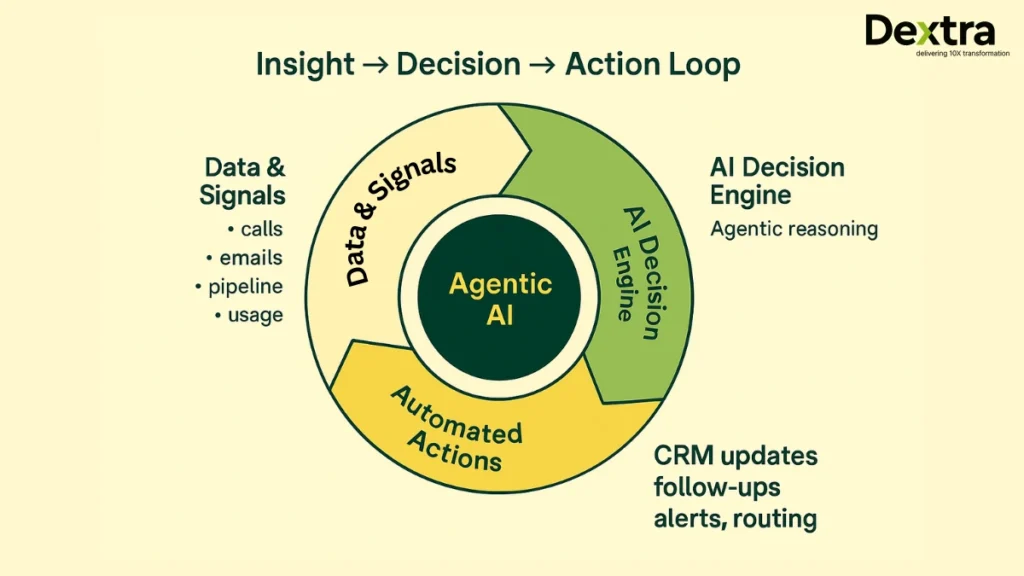
Example: “Instead of reminding a rep to update Salesforce after a discovery call, the AI reads the Gong transcript, extracts next steps, identifies stakeholders, updates the opportunity, and sets automated reminders — without human input.”
“Insight → Interpretation → Decision → Action”
This is the defining difference between insight-driven tools and action-driven orchestration — the latter actually moves revenue forward.
What are the Core Pillars of AI Revenue Orchestration?
To build a truly autonomous revenue engine, companies need more than automation—they need structured, intelligent coordination across the entire GTM ecosystem. SpurIQ uses a proven framework built on four core pillars, forming the backbone of Revenue Action Orchestration and AI driven Revenue Action Orchestration.
1. Sales Orchestration
Sales teams lose hours each week to manual tasks: CRM updates, contact role mapping, follow-up reminders, and status alignment. AI changes this dynamic completely. With orchestration, every call, email, and meeting is automatically captured, analyzed, and synced into the CRM. AI updates opportunity stages, identifies missing stakeholders, tags risks, and maintains complete pipeline hygiene—eliminating the need for reps to “log data.”
2. Forecast Orchestration
Forecasts often collapse under incomplete data and human bias. Through agentic AI, SpurIQ builds models that interpret deal behavior, evaluate signals across tools, and identify true forecast confidence. The result is dramatically improved predictability—forecasts that reflect reality, not assumptions.
3. RevOps Automation Layer
Most GTM stacks operate as disconnected islands. The orchestration layer binds them together into a unified, intelligent system. AI connects Salesforce, HubSpot, Gong, Outreach, Zendesk, and product telemetry—making them act as one coordinated engine that executes tasks automatically.
4. Continuous Learning Loop
Unlike static automation rules, agentic AI learns from rep behavior, deal outcomes, and historical trends. The longer it runs, the smarter your orchestration becomes—creating compounding revenue efficiency.
At SpurIQ, we design AI orchestration systems that not only think — they execute. Every workflow becomes a self-improving system.
AI Revenue Orchestration vs Revenue Intelligence Tools
Most GTM teams today rely on Revenue Intelligence platforms to understand what’s happening across the funnel. These tools surface insights, highlight risks, and provide dashboards—but they stop at analysis. This is where AI Revenue Action Orchestration fundamentally changes the equation.
Revenue Intelligence answers what happened.
AI-driven orchestration answers what should happen next—and then executes it automatically.
Key Differences at a Glance
| Aspect | Revenue Intelligence | AI Revenue Action Orchestration |
| Purpose | Shows insights | Executes actions |
| Data Dependency | Requires manual CRM hygiene | 100% automated activity capture |
| Outcome | Better dashboards | Better revenue execution |
| Cost | Requires new tools | Activates your existing stack |
| Example | Flags forecast risk | Automatically mitigates risk with actions |
Platforms like Clari, People.ai, and Aviso are designed for insights. They help CROs understand pipeline health but still rely on reps and managers to manually interpret and act on the data.
With AI-driven Revenue Action Orchestration, intelligent agents detect stale opportunities, missing contacts, risk trends, or slipping deals—and automatically trigger the correct next step across tools. This creates execution consistency that human-led RevOps simply cannot match.
SpurIQ positions itself as the consulting-first orchestrator, not a software vendor. This makes the distinction even sharper. Unlike traditional platforms that require new implementations or tool purchases, SpurIQ embeds Agentic AI directly into the systems companies already use—Salesforce, HubSpot, Gong, Outreach, Zendesk—ensuring fast adoption and measurable impact.
AI Revenue Orchestration activates what you already own, no new licenses needed. It doesn’t replace insights; it activates them.
How AI Revenue Orchestration Works in Practice?
While most teams imagine AI as a mysterious black box, AI driven Revenue Action Orchestration follows a clear, structured implementation path. SpurIQ uses a consulting-first methodology that transforms scattered GTM workflows into a unified, intelligent execution engine.
Step 1 — Data Mapping
The process begins by identifying every GTM touchpoint: CRM fields, sales engagement tools, customer success systems, call intelligence data, product usage signals, and marketing automation inputs. This creates a single blueprint of your revenue ecosystem and exposes gaps, redundancies, and broken workflows.
Step 2 — Orchestration Design
Next, SpurIQ designs how your revenue system should behave. This includes defining agent roles, automated decision logic, cross-tool communication flows, and intelligent action sequences. Instead of static rule-based workflows, the design focuses on adaptable, context-aware automation powered by Agentic AI.
Step 3 — AI Layer Integration
Once workflows are architected, SpurIQ deploys the AI layer across your existing stack. Intelligent agents capture activities automatically, enrich CRM records, evaluate deal health, identify risks, and execute actions that previously required manual intervention. No new platform—just orchestrated performance.
Step 4 — Continuous Optimization
Unlike traditional RevOps automation, these systems continuously learn. As your team works, the AI refines predictions, route tasks more accurately, and improves decision quality over time. The longer it runs, the smarter your GTM engine becomes.
“SpurIQ’s orchestration isn’t a one-time setup — it’s a living system that evolves with your GTM motion.” — SpurIQ’s CEO
What are the business Impacts of AI Revenue Action Orchestration on SaaS Founders?
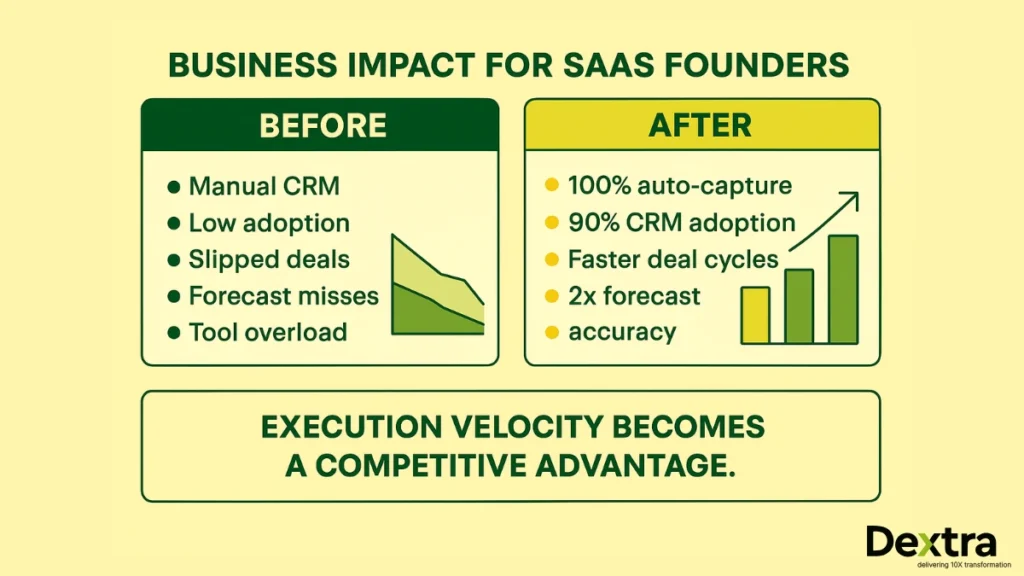
For SaaS founders, CROs, and RevOps leaders, AI Revenue Orchestration delivers outcomes that traditional RevOps teams simply can’t achieve manually. When every GTM action—across sales, marketing, and customer success—is intelligently coordinated, revenue operations shift from being reactive and fragmented to predictable, proactive, and fully data-driven. Founders finally gain the clarity they need to make faster decisions, improve pipeline health, and unlock predictable growth without expanding headcount.
At the core of this transformation is the complete automation of revenue data. With intelligent activity capture and orchestration, the CRM becomes a system that teams actually trust. This accuracy fuels faster sales cycles, better forecast reliability, and a meaningful reduction in operational overhead. The impact is both immediate and compounding, giving SaaS businesses the ability to scale with far more precision.
Measurable Outcomes for SaaS Founders:
- 0 manual CRM input & 100% auto-captured data: Every email, call, meeting, and pipeline update logs itself—eliminating rep frustration and ensuring clean, real-time data.
- >90% CRM adoption: Teams use the CRM naturally because it works for them, not against them.
- 50% faster deal cycles: Orchestrated workflows remove bottlenecks, accelerate follow-ups, and prevent stalls.
- 2x forecast accuracy: With complete and trustworthy data, founders finally get forecasts they can rely on.
- 30% reduction in tool bloat & human Ops cost: Fewer tools, fewer manual processes, and lower operational drag.
Example outcome:
A hypothetical SaaS company reduced deal slip by 40% after implementing SpurIQ-led revenue orchestration.
Want to see what AI orchestration could unlock for your revenue systems?
Let SpurIQ design your 7-Day Orchestration Blueprint.
Why SpurIQ: The Consulting Edge

In a world where every platform claims to “automate revenue,” SpurIQ stands apart for one simple reason: we’re not a tool — we’re your AI orchestration consulting partner. SaaS founders, CROs, and RevOps leaders don’t just need another dashboard; they need a team that can understand their GTM reality, design the right AI systems, and ensure those systems actually execute. That is where SpurIQ delivers the advantage no platform can replicate.
Backed by Dextralabs — experts in LLM deployments, agentic AI systems, and enterprise AI integration — SpurIQ brings together two worlds that rarely intersect: deep go-to-market knowledge and cutting-edge AI engineering. Most RevOps leaders know their GTM workflows intimately; most AI teams know their models deeply. SpurIQ unifies both — translating strategy into orchestrated, measurable execution.
Unlike typical RevOps agencies that stop at strategy decks or CRM cleanups, SpurIQ owns the end-to-end implementation: from selecting the right AI model to wiring its intelligence directly into your CRM, pipeline workflows, forecast engines, and customer-facing motions. The result is not a set of recommendations — it’s an autonomous revenue infrastructure that learns from your data, predicts risks, and initiates actions without human intervention.
Why Founders Choose SpurIQ?
- Not a platform — a specialist AI orchestration consultant
- Backed by Dextralabs’ enterprise-grade AI expertise
- Deep GTM + AI fusion for execution that actually works
- Bridges’ strategy, implementation, and continuous optimization
Founders’ Translation: “SpurIQ helps your RevOps think, act, and learn — autonomously.”
Future of RevOps: From Manual to Agentic Systems
The next decade of revenue operations is set to be agentic. As AI orchestration becomes the backbone of GTM execution, RevOps teams will no longer be burdened with repetitive data entry, manual follow-ups, or fragmented dashboards. Instead, they will focus on what humans do best: building relationships, guiding strategy, and driving customer success. Meanwhile, AI will handle the complex coordination of workflows, deal prioritization, and forecasting, effectively becoming a proactive, self-learning operational partner.
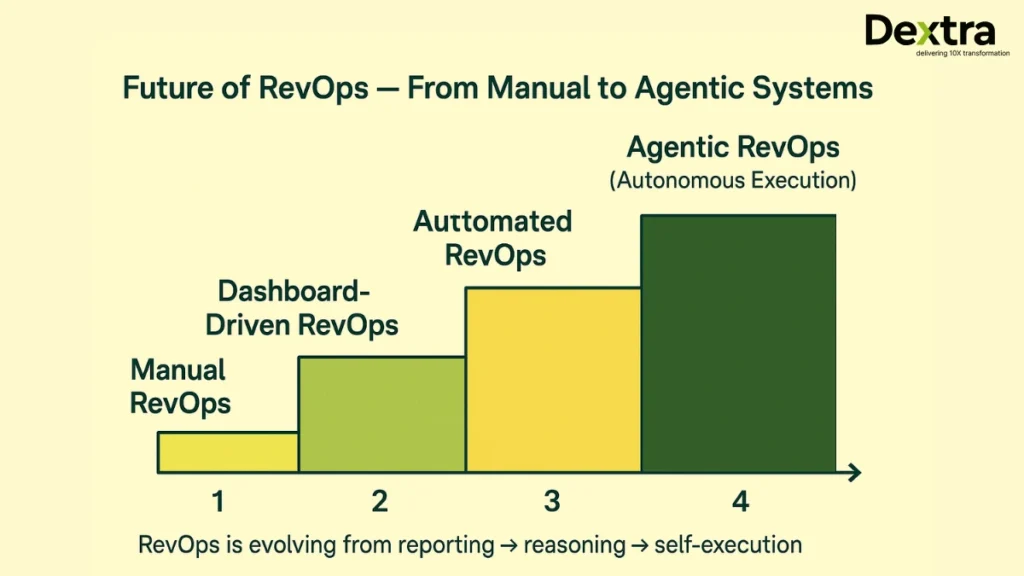
RevOps will evolve through four distinct stages:
- Dashboards: simply visualizing data.
- Decisions: deriving actionable insights from data.
- Delegation: automating routine tasks to systems.
- Automation: fully orchestrated workflows where AI predicts, executes, and optimizes GTM activities autonomously.
Companies that adopt AI orchestration early will gain a decisive edge, building self-sustaining, scalable GTM engines that continuously improve and adapt without manual intervention. Founders and RevOps leaders who embrace this shift will see not just operational efficiency, but measurable growth acceleration, improved forecast accuracy, and faster deal cycles.
Why SpurIQ Leads the Way?
- Enables teams to focus on relationships while AI orchestrates operations.
- Transforms dashboards into autonomous decision-making engines.
- Bridges strategy and execution with AI-powered RevOps.
“The future of RevOps isn’t more dashboards — it’s intelligent orchestration. SpurIQ helps you get there.” — Quoted by SpurIQ’s CTO
This vision positions SpurIQ as the partner helping companies navigate the transition from manual processes to truly agentic revenue operations.
Conclusion: Building the Foundation for Autonomous Revenue Systems
The future of revenue operations is for teams that embrace autonomous AI-orchestrated systems. Infusing intelligence directly into GTM workflows, companies gain levels of precision, speed, and scale execution that no manual process can hope to match. Data flows seamlessly; proactive decisions come out; and deal risks are surfaced before they have a chance to impact outcomes. The outcome is a GTM engine that doesn’t just react but learns, adapts, and drives growth on a continuous basis.
At SpurIQ, we don’t stop at recommendations or dashboards. Our consulting-first philosophy ensures that strategy gets translated into measurable action. From choosing the right AI model to orchestrating CRM workflows and automating pipeline activities, we help founders and RevOps leaders build systems that execute autonomously while teams focus on high-value work like customer relationships and strategic growth initiatives.
Key Takeaways
- Accuracy: AI captures and structures data automatically, excluding human error.
- Efficiency: Teams can spend less time on updates and more on revenue-generating activities.
- Execution: Orchestrated workflows ensure predictable, measurable outcomes across the GTM engine.
- Consulting-first approach: SpurIQ bridges strategy, technology, and implementation.
“Book your free 7-Day Orchestration Blueprint session with SpurIQ, and see how AI can unify your GTM systems for real execution.”
By taking this step, companies position themselves to lead in the era of agentic RevOps by transforming fragmented processes into self-sustaining revenue systems and building a foundation for growth that scales with intelligence.
Frequently Asked Questions (FAQs):
Q1. What is an AI orchestration platform?
An AI orchestration platform is the system that connects your tools, data, teams, and workflows, and then uses intelligence to automate what humans currently do manually. Instead of giving insights, it acts on them–routing tasks, triggering workflows, and optimizing GTM operations in real time. For SpuriQ, that means predicting what should happen next to drive revenue and automatically doing it.
Q2. What is a revenue orchestration platform?
A revenue orchestration platform aligns sales, marketing, and customer success with automation of the entire revenue engine. It ensures that every lead, account, and opportunity gets the right next action at the right time to increase conversions and reduce revenue leakage. SpuriQ takes that further with AI-driven actions, not just workflows.
Q3. What is an AI SaaS platform?
An AI SaaS platform refers to artificial intelligence being offered as a cloud-based service, where no installations are required. SpuriQ is in this vein, offering an easy-to-use platform via subscription that makes available AI orchestration, AI predictions, automation, and GTM optimization.
Q4. How will AI generate revenues?
AI generates revenue by the following means:
– Finding high-intent leads before humans notice
– Recommendation for next best action
– Automating follow-ups, data entry, and routing
– Reduce drop-offs within the sales cycle.
– Ensuring no opportunity slips through the cracks
SpuriQ becomes your 24/7 revenue operator.
Q5. What is orchestration with an example?
Orchestration means bringing many moving pieces together to work in unison.
Example:
If a lead demonstrates an intent to buy, AI automatically updates CRM, alerts sales, triggers an email, assigns a task, and mines data for insights from Gong, all without any manual intervention.
Q6. How does AI orchestration work?
AI orchestration connects all your tools, reads your data, understands the patterns, makes predictions about what will happen next, and then carries out the activities automatically. SpuriQ learns your GTM motions and runs them in autopilot.
Q7. How does AI increase revenue?
By getting follow-ups done quicker, optimizing lead routing, improving forecasting accuracy, facilitating improved prioritization of leads, and avoiding any leakage across the funnel. Basically, it makes your revenue engine smarter and faster than any human-only execution.
Q8. What does orchestration mean in business?
In business, orchestration means bringing all systems, workflows, and teams into one synchronized, automated engine so you get consistency, speed, accuracy, and efficiency.
Q9. What is the Salesloft revenue orchestration platform, and how is SpuriQ unique?
Salesloft is a sales engagement platform that helps reps send emails, make calls, and manage cadences.
SpuriQ is different and more advanced:
Salesloft = engagement
SpuriQ = intelligent end-to-end orchestration
SpuriQ connects your entire GTM stack (Salesforce, HubSpot, Gong, Zendesk, Outreach), predicts what needs to happen, and executes automatically.
Q10. Is AI revenue orchestration the same as sales automation?
No.
Sales automation = rule-based.
AI revenue orchestration = context-aware, predictive, self-learning.
Q11. Do we need new software to adopt AI orchestration?
Not always. SpuriQ is consulting-first and can activate AI orchestration inside your existing tools like Salesforce, HubSpot, Gong, Outreach, Zendesk, etc.
Q12. Does AI orchestration replace RevOps teams?
Not at all.
It simply removes tedious manual work so RevOps can focus on strategy, insights, and optimization instead of operations.
Q13. What kind of companies benefit the most?
B2B SaaS (Seed → Growth → Series D)
Teams heavily using Salesforce/HubSpot
GTM orgs with tool bloat
Companies using Gong, Outreach, Apollo, etc.
Basically, revenue teams are drowning in manual ops.
Q14. Difference between revenue intelligence and revenue orchestration?
Revenue Intelligence = Insights.
Revenue Orchestration = Execution based on those insights.
Q15. Does AI orchestration work with small or mid-sized teams?
Absolutely. These teams benefit most because AI acts like 2–3 extra RevOps hires, without the cost.