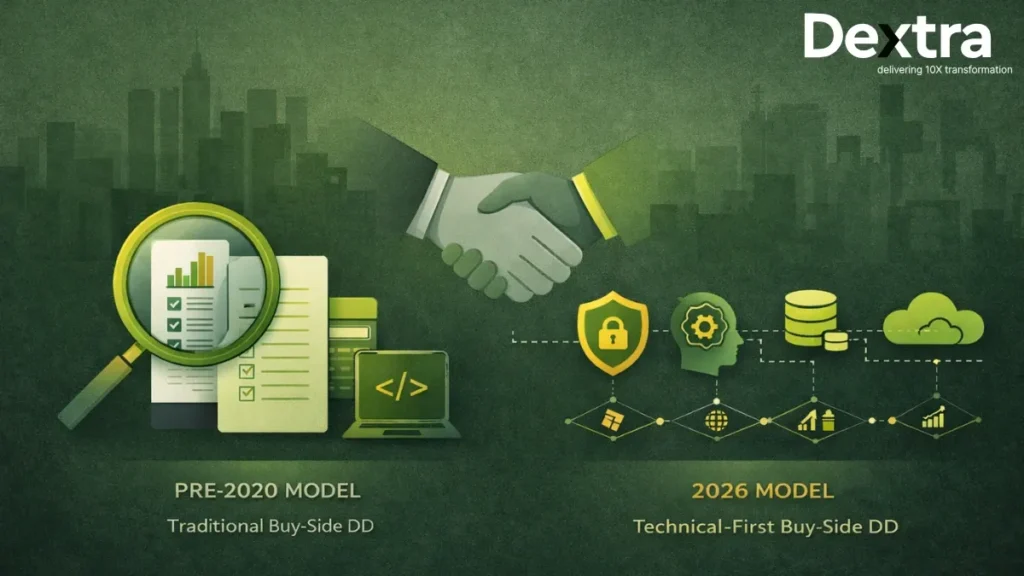
Traditional buy side due diligence focused on financial, legal, and compliance validation. Investors verified earnings, confirmed legal clean title, and assessed operational risks, assuming that if the numbers checked out, the deal would succeed.
That model is structurally outdated for software-driven businesses in 2026.
Research from Harvard Business School shows the M&A failure rate is between 70% and 90% despite companies spending more than $2 trillion on acquisitions every year. Yet according to Morrison Foerster’s 2025 M&A report, global M&A deal value rose 8% to $3.4 trillion, with technology seeing $640 billion in deal activity, up 16% from 2023.
The disconnect is clear: deal volume is rising, but failure rates remain catastrophic. The gap? Most buy-side due diligence still treats technology as a checklist item rather than the primary risk layer.
At Dextra Labs, we conduct technical due diligence for private equity firms, strategic acquirers, and enterprises across the UAE, USA, and Singapore. From hundreds of engagements, we’ve seen a fundamental shift: in 2026, buy-side due diligence is no longer about verifying numbers, it’s about validating technical reality.
What Is Buy Side Due Diligence? (Modern Definition)
Traditional definition: Buy-side due diligence is the investigation conducted by a buyer to validate financial, legal, and operational claims before acquisition.
Modern definition (2026): Buy-side due diligence is a multi-layered risk intelligence process where technical systems, software architecture, data integrity, AI readiness, cybersecurity posture, and scalability now determine real deal risk and post-acquisition success.
As per Deloitte Research shows that between 40-60% of expected synergies in M&A deals are directly linked to IT integration success, yet technology integration issues account for approximately 30% of failed mergers.
The shift from “business validation” to “system validation” isn’t semantic, it’s survival.
How Main Goal of Buy Side Due Diligence Has Changed?
Old Goal (Pre-2020):
- Avoid financial misrepresentation
- Validate earnings
- Prevent legal exposure
New Goal (2026):
- Prevent post-acquisition execution failure
- Detect scalability ceilings
- Identify technical debt bombs
- Quantify integration complexity
- Model cloud and AI cost risk
- Validate engineering maturity
- Assess platform sustainability
According to industry research, 84% of all system integration projects fail or partially fail and 85% of big data projects fail (Forbes ; BCG). These aren’t implementation problems, they’re due diligence failures that should have been flagged pre-close.
Modern buy-side DD is not about deal approval, it’s about deal survivability.
Why Technical Due Diligence Is Now the Real Risk Layer?
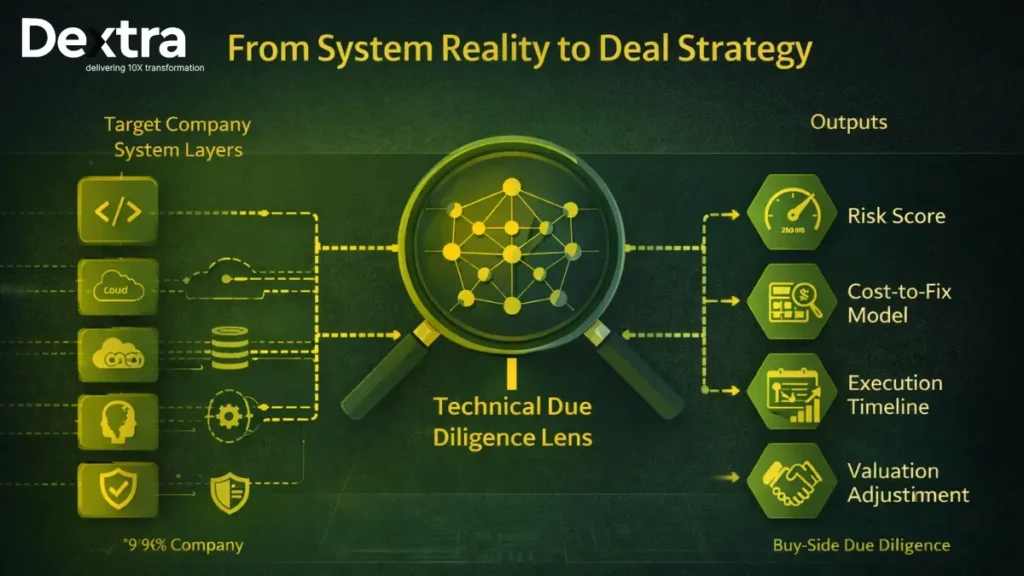
Core Risk Drivers in 2026:
- Software-defined business models
- AI-native companies
- Platform ecosystems
- Data-driven valuations
- Cloud-first infrastructure
- API dependency chains
- Automation-led operations
The Risk Reality Financial Statements Don’t Expose:
- Architecture fragility
- Scalability constraints
- AI hallucination risk
- Data pipeline decay
- Cybersecurity exposure
- Cloud cost explosion
- Engineering team capability
- System integration feasibility
Morrison Foerster reports that 47% of tech M&A dealmakers predict AI and machine learning will present the greatest M&A opportunities, while cybersecurity surpassed AI as the top subsector of focus, underscoring risk mitigation as a priority.
In 2026, technology risk = deal risk.
Research tracking global digital transformation found that only 35% of companies meet value targets globally, with 74% of companies struggling to achieve and scale AI value despite widespread adoption.
If you’re acquiring an AI-native or cloud-first company, these aren’t edge cases, they’re base probabilities.
What is the Buy-Side Due Diligence Process (Modern Model)?
Phase 1: Red Flag Technical Screening
What to evaluate:
- Architecture review
- Core system dependencies
- Security posture
- Data maturity
- AI readiness
- Cloud cost structure
- Engineering org assessment
Output: Go/no-go technical recommendation before deep DD investment
Phase 2: Deep Technical Due Diligence
What to validate:
- Codebase quality analysis
- Infrastructure scalability
- DevOps maturity
- System resilience
- AI model governance
- Data governance
- Platform interoperability
Output: Comprehensive technical risk register
Phase 3: Execution Risk Modeling
What to project:
- Post-close integration feasibility
- Scaling risk projection
- Technical debt monetization
- Cost-to-fix modeling
- Timeline-to-stability modeling
Output: Decision-grade risk intelligence for pricing and integration planning
What are Buy-Side Due Diligence Checklists (Technical-First Model)?
At Dextra Labs, we evaluate buy-side due diligence across these technical risk dimensions:
Dextralabs’ Technical Risk Checklist:
- System architecture sustainability: Can it scale 3-5x without rewrites?
- Codebase quality and maintainability: What’s the technical debt exposure?
- Cloud economics and unit costs: What happens to margins at 2x usage?
- Security and compliance posture: Any undisclosed breaches or certification gaps?
- Data integrity and lineage: Can you trust the data?
- AI maturity and governance: Are models production-grade or prototypes?
- Platform scalability: Where are the bottlenecks?
- API dependency risk: What breaks if a third-party service fails?
- DevOps maturity: Can they deploy without downtime?
- Engineering velocity: What’s the actual development cadence?
- Documentation quality: Is tribal knowledge captured?
- Technical debt exposure: What will remediation cost?
- System resilience: What’s the DR/BC plan?
- Integration complexity: How hard is this to absorb into your stack?
Given that organizations average 897 applications but only 29% are integrated, integration complexity is a first-order concern, not an afterthought.
Buy-Side Due Diligence Report: What It Must Contain in 2026?
Modern Buy Side DD Report Structure:
- Technical Risk Summary: Executive overview of critical findings
- Architecture Health Score: Scalability, maintainability, resilience ratings
- Scalability Risk Model: What breaks at 2x, 5x, 10x growth?
- Security Posture Analysis: Vulnerabilities, compliance gaps, incident history
- Cloud Cost Exposure Model: Unit economics and margin behavior at scale
- AI Readiness Scorecard: Model maturity, governance, production capability
- Data Maturity Model: Quality, lineage, governance, portability
- Engineering Org Maturity: Velocity, process, retention risk, key person dependencies
- Integration Complexity Index: Effort, timeline, risk by integration path
- Execution Risk Forecast: Probability-weighted scenarios for post-close performance
- Post-Acquisition Risk Timeline: 90/180/365-day risk mitigation roadmap
- Cost-to-Stabilize Model: Investment required to achieve production readiness
- Value Creation Constraints: Technical limits on synergy capture
This isn’t a compliance checklist, it’s decision-grade technical intelligence that protects pricing and informs integration strategy.
Buy-Side Due Diligence in M&A vs Vendor Due Diligence:
| Dimension | Buy-Side Due Diligence | Vendor Due Diligence |
| Objective | Risk detection | Valuation optimization |
| Control | Buyer-driven validation | Seller-driven narrative |
| Lens | Skeptical | Presentational |
| Data Flow | Investigative | Curated |
| Outcome | Price protection | Deal acceleration |
| Tech Focus | Risk exposure | Readiness optics |
Vendor due diligence (VDD) is prepared by the seller to accelerate the deal process. Buy-side due diligence is conducted by or on behalf of, the buyer to protect against undisclosed risk.
They are not substitutes. VDD provides a starting point; buy-side DD validates reality.
Private Equity Buy Side Due Diligence Roles
Modern Roles Include:
- Technical diligence advisors: Overall architecture assessment
- Architecture auditors: System design validation
- AI risk evaluators: Model governance and production readiness
- Cybersecurity specialists: Threat landscape and compliance gaps
- Cloud economics analysts: Cost structure and optimization opportunities
- Data governance assessors: Data quality, lineage, and portability
- Platform integration strategists: Post-close integration planning
- Engineering org assessors: Team capability and retention risk
According to Bain’s research, companies must focus more on revenue growth and margin expansion in the current M&A environment, making technical validation of growth capacity and cost structure critical to deal success.
Why Most Buy-Side Due Diligence Still Fails?
Here are the Failure Patterns:
- Financial-first frameworks: Technology treated as a checkbox
- Checklist compliance mentality: “Did we ask all the questions?” vs. “Do we understand the system?”
- Shallow tech reviews: Surface-level audits missing architectural reality
- Tool-based audits without system modeling: Static analysis without understanding dynamics
- No execution risk modeling: “Can we integrate this?” is never answered
- No integration feasibility analysis: Assuming integration will “just work”
- No cost-to-fix projections: Discovering $5M in technical debt post-close
Deals don’t fail in Excel. They fail in systems.
A research report analyzing M&A failure trends noted that goodwill write-offs often lead to reported losses and negative investors’ reaction, yet managers are understandably very reluctant to declare this event, meaning goodwill write-offs, reflecting failed acquisitions, are postponed for considerable time.
This creates a lag between when technical issues cause failure and when they’re publicly acknowledged, making post-mortems less useful than pre-acquisition technical rigor.
What is the New Buy-Side Due Diligence Model?
Old Model:
Financial DD → Legal DD → Operational DD → Tech DD
New Model:
Technical DD → Execution Risk → Integration Feasibility → Value Creation → Financial Validation
Why? Because technology risk determines whether synergies are capturable.
If the platform can’t scale, integration will fail, or technical debt requires $10M in remediation, the financial model is fiction. Technical DD must inform financial DD, not follow it.
Buy-side due diligence is no longer a validation process, it is a technical risk intelligence function.
The goal isn’t confirming the seller’s claims. It’s understanding the system’s reality well enough to:
- Price risk accurately
- Plan integration realistically
- Model remediation costs
- Forecast execution timelines
- Protect against technical surprises
Dextra Labs: Technical Core of Buy-Side Due Diligence
Dextra Labs operates at the technical core of buy side due diligence, focusing exclusively on:
- Software architecture validation: Scalability, maintainability, resilience
- AI maturity assessment: Model governance, production capability, hallucination risk
- Cloud economics modeling: Unit cost structure, optimization opportunities, margin behavior
- System scalability analysis: Bottleneck identification, capacity planning, growth ceilings
- Cybersecurity posture evaluation: Threat landscape, compliance gaps, incident history
- Data integrity validation: Quality, lineage, governance, portability
- Platform sustainability assessment: Long-term viability, modernization requirements
- Post-acquisition execution risk modeling: Integration feasibility, timeline, cost
This creates decision-grade technical intelligence for investors, PE firms, VCs, and M&A leaders, enabling informed deal structuring, pricing protection, and post-close execution planning.
We serve clients across the UAE, USA, and Singapore, conducting technical due diligence for software acquisitions, AI-native companies, and platform businesses where technology is the primary value driver.
Conclusion: The Future of Buy-Side Due Diligence
In 2026, buy side due diligence is no longer about verifying claims,
It’s about understanding systems.
It’s no longer about protection—
It’s about execution reality.
It’s no longer about compliance—
It’s about survivability at scale.
With the M&A failure rate between 70-90% (Harvard Business School) and technology integration accounting for 30% of merger failures (Deloitte), the cost of inadequate technical due diligence isn’t theoretical, it’s billions in write-downs, failed integrations, and missed synergies.
Technology due diligence (Tech DD) is no longer a workstream of buy-side due diligence, it is the core risk layer.