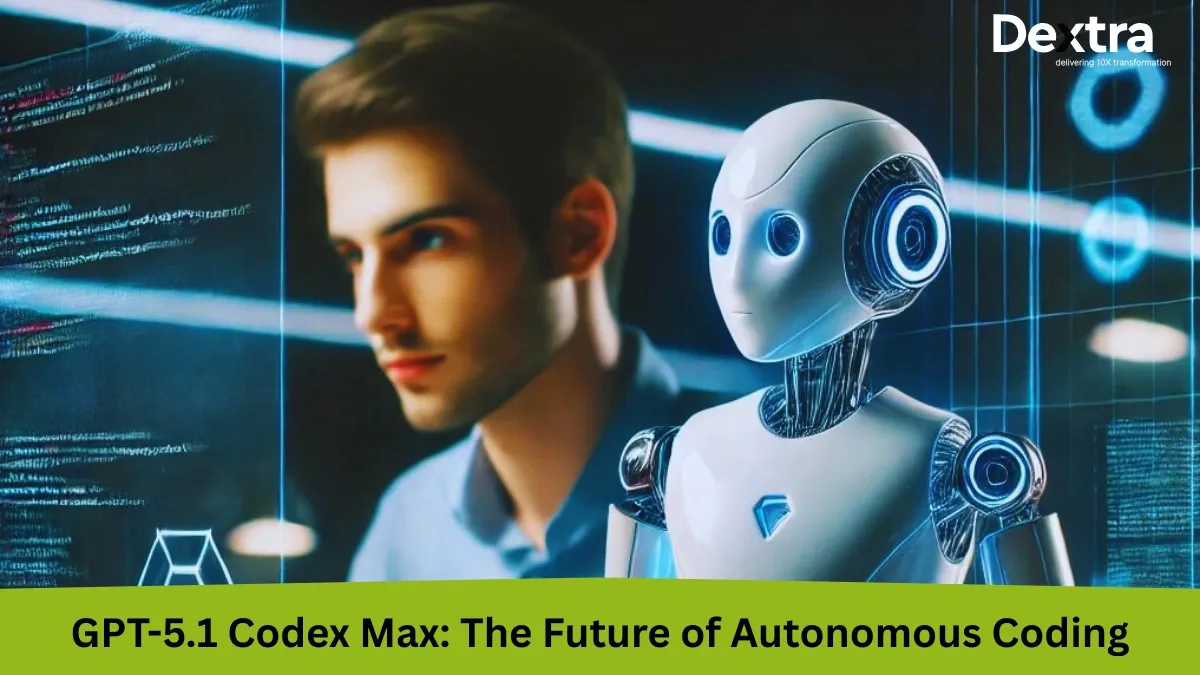
Artificial intelligence is moving at a pace that forces every developer, team, and tech company to rethink what productivity means. With the launch of GPT-5.1 Codex Max, OpenAI has taken another major step toward fully autonomous software development. This new model is not just built to write snippets or complete functions. It is designed to handle long sessions, deep multi-file refactors, memory-heavy tasks, and iterative debugging loops that can run for more than twenty-four hours.
According to OpenAI, here are some key stats that underline why Codex Max is a game-changer:
- 77.9% accuracy on the SWE-Bench Verified benchmark (n = 500), with “xHigh” reasoning effort.
- 79.9% on SWE-Lancer IC SWE, a big jump from 66.3% on the previous Codex model.
- 58.1% on Terminal-Bench 2.0, up from 52.8%.
- It uses about 30% fewer “thinking tokens” at medium reasoning effort, meaning more efficiency and lower cost.
At Dextralabs, Codex Max is more than a benchmark it solves real problems our teams face daily. Long debugging cycles, multi-file refactors, and evolving architectures demand continuity, and Codex Max delivers exactly that. The model helps us ship faster, reduce rework, and handle complexity with far more stability. Let’s get to know GPT-5.1 is the smarter & more conversational ChatGPT models.
What Is GPT 5.1 Codex Max?
Codex Max is OpenAI’s specialized coding model based on the GPT 5.1 architecture. It is built for long-horizon reasoning, which means it can stay focused across multi-stage tasks. These tasks include project-wide refactors, test-driven workflows, repeated debugging cycles, infrastructure rewrites, and detailed architectural changes that usually require senior developer attention.
GPT 5.1 Codex Max has a defining capability “compaction”, a method that filters, compresses, and preserves critical information from extended coding sessions. When a conversation grows too large, compaction identifies the essential details, removes unnecessary context, and seeds a fresh window with only the information needed for the next steps. The workflow continues smoothly without losing direction or memory of earlier decisions.
Codex Max can work across millions of tokens while keeping track of earlier decisions. It can follow plans step by step. It can reflect on past iterations. It can maintain continuity through long workflows.
As one of the top AI Consulting companies in USA, Dextralabs’s experts perform many projects involving complex architectures, evolving requirements, or heavy iteration, so this level of continuity is a major shift.
Performance Gains That Matter
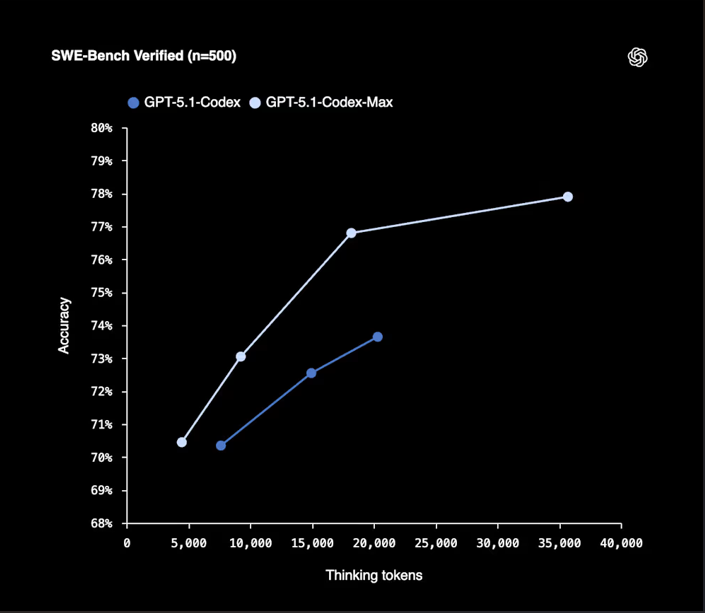
OpenAI’s internal tests show strong jumps in accuracy and efficiency.
- On SWE Bench Verified, Codex Max reached about 78 percent accuracy.
- On Terminal Bench 2.0, it reached more than 58 percent accuracy.
- It uses about thirty percent fewer reasoning tokens in medium effort mode.
These numbers tell a clear story. The GPT 5.1 model is smarter, more stable, and more economical. You get better results while consuming fewer tokens.
Why Compaction Matters in GPT 5.1?
Traditional models struggle with long conversations. Once the token window fills, the model loses the ability to stay consistent. It forgets earlier decisions. It repeats mistakes. It wastes time. Compaction solves this problem.
Here is what compaction does:
- Keeps the important details: Architecture notes, test outcomes, design choices, dependency changes, and critical context are preserved.
- Removes clutter: Outdated logs, exploratory messages, and irrelevant details are stripped away.
- Seeds a fresh context window: The model gets a clean slate without losing the thread of the project.
This lets GPT 5.1 Codex Max work across hours or days without collapsing. For long engineering tasks at Dextralab, this unlocks workflows that were impossible with earlier models.
Also Read: GPT-5 New Features, Tests, benchmarks in 2025
Real Impact of GPT 5.1 on Engineering Workflows:
1. Large Scale Refactors
Chat GPT 5.1 Codex Max can track systems across dozens of files. It can update modules, restructure architecture, migrate patterns, and maintain consistency across an entire repository.
2. Autonomous Debugging
The ChatGPT 5.1 model can run self-directed loops. It writes code, tests it, reads failures, reasons about the errors, and tries again. It continues until it reaches a stable state or the session is ended by the user.
3. Pull Request Creation and Review
Codex Max can generate clean pull requests, explain its changes, and review existing code for flaws, potential bugs, or hidden inefficiencies.
At Dextralab, this means less time spent on repetitive chores and more time focused on strategy and high-level design.
4. DevOps and Infrastructure
GPT 5.1 Codex Max handles infrastructure files with surprising reliability. It can reason across Terraform, Kubernetes, Helm charts, CI pipelines, and cloud configuration. As these systems get more complex, Codex Max becomes even more valuable.
5. Multi-Stage Simulation
For research and experimental builds, ChatGPT 5.1 can run repeated simulation cycles. It can test, observe, and refine logic over extended periods. This shortens prototyping cycles at Dextralabs.
What are Safety and Human Oversight in ChatGPT 5.1?
Even with its capabilities, Codex Max is built to work with human supervision. OpenAI added safety features to help developers stay in control.
Key safeguards include:
- Full logs of tool calls
- Traceable reasoning steps
- Clear error reporting
- Sandbox execution for code
- Adjustable reasoning modes
At Dextralabs, oversight is non-negotiable. We treat AI like a powerful tool, not an autonomous engineer. Codex Max strengthens this approach with built-in transparency.
The Dextralabs’ View for ChatGPT 5.1:
At Dextralabs, we see software development as a hybrid practice. Engineers provide leadership, judgment, experience, and architectural thinking. AI supports reasoning, repetition, and long-term attention. The GPT 5.1 Codex Max fits this model perfectly.
This release enables:
- Shorter development cycles
- Higher consistency across projects
- Reduced cognitive load for engineers
- Cleaner and more maintainable code
- Faster experimentation and iteration
For clients working with Dextralabs, the result is faster delivery and better software. For our internal teams, Codex Max clears room for creativity and deeper engineering work.
This model is not the endpoint. It is a strong step forward. And it sets the direction for the next generation of AI-assisted engineering.
How Dextralabs Plans to Use GPT 5.1 Codex Max?
Here is how we intend to leverage it across our workflow.
Structured memory files
We will maintain architecture documents like ARCHITECTURE_NOTES, DESIGN_HISTORY, and MIGRATION_PLANS. Codex Max will use these as anchors for long-running tasks.
Human checkpoints
Even if the model runs for hours, engineers will monitor summaries, review changes, and approve decisions.
Sandbox testing
All changes produced through Codex Max will run in sandboxed testing environments before merging.
Pull request flow
Codex Max will assist with PR generation, code cleanup, and high-level refactor suggestions.
Multi-day tasks
For heavy migrations or long-running research loops, Codex Max will operate in structured cycles until stable results are reached.
At Dextralab, the focus is not only on using the technology but also on designing safe and effective workflows around it.
Conclusion
Agentic coding is no longer a theory. Codex Max shows what is possible when an AI model can maintain memory, manage its own context, and work continuously. It takes AI beyond isolated actions into sustained collaboration.
At Dextralabs, we view this shift as an expansion of developer capability. Engineers become more strategic. Projects become more organized. Workflows become faster. And AI becomes a consistent, reliable partner.
Codex Max signals the start of an era where teams that master hybrid development will outperform teams that try to work alone. The companies that embrace long-horizon AI will build quicker, adapt faster, and maintain cleaner codebases.
We are ready for that future, and Codex Max moves us one step closer.
FAQs on GPT 5.1 Codex Max:
Q. What is the main difference between Chat GPT 5.1 Codex Max and previous coding models?
Codex Max is built for long sessions. It can track millions of tokens, retain critical context, and continue working through multi-stage tasks without losing direction.
Q. Does GPT 5.1 Codex Max replace developers?
No. It supports developers. Human review, approval, and guidance are still essential. It is a partner, not a substitute.
Q. Is GPT 5.1 Codex Max safe for production use?
Yes, when paired with standard engineering practices such as PR reviews, sandbox testing, version control, and clear oversight. Safety is built into the workflow.
Q. How is Dextralabs planning to integrate GPT 5.1 Codex Max?
As one of the top AI Consulting Companies in USA, we use structured memory files, human checkpoints, sandboxed testing, and PR based workflows to keep AI aligned with project goals.
Q. Does Codex Max help with DevOps tasks?
Yes. It can analyze infrastructure files, CI pipelines, deployment configs, and cloud settings. It helps across the full stack.
Q. Why is compaction a breakthrough?
Compaction preserves essential information during long sessions. Without it, models would lose context and produce inconsistent work.
Q. Is long-horizon coding expensive?
Chat GPT 5.1 Codex Max uses reasoning tokens more efficiently, which helps control cost. The bigger savings come from faster development and fewer manual revisions.
Q. Will Dextra labs adopt GPT 5.1 Codex Max across all projects?
As a AI Consultant in USA, we plan to use it for client work, internal systems, architecture support, refactors, and long-running research tasks. The model aligns well with how we operate.