
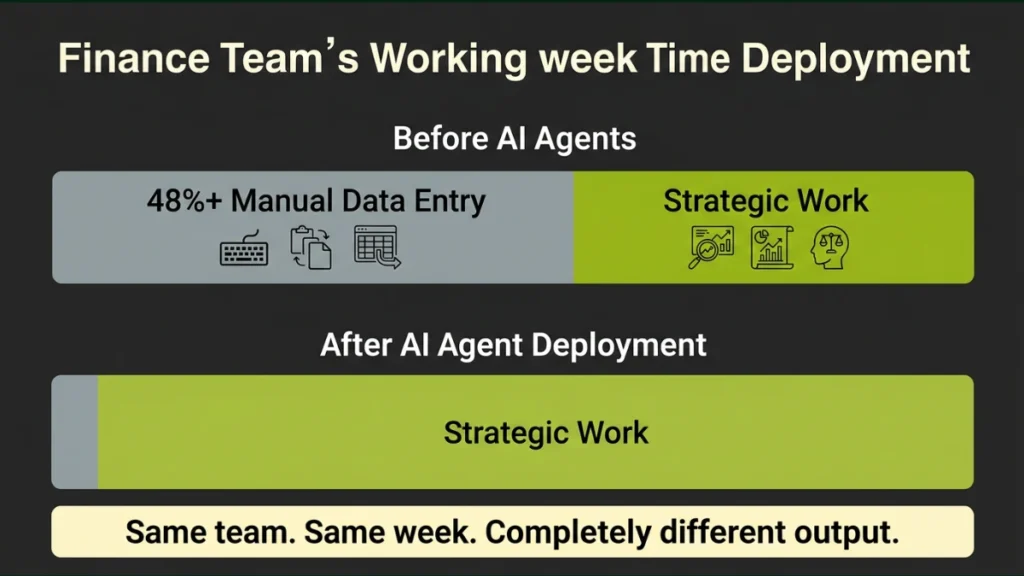
Finance teams have been using automation for years for tasks like cash flow forecasting, invoice tracking and expense management. But even now, a lot of the work still depends on people. In fact, more than 48% of finance teams still do manual data entry for over half of their daily tasks. Because of this, teams spend too much time on repetitive work instead of focusing on more important, strategic tasks.
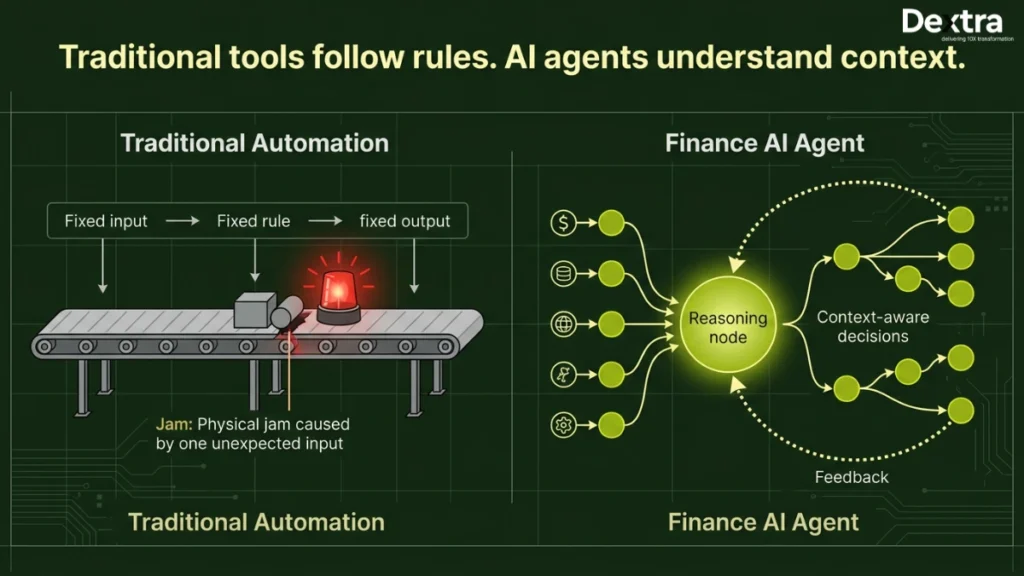
Traditional tools mostly follow fixed rules and work in separate systems. This makes them less flexible, particularly when something unexpected comes up or when handling real-time data. As companies grow, these issues become more obvious. This can lead to inefficiencies, missing data and higher operational costs instead of true automation.
And because of these challenges, more companies are now moving toward AI agents in finance. These systems can understand context, think through financial data and take action with very little human input.
At Dextralabs, we work with financial institutions to design AI agents for finance industry that function within real world constraints like compliance, legacy systems and data security. This guide explores how AI agent applications in finance are evolving and how to build financial AI agent systems that can operate reliably at scale.
What are Finance AI Agents?
Financial AI agents are intelligent systems that use financial data and tools to achieve predetermined objectives with limited human intervention. It combines models, data sources and decision logic to handle tasks that usually require human judgment, such as reporting, risk detection, or reconciliation.
Unlike traditional automation, AI agents for finance are goal driven. They can pull data from multiple systems, understand context and can take action based upon that understanding (e.g., generate an insight, trigger an alert). The ability to reason and modify behavior rather than strictly adhering to predefined rules makes finance AI agents immensely powerful.
With agentic AI in finance, these systems go beyond task execution. They can make decisions, adjust to new data and operate across workflows in real time, making AI agent applications in finance far more scalable and effective than legacy automation tools.
Real-World AI Agent Use Cases in Finance
Finance AI agents are not universal tools but they are tailored to the specific needs of a company. Depending on objectives, an agent can focus on a single function or cover multiple domains. Some of the most impactful applications include:
- Fraud Detection: AI agents continuously monitor transaction patterns to identify any suspicious transfers. The AI agents provide real-time alerts to compliance teams helping to reduce financial risk from fraudulent transactions, potential regulatory penalties and reputational damage, while improving overall security.
- Accounting and Bookkeeping: Agents automate routine tasks that typically require human intervention such as parsing invoices, categorizing expenses, reconciling bank statements and generating reports. This streamlines operations and minimizes human error in financial reporting.
- KYC and AML Compliance: During onboarding, AI agents verify identity documents, cross-check data against sanction or PEP lists and flag high-risk profiles. This makes onboarding quicker, as well as compliant.
- Cash Flow Forecasting and Scenario Planning: AI Agents examine past transactions, market trends and seasonal patterns in order to forecast the future cash flow. They can simulate scenarios such as cash shortfalls, unexpected expenses and market fluctuations to help finance teams plan liquidity and investment decisions.
- Wealth Management: AI agents can evaluate portfolios, assess risk, suggest rebalancing and offer personalized investment advice. They can execute recommendations effectively when integrated with broker APIs, helping clients optimize returns while managing investment risk efficiently.
What Do You Need to Build a Finance AI Agent?
Building a finance agent AI is a lot more than just using a model or API, it requires a full system that can handle real financial data, workflows and compliance rules.
Key requirements include:
- Access to data: Structured and unstructured sources like transaction records, invoices, CRM entries and market feeds.
- Integration with systems: Connect to financial APIs and internal tools to generate reports, spot anomalies, or execute transactions.
- Decision-making ability: Use large language models or custom rules so the AI understands context and makes smart choices.
- Monitoring and governance: Ensure security, compliance and adaptability as business needs change.
While prototypes can be built using standard frameworks, Dextralabs helps finance teams combine all these elements into scalable, reliable AI agents that work in real-world financial environments.
How to Build a Finance AI Agent?
Building a finance AI agent means putting together different parts so it can handle real financial tasks properly. Here’s a simple way to approach it:
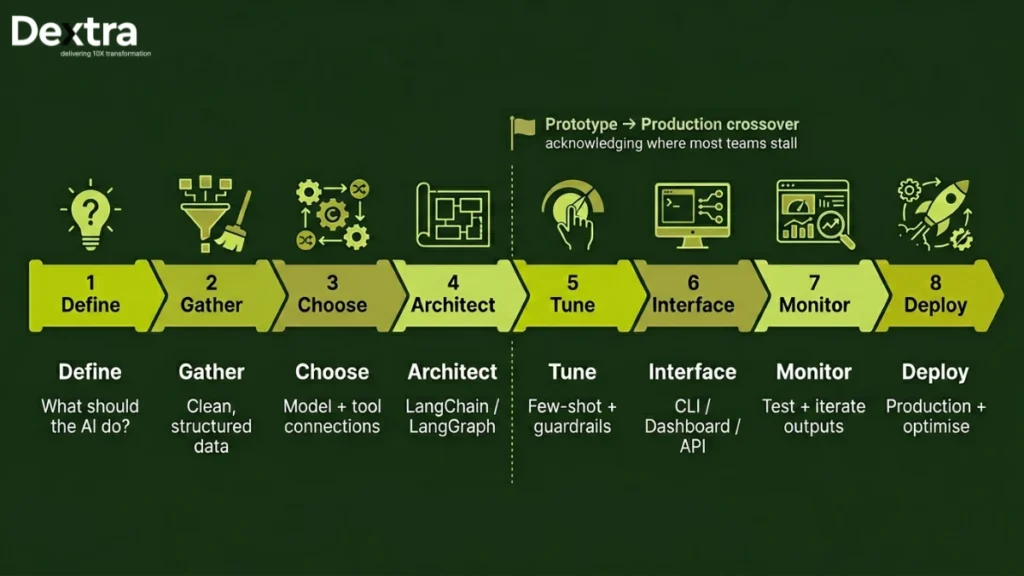
Step 1: Decide what the AI should do
Start by figuring out the tasks you want your AI to handle. Do you want it to manage budgets, track expenses, forecast trends, handle invoices, or check compliance? Getting clear on this upfront helps you focus on the tasks that matter most and avoid getting sidetracked trying to do everything at once.
Step 2: Gather and organize data
Collect all the data your AI will need. This includes structured data like transaction records and balance sheets, as well as unstructured data like emails, scanned documents and chat logs. Take the time to clean and organize everything so your AI can work accurately and efficiently.
Step 3: Choose a model and connect tools
Pick an AI model that fits your needs, like GPT-4, Claude, Gemini, or an open-source option. Then connect it to your financial tools, such as Plaid, Xero, Yodlee, or Stripe. These connections let your AI access real-time data and actually perform tasks instead of just giving advice.
Step 4: Build Agent Architecture
Use frameworks like LangChain, LangGraph, AutoGen, or DSPy to structure how your AI reasons, remembers and acts. While these tools make prototyping easier, building a production-ready system requires careful orchestration, something we frequently implement at Dextralabs for finance teams. This ensures modular, scalable and maintainable agent design.
Step 5: Train and Tune Behavior
Refine your AI by using few-shot learning or domain-specific fine-tuning. Put guardrails in place through prompt engineering, context management and methods to reduce errors. This helps your AI stay accurate, compliant and trustworthy.
Step 6: Design Interfaces
Decide how you want to access the AI, via a command line, web dashboard, or API. Make sure the interfaces are secure, easy to use and tailored to your workflows so you can get the most out of your AI agent.
Step 7: Monitor, Test and Iterate
Keep track of what your AI is doing, test its outputs and refine its behavior regularly. This ensures it adapts to changes in your data, business needs and regulations.
Step 8: Deploy and Optimize
Plan your deployment carefully, considering infrastructure, model selection, observability and cost. With the right approach, you can move beyond prototypes and have a production-ready AI agent that delivers real results for your finance team.
How Dextralabs Can Help You Build Finance AI Agents?
Building a finance AI agent is much more than connecting a chatbot to your data. Many internal projects succeed during pilot phases but fail in production because agents struggle with compliance gaps, poor integration with legacy systems, missing audit trails, or high operational costs. This is where Dextralabs helps moving from prototype to production with systems that actually work and offers the best AI agent development services for finance teams.
We follow a structured, step-by-step approach to ensure your AI agents are reliable, compliant and fully integrated:
Phase 1: Use Case Engineering
We identify key financial workflows and prioritize them based on value and risk. Agents are designed for tasks like fraud detection, loan processing and compliance monitoring. Understanding the use case upfront avoids wasted effort on pilots that fail to scale.
Phase 2: Agent Architecture Design
Next, we design the agent systems. Multi-agent architectures separate planning, execution and verification tasks. Each agent communicates with CRMs, ERPs, core banking systems and other tools, ensuring smooth workflow automation while maintaining operational integrity. This step guarantees the AI is not just a pilot but a system built to handle real-world complexity.
Phase 3: Secure Deployment
Once designed, we ensure role-based access, data protection, audit logs, human approvals and regulatory compliance. Agents can operate on-premises, in a private cloud, or in hybrid environments, giving you flexibility without compromising security.
Phase 4: Enterprise Integration
After deployment, we integrate agents across your enterprise. They connect seamlessly with modern APIs, legacy systems, or internal tools, ensuring that automation works with your existing infrastructure rather than waiting for costly upgrades.
Phase 5: Monitoring and Scaling
We track outputs, reduce errors, optimize costs and tune performance to keep agents reliable as operations grow.
When you work with Dextralabs, you don’t just get an AI tool, you get production-ready finance AI agents built for real-world financial environments. Multi-agent orchestration allows different AI agents to collaborate across tasks and systems, while secure APIs and data pipelines make integration seamless. All systems are built to meet compliance requirements, including audit trails, data protection and governance. Internal AI copilots help finance teams manage operations, make faster decisions and reduce manual work all without sacrificing accuracy or security.
Benefits of AI Agents in Finance
- Improved Accuracy: AI agents can identify inconsistencies or anomalies that are prone to human error, particularly during high-volume periods such as month-end closing. This helps protect the business from costly mistakes and ensures critical financial processes remain accurate.
- Reduced Risk: AI can give early warnings about possible problems, so teams can act before things go wrong. Although risks can’t be removed completely, this helps teams stay prepared and avoid bigger issues. It also helps businesses stay compliant and protect their margins.
- Increased Efficiency: Finance AI agents take care of repetitive tasks like invoice routing and cash application. Because of this, teams don’t have to spend time on manual work. Instead, they can focus more on important tasks like analysis and decision-making, while workflows run smoothly.
- Lower Costs: Automating repetitive tasks can help businesses save time and reduce costs. This enables businesses to be able to complete new projects without having to hire more staff as their client base increases. Thus, employees can concentrate on higher-value work and produce more with the same amount of resources.
What is the Difference Between Traditional AI vs Agentic AI?
| Aspect | Traditional AI | Agentic AI |
| Scope of Work | Traditional AI executes predefined tasks such as matching invoices | Agentic AI manages entire workflows, from detection to action, such as approving loans |
| Decision-Making | Traditional AI follows fixed rules and lacks context | Agentic AI makes decisions using goals, real-time data and situational awareness |
| Flexibility | It works with fixed inputs and rules | It adapts to changing data and business needs |
| Human Involvement | Traditional AI requires ongoing human supervision | Agentic AI runs autonomously and involves humans only when necessary |
| Learning | Traditional AI is static and requires retraining to update behavior | Agentic AI continuously improves from feedback and new data |
| Integration | It connects to specific tools or legacy systems | Agentic AI integrates broadly across APIs, ERPs and multiple data sources |
| Example Use Case | Traditional AI can match invoices to payments | Agentic AI can detect suspicious transactions and alert compliance teams automatically |
| Strategic Value | Traditional AI speeds up routine tasks | Agentic AI reduces risk, improves decision quality and delivers measurable impact |
Final Words
If you want to build finance AI agents but aren’t sure how to move beyond prototypes, Dextralabs can help. We design and deliver scalable, secure AI systems tailored for the financial sector.
From architecture and integration to governance and deployment, we guide financial institutions through the full transition from experimentation to production-ready AI.
As a governance-first implementation partner, Dextralabs ensures advanced AI capabilities are effectively applied for enterprise-grade results, supporting you at every step.

Build AI Agents That Finance Teams Can Trust
Connect with one of India’s top AI agent development companies today.
👉 Book a 30-min AI ConsultationFAQs on AI agents development for Finance:
How can AI agents be used in finance?
AI agents in finance go beyond analysis, they act autonomously while staying fully compliant. By integrating with automated execution systems, they can identify opportunities, trigger pre-approved trades, dynamically adjust risk models and generate automated compliance reports. This enables faster decision-making, reduces human error and ensures financial operations run efficiently and securely.
What compliance standards do finance AI agents support?
Finance AI agents are designed with built-in governance to meet key regulations such as GDPR, SEC and RBI. They include features like audit trails, role-based access controls and secure data handling, ensuring your AI operates safely, transparently and in full compliance with financial and data regulations
How quickly can a fintech implement a finance AI agent?
The timeline depends on your specific workflows and systems, but with the right frameworks and expertise like Dextralabs provides, companies can go from prototype to production ready AI agents in just a few months.
What kind of workflows can finance AI agents handle?
Finance AI agents can manage a wide range of financial workflows, including fraud detection, risk assessment, loan processing, reconciliation and compliance monitoring. They are designed to handle end-to-end processes, not just isolated tasks.
Do finance AI agents require ongoing human supervision?
While some human oversight is definitely needed for exceptions or approvals, finance AI agents are largely autonomous. They continuously monitor data, make context-aware decisions and follow regulatory guidelines hence reducing manual effort and minimizing human error.