
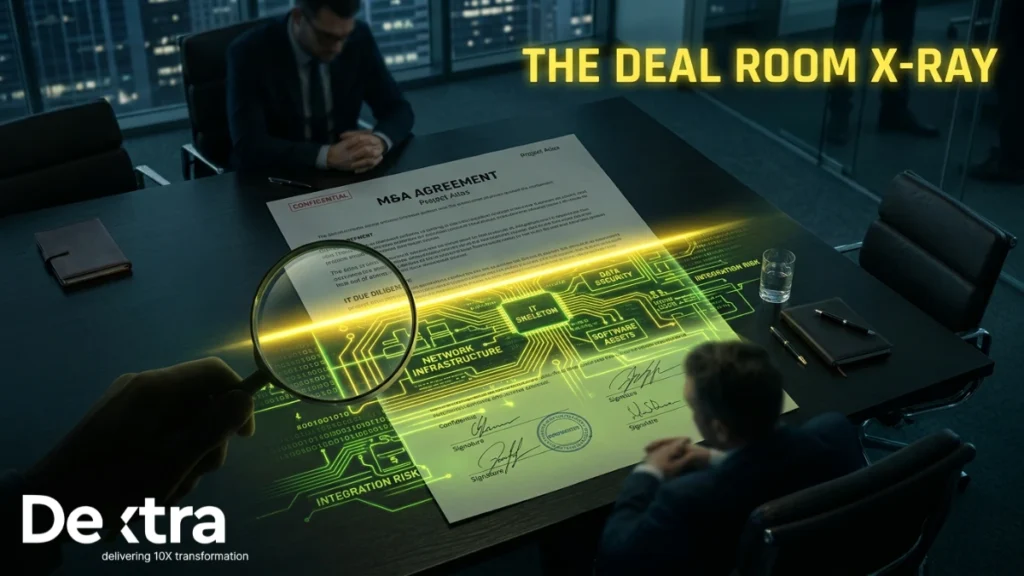
Most PE firms still treat IT DD as a checkbox. The ones generating outsized returns use it as a precision profit lever — de-risking deals, unlocking EBITDA, and sharpening their exit thesis before they ever reach close.
You’ve done your commercial DD. The financial model is tight. The sector thesis holds. But here’s what keeps experienced dealmakers up at night: the IT skeleton in the closet you didn’t see coming. Technical due diligence must carry the same weight as financial, legal, and operational review processes in private equity.
A legacy ERP that’ll cost £4M to replace. A cybersecurity due diligence gap one phishing email away from a breach notification. A tech stack so siloed that the post-merger IT integration timeline just doubled. We’ve seen every version of this — and more often than not, it surfaces after the ink is dry. A detailed technology audit, delivered through comprehensive diligence services, uncovers hidden issues and strengthens deal terms in private equity investments. The depth of these assessments is important for identifying risks, ensuring regulatory compliance, and understanding how technology impacts overall business value. Private equity firms must ensure that the technology of a target company aligns with their strategic goals to maximize investment returns.
IT due diligence in private equity isn’t about ticking boxes. At its best, it’s a strategic lens that reshapes valuations, informs your 100-day plan IT roadmap, and gives you an honest answer about whether your EBITDA ambitions are grounded in reality. In this piece, we walk through the four areas where technical due diligence in PE buy-side investments actually moves the needle.

What Separates Good IT DD from Deal-Defining IT DD
We work exclusively at the intersection of technology and M&A transactions. Our technical due diligence specialists bring together senior technology operators and deal advisors who have sat on both sides of the table. We don’t just assess what’s there — we translate every finding into financial impact, integration risk, and exit value.
Download Our IT DD FrameworkWhat Is IT Due Diligence and Why Does It Matter in PE?
IT due diligence plays a critical role in private equity investments, acting as a deep dive into a target company’s technology infrastructure, cybersecurity posture, and overall IT capabilities. For PE firms, this process is about far more than just checking the tech box—it’s about gaining a clear, data-driven understanding of the strengths and weaknesses that could impact the investment, both immediately and over the longer term. Diligence at this level uncovers not only hidden risks but also untapped opportunities for value creation, ensuring that the technology foundation aligns with the firm’s investment thesis and growth ambitions.
In today’s environment, where digital transformation and cybersecurity threats are ever-present, IT due diligence is essential for making informed decisions. It provides PE firms with the clarity and confidence needed to validate assumptions, assess alignment with strategic goals, and ultimately protect and enhance the value of their investments. By thoroughly evaluating the target’s technology landscape, PE firms can identify areas where IT can drive operational efficiency, support scalability, and deliver sustainable competitive advantage—making IT due diligence a cornerstone of successful private equity investing.
Does the IT Story Match the Financial Story?
Every valuation model tells a story. IT due diligence in buy-side transactions asks the uncomfortable question: does the technology actually support it?

At Dextralabs, we see it consistently — a target company’s EBITDA margin expansion story hinges on a digital transformation programme that hasn’t started, or their revenue growth projections assume platform scalability that the current IT infrastructure assessment would immediately flag as unrealistic. IT due diligence informs investment decisions by identifying necessary CapEx for tech upgrades, cybersecurity vulnerabilities, andintegration hurdles, all of which directly impact the final acquisition valuation.
What rigorous technical due diligence does here is ground-truth the financial narrative. Are IT budgets and forecasts internally consistent? Is IT spend benchmarking aligned with the company’s size and sector? Are IT investments and costs accurately reflected in the valuation model, ensuring that all expected outcomes and returns are based on reliable projections? Is there hidden CapEx lurking beneath the operating cost line — deferred investments in legacy systems that will land squarely in your post-acquisition P&L? Validation of assumptions and forecasts is critical, and leveraging past trading experience helps assess future risks and validate these assumptions.
Tech debt in M&A is one of the most consistently underpriced risks in deal modelling. The cost of carrying it doesn’t disappear at close — it compounds. A well-structured IT infrastructure assessment at this stage gives your deal team the confidence to negotiate with precision rather than assumption, and to build a post-merger IT integration plan grounded in what’s actually there.
A thorough tech diligence report informs the entire go-forward plan, including pricing and integration strategies.
“A £2M EBITDA uplift story unravelled when our IT infrastructure assessment found the target’s core platform hadn’t been updated in 6 years. The upgrade cost alone wiped the projected margin.”
Where IT Becomes Your Competitive Moat — or Your Anchor
PE deal rationale typically centres on one or more of: market expansion, operational efficiency, or platform play. IT either enables all three or quietly undermines them. This is the heart of IT due diligence value creation — and where experienced technical advisors earn their fee. The focus during IT due diligence should be on key areas for value creation, innovation, and identifying opportunities for growth and efficiency.
Identifying hidden opportunities in historically underinvested targets is one of the highest-leverage activities in PE technology risk assessment. A company that’s been running lean on IT spend for five years often has two sides to that coin: near-term risk, yes, but also significant headroom once the right investments are made. Addressing historical underinvestment in IT reveals overlooked expenses and reframes the financial planning conversation entirely. Ensuring the right resources—capabilities, personnel, and tools—are in place is critical for effective operations and smooth integrations. Collaboration within the IT team and across business units fosters effective teamwork, structured training, and alignment with value-based KPIs. Artificial intelligence is increasingly central to driving innovation and operational efficiency, making it a core consideration in modern tech due diligence. Scalability and technical debt assessments determine whether core systems can handle significant growth without requiring an immediate, expensive overhaul. A robust tech diligence process helps investors identify true drivers of risk and value. Additionally, a detailed technology audit uncovers hidden issues, strengthens deal terms, and ensures that core systems can support integration and expansion plans.
What does that value creation potential look like in practice?
- A manufacturer with manual reporting processes ripe for automation and data analytics deployment — freeing 40+ hours of management time per week and compressing the monthly close cycle.
- A SaaS business where accumulated tech debt is suppressing expansion into adjacent markets — clear it through structured cloud migration due diligence, and the addressable market doubles.
- A PE portfolio company technology stack so fragmented it’s the only thing preventing a £10M revenue synergy from being realised with an existing portfolio asset, highlighting the importance of identifying and capturing synergies during integration.
This layer of analysis shapes your 100-day plan IT roadmap and exit multiple thesis simultaneously. The best technical due diligence in PE investments doesn’t just surface risk — it builds the case for where IT is a value multiplier.
“Identified £3.8M in unrealised automation and data analytics opportunities in a logistics target during IT due diligence buy-side review. That single finding reshaped the entire value creation roadmap.”
The Operational Efficiency Play Most Deals Miss
IT due diligence is a structured review of a target company’s technology environment, including systems, security, software, data governance, and IT operations.
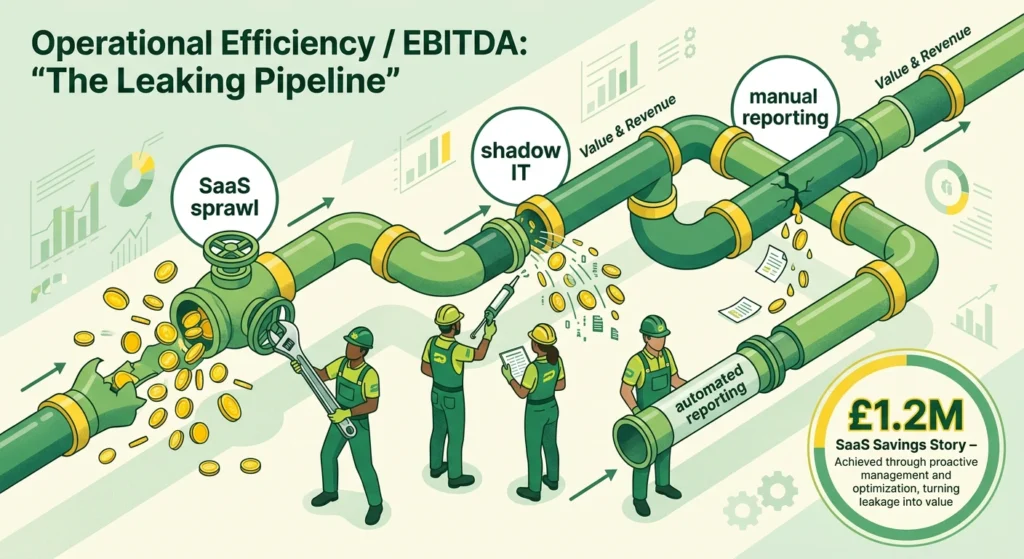
“The Leaking Pipeline”
IT due diligence EBITDA improvement is not a new idea. But the approach that actually delivers results looks very different from generic “digital transformation” language in an investment memo. The real question is whether the IT organisation — and the stack it operates — is structured for efficiency or has grown organically into something expensive and fragile. Assessing engineering leadership and team capabilities is essential to determine if the IT function is effective in supporting business goals and value creation. Data integrity and intellectual property (IP) assessment is also required to verify ownership or proper licensing of all software and critical IP, ensuring compliance and reducing risk. Certain technology resources and standards are required for successful integration and to meet deal deadlines or regulatory obligations. Validation of the team’s ability to deliver on operational improvement is critical to confirm that operational goals can be achieved post-acquisition.
At Dextra Labs, our technical due diligence work in PE buy-side investments consistently identifies four operational levers that produce measurable EBITDA improvement:
- Cloud migration with genuine cost optimisation — not lift-and-shift, but a right-sized architecture that reduces infrastructure spend by 20–40% in most mid-market targets.
- Automation of finance and operations workflows, from invoice processing to management reporting, compressing cycle times and reducing headcount dependency.
- IT standardisation across multi-site or recently-acquired businesses where shadow IT and duplicate systems are silently inflating the cost base.
- SaaS vendor rationalisation — where unchecked growth has created subscription sprawl that nobody in the business is actively managing.
Validating scalable technologies capability is equally critical. A cloud migration roadmap is only as good as the team delivering it. During our IT due diligence for PE investments, we assess not just what’s planned — but whether the talent, governance structures, and vendor relationships exist to execute. Proficiency in cloud computing, data analytics platforms, and enterprise automation tools must be verified, not assumed.
This is the distinction between a technical due diligence report that describes a situation and one that tells you whether your operational improvement thesis is achievable with the team currently in place.
Early identification of vulnerabilities helps prevent incidents that disrupt operations or erode valuation.
“£1.2M annual saving identified through SaaS vendor rationalisation alone — a 200-person professional services firm carrying 47 overlapping subscriptions. None of the three previous DD providers had flagged it.”
The Risk That Can Turn a Good Deal Into a Bad Headline
Cybersecurity due diligence in M&A has moved from a technical annex to a board-level and, increasingly, a deal-level concern. Regulatory requirements under GDPR and sector-specific frameworks are tighter. Threat actors are more sophisticated. And the reputational and financial consequences of a post-acquisition breach are severe enough to reshape how W&I insurers are pricing coverage.
What our cybersecurity due diligence process evaluates isn’t simply whether the target has a firewall. It’s whether the business can operate, recover, and communicate effectively under a live cyber incident — including resilience planning for outages caused by cyberattacks — and whether its controls are proportionate to the data it holds and the systems it relies on. We also assess the presence and adequacy of cybersecurity insurance, which is increasingly required by lenders and plays a critical role in risk management to protect against data breaches and cyber threats.
Key areas that consistently surface in our IT due diligence for PE buy-side investments:
- Unpatched systems and vulnerability backlogs — often the most immediately material finding, particularly in OT-heavy businesses or those running legacy infrastructure.
- Inadequate identity and access management — a leading attack vector that’s frequently underdeveloped in sub-£100M revenue businesses.
- GDPR acquisition compliance gaps and sector-specific data privacy regulations that create latent liability invisible in financial DD.
- Business continuity plans that exist as documents but have never been exercised — common in businesses that have grown through acquisition without IT integration.
The acquisition moment is itself a cybersecurity risk event. Post-merger IT integration creates new attack surfaces. Attention is divided. IT teams are stretched across two organisations. These are precisely the conditions that threat actors monitor and exploit. Mitigating cybersecurity threats during the transition window requires a plan that begins in due diligence, not after close.
Protecting customer data is paramount, and our process ensures that security measures, privacy compliance, and encryption are in place to safeguard customer information. Assessing IT and cybersecurity risks during due diligence increases the likelihood of a successful acquisition and helps mitigate potential failures. Our cybersecurity and compliance posture evaluation covers adherence to frameworks like CIS Top 18 and regulatory standards such as GDPR and HIPAA. Cybersecurity is a foundational element of scalability for private equity investments, ensuring that growth does not compromise security. Investors must also verify alignment with relevant regulations such as GDPR, HIPAA, or SOX during due diligence to avoid regulatory pitfalls.
Understanding these risks during technology due diligence (tech dd) means you can price them accurately, require remediation as a closing condition, or structure appropriate representations and warranties coverage, rather than absorbing them silently into your post-close integration budget.
“One target had three critical CVEs unpatched for over 18 months across internet-facing systems. Our cybersecurity due diligence identified all three. Remediation was made a condition of close, and the W&I premium was reduced as a result.”
Where IT Due Diligence Fits in the Private Equity Investment Process
IT due diligence is a pivotal step in the private equity investment process, typically initiated during the pre-acquisition phase once initial financial and commercial assessments are underway. At this stage, PE firms engage in a comprehensive review of the target company’s IT infrastructure, network, and cybersecurity systems to validate the company’s ability to support future growth and scalability. This diligence process is designed to uncover real risks—such as potential data breaches, outdated systems, or gaps in cybersecurity, that could disrupt operations or undermine the investment thesis.
Depending on the complexity of the target’s technology environment, IT due diligence can range from a focused assessment to a deep, multi-week investigation. The goal is to provide a clear picture of the target’s current capabilities, identify areas that require immediate attention, and support the development of a robust post-acquisition integration plan. By validating the technology’s alignment with business objectives and identifying opportunities for value creation, PE firms can optimize their investment strategy and ensure that the target company’s IT foundation is strong enough to support long-term growth. The importance of this step cannot be overstated—it is the bridge between ambition and execution, enabling PE firms to make confident, well-informed investment decisions.
Why It Matters Who Does Your IT Due Diligence?
The methodology gap between providers is narrower than it used to be. Many firms now conduct technology audits as a standard practice, recognizing the importance of assessing technology’s role in scaling and improving efficiency in portfolio companies. Most technical due diligence firms can run an IT infrastructure assessment, score a cybersecurity maturity model, and produce a risk register. That’s the baseline.
The real differentiator is whether your IT DD partner understands deals — and whether they can translate technical findings into the language your investment committee, your lenders, and your future exit buyers actually use. A thorough assessment of the target company’s technology—including systems, infrastructure, and cybersecurity—can lead to negotiation impacts such as price adjustments or additional protections by providing objective insights into technology risks and issues. A thorough tech diligence report informs the entire go-forward plan, including pricing and integration. IT due diligence provides a clear understanding of a target company’s systems, cybersecurity posture, infrastructure, and scalability before a deal closes. IT insights guide integration activities, modernization plans, and value-creation roadmaps. A thorough private equity technology audit helps investors avoid unexpected liabilities, strengthen deal terms, and prepare portfolio companies for post-acquisition growth. IT due diligence helps investors understand risks, costs, and scalability before completing a deal.
At Dextra Labs, we work exclusively at the intersection of technology and M&A transactions. Every IT due diligence engagement we run is designed to do four things: validate the business case, identify IT due diligence value creation opportunities your model hasn’t priced, assess PE portfolio company technology risk with exit buyers in mind, and give you the cybersecurity due diligence confidence to close without a hidden liability waiting on the other side.
If you’re preparing for a PE buy-side process and IT is on the critical path — or should be — we’d welcome the conversation.
Conclusion: Turning IT Insights Into Investment Advantage
In conclusion, IT due diligence is not just a procedural step—it is a key driver of competitive advantage and value creation in private equity investments. By delivering a clear, comprehensive understanding of a target company’s technology capabilities, security posture, and alignment with strategic objectives, IT due diligence empowers PE firms to optimize their investment approach and protect their capital. The insights gained from this process enable firms to identify and mitigate risks, unlock opportunities for scalability, and ensure that their portfolio companies are positioned for sustainable growth.
As the private equity industry continues to evolve and technology becomes increasingly central to business success, the importance of IT due diligence will only grow. It is a critical responsibility for PE firms to prioritize this process, leveraging it to inform investment decisions, drive operational improvements, and ultimately deliver superior returns. By making IT due diligence a core part of their investment strategy, PE firms can stay ahead of industry trends, safeguard their investments, and create lasting value in an increasingly complex and competitive landscape.