As enterprises move beyond experimental AI and chat-based assistants, Agentic AI is rapidly emerging as the next frontier of digital transformation. These systems are capable of planning, reasoning, taking actions, and adapting across multiple steps to achieve defined business goals; they don’t just respond; they act with purpose, orchestrating tools, data, and workflows autonomously.
Enterprise adoption of advanced AI tools is now mainstream: 85 % of enterprises are projected to implement or significantly integrate AI agents into core business operations by the end of 2025, reflecting a rapid shift from pilots to production-ready systems (source:sci-tech-today.com).
At Dextralabs, we design and deploy enterprise-grade agentic AI systems that deliver measurable 10X impact across operations, decision-making, and innovation. Drawing from our experience in AI consulting, enterprise LLM deployment, and AI agent development, this article outlines seven practical steps to mastering agentic AI — with a focus on reliability, scalability, and business value.
Step 1: Understand the Core Agent Loop
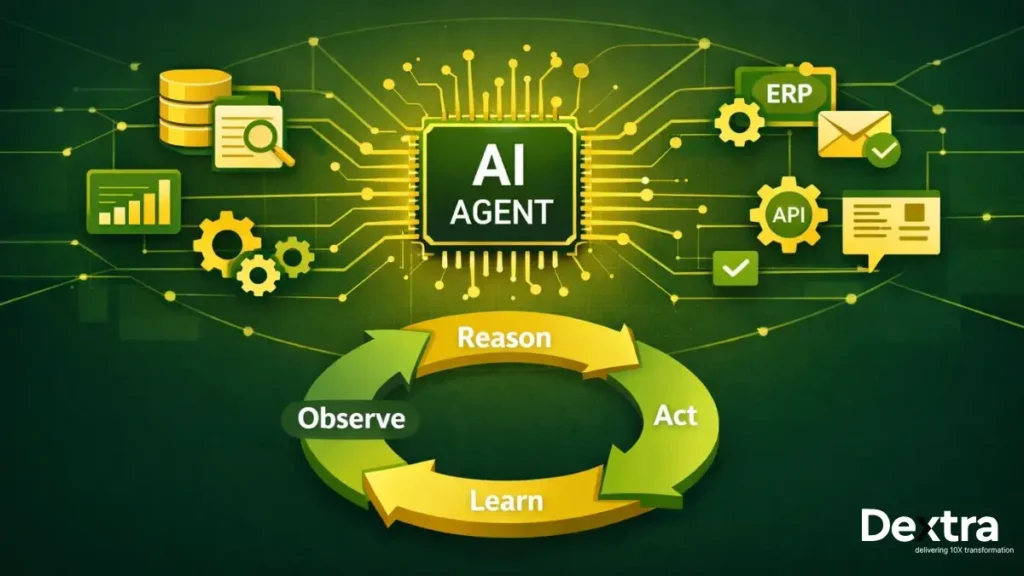
Every agentic system operates on a foundational loop: Observe → Reason → Act → Learn
- Observe: Ingest the current state from data sources, user inputs, or system events.
- Reason: Decide the next best action using LLM-driven reasoning aligned with business rules.
- Act: Execute actions via tools; APIs, databases, workflows, or enterprise systems.
- Learn: Observe outcomes and update state or memory before the next iteration.
At Dextralabs, this loop is treated as a first-class architectural primitive. Whether we’re building AI agents for research automation, field operations, or enterprise decision support, we design each stage with failure handling, observability, and control mechanisms. Understanding and engineering this loop is the foundation of building agents that perform consistently in production — not just demos.
Step 2: Define Clear Goals, Boundaries, and Success Criteria
Agentic AI systems are only as effective as the clarity of their objectives. Vague instructions lead to unpredictable behavior and operational risk.
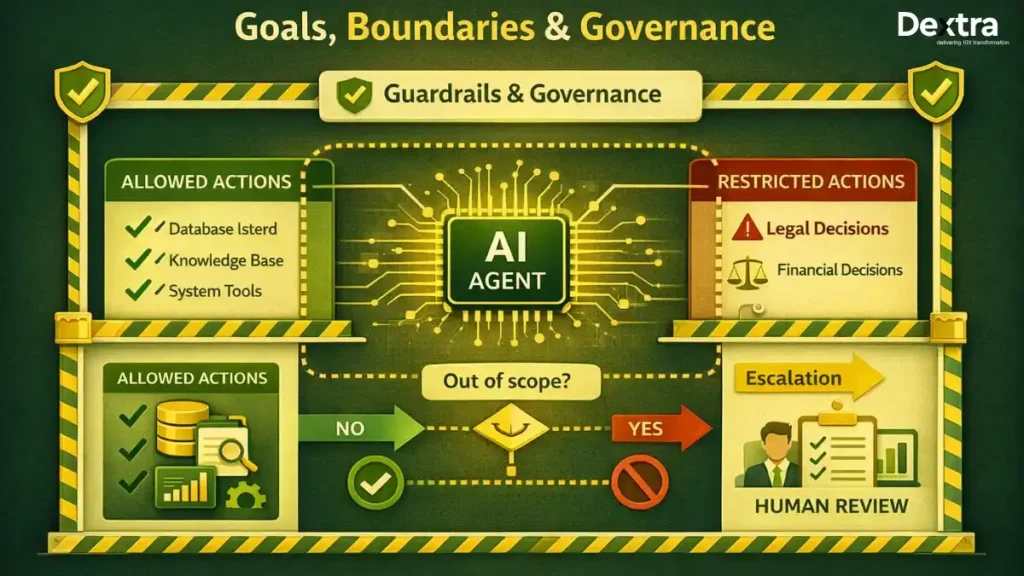
At Dextralabs, we work with business stakeholders to translate strategic goals into machine-checkable success criteria, such as:
- What defines task completion?
- When should the agent stop or escalate to a human?
- What decisions are explicitly out of scope?
For example, an enterprise support agent may be allowed to resolve issues using a knowledge base but must escalate financial or legal decisions. These constraints are encoded directly into agent instructions and validation layers.
Clear task boundaries enable safe autonomy, ensuring agents operate within governance frameworks while still delivering speed and efficiency.
Step 3: Equip Agents with the Right Tools — No More, No Less
Agentic AI derives its power from tools. Tools define what an agent can do in the real world.
Dextralabs follows a minimalist, capability-driven tooling strategy:
- Data retrieval tools (databases, vector stores, search)
- Action tools (workflow triggers, ticketing systems, ERP actions)
- Computation tools (code execution, analytics functions)
Each tool is clearly documented with:
- Purpose and allowed usage
- Input and output schema
- Error semantics and retry behavior
This disciplined approach reduces hallucinations, simplifies debugging, and improves agent decision quality. In platforms like RA:1 and enterprise AI deployments, this ensures agents behave deterministically even in complex workflows.
Step 4: Design System Prompts as Operational Playbooks
The system prompt is the operating manual for an AI agent. Poorly designed prompts lead to fragile behavior; well-designed prompts produce consistent, auditable outcomes.
Dextralabs structures agent prompts with:
- Role and business context
- Explicit goals and constraints
- Tool usage rules
- Step-by-step reasoning expectations
- Output formatting standards
For complex tasks, agents are instructed to plan before acting, breaking down objectives into smaller steps. This planning-first approach significantly improves coherence, reduces tool misuse, and aligns agent behavior with enterprise processes.
Prompt engineering at Dextralabs is not trial-and-error, it is a repeatable engineering discipline supported by evaluation and version control.
Step 5: Engineer Robust State and Memory Management
Agentic AI systems operate over time. Without structured memory, agents lose context, repeat work, or make inconsistent decisions.
Dextralabs implements multi-layered memory architectures:
- Short-term state: Current task context, recent actions, and intermediate results
- Long-term memory: User preferences, historical decisions, reference knowledge stored in databases or vector stores
To manage token limits and cost, we apply:
- Summarization strategies
- Sliding context windows
- Selective retention of critical facts
This approach enables agents to scale across long-running workflows such as research analysis, compliance interpretation, or field service coordination — all without losing reliability.
Step 6: Build Guardrails, Governance, and Human Oversight
Enterprise adoption of agentic AI demands trust and control. At Dextralabs, guardrails are implemented at multiple layers:
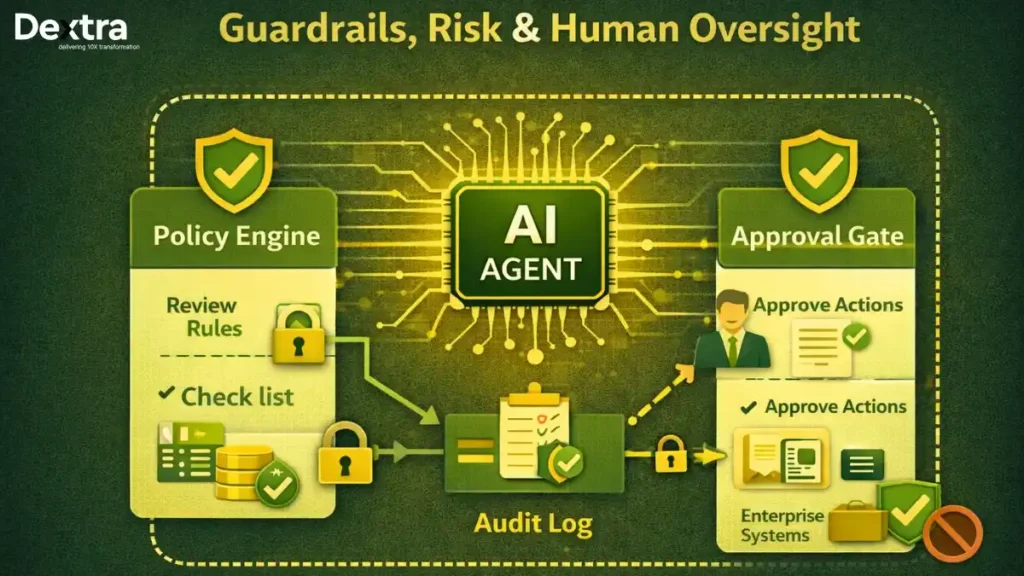
- Tool-level permissions
- Action approval workflows for high-risk operations
- Loop limits, cost ceilings, and rate controls
- Circuit breakers for repeated failures or off-task behavior
Human-in-the-loop mechanisms are integrated wherever business risk is high. Every agent action is logged, auditable, and explainable — a critical requirement for regulated industries and investor-backed organizations.
This governance-first design ensures that autonomy never comes at the cost of accountability.
Step 7: Test, Evaluate, and Improve Continuously
Unlike single-turn AI systems, agentic AI must be evaluated as a behavioral system.
Dextralabs applies continuous evaluation across:
- Task success rates
- Efficiency (steps, time, cost)
- Tool usage patterns
- Failure recovery behavior
We rigorously test agents against adversarial scenarios, tool failures, contradictory inputs, missing data, to ensure resilience. Feedback from real users is looped back into prompt refinement, tool redesign, and policy updates.
This continuous improvement cycle is what transforms agentic AI from a prototype into a durable competitive advantage.
Conclusion: Agentic AI as a Strategic Capability
Agentic AI represents a shift from passive AI assistance to active, goal-driven digital workers. However, success depends on disciplined design, strong governance, and deep alignment with business objectives.
At Dextralabs, we help organizations master agentic AI by combining:
- Strategic CTO leadership
- Enterprise AI engineering
- Robust guardrails and evaluation frameworks
The result is not just smarter AI, but AI systems that drive 10X transformation.
If your organization is exploring enterprise-grade AI agents, now is the time to build them right, from architecture to execution. Let’s build the future of agentic AI, together.