

You’ve closed the deal. The press release is out. The resolution plan is approved. The keys to the kingdom are yours. Now comes the part nobody warned you about: figuring out what you actually bought.
Day One Is Already Too Late to Start Thinking About Technology
There’s a moment in every acquisition, whether it’s a PE-backed buyout, an IBC resolution, or a strategic bolt-on, where the new owner walks into the acquired company’s tech environment for the first time. The servers are humming. The dashboards are blinking. Everything looks operational.
And then someone asks a simple question: How does this system actually work?
The room goes quiet. The lead developer who built the core platform left two months ago. The documentation, such as it is, was last updated 4 years ago. The cloud infrastructure is running on a personal account that nobody has the credentials for. The ERP has been customized so heavily that the original vendor no longer supports it.
This isn’t an edge case. This is the default scenario for most acquisitions where technology transfer wasn’t planned. And the data confirms it: nearly 50% of key employees leave within the first year after a deal, with that number climbing to 75% within three years. When those people walk out, they take something no amount of capital can quickly replace, the institutional knowledge of how things actually work.
The first 90 days after acquisition aren’t just important. They’re definitional. What you discover, document and decide in this window determines whether your turnaround thesis survives or collapses under the weight of systems nobody understands.
The Three Things That Go Wrong When Tech Transfer Is an Afterthought
Most post-acquisition integration plans are built by deal teams with deep financial and operational expertise. Technology integration gets a line item and a vague mention of “system harmonisation.” Here’s what actually happens when that’s the extent of your tech transfer strategy:
1. The Knowledge Walks Out Before You Know What You Need
In knowledge-intensive acquisitions, a significant portion of the deal’s value resides in the acquired firm’s processes, technologies, customer relationships and talent, not in physical or financial assets. Research consistently shows that when talent attrition spikes in the first 90 days, it’s often because leadership clarity was lacking. Employees don’t leave because they’re unhappy with the deal. They leave because nobody told them what their role is, whether their work matters, or what’s happening to the systems they built.
The cost of replacing a knowledge worker runs between 50% and 200% of their annual salary. But the real damage isn’t the replacement cost — it’s the institutional knowledge that leaves with them. Academic research has demonstrated that individual productivity is often institution-specific rather than portable. When experienced employees exit, their firm-specific expertise, knowledge of internal systems, historical design choices, informal processes and coordination routines, is destroyed, not transferred.
In the M&A context specifically, firms that experience higher post-acquisition employee turnover see measurable drops in innovation output, confirming that simply hiring replacements cannot immediately substitute for lost institutional knowledge.
2. You Operate on a System Nobody Can Explain
Here’s a question every acquirer should ask in the first week: How many undocumented workarounds exist in our critical systems?
The answer is always more than you think. Distressed companies, in particular, accumulate years of technical shortcuts, manual overrides and tribal knowledge that never gets written down. The billing system sends invoices through a script that one person wrote in 2019. The warehouse management module has a bug that everyone knows about but works around. The customer-facing application has a login flow that breaks if you change a single configuration parameter.
Without structured knowledge transfer, the new owner inherits these systems but not the understanding of how to keep them running. The result: minor issues escalate into outages, operational costs spike and the technology team spends its first six months fighting fires instead of building the future.
3. The Integration Budget Explodes
In the technology sector, 40% of integration efforts end up costing more than planned. The most common cause is underestimating complexity — incompatible tools, undocumented dependencies and unexpected licensing costs that only surface once you’re inside the system.
Across industries, M&A integration costs range from 1% to 4% of the deal value, with technology-heavy acquisitions trending higher. Media and telecom companies report a median integration cost exceeding 5.6% of target revenue. These numbers assume a reasonably well-understood tech stack. When the tech estate hasn’t been mapped and knowledge transfer hasn’t happened, costs compound further.
| The Pattern The deal team optimises for closing. The integration team inherits the mess. The technology team gets blamed for the delays. And the turnaround plan, the one that convinced the CoC or the board, quietly falls behind schedule because the technology layer was never properly transitioned. |
What “Tech Transfer” Actually Means in Practice?
Tech transfer after acquisition is not an IT project. It’s a structured process of discovering, documenting, evaluating and deciding the fate of every technology component you’ve inherited, from the ERP to the email server to the custom scripts that hold the supply chain together.
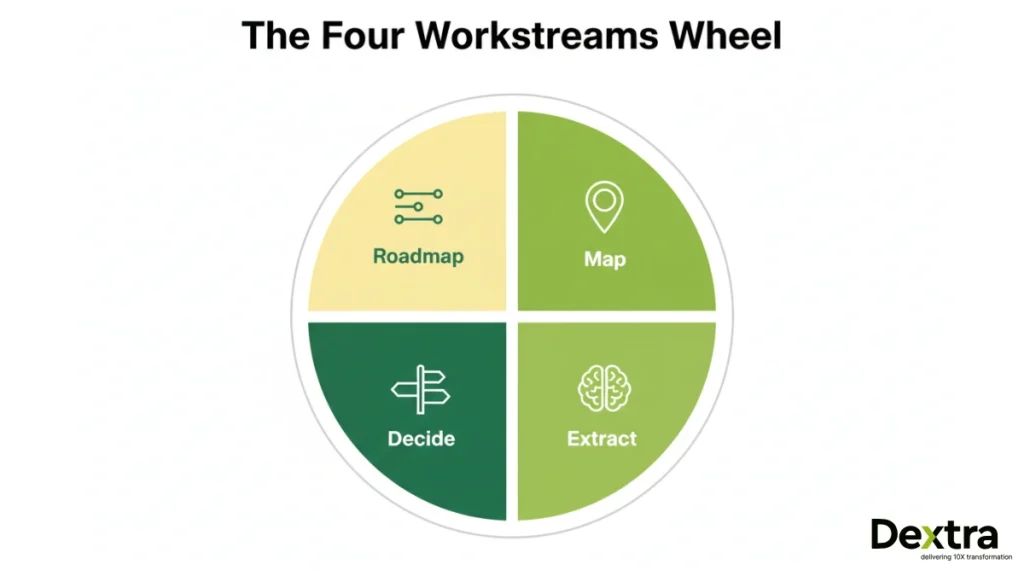
At Dextra Labs, we break this into four distinct workstreams that run in parallel during the first 90 days:
| Workstream | What It Covers | Why It Matters |
| Tech Estate Mapping | Complete inventory of all technology assets: applications, databases, infrastructure, cloud services, SaaS subscriptions, custom code, APIs, third-party integrations, shadow IT | You cannot decide what to keep, migrate, or retire until you know what exists. Most acquirers discover 30–40% more systems than what was disclosed during due diligence. |
| Knowledge Extraction | Structured interviews with key technical staff, documentation of undocumented processes, architecture walkthroughs, system dependency mapping, tribal knowledge capture | If a critical employee leaves tomorrow, can the system survive? Knowledge extraction converts tacit, person-dependent expertise into documented, transferable assets. |
| Keep / Migrate / Kill Decisions | Assessment of each system against business requirements, technical health, integration feasibility, cost of ownership and strategic alignment | The fastest way to waste capital post-acquisition is to maintain systems you don’t need or migrate systems you should retire. This framework forces disciplined decision-making. |
| Transition Roadmap | Phased execution plan with timelines, resource requirements, dependencies, risk mitigation and success metrics for the first 90 days, 6 months and 12 months | The roadmap translates technical decisions into a project plan that leadership, investors and integration teams can execute against with clear accountability. |
This isn’t theoretical. This is the work that determines whether the technology you acquired becomes a foundation for growth or a drag on every plan you try to execute.
The 90-Day Framework: What Happens and When?
The first 90 days aren’t a single sprint. They’re three distinct phases, each with its own objectives and deliverables. Here’s how we structure them:
Days 1–30: Stabilise and Discover
- Primary goal: Business continuity. Nothing breaks.
- Tech estate mapping: Complete the full inventory. Identify every application, database, server, cloud account, SaaS tool and integration point.
- Critical knowledge identification: Map which systems depend on which people. Flag anyone whose departure would create a single point of failure.
- Quick security sweep: Verify MFA is active, endpoint protection meets minimum standards and no critical vulnerabilities are being actively exploited.
- Shadow IT sweep: Identify all software services that aren’t monitored by IT, personal cloud accounts, unsanctioned SaaS tools, developer-managed infrastructure.
- Credential transfer: Ensure the new ownership has administrative access to every system. This sounds basic. It fails more often than you’d expect.
Days 31–60: Evaluate and Decide
- Primary goal: Clarity on what stays, what goes and what transforms.
- Technical health assessment: Code quality review, architecture evaluation, infrastructure audit and security posture assessment for every system in the estate. This is where Dextra Labs’ comprehensive tech audit delivers its highest value.
- Knowledge extraction: Structured interviews, system walkthroughs and documentation sprints with key technical staff. Convert tribal knowledge into written, transferable assets.
- Keep / Migrate / Kill framework: Score every system on a matrix of business criticality, technical health, integration complexity and cost of ownership. Make the decisions.
- Cost modelling: Build the remediation and integration budget based on actual findings, not assumptions from the deal room.
Days 61–90: Plan and Begin Execution
- Primary goal: A funded, resourced and accountable transition roadmap.
- Transition roadmap delivery: Phased plan covering immediate stabilisation, short-term integration (3–6 months) and long-term modernisation (6–12 months).
- Integration workstream kick-off: Begin executing the highest-priority items: data migration for retired systems, security remediation, infrastructure consolidation.
- Talent retention plan: Based on the knowledge mapping from Days 1–30, implement targeted retention strategies for employees who hold critical institutional knowledge.
- Governance framework: Establish ongoing technology oversight, how decisions get made, who owns what and how technical health gets reported to leadership.
| Why 90 Days? Research from multiple M&A integration studies confirms that the 90-to-100-day window is when integration outcomes are largely determined. Talent attrition spikes when leadership clarity is lacking within this period. The most recent best practices for 2026 suggest this window may actually be shrinking with critical functions like IT needing to be integrated within the first 60 days for larger acquisitions. Either way, the message is clear: what you don’t resolve in the first quarter, you pay for in the next four. |
The Knowledge Transfer Problem Nobody Plans For
Let’s talk about the specific challenge that derails more post-acquisition technology transitions than any other: institutional knowledge loss.
Every company has two kinds of knowledge. Explicit knowledge, the stuff that’s written down: documentation, runbooks, architecture diagrams, API specs. And tacit knowledge, the stuff that lives in people’s heads: why the system was built this way, what breaks when you change that parameter, which vendor contact actually gets things done and the workaround for that bug nobody ever fixed.
In distressed acquisitions, the ratio of tacit to explicit knowledge is heavily skewed. Documentation is often the first casualty of financial stress — when you’re fighting for survival, nobody’s updating the wiki. The result is that 80% of how the technology actually works is locked inside a handful of people.
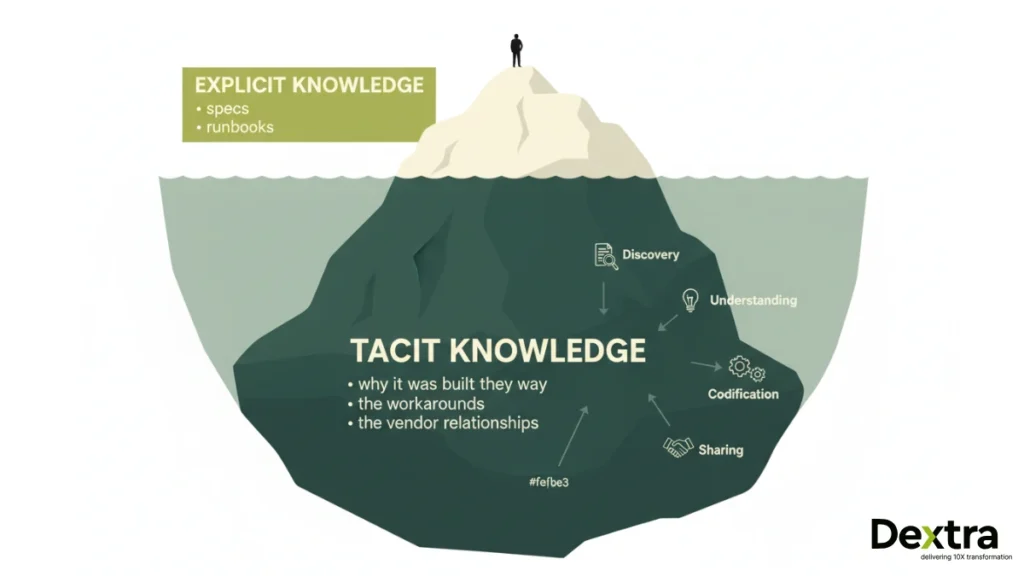
A structured knowledge transfer process addresses this by:
- Identifying knowledge holders: Map every critical system to the people who understand it. Use a knowledge risk matrix that scores both the criticality of the knowledge and the attrition probability of the person holding it.
- Extracting before it leaves: Structured interviews, shadowing sessions and guided documentation sprints that capture not just what the system does, but why it was built that way and how it behaves under edge conditions.
- Creating transferable assets: Convert extracted knowledge into architecture decision records, system runbooks, troubleshooting guides and onboarding documentation that new team members can actually use.
- Validating transfer: Test whether the knowledge has actually transferred by having a different team member operate the system using only the documented material. If they can’t, the documentation isn’t done.
This work needs to start in Days 1–30 and continue aggressively through Day 60. After that, it’s often too late, the people who hold the knowledge have either left or disengaged.
How Dextra Labs Supports Tech Transfer After Acquisition?
Dextra Labs is not a generic IT consultancy. We’re a technology due diligence and advisory firm built specifically for the deal lifecycle, from pre-investment assessment through post-acquisition transition and ongoing technology governance.
Our post-acquisition support operates through three integrated service lines:
- Remediation Workshop: A structured engagement immediately following deal close where we map the tech estate, extract critical knowledge, build the keep/migrate/kill framework and deliver the transition roadmap. This is the 90-day playbook, executed by a team that’s done it before.
- CTO Office: For acquired companies that lack senior technical leadership, a common scenario in distressed acquisitions, we provide fractional CTO services. This means strategic technology oversight, vendor management, team structure guidance and architecture decision-making during the critical transition period.
- M&A Integration Management Office (IMO): For complex integrations where the acquired entity needs to merge into the buyer’s existing technology ecosystem, our IMO coordinates platform migration, data consolidation, AI agent development for process automation and cross-team alignment.
These services connect directly to our pre-acquisition technical due diligence. The RCOI framework, Risks, Costs, Opportunities, Impact that drives our pre-deal assessment carries forward into post-deal execution. Risks identified during DD become remediation priorities. Costs become budget line items. Opportunities become the technology roadmap. Impact becomes the KPIs you track.
What Good Looks Like: The Signals That Tech Transfer Is Working
By Day 90, a well-executed tech transfer should give you:
- A complete tech estate map that accounts for 100% of applications, infrastructure, data stores and third-party dependencies, not just what was in the VDR.
- A documented knowledge base that would allow a new team member to understand and operate critical systems without relying on the original builders.
- A keep/migrate/kill decision log with business rationale, cost estimates and timelines for every system in the estate.
- A funded transition roadmap with clear milestones for the next 12 months, resource requirements and risk mitigation plans.
- Zero critical single points of failure, no system where one person’s departure would cause operational collapse.
- A talent retention plan for every employee identified as a knowledge holder, with specific incentives and engagement commitments.
If you don’t have these six things by the end of your first quarter, you’re not transitioning. You’re hoping. And hope is not a technology strategy.
The Bottom Line: You Don’t Get a Second Chance at the First 90 Days
The deal is the beginning, not the end. The financial thesis, the operational plan, the growth projections, all of it depends on technology that works, people who stay and knowledge that transfers. None of that happens by default.
Companies that succeed in post-acquisition integration share common traits: they plan integration before signing, they invest heavily in due diligence and they retain key employees by acting early and acting clearly. The integration success rate in 2026 sits at a disappointing 25–30%. The companies that beat those odds are the ones who treat the first 90 days as the foundation of everything that follows.
The technology estate you acquired is either an asset or a liability. The first 90 days determine which one it becomes.
FAQs
What is tech transfer after acquisition?
Tech transfer after acquisition is a structured process of discovering, documenting, evaluating, and deciding the fate of every technology component you’ve inherited, from ERP systems to custom scripts. It goes far beyond an IT handover; it’s how you determine whether the technology you bought becomes an asset or a liability.
Why are the first 90 days critical for post-acquisition technology integration?
The first 90 days determine integration outcomes. Nearly 50% of key employees and the institutional knowledge they carry, leave within the first year. What you discover, document, and decide in this window directly determines whether your turnaround thesis holds or collapses under systems nobody understands.
What is tech estate mapping and why does it matter?
Tech estate mapping is a complete inventory of every technology asset you’ve acquired, applications, databases, cloud services, APIs, SaaS tools, and shadow IT. It matters because most acquirers discover 30–40% more systems than disclosed during due diligence. You cannot decide what to keep or retire until you know what exists.
How do you prevent institutional knowledge loss during M&A integration?
Start a structured knowledge extraction process in the first 30 days. Identify who holds critical system knowledge, conduct structured interviews and documentation sprints, and convert tacit expertise into runbooks and architecture records. Validate transfer by having a different team member operate systems using only the documented material.
What is a keep/migrate/kill framework for post-acquisition technology?
It’s a decision framework that scores every inherited system against business criticality, technical health, integration complexity, and cost of ownership. Each system is then designated to be kept, migrated to a new platform, or decommissioned. It prevents capital being wasted on maintaining systems that should be retired or replaced.
How much does technology integration typically cost after acquisition?
M&A integration costs typically range from 1% to 4% of deal value, with technology-heavy acquisitions trending higher. In media and telecom, median integration costs exceed 5.6% of target revenue. Without proper tech estate mapping and knowledge transfer, these costs compound significantly and 40% of integrations exceed their planned budgets.