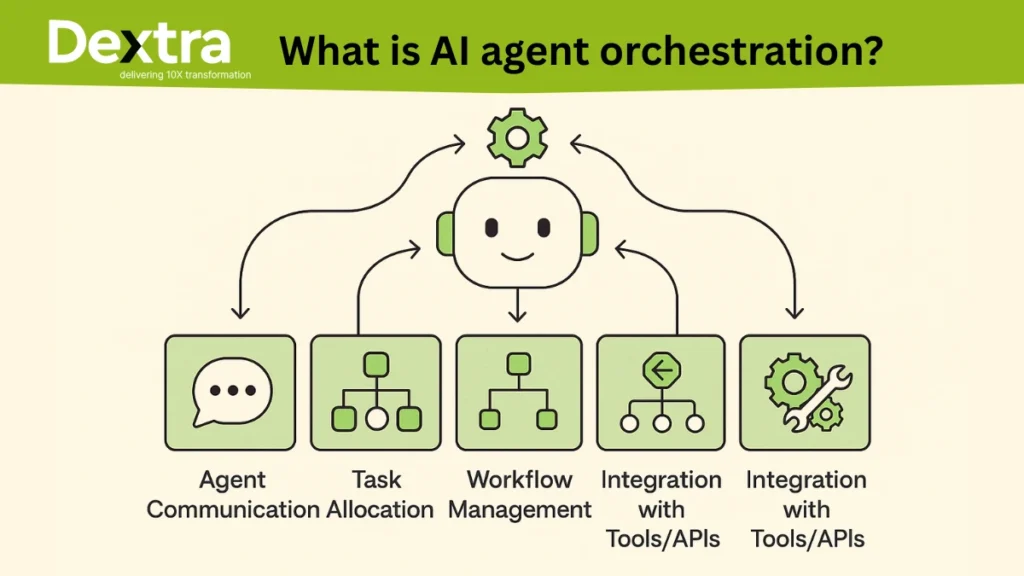
AI agent orchestration means making many intelligent AI tools (called AI agents) work together in a coordinated system to reach a common goal. Instead of relying on one large general-purpose AI, orchestration brings together specialized AI agents, each designed for a specific task, to collaborate and complete complex workflows.
This is achieved by an AI orchestration platform or orchestration system, so the AI agents are synchronized and seamlessly working together. Multi agent orchestration refers to the coordination of multiple specialized agents to solve complex problems more efficiently than a single agent, enabling organizations to handle tasks that would otherwise overwhelm a single agent.
To understand AI agent orchestration, it’s helpful to know what an AI agent is.
There are two distinct types of AI:
- Generative AI: This type of AI creates some new content – such as writing you text or generating you images – based on what you asked for.
- Agentic AI: This type of AI can think for itself, make choices, and take actions to accomplish tasks largely devoid of human assistance. In advanced systems, multiple specialized agents can be orchestrated to tackle complex problems that would be difficult for a single agent to handle.
An AI orchestrator is similar to a manager. It helps the agents to work together in an orchestration framework. They control application orchestration, model orchestration, and the different orchestration layers that help apps and data communicate with each other. Multi agent orchestration improves operational efficiency by distributing tasks among specialized agents, reducing bottlenecks and streamlining workflows.
This approach is becoming essential in enterprise-level AI applications, and Dextralabs is at the forefront of helping businesses deploy and manage such systems.So if you want to know “What is orchestration?”, “orchestration là gì?”, or want to know how it helps with orchestration IT, this guide is a great place to start.

Thinking About Building Your Own AI Agents
Partner with Dextralabs for getting custom design & deployment of Agentic Systems that work
AI Agents Development ServicesWhat is AI Agent Orchestration?
Consider AI agent orchestration as a way to coordinate several AI assistants (each with a defined job) all together in a single orchestration platform. Orchestration platforms enable multi agent workflows and provide control flow for coordinating specialized agents, ensuring efficient execution and communication. Rather than working with a single general AI, you instead collaborate with a network of AI agents, each with a particular specialism, that operate together to automate complex workflows and processes.
For instance, an AI agent could be involved in natural language processing, while another initiates data analytics and yet another sends requests to external APIs. Agent orchestration platforms support task-based assignment and tool usage, allowing each agent to focus on its area of expertise and dynamically adapt to the needs of each task. The orchestration layer brings all of those AI agents together so that they can work as a unified group coordinating and operating as one unit.
Types of AI Agent Orchestration: How Specialized AI Agents Work Together?
When AI agents work together, they can be organized in different ways. Here are the main types of AI agent orchestration, explained simply:
Different orchestration patterns, such as group chat and multi agent collaboration, define how agents interact within the system, enabling real-time coordination and communication among agents.

1. Centralized Orchestration
In this type, there is one “boss” AI agent. The boss tells all of the other agents what to do and makes the big important decisions. This structure allows control from one centralized point, which has the potential to easily keep things organized and running smoothly.
2. Decentralized Orchestration
In this type, there is no “boss” agent. All the AI agents talk directly to each other and work together to make decisions, with decentralized orchestration relying on distributed agents and multi agent collaboration to reach consensus. This structure builds strength in the system and a better ability to handle problems without reliance on just one agent.
3. Hierarchical Orchestration
This type is similar to a team with different levels, where some AI agents act as leaders and the other AI agents act as workers. In this organization, the leaders manage the workers, which adds a level of control with freedom. This helps keep things organized but still lets agents work on their own tasks.
4. Federated Orchestration
This type allows different AI agents or even different corporations to cooperate together without sharing all their data with other parties. Federated orchestration enables collaboration across multiple systems while maintaining robust data governance. This is useful when privacy and security are very important, such as in hospitals or banks. The agents are able to cooperate with each other but still protect their respective information.
Data privacy and security concerns are addressed in federated orchestration through strong encryption protocols and strict access controls, ensuring sensitive information remains protected throughout the orchestration process.
Why Does AI Orchestration Matter?
As AI technology continues to advance, utilizing a single AI system is often insufficient for larger, complex tasks. Many industries like healthcare, finance, and customer service require multiple AI agents to work together in order for their tasks to be completed efficiently. Without an AI orchestration system, they may perform their tasks in isolation and unnecessarily slow things down.
Imagine in healthcare: one AI agent processes diagnostics, another makes appointments, a third processes the insurance paperwork. Orchestration serves as the adhesive in these types of situations, facilitating communication and collaboration in pursuit of common objectives and improving accuracy and speed. AI agent orchestration also breaks down data silos by automating how data flows and integrates across different departments and software platforms.
Dextralabs, we help businesses:
- Deploy LLMs with multi-agent architectures.
- Integrate Agentic AI with real-world tools.
- Design orchestration layers that scale with your needs, delivering process intelligence, real time data, and continuous monitoring as key benefits of effective AI agent orchestration.
AI Agents vs. AI Orchestration: What’s the Difference?
| AI Agents | AI Orchestration |
| Individual AI entities designed to perform specific tasks autonomously, from chatbots to decision-making systems. Task specific AI agents possess unique agent capabilities, such as managing state, memory, and coordination, which are leveraged by orchestration platforms. | The process or platform that connects and coordinates multiple AI agents to work seamlessly together. Orchestration platforms manage and optimize AI agent capabilities across the system, ensuring efficient workflow automation and execution. |
| Operate independently using algorithms that learn from data to make decisions or take actions. | Manages data flows, synchronizes activities, and optimizes resources across all agents in the system. |
Core Components of AI Orchestration: Context Management
To get a clear picture of how orchestration works, let’s understand it in three main parts:
- Automation
This section describes the use of AI to undertake tasks automatically. For example, an AI orchestrator might deploy new models, allocate computing resources for AI workloads, or even self-heal by fixing errors without human effort. Orchestration technologies often use event-sourced execution engines for real-time analysis and scalable process management.
- Integration
Different AI tools and data sources must communicate well. Integration makes sure data flows smoothly and different AI models can interact to boost each other’s performance, with context management and knowledge bases being essential for efficient agent communication and information retrieval.
- Management
Managing AI throughout its lifecycle is crucial. This includes monitoring performance, updating models, and making sure everything complies with security and privacy standards. Explicit state management, memory management, and long term memory are critical for tracking agent state and ensuring reliable operation, with building blocks like Redis Streams supporting these features.
What are the benefits of AI Agent Orchestration?
When you use an AI orchestration platform, you’re giving your AI systems the power to work smarter, faster, and more efficiently. Here are some of the biggest benefits you’ll notice:
- Increased Efficiency- Multi agent orchestration with specialized agents streamlines workflows, reduces redundancies, and allows AI agents to divide the work and complete tasks less repetitively and quickly.
- Greater Flexibility – Adapt easily to new needs, goals or market changes and not having to start everything again.
- Enhanced User Experience: Smarter teamwork leads to less cumbersome, quick and more helpful AI responses.
- Greater reliability: In case one agent goes down the others will take over to ensure things continue going well.
- Easy to Scale – Add more agents or handle bigger workloads without slowing things down.
- Smarter Over Time – AI agents learn and improve with use, making your system better on its own.
Challenges in AI Orchestration (and How We Can Tackle Them)
Just like any other tech, AI orchestration comes with its own set of challenges. But the good news? Most of them can be solved with the right approach.
| Challenge | Solution |
| Complex dependencies | Robust governance + pre-deployment testing. Note: Multi-agent dependencies can lead to widespread failures if agents built on the same foundation models share vulnerabilities highlighting the need for robust data governance and thorough training processes. |
| Coordination issues | Use of standard APIs and communication protocols, plus conflict resolution mechanisms to maintain consistency across distributed agents. |
| Difficulty in scaling | Modular architectures & decentralized agents |
| Task confusion | Reinforcement learning + smart prioritization |
| Data security | Federated orchestration + encrypted communication, with strict adherence to enterprise policies and compliance requirements. |
| System breakdowns | Self-healing agents with fallback systems, supported by human intervention and human in the loop processes for reliability and oversight. |
| Learning stagnation | Feedback loops + online learning models, leveraging machine learning for continuous improvement and adaptation. |
At Dextralabs, we implement all of the above as part of our AI orchestration consulting and development services.
Dextralabs: Your Partner in AI Agent Orchestration
At Dextralabs, we don’t just build AI, we engineer intelligent systems that work together. Our services include:
AI Agent Development – From simple chatbots to advanced agentic systems.
LLM Deployment – End-to-end setup of large language models for enterprise use.
Agentic AI Integration – Connect AI agents into your real-time workflows and tools. Prompt Engineering & Optimization – For agents powered by LLMs like GPT, Claude, or open-source models.
With us, you get custom AI orchestration frameworks built to scale and evolve, designed by a team that understands both the technology and your business needs.
Conclusion
To maximize value from your AI systems, you should begin with an understanding of, and the use of, native integrated orchestration and the right application orchestration tools. Whether you’re an orchestration expert or just simply beginning to try to explore orchestration là gì (which means “what is orchestration?” in Vietnamese ), one thing that is clear is that your success is dependent upon how well your specialized AI agents collaborate.
AI is not only about smarter models in the future, but smarter engagement. Orchestration frameworks relate to this idea. From the orchestration layer to the complete orchestration system, having the right structure makes everything run better.
When you bring in app orchestration, orchestration enablement, and strong model orchestration, you’re not just building powerful AI – you’re building systems that are faster, more reliable, and ready to grow with your needs.
So, what is orchestration? It’s the ability to connect, manage, and improve all your AI tools through teamwork. And that’s exactly what will drive the next wave of AI innovation, for all of us. Whether you’re just beginning to explore “orchestration là gì” (which means “what is orchestration?” in Vietnamese) or you’re scaling enterprise-level AI systems, Dextralabs is here to help.
If you’re looking to move from agentic AI concepts to a production-ready system, our AI engineers Labs can help you architect and build the right orchestration layer around your business workflows. Explore our AI Agent Development Services to build custom agents that can coordinate tools, data, and multi-step processes reliably.
FAQs on AI agents orchestration:
Q1. What is AI agent orchestration and how does it work?
AI agent orchestration is the process of managing and coordinating multiple AI agents, each specialized for a specific task, to work together as a unified system. It involves an orchestration platform that facilitates communication, synchronizes workflows, handles task delegation, and ensures all agents operate efficiently. Orchestration platforms coordinate autonomous systems and autonomous AI agents, enabling them to collaborate, manage memory, and achieve unified goals. This system enables automation of complex, multi-step processes across applications and data sources.
Q2. What are the main types of AI agent orchestration architectures?
There are four key orchestration types:
– Centralized Orchestration: One lead agent makes decisions and controls others.
– Decentralized Orchestration: Agents work together peer-to-peer without a central authority.
– Hierarchical Orchestration: Structured like a team with leader and worker agents.
– Federated Orchestration: Allows agents across different systems to collaborate without sharing sensitive data ideal for healthcare, finance, and privacy-first environments.
Q3. What are the core components of an AI orchestration platform?
An effective AI orchestration platform includes:
– Automation Layer: Deploys models, allocates compute, and handles self-healing.
– Integration Layer: Connects data pipelines and APIs for seamless agent communication.
– Management Layer: Monitors agent performance, updates models, and enforces security and compliance.
Dextralabs builds orchestration frameworks combining all three for enterprise-scale deployments.
Q4. What is the difference between AI agents and AI orchestration?
– AI Agents are autonomous units that perform specific tasks, such as responding to queries, analyzing data, or sending API calls.
– AI Orchestration is the system that connects, manages, and synchronizes multiple agents to complete larger workflows collaboratively.
Think of agents as workers, and orchestration as their project manager.
Q5. How is generative AI used in orchestration?
Generative AI orchestration involves coordinating multiple generative models (e.g., text, code, images) to automate content creation processes. For instance, one agent might generate customer emails, another creates product descriptions, while another reviews the tone for brand consistency. Orchestration ensures these generative tasks happen in sequence and integrate seamlessly with business tools or APIs.
Q6. What are the biggest technical challenges in AI agent orchestration?
Common challenges include:
– Scalability: More agents mean more complexity solved by modular, decentralized architecture.
– Task Assignment Conflicts: Handled using reinforcement learning or dynamic decision trees.
– Security & Privacy: Addressed through federated learning and encryption.
– Coordination Errors: Minimized by using standard APIs and real-time feedback loops.
Dextralabs tackles these issues with customized orchestration frameworks and pre-tested agent integration layers.
Q7. Can I integrate LLMs like GPT-4 into my AI agent orchestration system?
Absolutely. Large Language Models (LLMs) like GPT-4 can act as central reasoning agents, natural language processors, or prompt responders within an orchestration system. At Dextralabs, we specialize in LLM deployment, prompt engineering, and integrating LLMs into multi-agent systems for customer service, RPA, document processing, and more.