Artificial intelligence agents are autonomous systems that can perceive information, make decisions, and take actions to achieve specific goals. As businesses increasingly adopt AI-driven automation, understanding the different types of AI agents has become essential for selecting the right solutions for customer service, operations, analytics, and decision-making.
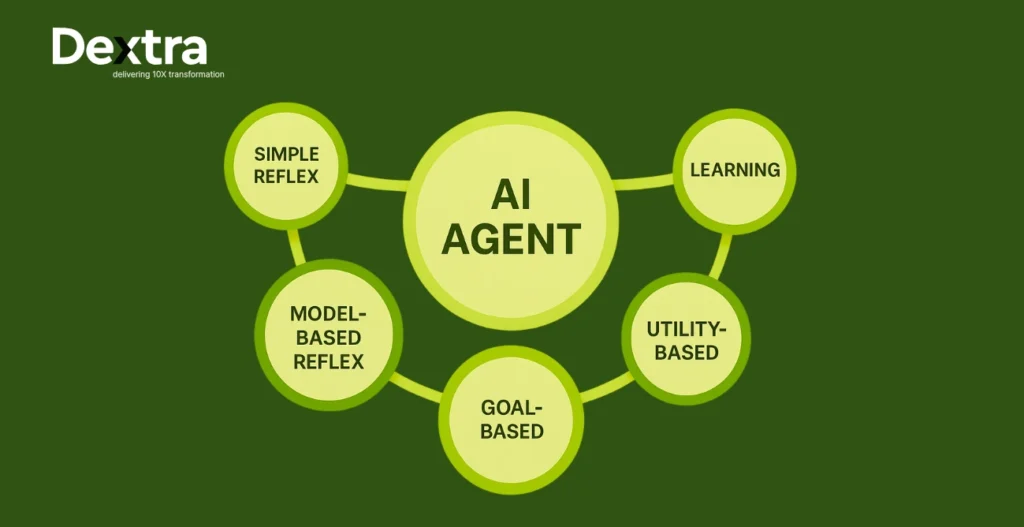
The most common AI agent types include simple reflex agents, model-based reflex agents, goal-based agents, utility-based agents, and learning agents. Each type uses a different approach to processing information, solving problems, and interacting with its environment.
In this guide, we’ll explain the 5 core types of AI agents with examples, diagrams, functions, and real-world business applications. You’ll also learn what are the 4 types of agents commonly discussed in AI, how a rational agent in AI makes decisions, and when to use each architecture for enterprise automation and intelligent systems.
Whether you’re a business leader, developer, or AI strategist, understanding these AI agent types will help you build smarter, more scalable AI solutions in 2026.
The 5 Core Types of AI Agents (With Examples)
1. Simple Reflex Agents
These are the most basic types of AI agents. They respond directly to what’s happening around them using predefined rules—no memory, no reasoning, just action.
How They Work:
Simple reflex agents operate using direct condition-action rules. They check environmental conditions and, based on these predefined condition action rules, trigger specific actions. Simple reflex agents operate using direct condition-action rules and do not maintain any internal state.

Example:
A thermostat is a perfect example. When the temperature drops below a set point, it turns the heat on, no thinking involved. Simple reflex agents operate based on direct responses to environmental conditions using predefined rules.
Ideal For:
Simple, repetitive tasks where fast response matters more than strategy.
2. Model-Based Reflex Agents
These agents keep an internal model of their environment, so they don’t just react, they actually think things through. Model-based reflex agents extend simple reflex agents by maintaining an internal representation of the environment, allowing them to reason about aspects of the world they cannot directly observe. They can look at the current situation, weigh the possible outcomes of different actions, and then decide what to do next. A great example? A self-driving car. It uses past data and current conditions to make smart driving decisions in real time. These agents use past interactions to inform their decisions and adapt to changing environments.
How They Work:
They evaluate current input and past states to choose a better response. Model-based reflex agents maintain an internal representation of the environment, which helps them infer unobservable aspects and update their understanding over time.

Example:
A self-driving car is a great example. It tracks road conditions, previous turns, and nearby vehicles to adjust its driving. Model-based reflex agents incorporate an internal model of the world to track the current state of the environment and understand past interactions.
Ideal For:
Autonomous machines, robotics, and smart environments.
3. Goal-Based Agents
Goal-based agents are all about purpose. Unlike reflex agents, they’ve got a clear objective, and they plan their actions to reach it. Instead of just reacting, they think ahead and choose steps that move them closer to their goal. Goal-based agents evaluate actions based on whether they move the system closer to defined objectives. For example, think of a fitness app that tracks your daily activity and suggests workouts—it’s using your data to help you hit your fitness targets. That’s a goal-based agent in action.
How They Work:
They plan actions to achieve their objectives and evaluate potential actions based on whether they’ll help achieve the goal. These agents consider future states and future consequences when making decisions, using planning and reasoning to optimize outcomes.

Example:
Think about a fitness app that tracks your steps and suggests workouts. Its goal is to improve your health, and it chooses strategies that get you closer to that goal.
Ideal For:
Systems that need to adapt to changing conditions to meet a goal.
As tasks become more open-ended or require sequencing, goal-based or utility-based agents become more appropriate.
4. Utility-Based Agents
These agents are all about making smart choices. They’re usually assigned a specific function and often work alongside other agents to get tasks done. What sets them apart is how they use advanced reasoning to compare different options and pick the one that gives you the best result.
Utility-based agents optimize decisions by measuring the utility of each possible action to maximize overall benefit.
Let’s say you need to query a database, send an email, or retrieve a document, a utility-based agent can handle that. It examines all the potential results it can produce in order to select the most advantageous based on a utility function. It’s not just about getting things done but it’s about doing them in the most effective way.
How They Work:
They assign a value (utility) to each possible outcome and pick the one with the highest score. Utility-based agents use expected utility to evaluate possible outcomes, allowing them to make decisions that maximize overall benefit even in dynamic environments.

Example:
A utility-based agent would scan possibly thousands of product options, customer preferences, and past behavior to recommend the perfect item.
Or a self-driving car might balance speed, safety, and fuel efficiency to pick the best route.
Utility-based agents are also used in e-commerce systems to optimize prices based on demand and inventory levels.
Ideal For:
Complex environments with trade-offs and multiple desirable outcomes.
Utility-based agents are effective in dynamic and complex environments, where simple binary goal-based decisions might not be sufficient.
5. Learning Agents
Learning agents are the most complex type of AI agents, possessing the ability to learn. They are like the AI that never stops improving. They don’t just follow fixed rules, they learn from experience. Over time, they refine their behavior based on the data they collect and the feedback they get.
They prove to be very beneficial when you require your systems to evolve quickly or gain additional intelligence as they run.
How They Work:
They use feedback from the environment to adjust behavior. The more they interact, the better they get. The performance element of a learning agent is responsible for selecting actions based on updated knowledge, working alongside the learning element and critic to enhance decision-making over time.

Example:
A spam filter is a classic example. It starts with basic rules, then learns from what you mark as spam and what you don’t, improving its accuracy over time. The ability to learn from interactions makes learning agents valuable for applications in fields such as persistent chatbots and social media.
Ideal For:
Dynamic environments like customer support, personalization, NLP-based assistants, and predictive systems.
Learning introduces operational overhead and evolving behavior that complicates testing and governance.
Extended Architectures: Going Beyond the Core 5
6. Hierarchical Agents
These agents operate within a hierarchy where higher-level agents manage strategy and oversee lower-level agents, who handle specific tasks. They break complex tasks into manageable chunks by organizing and coordinating multiple levels of abstraction.
- Example: In a smart city, lower-level agents might manage traffic signals, while higher-level agents optimize traffic flow city-wide.
Hierarchical agents break down complex tasks into smaller, manageable subtasks, allowing for better organization and execution. As AI systems become more intricate, the need for hierarchical agents arises to manage complex problems by breaking them into smaller tasks.
7. Multi-Agent Systems (MAS)
Sometimes, it’s not about one super-agent, it’s about multiple agents working together. In many complex, large-scale, or fast-changing problems, one agent or a single agent is not sufficient to handle all the requirements. That’s why multi-agent systems (MAS) are used, where each agent handles a different task, and together, they achieve a shared goal.
- Example: In a smart factory, different agents might:
- Control machines (reflex agents)
- Monitor production status (model-based agents)
- Plan manufacturing schedules (goal-based agents)
- Optimize resources (utility-based agents)
- Improve efficiency over time (learning agents)
- Interact and collaborate with other AI agents to coordinate actions, share information, and adapt to changes in real time
This coordinated approach is a key foundation of agentic AI, where multiple specialized agents can plan, use tools, and work together toward a broader objective.
Moreover, this orchestration of agents is where real AI power shines. However, it’s important to note that each type of AI agent has its own drawbacks for deployment or adoption.
How AI Agents Work?
The way AI agents work depends on their underlying architecture, ranging from simple reflex agents that react instantly to inputs, to advanced hierarchical agents that break down complex tasks and delegate them to lower level agents for execution.
At the core, every AI agent operates through three main components: perception, reasoning, and action. Perception involves collecting data from various sources—such as APIs, databases, sensor data, or user interactions—giving the agent context about its environment. Reasoning is where the agent processes this information, using logic, rules, or machine learning to determine the best course of action. Finally, the action component executes the chosen decision, often by interacting with external systems, APIs, or business processes.
Unlike simple reflex agents, which rely solely on fixed rules and immediate inputs, more advanced agent types—such as model based reflex agents—maintain an internal representation of the environment. This internal model allows them to reason about unobserved or partially observable aspects, anticipate future consequences, and make more informed decisions. Goal based agents take this further by evaluating possible actions based on how well they help achieve a desired outcome, while utility based agents use utility functions to weigh multiple options and select the one with the highest expected benefit.
Learning agents add another layer of sophistication by incorporating feedback loops. These agents use historical data and past interactions to continuously improve their performance, adapting to dynamic environments and evolving business needs. By leveraging techniques like natural language processing and machine learning, learning agents can handle complex tasks such as customer support, workflow automation, and predictive analytics with minimal human input.
In many enterprise scenarios, businesses deploy multi agent systems—collections of multiple autonomous agents that collaborate or compete to solve complex tasks. In these multi agent setups, each agent may specialize in a specific function, such as monitoring, planning, or optimization. Through cooperative and competitive behaviors, these agents can manage distributed workflows, automate routine tasks, and enable multi agent collaboration for large-scale operations.
Choosing the right agent type depends on the nature of the task, the complexity of the environment, and the level of autonomy required. For example, simple reflex agents are ideal for repetitive tasks with clear condition action rules, while model based agents excel in partially observable environments where reasoning about past and future states is crucial. Goal based and utility based agents are suited for decision making in scenarios with multiple possible outcomes, and learning agents are essential for applications that demand continuous improvement.
Real world scenarios showcase the versatility of AI agents. Self driving cars combine sensor data, computer vision, and advanced reasoning to navigate dynamic environments. Energy management systems use multiple specialized agents to optimize resource usage across facilities. Conversational agents powered by large language models automate customer interactions and streamline business processes.
By building AI agents tailored to specific business needs—whether as custom ai agents or by integrating multiple agents into a cohesive system—organizations can automate routine tasks, enhance decision making, and adapt to rapidly changing markets. Understanding how different types of ai agents work, and how to deploy ai agents effectively, is key to unlocking the full potential of advanced ai systems in the enterprise landscape.
Customization and Deployment: Bringing AI Agents to Life
Bringing AI agents from concept to reality requires more than just understanding their types, it’s about customizing and deploying them to fit your unique business landscape. Whether you’re automating routine tasks or orchestrating complex workflows, the right approach to deploying AI agents can make all the difference.
The right architecture also needs to account for your workflows, existing systems, data, and level of autonomy. That’s where AI Agent Development Services can help turn a suitable agent type into a production-ready solution built around your specific business requirements.
Selecting the Right AI Agent Types
The first step is to identify which AI agent type aligns with your business goals. For straightforward, repetitive tasks, simple reflex agents—driven by fixed rules and minimal human input, are ideal. When your environment is more dynamic or partially observable, model-based reflex agents shine by leveraging an internal model and sensor data, such as computer vision, to inform decisions. Goal-based agents are perfect for scenarios where achieving specific outcomes, like optimizing energy management systems, is the priority. Utility-based agents excel in situations requiring nuanced decision making, using utility functions to weigh options, think conversational agents that tailor responses for maximum user satisfaction. For environments that demand adaptability and continuous improvement, learning agents harness machine learning to evolve over time.
Deploying Multi-Agent Systems for Complex Tasks
In many enterprise scenarios, a single agent isn’t enough. Multi agent systems, composed of multiple autonomous agents, each specialized for different tasks, enable organizations to tackle complex tasks that require both cooperation and competition. For example, in a smart factory, multiple agents might collaborate to optimize production schedules, monitor equipment, and manage resources, all while adapting to real-time changes in the environment.
Hierarchical and Hybrid Agents for Scalable Solutions
Hierarchical agents take this a step further by structuring agents into higher-level and lower-level layers. Higher level agents oversee strategy and coordination, while lower level agents handle specific, granular tasks. This approach is especially effective for breaking down complex workflows into manageable components, ensuring both agility and scalability. Hybrid agents and workflow agents can also be customized to automate business processes that span multiple systems or departments.
Best Practices for Deploying AI Agents
To successfully deploy AI agents and maximize their impact, consider these best practices:
- Define clear objectives: Pinpoint the specific tasks, business processes, or desired outcomes you want to automate or enhance.
- Choose the right agent type: Match the agent type—be it reflex agents, model based agents, goal based agents, utility based agents, or learning agents—to the complexity and adaptability required for your use case.
- Configure and customize: Tailor your AI agents using advanced techniques like natural language processing and machine learning to address your organization’s unique needs.
- Integrate with existing systems: Ensure seamless communication by connecting AI agents to your current infrastructure through APIs and robust data pipelines.
- Monitor and evaluate: Continuously track agent performance using metrics such as accuracy, efficiency, and user satisfaction, and refine as needed.
Unlocking the Power of Multi-Agent Collaboration
Multi agent collaboration enables multiple agents to work together—sometimes cooperatively, sometimes competitively—to achieve business goals more efficiently. This is especially valuable in dynamic environments where conditions change rapidly and agents must adapt in real time.
Tailoring AI Agents for Real-World Scenarios
By understanding the strengths of different types of AI agents and how they can be customized, businesses can deploy AI agents that not only automate routine tasks but also drive innovation and efficiency across complex, real-world scenarios. Whether you’re leveraging simple reflex agents for repetitive processes, deploying model based agents in partially observable environments, or orchestrating multiple specialized agents in a multi agent system, the key is to align your AI strategy with your business objectives.
At Dextralabs, we help organizations build, customize, and deploy AI agents that deliver measurable results, empowering you to automate, optimize, and scale with confidence in 2026 and beyond.
Wrapping It Up: Why AI Agent Types Matter for Businesses in 2026
So, now that we’ve explored the types of AI agents, it’s clear that understanding the agent architecture in AI isn’t just a tech detail—it’s a strategic advantage. Whether you’re looking at a simple reflex agent or a highly adaptable learning agent in AI, each plays a unique role in how systems think, react, and improve.
By combining different agent types, like the rational agent in AI that always aims to make the best decision, or the utility-based agent in AI that chooses the most beneficial action, you can build powerful systems that not only automate tasks but actually improve how your business runs day-to-day.
As we head deeper into 2026, businesses that invest in the right mix of AI agents will be better equipped to handle change, scale efficiently, and deliver smarter, faster solutions. Artificial intelligence agents already make a difference by speeding up processes and improving customer interactions and they keep improving further.
If you’ve ever asked, “What is AI agents?” or “How many types of AI agents are there?”, now you’ve got the answer.

Looking to Build Custom AI Agents?
From workflow automation to autonomous decision-making, Dextralabs develops AI agents tailored to your business needs. ✔ Custom AI Agents ✔ Multi-Agent Systems ✔ Enterprise AI Automation
? Talk to Our AI Agent ExpertsFAQs:
Q1. What are the 5 types of agents in AI?
The five main types are simple reflex agents, model-based reflex agents, goal-based agents, utility-based agents, and learning agents.
Q2. What are the 7 types of AI?
The 7 types of AI are Reactive Machines, Limited Memory, Theory of Mind, Self-Aware AI, Narrow AI, General AI, and Super AI.
Q3. What are examples of AI agents?
Examples include thermostats (simple reflex), self-driving cars (model-based), fitness apps (goal-based), recommendation engines (utility-based), and spam filters (learning agents).