
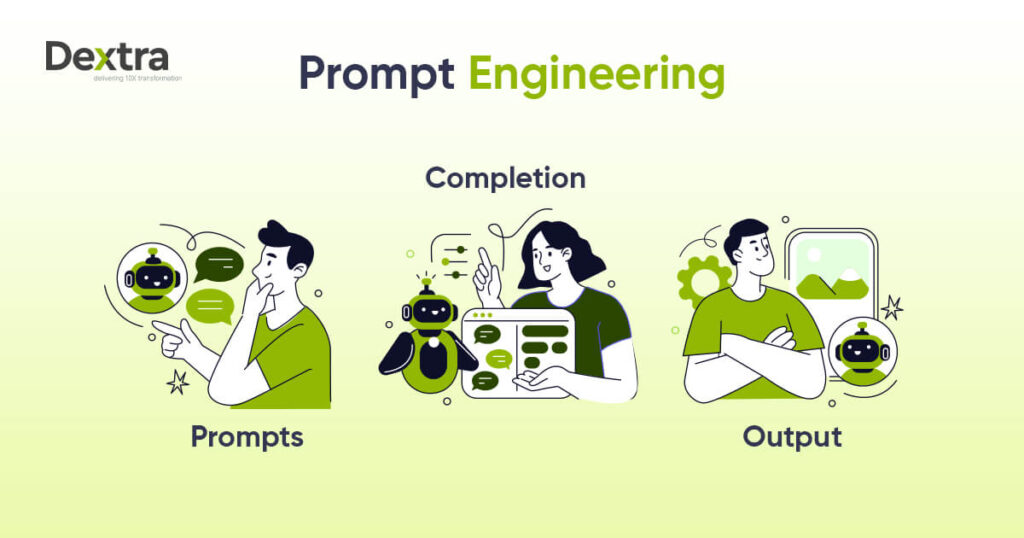
Today, fast-growing tech companies are evolving to deliver more automated and prompt results for their business growth, and the enormously increasing market demand is for building more adjustable and understandable business models. Many tech giants are in the race to bring prompt results in their operations and user-generated feedback to enhance the overall goodwill of their business and products, respectively. Prompt engineering is important for optimizing AI outputs and is becoming a foundational skill for anyone working with AI systems, as it enables professionals to shape model behavior with clarity and purpose.
The prolific combination of human interaction and Artificial Intelligence remarkably achieves top-of-the-line milestones in generating constructive results. Prompt engineering acts as a bridge between human intent and machine understanding for AI systems, particularly large language models (LLMs). The rise of large language models (LLMs) has brought forth exciting possibilities for human-computer interaction, and prompt engineering use cases now span coding, data analysis, content generation, and conversational system design. This article explains the dynamic, trendy implementation of Artificial Intelligence (AI), its importance, and the future of AI.

Optimize Your AI Investment
Maximize accuracy, efficiency, and ROI with Dextralabs’ prompt engineering expertise
LLM prompt consultingIntroduction to Generative AI
Generative AI is a transformative branch of artificial intelligence designed to create new, original content—ranging from text and images to music and code—by learning from vast datasets. Unlike traditional AI systems that simply analyze or classify data, generative AI models can produce human-like text, realistic images, and even complex code snippets based on natural language instructions. This capability is powered by sophisticated algorithms that recognize patterns and relationships within the data, enabling the AI to generate outputs that are both relevant and creative.
In the context of prompt engineering, generative AI systems rely heavily on the quality and clarity of the prompts they receive. Effective prompt engineering is crucial for guiding these AI models to deliver the desired outcomes, whether that means generating accurate responses, summarizing information, or automating business workflows. As organizations increasingly adopt generative AI tools for tasks like language translation, content creation, and workflow automation, mastering prompt engineering becomes essential for unlocking the full potential of artificial intelligence.
Understanding Language Models
At the heart of generative AI are language models—powerful algorithms trained on massive amounts of text data to understand and generate natural language. These models, such as transformers and recurrent neural networks (RNNs), are designed to predict and produce coherent text based on a given prompt. Large language models (LLMs) like GPT-4 and similar AI systems have set new standards for generating human-like responses across a wide range of applications.
Understanding how these language models work is key to effective prompt engineering. By knowing the strengths and limitations of different models, prompt engineers can craft prompts that maximize the model’s reasoning ability and produce more relevant output. Techniques such as few-shot prompting, where one or more examples are provided, and chain-of-thought prompting, which encourages step-by-step reasoning, help guide the model to generate more accurate and contextually appropriate responses. Mastering these prompt engineering techniques allows organizations to leverage generative AI for more complex tasks and achieve higher-quality results.
What Is the Prompt Engineering?
In prompt engineering, humanly written instructions are given to AI tools in a set of sentences, phrases, or topics, which are processed into valuable information called prompts. These prompts can vary depending on the variety and complexity of the topics. Each written prompt requests the Generative AI for a specific topic, not for a variety of information on multiple topics. The fundamental integration in the Generative AI is based on Machine Learning (ML), which helps to transform the searched text query into helpful information. However, Generative AI cannot process your data into your desired information until you provide the best-matched and relevant piece of context (prompt). Prompt engineering is the practice of writing clear, purposeful inputs that guide AI models to deliver accurate and context-aware outputs.
For Example, if you are hosting a weekend party and calling all of your office colleagues to your home, the first thing you will be doing is asking about their favourite night meal, which ultimately helps you to order food of their choice. Adding prompts is the same as this example; your small pieces of words can be processed into useful information, sticking to your desired topic. Crafting effective prompts involves specifying the desired task and using direct instruction to ensure the AI understands exactly what is needed. Clarity and specificity in prompt engineering help to clearly communicate requirements, avoiding ambiguity and irrelevant answers.
How to Write the Best AI Prompt?
Mastering the best-optimised AI prompt and finding related materials and examples can be easy if you know the basic fundamentals of using Generative AI tools and are familiar with some basics of AI prompts. Crafting effective prompts is crucial, as the quality of your prompt is directly related to the quality of the response you receive from a large language model (LLM). These commanding words can generate consummate information that can play a vital role in your business growth. Some key tips for writing a well-constructed AI prompt are:
- Be clear and specific in your instructions.
- Use concise language and avoid ambiguity.
- Provide background information in your prompt to help the model understand the scenario and context.
- Experiment with different prompt structures to determine which yields the most effective prompts for your use case.
Testing prompts and refining prompts through an iterative process is essential for achieving optimal results. By continuously adjusting and improving your prompts, you can better align AI outputs with your expectations and real-world needs.
Step 1-Prior Data Input Practices
The basics of the best data input writer require prior data input knowledge and hands-on practices to generate multiple results and find the exact information available on these tools. There are millions of data points and their dimensions; the expert writer can write the particulars to find and deliver the project. Prompt engineers must be familiar with the trends and updates regarding data mining.
Step 2-Following the Data Updates
If you are a prompt engineer serving industries with data extraction, you must be aware of finding the relevant data and following up until the exact data is extracted and your desired goals are achieved. You can instruct the tool multiple times and can play until you sense of getting the desired outputs in the keyframe.
Step 3-Crystal Clear With Your Thoughts
This is the most important ingredient in finding relevant data and helping you write optimal prompts. Prompt engineers must clearly understand their thoughts and vision about their search query. You have to be logical and specific with your details in forming a prompt and removing all unnecessary mentions for a smooth and relevant outline.
What is Prompt Engineering in Large Language Models?
Prompt engineering is the process of turning a user-given context in the form of sentences, phrases, or words into the best generative AI tools for searching specific topic information aligned with user intent. Prompt engineering helps teams build AI capabilities directly into products and services, defining how models interact with user input and interpret context. The AI tool collects data at the first stage, and then it refines the processed data to show helpful material.
The primary tools in AI engineering are ChatGPT, Google Gmeini, or DALL-E. These tools are integrated with large language models (LLMs) and provide accurate and fact-generating results. Language models generate responses and generate desired outputs based on the prompts they receive. The process of these tools refines topic-relevant prompts and shows a detailed understanding, such as search results for coding and other materials. Effective prompt engineering directly influences the quality and relevance of the model’s responses.
Top Skills for a Prompt Engineer
Top Skills for a Prompt Engineer
Generative AI has transformed data-searching queries and is rapidly growing worldwide on the internet with helpful tools, which is increasing the demand for prompt engineers to generate dedicated results and reform their pre-existing data infrastructure into useful information and prompt performance results. Developing prompt engineering skills is becoming foundational for anyone working with AI systems, as it teaches how to shape model behavior with clarity and purpose.
In light of an industrial requirement and managing the business loads, there are some basic skills a professional Prompt Engineer must learn and have a strong grip on for phenomenal results, which are:
- Detailed Understanding of Artificial Intelligence (AI)
- Basic understanding of Machine Learning (ML) and Natural Language Processing NLP
- Data Analysis and Familiar with Integrated Tools
- Understanding programming language and external tools
- Ability to Write Useful Prompts
- Scientific Acumen
Types of Prompt Engineering
Prompt engineering is technically effective for large language models and OpenAI’s GPT-4 or ChatGPT for maximum data outputs. By experimenting with different prompt structures and using direct prompts in zero-shot scenarios, users can optimize AI performance for various applications. Prompt engineering enables instructing AI to perform different tasks—such as summarization, sentiment analysis, or coding—by designing prompts that guide the model efficiently. Techniques like few-shot prompting can be used to perform a specific task by providing examples within the prompt. Some major types of Prompt Engineering are commonly used in personal and business enterprises.
1. Zero-Short Learning
Zero-shot engineering refers to a user who writes prompts without exact objectives and inputs without examples of specific queries. In zero-shot prompting, the model is instructed to perform a task without providing any examples, relying on its understanding of the task. This approach often uses direct prompts and direct instruction, where explicit, clear commands are given to guide the AI without additional context or examples. This learning can be used by beginner-level users or experts who intend to test the tools before delivering many inputs.
2. One-Short Learning
This is an advanced type of zero-shot prompting because, in one-shot prompting, the user can write a more detailed prompt and add only one relevant example, which helps the tools understand the input more efficiently and provide the best results.
3- Few-Short Learning
The input with a few topic-relevant examples and the best-constructed prompt can suggest to the tool exactly what you are searching for. You can break your prompt into small segments for more understanding and to deliver quality results to your search.
4-Chain-of-Thought Prompting
This is considered the most critical and logical type of prompting in which users can put all the related prompt details and sets of examples aligned to the topic. In the Chain-of-thought prompting, the whole informational input breaks into smaller segments to perfectly understand the topic and perform the best-optimised results in a more efficient and logical way. Just like human performance, these smaller segments are easily understandable and they also enhance the quality of the tools.
5-Negative Prompting
Negative prompting is the most organised way of prompting that allows the tools not to perform such activities and does not show irrelevant results where the user gives clear instructions to the tool not to do so. For example, you are clearly instructing your tool not to do such things, and don’t show me these results, and they don’t want certain information in their search.
What are the Important Benefits of Prompt Engineering?
In recent years, the use of prompt engineering has increased staggeringly because it provides prompt, more accurate results and assistive information for any personal or business query. There are packs of prompt engineering benefits, but we are elaborating on a few for your understanding.
1. Generating Accurate and Assistive Outputs
The basic fundamental of prompt engineering is providing high-quality and relevant information on any topic. Well-structured prompts can generate boilerplate code, offer syntax corrections, or suggest cleaner ways to refactor existing logic in software development. You have to be focused while writing your prompt and providing relevant material to your problem to gain the maximum output. The information and stats are updated and correct, gathered from the available information on the Internet. The well-researched results process on these AI tools can be obtained only if you can write a best-matched prompt and maintain the topic relevancy throughout your input for maximum output and data accuracy.
2. Enhance Efficiency in AI Interactions
Prompt engineering accurately processes and refines the given data, building and strengthening the tool’s efficiency. These tools are integrated with each other to improve the performance of their user data, reduce bugs, maintain an easy-going process, and generate millions of ideas for their topics. These technologies enhance overall productivity and working efficiency, and the major AI integrations in their business can benefit them by acquiring fewer teams to manage their workflows more smoothly.
3. One-to-One Response
In the whole search process of prompt engineering, single or multiple users can benefit from these AI tools and process their data into assistive information for their personal or business use. When a user writes a prompt and the AI tools generate their results, it forms a one-to-one human-AI interaction, which leads them to curate a professional bond with technology.
4. Best Performance
All the tools in Generative AI (ChatGPT, Google Gemini AI, and others) are continuously improving and optimizing their tools for better performance and using all relevant technologies to manage the rapidly growing number of users on the internet with well-researched information to their queries. Better control over understanding the prompts and processing them into their desired intent is definitely building more trust and the user’s objectives for using this specific tool.
5. Creative and Innovative Integrations
AI is more focused on building authentic goodwill and merging with all the technologies to perform for each model. The variety of creative ideas, nurturing the data into useful information, and providing creative instructions for their coming projects and benefiting them in their personal and professional lives make it more creative and innovative. These tools are integrated with major technologies working for the user’s intent to provide valuable material.
Measuring the Success of Prompt Engineering
Evaluating the effectiveness of prompt engineering is essential for ensuring that AI models consistently deliver the desired output. Success can be measured using several key metrics: accuracy (how closely the model’s response matches the intended result), relevance (how well the response addresses the prompt), and fluency (the coherence and readability of the generated text). By systematically measuring these factors, organizations can identify areas for improvement and refine their prompt engineering strategies.
For more complex tasks, leveraging advanced techniques such as zero-shot prompting—where the model is given a direct prompt without prior examples—or few-shot prompting, which includes a few examples to guide the model, can significantly enhance performance. These shot prompting methods help AI systems generalize better and produce more accurate responses, even when faced with unfamiliar or nuanced requests. Regularly testing and optimizing prompts using these metrics ensures that generative AI tools remain effective and aligned with business objectives.
Overcoming Challenges in Prompt Engineering
Prompt engineering is not without its challenges, especially when dealing with complex tasks or deploying large language models in enterprise environments. One major hurdle is crafting prompts that are clear, specific, and unambiguous—vague or poorly structured prompts can lead to irrelevant or inaccurate AI outputs. Another significant concern is the risk of prompt injection attacks, where malicious actors manipulate prompts to influence the model’s responses in unintended ways.
To address these challenges, prompt engineers can employ advanced prompting techniques such as meta prompting and directional stimulus prompting, which help guide the model’s reasoning ability and reduce ambiguity. Chain-of-thought prompting and generated knowledge prompting are particularly effective for breaking down complex reasoning tasks, enabling large language models to produce more logical and accurate results. By staying vigilant against prompt injection attacks and continuously refining prompt structures, organizations can ensure the reliability and security of their generative AI systems.
The Importance of Human Judgment in Prompt Engineering
While advanced prompting techniques and automation have greatly enhanced the capabilities of generative AI, human judgment remains a cornerstone of effective prompt engineering. Human evaluators play a critical role in assessing the accuracy, relevance, and fluency of AI-generated responses, ensuring that outputs meet the desired standards and are appropriate for the target audience. This oversight is especially important for applications where fairness, bias mitigation, and ethical considerations are paramount.
Incorporating human feedback allows prompt engineers to iteratively refine prompts and improve the overall performance of AI systems. Techniques such as prompt chaining—where multiple prompts are linked to guide the model through complex reasoning—and self-consistency prompting can help reduce the need for constant human intervention, but they cannot fully replace the nuanced understanding that human reviewers provide. By combining human expertise with advanced prompt engineering best practices, organizations can achieve more reliable, scalable, and impactful results from their generative AI investments.
Application of Prompt Engineering
Generative AI is playing an assistive role and becoming more sustainable in digital reforming business models. It is also benefiting individuals by refining their intellectual thoughts and career growth. Therefore, many websites and apps are adding AI in their products and real-life experience.
Prompt engineering is a foundational skill across AI-assisted workflows, enabling teams to shape how AI models respond to a wide range of tasks. Prompt engineering use cases span industries such as software development, documentation, testing automation, chatbot interactions, data analysis, AI feature development, and workflow optimization, demonstrating its versatility and value in real-world scenarios.
1. Chat Support System
The advanced use of Generative AI is integral in the customer chat support system. It generates automated replies and suggests the best communication material for maximum customer engagement, enhancing mutual trust and confidential bonding. This integration makes the role of the prompt engineer more significant and generates real-time feedback.
2. Healthcare Organizations
Nowadays, the data in the hospital organisation is converting into helpful information that helps the long-term disease-fighting patient to monitor their health record, and can be used for more useful information for the students and the pharmaceutical teams. The data of daily visiting patients is summarised into the data sheets, and their treatment prescriptions can help the management maintain the supply of medicine and medical equipment.
3. Coding
In the whole process of web development, generative AI tools help developers learn and code their respective websites. Prompt engineering can be used to guide AI in code completion tasks, where developers provide partial code snippets and request the AI to generate the remaining code based on the programming language and context. It also enables the AI to analyze, enhance, or modify existing code, making it easier to optimize, debug, or translate code segments. For example, developers can prompt AI to generate or improve python code for specific programming tasks. Specifying the programming language in prompts is crucial when using AI for code-related tasks, as it ensures accurate translation, optimization, or debugging across different programming environments. The maximum use of these tools enables the development teams to perform their tasks more efficiently and in more controlled ways, enabling them to track their overall achievement and performance.
The Bottom Line: Prompt Engineering Is the Skill That Separates Good AI From Great AI
Prompt engineering is no longer a niche technical skill, it’s quickly becoming as fundamental as knowing how to use a search engine. Whether you’re a developer building AI-powered products, a marketer automating content workflows, or a business leader looking to cut operational costs with AI, your ability to write clear, purposeful prompts directly determines the quality of results you get.
From zero-shot prompting to chain-of-thought reasoning, the techniques covered in this guide give you a practical foundation to start extracting real value from large language models like ChatGPT, GPT-4, and beyond. But mastering prompts is just the beginning.
The real competitive advantage comes from building AI into your systems at scale and that’s where most businesses hit a wall. Crafting a great prompt is one thing; architecting an AI pipeline that’s accurate, secure, scalable, and aligned with your business goals is an entirely different challenge.
That’s where Dextralabs comes in.
As an enterprise-grade AI consultancy, Dextralabs helps US businesses go beyond basic prompt engineering and build production-ready AI systems tailored to their specific workflows. Whether you need LLM integration, custom AI model selection, prompt optimization at scale, or end-to-end AI deployment — Dextralabs brings the expertise to make it happen efficiently and responsibly.
💡 Ready to turn your AI investment into measurable ROI? Talk to Dextralabs and find out how enterprise prompt engineering can transform your operations.
The future of business is AI-powered. The businesses that master how to talk to AI and build systems that do it consistently, will be the ones that lead their industries. Start with the fundamentals here, and when you’re ready to scale, you know where to go.
Frequently Asked Questions:
Q1. What is prompt engineering in simple terms?
Prompt engineering is the practice of writing clear, well-structured instructions (called “prompts”) that guide AI tools like ChatGPT to produce accurate, relevant, and useful responses. Think of it as learning how to communicate effectively with AI — the better your input, the better the output.
Q2. Is prompt engineering a real job in 2026?
Yes. Prompt engineering has evolved into a legitimate and in-demand career, especially in the US. Companies across healthcare, finance, software, and marketing are actively hiring prompt engineers to optimize how their teams interact with large language models (LLMs) and integrate AI into business workflows.
Q3. What is the average salary of a prompt engineer in the USA?
In the USA, prompt engineers typically earn between $75,000 and $180,000 per year depending on experience, industry, and the complexity of AI systems they work with. Senior prompt engineers at top tech companies can command salaries at the higher end of that range.
Q4. What are the most effective prompt engineering techniques?
The most widely used and effective techniques include zero-shot prompting (direct instructions with no examples), few-shot prompting (providing examples to guide the AI), chain-of-thought prompting (breaking complex tasks into logical steps), and negative prompting (explicitly telling the AI what to avoid). Each technique suits different use cases and task complexity levels.
Q5. What is the difference between prompt engineering and fine-tuning?
Prompt engineering involves crafting better inputs to guide an existing AI model without changing the model itself. Fine-tuning, on the other hand, involves retraining the model on new data to adjust its behavior at a deeper level. Prompt engineering is faster, cheaper, and requires no ML expertise, making it the preferred first step for most businesses.
Q6. Can prompt engineering improve ChatGPT responses?
Absolutely. The quality of ChatGPT’s output is directly tied to how well your prompt is structured. By being specific, providing context, defining the tone and format, and using techniques like chain-of-thought prompting, you can dramatically improve the accuracy and usefulness of ChatGPT’s responses for both personal and professional tasks.
Q7. What industries use prompt engineering the most?
Prompt engineering is most heavily used in software development (code generation and debugging), healthcare (patient data summarization, clinical documentation), marketing (content creation, SEO), customer support (chatbot optimization), finance (report generation, data analysis), and legal tech (document drafting and review).
Q8. How do businesses scale prompt engineering beyond individual use?
Scaling prompt engineering for enterprise use requires more than writing good prompts — it involves building standardized prompt libraries, integrating LLMs into existing workflows, managing data security, and continuously evaluating model outputs. Enterprise AI consultancies like Dextralabs specialize in exactly this, helping businesses deploy and optimize AI systems at scale across departments.