
Technology due diligence (or tech DD) is an expert-led, in-depth assessment of a company’s technology and product delivery system, including architecture, codebase, infrastructure, security, engineering processes, and team structure, as well as the organization’s technology infrastructure, systems, processes, intellectual property, cybersecurity measures, and overall technical capabilities. It is typically conducted during mergers and acquisitions (M&A), investments, partnerships & joint ventures, IPOs, technology licensing or transfer, or when doing strategic planning and risk assessment to understand an organization’s technology assets and risks. Assessing market potential is also a key part of the process, helping to determine the demand and growth prospects of the technology or product. This makes it a critical priority for early-stage startups seeking funding, SMEs looking for partnerships or joint ventures, companies looking for mergers or aspiring to go public.
In 2025, the total value of global mergers and acquisitions (M&A) deals increased by 12% to $3.4 trillion (McKinsey). Yet even with all that activity, up to 90% of mergers ultimately fail (Harvard Business Review). One major reason is that many companies overlook critical technology-related issues like having hidden technical debt, security flaws, or systems that can’t grow well. Overhyped technologies, such as artificial intelligence (AI) adopted to impress stakeholders or inflate valuation, can lead to wasted resources and do not necessarily deliver real business value. During technology due diligence, AI model architecture and training data provenance are scrutinized to ensure legal rights and to avoid these pitfalls.
Technical due diligence plays a key role in M&A. It allows investors and buyers to closely evaluate a company’s technology to properly assess the true strength of the investment and its technology-related risks. Technical due diligence identifies technical risks such as hidden liabilities, security gaps, and architectural incompatibilities that could impact the investment. Skipping this step can lead to major problems later.
Let’s discuss and understand it in more detail!
When you’re thinking about investing in a tech company or a business that relies heavily on technology, technology due diligence (or tech DD) is a must. It’s not just about reviewing finances or legal paperwork anymore. Today, investors, VCs, and private equity firms (PE firms) need to understand how strong a company’s technology really is and how well the company’s technology supports business value, scalability, security, and future growth potential.
In a typical Tech DD, experienced experts, usually former CTOs or tech executives, carefully analyze the company’s entire technology setup. This includes how products are built, how scalable the systems are, and whether the tech team is ready to support growth. They analyze risks, hidden issues and opportunities to create more value after the deal. The goal of Technology Due Diligence is to support a fact-based view of technical risk, scalability limits, and execution readiness.
You can also think of it like, suppose while you’re already doing your financial, legal, and commercial due diligence, adding technology due diligence helps you make a smarter, more complete decision. It gives you real insights into whether the company’s tech is truly an asset or a hidden liability. Technical Due Diligence helps organizations gauge how adaptable their systems are for future trends, ensuring they stay ahead of the curve.
At Dextralabs, we specialize in helping Investors, PE Firms, deal aggregators make confident, informed choices. Our team offers clear, in-depth technology due diligence consulting that fits your investment goals. Our diligence expertise comes from years of experience conducting comprehensive technical assessments, ensuring you have the insights needed for confident decision-making.
For IPOs and funding rounds, technology due diligence provides valuable insights to potential investors, helping them understand the true quality and long-term viability of the technology they are acquiring. This transparency can increase company valuation and ensure informed decision-making during funding processes.

Making an Investment Decision? Don’t Let Hidden Tech Risks Surprise You.
Every year, billions in deal value gets destroyed by technical debt, security gaps, and systems that can’t scale. Dextra Labs helps VCs, PE firms, and strategic investors see what’s really under the hood, before the deal closes.
Talk to Our Tech DD TeamIntroduction to Technology Due Diligence
Technology due diligence is a vital step in evaluating a company’s technology assets, infrastructure, and operational processes. This technical due diligence process is typically conducted before significant business events such as mergers, acquisitions, or investment rounds. The primary goal of tech due diligence is to identify potential risks and ensure that the technology aligns with the acquiring company’s business objectives.
By conducting a thorough diligence process, investors and companies gain a clear understanding of the target company’s technology environment, uncovering both strengths and vulnerabilities. This comprehensive due diligence not only highlights potential risks but also reveals opportunities for growth and innovation, enabling stakeholders to make informed decisions that support long-term business success.
Who Needs Tech Due Diligence and When?
There are a few key moments when it really makes sense to do a tech due diligence (or tech DD). The most common one? Right before an investment or acquisition.
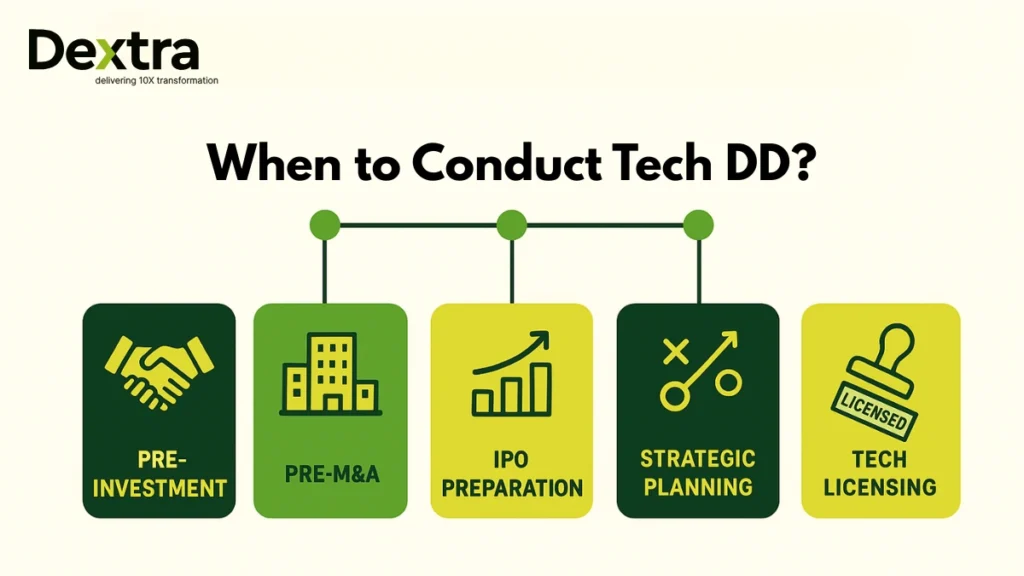
Conditions or Stages for Getting Tech DD Done (Pre/Post Investment, M&A)
If you’re on the buy-side like a VC, investor, or private equity firm, you’ll want a deep understanding of the company’s technology and product setup before committing your money. At Dextralabs, we help you spot risks early, uncover hidden strengths, and find ways to create long-term value. You’ll walk away with clear insights, red flags (if there are any), and a plan for what to prioritize after the deal closes like automating processes or using data more effectively. Effective resource allocation is crucial at this stage to ensure that recommendations are implemented efficiently and deliver maximum impact.
But it’s not just buyers who benefit.
Sometimes the sell-side, that is, the company itself, wants a technology due diligence done. In this case, the goal isn’t just to understand the tech, but to improve it. We often call this a technology health check. It helps founders, CTOs, or internal teams figure out how to speed up product development, improve workflows, or reduce growing pains.
This kind of technical diligence is also really helpful if you’re looking to raise funds or sell your business. You can clearly see what your current status is, including whether your team structure is scalable, or missing necessary skills at the leadership level (for example, CTO or CPO). A gap analysis can help identify differences between your current technological capabilities and industry benchmarks, highlighting areas that need improvement. From there, you can determine whether you need to hire and train or adjust your tech organization to accommodate your next stage of growth. Evaluating the innovation potential of your technology is also essential to ensure your business can adapt and sustain competitive advantages as you scale.
Whether you’re buying, selling, or scaling, Dextralabs offers reliable technology due diligence consulting tailored to what your business requires. The scope of a Technology Due Diligence assessment can vary based on industry, company stage, and transaction context, ensuring that each evaluation is aligned with your specific needs and risk factors.
What Should a Technology Due Diligence Cover?
The scope of a technology due diligence (or tech DD) can vary depending on the goals of the assessment. A thorough tech assessment is essential for evaluating the technical health of a target company during mergers and acquisitions. While there are many different approaches and even detailed tech due diligence checklists out there, most evaluations cover some key areas. A Technology Due Diligence process should include reviewing the source code, scalability, security, and outdated technologies. At Dextralabs, we customize our tech due diligence consulting to fit your specific needs.
Below are the core areas we typically cover, each introduced with a descriptive subheading for easier scanning:
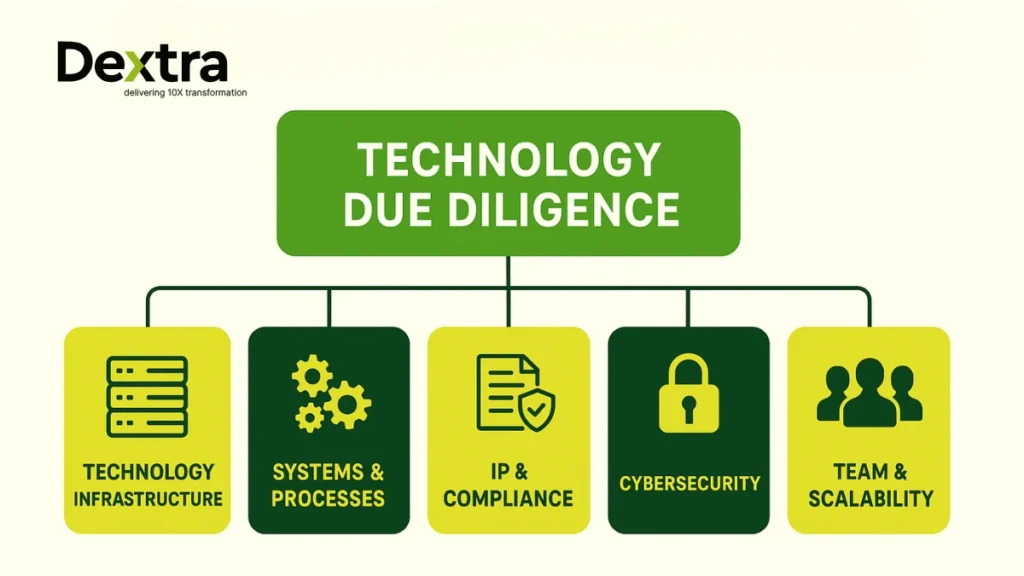
Core Areas of Tech DD
Our process includes technical assessments and focuses on key components and technical components of your technology infrastructure and architecture. Key focus areas in Technology Due Diligence include code quality, scalability, security, and compliance.
Scalability
- Infrastructure scaling: Can the tech infrastructure accommodate 10 times or even 100 times more users? Performance and scalability testing is crucial to validate a system’s capacity to meet future demands. Load testing is used to identify bottlenecks in system performance, ensuring the infrastructure can handle increased demand. How much is still manual work?
- Team scaling: Will adding more team members improve productivity or slow things down?
- Scaling cost: What happens to infrastructure costs as the business grows?
- Business continuity & disaster recovery: If we have a major problem (e.g. a data centre outage), how much data could be lost? Do we have good redundancy?
- Monitoring & alerting: How quickly and accurately can the team detect infrastructure problems?
Tech Team
- Team structure: Does it encourage productivity?
- Team autonomy: Do the teams have the right combination of skills to work independently and without delays?
- Processes & workflows: Are there clear ways of working together, and do they match the company’s current stage?
- Meeting culture: Are meetings focused, effective, and goal-driven?
- Recruiting & onboarding: How does the company attract, hire and train new talent? How quickly can they get new hires up to speed?
Tech Stack & Architecture
- Tech stack choices: Is the tech stack (e.g. languages, frameworks) a good fit for the company’s goals?
- Architecture: How flexible is the system when changes are needed? Incompatibility with existing systems can lead to unexpected costs and integration challenges. Incompatible architectures can also delay post-acquisition alignment and increase costs.
- Security: Are there strong practices in place to protect data and systems?
- Technical debt: Is the team aware of past shortcuts? Are they actively paying down tech debt? Technical debt can lead to increased maintenance costs and a slower development process, impacting future development costs and making integration with other systems more challenging.
Legal, Compliance & IP
- GDPR compliance: Are systems and roles in place to respect user privacy and data rights? Data protection and privacy reviews are essential for businesses that handle sensitive data, ensuring compliance with regulations like GDPR. Non compliance with these regulations can result in significant fines, legal issues, and security vulnerabilities.
- IP ownership: Does the company truly own its intellectual property even when employees or freelancers leave?
- Patent strategy: Is there a structured approach to protecting valuable tech assets through patents?
- Open source use: When using open-source tools, do developers understand the risks? Are license checks in place?
Core Tech Assets
- Documentation: Is there a well-maintained knowledge base that helps reduce dependence on key individuals? Gathering and organizing all relevant documentation—such as code repositories, architectural diagrams, and audit reports—is crucial in the Technical Due Diligence process. This includes not only user manuals and process guides, but also development pipelines and system overviews, ensuring a comprehensive understanding of the technology landscape.
- Software Development Life Cycle (SDLC): What’s the full process from idea to deployment?
- Code quality & Testing: Are there clear standards for writing code? Is automated testing part of the workflow?
Product & Strategy
- Product strategy: Is the roadmap aligned with the company’s mission? Who influences it? As part of technology due diligence, we also evaluate competitive positioning—analyzing the company’s market stance, customer base, and pricing strategies to understand its strategic advantage relative to competitors.
- Product discovery: How does the team decide what to build (and what not to)?
- UX capabilities: Are user experience experts involved in shaping the product?
- Product intelligence: What kind of data is used to guide product decisions? We assess market potential to determine the demand and growth prospects for the technology or product, ensuring alignment with broader market trends and investment goals. Technology due diligence can also showcase a company’s technological advantages and competitive edge, providing valuable insights for strategic decision-making.
Industry-Specific Deep Dives
Depending on the industry, stage, and goals of the company, a tech due diligence may need to go deeper in some areas:
- If a company handles sensitive personal data, we’ll do a more in-depth review of security and compliance.
- In fintech, we focus more on things like transaction security, API scalability, and business continuity.
- For early-stage startups, we look at how well the team is testing and validating ideas quickly.
- For growth-stage companies, we focus on whether their teams, processes, and infrastructure can handle fast scaling.
At Dextralabs, our technology due diligence (TDD) services adapt to your deal’s needs. We help you assess maturity, identify gaps, and spot opportunities to build value right from the start.
Code Quality Review
A code quality review is a cornerstone of the technical due diligence process, offering an in-depth analysis of the target company’s software components and programming language choices.
What Does a Code Quality Review Involve?
- Examining the structure, readability, and maintainability of the codebase
- Identifying technical debt, security vulnerabilities, and inefficient processes that could hinder future growth
- Assessing how well the code supports scalability and system performance, ensuring it can adapt to evolving business needs
Findings from this analysis are summarized in the diligence report, providing actionable insights and clear recommendations for improvement. This empowers the acquiring company to address critical risks, enhance code quality, and make strategic decisions about the target company’s technology.
Business Requirements
Business requirements are at the heart of any successful technical due diligence process.
Key Elements of Business Requirements Assessment
- Evaluating whether the target company’s technology stack, system performance, and data flows are aligned with the acquiring company’s business strategy
- Conducting a comprehensive technical review of software licenses, third-party libraries, and dependencies to identify potential risks and liabilities that could impact integration or future growth
By thoroughly examining these elements, the diligence process provides a clear understanding of the target company’s technology environment. This enables the acquiring company to mitigate risks, ensure compliance, and capitalize on opportunities that support their strategic objectives.
Data Flows and Infrastructure
Robust data flows and resilient infrastructure are essential for any technology-driven business, making them a critical focus of the technical due diligence process.
What Is Assessed in Data Flows and Infrastructure?
- Examining how the target company stores, processes, and transmits data, ensuring that protocols meet industry standards and regulatory requirements
- Reviewing disaster recovery and business continuity plans to identify potential risks and vulnerabilities that could threaten operations
The resulting diligence report delivers actionable insights into the company’s data architecture and infrastructure, equipping the acquiring company with the information needed to make informed decisions, strengthen security posture, and support future growth.
How Dextralabs Tailors Every Technology Due Diligence to Your Needs?
At Dextralabs, we believe that every tech due diligence (or tech DD) project should be built around the unique needs of the business being assessed. That’s why we take the time to set the right direction from the very beginning.
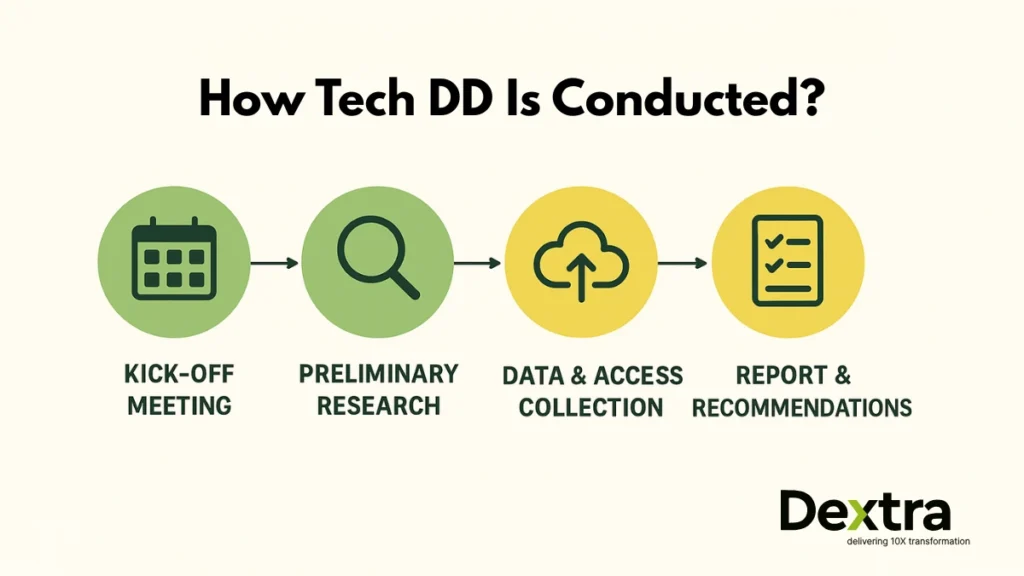
Essential Steps in the Dextralabs Tech DD Process
- Kick-off Meetings: We start by holding detailed kick-off meetings to align on goals and expectations.
- Preliminary Research: Our team conducts early research and gathers input from experienced industry experts.
- Understanding the Tech Environment: We fully analyze the target company’s tech environment, current challenges, and opportunities for scaling or improving operations.
- Modular Due Diligence Framework: We use a modular framework, adjusting the scope based on your needs—ranging from light-touch reviews to full-scope confirmatory due diligence with deep dives and multiple stakeholder interviews.
- Comprehensive Evaluation: We evaluate the target company’s product, infrastructure, team, security, codebase, and scalability, all aligned with your deal’s goals.
- Tailored Reporting: We deliver an easy-to-understand, actionable IT due diligence report, clearly outlining the potential impact of each finding.
- Post-Assessment Support: You’ll have access to seasoned professionals for follow-up questions and guidance.
For early-stage startups, we might focus on speed, agility, and technical leadership. For growth-stage or enterprise-level targets, our technology due diligence checklist will likely go deeper into things like infrastructure automation, information technology due diligence, and technical diligence across teams and platforms.
At Dextralabs, we don’t just assess technology but we help you use its full potential.
Common Risks a Tech DD Should Cover:
It’s important to understand what all can go wrong when you’re investing in a tech company whether through a startup round, private equity deal, or M&A transaction. A well-run technology due diligence (or tech DD) involves a comprehensive tech assessment that doesn’t just confirm what’s working; it identifies technical risks and hidden technical liabilities that could impact your investment and influence valuations.
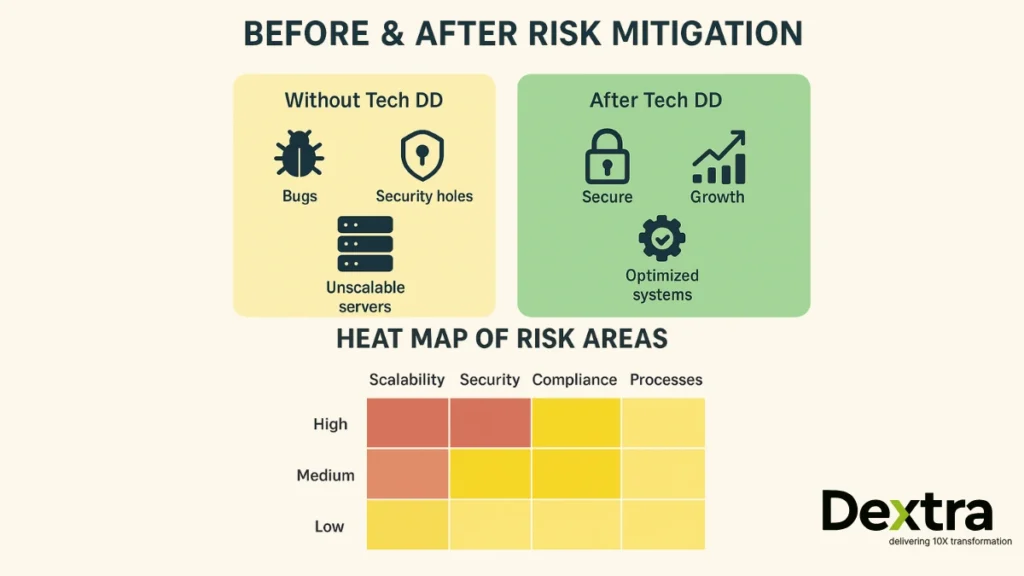
Key Risk Areas Assessed During Tech DD
At Dextralabs, we make sure every technology due diligence project gives you a clear view of potential threats, inefficiencies, technical risks, and blockers to growth. Our tech assessment process is designed to uncover hidden technical liabilities—such as security vulnerabilities, architectural incompatibilities, and technical debt—that can undermine technology investments and lead to misjudged valuations. Security vulnerabilities and non-compliance can create material legal and operational exposure after a deal closes, making them essential areas of focus in technology due diligence.
Scalability Risks
If your infrastructure and systems can’t scale fast enough, it will hinder your growth. You might miss out on key market opportunities, or worse you can lose customers permanently. Instead of building new features, your team could waste time patching tech that can’t keep up. During tech due diligence, we examine how well the current tech setup can support 10x or 100x growth, and whether processes are automated or too reliant on manual work.
Knowledge Gaps & Skill Shortages
Many growing companies rely too heavily on a few senior engineers. If those people leave, the company risks losing vital knowledge. This creates “knowledge silos” that slow down development and make scaling difficult. As part of our IT due diligence checklist, we assess how well knowledge is documented and distributed across teams, and how resilient the company is to unexpected talent turnover.
Hiring Challenges
If the company’s technology stack is outdated or unattractive, it becomes harder (and also more expensive) to hire skilled engineers. Poor technical decisions also lead to growing technical debt, which demoralizes developers and leads to high churn. Our technology due diligence consulting takes an indepth look at whether the stack is helping or hurting the team’s ability to scale and hire.
Security Weaknesses
Security issues can cause serious damage like data loss, system outages, legal action, or reputation loss. Our technical due diligence includes a deep look into how security is managed across infrastructure, applications, and teams. We assess policies, encryption, access control, and whether the team actively monitors threats.
GDPR & Compliance Risks
For companies operating in or with the EU, GDPR compliance is a legal must. Failing to meet these standards can result in fines and legal restrictions. As part of our information technology due diligence, we evaluate how personal data is handled and whether the company has structured privacy practices in place.
Valuation-Driven Tech Stack
Some companies adopt new technologies simply to impress investors or increase their valuation. However, incorporating technologies like AI or blockchain without a real purpose only adds expense and limits long-term value. Our M&A technical due diligence evaluates whether the tech is actually solving problems or is just a diversion.
Process Inefficiencies
Teams that lack clear, efficient processes struggle with productivity. During our tech DD, we focus on understanding how work is planned, prioritized and delivered. Is there a defined delivery pipeline? Do meetings have great outcomes? Are teams aligned and working on the same initiatives? Poor process leads to wasted time, capital loss, and team frustration.
Data Mismanagement
Having a weak data strategy is a wasted opportunity. Without proper systems in place, companies fail to understand their users or make data-backed decisions. We look at data pipelines, reporting tools, and analytics capabilities as part of our technical DD to help you better understand what you may be missing out on to allow for better decision-making.
Tech Stack Misalignment
A tech stack should empower teams and not hold them back. If the current setup is slowing down product delivery or causing vendor lock-in, that’s a clear red flag. Our technology due diligence checklist covers stack selection, ecosystem maturity, long-term supportability, and risks tied to third-party tools or platforms.
Why Does It Matter?
Identifying these risks during a tech DD helps investors, VCs, and private equity firms avoid costly surprises. With Dextralabs as your technical due diligence consultant, you get actionable insights and practical recommendations no matter whether you’re preparing for a deal, planning a scale-up, or assessing a potential acquisition.
Our IT due diligence reports go beyond surface-level analysis. We tailor every review to your deal type, company size, and goals whether you’re doing a technical DD on a startup, a mid-sized SaaS business, or an enterprise tech provider.
Mergers and Acquisitions
Mergers and acquisitions (M&A) are high-stakes transactions where thorough technical due diligence is essential.
What Does M&A Technical Due Diligence Involve?
- In-depth analysis of the target company’s technology environment, including its tech stack, system performance, and data flows
- Comprehensive review to uncover potential risks and liabilities
- Actionable insights into the company’s technical strengths and weaknesses
The technical due diligence report enables the acquiring company to make informed decisions, mitigate risks, and identify opportunities for value creation. For private equity firms and venture capital investors, this process is crucial to uncover risks, validate the investment thesis, and secure a competitive advantage in the market. By leveraging technical due diligence, stakeholders can confidently navigate the complexities of mergers and acquisitions and maximize their return on investment.
What Does a Technology Due Diligence Report Include?
If you are going to invest in tech/Saas startups, AI companies or are getting ready for a funding round one of the important things that you will receive (or create) is a Technology Due Diligence report. This is not merely paperwork. A Technology Due Diligence report is the key to understanding the tech risks, opportunities, and future-readiness of a business.
At Dextralabs, we specialize in delivering sharp, focused, and actionable tech DD reports that help investors and decision-makers act with confidence.
What You Can Expect in a Tech Due Diligence Summary Report
Every tech DD report we deliver includes a clear, concise executive summary. This gives you a quick overview of the most critical findings about what’s working, what’s not, and where your biggest risks (and opportunities) lie.
We prioritize the findings based on their impact on the investment case. This means the report doesn’t just list issues; it explains which ones matter most, and why. You’ll see:
- Where the company is outperforming and may have a competitive edge
- Areas that need urgent improvement to support growth
- Evidence and rationale for each finding
- The potential impact of each issue on your business goals
Even if everything looks fine today, a 10x increase in users or headcount could break fragile systems. That’s why we don’t stop at what’s working now but we think about what happens next.
Tailored Analysis & Not Just Checklists
Not all findings are equally relevant for every company. Our assessments use a flexible framework inspired by our proprietary technology due diligence checklist, benchmarked against industry peers and adjusted for each company’s:
- Stage of growth
- Industry and regulatory environment
- Product and tech stack
- Strategic goals
As part of this process, we conduct a gap analysis to identify differences between your current technological capabilities and industry standards, helping to uncover material risks and areas for improvement.
Our team brings years of real-world experience, from M&A technical due diligence to advising CTOs and product teams. We give you not only the data, but also the context behind each insight.
Clear, Actionable Recommendations
One thing we constantly hear from investors and founders is this: “Don’t just tell me what’s wrong, tell me what to do.”
So that’s what we do.
Each finding comes with specific, actionable advice. We answer the question: If I were the CTO, what would I do next? In what order? Depending on the scope of your technical DD, our recommendations may include:
- Quick wins like adding tools to the CI/CD pipeline
- Improving code quality or team workflows
- Reorganizing team structures
- Addressing security gaps
- Reducing technical debt
- Preparing for future scale with smarter infrastructure choices
Effective implementation of these recommendations depends on thoughtful resource allocation, ensuring your team can prioritize and execute the most impactful initiatives for scalable growth.
You’ll receive advice that your CTO can start using immediately without having to translate jargon or guess what we meant.
After delivering the report, we don’t just leave you to figure it out. We walk you through the results during a live session or “read-out,” where we explain key findings, answer questions, and dive deeper into anything you want to explore.
Post-DD Support (With Boundaries)
Some technology due diligence providers offer post-deal consulting or try to sell tech transformation services based on the findings. At Dextralabs, we intentionally avoid this.
We prefer to focus 100% on delivering the fastest, sharpest, most unbiased technology due diligence services in the market.
That said, we don’t disappear. We’re always available to answer questions, offer second opinions, or provide CTO sparring sessions. We love seeing tech companies thrive and we’re more than happy to support that mission however we can.
So, whether you’re:
- An investor planning your next deal
- A startup founder preparing for a funding round
- A business leader wanting a technology health check
Dextralabs is here to help you make smart, tech-informed decisions. Our reports give you what you really need: clarity, direction, and confidence
Technology Due Diligence Checklist: What You Need to Prepare?
Going through a Technology Due Diligence (Tech DD) can feel overwhelming, especially if it’s your first time. These reviews usually happen under tight deadlines and while your team is still trying to manage day-to-day business. However, with the right preparation—including gathering and organizing all relevant documentation such as code repositories, architectural diagrams, and audit reports—the process can be smooth and even valuable.
At Dextralabs, we’ve already helped many companies like you that went through technology due diligence from Series A startups to Series C level to growth-stage tech firms. Whether you’re getting ready for an investment round, a sale, or a technical audit check, using a solid Technology Due Diligence checklist can help confirm that you have prepared for and considered all pertinent factors, saving you time and reducing stress.
Why You Should Prepare Ahead
Depending on the scope, a Tech DD can take a few hours or several days of work. It all depends on how much documentation you already have and how clean your tech setup is (especially if there’s a lot of technical debt).
A simple but helpful tip: Always ask for the expected scope and timeline before your Tech DD begins. This will help you plan and avoid last-minute scrambling.
What to Prepare for a Technology Due Diligence
No matter who your Tech DD provider is, or when it’s scheduled, you can start preparing today. Here are four things we always recommend getting ready:
1. Product Demo & Demo Account
- Have a live product demo ready to walk through your core features.
- Create a demo account, and make sure your team has all of the details of the product so that they feel comfortable explaining it thoroughly.
- Bonus tip: Include a quick product vision overview and a feature comparison list to help reviewers understand your value!
2. Key Metrics & KPIs
- Organize important performance metrics like:
- Uptime
- Test coverage
- Development velocity
- Deployment frequency
- Charts showing improvements over time can go a long way in demonstrating progress. Update them with the latest data so everything is current.
3. Core Documentation
You don’t need to start from scratch—you can just gather what’s already available as relevant documentation, such as:
- Technical architecture diagrams
- Product & engineering roadmaps
- List of third-party tools and software licenses
- IT infrastructure and data flow documents
- Code repositories
- Audit reports
- Development pipelines
Documentation is crucial in the Technical Due Diligence process. Comprehensive and well-organized relevant documentation—including code repositories, architectural diagrams, and development pipelines—ensures the technical due diligence consultant can understand your system faster and more thoroughly.
4. Access to Tools and Platforms
The Tech DD team may need access to:
- GitHub or GitLab (codebase)
- JIRA or Linear (issue tracking)
- Datadog or similar (monitoring tools)
- Notion, Confluence, or Google Docs (internal documentation)
Having accounts and permissions set up in advance can save time and help the technical DD team do their job efficiently.
Why a Technology Due Diligence Checklist Matters
A proper checklist helps you stay one step ahead. It ensures you:
- Gather all relevant paperwork (e.g., software licenses, IP contracts and architecture diagrams)
- Evaluate your technology stack and development team to improve the vulnerable areas
- Get ready for technical interviews with investors or buyers
- Identify weak areas and start fixing them before they become deal-breakers.
- Highlight your strengths and show your tech in the best light possible
If your business relies heavily on software, data, or digital infrastructure, a technology due diligence checklist isn’t just helpful but it’s essential.
Whether you’re raising capital, planning for M&A, or simply checking in on your tech foundation, Dextralabs is here to support you with expert tech due diligence consulting. Our reports are clear, actionable, and built to help you move fast without missing what matters.
Why Choose Dextralabs as Your Technology Due Diligence (Tech DD) Partner?
Making smart decisions about tech investments is crucial and even one wrong move can cost millions. That’s why technology due diligence (Tech DD) is essential before investing, merging, or scaling your tech business. Technical Due Diligence (TDD) is a comprehensive evaluation of a company’s technical infrastructure, products, and processes. At Dextralabs, we offer expert tech due diligence consulting that helps investors and companies understand the real value and risks tied to their technology.
Our services include Technology Due Diligence, which is an expert-led assessment of a company’s technology and product delivery system, including architecture, codebase, infrastructure, security, engineering processes, and team structure.
Dextralabs’ team brings deep diligence expertise, with industry veterans who have extensive experience in conducting comprehensive technical evaluations. This expertise ensures thorough assessments of code quality, architecture, and risk, supporting confident decision-making in M&A, startups, and post-merger scenarios.
Technical Due Diligence is a crucial process that holds immense value throughout various stages of a business’s journey, enabling organizations to make informed decisions and mitigate risks.
Our Unique RCOI Approach
What sets Dextralabs apart is our special RCOI approach that focuses on:
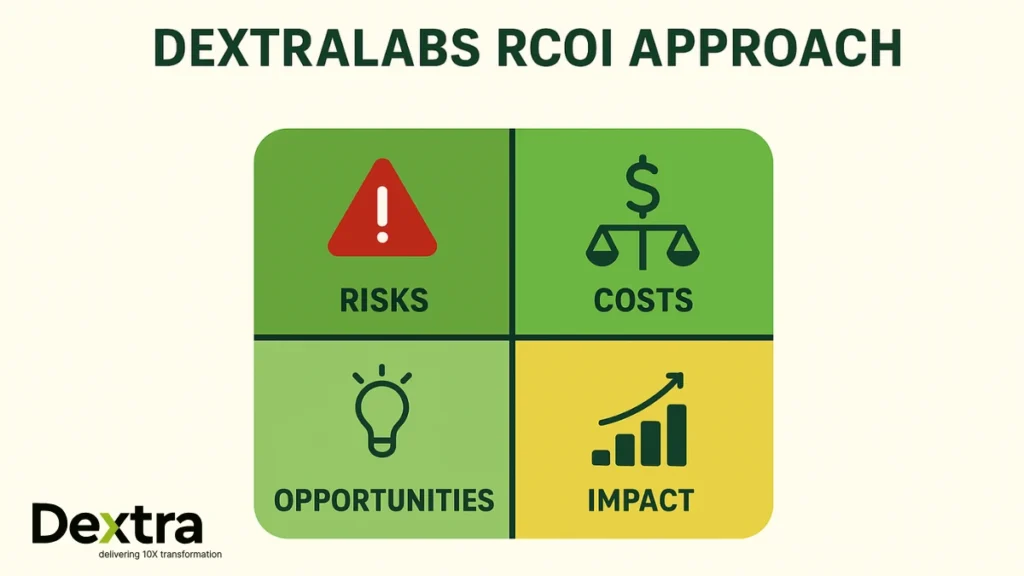
Dextra Labs Unique Model (RCOI) for Tech DD
- Risks: Identifying potential tech problems that could cause liabilities.
- Costs: Understanding the financial impact linked to those risks.
- Opportunities: Spotting areas where improvements can boost growth.
- Impact: Showing the financial benefits from seizing these opportunities.
This means we don’t just find issues but we also explain how they affect your investment and what actions can improve the future.
When to Partner with Dextralabs for Tech DD
- Pre-Investment: Spot hidden risks, know the real tech value, and get clear insights before you commit.
- Post-Investment: Fix tech problems fast, optimize your systems, and maximize returns.
- M&A Support: Help manage technology integration and uncover risks before deals close.
Comprehensive Technology Due Diligence Services
Our team brings broad experience across industries like SaaS, fintech, healthtech, and more.
Our Service Areas Include:
- Technology stack and architecture reviews
- Code quality and security assessments
- Cloud cost and service evaluations
- Data privacy and GDPR compliance checks
- Intellectual property (IP) and open-source software analysis
- Team skill evaluation and process reviews
Why Clients Trust Dextralabs
- Flexible for Any Business Size: We customize our Tech DD to your scale and complexity whether you’re a small company or a large enterprise.
- Actionable Recommendations: Our reports include clear next steps, often written from the perspective of experienced CTOs, making it easy to prioritize and act on findings.
- Focus on Accuracy and Speed: We specialize in Tech DD and provide accurate, unbiased, timely information.
- Proven Track Record: With dozens of successful Tech DD projects, we understand what matters most to investors and tech leaders.
- Deep Industry Knowledge: Our team stays on top of the latest trends and challenges in tech, allowing us to provide insights that are not only relevant but also forward-thinking that also ensures your business stays ahead of the curve.
- Collaborative Approach: We take the time to fully engage with your team, working hand-in-hand to understand your unique goals, technical challenges, and business needs, so that we can deliver tailored, practical solutions that align with your vision for the future.
What You Gain by Choosing Dextralabs
- A thorough understanding of your technology’s strengths and weaknesses
- Clear insights into risks that could impact your business value
- Expert guidance on where to improve for better growth and scalability
- Confidence to make informed investment decisions
- A trusted partner who cares about your tech success
If you want to reduce risk, unlock hidden tech value, and make smarter investment choices, Dextralabs is the technology due diligence partner you need. Reach out today and let us help you navigate your next tech investment with confidence!
Ready to See What’s Really Behind the Technology? Let’s Talk.
Whether you’re evaluating a target, preparing for due diligence, or looking for a second opinion on a deal you’re already in, Dextra Labs delivers fast, unbiased, expert-led Technology Due Diligence built for the pace of real transactions. Our team of seasoned CTOs and product leaders is ready when you are.
Schedule a Free ConsultationFAQs:
Who performs the Technology Due Diligence at Dextra Labs?
Every Technology Due Diligence at Dextra Labs is led by seasoned CTOs and Product Leaders who bring an average of 20+ years of hands-on experience across SaaS, fintech, healthtech, and enterprise technology. These aren’t junior analysts running checklists — they’re operators who have built, scaled, and sometimes rescued real technology organizations. What makes our approach different is the layer underneath that expertise. Our data-driven platform automates the extraction of structured insights directly from the target company’s systems, repositories, and documentation. So when our leads make a strategic call — say, flagging an architectural bottleneck or a team structure risk — it’s grounded in hard evidence, not gut feeling.
The result is a Tech DD that combines the pattern recognition of experienced technology leaders with the precision of systematic, data-backed analysis.
How fast can Dextra Labs deliver a Tech DD?
Speed is one of the things we’re known for. A standard Technology Due Diligence engagement at Dextra Labs typically takes between 2 to 4 weeks, depending on the scope, complexity of the target’s technology landscape, and how readily documentation and access are made available.
For time-sensitive deals — which, frankly, most are — we offer an accelerated Dipstick Audit format that delivers actionable findings within 5 to 10 business days. This lighter-touch review covers the highest-risk areas first, giving you enough clarity to make informed decisions without holding up your deal timeline.
We’ve structured our process specifically for the realities of transaction environments. Tight timelines shouldn’t mean shallow analysis. They just mean you need a team that knows exactly where to look.
Is the Tech DD process disruptive for the target company?
No, and we’re intentional about that. We understand that the target company’s engineering team is still shipping product, fixing bugs, and running a business while the due diligence is happening. The last thing anyone needs is a process that pulls key people away from their work for weeks.
Our approach is designed to minimize disruption. We typically require a small number of focused interviews — usually 3 to 6 sessions with key technical and product stakeholders — combined with access to existing documentation, code repositories, and tooling. Most of the heavy lifting happens on our side, through our platform’s automated analysis of codebases, infrastructure configurations, and development workflows.
Target teams often tell us the process felt lighter than they expected. Some even say it was useful for them — surfacing things they hadn’t had time to look at themselves.
What does Dextra Labs evaluate, and does it involve AI?
Our Technology Due Diligence covers the full spectrum of a company’s technology and product delivery capability. That includes architecture and tech stack choices, code quality and technical debt, infrastructure scalability, security posture, data management, team structure and engineering processes, GDPR and regulatory compliance, and intellectual property ownership. Where AI is part of the target’s product or operations, we go deeper. We assess AI model architecture, training data provenance and licensing, model performance and reliability, MLOps maturity, and whether the AI is delivering genuine business value or functioning primarily as a valuation narrative. This is increasingly important as more companies position AI capabilities as central to their value proposition — investors need to know what’s real and what’s aspirational.
Our own process also leverages AI and automation through our proprietary platform, which accelerates data extraction and pattern detection across codebases and documentation. This means our senior assessors spend their time on judgment and interpretation, not manual data gathering.
Does Dextra Labs support early- and late-stage deals?
Yes, and the distinction matters because the risks and priorities are fundamentally different at each stage.
For early-stage companies, typically Seed through Series B, we focus on founding team technical capability, speed of iteration, architecture decisions that will either enable or constrain future scaling, and whether the product-market fit hypothesis is supported by how the technology is being built and tested. For growth-stage and late-stage companies — Series C and beyond, or pre-exit — the emphasis shifts to infrastructure scalability under real load, engineering team structure and autonomy, technical debt accumulation, security and compliance maturity, and whether the technology organization can sustain performance as headcount and user base grow significantly.
We also support pre-IPO technology assessments, where the bar for documentation, governance, and risk disclosure is materially higher.
Our modular framework adapts to the deal stage, so you’re never paying for depth you don’t need or missing coverage that matters.
How does Dextra Labs create value for Private Equity (PE) clients?
For Private Equity, our Technology Due Diligence is built around three priorities: protecting carry, identifying value creation levers, and preparing the asset for exit.
On risk mitigation, we identify hidden technical debt, architectural fragility, and engineering process gaps that could derail the Value Creation Plan or inflate CAPEX requirements post-close. These are the issues that don’t show up in financial models but can quietly erode returns over a hold period.
On value creation, we pinpoint specific, actionable opportunities to improve EBITDA through engineering efficiency gains, cloud cost optimization, R&D rationalization, and automation of manual processes. We quantify these where possible, so they can feed directly into the value creation roadmap.
On exit readiness, we help PE firms ensure the technology story is clean, compelling, and defensible when it’s time to sell. That means the architecture supports the growth narrative, technical debt has been managed down, and the engineering organization looks like an asset — not a liability — to the next buyer.
We frame every finding through our RCOI model — Risks, Costs, Opportunities, and Impact — so that technology insights translate directly into the financial language PE operating partners and deal teams work in.
How does Dextra Labs reduce risk for Venture Capital (VC) investors?
Venture Capital moves fast, and the technology risk profile at the stages VCs operate in is different from later-stage deals. The question isn’t usually whether the infrastructure can handle a million users today — it’s whether the technical foundations, team, and decision-making patterns will support the company getting there.
We help VC investors in three specific ways.
First, pre-investment validation. Before you commit capital, we give you an honest, expert-led view of the target’s technology maturity. Can the architecture scale beyond its current form? Is the tech stack a hiring advantage or a liability? Is the founding team making sound engineering trade-offs for their stage? These insights help you price risk accurately and structure your investment thesis with confidence.
Second, red flag identification. We surface issues that founders may not disclose or may not even be aware of. That includes single points of failure in the team, IP ownership gaps when contractors or freelancers have contributed code, open-source license risks, and security practices that don’t match the sensitivity of the data being handled.
Third, post-investment leverage. Our findings don’t just inform the investment decision — they give you a ready-made technical improvement roadmap you can hand to the founding team on day one. This accelerates time to value and gives your portfolio company a head start on the improvements that matter most for the next funding round.
We work at the pace VCs need, delivering clear, concise findings without unnecessary complexity. Because at the early stage, clarity is worth more than volume.