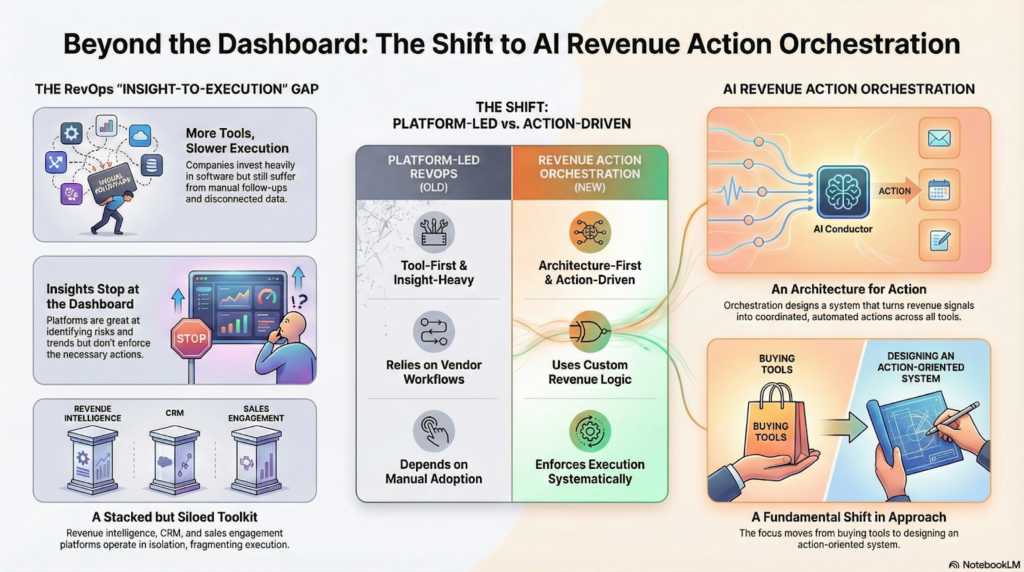
Revenue operations teams were promised speed, clarity, and predictable growth. Instead, many organizations are facing the opposite reality. Sales stacks have expanded. Dashboards have multiplied. Tools continue to report insights, but deals still slow down, forecasts remain uncertain, and CRM hygiene depends heavily on manual effort.
This gap between insight and execution is where most RevOps strategies quietly fail.
Modern SaaS companies do not struggle because they lack tools. They struggle because their tools do not work together to drive action. This is why AI RevOps automation has become a strategic priority, and why AI revenue action orchestration is replacing platform-led RevOps models.
SpurIQ operates in this exact gap, not as another tool vendor, but as a Revenue Action Orchestration Architect, helping teams design systems that convert revenue signals into coordinated execution.
The RevOps Tooling Paradox: More Software, Slower Execution
RevOps teams today are among the most heavily tooling functions in modern organizations. Most SaaS companies have invested in:
- Revenue intelligence platforms
- Conversation intelligence tools
- CRM extensions and forecasting software
- Sales engagement and analytics tools
Each platform promises better visibility and smarter decision-making. Yet execution remains constrained.
Despite these investments, teams continue to struggle with:
- Low and inconsistent CRM adoption
- Manual follow-ups and data entry
- Disconnected insights across tools
- Sluggish deal velocity and forecast risk
The core issue is not the absence of intelligence. It is the absence of orchestration.
Dashboards highlight problems. Tools surface trends. But no system ensures the right action happens at the right time across the stack. This is the promise AI RevOps automation was meant to deliver—but tooling alone has failed to fulfill it.
The missing layer is revenue action orchestration.
Platform-Led RevOps Tools: What They Solve—and Where They Stop
Platform-led RevOps tools have become foundational to modern GTM teams, promising better visibility into pipeline health, seller activity, and revenue risk—but their impact often stops at insight rather than execution.
- What Platform-Led RevOps Tools Do Well
Platform-led RevOps tools play an important role in modern GTM teams. They are effective at:
- Aggregating sales and pipeline data
- Surfacing insights, risks, and trends
- Improving forecasting visibility
- Analyzing calls, emails, and rep activity
Revenue intelligence platforms, sales engagement tools, and conversation intelligence software all contribute valuable insight into performance and behavior.
They help teams see what is happening.
- Where Platform-Led RevOps Tools Fall Short
The limitation appears immediately after insight is generated.
- Insights stop at dashboards
- Actions rely on human interpretation
- Each tool optimizes its own workflow
- Execution fragments across systems
A forecast risk is identified, but no system enforces follow-ups.
A deal stalls, but ownership of next steps remains unclear.
Signals are present, but execution depends on memory, discipline, and manual coordination.
Gartner research has consistently highlighted this gap—showing that insight without execution creates decision latency. This has driven the rise of seller action hubs and orchestration layers.
This is where RevOps software vs services becomes an incomplete framing of the real challenge.
RevOps Software vs Services: Why Buyers Misframe the Decision
Many organizations approach RevOps transformation as a binary choice: buy better software or hire better consultants. Both approaches fall short when used alone.
- The Software-First Model
The software-first approach focuses on:
- Tool-centric deployments
- Vendor-defined workflows
- Rep-dependent adoption
- Limited coordination across tools
While software scales well, it assumes teams will adapt behavior to fit predefined workflows. In practice, adoption declines, data quality suffers, and execution remains inconsistent.
- The Traditional Services Model
The services-first approach emphasizes:
- Process documentation
- Change management initiatives
- Manual execution support
- Limited AI leverage
While services improve alignment, they struggle to scale and cannot enforce execution in real time.
- Why Neither Works Alone
Software without architecture fails adoption.
Services without AI fail to scale.
Modern RevOps requires architecture-led systems that blend intelligence, automation, and governance. This is why AI orchestration services have emerged as the missing layer—bridging insight and execution across the revenue stack.
Also Read: Revenue Intelligence vs Revenue Orchestration
Gartner’s Shift: From Revenue Intelligence to Revenue Orchestration
For years, revenue intelligence has been positioned as the pinnacle of modern RevOps maturity. Dashboards became more advanced, analytics more granular, and AI more capable of surfacing risks and trends. Yet even as insight quality improved, execution outcomes often remained unchanged.
Gartner’s recent research reflects a clear turning point in this thinking. In the first‑ever Gartner Magic Quadrant for Revenue Action Orchestration, analysts evaluated 12 vendors and highlighted how orchestration platforms unify data, AI insights, and workflows to drive real outcomes rather than just report on them.
Leaders in this category, such as Clari and Gong, demonstrated strong execution capabilities across many use cases, including acquiring new customers, forecasting, and retaining or growing accounts, often placing highest across all evaluated scenarios.
- The Evolution of RevOps Terminology
Gartner’s evolving terminology signals a deeper shift in how revenue systems are expected to function. Rather than emphasizing visibility alone, newer frameworks increasingly reference:
- Revenue orchestration, where systems coordinate actions across the GTM stack
- Seller action hubs, designed to guide and enforce next-best actions
- AI-driven execution systems, where intelligence directly triggers workflows
This evolution acknowledges a critical reality: insight without execution does not create sustained advantage. Organizations that merely understand what is happening in their pipeline do not outperform those that ensure the right actions occur consistently.
The competitive edge now comes from execution discipline embedded directly into systems, not from reporting layers added on top of them.
- What Gartner Is Really Signaling
Gartner’s shift also clarifies a common misconception. Revenue orchestration is not a feature that can simply be switched on within an existing platform. It is a system-level capability that must be intentionally designed and governed.
True orchestration requires:
- Defined revenue logic that determines what actions follow which signals
- Coordination across tools, roles, and teams
- Continuous evolution as GTM motions, markets, and products change
Someone must own how signals move through the system—from detection to decision to execution. Without this ownership, organizations accumulate insight but remain dependent on human interpretation, memory, and manual follow-through.
In this context, orchestration becomes less about technology and more about architectural design.
- The Ownership Gap
Most RevOps platforms are built to sell licenses, not to own architecture. They provide powerful capabilities within their own boundaries, but they do not take responsibility for how multiple systems work together to drive revenue outcomes.
As a result, architecture ownership is often missing.
This gap leaves organizations with sophisticated tools but no governing layer that ensures consistent execution across the revenue lifecycle. It is within this gap that SpurIQ operates.
Rather than adding another platform, SpurIQ designs and governs revenue action systems—ensuring that insights are translated into coordinated, automated actions across the existing GTM stack. The focus shifts from deploying tools to architecting outcomes.
What is AI Revenue Action Orchestration?
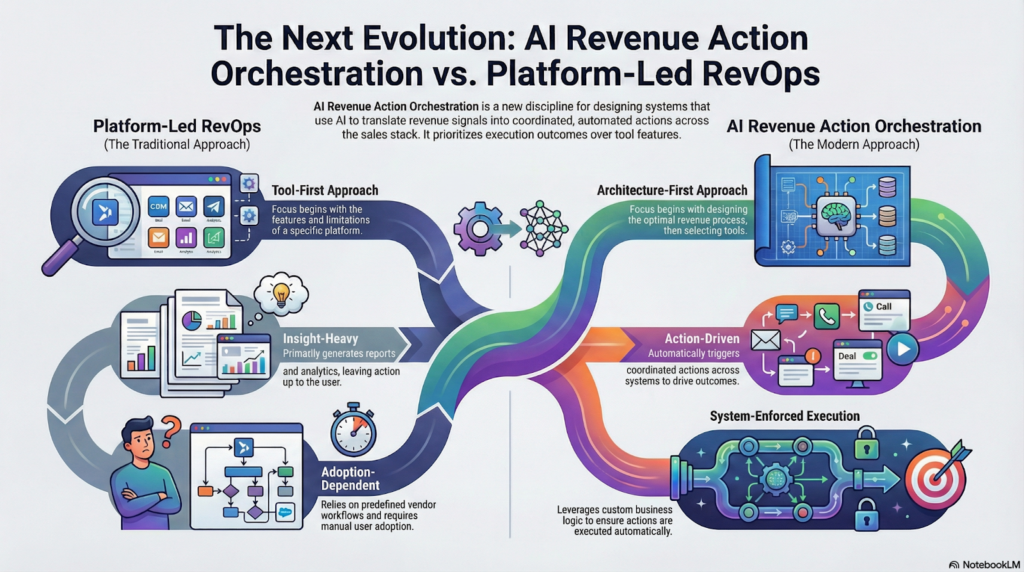
Definition: AI revenue action orchestration is the discipline of designing systems that translate revenue signals into coordinated, automated actions across the sales stack using AI intelligence and business logic.
Unlike platform-led RevOps, orchestration focuses on execution outcomes, not tool features.
Platform-Led RevOps vs Revenue Action Orchestration
| Platform-Led RevOps | Revenue Action Orchestration |
| Tool-first | Architecture-first |
| Insight-heavy | Action-driven |
| Vendor workflows | Custom revenue logic |
| Adoption-dependent | System-enforced execution |
This is where AI RevOps automation evolves from promise to practice.
Why AI Orchestration Services Matter More Than Tools?
AI models alone do not understand:
- Your deal stages
- Your approval logic
- Your revenue risk signals
- Your GTM motion
Without context, AI produces generic recommendations that fail to align with real execution needs.
AI orchestration services provide what tools cannot:
- Revenue logic design
- Orchestration rules
- Cross-tool workflows
- Governance and continuous evolution
This is why orchestration cannot be “installed.” It must be architected.
SpurIQ’s Revenue Action Orchestration Architecture
SpurIQ operates as a Revenue Action Orchestration Architect, not as a software replacement or another point solution. Instead of adding to the existing RevOps stack, SpurIQ designs how every system, signal, and workflow works together to drive consistent execution.
The architecture is layered, governed, and tailored to real GTM environments, ensuring that insights do not remain passive and actions do not rely on manual follow-through.
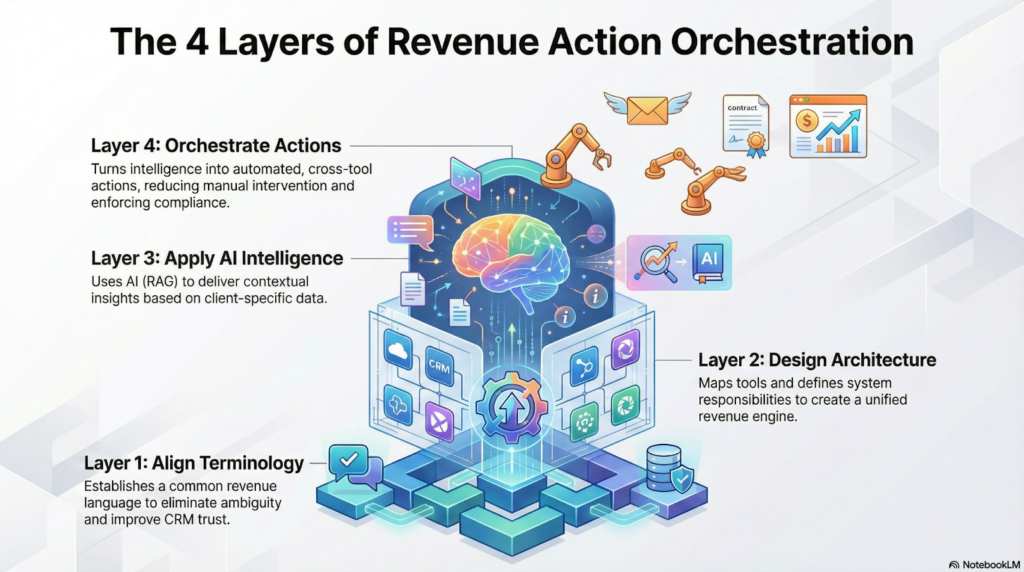
Layer 1: Revenue & Sales Terminology Alignment
The foundation of effective orchestration is a shared understanding of revenue language. SpurIQ begins by aligning terminology across sales, RevOps, and leadership teams.
This layer:
- Establishes a common revenue language for stages, deal health, risks, and actions
- Eliminates execution ambiguity caused by inconsistent definitions
- Improves CRM trust and usage by ensuring data reflects real-world selling behavior
When everyone interprets signals the same way, orchestration becomes reliable and enforceable.
Layer 2: Sales & RevOps Architecture Design
Once language is aligned, SpurIQ designs the underlying RevOps architecture that governs execution across tools and teams.
This layer:
- Maps, tools, and workflows by segment, motion, and scale
- Defines clear system responsibilities, avoiding overlap and gaps
- Tailors architecture for SaaS, services, and enterprise GTM motions
Rather than forcing teams into vendor-defined workflows, SpurIQ ensures each system plays a clear role within a unified revenue engine.
Layer 3: AI Intelligence Layer (RAG)
With architecture in place, SpurIQ applies AI through a Retrieval-Augmented Generation (RAG) intelligence layer that is grounded in client-specific data and business logic.
This layer delivers:
- Contextual AI insights based on CRM data, activity signals, and deal history
- Business-rule-aware recommendations that respect revenue policies and approvals
- Personalized guidance aligned with real workflows and GTM motions
AI becomes execution-aware—not generic or disconnected from reality.
Layer 4: Action Orchestration & Execution
The final layer turns intelligence into coordinated action across the revenue stack.
This layer enables:
- Automated next-best actions triggered by real-time signals
- Cross-tool coordination across CRM, engagement, forecasting, and communication systems
- Reduced manual intervention while improving consistency and compliance
Execution is enforced by the system, not dependent on memory, follow-ups, or rep discipline.
Together, these layers form a complete revenue execution system—where insight, intelligence, and action operate as one. This is AI orchestration services applied with architectural discipline, enabling teams to move from visibility to predictable revenue outcomes.
Why Platform-Led RevOps Tools Struggle to Deliver Orchestration
While platform-led RevOps tools provide valuable insight, they are not designed to orchestrate end-to-end revenue execution.
- Structural Limitations
These tools are built for broad use cases, making deep customization complex and inefficient. Each platform optimizes its own workflow, which fragments execution and prevents coordinated actions across the revenue stack.
- Commercial Limitations
License-driven models prioritize feature adoption over execution outcomes. Architecture, governance, and orchestration require strategic design and consulting depth—capabilities that tools alone cannot provide. This is why RevOps software vs services remains incomplete without orchestration leadership.
These constraints explain why RevOps software vs services remains an incomplete solution without orchestration leadership.
Who Benefits Most from SpurIQ’s Approach
SpurIQ’s orchestration-first approach delivers the greatest impact to roles responsible for revenue scale, execution discipline, and system governance.
- SaaS Founders
SpurIQ enables founders to scale go-to-market operations without replacing their existing tech stack. By enforcing execution through orchestration, it reduces revenue risk during rapid growth and expansion phases.
- CROs
CROs benefit from faster deal cycles driven by system-enforced actions rather than rep-dependent follow-through. Forecasting becomes more predictable because outcomes are guided by real execution, not assumptions.
- RevOps Leaders
RevOps teams gain systems that drive compliance automatically, improving data quality and execution consistency while reducing the need for manual monitoring and policing.
- CIOs
CIOs gain governed, architecture-first AI adoption with reduced shadow automation risk. This is where AI RevOps automation becomes a strategic advantage rather than a tactical experiment.
The Future of RevOps is Orchestrated, Not Installed
The next phase of RevOps will not be won by:
- Better dashboards
- More tools
- Louder AI claims
It will be won by teams that consistently convert signals into action.
SpurIQ does not replace RevOps tools. SpurIQ architects how they work together—so execution becomes automatic, governed, and scalable.
By combining AI orchestration services with deep RevOps architecture, SpurIQ enables organizations to move beyond insight and into execution.
Conclusion
Revenue teams are no longer limited by access to data or insight. Today’s RevOps stacks already surface pipeline risks, performance gaps, and buyer signals in real time. The challenge lies in execution. When insights remain confined to dashboards and actions rely on manual follow-through, revenue systems fail to scale with confidence.
This is why the question of RevOps software vs services no longer captures what modern teams need. Tools alone cannot enforce execution, and services alone cannot sustain it at scale. What matters is whether the revenue system itself is designed to act.
As a Dextralabs‘ revops stack & Consulting, SpurIQ addresses this gap by combining architecture, contextual intelligence, and system-driven execution through AI RevOps automation. Teams that want predictable growth must evaluate whether their RevOps stack merely reports what is happening—or actively drives what should happen next. By designing revenue systems that turn signals into coordinated action, SpurIQ helps organizations close deals faster and scale execution with confidence.