Manual invoice processing is still one of the biggest operational bottlenecks for Accounts Payable (AP) teams. According to Ardent Partners 2025 State of ePayables report, best-in-class AP departments process invoices at around $2.78 per invoice, while other organizations still spend over $12 per invoice on average.
But the real problem is not data capture or approval routing anymore. It is exception handling. Many AP teams still spend hours resolving mismatches, duplicate invoices, missing PO data, supplier errors and approval exceptions manually because traditional automation systems struggle when workflows become unpredictable.
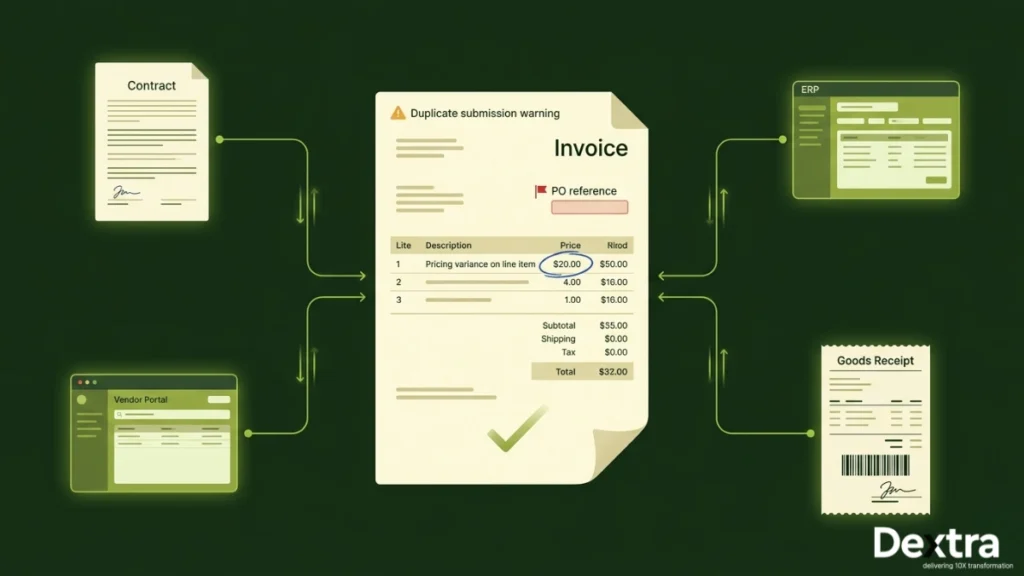
When a vendor changes an invoice format, a line item fails a three-way matching AI check by a few dollars or the same invoice arrives through email and the supplier portal, traditional AP workflow automation tools often break down under exceptions and edge cases and this is where agentic AI for accounts payable starts creating measurable value.
In this guide, we’ll explain how agentic AI for accounts payable transforms the invoice-to-payment cycle, how it differs from conventional automation and how AI agents for accounting workflows are improving touchless invoice processing, reducing manual intervention as well as optimizing AP operations in 2026.
What Makes Agentic AI Different from Traditional Accounts Payable (AP) Automation?
The main difference between traditional AP automation and agentic AI is that traditional systems follow predefined rules, while agentic AI can investigate issues, understand context and take actions dynamically across workflows.
Most AP workflow automation systems work well only when invoices match expected formats, PO data and approval conditions perfectly. But when exceptions appear such as pricing mismatches, duplicate invoices, missing PO references, or approval delays, the workflow usually stops and requires manual investigation from finance teams.
We have seen multiple times that a SaaS vendor sends an invoice for 150 user seats while the contract only covers 120. In such cases, the traditional automation system simply flags the mismatch as an exception. Meanwhile, an AI agent for accounts payable handles the situation differently by investigating the issue before escalating it. The agent can pull the vendor contract from the CLM system, verify whether overage billing is allowed, check whether the additional seats were activated, review contracted pricing terms and even draft a supplier inquiry automatically if discrepancies exist.
That is what separates agentic AI from traditional AP automation. Instead of only following fixed rules, AI agents in finance can connect data across ERP systems, contracts, procurement tools, emails and vendor portals to help resolve exceptions with far less manual intervention from finance teams.
Let’s understand the difference more clearly through a quick comparison table.
| Capability | Traditional AP Automation | Agentic AI for AP |
| Trigger | The workflow starts only when predefined rules or matching conditions are met. | The AI agent works toward completing the invoice process and resolving issues automatically. |
| Exception Handling | The system flags exceptions and waits for a human to investigate and decide the next step. | The agent investigates the issue, gathers supporting information and recommends or takes action within approved limits. |
| Data Scope | Most systems work only with ERP or invoice data available inside one platform. | The agent can pull data from ERP systems, contracts, procurement tools, banking platforms, emails and vendor portals. |
| Learning | Rules need to be updated manually whenever workflows or vendor patterns change. | The system improves over time by learning from previous corrections and finance team decisions. |
| Non-PO Invoices | Non-PO invoices often require manual review because there is no purchase order for matching. | The agent validates invoices using contracts, budgets, approval history and vendor spending patterns. |
| Audit Trail | The system records what action was taken during the workflow. | The agent provides a full reasoning trail explaining why a decision was made and which policies or records were referenced. |
How Agentic AI Transforms Each Stage of the Invoice-to-Payment Cycle
Agentic AI improves every stage of the invoice-to-payment cycle by helping AP teams handle exceptions, reduce manual work and increase straight-through processing. Instead of only automating repetitive tasks, AI agents for accounts payable can investigate issues, make context-aware decisions and keep workflows moving with minimal human intervention.
Here’s how agentic systems improve each stage of modern AP operations.
1. Invoice Capture and Data Extraction
Invoice data rarely arrives in one clean format. AP teams deal with PDFs, scanned files, supplier emails, images, spreadsheets, e-invoices and sometimes even handwritten notes. Traditional OCR systems often require template training for every vendor layout change, which becomes difficult to maintain at scale.
According to Ardent Partners, 47% of AP and finance leaders say invoice exceptions still create major operational inefficiencies despite ongoing automation investments. This is largely because of the inconsistent nature of incoming invoice data and the limitations of rule-based extraction systems.
An AI agent for accounts payable can process invoices more intelligently by understanding both the document structure and the meaning of the content. If a long-time supplier changes branding, updates invoice formatting, or moves line items around, the system can still recognize the vendor and extract the correct data without retraining workflows manually. This flexibility is becoming increasingly important as invoice formats and supplier behaviors continue to change.

2. GL Coding and Classification
After invoice data is captured, each transaction needs to be assigned the correct GL account, cost center, department, or project code. In many organizations, this still depends heavily on manual review and historical knowledge from AP staff.
AI agents for accounts payable automate this process by learning from previous coding decisions, department rules, vendor behavior and historical posting patterns. For recurring suppliers, the system gradually improves coding accuracy over time and applies those patterns automatically to support faster straight-through processing.
When a new vendor appears, the agent does not blindly assign codes. Instead, it identifies similar invoice patterns, suggests the most likely classification and requests confirmation before applying that logic to future invoices.
3. Three-Way Matching (PO, Invoice, Goods Receipt)
Three-way matching is one of the most important stages in AP automation because it validates invoices against purchase orders and goods receipt records before payment approval.
Traditional systems work effectively only when invoice values, quantities and shipment details match perfectly. Even small differences often stop the workflow completely and create manual review queues.
An AI agent for accounts payable approaches mismatches differently. Instead of simply flagging the invoice, the system investigates whether the variance falls within approved tolerances, supplier agreements, or contract terms. It can review pricing escalations, delivery records, usage-based billing and procurement policies before deciding whether escalation is actually necessary.
This allows organizations to improve straight-through processing while reducing unnecessary AP exception handling for low-risk variances.
4. Exception Management
Exception management is where most AP teams lose the majority of their processing time. Missing PO references, approval delays, pricing mismatches, duplicate invoices and supplier disputes can stall invoices for days.
Traditional automation can identify exceptions, but resolving them still depends heavily on manual investigation. Agentic AI helps move the process forward by investigating the issue automatically.
Instead of pushing raw exceptions to finance staff immediately, the system gathers supporting context automatically. It can review contracts, historical invoices, approval records, procurement data and policy thresholds before recommending the next action.
This significantly reduces the investigative workload for AP teams. Employees spend less time chasing information across ERP systems, supplier emails, procurement platforms and contracts because the agent already presents the issue with supporting documentation attached.
According to DocuClipper research, nearly 39% of invoices contain errors or exceptions that slow processing workflows. This is why AP exception handling remains one of the biggest opportunities for operational improvement.
5. Duplicate Detection and Fraud Prevention
Duplicate payments continue to be one of the most expensive AP risks, especially for organizations receiving invoices through multiple channels such as email, EDI, supplier portals and shared inboxes. According to SAP Concur research, duplicate invoices account for roughly 1.29% of processed invoices, creating significant financial leakage for high-volume AP teams. This makes early detection and prevention critical for maintaining control over AP spend and reducing avoidable losses.
Traditional systems rely mostly on exact-match rules like invoice number, amount, or vendor ID. AI agents for accounts payable go further by analyzing submission patterns, line-item similarities, payment timing, vendor behavior and invoice structures to detect near-duplicate invoices that rules-based systems often miss.
The system can also identify suspicious activity such as:
- Sudden changes in vendor bank details
- Unusual payment terms
- Invoice amount spikes
- Multiple submissions across different channels
- Vendor records that resemble existing suppliers
6. Payment Optimization and Execution
Most AP automation systems focus mainly on processing invoices faster. Agentic AI focuses on improving payment decisions as well.
AI agents evaluate payment terms, discount windows, cash flow forecasts and supplier priorities to determine the best payment timing. This helps organizations capture more early payment discounts while maintaining healthy liquidity levels.
The system can also prioritize urgent invoices, accelerate approval routing when discount deadlines are approaching and optimize payment scheduling across entities, currencies and banking systems.
For organizations processing large invoice volumes, even small improvements in discount capture and payment timing can generate substantial annual savings while supporting more efficient straight-through processing across the AP function.
| Implementing an ai agent for accounts payable is not just about automation. The real challenge is integrating it with your ERP, approval workflows, vendor systems and compliance processes effectively.At Dextra Labs, we build AI agents for accounts payable tailored to existing finance operations, helping teams automate the full invoice-to-payment cycle with minimal disruption. [Talk to Our Finance Automation Team→] |
Architecture of an AP AI Agent System
An AP AI agent system is typically built on four connected layers that work together to support invoice processing, ERP integration, AP exception handling and straight-through processing. Each layer is responsible for a different part of the invoice-to-payment workflow.
The same architecture patterns are now being adopted across broader finance operations, including AI agents for accounts receivable and autonomous cash management systems.
Let’s understand it in more detail:
1. Perception Layer (The Eyes)
This layer handles invoice reading and data extraction. It combines OCR, computer vision and LLM-based document understanding to process invoices across PDFs, scans, images, handwritten files and supplier emails. Instead of relying only on fixed templates, the AI-based system understands invoice content in context, which improves straight-through processing even when formats change.
2. Reasoning Layer (The Brain)
This is where the agent evaluates invoice data against business rules, contracts, approval policies, historical transactions and vendor patterns. The system decides whether an invoice should move forward automatically, require further investigation, or be escalated for review. This reasoning layer plays a major role in reducing AP exception handling workloads.
3. Action Layer (The Hands)
Once a decision is made, the agent executes the next steps through ERP integration and workflow automation. This includes triggering approvals, posting GL entries, sending supplier inquiries, updating procurement systems, or scheduling payments. Most enterprise systems integrate with platforms like SAP, Oracle, NetSuite, QuickBooks, Xero and custom ERP environments.
4. Audit Layer (The Record)
Every action the agent takes is logged with supporting context. The system records not only what decision was made, but also why it was made, which policy was referenced and what data influenced the outcome. This creates a stronger audit trail for compliance, financial controls and SOX readiness.
This four-layer architecture forms the foundation of the AP agent systems we build at Dextra Labs. In many organizations, the audit layer becomes the most critical piece because finance teams need more than automated workflows and they need clear decision-trail documentation that explains why invoices were approved, escalated, or flagged during AP exception handling and compliance reviews.
ROI of Agentic AI in Accounts Payable: Real Numbers
The growing interest in agentic AI for accounts payable comes down to measurable business impact. Organizations are using AI agents for accounts payable to reduce manual workload, improve straight-through processing, lower invoice costs and accelerate payment cycles across finance operations.
| Metric | Before Agentic AI | After Agentic AI | Source |
| Cost per invoice | $12.88 average / $15.97 manual processing | $2.78 best-in-class / under $1 target | Parseur AP Automation Research |
| Exception handling workload | 30–40% of AP team time spent resolving issues manually | Reduced by 60–80% with intelligent automation | DocuClipper Invoice Processing Research |
| Straight-through processing rate | Typically 50–65% | Often improves to 85–95%+ | Industry Benchmarks |
| Invoice processing time | Manual invoice processing can take days due to approvals and exception handling | Standard invoices can be processed in minutes with automation | DocuClipper AP Statistics |
| Time to ROI | — | Early results often visible within 30–60 days; full deployment timelines vary based on ERP complexity and workflow requirements | Ramp AI Finance Automation Insights |
| Agentic AI ROI vs General AI ROI | 67% average ROI for general AI initiatives | Up to 80% ROI reported in agentic AP deployments | Safebooks Autonomous AP Guide |
The opportunity is significant, which is why accounts payable is becoming one of the most common starting points for enterprise AI adoption. Research from FT Longitude and Basware found that 72% of finance leaders see AP as the most practical area for agentic AI deployment. At the same time, many organizations are still experimenting without a clear implementation strategy.
That lack of direction is becoming a growing risk. Gartner predicts that more than 40% of agentic AI projects could be canceled by 2027 because of unclear business value, weak governance, or inadequate controls.
The organizations seeing the strongest ROI are not simply deploying AI because it is trending. They start with clean vendor data, structured approval policies, strong ERP integration and clearly defined outcomes tied to AP efficiency, straight-through processing and exception reduction.
Estimate your AP savings in minutes
Most finance teams know their invoice volume, processing cost and exception rates but rarely have a clear view of how much they could actually save by improving AP automation.
Use Dextralabs’ AI Agent ROI Calculator for Accounts Payable to get a realistic estimate of potential savings based on your current AP performance. Just input your monthly invoice volume, processing cost per invoice and exception rate to see where your biggest efficiency gains could come from.
[Download the ROI Calculator →]
Why Pre-Built AP Platforms Fall Short in Complex Finance Environments
Pre-built AP automation platforms like Ramp, HighRadius, Automation Anywhere and GEP may be well-suited for standard accounts payable environments. They typically handle common ERP integrations, rule-based approvals, invoice matching and straightforward payment workflows effectively, especially in organizations with relatively uniform processes.
However, limitations start to appear as AP environments become more complex. This is where many finance teams begin to explore AI agents for accounts payable built through custom development rather than relying only on pre-configured platforms.
Custom agent-based AP systems become more relevant in scenarios such as:
- Multi-entity finance structures where invoices flow across subsidiaries with different charts of accounts, tax rules, currencies and approval hierarchies, making standardized workflows insufficient.
- Legacy or heavily customized ERP systems that do not expose clean APIs, requiring deeper integration logic beyond plug-and-play connectors.
- Non-standard payment models such as construction progress billing, milestone-based invoicing, retainage schedules, or usage-based contracts that don’t fit rule-based automation templates.
- Regulatory and audit-heavy environments where organizations need detailed, explainable decision trails for every invoice action, beyond basic platform logging.
- Long-established internal finance rules that have evolved over years and cannot be fully replicated using fixed configuration layers inside off-the-shelf tools.
In these cases, standard AP platforms handle routine workflows well but often struggle with edge cases, exception handling and cross-system decision-making. This is where custom AI agents for accounts payable systems offer more flexibility through deeper ERP integration, policy reasoning and adaptive automation.
The key difference is not whether platforms automate AP but how far they can adapt when real-world complexity goes beyond predefined workflows.
For organizations operating in this kind of environment, we understand these limitations clearly. At Dextra Labs, we build custom AP agent systems for organizations where off-the-shelf platforms fall short. These systems integrate with ERPs like SAP, Oracle, NetSuite and custom environments, while embedding your specific business rules, approval logic and audit requirements directly into the workflow.
What You Should Evaluate While Choosing An Account Payable Agent Solution?
Not every tool labeled as an “AI agent” actually behaves like one. Many solutions still rely on traditional automation under a new name. The real difference shows up in how deeply they operate across systems as well as how reliably they handle real AP complexity. So, let’s see what you should consider before adapting an Account Payable agent solution.
- Resolution, not just exception flags: You should look for solutions that don’t just simply identify issues and pass them to your AP teams. A well-designed agent should help you resolve exceptions within defined business rules so your team spends less time investigating and more time approving outcomes.
- Cross-system visibility, not ERP-only thinking: You should ensure your AP agent is not limited to ERP data alone. It should be able to access contracts, procurement systems and payment platforms so you get a full transaction context. If it works in isolation, you will still end up making decisions with incomplete information.
- Clear and explainable controls: You should always be able to understand what the system did and why it did it. Finance processes require transparency. Every action taken by the system should be explainable such as what was done, why it was done and which policy or rule supported the decision. This becomes critical when you need audit readiness and compliance confidence.
- Clean and governed vendor data: You should not expect automation to fix poor data. If your vendor records are inconsistent or duplicated, you will only scale those errors. Strong AP agents work best when your vendor master data is structured and well-governed from the start.
- Controlled learning within business rules: You should look for systems that improve over time based on past decisions, but still stay strictly within your financial policies and approval thresholds. Without this control, automation can quickly drift into compliance risk.
- Complete audit trail for every action: You should have full visibility into every decision the system makes, including data sources, validations and policy references. This ensures you always stay audit-ready, whether the action was taken by a human or an AI agent.
Final Thoughts
Account Payable delivers one of the highest-ROI entry points for agentic AI in finance because the outcomes are already proven in real operations. For AP managers, controllers and finance/IT leaders, the value is not in the concept of automation itself, but finally closing the gaps left by existing systems. Whether an organization uses a platform or builds a custom solution, the foundation remains the same: clean vendor data, clearly defined exception rules and measurable performance baselines.
The most effective approach is not to transform everything at once, but to start small with one exception type, one business unit, or one controlled workflow. From there, teams can measure results in a structured way, refine what works and gradually expand agentic AI across the AP function where it delivers consistent value.
FAQs
How do AI agents support fraud detection and invoice payments?
AI agents help monitor the entire AP process to identify unusual activity in invoice payments or vendor behavior. They can detect duplicate invoices, suspicious changes in payment details and abnormal patterns before payments are processed. This strengthens fraud detection while making invoice payments more reliable in enterprise finance.
Will AI agents replace people working in accounts payable?
No. AI agents are designed to take over repetitive work like manual data entry, invoice matching and routine AP process tasks and not replace people. This helps reduce errors and improve efficiency in financial operations. AP teams then focus more on fraud detection, approvals and vendor coordination instead of repetitive processing.
How are AI agents different from traditional AP automation in financial operations?
Traditional AP automation works on fixed rules for tasks like invoice processing and approvals. If something doesn’t match, it usually requires manual intervention. AI agents, on the other hand, analyze ap data, understand context and help resolve issues within policy limits, leading to fewer errors and less manual data entry across financial operations.
Why does data quality matter in AP automation and AI systems?
The effectiveness of AI in the AP process depends heavily on clean and accurate ap data. Poor vendor records or inconsistent information can lead to mistakes in invoice payments and approvals. Better data quality reduces manual corrections and improves overall accuracy in financial operations.
What improvements do AI agents bring to enterprise finance workflows?
AI agents improve efficiency by reducing manual data entry, speeding up invoice processing and improving accuracy across AP workflows. They help streamline invoice payments, reduce delays in the AP process and give better visibility into financial operations within enterprise finance teams.