
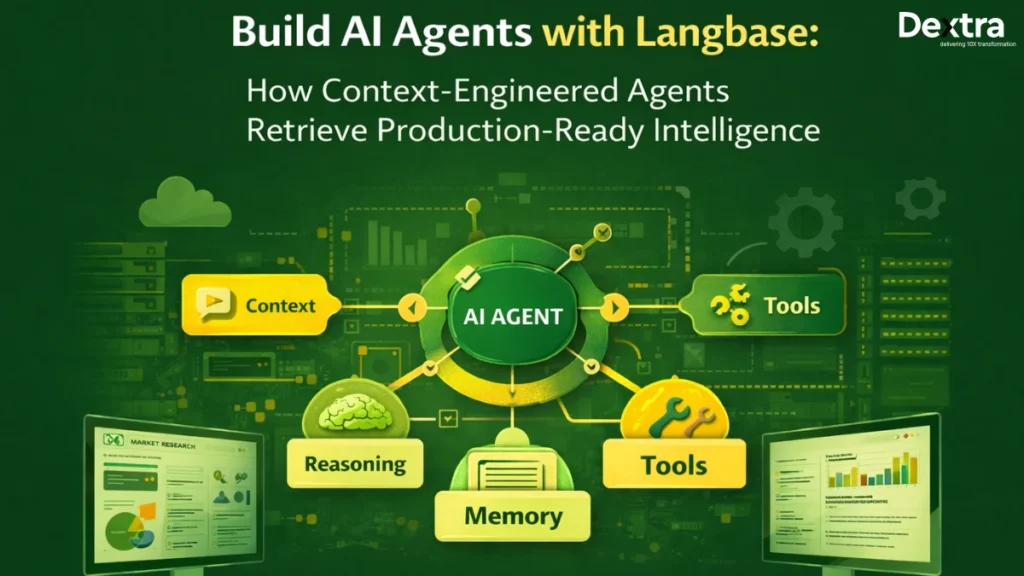
Enterprises are clamoring to deploy AI agents at scale, but most current approaches fall short. Simple workflow bots don’t reason beyond shallow triggers, while heavyweight research-style systems are powerful but prohibitively costly and slow for production use.
According to Gartner, 40 % of enterprise applications will embed task-specific AI agents by the end of 2026, up from less than 5% today, signaling a rapid shift in how business systems are architected. Yet this trend also highlights a key challenge: many organizations struggle to build agents that deliver reliable, context-aware outcomes at enterprise scale.
What’s needed is a middle layer, cognitive, context-engineered agents that combine memory, multi-step reasoning, tool use, and the ability to act on information in real time. Langbase provides precisely the primitives to build such agents, and teams that master its capabilities can retrive powerful, production-ready AI systems.
At Dextralabs, we design and deploy context-engineered AI agents that move beyond experimentation and deliver reliable, production-ready intelligence.
Also Read: From Task-Based AI Agents to Human-Level Research Systems: The Missing Layer in Agentic AI
Why Context Engineering Matters?
AI agents are often misunderstood. At one extreme are basic assistants that answer isolated prompts. At the other are deep, academic research architectures that require massive orchestration and compute. What both lack is a practical reasoning and context model that maps to real business needs.
Context-engineered agents are designed to:
- Maintain evolving context across sessions.
- Retrieve and reason over long-term knowledge.
- Invoke tools and workflows to take concrete actions.
- Adapt dynamically based on past outcomes and memory.
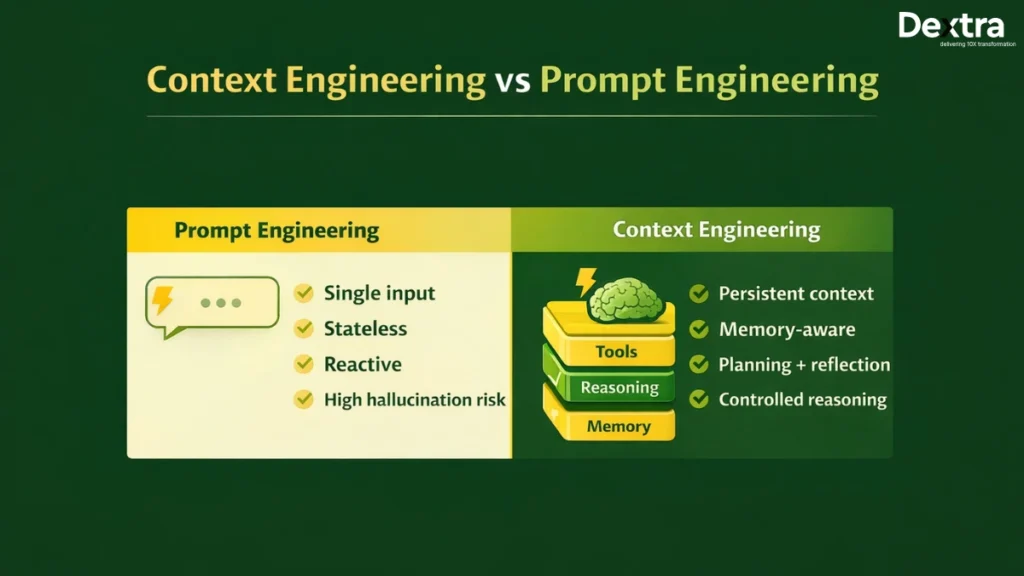
This shift from “prompt engineering” to context engineering is what makes agents genuinely useful beyond experimental demos.
Langbase: A Natural Foundation for Agentic Systems
Langbase is a serverless AI cloud platform built around simple, composable primitives rather than monolithic frameworks:
- Pipes for orchestrating decision sequences
- Memory (RAG) for structured knowledge retrieval
- Workflows for persistent task flows
- Tools for actionable integrations
This primitives-first architecture aligns with how cognitive agents should be designed for enterprises: lightweight, explainable, and scalable.
By composing these primitives intentionally, developers can build systems that reason with purpose, rather than merely respond to prompts.
How Cognitive Agents Actually Think?
1. Layered Reasoning Over Single Prompts
Traditional agents rely on one-shot prompt-response loops. Cognitive agents operate across layers of reasoning:
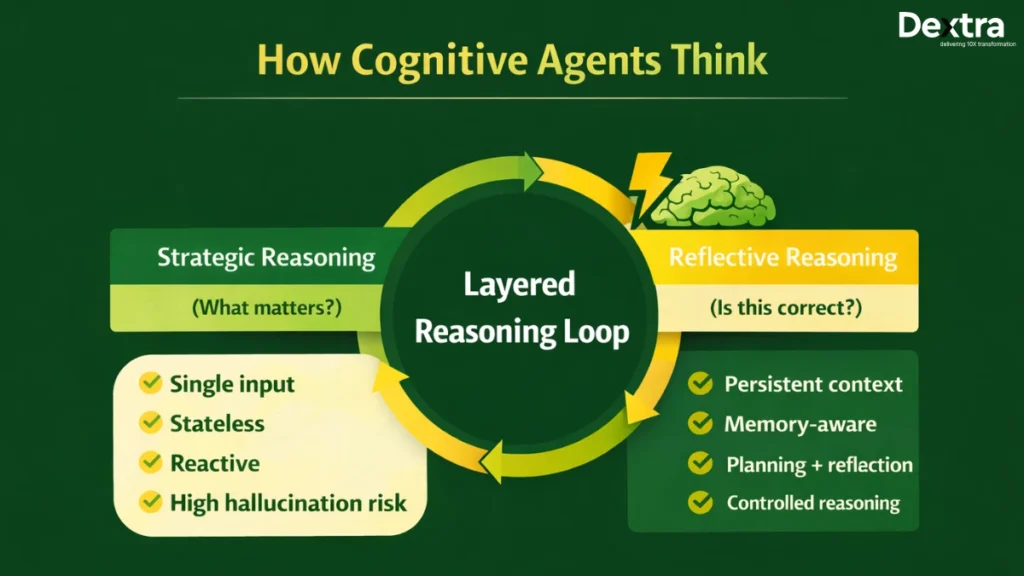
- Task reasoning for immediate steps
- Strategic reasoning to prioritize and plan
- Reflective reasoning to validate conclusions
This layered thinking mirrors human problem solving and reduces errors caused by shallow responses.
2. Planning Before Acting
Rather than reactively answering queries, cognitive agents plan:
- Planner agents map what needs to be done
- Executor agents carry out tasks
- Validator agents check results against quality criteria
This separation ensures reliability and predictable behavior.
3. Controlled Iteration
Unlimited loops waste resources. Cognitive agents use:
- Confidence thresholds
- Stop conditions
- Controlled refinement cycles
This keeps cost and latency under control while improving outcome quality.
Memory That Works: Not Just Stores
Many RAG-based systems indiscriminately dump context into a vector store. In practice, this creates noise and reduces accuracy.
Cognitive agents require structured memory:
- Short-term context for current tasks
- Long-term factual knowledge for reference
- Episodic memory for past decisions and outcomes
Selective memory and intelligent compression allow agents to focus on relevant knowledge without accumulating irrelevant data.
Real-World Use Cases of AI Agents :
Below are real examples of how advanced AI agents are already transforming business processes:
1. Competitive Intelligence and Market Research
Modern AI agents can monitor competitor pricing, product launches, public filings, social sentiment, and market shifts—synthesizing insights that traditionally took teams weeks to uncover. These autonomous systems continuously gather, analyze, and contextualize market data at enterprise scale.
2. Legal Document and Research Automation
AI agents in legal workflows are increasingly used to automate contract analysis, review case law, and generate draft documents, drastically reducing human workload while improving accuracy and turnaround time (source: AIMultiple).
3. Finance and Due Diligence Support
Agents equipped with retrieval, planning, and synthesis capabilities can assist in tasks like extracting key financial metrics, analyzing earnings reports, and generating structured summaries, accelerating decision cycles in finance teams.
4. Intelligent Sales & Documentation Automation
Agents that combine reasoning with operational tooling (e.g., automated summarization, document generation, and real-time response systems) are being deployed in enterprise sales support and technical documentation workflows. These systems help reduce manual tasks and increase consistency in output.
Also Read: The Agentic AI Maturity Model 2025: From Level 1 to Level 4 Enterprise Readiness
How Dextralabs Builds Scalable Agentic Systems with Langbase?
Dextralabs leverages Langbase’s primitives as the backbone of enterprise agentic systems, integrating them into a production-grade cognitive architecture that includes:
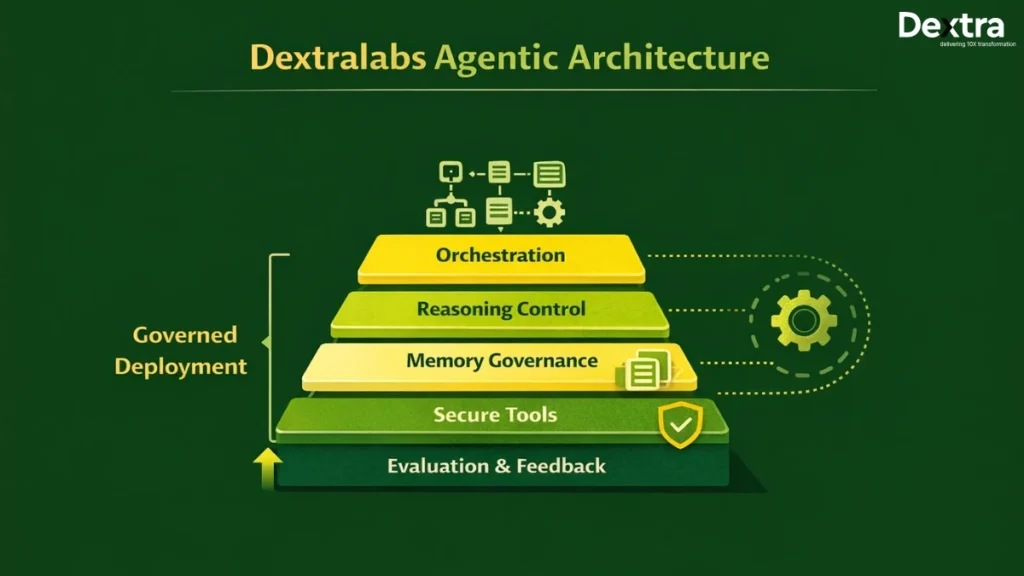
- Orchestration Layer: Manages agent roles, sequencing, lifecycle, and dependencies.
- Reasoning Control: Guides planning, decisions, and validation.
- Memory Governance: Filters outdated or noisy information and ensures accurate context retrieval.
- Secure Tool Execution: Applies role-based access and permissions for safe operations.
- Evaluation & Feedback Loops: Continuously measures quality, performance, and improvements.
This structural discipline turns primitives into reliable, scalable agentic workflows capable of delivering measurable business value.
Also Read: 7 Steps to Mastering Agentic AI: How Dextralabs Helps Enterprises Build Production-Ready AI Agents?
Key Takeaways
- Modern AI agent adoption is accelerating across enterprises, with Gartner forecasting 40% of applications to integrate task-specific agents by 2026.
- Cognitive agents built with Langbase primitives provide a middle layer between shallow automation and heavy research systems.
- Memory, layered reasoning, and planned execution are essential for production performance.
- Real-world agent deployments are already delivering strategic insights and operational automation.
Wrapping Up
Agentic AI is not just a buzzword, it’s reshaping how business workflows, insights, and decisions are automated and scaled. Yet success depends on context, structure, and thoughtful engineering, not just model size or framework complexity.
Langbase offers the primitives necessary to build thoughtful, context-aware agents. When paired with Dextralabs’ architectural discipline and governance, these agents become production-ready systems capable of driving real business impact.
If your organization is ready to move beyond simple automation and toward intelligent, context-driven agents, Dextralabs can help you design and deploy systems tailored to your goals.

Move Beyond Experiments. Build Real AI Agents
Dextralabs helps enterprises design cognitive, context-aware AI agents using Langbase, engineered for accuracy, scale, and governance
Explore AI Agent Development ServicesFAQs:
Q. Why use Langbase instead of traditional agent frameworks?
Langbase offers lightweight AI primitives that reduce complexity, improve performance, and make agent behavior easier to control in production.
Q. Can these AI agents scale across large enterprises?
Yes. Serverless deployment and structured memory allow agents to scale efficiently while maintaining reliability and predictable costs.
Q. How do context-engineered agents improve accuracy?
They use structured memory, planned execution, and validation steps to reduce hallucinations and deliver more consistent results.
Q. Do all workflows need advanced AI agents?
No. Simple tasks can use lightweight agents, while complex decisions benefit from cognitive, context-aware agents, ensuring the right level of intelligence for each use case.