
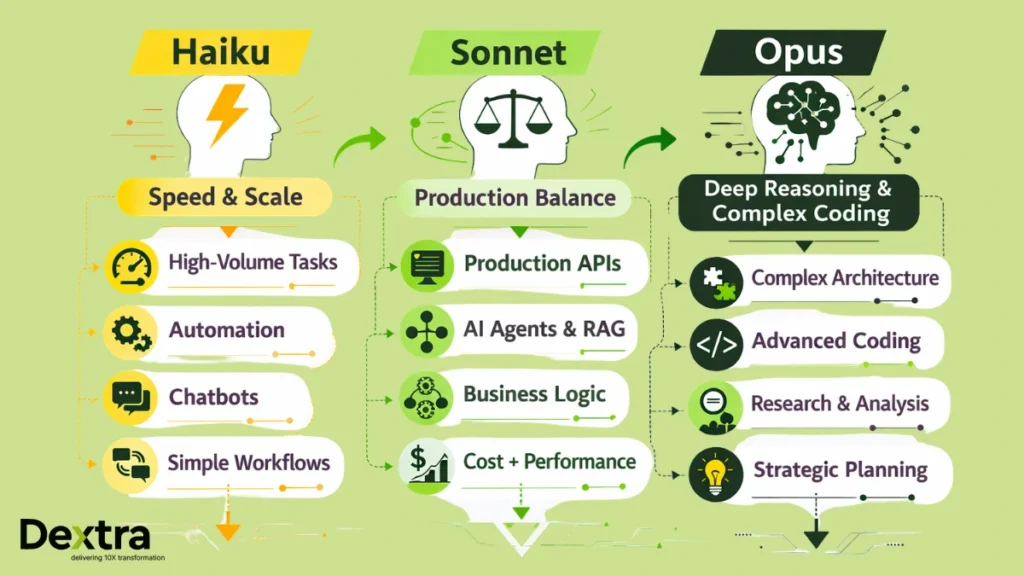
The Claude models developed by Anthropic are available in three main variants: Opus (with the strongest reasoning capability), Sonnet (with balanced performance and pricing), and Haiku (designed for speed and efficiency). Opus is suitable for complex problem-solving and heavy coding, Sonnet for general production tasks, and Haiku for speed and large-scale tasks.
If you are deciding on the best Claude model, the answer depends on your workload complexity, speed requirements, and budget.
Many businesses comparing Claude Opus vs Sonnet, Claude Opus vs Sonnet vs Haiku, or Claude Sonnet vs Opus are essentially asking one question: how much intelligence do you truly need, and at what cost?
Quick Comparison Table:
| Features | Opus | Sonnet | Haiku |
| Reasoning Depth | Highest | Strong | Moderate |
| Speed | Slower | Fast | Fastest |
| Cost | Highest | Moderate | Lowest |
| Coding Quality | Excellent | Very Good | Good |
| Best For | Complex analysis | Production coding | High-scale automation |
Use Sonnet for 80–90% of tasks. Choose Opus for extremely complex reasoning or architecture design. Choose Haiku for latency-sensitive and cost-efficient workloads.
What is Claude Opus?
Claude Opus is Anthropic’s most capable reasoning model, designed for deep analytical tasks, complex coding, long-horizon planning, and multi-step problem solving. When evaluating Claude Opus vs Sonnet, Opus stands out in situations where depth and precision matter more than speed.
It belongs to the high-intelligence tier within the anthropic claude opus sonnet ai opus lineup and is built for advanced enterprise use cases.
Best Use Cases:
- Advanced debugging
- Complex architecture planning
- Multi-stage reasoning
- Technical research synthesis
Opus is especially strong in ambiguous tasks where instructions are incomplete or require interpretation across long contexts.
What is Claude Sonnet?
Claude Sonnet is a well-rounded model that is optimized for speed, cost, and reliable performance in coding, writing, and enterprise use cases.
In most Claude Opus vs Sonnet discussions, Sonnet emerges as the practical production choice.
Best Use Cases:
- API-based production workloads
- Day-to-day coding
- RAG systems
- AI agents
Sonnet delivers nearly Opus-level performance at a significantly lower cost and higher speed.
This is why many teams comparing claude opus vs sonnet vs haiku ultimately select Sonnet for real-world deployments.
What is Claude Haiku?
Claude Haiku is the lightweight and fastest variant, optimized for high-throughput, latency-sensitive tasks where cost efficiency is critical.
Claude Haiku Use Cases
- Chatbots at scale
- Simple classification
- Content moderation
- Real-time automation
If your system processes millions of short requests daily, Haiku may outperform larger models purely due to efficiency.
Claude Opus vs Sonnet: Performance Comparison
When analyzing Claude Opus vs Sonnet, it is helpful to break the comparison into reasoning, coding, speed, and cost.
1. Reasoning & Intelligence
Opus offers stronger high-level reasoning and is better at ambiguous, long-context tasks. Sonnet handles structured workflows extremely well but may struggle with highly complex architectural reasoning.
In most Claude Sonnet vs Claude Opus evaluations, the difference becomes noticeable only in edge cases involving advanced abstraction.
2. Coding Performance
Targeting Claude Opus vs Sonnet for coding, here is the practical answer:
For complex debugging and deep system design, Opus performs better. For everyday backend coding, API building, and scripting, Sonnet is often sufficient and more cost-effective.
According to Claude 3.5 Sonnet vs Claude 3 Opus benchmarks, Sonnet closes much of the performance gap for production-ready development tasks.
If teams compare Claude Sonnet vs Opus vs Haiku for coding, the ranking typically becomes:
- Opus for complex system design
- Sonnet for production APIs
- Haiku for lightweight scripting
3. Speed Comparison
In a Claude Sonnet 4.5 vs Opus 4.5 speed comparison, Sonnet shows lower latency and better responsiveness.
Sonnet has:
- Lower average response time
- Higher throughput capacity
- Better scalability for API workloads
Sonnet is noticeably faster than Opus, making it more suitable for production APIs.
This is one of the key reasons developers choose Sonnet in the claude sonnet 4.5 vs opus 4.5 speed comparison.
4. Cost Comparison
When evaluating claude opus 4.5 vs sonnet 4.5, pricing differences become important.
Opus typically carries:
- Higher input token cost
- Higher output token cost
For example, at scale, a million-token workload processed daily can cost significantly more with Opus compared to Sonnet.
Sonnet can reduce inference costs by up to 60–80% compared to Opus, depending on workload scale.
This cost-performance ratio heavily influences the Claude opus vs sonnet vs haiku which is better debate.
Claude 3.5 Sonnet vs Claude 3 Opus: Benchmark Overview
In a detailed Claude 3.5 Sonnet vs Claude 3 Opus comparison, several patterns appear:
- Reasoning benchmarks: Opus scores higher in multi-step logical reasoning.
- Code generation benchmarks: Performance gap narrows significantly.
- Hallucination tendencies: Both show improved reliability in structured tasks.
- Output reliability: Sonnet offers strong consistency in production flows.
From a claude 3.5 sonnet vs claude 3 opus performance perspective, Sonnet has improved significantly compared to earlier releases.
Claude 4 Opus vs Sonnet 4: What Changed?
In independent Python coding benchmarks, Claude Sonnet 4 achieved a 95.1% Pass@1 success rate, with Claude Opus 4 close behind at 94.5% on the HumanEval benchmark, showing both models excel in code generation accuracy compared to other AI models.
Comparing claude opus 4 vs sonnet 4:
- Better reasoning stability
- Reduced hallucination frequency
- Improved tool-calling integration
- Enhanced context handling
Newer Claude versions improve reliability and tool-calling stability rather than radically altering capability tiers.
This pattern also appears in comparisons like claude 4 sonnet vs opus.
How Big is the Difference Between Opus and Sonnet for Coding?
The difference between Opus and Sonnet for coding is noticeable in complex, multi-file, architectural problems. For typical backend APIs, frontend components, and script automation, Sonnet performs nearly as well at a lower cost.
Opus justifies a higher cost when:
- Designing distributed systems
- Refactoring large legacy codebases
- Debugging ambiguous production failures
For standard SaaS development, Sonnet is often sufficient.
Is Sonnet Better Than Claude?
This is a common misconception. Sonnet is not a competitor to Claude, it is a variant within the Claude model family. Comparing “Sonnet vs Claude” is like comparing a trim level to a vehicle brand; Sonnet is one configuration of Claude, alongside Opus and Haiku.
Whether Sonnet is “better” depends entirely on the task. In many production API-heavy use cases, Sonnet may actually be more efficient than Opus, and it has excellent reasoning and coding skills with lower latency and cost. This makes it a viable option for scalable applications, automation scripts, and customer-facing applications.
But for highly complex reasoning, research-level tasks, or deep analysis, Opus may still be the better choice.
The question isn’t whether Sonnet replaces Claude, but rather Claude Sonnet vs Claude Opus and which model tier is best suited for your performance, cost, and workload needs.
Is Claude Opus 4.5 Better Than Sonnet?
When comparing Claude Opus 4.5 vs Sonnet 4.5, the answer isn’t which one is generally the best, it’s which one aligns with your business needs.
Both are highly capable, but they’re built with different goals in mind.
Claude Opus 4.5 is built to be as smart and complex as possible. It performs best at complex reasoning, complex problem-solving, advanced coding, and long-context analysis. If your business or organization is research-oriented or makes technical decisions, Opus 4.5 will typically offer more complete and accurate results.
Claude Sonnet 4.5, on the other hand, is built to be fast, efficient, and cost-effective. It also has strong reasoning capabilities but is faster and more affordable, making it ideal for business use cases that require scalability.
Key Differences
Select Opus 4.5 if your business requires:
- Deep reasoning and complex analysis
- Advanced code generation
- High-stakes or enterprise-grade tasks
- Maximum model capability
Choose Sonnet 4.5 if you prioritize:
- Faster response times
- Lower operational cost
- Scalable automation
- Balanced performance for everyday business use
Ultimately, “better” depends on whether intelligence depth or operational efficiency matters more to your organization.
Which Claude Model Should Developers Choose?
Selecting the right Claude model depends on the complexity of your workload, performance needs, and budget. Each level of the model, such as Opus, Sonnet, and Haiku, is designed for a different development need. Rather than asking which one is “best,” developers should consider the level of reasoning depth, latency tolerance, and scale their applications require.
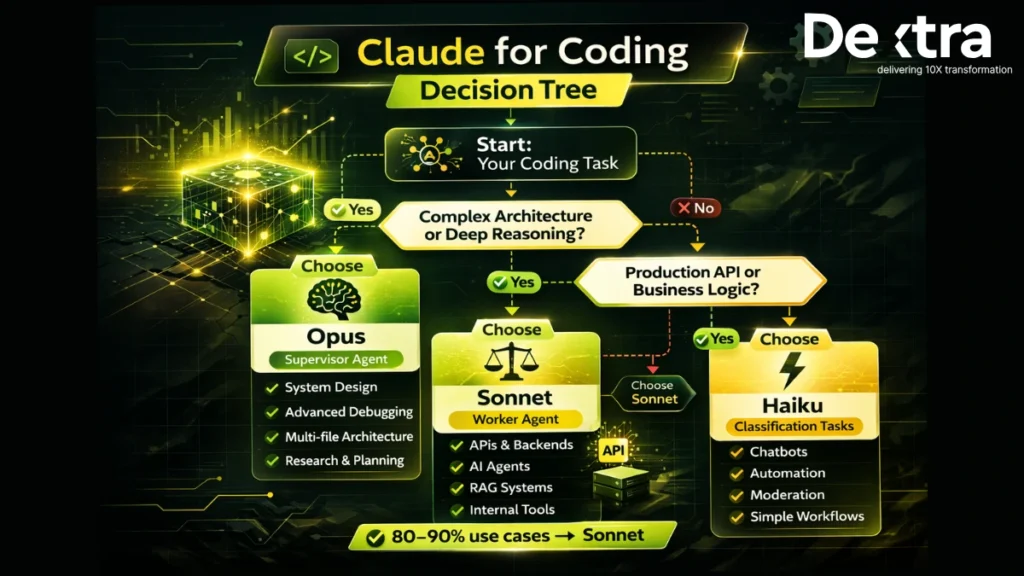
Select Opus if you are:
- Solving ambiguous or open-ended research problems
- Performing architectural system design
- Handling deep technical debugging
- Conducting legal or financial reasoning analysis
- Working on mission-critical, high-precision tasks
Opus is ideal when maximum intelligence and nuanced reasoning matter more than cost or speed.
Choose Sonnet if you are:
- Building production-grade AI agents
- Deploying APIs at scale
- Managing Retrieval-Augmented Generation (RAG) pipelines
- Balancing performance with cost efficiency
- Powering internal tools and SaaS workflows
Sonnet offers strong reasoning with better speed and operational efficiency, making it a practical default for most production environments.
Choose Haiku if you are:
- Running high-volume automation
- Powering real-time chatbot systems
- Handling simple, repetitive tasks
- Optimizing for minimal latency and cost
Haiku is particularly well-suited to light, fast-response applications where size and cost are the primary considerations.
Ultimately, model selection should correlate with task complexity, scalability requirements, and cost planning.
Claude Models for AI Agents & RAG Systems
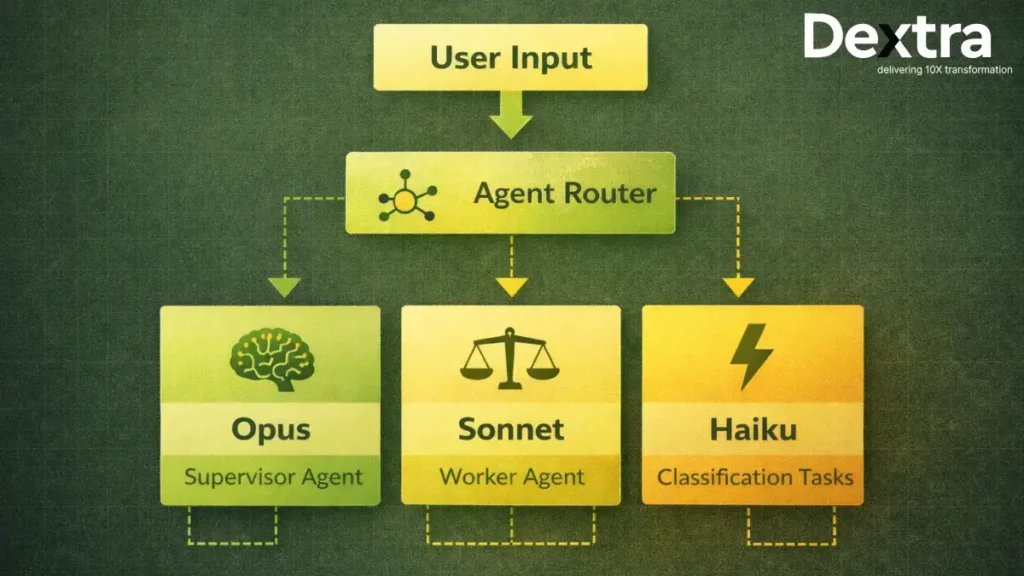
For AI agents and retrieval-augmented generation systems:
- Sonnet works well as the default production agent model.
- Opus can act as a supervisory agent in multi-agent systems.
- Haiku supports classification side-tasks within agentic workflows.
In multi-model architectures, mixing tiers improves cost control without sacrificing intelligence.
Enterprise Deployment Considerations
For CTOs and enterprise teams evaluating Claude Opus vs Sonnet, consider:
- Latency vs reasoning tradeoff
- Token budgeting
- Model fallback strategy
- Observability and monitoring
- Multi-LLM strategy
Compared to GPT-4 and other enterprise models, Claude emphasizes strong reasoning with improved safety controls.
Best Claude Model for Your Business? Here’s How to Decide?
Selecting the right Claude model involves more than simply selecting the model with the highest benchmark performance.
The right model for your business will depend on the nature of your business, the type of tasks you are doing on a day-to-day basis, and the budget you have available.
A model that works well in a research-oriented environment may not be the best choice for a high-speed customer service application. Before choosing a model, you should consider the following:
- Task complexity – Are you doing complex analytics or just answering simple questions?
- Response time – Do you need an answer in real time, or can you tolerate a slight delay?
- Cost constraints – What is your desired trade-off between performance and cost?
- Industry compliance needs – Are there strict legal, financial, or data regulations?
- Scale of deployment – Will this run for a small team or across enterprise-level systems?
Ultimately, the best Claude model aligns with your operational goals, not just performance metrics.
How Dextralabs Helps You Choose & Deploy the Right Claude Model?
Most enterprises overpay for intelligence they don’t need. Dextralabs helps you deploy the right Claude model for the right workload, balancing cost, speed, and reasoning depth.
Dextra Labs’ Model Selection Framework includes:
- Benchmark use-case simulation
- Cost modeling
- Latency profiling
- Accuracy scoring
- Risk evaluation
Services include:
- Claude model advisory
- Claude API integration
- AI agent development
- RAG implementation
- Multi-model deployment
Whether your team is evaluating Claude Opus vs Sonnet, evaluating a Claude 3.5 Sonnet vs Claude 3 Opus comparison, or comparing claude sonnet 4.5 vs opus 4.5, Dextralabs helps in making an informed decision.
Conclusion
Choosing between Claude Opus vs Sonnet, or evaluating claude opus vs sonnet vs haiku, is not about picking the most powerful model. It is about aligning intelligence levels with business requirements.
Opus excels in complex reasoning. Sonnet dominates production environments. Haiku powers high-scale automation.
The right choice reduces cost, improves speed, and strengthens system reliability.
If your organization is unsure which model fits your architecture, As an AI Consulting Company, Dextralabs can help you evaluate, benchmark, and deploy the optimal Claude solution.
Ready to choose the right Claude model for your business? Connect with Dextralabs today and build AI systems that are intelligent, efficient, and built to scale.
Q. What are the differences between Opus and Sonnet?
Opus is intended for more in-depth reasoning, complex analysis, and high-risk problem-solving. Sonnet offers high performance at a balanced speed-to-cost ratio, making it more viable for most production applications.
Q. Is Claude Opus 4.5 better than Sonnet 4.5?
Opus 4.5 has better multi-step reasoning and is more comprehensive in complex tasks. Sonnet 4.5 is faster and more cost-effective, making it better suited to scalable business applications.
Q. Which Claude model is best for coding?
For advanced debugging, architectural design, and complex logic, Opus is ideal. For everyday production coding, API integrations, and agent workflows, Sonnet is typically the better balance.
Q. What is the cheapest Claude model?
Haiku is the most cost-effective solution, designed for lightweight tasks and high-volume automation. It is best suited for applications where speed and price are the top priorities.
Q. What are the differences between Claude Sonnet, Opus, and Haiku?
The main differences lie in reasoning complexity, speed, and cost, Opus is designed for intelligence, Sonnet for balance, and Haiku for speed and efficiency.
Q. Is Claude 3.5 Sonnet or Haiku better?
Sonnet 3.5 offers stronger reasoning and better handling of moderately complex tasks. Haiku is better for fast responses and budget-sensitive, large-scale deployments.
Q. What is Claude’s Haiku?
Haiku is the fastest and lightest Claude model, built for high-volume, low-latency applications like chatbots, automation, and repetitive workflows.