2026 feels like a turning point for large language models. LLMs are no longer just tools for generating text or answering questions.
LLMs are now mission-critical infrastructure with multimodal reasoning, agentic tool use, and enterprise-grade deployment features. From independent financial advisors in the UAE to regulatory-heavy healthcare copilots in the United States to e-commerce agents in Singapore, organizations are wiring these models into workflows that handle sensitive data, regulatory duties, and customer interactions at scale.
The scale of adoption is remarkable:
- Worldwide spending on AI is forecast to total $2.59 trillion in 2026, a 47% increase year-over-year, according to a Gartner report. Within that, spending on agentic AI inside software is expected to rise 141% in 2026, reaching nearly $202 billion, and is forecast to surpass spending on chatbots and assistants by 2027.
- The model layer is the fastest-growing slice of that spend. Worldwide end-user spending on AI models and platforms is projected to total $64 billion in 2026, up 63.4% from $39 billion in 2025, with spending on GenAI models alone forecast to grow 117%.
- Yet not every deployment survives contact with production. Gartner predicts that over 40% of agentic AI projects will be canceled by the end of 2027, due to escalating costs, unclear business value, or inadequate risk controls. The firm also notes widespread “agent washing,” estimating only about 130 of the thousands of self-described agentic AI vendors are real.
That creates a very practical problem for anyone choosing an LLM in 2026: which model should you actually use?
Here’s the problem this guide solves. Dozens of proprietary and open-weight models now launch every quarter. Choosing the right one has never been more complex. That’s exactly why LLM leaderboards have become indispensable decision-making tools, offering clarity on accuracy, reasoning, cost, speed, and risk.
We’ve watched a clear shift at Dextra Labs. Multinationals, SMEs, and startups across the US, UAE, and Singapore now use LLM rankings as the starting point for model selection. Leaderboards expose trade-offs that directly affect Total Cost of Ownership, time-to-deployment, and regulatory compliance. This guide is built to help you read the most reliable LLM benchmark leaderboards of 2026, and, just as importantly, to know where they stop being useful.
Live LLM Rankings: Best AI Models Right Now (2026 Updated!)
Before we get into which leaderboard to trust for which job, here’s the snapshot most readers actually came for: how today’s frontier models rank across the benchmarks that still discriminate between them.
Best Overall Intelligence
Ranked by composite intelligence index (blended reasoning, coding, math, and general knowledge).
| Rank | Model | Provider | License | Intelligence Index |
| 1 | Claude Opus 5 | Anthropic | Closed | 63.0 |
| 2 | Claude Fable 5 | Anthropic | Closed | 62.1 |
| 3 | Grok 4.6 | xAI | Closed | 60.9 |
| 4 | Kimi K3 | Moonshot AI | Open weights | 59.7 |
| 5 | GLM-5.3 | Z.AI | Open weights | 59.5 |
| 6 | GPT-5.6 Sol | OpenAI | Closed | 58.9 |
| 7 | Qwen3.8 Max | Alibaba | Open weights | 58.1 |
| 8 | Claude Opus 4.8 | Anthropic | Closed | 57.3 |
| 9 | GPT-5.5 | OpenAI | Closed | 56.3 |
| 10 | Gemini 3.7 Flash | Closed | 56.0 |
Best for Reasoning (GPQA Diamond)
Graduate-level science questions across physics, chemistry, and biology.
| Rank | Model | Provider | GPQA Diamond |
| 1 | GPT-5.6 Sol | OpenAI | 94.6% |
| 2 | Claude Mythos Preview | Anthropic | 94.6% |
| 3 | GPT-5.4 Pro | OpenAI | 94.5% |
| 4 | Claude Opus 4.8 | Anthropic | 94.4% |
| 5 | Claude Fable 5 | Anthropic | 94.1% |
Best for Agentic Coding (SWE-Bench Verified)
Real GitHub issues the model must resolve end-to-end. The single most-watched benchmark for developer teams.
| Rank | Model | Provider | SWE-Bench Verified |
| 1 | GPT-5.6 Sol | OpenAI | 96.2% |
| 2 | Claude Mythos 5 | Anthropic | 95.5% |
| 3 | Claude Fable 5 | Anthropic | 95.0% |
| 4 | GPT-5.6 Luna | OpenAI | 93.0% |
| 5 | Claude Opus 4.8 | Anthropic | 88.6% |
Best for Computer Use (OSWorld)
Real desktop GUI tasks completed end-to-end. The benchmark to watch if you’re deploying autonomous agents.
| Rank | Model | Provider | OSWorld |
| 1 | Claude Fable 5 | Anthropic | 85.0% |
| 2 | Claude Opus 4.8 | Anthropic | 83.4% |
| 3 | Claude Sonnet 5 | Anthropic | 81.2% |
| 4 | GPT-5.5 | OpenAI | 78.7% |
| 5 | Claude Sonnet 4.6 | Anthropic | 78.5% |
Fastest and Cheapest Models
Speed and price often matter more than raw intelligence for high-volume production workloads.
| Category | Model | Provider | Figure |
| Fastest (tokens/sec) | Llama 4 Scout | Meta | ~2,600 t/s |
| Fastest frontier-class | GLM 5.2 | Z.AI | ~347 t/s |
| Cheapest (per 1M tokens) | Nova Micro | Amazon | $0.04 / $0.14 |
| Best price-to-quality | DeepSeek V4 Pro | DeepSeek | $0.44 / $0.87 |
Context Window, Cost & Speed Comparison
| Model | Provider | Context | I/O Cost (per 1M) | Speed |
| Claude Opus 5 | Anthropic | 1M | $5 / $25 | — |
| Claude Sonnet 5 | Anthropic | 1M | $3 / $15 | 56.3 t/s |
| GPT-5.6 Sol | OpenAI | 1.05M | $5 / $30 | — |
| Gemini 3.7 Flash | 1M | $0.75 / $3.75 | 121 t/s | |
| Kimi K3 | Moonshot AI | 1.05M | $3 / $15 | 35.2 t/s |
| GLM-5.3-Flash | Z.AI | 1M | $0.15 / $0.50 | — |
| DeepSeek V4 Pro | DeepSeek | 1M | $0.44 / $0.87 | 174.9 t/s |
| Llama 4 Scout | Meta | 10M | $0.11 / $0.34 | ~2,600 t/s |
| Sarvam 105B | Sarvam AI | 128K | Open weights | — |
Why LLM Leaderboards Matter in 2026?
LLM benchmarks have evolved beyond raw accuracy; they now measure efficiency, safety, reasoning, and cost-effectiveness. These rankings help:
- Compare model accuracy and speed across domains.
- Understand trade-offs between size, latency, and resource use.
- Identify bias, hallucination vulnerabilities, and robustness.
While public LLM leaderboards are useful, they may not accurately reflect enterprise realities such as deployment efficiency in the cloud versus on-premises.
- Customizable flexibility for proprietary datasets.
- Fine-tuning flexibility for proprietary datasets.
- Compliance with GDPR, HIPAA, or UAE data residency laws.
That is why, at Dextralabs, we combine leaderboard data with enterprise-specific evaluation frameworks to ensure models meet performance, compliance, and operational resilience criteria before deployment.
Top LLM Leaderboards to Follow in 2026:
Not every leaderboard is equally useful anymore, and a few widely-cited ones have gone quiet. Here’s where to actually look, ordered by how much signal they give a buyer today.
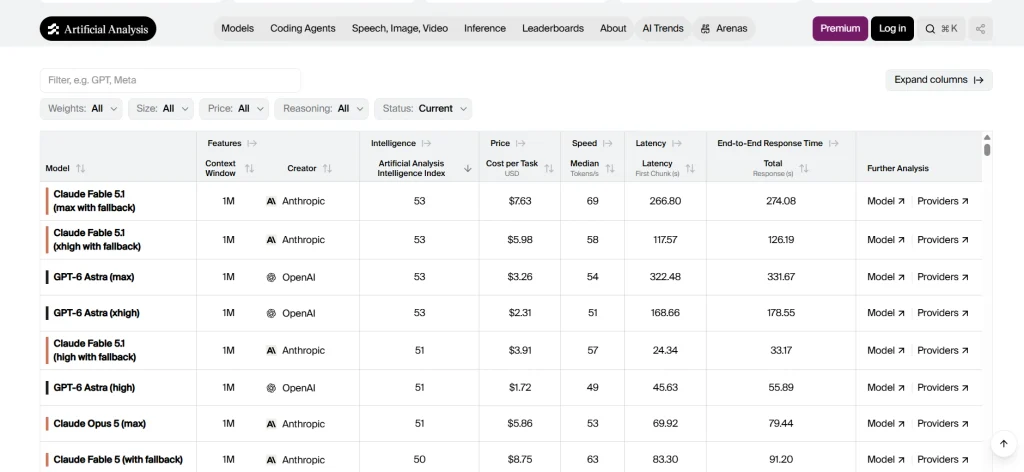
Artificial Analysis LLM Leaderboard
What it is: The most widely-referenced independent benchmark aggregator of 2026. It ranks 250+ models on a composite Intelligence Index alongside price, output speed (tokens/sec), latency (time to first token), context window, and cost-per-task.
Features:
- Blended intelligence score across roughly ten evaluations, so no single benchmark dominates.
- Rich price-performance and speed-vs-quality visualizations.
- Filters for open weights vs. proprietary, reasoning vs. non-reasoning, and model size.
Use cases: The best single starting point for a buyer who wants one defensible ranking across intelligence, cost, and speed together.
Pros: Broad coverage, frequently updated, strong price-performance lens.
Cons: Composite scores can obscure task-specific strengths; always drill into the individual benchmark that matches your workload.
Vellum LLM Leaderboard
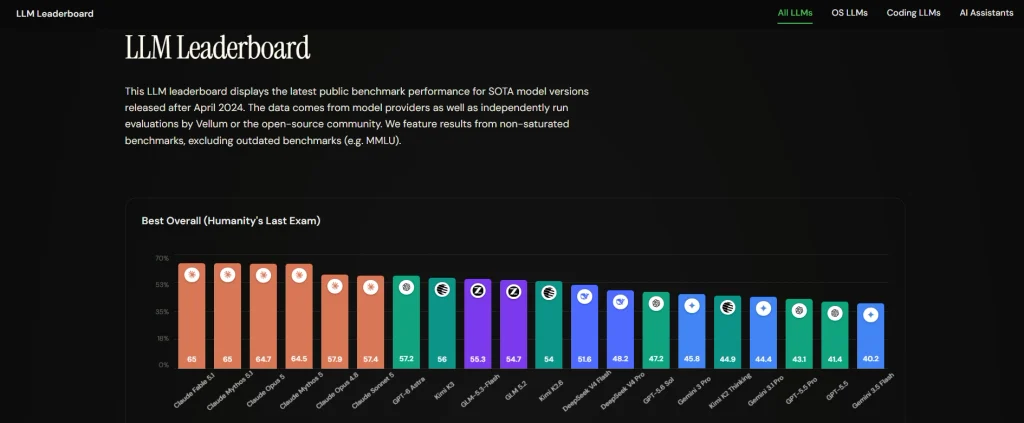
What it is: A task-segmented leaderboard that only features non-saturated benchmarks for models released after April 2024. It explicitly excludes outdated benchmarks like MMLU.
Features:
- Clear task breakouts: Best Overall (Humanity’s Last Exam), Reasoning (GPQA Diamond), Agentic Coding (SWE-Bench), Computer Use (OSWorld), Browsing (BrowseComp), Terminal Use (Terminal-Bench).
- Side-by-side model comparison with context, cutoff date, I/O cost, latency, and speed.
- A built-in benchmark glossary.
Use cases: Ideal when you already know the job to be done and want the best model for that specific task rather than a blended average.
Pros: Job-to-be-done structure maps directly to real buying decisions; deliberately avoids saturated metrics.
Cons: Focused on post-2024 frontier models, so it’s not the place for older or niche open-source models.
llmleaderboard.in
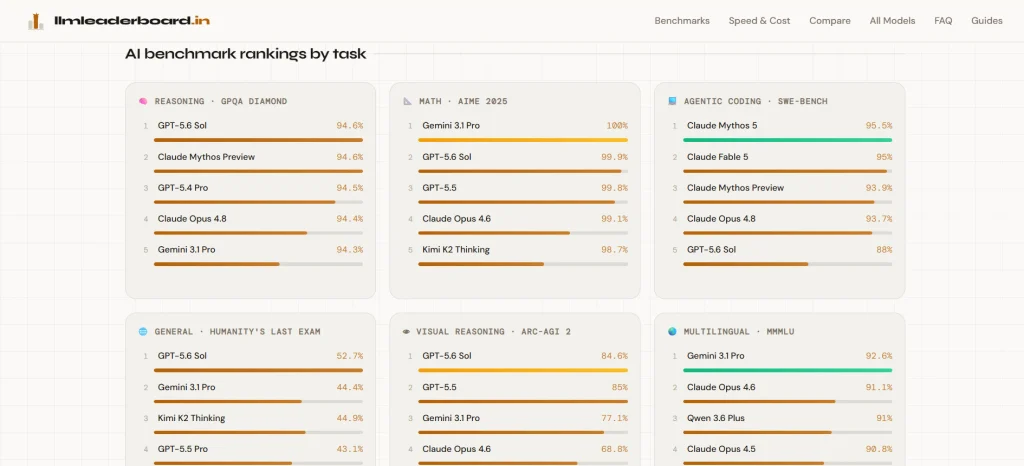
What it is: A fast, independent comparison site that ranks 50+ frontier models by benchmark score, speed, and API cost, with a strong secondary focus on multilingual and Indian-language models (Sarvam AI).
Features:
- Task-ranked views for reasoning, math, coding, vision, and multilingual performance.
- Country-of-origin and license columns, plus historical benchmark-progress charts.
- Use-case guides (“best for coding,” “cheapest,” “largest context window”).
Use cases: Strong for multilingual and regional deployment decisions, and for anyone who wants pricing and benchmarks in one scannable table.
Pros: Clean UX, regional-language coverage most Western leaderboards ignore.
Cons: Smaller model universe than Artificial Analysis; aggregates third-party data rather than running all evals in-house.
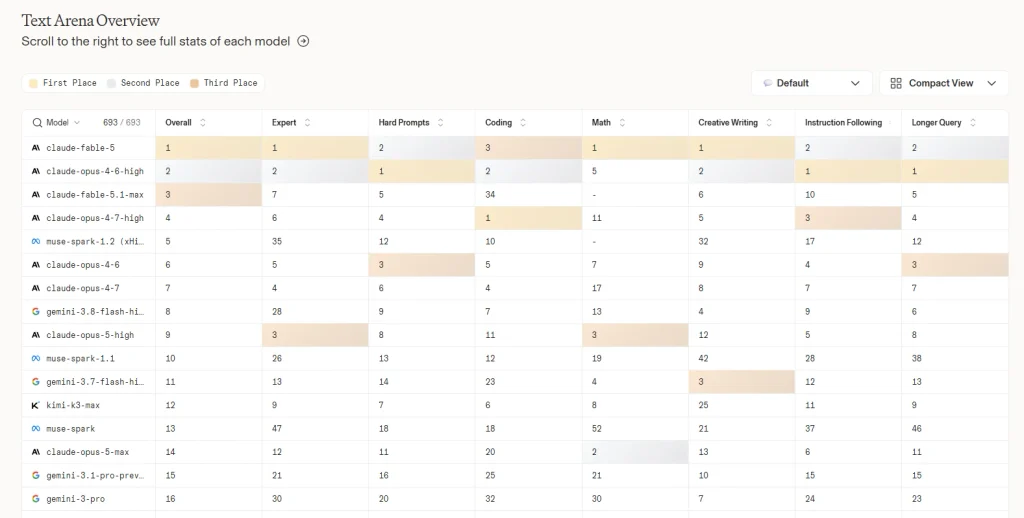
LMArena (formerly LMSYS Chatbot Arena)
What it is: The crowd-sourced leaderboard where models are pitted head-to-head in blind human comparisons and ranked by Elo. Think “Consumer Reports” for conversational AI.
Features:
- Pairwise human votes rather than academic scores.
- Reflects real-world chat quality and how “natural” a model feels.
- Rankings shift quickly with community voting.
Use cases: Best when your workload is customer-facing chat, support, or copilots where subjective conversational quality matters.
Pros: Captures conversational quality that benchmarks miss.
Cons: Susceptible to voting bias; no enterprise metrics like TCO or compliance.
Hugging Face Open LLM Leaderboard
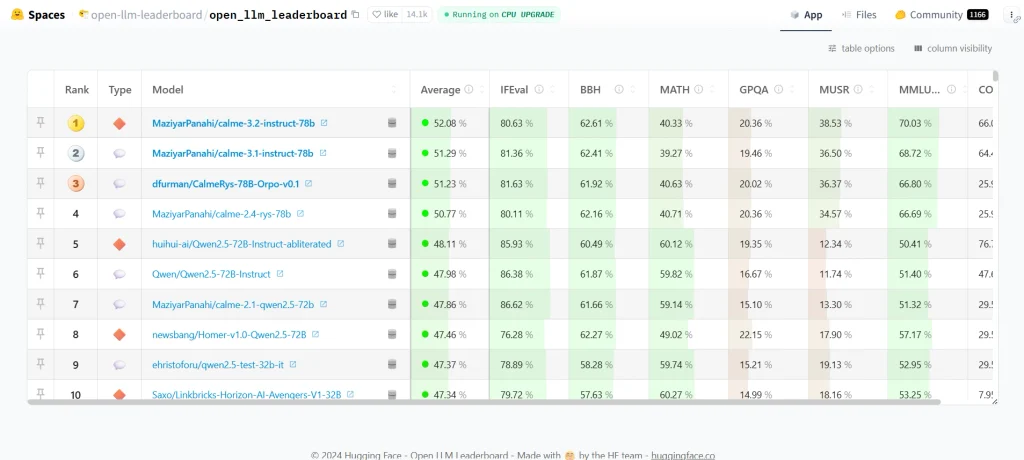
What it is:
The de facto public leaderboard for open-source models. It ranks models using academic benchmarks like MMLU, ARC, TruthfulQA, and GSM8K, updated almost daily.
Features:
- Covers reasoning, language understanding, math, and factual accuracy.
- Filters by model size, architecture, and quantization precision.
- Transparent submissions from model developers.
Use Cases:
- Great for comparing open-source models if you want transparency and community validation.
- Useful starting point for procurement teams deciding whether to build on OSS vs. pay for proprietary APIs.
Pros (CTO View): Clear, transparent, fast-moving; excellent for spotting rising OSS models.
Cons: Purely benchmark-driven; doesn’t account for latency, deployment cost, or compliance fit.
Also Read: LLM Jailbreaking: Steps by steps guide 2026
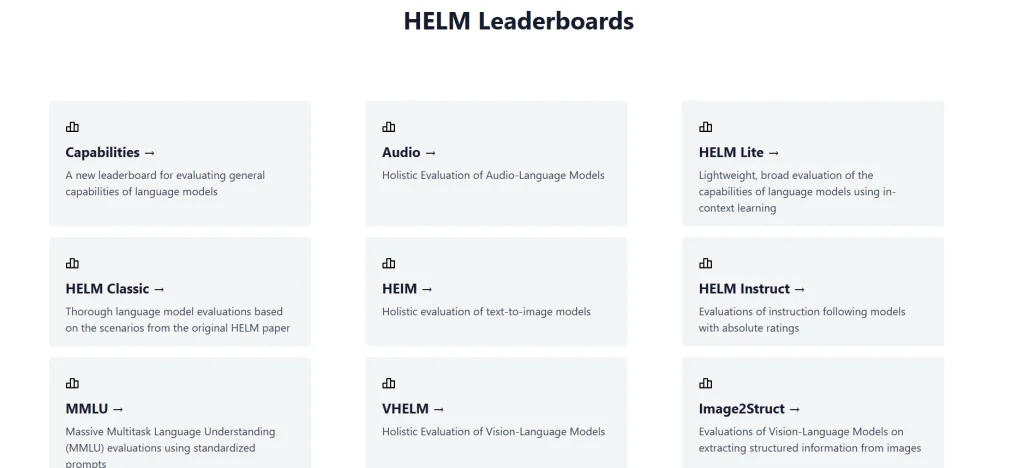
Stanford HELM (Holistic Evaluation of Language Models)
HELM evaluates models across 42 realistic scenarios and seven metrics: accuracy, fairness, bias, toxicity, efficiency, robustness, and calibration. It’s fully transparent and extensible, offering both overall and domain-specific leaderboards, including medical and finance.
What it is:
The most comprehensive academic benchmark for LLMs, evaluating across 42 scenarios and 7 dimensions: accuracy, fairness, bias, toxicity, efficiency, robustness, and calibration.
Features:
- Extensible to new domains (finance, healthcare).
- Fully transparent methodology.
- Offers domain-specific leaderboards (not just general performance).
Use Cases:
- Critical if you’re deploying in regulated industries like banking or healthcare.
- Great for vendor due diligence, proves whether a model meets bias and fairness standards.
Pros: Balanced, holistic view across accuracy, safety, and efficiency.
Cons: Academic setup—doesn’t always map neatly to enterprise deployment conditions (e.g., cloud costs).
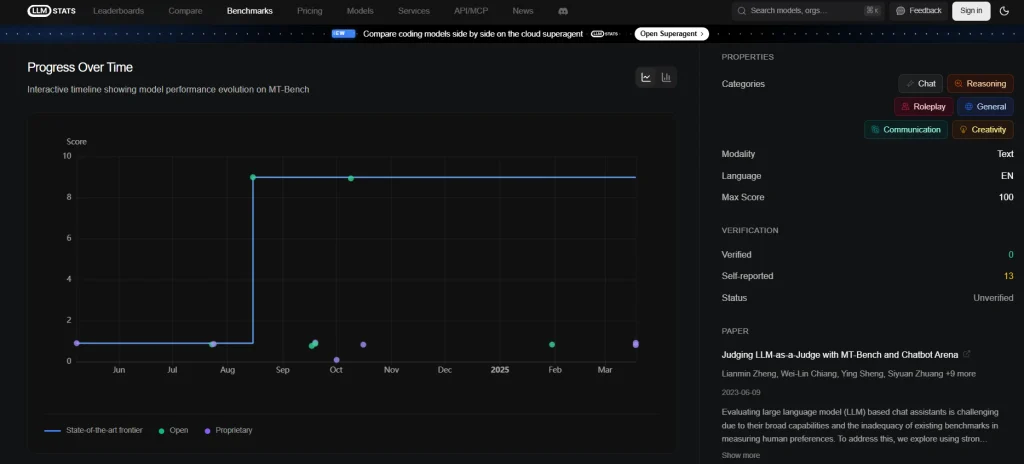
MT-Bench LLM Leaderboard
Crowd-evaluated chatbot performance via pairwise comparisons.
What it is: An evaluation designed specifically for multi-turn conversation quality, often used alongside LMSYS.
Features:
- Tests reasoning across chained, multi-step prompts.
- Focuses on dialogue coherence and sustained interaction.
Use Cases:
- Ideal if your LLM powers customer support bots, copilots, or tutoring systems where multi-turn reasoning matters.
Pros: Better at exposing weaknesses in long-form dialogue than single-question benchmarks.
Cons: Narrower focus—doesn’t cover embeddings, latency, or bias.
OpenCompass CompassRank:
Multi-domain leaderboard with both open and proprietary models.
What it is: A multi-domain leaderboard covering both open and proprietary models, developed in China but globally relevant.
Features:
- Evaluates across dozens of domains (STEM, humanities, law, etc.).
- Includes both closed-source and open-source LLMs.
Use Cases:
- Good for enterprises wanting a broad comparative view across model types.
- Especially useful in Asia-Pacific markets with local LLM players.
Pros: Wide coverage, includes proprietary models.
Cons: Methodology less transparent than HELM; regulatory environment may influence submissions.
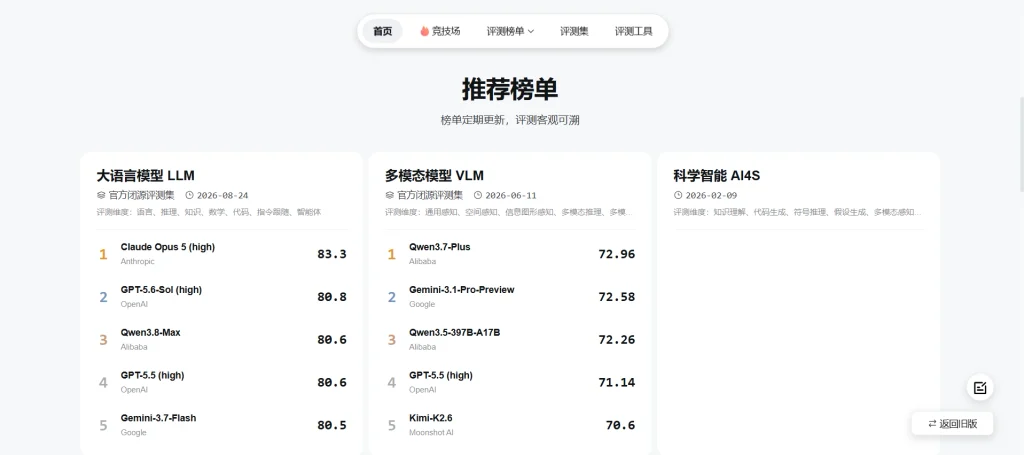
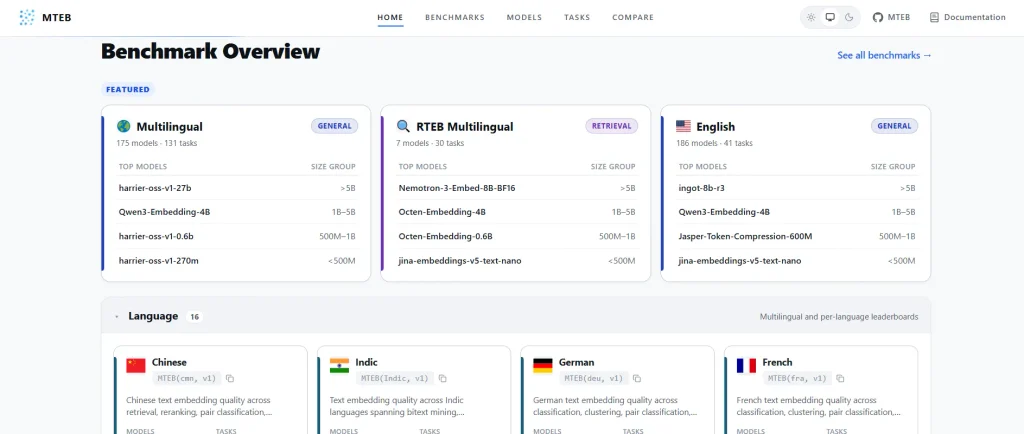
MTEB Leaderboard:
Benchmarks text embedding models across 56 datasets and languages.
What it is:
The standard benchmark for text embedding models, which power search, retrieval, and semantic similarity tasks.
Features:
- Covers 56 datasets and multiple languages.
- Evaluates embeddings for classification, clustering, RAG, and multilingual tasks.
Use Cases:
- Must-track if you’re building RAG systems, semantic search, or recommendation engines.
Pros: Gold standard for embeddings, highly detailed.
Cons: Embeddings ≠ generative performance; needs to be paired with other leaderboards for a full picture.
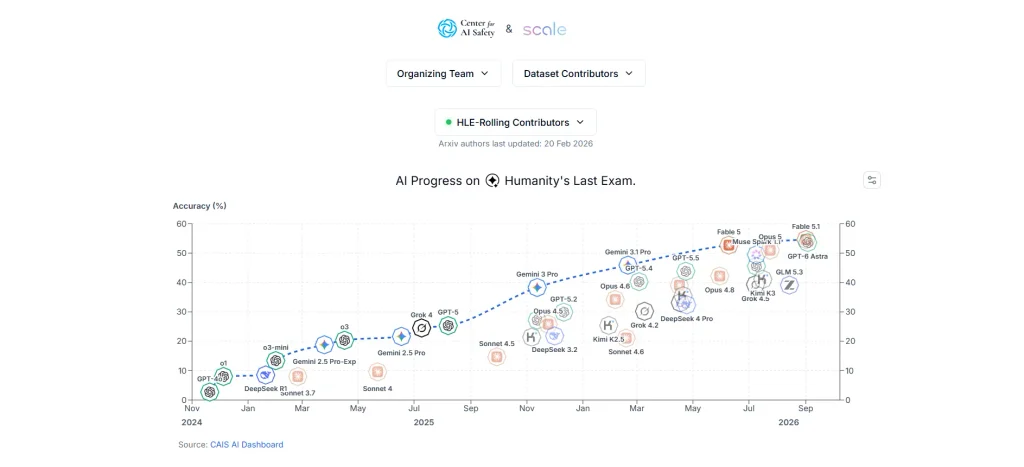
Humanity’s Last Exam LLM Leaderboard
A newly introduced, highly challenging benchmark measuring reasoning across broad topics, ideal for testing frontier models.
What it is: A new high-stakes benchmark measuring advanced reasoning and general knowledge. Designed to push frontier models to their limits.
Features:
- Covers reasoning across law, philosophy, science, and more.
- Designed to surface hallucinations and fragile reasoning.
Use Cases:
- Useful for evaluating frontier models for enterprise R&D and long-horizon strategy.
- Helps stress-test LLMs for mission-critical decision support.
Pros: Excellent for testing reasoning robustness.
Cons: Early-stage benchmark, less adoption in production contexts.
Also Read: Fine-Tuning Large Language Models (LLMs) in 2026
How to Read This Leaderboard (by Use Case)
Rankings only help once you map them to your own job. Here’s how three common teams should read the tables above.
For coding teams. Prioritize SWE-Bench Verified, Terminal-Bench, and tool-use scores over composite intelligence. Then weigh latency and per-token cost, because coding agents make many calls per task and cost compounds fast.
For budget-conscious builders. Start from the cost table, not the intelligence table. Compare input and output prices per 1M tokens, then check whether a cheaper model clears the quality bar for your specific task. Several lower-cost models are surprisingly capable for high-volume automation.
For multilingual or regional use cases. Look past English-centric benchmarks. Compare MMMLU, regional-language support, and context limits. Purpose-built models like Sarvam AI can beat larger frontier models on Indian-language work despite lower English scores.
How Businesses Should Interpret LLM Leaderboards?
Here’s the trap many enterprises fall into: assuming the top-ranked model is the best fit. In reality:
- Raw scores ≠ readiness. High accuracy may come at the expense of deployment cost or latency.
- Generalist vs. Specialist. GPT-4 may top global rankings, but a smaller fine-tuned model could outperform it in a compliance-heavy financial workflow.
- Hidden Costs. Models with higher leaderboard scores often require more GPU memory, longer training, or higher inference costs.
CTOs should balance leaderboard insights with:
- Latency benchmarks – Critical for customer-facing apps.
- Compliance alignment – Does the model meet HIPAA, GDPR, or UAE data localization standards?
- Domain adaptation – Does it specialize in legal, medical, or multilingual contexts?
At Dextralabs, our methodology helps enterprises map leaderboard results to real-world ROI metrics, ensuring the chosen model is technically feasible, compliant, and cost-optimized.
Also Read: Best LLM for Coding: Choose the Best Right Now (2026 Edition)
Consider this Real-Life example:
A UAE-based financial institution initially selected a leaderboard-topping model from Hugging Face. It performed well in general reasoning but struggled with compliance-heavy use cases, producing subtle errors in risk calculations.
Through Dextralabs’ enterprise evaluation framework, the client pivoted to a smaller, domain-adapted model. The outcome:
- 30% efficiency gains in processing compliance workflows.
- 40% reduction in inference costs.
- Improved auditability, reducing regulatory risk.
This case highlights why leaderboards are necessary but insufficient, and why expert interpretation matters.
The Future of LLM Leaderboards Beyond 2025
We expect leaderboards to evolve with greater enterprise alignment:
- Multimodal evaluations, models tested across text, image, audio, and video capabilities.
- Industry-specific metrics, compliance, governance, and performance in regulated environments.
- Regional leaderboards, for example, multilingual benchmarks like SEA-HELM, featuring Filipino, Indonesian, Tamil, Thai, and Vietnamese evaluations.
At Dextralabs, we anticipate integrating these real-world metrics, deployment success, domain fit, and governance standards into future model rankings.
Benchmark Glossary
Quick, plain-English definitions of the benchmarks that matter in 2026.
- Humanity’s Last Exam (HLE): A crowd-sourced exam of extremely hard questions across every academic discipline. Designed as the “final exam” before superhuman AI.
- GPQA Diamond: Graduate-level science questions curated by domain experts. Tests advanced reasoning in physics, chemistry, and biology.
- SWE-Bench Verified: Real GitHub issues from popular Python repos the model must resolve end-to-end. Measures agentic software-engineering ability.
- Terminal-Bench: Evaluates a model’s ability to execute multi-step tasks in a terminal environment.
- OSWorld: Real-world computer-use tasks requiring GUI interaction on a desktop OS. Measures end-to-end task completion.
- BrowseComp: Agentic web-search benchmark testing whether a model can browse and extract information to answer complex questions.
- AIME 2025: Competition-level mathematics, used to separate top math and reasoning models.
- ARC-AGI 2: Abstract visual-reasoning benchmark designed to resist memorization.
- MMMLU: Multilingual knowledge and understanding across many languages.
Conclusion
The takeaway is clear: LLM leaderboards are powerful guides, but not the final word. They tell you which models perform best under certain conditions, but not whether they align with your business needs.
As models proliferate, organizations will need strategic partners who can interpret leaderboards, benchmark real-world deployments, and align AI with compliance, cost, and operational realities.
At Dextralabs, we partner with enterprises, SMEs, and startups to simplify LLM selection, deployment, and evaluation, ensuring your AI journey is built on a foundation stronger than raw numbers.
Let’s move beyond rankings to build AI strategies that truly deliver.
FAQs on llm leaderboard:
Q1. Which AI model ranks #1 right now?
As of the latest data, Claude Opus 5 leads composite intelligence rankings on Artificial Analysis, with Claude Fable 5 and Grok 4.6 close behind. But “#1” depends on the job: GPT-5.6 Sol and Claude Mythos-class models trade the top spot on reasoning (GPQA Diamond) and agentic coding (SWE-Bench). Always match the leaderboard to your workload.
Q2. What is the best LLM leaderboard in 2026?
There’s no single best one. For a blended intelligence-plus-price view, use Artificial Analysis. For task-by-task selection (reasoning, coding, computer use), use Vellum. For multilingual and regional decisions, use llmleaderboard.in. For conversational quality, use LMArena. For regulated-industry due diligence, use Stanford HELM. The smart move is to cross-check two or three, then run your own real-world test.
Q3. Which LLM is best for coding in 2026?
On SWE-Bench Verified, GPT-5.6 Sol and the Claude Mythos/Fable 5 family currently lead agentic coding, with several models clustered in the 88–96% range. For coding teams, weigh SWE-Bench and Terminal-Bench scores alongside latency and per-token cost, since coding agents make many calls per task.
Q4. What is the cheapest LLM API?
Among capable models, Nova Micro and the Gemini Flash and GPT Luna tiers sit at the low end of per-token pricing, while DeepSeek V4 Pro is widely cited for the best price-to-quality ratio. Compare input and output cost per 1M tokens against the quality your task actually needs.
Q5. Is the Hugging Face Open LLM Leaderboard still updated?
No. The original Hugging Face Open LLM Leaderboard was retired/archived in 2025 as its benchmarks saturated. It’s still useful as a historical archive, but for current open-weights rankings use Artificial Analysis (open-weights filter) or Vellum’s OS LLM view.
Q6. GPT-5.6 vs Claude vs Gemini, which should I use?
Choose the Claude Opus/Fable 5 family for long-running agentic work, computer use, and top SWE-Bench scores. Choose GPT-5.6 Sol for frontier reasoning and ecosystem integration. Choose Gemini 3.x for very large context windows, multimodal tasks, and cost-effective research. Many teams route: cheaper models for simple tasks, frontier models for hard ones.
Q7. How often are LLM leaderboards updated?
It varies. Artificial Analysis and llmleaderboard.in update within a day or two of a new release. Vellum refreshes regularly with non-saturated benchmarks. LMArena updates continuously as votes come in. Academic frameworks like HELM run on a slower, more structured cadence.