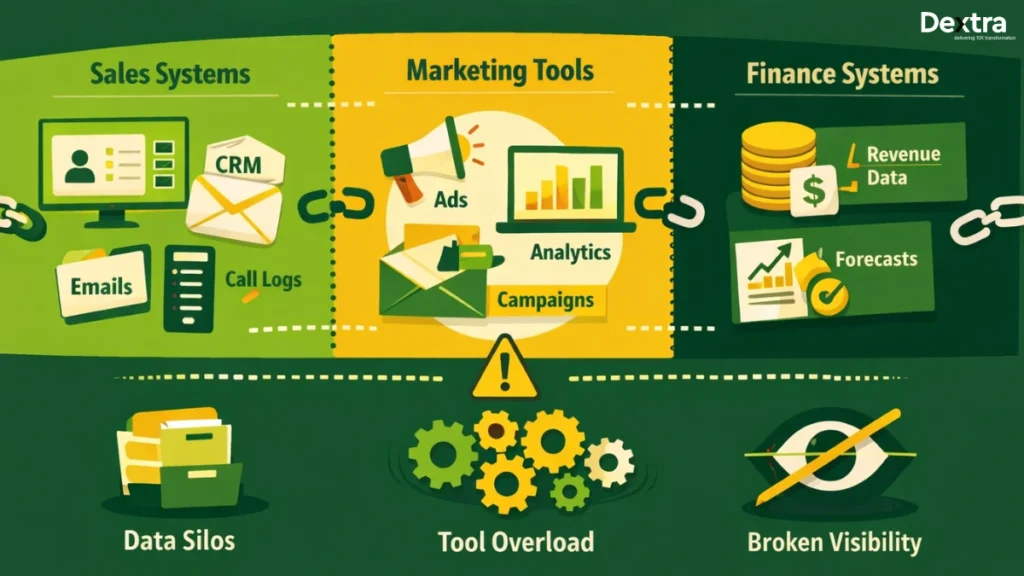
A common challenge faced by modern SaaS companies among revenue teams is that there are too many disconnected tools and fragmented datasets. Revenue teams operate off sales systems, while RevOps team members use financial systems, and marketing departments use marketing intelligence dashboards. These different systems create gaps in visibility, increase manual work, and create unreliable forecasts.
In response, the last few years have seen a rapid rise in AI revenue intelligence tools. These platforms give teams insights into pipeline activity, deal health, and sales performance, but insights alone don’t drive action. Revenue leaders may receive dashboards, risk scores, and activity reports, yet deals still stall, and CRM hygiene continues to break down. Visibility is valuable, but it is not execution.
The future of RevOps is becoming increasingly automated, with revenue processes coordinated through smart orchestration. According to Oliv.ai and Momentum.io, SaaS teams are increasingly adopting unified revenue platforms and revenue operations software to reduce tool fatigue, streamline workflows, and execute in real time.
This is where the evolution begins.
Revenue teams are now shifting from “getting insights” to actually orchestrating actions. Instead of telling sellers what’s wrong, new AI systems directly fix the problem inside the current GTM stack.
And this is precisely where SpurIQ stands apart. While most platforms (Clari, People.ai, Aviso, Gong) are insight-heavy, SpurIQ positions itself as a services-first AI revenue action orchestration architect, turning intelligence into execution. For SaaS companies comparing options for the best AI for sales, this distinction becomes a major decision-maker.
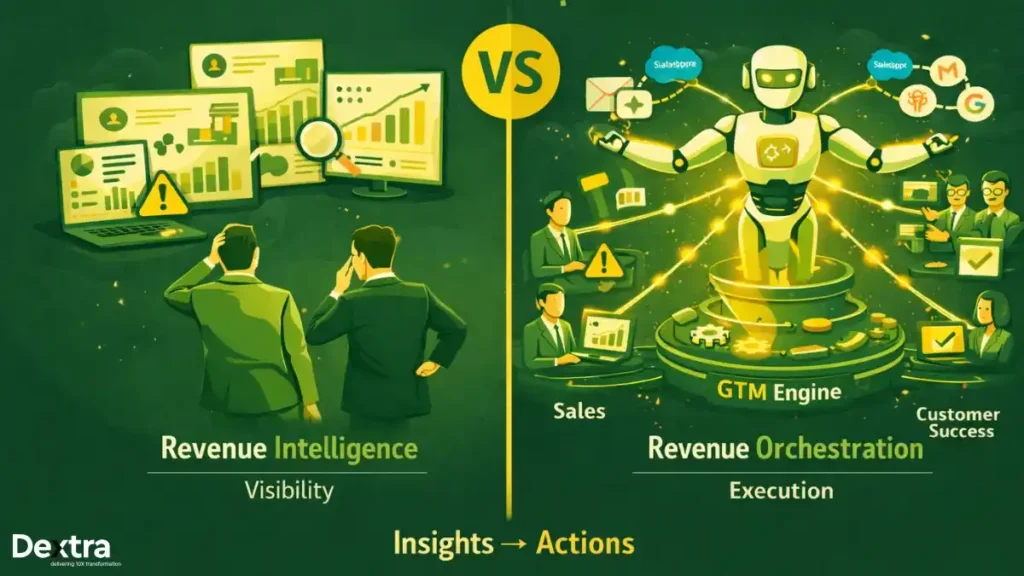
Thesis: Revenue intelligence tells you what’s wrong. Revenue orchestration fixes it.
Throughout this article, we’ll explore the difference between the two categories — revenue intelligence vs orchestration — and why companies are shifting toward action-first models like SpurIQ.
What is Revenue Intelligence?
Revenue intelligence is a category of analytic and AI revenue intelligence tools designed to capture, analyze, and interpret sales data. These platforms give teams visibility into deal health, activity levels, pipeline risks, and forecasting accuracy. They highlight what is happening and why it may be happening.

Core Capabilities of Revenue Intelligence
- Automatic activity capture from calls, emails, calendars, and CRM
- Conversation intelligence (Gong, Chorus)
- Pipeline risk detection based on buyer-seller engagement
- Deal scoring and forecasting visibility
- Sales performance analytics for managers
Examples of AI Revenue Intelligence Tools
Most companies exploring AI revenue intelligence tools list evaluate platforms such as:
- Clari – forecast visibility (revenue platforms)
- Gong – conversation intelligence
- People.ai – CRM activity capture (revenue operations software)
- Aviso – predictive forecasting
- Salesforce Einstein – AI-based analytics
- Outreach – sales engagement and activity capture
These revenue operations platforms and revenue platforms provide strong visibility, analytics, and insights into pipeline performance, but execution still relies on human follow-up. This is why many buyers searching for the best AI for sales are now shifting from intelligence tools to orchestration platforms like SpurIQ.
Limitations of Revenue Intelligence
While powerful, revenue intelligence platforms have key limitations:
- They still require a human to decide what to do next.
- Insights do not equal execution.
- Teams often get more dashboards instead of clear action.
- Reps experience “tool fatigue.”
- Revenue leaders still feel forecasting uncertainty.
Analogy:
Revenue intelligence is like a diagnostic medical report — it identifies the problem but doesn’t perform the treatment.
This is the root difference in the ongoing comparison between revenue intelligence vs orchestration.
What is Revenue Orchestration?
Revenue orchestration is the combination of revenue-generating activities from Sales, Marketing, and Customer Success. Unlike intelligence tools, orchestration focuses on taking the next best action automatically, with no additional tool adoption.
This is where SpurIQ differentiates itself as a Rev Action Orchestration player.
Core Capabilities of SpurIQ
SpurIQ delivers:
- Native execution inside your current GTM stack
- Automated next-best-action recommendations for sellers
- Zero-touch CRM hygiene (data entry, updates, enrichment)
- Accurate forecast automation
- Complete visibility into deal progression
- Real-time response to buyer signals
The Role of AI in Orchestration
SpurIQ uses Agentic AI that doesn’t just analyze — it acts.
It can:
- Trigger workflows across Salesforce, HubSpot, Outreach, and Gong
- Update CRM fields autonomously
- Send nudges, follow-up suggestions, and handoff tasks
- React instantly to new buyer behaviors
Analogy:
If revenue intelligence is the diagnostic report, revenue orchestration is the conductor ensuring every part of the GTM engine performs at the right time.
Revenue Intelligence vs Revenue Orchestration
| Feature | Revenue Intelligence | Revenue Orchestration |
| Core Goal | Provide insights | Execute and optimize workflows |
| Actionability | Manual follow-up required | Autonomous next actions |
| Scope | Sales-focused | GTM-wide (Sales + Marketing + Customer Success) |
| Output | Dashboards & reports | Automated execution |
| Value Type | Awareness | Measurable outcomes |
| Technology | Analytics + AI | AI + Workflow Automation + Agentic AI |
This is the technical core of the revenue intelligence vs orchestration debate.
SpurIQ vs Clari vs People.ai vs Aviso
SpurIQ: Services-First AI Revenue Orchestration
SpurIQ differentiates itself as:
- Consulting-led, not tool-led
- Installed on your existing GTM stack
- Operating through AI agents that improve CRM, forecasting, and deal execution
- Focused on measurable business outcomes
Impact areas include:
- Zero manual CRM work
- Shorter deal cycles
- Predictable forecasting
- Automated seller workflows
Clari & Aviso: Platform-First Revenue Intelligence
Platforms like Clari and Aviso excel at:
- Deal visibility
- Forecast dashboards
- Risk scoring
But they remain:
- Insight-heavy
- Dependent on humans to execute
- Underutilized when reps fail to follow up
This is where the comparison of Clari revenue intelligence vs SpurIQ revenue intelligence becomes relevant.
Clari identifies; SpurIQ acts.
People.ai: Activity Intelligence
People.ai is strong in:
- Data capture
- Signal analytics
But remains tool-centric and limited in orchestration flexibility.
Clari Run Revenue vs SpurIQ Orchestration
Clari’s Run Revenue gives a data-driven view of what’s happening.
SpurIQ’s orchestration layer directly fixes the gaps.
AI Revenue Intelligence Tools List
| Tool | Primary Function | Category |
| Gong | Conversation intelligence | Revenue Intelligence |
| Clari | Forecast visibility | Revenue Intelligence |
| People.ai | CRM activity capture | Revenue Intelligence |
| Aviso | Predictive forecasting | Revenue Intelligence |
| SpurIQ | AI execution layer | Revenue Orchestration |
This illustrates the category difference between AI revenue intelligence tools and orchestrators.
Why Orchestration Is the Future of RevOps
Modern SaaS revenue teams already have enough data. What they lack is:
- Fewer tools
- Faster workflows
- Fewer decisions
- Accurate forecasts
- Cleaner CRM processes
Revenue orchestration solves these challenges by:
- Auto-updating CRM
- Giving predictive pipeline movement
- Guiding sellers in real-time
- Automating handoffs between GTM teams
Gartner: Revenue Intelligence Market Review, 2024 shows that 48% of users still struggle with manual follow-up even after adopting intelligence tools, proving that insights alone cannot solve operational gaps.
This supports the shift from revenue intelligence vs orchestration toward orchestration-driven RevOps.
When Does a SaaS Company Need Orchestration?
Orchestration becomes essential when SaaS companies reach:
- 150–500 employees
- Complex multi-tool GTM environments
- CRM hygiene issues
- Unpredictable forecasts
- Manual revenue operations inefficiencies
These companies benefit the most from shifting from intelligence dashboards to execution systems.
Strategic Recommendation: SpurIQ’s Unique Model
SpurIQ positions itself uniquely as a:
- AI revenue orchestration consultant
- Focused on seller action flows
- Installed directly into existing GTM tools
- Zero disruption, zero migrations required
- Designed for founders and GTM leaders who want execution, not more dashboards
This services-first approach helps teams move past the limitations of traditional intelligence platforms in the revenue intelligence vs orchestration assessment.
Future Outlook: From Intelligence to Autonomous Revenue Systems
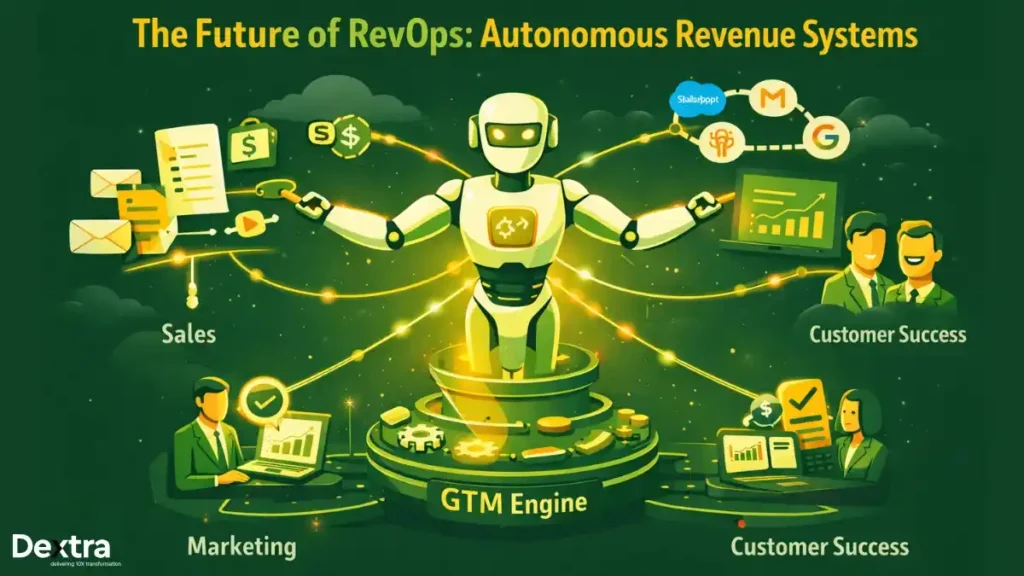
The future of RevOps is shifting toward automation-first, orchestration-driven revenue engines. According to Oliv.ai, SaaS teams are increasingly adopting unified revenue platforms and revenue operations software to reduce tool fatigue, streamline workflows, and execute in real time.
Key trends include:
- Self-driving GTM engines
- Agentic revenue operations
- AI-first sales execution models
- Real-time orchestration across Sales, Marketing, and Customer Success
SpurIQ plays a central role in this transformation, turning fragmented tool stacks into coordinated, actionable revenue engines.
Conclusion
As SaaS revenue teams evolve, the shift from revenue intelligence to orchestration becomes inevitable. Intelligence tells teams what happened, where risks exist, and what might go wrong. But orchestration—especially with SpurIQ’s agentic AI—executes the next best action automatically.
In the long debate of revenue intelligence vs orchestration, the future clearly belongs to orchestration.
If your revenue team is struggling with tool overload, inconsistent CRM, or uncertain forecasts, SpurIQ can turn your entire GTM motion into a unified, automated, and predictable system.
Ready to transform your revenue engine?
- Book a Revenue Orchestration Consultation
- Get a free sales stack audit
- Request your customized 7-Day AI RevOps Blueprint
No new tools required. Works with Salesforce, HubSpot, Gong, Outreach, and Gmail. Go live in 30 days.
FAQs on Revenue Intelligence vs Revenue Orchestration:
Q. What is revenue orchestration?
It is the automation and coordination of GTM workflows using AI that executes next-best actions across your existing tools.
Q. What is the meaning of revenue intelligence?
It refers to platforms that analyze sales data and provide visibility, insights, and forecasting support.
Q. What is the difference between sales intelligence and revenue intelligence?
Sales intelligence focuses on prospect data. Revenue intelligence focuses on pipeline visibility, forecasting, and rep behavior.
Q. What is a revenue intelligence platform?
A tool that captures data from CRM, emails, calls, and meetings to highlight deal health and pipeline risks.
Q. How does AI generate revenue?
By automating workflows, improving CRM hygiene, guiding reps in real time, and increasing seller productivity.
Q. Which AI tool is best for sales?
Platforms like Gong and Clari lead in intelligence, but SpurIQ leads in AI-driven orchestration and execution.
Q. What is Gong AI used for?
Conversation intelligence, call transcription, coaching insights, and activity analysis.
Q. Which tool is commonly used for forecasting in revenue management?
Clari, Aviso, and Salesforce Einstein are widely used. SpurIQ enhances forecasting accuracy through orchestration.


![How to Build LLM Applications with LangChain: A Complete Python Tutorial [2025]](https://dextralabs.com/wp-content/uploads/2025/08/langchain-for-llm-application-development.webp)