
Most IBC/ARC deals assess financials and legal compliance. Very few evaluate the tech stack. The buyer inherits broken systems and the turnaround plan collapses before it begins.
The Acquisition Looks Perfect on Paper. Then Reality Hits.
A resolution plan gets approved. The Committee of Creditors signs off. The acquirer walks in with a turnaround thesis built on growth projections, cost synergies, and operational restructuring.
Six months later, the ERP system crashes during a critical production cycle. The legacy codebase is so tangled that a single feature change takes three months. The cloud infrastructure bill is 4x what anyone modelled. Two of the three engineers who understood how the system worked have already left.
None of this showed up in the financial due diligence. None of it appeared in the legal review. Because nobody conducted a serious technical due diligence.
This pattern is far more common than most deal teams realise and the numbers back it up.

Ready to De-Risk Your Next Acquisition?
Dextra Labs helps VCs, PE firms, ARCs and resolution applicants evaluate technology risk in stressed asset acquisitions.
Talk to our deal-focused tech advisory teamThe Numbers That Should Worry Every Stressed Asset Buyer
A rigorous analysis of 40,000 acquisitions over four decades found that 70–75% of deals fail to achieve their stated objectives of enhancing sales growth, cost savings, or maintaining the buyer’s share price. Separately, research indicates that 60–80% of acquisitions fail to create meaningful shareholder value.
In India’s IBC ecosystem, the stress is even more pronounced. As of March 2025, the average CIRP resolution time stands at 713 days, more than double the statutory 330-day limit. For cases closed during FY 2025, the average resolution stretched to 853 days. Nearly 78% of ongoing CIRP cases have exceeded 270 days post-admission.
Creditor recovery rates hover around 32.8% of admitted claims. While the IBC has facilitated recovery of approximately ₹3.89 lakh crore till March 2025, extended timelines cause asset depreciation, employee attrition, customer loss, and supplier relationship breakdown — all of which erode enterprise value.
Now consider this: if these are the outcomes even with financial and legal diligence in place, imagine what happens when an entire dimension of risk — the technology stack — is never evaluated at all.
Why Technology Gets Ignored in IBC and ARC Deals?
The typical stressed asset acquisition playbook prioritises three pillars: financial health, legal compliance, and operational viability. Technology assessment, if it happens at all, is limited to an inventory of hardware assets and a quick review of software licences.
There are structural reasons for this blind spot:
- Time pressure: IBC processes are inherently time-bound. Resolution professionals and CoCs operate under statutory deadlines (even if routinely breached), and deep technology assessments get deprioritised as “nice to have.”
- Information asymmetry: Resolution applicants face significant information gaps when performing due diligence on CIRP companies. Technical documentation is often incomplete, outdated, or non-existent for distressed entities.
- Skill gap on deal teams: Most advisory teams in IBC transactions include financial analysts and lawyers. Very few include CTOs, solutions architects, or AI consulting specialists who can assess technical infrastructure.
- Underestimation of tech as a liability: In manufacturing or traditional sector acquisitions, technology is viewed as a support function, not a core risk vector. This assumption is dangerously outdated in 2026.
The result? Buyers inherit broken systems, undocumented codebases, security vulnerabilities, and infrastructure that cannot scale — all hidden behind a clean resolution plan.
What “Hidden Tech Debt” Actually Looks Like in a Stressed Asset?
Technical debt in a stressed asset is not just messy code. It is a compound risk that accumulates across multiple layers of the technology stack, and one McKinsey study found that tech debt accounts for roughly 40% of IT balance sheets across sectors. In distressed entities, this number is almost certainly higher.
Here is what buyers typically discover, too late:
| Tech Debt Category | What Buyers Inherit |
| Architecture Debt | Monolithic systems that cannot be modularised, single points of failure, no microservices pathway, and infrastructure that collapses under scale |
| Code Quality Debt | Undocumented codebases, no test coverage, tightly coupled components where a single change breaks cascading functions |
| Security Debt | Unpatched vulnerabilities, hardcoded credentials, no encryption at rest, expired SSL certificates, and zero compliance with modern security standards |
| Infrastructure Debt | On-premise servers past end-of-life, no disaster recovery, manual deployments, and no CI/CD pipeline |
| Knowledge Debt | All system knowledge concentrated in 2–3 individuals (“hero engineers”) who may leave post-acquisition, creating catastrophic operational risk |
| Data Debt | No data governance, fragmented databases, no backup validation, GDPR/DPDPA non-compliance, and data silos that block analytics |
Any one of these in isolation is manageable. Combined, as they typically are in distressed entities, they create a remediation cost that can exceed 20–25% of the total development effort and fundamentally alter the deal’s economics.
The Real Cost: How Tech Debt Silently Kills Turnaround Plans?
Technical debt does not announce itself in a balance sheet. It manifests as delayed product launches, spiralling cloud costs, integration failures, and talent attrition. For stressed asset buyers, the impact is compounded:
- Integration delays destroy synergy timelines: The harder it is to integrate acquired technology into the buyer’s ecosystem, the longer it takes to realise synergies. Delayed synergies reduce the real return on the deal.
- Unplanned capex erodes the deal thesis: A ₹50 crore system rewrite that nobody budgeted for can turn a profitable turnaround into a value-destroying exercise.
- Security breaches create legal liability: The average cost of a data breach now exceeds $4.35 million globally. Acquiring a company with unaddressed security vulnerabilities transfers that liability directly to the new owner.
- Talent flight accelerates value erosion: Talent retention is consistently ranked among the top three challenges in technology mergers. When hero engineers leave a distressed entity post-acquisition, the buyer loses the only people who understand how things actually work.
| ⚠️ Real-World Parallel: When Verizon acquired Yahoo, it required a $350 million price reduction after discovering previously undisclosed data breaches during late-stage diligence. In stressed asset scenarios where diligence is even more compressed, such discoveries often come after the deal closes. |
What Investor-Grade Technology Due Diligence Looks Like in 2026?
Conventional tech assessments that check hardware inventories and software licence counts are insufficient. Modern tech due diligence for stressed assets follows a structured, investor-grade workflow designed to translate technical findings into deal language.
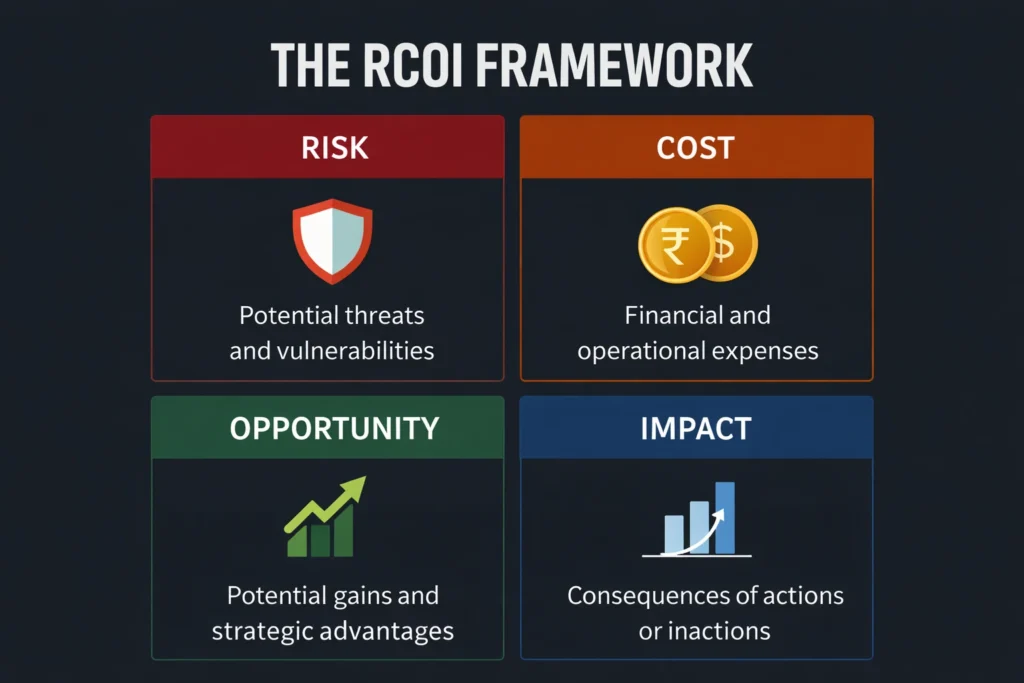
At Dextra Labs, our approach maps directly to the deal thesis through the RCOI framework:
| Phase | Focus | Deal Impact |
| R — Risks | Observations resulting in liabilities | Identifies deal-breakers and quantifies exposure: architecture failures, security gaps, compliance violations |
| C — Costs | Financial implications linked to risks | Translates every technical finding into capex/opex: remediation budgets, infrastructure upgrade costs, licensing gaps |
| O — Opportunities | Measures leading to enhanced prospects | Reveals hidden value: cloud migration savings, automation potential, AI-readiness of data assets |
| I — Impact | Financial gains from seizing opportunities | Projects ROI of tech improvements: faster time-to-market, reduced operational costs, scalability for growth |
This goes far beyond a checklist. Dextra Labs’ comprehensive tech due diligence covers technology stack assessment, architecture review, code quality analysis, security posture evaluation, cloud service and cost assessment, scalability testing, data management and privacy compliance, team expertise and skill gap analysis, IP and patent evaluation, and open-source software risk analysis.
For stressed assets specifically, the assessment focuses on survivability — determining if the technology can operate reliably under pressure, whether it can be safely restructured, and whether it has a viable path to supporting the turnaround thesis.
The 5-Step Tech DD Workflow for Stressed Asset Acquisitions
- Map Deal Thesis to Technical Reality: Connect the turnaround plan (growth, efficiency, or exit) to the actual technical capability of the asset. If the thesis depends on digital transformation, but the stack cannot support it, the thesis is broken before day one.
- Evidence Collection (Pre-Site): Focus on technical documentation, architecture diagrams, change control logs, maintenance backlogs, security audit history, and deployment records, not high-level spec sheets.
- Deep Technical Inspection: Conduct code quality analysis, architecture stress testing, security vulnerability scanning, infrastructure assessment, and knowledge concentration mapping. Verify actual condition versus reported condition.
- Stress Testing and Scenario Simulation: Simulate operational stress, full capacity loads, sudden downtimes, redundancy tests, to uncover weak points that only manifest under pressure. Critical for stressed assets where systems have often been running in degraded states.
- Translation into Deal Language: Convert every technical finding into a Quantified Risk Register (likelihood, severity, mitigation cost). Categorise required investment into mandatory (survivability) versus discretionary (value-add). Produce a capex/opex forecast that integrates directly into the resolution plan’s financial model.
What Changes When You Add Tech DD to the Deal Process?
Companies that conduct comprehensive technology due diligence are significantly less likely to experience major technology-related issues during integration. More importantly, for stressed asset buyers, tech DD fundamentally changes three aspects of the deal:
- Pricing accuracy: Technical findings feed directly into valuation adjustments. If the tech stack requires ₹30 crore in remediation, that should be reflected in the bid — not discovered six months post-close.
- Turnaround planning: A technology roadmap integrated into the resolution plan creates a realistic path to operational recovery, including immediate fixes, short-term stabilisation (1–3 years), and long-term modernisation.
- Risk mitigation: Identification of genuine deal-breakers, unmanageable security liabilities, irreparable architecture flaws, or IP contamination — before they become the buyer’s problem.
| 💡 Key Insight for Resolution Applicants In the IBC framework, contingent consideration mechanisms are increasingly being used to adjust purchase price based on post-acquisition discoveries. A robust tech DD report gives you the leverage to negotiate these mechanisms or avoid deals where the tech risk is simply too high. |
Beyond the Deal: From Tech DD to Remediation and Value Creation
Identifying tech debt is only the first step. The real value lies in what comes after. At Dextra Labs, our engagement model extends beyond assessment into structured remediation:
- Remediation Workshop: Post-investment sessions to design the technology roadmap, execute targeted remediation, and establish ongoing governance.
- CTO Office Services: Fractional CTO support to oversee the technology transformation, particularly valuable when the acquired entity lacks senior technical leadership.
- M&A Integration Management Office (IMO): Dedicated integration support that coordinates technology migration, platform consolidation, and AI agent development to accelerate operational efficiency post-acquisition.
For PE firms and special situation funds operating in India’s stressed asset market, this end-to-end approach transforms technical debt from a hidden liability into a structured value-creation lever.
The Bottom Line: You Cannot Turnaround What You Don’t Understand
In the IBC ecosystem, resolution plans live or die on their ability to revive the corporate debtor as a going concern. Financial modelling, legal structuring, and operational planning are essential but insufficient.
When 70–75% of acquisitions globally fail to deliver value, and India’s CIRP timelines stretch past 700 days, the margin for error is razor-thin. The technology stack is no longer a support function to be evaluated as an afterthought. It is a core risk vector that directly determines whether a turnaround thesis will survive contact with reality.
The question for every resolution applicant, every ARC, every PE fund looking at stressed assets in 2026 is simple: Can you afford to inherit a technology stack you’ve never evaluated?