Fintech companies depend on technology for almost every part of their business, from customer onboarding and payments to fraud detection, lending, data processing, and regulatory reporting. That makes a thorough fintech technology assessment, evaluating the quality of a company’s technology infrastructure, a material consideration for investors, acquirers, and strategic partners.
Technology due diligence (Tech DD) provides a structured way to assess that technology before an investment, acquisition, partnership, or major strategic decision. It examines the systems behind the business, including software architecture, cloud infrastructure, cybersecurity, data management, engineering practices, technical debt, scalability, resilience, and regulatory technology.
For fintech companies, the stakes can be particularly high. A technology weakness can affect transaction reliability, customer data protection, regulatory obligations, operational resilience, and the ability to scale. Conversely, a well-designed technology environment can support product expansion, automation, faster development, and sustainable growth.
Modern fintech tech due diligence therefore needs to go beyond identifying technical problems. It should help stakeholders understand which risks could affect the investment, what technology improvements may be required, how much investment they could require, and where technology can create additional value.
In this guide, we examine why Tech DD matters in fintech, what areas should be assessed, common technology red flags, regulatory and security considerations, and how technology findings can be translated into actionable investment and value-creation priorities.
What Is Technology Due Diligence in Fintech?
Technology due diligence in fintech, sometimes referred to as a fintech technology audit, is the structured assessment of a fintech company’s technology architecture, infrastructure, software, data, cybersecurity, engineering practices, compliance controls, and scalability to identify risks, investment requirements, and opportunities.
It helps answer questions such as:
• Can the technology scale with transaction and customer growth?
• Is sensitive financial data adequately protected?
• Are critical systems resilient and recoverable?
• Does the architecture support the product roadmap?
• Are there significant technical-debt issues that could constrain growth?
• Are third-party dependencies creating concentration risk?
• Can the company meet relevant technology and regulatory requirements?
• What technology investments will be required after the transaction?
Important: That last question, what technology investment is required post-transaction, is particularly important for investors and acquirers evaluating fintech targets.
Why Is Technology Due Diligence Especially Important in Fintech?
Fintech technology often sits directly inside critical financial workflows. Unlike many other industries where technology supports the business, in fintech, technology is the business. This elevates fintech technology risk to a level where it can directly affect business viability.
A technology failure in fintech can directly affect:
• Transaction processing and payment settlement
• Customer funds and account balances
• Identity verification and fraud detection
• Credit decisions and underwriting
• Financial data integrity and reporting
• Regulatory compliance and audit trails
• Customer access and service availability
Therefore, technology due diligence for fintech needs to examine not only whether systems work, but also whether they are secure, resilient, scalable, observable, and appropriately governed.
This makes fintech technical due diligence more complex and more consequential than in many other sectors, and it is why PE firms, VC investors, strategic acquirers, fintech founders, and corporate development teams need to prioritize it.
Why Fintech Technology Has Become a Due Diligence Priority
Fintech businesses increasingly depend on complex, interconnected technology stacks:
• Cloud infrastructure and multi-region deployments
• APIs and microservices architectures
• Mobile applications and progressive web apps
• Data platforms and real-time analytics
• Payment infrastructure and settlement systems
• AI and machine learning models for risk, fraud, and personalization
• Open banking integrations and third-party data sources
• Identity and KYC systems
• Cybersecurity controls and threat detection
As technology becomes more central to the business model, understanding the technology environment becomes increasingly important during investment and acquisition decisions. This is why tech due diligence fintech has become a priority for deal teams. What once could be deferred to post-close during fintech due diligence now needs to be understood before the deal is structured.
What Does Fintech Technology Due Diligence Assess?
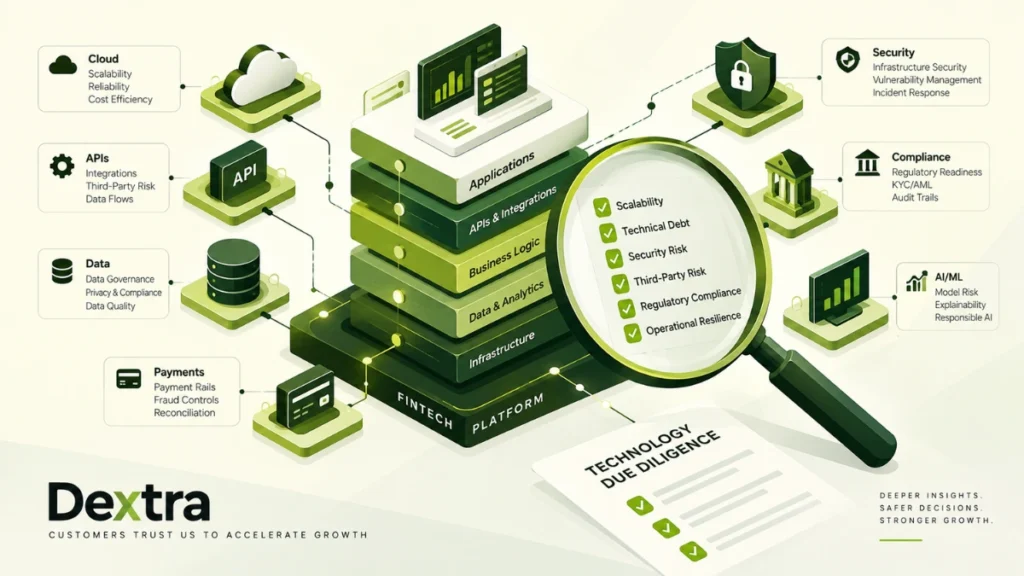
A comprehensive technology due diligence fintech assessment typically covers ten core areas. Each area contributes to a complete picture of the technology’s current state, risks, and future investment requirements.
1. Software Architecture
A fintech architecture assessment evaluates the application architecture, service dependencies, APIs, modularity, scalability patterns, and resilience design. Evaluate whether the architecture uses monolithic or microservices patterns, how services communicate, and whether the design supports horizontal scaling.
Key question: Can the architecture support the company’s projected growth and product roadmap without requiring a fundamental redesign?
2. Infrastructure and Cloud
Review cloud architecture, compute and storage configurations, networking, availability zones, disaster recovery readiness, infrastructure-as-code maturity, and cloud cost management.
For fintech, the question is not simply whether the company uses AWS, Azure, or GCP. The question is whether the infrastructure is appropriately designed for the business’s reliability, security, and growth requirements, and whether costs are sustainable at scale.
3. Cybersecurity
Assess identity and access management, encryption at rest and in transit, vulnerability management, security monitoring and alerting, incident response plans, application security practices, network security, and secrets management.
Also review the organization’s security governance model and history of security incidents, breaches, or near-misses. In fintech, where customer financial data and transaction systems are involved, fintech cybersecurity due diligence is a material assessment dimension.
4. Data Architecture and Privacy
This area deserves significant attention as part of fintech data due diligence. Assess data architecture, data flows between systems, data classification, data governance policies, access controls, data retention practices, encryption, privacy controls, and third-party data sharing arrangements.
For fintech companies handling sensitive financial and personal data, weaknesses in data architecture can create regulatory, security, and operational risks simultaneously.
5. Engineering Organization
Evaluate team structure and size, key-person dependency risks, hiring capacity and pipeline, development practices and methodology, the software development lifecycle (SDLC), code review processes, testing coverage and quality, CI/CD maturity, release frequency, and documentation quality.
This determines whether the engineering organization can actually execute the technology roadmap. A well-designed architecture with an under-resourced or poorly organized team is still a risk.
6. Technical Debt
A fintech technical debt assessment covers legacy systems still in production, unsupported frameworks and end-of-life dependencies, outdated libraries and security patches, architecture bottlenecks that limit development velocity, manual processes that should be automated, and deferred upgrades accumulating risk.
Nuance: Technical debt is not inherently bad, every growing company carries some. The real question for investors is: how does the technical debt affect growth, cost, security, reliability, and future investment requirements?
7. Scalability and Performance
A fintech scalability assessment evaluates current transaction volumes, concurrent user capacity, API throughput, database performance under load, peak-load handling, and capacity planning practices.
Then model the trajectory: current load versus expected load versus required capacity. Fintech companies that cannot demonstrate a credible path to handling projected volumes represent a scalability risk.
8. Resilience and Business Continuity
Review disaster recovery plans and testing history, backup procedures and restoration times, failover mechanisms, recovery time objectives (RTO) and recovery point objectives (RPO), incident response processes, service dependency mapping, and single points of failure.
For fintech, where system downtime can directly affect customer funds and regulatory standing, resilience is not optional, it is a core requirement.
9. Third-Party Dependencies
This is particularly important for fintech companies, which often rely heavily on external providers.
Assess dependencies on:
• Payment processors and acquiring banks
• Banking-as-a-Service (BaaS) providers
• Identity verification and KYC vendors
• Cloud providers and managed services
• Data providers and credit bureaus
• Fraud detection platforms
• Open-banking API providers
Critical question: What happens if a critical provider changes pricing, suffers an outage, terminates the relationship, or is acquired? Is there a fallback provider or is the business dependent on a single vendor?
10. Technology Economics
Assess cloud spend and trends, SaaS licenses, infrastructure costs, engineering costs and headcount trajectory, vendor costs and contract terms, support costs, and planned technology investments.
The objective is to understand both current technology cost and the future cost to scale. Investors need to know not only whether the technology works, but what it costs to run and what it will cost to grow.
Regulatory and Compliance Technology Assessment
The exact regulatory requirements vary by jurisdiction, licence type, and business model. However, technology due diligence can examine whether the fintech compliance technology supports relevant processes such as:
• Know Your Customer (KYC) onboarding and verification
• Anti-Money Laundering (AML) screening and monitoring
• Transaction monitoring and suspicious activity detection
• Fraud detection and prevention
• Regulatory reporting and data submissions
• Audit trails and activity logging
• Data retention and records management
• Access logging and privilege management
Important: Technology due diligence does not replace legal or regulatory due diligence. Instead, it evaluates whether the technology environment supports the organization’s relevant compliance obligations and controls. This distinction is important for credibility and for setting appropriate expectations with legal teams and regulators.
KYC and AML Technology in Fintech Tech DD
Given the centrality of KYC and AML processes in fintech, technology due diligence should specifically assess:
• Identity Verification: How are customers verified? What identity-proofing methods are used?
• Data Sources: What external identity, risk, or sanctions databases are used?
• Decision Logic: How are onboarding decisions made? Are they rule-based, model-based, or hybrid?
• Transaction Monitoring: How are suspicious patterns detected in real time?
• Alert Management: How are alerts generated, prioritized, and reviewed by compliance teams?
• Auditability: Can the organization reconstruct relevant decisions and activities for regulators?
• Scalability: Can the system handle increasing transaction volumes and customer growth without degradation?
AI and Machine Learning Due Diligence in Fintech
Many fintech companies use AI and machine learning for fraud detection, credit scoring, risk assessment, personalization, customer service, underwriting, and document processing. A thorough machine learning due diligence fintech assessment has become essential as these models increasingly drive critical financial decisions. When conducting an AI due diligence fintech evaluation, including a thorough fintech AI assessment, technology due diligence should evaluate:
• Data Quality: Is training and operational data reliable, representative, and appropriately governed?
• Model Governance: Are models versioned, monitored, and documented? Is there a model risk management framework?
• Model Performance: Are appropriate metrics tracked and reviewed regularly?
• Drift Monitoring: Can performance degradation or concept drift be detected before it causes harm?
• Explainability: Can material decisions (credit, fraud, risk) be explained to customers, auditors, or regulators?
• Security: Are models and training data protected from adversarial attacks and unauthorized access?
• Human Oversight: Are there appropriate review and escalation mechanisms for high-stakes decisions?
Differentiator: AI model due diligence is an area where Dextra Labs brings deep expertise. An AI readiness fintech evaluation helps investors understand both the value and risk of AI-powered products. As AI becomes more embedded in fintech products, this dimension of technology due diligence will become increasingly important.
Common Technology Red Flags in Fintech
During a fintech technology risk assessment, certain findings consistently indicate elevated risk. Here are the most common red flags organized by category:
| Category | Red Flags |
| Architecture | Monolithic architecture limiting scalability; critical single points of failure; poorly documented systems; tightly coupled services preventing independent deployment |
| Security | Weak access controls; unpatched vulnerabilities; inadequate monitoring and alerting; poor secrets management; no incident response plan |
| Data | Unclear data ownership; weak data governance; excessive data access permissions; poor retention controls; unencrypted sensitive data |
| Engineering | Key-person dependency on one or two engineers; weak testing coverage; poor release processes; inadequate documentation; no CI/CD pipeline |
| Infrastructure | No tested disaster recovery; uncontrolled or rapidly growing cloud costs; single-provider dependency with no fallback plan |
| Compliance | Inadequate audit trails; manual compliance processes that cannot scale; poorly integrated KYC/AML systems; gaps in regulatory reporting |
| Third Parties | Critical vendor concentration with no fallback; unfavorable technology contracts; no SLA monitoring; provider lock-in with high switching costs |
How Tech DD Findings Affect Fintech Investments
Technology due diligence findings should be translated into investment-relevant language. Every finding can influence one or more of the following:
• Deal Risk: Is there a material issue that could affect whether the transaction should proceed?
• Valuation: Does the target require significant technology investment that should be reflected in the price?
• Deal Structure: Are specific risks relevant to warranty provisions, escrow arrangements, or earnout terms?
• Post-Close Budget: What remediation or modernization costs should be expected in the first 12–24 months?
• Value-Creation Plan: Which technology initiatives can improve performance, efficiency, or competitive position?
• Exit Readiness: Will the technology become a concern for the next buyer or during IPO preparation?
Fintech Tech DD Value Matrix
The following matrix illustrates how specific technology findings translate into business impact and recommended actions:
| Finding | Potential Business Impact | Recommended Action |
| Legacy payment architecture | Scalability constraint; limits transaction growth | Architecture modernization |
| High or uncontrolled cloud costs | Margin pressure at scale | Cloud optimization and cost governance |
| Weak IAM controls | Security exposure; potential data breach risk | Access-control remediation |
| Manual KYC workflows | High operating cost; compliance scalability risk | KYC workflow automation |
| Poor data architecture | Limited analytics and AI readiness | Data modernization |
| Vendor concentration risk | Operational dependency; pricing leverage risk | Diversification and fallback planning |
| Weak disaster recovery | Business continuity risk | DR plan development and testing |
| AI model governance gaps | Model risk; regulatory exposure | Governance framework and monitoring implementation |
From Tech DD Findings to a Fintech Technology Roadmap
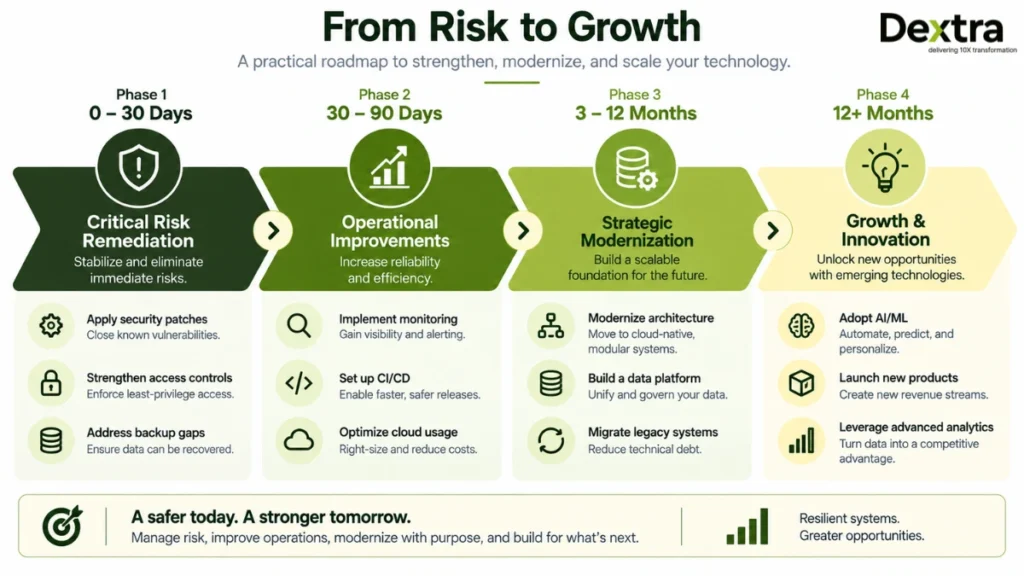
Technology due diligence findings should feed directly into a prioritized technology roadmap. A typical post-DD remediation and value-creation timeline follows four phases:
0–30 Days: Critical Risk Remediation
• Security vulnerabilities requiring immediate patching
• Access-control issues exposing sensitive data
• Backup and recovery gaps
• Critical third-party dependency risks
30–90 Days: Operational Improvements
• Monitoring and observability implementation
• Documentation and knowledge capture
• CI/CD pipeline improvements
• Cloud cost optimization
3–12 Months: Strategic Modernization
• Architecture modernization where required
• Data platform improvements
• Legacy system migration or retirement
• Process automation and workflow improvements
12+ Months: Growth and Innovation
• AI and ML capability development
• New product technology enablement
• Platform expansion and integration
• Advanced analytics and data capabilities
This phased approach connects technology due diligence directly to value creation, which is what investors, boards, and operating partners want to see.
How Dextra Labs Supports Fintech Technology Due Diligence
Dextra Labs helps fintech investors, acquirers, and leadership teams assess the technology foundations behind financial products. Our technical due diligence services combine architecture, engineering, cybersecurity, data, infrastructure, scalability, and AI assessments to identify material risks and translate technical findings into actionable investment and technology priorities.
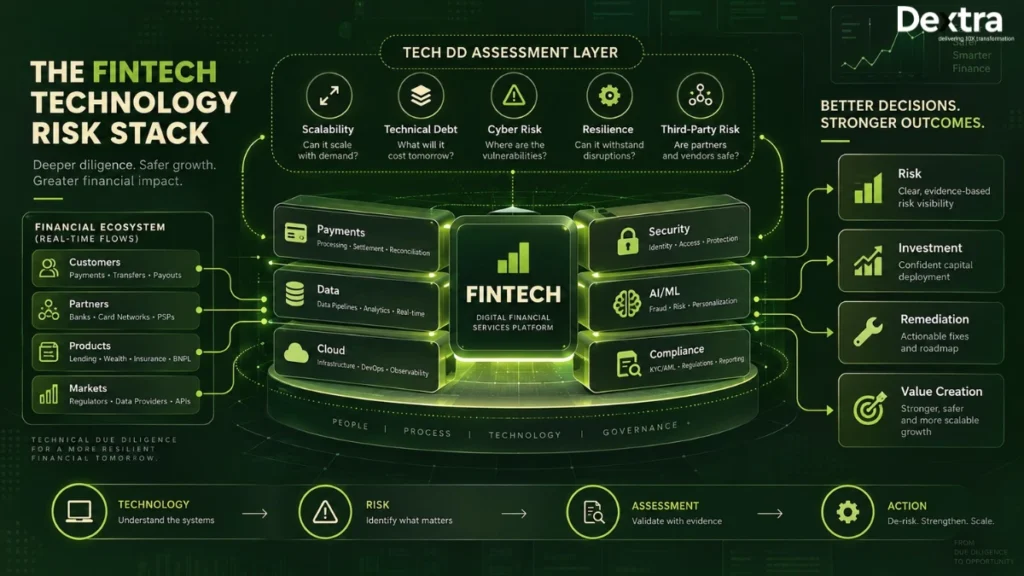
A Dextra Labs fintech Tech DD engagement can assess:
• Software architecture and service design
• Cloud infrastructure and cost sustainability
• Cybersecurity posture and incident readiness
• Data architecture, governance, and privacy controls
• Engineering organization and development practices
• Technical debt and modernization requirements
• Scalability and performance under projected growth
• Technology economics and cost-to-scale modeling
• Third-party dependencies and vendor risk
• KYC/AML technology and compliance controls
• AI/ML systems, model governance, and data quality
• Technology roadmap and value-creation planning
Conclusion
Technology due diligence in fintech is not a checkbox exercise, it is a strategic assessment that directly affects investment decisions, deal structures, and post-close value creation. Because fintech companies build their entire business on technology, the quality of their architecture, cybersecurity, data governance, compliance infrastructure, scalability, and engineering practices has a material impact on growth potential and risk.
A well-executed fintech technology assessment goes beyond identifying technical problems. It translates technology findings into investment-relevant priorities, what risks affect the deal, what remediation the technology requires, how much it will cost, and where technology can create additional value. From architecture and scalability to AI readiness and regulatory compliance, every dimension of the technology environment deserves structured evaluation.
For investors, acquirers, and fintech leadership teams, the question is no longer whether to conduct technology due diligence, it is whether the assessment is thorough enough to surface the risks and opportunities that matter.