Insurance fraud costs an estimated $308.6 billion each year which makes it one of the industry’s most persistent challenges. AI agents for customer service in insurance can help insurers identify unusual patterns, assist claims teams, and send higher-risk cases to the right people for review.
Beyond fraud, an AI agent for insurance customer service can handle everyday policyholder needs across claims, FNOL, policy servicing, renewals, and coverage questions. And insurers have already put this into practice, with full AI adoption across the insurance value chain rising from 8% in 2024 to 34% in 2025, according to Conning’s Insurance Technology Survey.
So, what does a serious insurance AI deployment actually involve? In this blog, we’ll look at:
- Key use cases across claims, FNOL, underwriting, and policy servicing
- Compliance and core system integration requirements insurers cannot overlook
- ROI and build versus buy considerations for insurance operations
- How to choose the best AI agents for insurance customer service and when custom AI agent development services make more sense
Why Does Insurance Customer Service Need Insurance-Specific AI?
Generic AI customer service agents can handle routine or simple questions, but insurance rarely stays simple for long. Each interaction can involve sensitive data, regulatory requirements, core policy systems, and decisions that can directly affect a policyholder.
That is why AI agents for customer service in insurance need to be designed around how insurance actually works. The table below shows where generic agents fall short and what you should look for instead when evaluating an Agentic AI customer service insurance solution.
| Insurance Reality | Why Generic AI Fails | What You Actually Need |
| Insurance interactions often involve compliance requirements, from disclosures and licensing rules to state regulations and customer data requirements. | Generic agents are not built around insurance-specific regulatory rules. They may provide you an answer without checking whether the right disclosure, approval, or restriction applies to that interaction. | You need compliance-gated responses with complete audit trails so the right rules are applied before a response is given and every action is recorded with its reason and timestamp. |
| Policy administration and claims systems remain the source of truth. Customer service often depends on current policy details, claim information, coverage, premiums, endorsements, and other records. | Generic agents usually cannot safely read from or write to these systems. Without access to the underlying records, the agent can only provide general information or hand the customer to an employee. | For this, build deep core-system integration into the workflow. The agent should securely access the policy admin system, claims management system, CRM, and other required systems to retrieve information and complete approved actions. |
| Insurance conversations can also become highly emotional, particularly when customers are dealing with an accident, property damage, serious illness, or the loss of a loved one. | Generic agents can miss emotional cues and continue with a scripted interaction and that can frustrate customers when the situation clearly requires empathy, discretion, or human support. | Include sentiment-aware escalation and human handoff, as it helps the system recognize when a customer is distressed, respond appropriately, and bring in the right person without making the policyholder explain everything again. |
| Many insurance processes involve multiple steps and documents, with FNOL, endorsements, claims servicing, and policy changes requiring information from several sources. | Generic agents often stop at information retrieval or simple routing. They may tell customers what to do next instead of actually completing the workflow. | Use multi-step workflow execution with clear controls; it lets the system gather and validate information, retrieve relevant documents, complete permitted actions, and escalate anything that falls outside its authority. |
Insurance is one of the more demanding customer-service environments because regulation, system complexity, and emotional stakes come together in the same workflow. That is why insurance AI needs to be designed around real policy, claims, and compliance workflows rather than simply adding AI to a generic customer-service setup. The same principle shows up in other regulated, system-heavy industries, our playbook on AI Agents for Automotive Customer Service walks through how a different vertical handles this same build-around-your-systems approach.
AI Agents vs Legacy Chatbots and IVR in Insurance
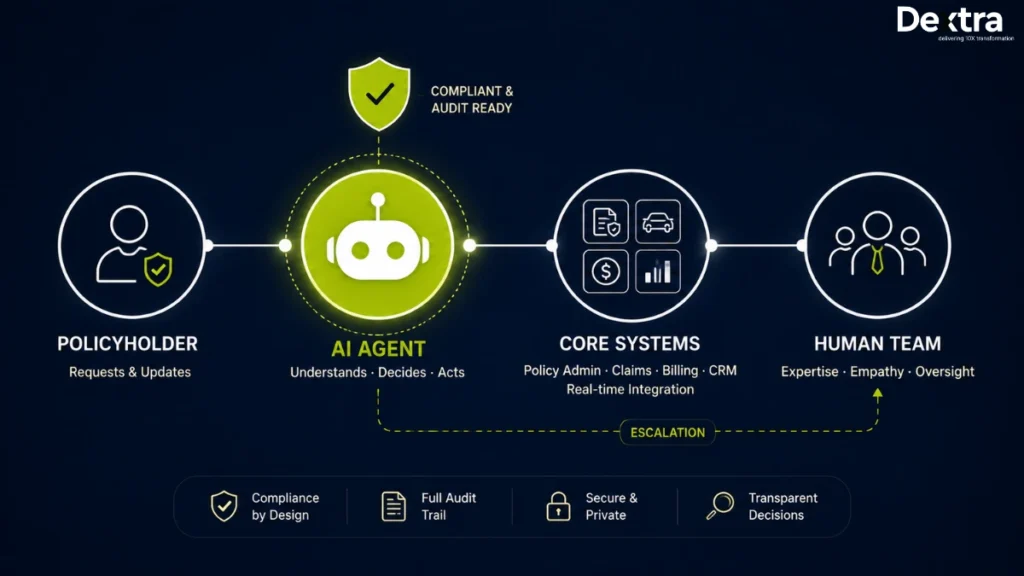
Legacy IVR systems and insurance chatbots are built mainly to answer questions, provide information, or route customers to the right team. AI agents take a different approach by understanding the request, accessing the right information, and completing the required action.
You can see the difference when you compare how each option handles common insurance workflows. The table below looks at the capabilities that matter most, from natural-language understanding and FNOL to system access, authentication, compliance, and human escalation.
| Capability | Legacy IVR | Insurance Chatbot | AI Agent |
| Understands natural language | ❌ Relies on fixed menu options and predefined call paths. | ⚠️ Handles basic questions using keywords and predefined responses. | ✅ Understands the customer’s intent and responds based on the wider conversation. |
| Files FNOL end-to-end | ❌ | ❌ | ✅ |
| Reads/writes policy admin system | ❌ | ❌ | ✅ |
| Authenticates policyholder | ⚠️ Basic | ❌ | ✅ |
| Generates compliance audit trail | ⚠️ Call log | ❌ | ✅ |
| Escalates with full context | ❌ | ❌ | ✅ |
| Handles claim-surge volume | ⚠️ Queues | ⚠️ Limited | ✅ Scales instantly |
What this comparison shows is the 2026 shift from deflection to resolution. Rather than just routing customers or answering questions, AI agents can complete tasks and move requests forward. In insurance, that means connecting them with policy, claims, and other core systems so customers can get the help they actually need.
Types of AI Agents Insurers Are Deploying Today
Insurers often use several types of AI agents together, with each one handling a specific part of the customer or insurance journey. You might use one agent for routine policy servicing, another for claims, and a third for routing complex requests to the right team.
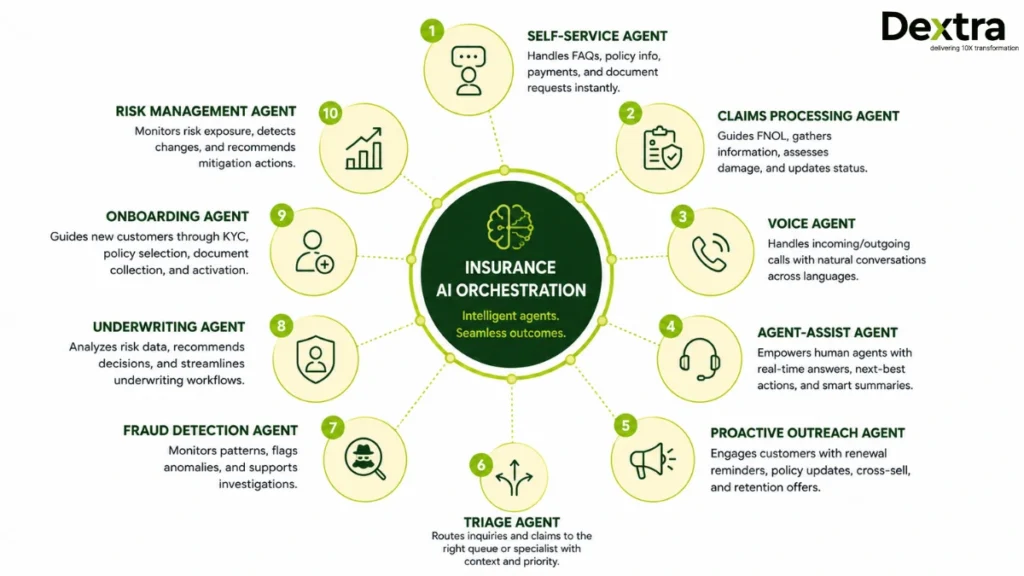
Here are the main types insurers are putting into practice today:
1. Self-Service Resolution Agents
Self-service resolution agents handle routine policyholder requests without requiring a human for every interaction. They can answer coverage questions, process payments, provide documents, and handle simple endorsements while escalating anything outside their authority.
For example, you can use self-service agents to:
- Check policy and coverage details
- Process an approved payment
- Provide policy documents
- Handle simple address or contact changes
- Answer renewal-related questions
2. Claims Agents
Claims agents support policyholders throughout the claims journey, from FNOL and document collection to claim status updates and routine servicing. They help reduce the manual work involved in keeping customers informed while allowing claims teams to focus on cases that need deeper judgment.
For example, after an accident, the agent can:
- Collect the details needed for FNOL
- Request photos and supporting documents
- Verify relevant policy information
- Provide claim status updates
- Escalate complex cases to a claims adjuster
3. Voice Agents
Voice agents let policyholders handle insurance requests through natural conversation instead of navigating long IVR menus. They are useful for claims, renewals, payments, policy questions, and other situations where customers prefer speaking with someone in their own language.
For example, during a claim-related call, a voice agent can:
- Authenticate the policyholder
- Understand the reason for the call
- Retrieve relevant policy information
- Answer routine questions
- Transfer the call with the full context when human help is needed
4. Agent-Assist Copilots
Agent-assist copilots work alongside your service representatives and give them useful information while they are speaking with customers. They can surface policy details, claims history, relevant documents, and suggested next steps without making the representative search through multiple systems.
For a complex claim, the copilot could:
- Pull the customer’s policy and claims history
- Surface relevant coverage information
- Summarize previous interactions
- Suggest the next action
- Help the representative prepare a response
5. Proactive Outreach Agents
Proactive outreach agents contact policyholders before they need to reach your service team. They can support renewals, payment reminders, lapse prevention, missing-document requests, and other time-sensitive policy activities.
For example, an agent can contact a policyholder before renewal to:
- Remind them about the upcoming renewal
- Answer questions about their premium or coverage
- Collect required information
- Identify potential coverage concerns
- Hand the conversation to a human when needed
6. Triage and Routing Agents
Triage and routing agents determine what a customer needs before sending the interaction to the right workflow or team. These can help assess intent, urgency, and complexity so straightforward requests move quickly while sensitive or high-value cases receive the right attention.
For example, an incoming claim can be assessed for:
- Severity and urgency
- Claim type and complexity
- Required documentation
- Appropriate claims team
- Whether immediate human intervention is needed
7. Fraud Detection Agents
Fraud detection agents look across claims and related information to identify unusual patterns that may deserve further investigation. These agents are quite helpful in supporting fraud teams by flagging suspicious activity rather than leaving investigators to manually review every claim.
For example, an agent can compare:
- Current claims with historical claims
- Policyholder information across records
- Claim details and supporting documents
- Multiple claims showing similar patterns
- Other approved data sources used for fraud investigation
8. Underwriting Agents
Underwriting teams lose valuable time when skilled professionals have to sift through lengthy broker submissions before they can assess the actual risk. QBE shows what AI can change here, with its Cyber Underwriting AI Assistant reducing broker submission review time by approximately 65%. Underwriting agents can take on the information-heavy work, organizing submissions, surfacing relevant risk factors, and helping underwriters move from submission to quote faster while keeping final decisions with the human team.
For example, an underwriting agent can:
- Collect information from submitted documents
- Extract relevant risk factors
- Organize information for underwriter review
- Flag missing or inconsistent details
- Prepare a submission summary
9. Onboarding Agents
Onboarding agents guide customers through the early stages of getting insurance, from application questions and identity checks to document collection and policy issuance. They reduce repetitive work while helping customers complete the process without waiting for a service representative.
For example, an onboarding agent can:
- Guide customers through an application
- Collect required information
- Support identity verification
- Request missing documents
- Answer questions before policy issuance
10. Risk and Policy Management Agents
Risk and policy management agents help insurers work with changing information throughout the policy lifecycle rather than relying only on data collected at application. They can bring together approved data sources to support ongoing risk assessment, policy servicing, and customer-specific recommendations.
For example, in auto insurance, an agent could use approved telematics and policy information to help:
- Build a more current risk profile
- Identify changes that may require attention
- Support policy reviews
- Flag potential coverage gaps
- Assist with relevant policy recommendations
The 2026 reality is that these agents work best together rather than in isolation. A triage agent can identify the request, a claims or self-service agent can handle the workflow, and an agent-assist copilot can support your team when human judgment is needed. Connecting that orchestration to your policy admin system, CRM, and other core systems is where the implementation becomes much more valuable and much more specialized.
Use Cases for AI Agents in Insurance Customer Service
AI agents can support almost every stage of the insurance journey, but the value looks different at each stage. Below are the key use cases insurers can consider across the customer and policy lifecycle:
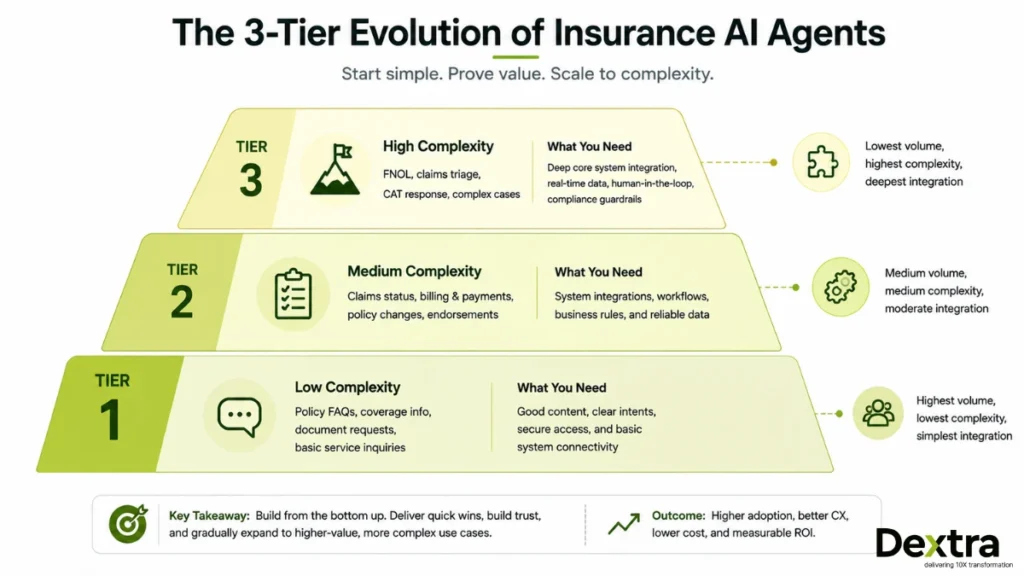
Category 1: Pre-Purchase & Onboarding
1. Quotes and coverage questions
You can use an AI agent to answer questions about premiums, coverage, deductibles, and eligibility while helping prospects move toward a quote through chat or voice. This gives potential customers quick access to the information they need before choosing a policy.
2. Policyholder onboarding
An onboarding agent can guide new customers through document collection, identity verification, policy explanations, and first-payment setup without making them navigate multiple teams which makes it easier for policyholders to complete the early steps without waiting for a service representative.
Category 2: Policy Servicing
3. Policy inquiries
You can give policyholders 24/7 access to information about coverage, premium status, deductibles, policy documents, and renewal dates without requiring a service representative for every question. The AI agent can pull the relevant details instead of making customers search through paperwork or contact your service team.
4. Endorsements and policy changes
An AI agent can handle approved changes such as adding a vehicle, updating an address, or changing a beneficiary by working directly with your policy admin system. This allows the request to be completed during the interaction rather than just being logged for someone else.
5. Renewals and retention
Proactive agents can remind policyholders about upcoming renewals, answer questions about premiums or coverage, and identify potential lapse or coverage-gap risks. This way you can improve renewal rates while retaining more of your existing policyholders.
6. Billing and payments
Policyholders can use an agent to check premium balances, make payments, set up autopay, or raise billing concerns without requiring assistance from a billing representative. The agent can also identify issues that require additional review and route them accordingly.
Category 3: Claims
7. First Notice of Loss (FNOL)
An AI agent can collect loss details, request photos and documents, verify policy information, open the claim in your claims management system, and explain what happens next. FNOL cycle time can move from hours toward minutes while reducing manual intake work.
8. Claim status
Instead of calling your claims team for every update, policyholders can ask an AI agent for real-time claim status, outstanding documents, next steps, and expected milestones. This is one of the most common reasons inbound claims calls shift to self-service.
9. Claims triage and routing
A claims triage agent can assess the severity, complexity, and urgency of an incoming claim before routing it to the appropriate claims adjuster or workflow. This helps straightforward cases move faster while giving complex claims the attention they require.
Category 4: Across the Insurance Journey
10. Authentication and identity verification
Before showing sensitive policy or claims information, the agent can verify the policyholder through the authentication methods defined for your workflow. This will help customers get convenient self-service without removing the security controls required for sensitive transactions.
11. Catastrophe surge handling
When a hurricane, wildfire, flood, or other CAT event suddenly drives thousands of policyholders to contact you, AI agents can absorb routine interactions across voice and digital channels. This will help your teams focus on urgent claims while routine demand continues to receive timely responses.
12. Underwriting support
During quote and submission workflows, an AI agent can collect missing information, organize documents, and pre-validate relevant details before sending the case to an underwriter. This is a practical example of how AI agents reduce underwriting delays in banking and insurance, helping shorten the quote-to-bind cycle while allowing underwriters to focus on important risk decisions.
These examples show how AI can support real insurance workflows, not just routine customer questions. AI agents in insurance customer service use cases become clearer when these agents are connected to the right workflows and systems which helps reduce servicing effort, improve response times, and move actual insurance processes forward.
The table below groups these use cases by complexity and the level of integration each one typically requires:
| Complexity Tier | Typical Use Cases | What You Need |
| Tier 1: Low | Policy questions, document requests, basic billing queries, claim status | Knowledge access, authentication, and basic CRM integration |
| Tier 2: Medium | Payments, renewals, endorsements, onboarding, underwriting support | Core-system integration, workflow execution, validation, and guardrails |
| Tier 3: High | FNOL, claims triage, CAT response, complex policy servicing | Deep PAS and claims integration, compliance controls, audit trails, human escalation, and multi-step orchestration |
The more complex the workflow becomes, the less useful a disconnected chatbot becomes and that is where custom AI agent development services can give insurers more control over integrations, compliance, and how each agent fits into the wider policy lifecycle.
Benefits of AI Agents in Insurance Customer Service
Here are the key AI agents in insurance customer service use cases benefits you can expect when these agents are connected to your workflows and core systems:
1. Lower cost per interaction
You can handle routine policyholder requests more efficiently, reducing the amount of human time spent on repetitive servicing work.
2. Handle catastrophe surges
When a CAT event suddenly pushes claim volumes to 3x normal levels, AI agents can absorb routine demand while your teams focus on urgent and complex cases.
3. Faster First Notice of Loss
You can capture FNOL in minutes rather than waiting hours or until the next business day, helping your claims process start sooner.
4. 24/7 policyholder support
Your customers can get help with claims, coverage, payments, and policy servicing at any hour without joining a business-hours queue.
5. Less claims leakage
By applying consistent triage, validation, and routing, you can prevent missed steps, keep claims moving smoothly and ensure each case reaches the right team at the right time.
6. Higher agent productivity
AI can take repetitive Tier 1 requests off your team’s workload which also gives representatives more time for complex claims, disputes, and retention.
7. Stronger compliance controls
You can capture interactions, decisions, and approved actions in a traceable audit trail, thereby making compliance reviews easier to manage.
8. Better customer retention
Proactive agents can support renewals, payment reminders, and lapse prevention before policyholders decide to leave.
9. More consistent service
You can easily deliver accurate policy and claims information across voice, chat, and digital channels, even when interaction volumes increase.
10. Better policyholder experience
AI agents can provide 24/7 support for routine claims, policy, payment, and account requests, helping you deliver faster and more consistent service. McKinsey findings revealed that insurers with stronger customer experience outperformed peers by 20 percentage points in TSR for life insurance and 65 percentage points for P&C over five years.
Key AI Technologies Behind Insurance Customer Service Agents
To understand how these agents work in practice, it helps to look at the key technologies behind them and what each one does within an insurance workflow:
| Technology | What It Does in Insurance |
| Large Language Models (LLMs) | LLMs help the AI agent understand policyholder questions and respond in natural language. They can also handle insurance terminology and reason through multi-step requests. |
| Retrieval-Augmented Generation (RAG) | RAG gives the AI agent access to your actual policy documents, coverage rules, and internal knowledge. This helps it provide answers based on your specific products instead of generic insurance information. |
| Natural Language Understanding (NLU) | NLU helps the AI agent understand what the policyholder is actually asking, whether they need help with a premium, claim, or policy change. It can then direct the request to the appropriate workflow. |
| Agent Orchestration | Orchestration connects multiple steps needed to complete a request, such as verifying identity, checking coverage, and retrieving policy details. It helps the AI agent move from understanding a request to completing the approved action. |
| Core System Integration (APIs) | APIs connect the AI agent with your policy admin system, claims management system, billing systems, and CRM. This gives the agent the access it needs to file an FNOL, process an endorsement, or retrieve current policy information. |
| Compliance Guardrails | Guardrails help control what the agent can say and do within an insurance workflow. They can enforce disclosures, prevent unauthorized advice, protect sensitive data, and record actions for an audit trail. |
| Sentiment Analysis | Sentiment analysis helps identify when a policyholder is distressed, frustrated, or dealing with a sensitive situation. The conversation can then be escalated to the right human team with the relevant context preserved. |
The real difference comes from how well these technologies work together because agentic AI customer service insurance requires more than a capable LLM; it needs the right data, workflows, integrations, and controls behind it.
Compliance, Audit Trails, and Regulatory Guardrails
Insurance customer service carries more regulatory weight than a typical support interaction. When an AI agent can access policies, handle claims, or take actions on a policyholder’s behalf, compliance needs to be part of the workflow from the start.
If you are deploying AI agents for customer service in insurance, these are the controls you must handle:
- Audit Trail for Every Interaction: Every conversation, decision, and approved action should be logged with a timestamp and enough context to show what happened and why.
- Disclosure and Licensing Compliance: The agent should deliver required disclosures at the right point in the conversation and stay within the boundaries of what it is authorized to explain or recommend.
- State-by-State Regulatory Variation: US insurance rules vary across states, so a multi-state carrier needs compliance rules that can change based on the customer’s location, policy, and line of business.
- Data Protection: Insurance workflows often involve PII, financial information, and health data. Your architecture should control access, protect sensitive information, and account for requirements such as HIPAA and data residency where applicable.
- Explainability and Model Governance: When AI influences an important insurance workflow, you should be able to understand what information it used, what action it took, and where human review was involved.
- Human-in-the-Loop for High-Stakes Decisions: Coverage disputes, claim denials, complex claims, and other decisions with significant financial or legal consequences should have clear escalation paths to qualified human teams.
The important point is that insurance compliance cannot stop at generic security certifications or privacy controls. Off-the-shelf platforms may cover broad requirements such as SOC 2 or GDPR, but they generally do not account for the specific states, products, disclosure requirements, licensing boundaries, data rules, and approval processes that apply to your business.
On the other hand, with custom AI agent development, you can build these requirements directly into the agent’s workflows and guardrails instead of adapting your insurance processes to a generic setup. Dextra Labs is a Custom AI Agent Development Company in USA, Singapore, India, UK, and UAE, where our AI engineers can build these controls into the architecture from the beginning rather than trying to retrofit them later.
Core System Integration: The Factor That Decides Everything
For insurance, an AI agent is only as useful as the systems it can actually work with. If it cannot access your policy, claims, or billing systems, it may answer questions, but it cannot complete the work behind them.
The core systems an insurance agent must connect to include:
- Policy administration systems: Guidewire PolicyCenter, Duck Creek, Sapiens, and Majesco
- Claims systems: Guidewire ClaimCenter and Duck Creek Claims
- Billing systems: Guidewire BillingCenter and other billing systems
- Customer and distribution systems: CRM platforms, agent portals, and broker portals
The depth of this integration directly affects what your agent can resolve:
| Integration Level | What Your Agent Can Do | Typical Resolution |
| Knowledge base only | Answer general coverage and policy questions | ~28% |
| Knowledge base + CRM | Provide personalized policyholder information | ~38% |
| Policy Admin + Claims + CRM | File FNOL, process endorsements, check claims, and complete approved workflows | 50%+ |
An AI agent can only resolve an insurance request when it can access the systems where the work actually happens. If it cannot read a policy in Guidewire or open a claim in ClaimCenter, it can provide information but cannot file an FNOL, update coverage, or complete an endorsement.
That is the difference between answering and actually resolving. For AI agents for customer service in insurance, deep integration with your core systems is what makes these workflows possible, and customized insurance environments often require custom development beyond what off-the-shelf solutions provide. If you’re mapping this against a broader implementation timeline, our guide on how to build a 24/7 AI customer service agent covers the end-to-end build process this level of integration requires.
The ROI of AI Agents in Insurance Customer Service
AI agents in insurance customer service use cases benefits are easier to justify when you can see exactly where those gains come from. The table below highlights the main areas where AI agents can improve insurance operations and create measurable business value:
| Benefit | Business Impact |
| Cost per interaction | Lower servicing costs by automating routine policyholder requests and reducing human handling time. |
| Claim-surge handling | Absorb sudden 3x CAT-event volumes without adding emergency staffing or overtime. |
| FNOL cycle time | Capture loss details in minutes instead of waiting hours or until the next business day. |
| First-response time | Provide immediate support 24/7 instead of sending policyholders into business-hours queues. |
| Claims leakage | Consistent triage and routing can reduce missed steps and help claims reach the right team faster. |
| Agent productivity | Free human teams from repetitive servicing so they can focus on complex claims, disputes, and retention. |
| Compliance risk | Automatically record interactions and approved actions in a traceable audit trail. |
Should Insurers Build or Buy Their AI Customer Service Agents?
There is no definite answer when it comes to build vs buy AI customer service agent for insurance customer service. The right choice depends on your lines of business, core systems, regulatory requirements, and how much control you need. Below, you can quickly evaluate which approach fits your insurance operations better.
When buying an off-the-shelf platform makes sense
An off-the-shelf option can be a practical choice if your customer service workflows are relatively standard and you want to get started quickly.
It can work well when you:
- Run a single line of business with straightforward servicing needs.
- Use a common core system with ready-made connectors.
- Operate across only one or a few states with simpler compliance requirements.
- Prioritize faster deployment over extensive customization.
- Have limited internal engineering resources to maintain the agent.
When building a custom agent makes more sense
Custom development becomes more valuable when your insurance operations involve complex workflows, multiple systems, or regulatory requirements that generic solutions cannot easily accommodate.
It is the better fit when you:
- Operate across multiple states or lines of business and need configurable compliance rules.
- Use a heavily customized Guidewire or Duck Creek environment, or rely on legacy systems.
- Have FNOL and claim workflows that span several core systems.
- Need tighter control over data residency, model governance, or sensitive policyholder data.
- Have proprietary products, underwriting rules, or policy structures that standard solutions cannot handle well.
Side-by-side comparison:
| Factor | Buy Off-the-Shelf | Build Custom |
| Time to launch | 30–90 days | 4–8 months |
| Upfront cost | Low to moderate | Higher (500K–1.5M) |
| Cost at scale | Compounds per conversation | Amortizes on owned infrastructure |
| Core-system integration | Standard connectors only | Deep, including customized instances |
| Compliance | Generic (SOC 2, GDPR) | Architected to your regulatory footprint |
| Ownership | Licensed (vendor-controlled) | You own the agent and IP |
| Best fit | Simple, single-state servicing | Complex, multi-state, claims-heavy |
The choice becomes clearer when you look at what insurance actually requires. Regulatory complexity and deep core-system integration can quickly push generic solutions to their limits, especially when an agent needs to file FNOL in a customized ClaimCenter setup while following state-specific rules.
How Dextra Labs Builds Custom AI Agents for Insurance?
Building an AI agent for insurance requires more than adding a conversational layer to existing customer-service workflows. The agent needs to work with policy administration and claims systems, follow state-specific compliance requirements, execute approved multi-step processes, and know when to hand a case to a human. For insurers with complex workflows or customized core systems, these requirements often make a tailored approach more practical than adapting a generic solution.
Dextra Labs approaches custom insurance AI agent development around these operational requirements, connecting the agent to existing systems while building compliance controls, workflow automation, and human escalation into the architecture from the beginning.
How we approach your insurance AI build
We focus on the areas that determine whether your AI agent can actually work within your insurance operations:
- Start with your core systems: We build around Guidewire, Duck Creek, Sapiens, Majesco, or your existing PAS and claims systems so your agent works with the systems you already rely on.
- Build compliance into the foundation: We include audit trails, disclosure rules, state-specific controls, data protection, and model governance from the beginning.
- Automate FNOL and claims workflows: Instead of simply answering policyholder questions, we connect the steps needed to collect information, open claims, retrieve documents, and move approved tasks forward.
- Keep humans in the loop: When a conversation involves distress, complex claims, disputes, or decisions outside the agent’s authority, it can escalate to your team with the relevant context intact.
How we work
Once the use cases, systems, and compliance requirements are clear, we move into three practical phases: discovery, build, and deployment.
- Phase 1: Discovery & Scoping (~$50K–$100K, 4 weeks): We review your use cases, compliance requirements, core systems, and integration needs to define the right approach.
- Phase 2: Build (~$400K–$1.2M): We then develop the agent, connect your systems, and implement the required workflows, controls, and compliance layer.
- Phase 3: Deploy & Handoff: At last, we roll out the solution gradually, measure performance, and help your team take ownership of the deployed system.
Ready to see how this could work for your insurance operation? Schedule a scoping call with Dextra Labs, and we’ll discuss your use case, systems, and requirements.
Conclusion
Insurance customer service is moving beyond simple FAQs, as AI agents are now being used to handle high-value workflows across FNOL, claims, policy servicing, underwriting support, and routine customer requests. Instead of stopping at an answer, these agents can take approved actions, work with core insurance systems, and bring in human teams when a case needs further attention.
But making that level of automation work in a real insurance environment is where things get difficult. Off-the-shelf platforms can handle standard requests, but customized core systems, state-specific compliance, and complex claims workflows often call for a more tailored approach. Dextra Labs provides custom AI agent development services to build agents around your systems and workflows, so book a 1:1 call with our Senior Engineers to discuss what would work best for your insurance operation.
Frequently Asked Questions:
What are AI agents for customer service in insurance?
AI agents for customer service in insurance are AI systems that can understand policyholder requests, access relevant insurance systems, and take approved actions. They are different from traditional AI agents that mainly answer questions or route customers; they can actually complete tasks across claims, FNOL, policy servicing, billing, renewals, and customer support.
How do AI agents handle insurance claims (FNOL)?
AI agents handle FNOL by capturing the policyholder’s loss report, identifying key details, verifying policy information, collecting photos or documents, and sending everything into the claims system while keeping the policyholder updated and handing complex cases to a claims professional when needed.
Are AI agents compliant with insurance regulations?
Yes, they can be compliant when built with the right controls, including state-specific rules, required disclosures, data protection, audit trails, and human review for high-stakes decisions, which is why custom AI agents can be a better fit for insurers with complex regulatory and workflow requirements.
Can AI agents integrate with Guidewire or Duck Creek?
Yes, AI agents can integrate with both Guidewire and Duck Creek through APIs and integration layers which allow them to access policy, claims, and billing data and trigger approved actions. For insurers with customized systems or complex workflows, the key is building the integration around your specific setup rather than relying only on standard connectors.
What’s the ROI of AI agents in insurance customer service?
The ROI comes from reducing routine servicing costs, speeding up claims and FNOL, providing 24/7 support, and freeing your team to focus on complex work. Your actual returns will depend on factors such as interaction volume, automation rate, system integration, and which workflows you choose to automate.
Should insurers build or buy AI customer service agents?
When you’re deciding whether to build or buy, start with how your insurance operations actually work. Buy if your workflows are simple, your systems have standard connectors, and you want to launch quickly; build if you need deeper integration, state-specific compliance, proprietary workflows, or more control over the agent.
When evaluating agentic AI use cases in insurance claims underwriting customer service, look at the workflows you want to automate and the systems the agent needs to access. This will make it easier to determine how to choose AI agents for insurance customer service operations and whether an off-the-shelf solution or custom build is the better fit.