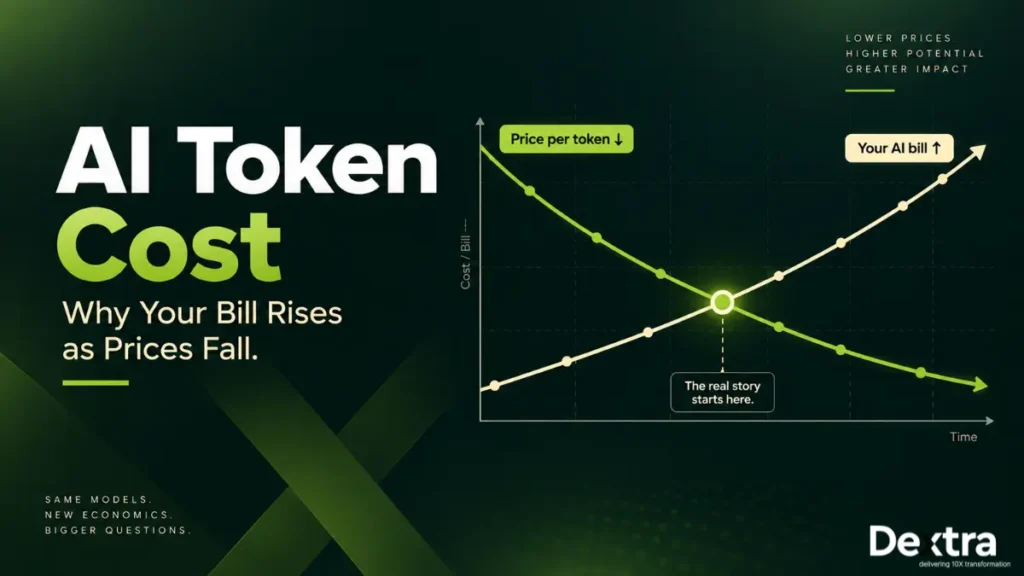
The loudest conversation in enterprise AI right now is about what it costs. Token bills that were a rounding error during the pilot phase have become a line item that finance teams actually notice, and for a lot of organisations the last few quarters have brought an uncomfortable surprise: the model got cheaper per token, and yet the bill went up.
That paradox is the whole subject of this guide. Understanding AI token cost has become a genuine enterprise competency, not because the per-token rate is complicated, but because the rate is only a small part of what an enterprise actually pays. The organisations getting real value from AI are not the ones who found the cheapest model. They are the ones who understood where the cost actually comes from, and built accordingly.
What Is an AI Token Cost?
A token is the basic unit that language models read and write. It is roughly three-quarters of a word, so a million tokens is somewhere around 750,000 words, and models charge by the token in two directions: the input tokens they read (your prompt, your documents, the retrieved context) and the output tokens they generate (the response). The AI token cost is simply the usage-based fee for that processing, quoted per million tokens.
Two structural facts matter more than any specific price. First, output tokens almost always cost several times more than input tokens, typically three to five times, which means a model that writes long, verbose answers costs far more than the input rate alone suggests. Second, prices span an enormous range: efficient, high-volume models can cost well under a dollar per million tokens, while frontier reasoning models can run into the tens of dollars per million output tokens. Choosing the wrong model for a task can mean paying fifty times more than necessary for output that isn’t meaningfully better.
AI Token Cost Comparison: OpenAI, Claude, and Gemini
Buyers reasonably want to see the numbers side by side, so the table below gives representative 2026 pricing across the three major providers. One caveat worth stating plainly: model versions and prices change frequently, so treat these as illustrative of the shape of the market rather than as a live rate card, the relationships between the tiers are far more durable than any single figure.
| Tier | Representative model | Input ($/M) | Output ($/M) |
|---|---|---|---|
| Budget / high-volume | Gemini Flash-class, GPT mini-class, Claude Haiku-class | ~$0.10 – $1.00 | ~$0.40 – $5.00 |
| Mid / balanced | Gemini Pro-class, GPT standard, Claude Sonnet-class | ~$1.25 – $3.00 | ~$10 – $15 |
| Frontier / reasoning | Claude Opus-class, GPT frontier, Gemini Pro high-tier | ~$5.00 – $15+ | ~$25 – $75+ |
The single most useful thing to read from that table is the spread. The gap between a budget model and a frontier one is not ten or twenty percent, it is often more than fifty times. That spread is precisely why enterprise AI cost is an architecture decision, not a procurement one: the money is made or lost not by negotiating a better rate on one model, but by sending each task to the right model in the first place. A greeting routed to a frontier reasoning model is money set on fire.
Why the AI token Costs Bill Goes Up Even as Prices Fall
Here is the paradox that catches most enterprises out. Per-token prices have broadly fallen over the past two years, and yet AI bills have risen, often sharply. The reason has nothing to do with the rate card and everything to do with how AI is now being used.
A simple chatbot reads a prompt once and writes one answer. That is a small, predictable number of tokens. But enterprises have moved beyond chatbots to agents, systems that plan, retrieve information, call tools, spin up subagents, evaluate their own results, and loop until a task is done. And every one of those steps consumes tokens, often re-reading the same large context on each pass. A single agentic session can burn hundreds of thousands of tokens where a chat used a few hundred.
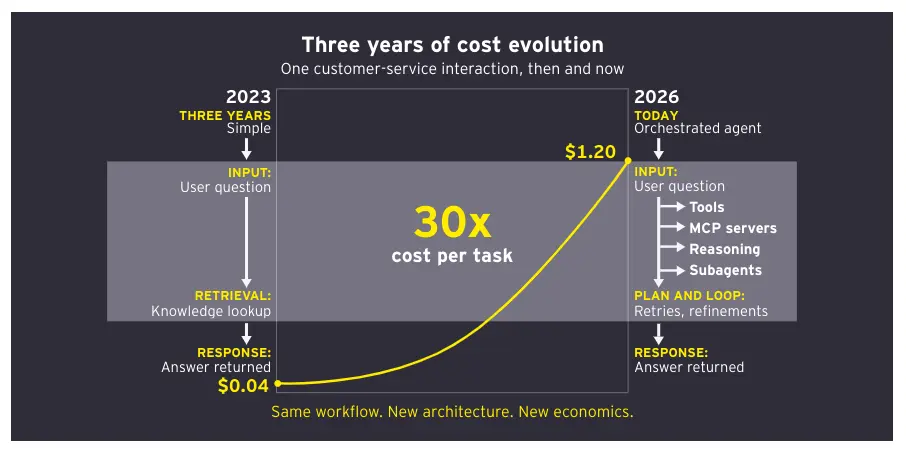
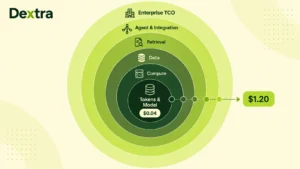
| THE $0.04 → $1.20 SHIFT (EY) EY’s Total Cost of Agents research gives the cleanest illustration of this. A customer-service interaction that cost about $0.04 in 2023, a simple read-and-respond, costs roughly $1.20 in 2026 once it involves tool retrieval, planning, and subagents. That’s around 30 times more per interaction, on models whose per-token price actually went down. The lesson: token price is falling, but token consumption per task is rising much faster. Multiply that across millions of interactions a month and you have the enterprise AI budget shock in one line. (Source: EY, Agentic AI token costs.) |
This is also why long-context and agentic workloads make caching economics so important, a point we covered in depth in our analysis of Claude Fable 5.1 where a 75% cut in cache-read pricing barely touched simple chat but transformed the cost of agents that re-read context on every loop.
The Costs the Invoice Doesn’t Show
The token bill from your model vendor is real, but it is not the total cost of running AI in an enterprise, and treating it as if it were is how business cases quietly fall apart. Drawing on EY’s Total Cost of Agents framework, the full picture spans several categories, most of which never appear on the model vendor’s invoice at all:
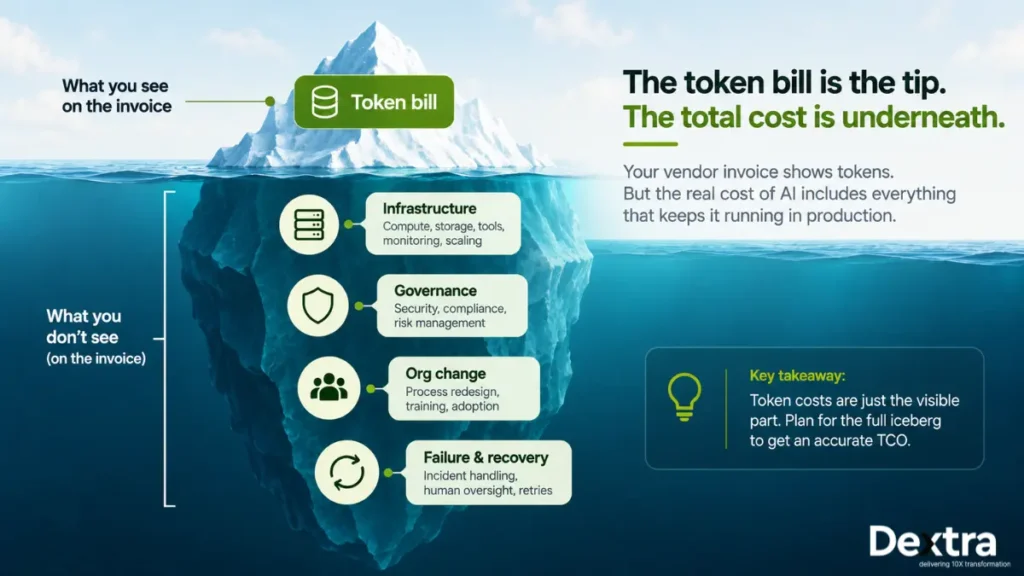
- Tokens and API calls: The visible line item: input, output, model choice, retries. Real, but usually the smallest part of the total for a serious deployment.
- Subscriptions and licences: model contracts, orchestration platforms, committed-use agreements. Predictable, but they sit underneath the metered token spend, not instead of it.
- Platform infrastructure: the orchestration runtimes, retrieval systems, and application environments that keep agents running. This lands on the cloud bill, not the model invoice, and is easy to miss.
- Governance burden: guardrails, audits, security controls, human-in-the-loop review. This compounds with every agent added, and it’s often headcount rather than software.
- Organisational change: retraining, role redesign, and the human-in-the-loop architecture the new workflow depends on. Front-loaded, and it recurs with every major model upgrade.
- Failure and recovery: the probabilistic cost of hallucinations, remediation, and the rare catastrophic error. Zero until it isn’t, and most organisations haven’t priced it at all.
EY’s own finding is that most companies only budget for the first three and discover the rest as they scale. For an enterprise, the practical takeaway is blunt: if your AI business case only counts the token bill, it is understating the true cost, sometimes dramatically, and any comparison you make between providers on token price alone is answering the wrong question.
Also Read: What Affects AI Development Cost in 2026
How Enterprises Actually Control AI Token Costs?
The good news is that token cost is one of the most controllable line items in the whole AI stack, far more so than infrastructure or governance, because it responds directly to how the system is designed. A handful of levers do most of the work, and none of them require accepting worse output.
Route tasks to the right model
This is the single biggest lever, and most enterprises leave it unused. Simple tasks, classification, formatting, basic lookups, routine drafting, belong on cheap, fast models. Hard reasoning belongs on frontier models. Putting a lightweight classifier in front of your model router, so each request goes to the cheapest model that can handle it, routinely cuts costs by 60 to 80% on mixed workloads with no drop in quality, because the quality only ever mattered on the hard requests anyway.
Use prompt caching aggressively
When the same context, system instructions, a knowledge base, a large document, is sent repeatedly, caching lets the model read it from cache at a fraction of the input price, often around 90% cheaper. For agents that re-read the same context on every loop, this is transformative rather than marginal. The catch is that caching only helps if the system is architected to reuse context deliberately; many teams pay full price on every call simply because nobody designed the caching in.
Batch what doesn’t need to be real-time
Work that doesn’t need an instant answer, overnight report generation, bulk classification, evaluation runs, can go through batch APIs that typically cost 50% less. A surprising share of enterprise AI workload is not actually latency-sensitive, and moving it to batch is close to free money.
Control context and output length
Because you pay for every token in and out, discipline about what you send and what you ask for matters. Retrieving only the relevant context rather than dumping everything into the prompt, summarising long histories, and instructing models to be concise where verbosity adds nothing all cut cost directly, and, as long-context research has shown, often improve quality too, since models reason better over focused context than over a wall of tokens.
For teams working in Claude Code specifically, these principles translate into concrete practice, our guide to Claude Code token optimization walks through cutting costs without losing the context the work depends on.
Instrument spend before you scale
EY’s term for this is agentic FinOps: making AI spend visible per task or per outcome, assigning an owner to each cost category before the spend rather than after the invoice, and installing hard limits, spend ceilings, call caps, automatic shutoffs, so a runaway agent can’t quietly generate a five-figure bill overnight. You cannot control what you cannot see, and most enterprises cannot yet see what a single unit of agentic work costs them.
The Thing Most Enterprises Get Wrong: Saving Isn’t Buying
Here is the pattern we see most often at Dextra Labs, and it is worth naming directly because it costs enterprises real money. Faced with a rising AI bill, the instinct is to treat it as a procurement problem, to shop for a cheaper model, negotiate a better rate, or switch providers. That instinct is almost always aimed at the wrong target.
The saving on enterprise AI is not something you buy. It is something you build. Switching to a model with a lower rate card, without changing the architecture around it, typically captures a fraction of the available saving, because the cost was never really in the rate. It was in the routing, the caching, the context discipline, and the agent design. Two companies using the identical model, at the identical published price, will have wildly different bills depending entirely on how well their systems are engineered. The cheaper invoice belongs to the better architecture, not the better negotiator.
This is why we approach AI cost as an engineering problem rather than a purchasing one. Building the right routing, caching, and context layer, the intelligence context layer we build for enterprises across the USA, UK, Singapore, and India, is what actually moves the bill, and it moves it far further than any rate negotiation could. The model is a commodity anyone can buy at the same price. The architecture that makes it cheap to run is the part that has to be built, and it’s the part that compounds.
Final Words
AI token cost has become a real enterprise discipline, but not the one most teams think. The per-token rate is the most visible number and the least important; the real cost lives in how AI is used, how agents consume tokens as they scale, and the whole envelope of infrastructure, governance, and change that the model invoice never shows. The organisations that will win the next phase of enterprise AI are not the ones who found the cheapest model, they’re the ones who understood where the cost actually comes from and engineered their systems to control it.
The question worth asking your team isn’t “which model is cheapest?” It’s “what does one unit of our AI work actually cost, across everything, and are we architected to make it cheaper?” The first question sends you shopping. The second sends you building. Only one of them actually lowers the bill.
Frequently Asked Questions:
How much does an AI token cost?
A single token costs a tiny fraction of a cent, so pricing is quoted per million tokens. In 2026, that ranges from well under $1 per million for efficient, high-volume models to $15–$75+ per million output tokens for frontier reasoning models, a spread of more than fifty times between the cheapest and most expensive tiers.
What is the difference between input and output token cost?
Input tokens are what the model reads, your prompt, documents, and retrieved context. Output tokens are what it generates. Output almost always costs several times more than input (commonly 3–5x), so verbose responses and long generations drive cost faster than large inputs do.
Why is my AI bill rising even though token prices are falling?
Because token consumption per task is rising faster than prices are falling. As enterprises move from simple chatbots to agents that plan, retrieve, call tools and loop, a single task consumes far more tokens, EY reports a customer-service interaction rising from about $0.04 in 2023 to roughly $1.20 in 2026, even as per-token prices dropped.
How can enterprises reduce AI token costs?
The biggest levers are routing each task to the cheapest capable model (often 60–80% savings on mixed workloads), using prompt caching for repeated context (up to ~90% cheaper on cached tokens), batching non-real-time work (~50% cheaper), and controlling context and output length. Most of the saving comes from architecture, not from switching to a cheaper rate card.
What hidden costs does the AI token bill not show?
The model invoice shows tokens and API calls, but not platform infrastructure, governance and compliance burden, organisational change, or failure-and-recovery costs, which per EY’s framework often exceed the token spend itself for a scaled deployment. An AI business case that counts only tokens understates the true total cost of ownership.