Revenue impact measurement sits at the center of every AI deployment decision for CFOs, finance directors, and PE-backed operations teams, and finance AI is no exception.
AI agents are no longer experimental. They are running in production at financial institutions of every size, handling everything from invoice processing and fraud triage to regulatory reporting and customer onboarding. The organizations that moved early are now measuring real returns. Those still deliberating are measuring the cost of waiting.
According to McKinsey’s Global Institute, generative AI could add $200 billion to $340 billion in annual value to the global banking sector, equivalent to 9 to 15 percent of operating profits, primarily through productivity gains (McKinsey Global Institute, 2023). That is the scale of what is on the table. The challenge for most finance functions is not whether AI delivers value. It is knowing how to measure that value accurately, deploy it in the right sequence, and sustain it beyond the first year.
Today, at Dextralabs, you will get a practical, honest answer to what the ROI of implementing AI agents in finance actually looks like. We cover the financial overview, a step-by-step calculation process, the use cases with the strongest returns, and the mistakes that cause most deployments to fall short.
Overview of Financial Returns By Implementing Finance AI Agents
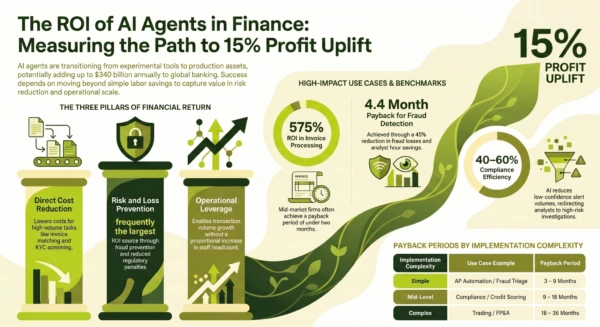
The financial overview of implementing AI agents in finance covers three distinct categories of return that must all be counted to get an accurate picture. Taken together, these categories define the full ROI of implementing AI agents in finance, not just isolated cost savings.
Category 1: Direct Cost Reduction
This is the most visible and easiest to quantify. AI agents lower the cost of high-volume, rule-based finance activities like invoice matching, transaction monitoring, KYC document screening, regulatory report production, and customer query answering.
The benefits are simple: fewer manual hours, lower mistake rates, and transaction volume scaling without workforce increase. When finance teams run the numbers, this category alone often justifies the investment.
Category 2: Risk and Loss Prevention
This is the most undervalued category in most ROI calculations, and it is frequently the largest single source of financial return in finance AI deployments.
Fraud detection AI prevents direct financial losses. Credit scoring AI reduces default rates and saves provision release costs. Compliance automation reduces the probability of regulatory penalties. None of these appear in standard labor-savings spreadsheets, but all of them have concrete, quantifiable monetary value that belongs in the business case. This is often the most overlooked driver of the ROI of AI automation, as prevented losses rarely appear in traditional cost-saving calculations.
Category 3: Operational Scale Without Proportional Cost Growth
AI lets finance departments handle more transactions, serve more customers, and produce more analytics without adding staff. This compounding operational leverage creates long-term value, especially for growing companies.
What the Numbers Look Like Across the Industry
Finance teams using AI are reporting measurable improvements across all three categories. Gartner’s 2024 survey of 121 finance leaders found that AI adoption in finance jumped from 37% in 2023 to 58% in 2024, with two-thirds of adopters saying they feel more optimistic about AI’s impact than the previous year, particularly those who had progressed beyond early experimentation (Gartner, 2024). The gap between optimistic early movers and cautious late adopters is not just attitudinal. It is financial. The organizations that moved in 2023 are now compounding returns from systems that have had two years to improve their accuracy and reduce their marginal cost per transaction.
Why Calculating ROI with Finance AI Agents Matters?
Calculating the ROI of implementing AI agents in finance matters because without a structured measurement framework, even strong deployments get cancelled before they deliver meaningful returns.
IBM’s research found that only about 25% of AI initiatives deliver expected ROI, and only 16% have scaled enterprise-wide (IBM CEO Study, 2025). The barrier is rarely technology. It is measurement, governance, and organizational alignment. Leaders who cannot demonstrate value in the first year lose budget approval for the second year, which is typically when compound returns begin.
Finance AI ROI also has three characteristics that make standard measurement frameworks inadequate.
- Risk reduction is invisible in standard calculations. A fraud detection system that prevents $1.5 million in annual losses generates exactly the same financial value as a system that saves $1.5 million in labor costs. But risk reduction never shows up in a headcount savings report. Finance leaders who only measure labor savings are systematically understating their AI returns and underbuilding their business cases.
- Revenue from regulatory compliance is quantified. Finance AI that increases AML monitoring, automates regulatory reporting, and eliminates audit exceptions reduce regulatory penalties, enforcement proceedings, and reputational harm.
- Payback timelines are longer than standard IT. Most enterprise software pays back within 7 to 12 months. Finance AI in risk and credit functions typically takes 18 to 36 months to deliver full returns. CFOs who measure only year-one results often cut programs precisely when they are approaching the inflection point where returns accelerate.
Understanding these three characteristics is what allows finance leaders to build measurement frameworks that sustain investment through the full payback period.
How to Calculate ROI from Investment in AI Agents?
How to calculate ROI from investment in AI agents goes beyond plugging numbers into a formula. The process has six steps, and getting them right before deployment is what separates organizations that can demonstrate value from those that cannot.
Step 1: Define the Business Problem You Are Solving
Before any calculation, you need a specific, bounded problem statement. Not “improve our finance operations” but something concrete like “reduce manual invoice processing cost” or “lower fraud-related losses in our payments division.”
The more specific the problem, the more credible the ROI calculation. Vague problem statements produce vague numbers that do not survive budget scrutiny.
Questions to answer at this step:
- What process or risk are you targeting?
- What does it currently cost you in time, money, or losses?
- What does a 30%, 50%, or 70% improvement look like in dollar terms?
- Who owns the outcome and who will measure it?
Step 2: Establish Your Baseline Metrics Before Deployment
This step is where most organizations fail. You cannot calculate ROI without a documented baseline to compare against. If you deploy first and try to measure later, you have no reference point.
Baseline metrics to capture before go-live:
- Cost per transaction processed (invoices, trades, claims, applications)
- Manual hours required per process per month, valued at fully loaded salary cost
- Annual fraud, default, or error-related financial losses
- Customer resolution time and cost per interaction
- Compliance exception rate and cost per review
- Current headcount and overtime costs in targeted functions
Capture these numbers for at least 3 months before deployment. The baseline period gives you seasonal variation and makes your post-deployment comparison statistically defensible. Without this baseline, measuring the true artificial intelligence ROI becomes speculative rather than data-driven.
Step 3: Map Your Total Costs Honestly
Under-budgeting implementation cost is one of the most common reasons finance AI projects fail to hit projected ROI. IBM’s research highlights that technical debt from legacy systems can reduce AI ROI by up to 29%, meaning the cost of integration and data preparation is often larger than expected.
Total costs to include:
- Platform licensing or custom development and build cost
- Data preparation and quality remediation (budget 20 to 30% of total project cost here specifically)
- ERP, core banking, or payment system integration
- Compliance configuration and regulatory audit framework setup
- Change management, training, and internal communication
- Ongoing model monitoring, retraining, and maintenance for years 2 and 3
Most organizations budget for deployment costs and forget years 2 and 3. A model that works perfectly in year one but degrades due to lack of monitoring and retraining will show falling ROI, which erodes confidence in the entire program. Accurately capturing these costs is essential to avoid overstating the ROI of AI automation and ensures realistic financial projections.
Step 4: Calculate Your Total Benefits Across All Three Categories
Category A: Labor savings
Labor savings = (Hours eliminated per month x fully loaded hourly cost) x 12
Use the fully loaded cost, not the base salary. Include benefits, overhead allocation, and management time. This is typically 1.3 to 1.7x base salary depending on seniority and location.
Category B: Risk and loss prevention
Fraud prevention benefit = Annual fraud loss baseline x AI reduction percentage achieved. Credit default benefit = Annual loan portfolio x default rate improvement x net loss rate Compliance benefit = Probability-weighted value of penalties avoided x estimated reduction in exposure
These calculations require your risk team’s input, but they are worth building carefully because they are often the largest numbers in the ROI model.
Category C: Working capital and revenue
Days Payable Outstanding improvement = (DPO improvement in days x daily COGS) = cash flow released Revenue protected = Customer satisfaction improvement x estimated churn reduction x average customer lifetime value
Step 5: Apply the ROI Formula and Model Multiple Scenarios
ROI (%) = [(Total Benefits – Total Costs) / Total Costs] x 100
Build three scenarios, not one:
| Scenario | Assumption | What it tells you |
| Conservative | 50% of projected benefits, 120% of projected costs | Minimum defensible return |
| Base case | 80% of benefits, 100% of costs | Most likely outcome |
| Optimistic | 100% of benefits, 90% of costs | Upside if execution is strong |
Presenting all three to your board is far more credible than presenting a single number, and it demonstrates that you have thought through the risks rather than selling an unjustifiably optimistic projection.
This formula is the foundation for quantifying the ROI of implementing AI agents in finance across different business scenarios.
A Worked Example: Invoice Processing Automation
A mid-market financial services firm processes 40,000 invoices per month at a current cost of $9 per invoice:
| Item | Before AI | After AI |
| Monthly invoice volume | 40,000 | 40,000 |
| Cost per invoice | $9.00 | $2.25 |
| Monthly processing cost | $360,000 | $90,000 |
| Monthly saving | — | $270,000 |
| Annual saving | — | $3,240,000 |
| Implementation cost | — | $480,000 |
| Payback period | — | Under 2 months |
| Year 1 ROI | — | 575% |
A Worked Example: Fraud Detection
A regional bank with $3 million in annual fraud losses deploys AI fraud detection achieving a 45% loss reduction:
| Item | Value |
| Annual fraud loss baseline | $3,000,000 |
| AI reduction achieved | 45% |
| Annual fraud losses prevented | $1,350,000 |
| Compliance analyst hours saved | $280,000 |
| Total annual benefit | $1,630,000 |
| Implementation cost | $600,000 |
| Payback period | 4.4 months |
For a real production deployment showing AI agents in lending operations, see our AI agents for SMB lending underwriting case study.
Step 6: Build a Review Cadence and Stick to It
Define review points at 90 days, 6 months, 12 months, and 24 months. At each review:
- Compare actual performance against the baseline metrics captured in Step 2
- Identify whether underperformance traces to model issues, data quality issues, or adoption issues
- Adjust the model, the data, or the change management approach accordingly
- Report results to leadership in the same format as the original business case
Organizations that build this review cadence sustain investment and compound returns. Organizations that skip it cannot demonstrate value and lose budget in year two.
The AI and GenAI Use Cases That Generate the Highest ROI
The AI and GenAI use cases that generate the highest ROI of implementing AI agents in finance are those where transaction volumes are high, outcomes are measurable, and the cost of manual processing or errors is clearly quantifiable.
1. Fraud Detection and AML Automation
Fraud detection is the highest-ROI use case in financial services for most institutions because the value is immediate, large, and directly measurable against a documented baseline. AI systems analyze hundreds of behavioural and contextual signals simultaneously, catching patterns that rule-based systems consistently miss.
On AML specifically, the bulk of most compliance budgets goes toward transaction monitoring and alert review. AI that reduces low-confidence alert volume by 40 to 60% cuts compliance operating costs significantly and redirects analyst capacity to genuine high-risk investigations. The financial benefit comes from both sides of the ledger: lower operating cost and better risk outcomes.
KYC onboarding sits in the same category. Manual corporate client onboarding takes 7 to 10 business days. AI-assisted onboarding compresses that to hours, which reduces cost per client onboarded and improves the customer experience simultaneously. This is why fraud detection consistently delivers one of the highest returns in terms of the ROI of AI automation within financial services.
See our AI agents for fraud detection in banking guide for the full architecture and deployment pattern.
2. Compliance and Regulatory Reporting Automation
One of the most defensible finance AI ROI cases is compliance automation, which saves labor and reduces risk. AI agents that monitor regulatory feeds, auto-generate reports, and identify policy deviations improve accuracy, audit defensibility, and lower operating costs.
BCG’s research on finance AI highlights compliance as one of the functions where AI is already delivering measurable impact at institutions that have moved beyond narrow use cases to transform end-to-end workflows. The institutions seeing the strongest returns are those that designed compliance AI as part of a broader finance transformation rather than as a standalone point solution.
3. Intelligent Credit Scoring and Loan Processing
Compared to scorecards, AI credit models with alternative data, real-time financial signals, and behavioral indications enhance default forecast accuracy. Financial institutions with substantial consumer or SME lending books can save a lot on provision releases even with a little default rate improvement.
Lending automation cuts approval times, lowers manual underwriting expenses, and enhances risk accuracy. It is one of the clearest examples of finance AI delivering both cost reduction and revenue improvement from the same system.
4. Financial Planning and Analysis Acceleration
FP&A is where AI agents change the quality and speed of financial decision-making rather than just reducing operating costs. McKinsey’s 2025 survey of 102 CFOs found that 44% were using generative AI for more than five use cases in finance in 2025, up from just 7% the prior year, with FP&A applications including scenario modeling, variance analysis, and cash flow forecasting among the most commonly cited use cases (McKinsey, 2025).
The practical value is the reduction in time between a financial question and a reliable answer. Finance teams that can model ten scenarios in the time it used to take to model two make better capital allocation decisions, respond faster to business changes, and operate as genuine strategic partners rather than reporting functions. This shift highlights how the ROI of artificial intelligence extends beyond cost savings into faster, higher-quality financial decision-making.
5. Customer Service and Onboarding Automation
Conversational AI is the most widely deployed AI application in financial services today because it delivers fast, measurable returns at relatively low implementation complexity. Cost per customer interaction drops significantly. Resolution times improve. Customer satisfaction scores improve. And every metric is visible from the first week of deployment.
For most financial institutions, customer support AI is also the recommended entry point because it generates the internal proof of value needed to sustain investment in deeper, higher-value applications.
6. Algorithmic Trading and Portfolio Management
For larger institutions, AI-driven trading and portfolio management generate returns through execution efficiency, cross-asset pattern recognition, and continuous market monitoring that human teams cannot replicate at scale. Payback timelines are longer, typically 12 to 24 months, due to model validation and regulatory requirements. The compounding returns over a 3 to 5-year horizon are among the highest across all finance AI categories.
Strategies for Maximizing ROI of AI Agents in Finance
Maximizing the ROI of implementing AI agents in finance requires five disciplines that consistently separate high-performing deployments from stalled ones.

1. Fix Data Before You Deploy
IBM’s research shows that paying down technical debt from legacy systems can improve AI ROI by up to 29%. Data quality is the most direct form of that technical debt in finance. AI learns from data. Inconsistent, incomplete, or poorly governed data produces unreliable outputs at scale, and no model sophistication compensates for bad inputs.
Budget 20 to 30% of your total project cost for data preparation before deployment. Organizations that skip this step do not save money. They find the problems later when they are more expensive to fix and more damaging to stakeholder confidence. Strong data foundations are one of the most important drivers of long-term artificial intelligence ROI in finance.
2. Choose the Right Starting Use Case
AP automation, fraud triage, and customer support automation are the right starting points for most financial institutions. Transactions are frequent. Patterns are learnable. Outcomes are measurable in weeks. Starting with a use case where payback is visible quickly builds the internal credibility and board confidence needed to sustain investment in longer-payback, higher-value applications.
Starting with complex applications like algorithmic trading or real-time portfolio rebalancing is a common mistake. They require extensive historical data, regulatory validation, and model testing before production deployment. Starting there adds 12 to 18 months before you can show any return.
3. Establish Baselines Before Go-Live
You cannot demonstrate ROI without a baseline to compare against. Define your measurement framework in the planning phase. Capture cost per transaction, analyst hours per process, fraud loss rates, and customer resolution times before the system goes live. This takes time, but it is the only way to build a defensible business case.
4. Build for Production, Not Just the Pilot
The biggest gap in finance AI is between pilot and scale. A successful pilot stalls at scale when the data pipelines, governance framework, integration architecture, and monitoring infrastructure were not built for production. Design your initial deployment with production architecture from the start. It costs more upfront and saves far more in delayed returns and retrofitting costs.
5. Involve Finance Teams in Design
Finance teams excluded from AI design resist adoption, maintain shadow manual processes, and reduce utilization to the point where projected ROI becomes mathematically impossible. Involving finance staff in the design phase, having them validate outputs and shape exception handling, producing adoption rates and output quality that isolated technical implementations simply do not achieve.
How Dextra Labs Can Maximize ROI By Implementing AI in the Finance Industry?
Dextra Labs helps financial businesses across the USA, Singapore, UAE, and India design, build, and scale AI agent solutions that generate measurable financial returns. The difference between a finance AI deployment that delivers strong ROI and one that stalls is almost never the model. It is the architecture, the data layer, the use-case selection, and the governance framework. Dextra Labs focuses on maximizing the ROI of implementing AI agents in finance through better architecture, data readiness, and use-case prioritization. These are exactly where we focuses.
What Dextra Labs delivers for finance clients:
- AI Agent Development for Finance Operations: Custom AI agents for AP automation, FP&A acceleration, compliance monitoring, and customer onboarding built for your specific ERP environment and regulatory context. Not generic tools. Systems designed around your workflows and your data.
- Enterprise LLM Deployment: Production-grade LLM implementations with optimized latency, intelligent caching, and contextual accuracy improvements for finance-specific language, compliance language, and regulatory terminology.
- Fraud Detection and AML Automation: End-to-end AI pipelines for transaction monitoring, alert triage, and AML reporting that reduce false positive volumes and free compliance teams for genuine investigative work.
- AI Consulting and ROI Roadmapping: A structured assessment of your current finance operations, identification of the highest-ROI AI use cases for your business size and regulatory environment, and a phased deployment plan with defined KPIs and a baseline measurement framework built before any deployment begins.
- Tech Due Diligence for AI Investments: For PE/VC investors evaluating AI-driven financial services acquisitions, deep technical audits covering AI architecture quality, data readiness, model scalability, and the accuracy of revenue-impact claims in investment materials.
Every Dextra Labs engagement includes a measurement framework before deployment begins. Your board sees ROI evidence, not activity reports. If you are evaluating AI agents for your finance function or assessing an AI-driven financial services business, contact our experts for a free AI consultation.
Common Mistakes Businesses Make While Integrating Finance AI Agents That Leads to Low ROI
Common mistakes businesses make while integrating finance AI agents follow predictable patterns across organizations of every size. Knowing them in advance is the most cost-effective way to avoid them.
Mistake 1: Deploying Before Data is Ready
AI trained on inconsistent, duplicated, or poorly governed data produces inconsistent, inaccurate outputs at scale. The financial cost of discovering this after deployment, including rework, stakeholder trust damage, and implementation delays, is significantly higher than the cost of fixing data quality before go-live. Fix the data first.
Mistake 2: No Baseline Metrics Before Go-Live
Organizations that deploy AI without capturing baseline metrics cannot demonstrate ROI. Without a documented cost per transaction, analyst hours per process, or fraud loss rate before deployment, there is nothing to compare results against. When leadership asks, “Is this working?” the answer is “We do not know,” and budget approval for year two disappears.
Mistake 3: Starting with the Wrong Use Case
Beginning with high-complexity applications like portfolio management or real-time trading extends time-to-value by 12 to 18 months and burns stakeholder goodwill when early results are unclear. Start with AP automation, fraud triage, or customer support. Show payback fast. Then build outward.
Mistake 4: Treating Deployment as the Finish Line
Finance AI models degrade as transaction patterns, fraud typologies, and business processes evolve. Organizations that treat go-live as completion find their systems underperforming within 12 to 18 months. Active monitoring, scheduled retraining, and governance reviews are not maintenance overhead. They are what keeps the returns compounding rather than eroding.
Mistake 5: Underfunding Integration
Finance AI does not operate in isolation. It connects to ERP systems, core banking platforms, payment rails, and reporting tools. Organizations that underestimate integration complexity see their projects delayed by 3 to 6 months and over budget, which compresses the ROI window and sometimes triggers cancellation before deployment is complete. Plan integration realistically and budget for it fully.
Mistake 6: Excluding Finance Teams from Design
Finance teams that feel AI was deployed on them rather than built with them resist adoption, maintain manual workarounds, and reduce system utilization to levels that make projected ROI impossible. Involve your finance staff early. It is not a soft consideration. It is a direct driver of whether the deployment delivers its projected returns.
Mistake 7: Measuring Only Hard ROI
IBM’s framework for AI ROI distinguishes between hard ROI, which covers direct cost and profit impacts, and soft ROI, which covers employee satisfaction, decision quality, and customer experience improvements. Finance leaders who measure only labor savings are leaving out risk reduction, regulatory cost avoidance, and strategic option value, which are frequently the largest contributors to long-term financial return in finance AI deployments. Ignoring these factors lead to a significant underestimation of the true ROI of AI automation across finance operations.
Conclusion
The ROI of implementing AI agents in finance is no longer theoretical. Organizations that approach deployment with clear baselines, strong data foundations, and the right use-case sequencing are already seeing compounding returns. The difference between success and failure is not the technology; it is execution, measurement, and the ability to sustain investment long enough to capture long-term value. Those who build structured governance, continuously refine models, and align teams around measurable outcomes will be the ones who unlock consistent, scalable financial impact from AI, an approach followed by Dextra Labs in delivering measurable, production-grade AI outcomes for finance teams.
Dextra Labs is an enterprise AI consulting firm helping businesses across the USA, Singapore, UAE, and India deploy, optimise, and scale AI solutions with measurable ROI. Services include AI agent development, enterprise LLM deployment, AI consulting, and tech due diligence for investors and acquirers in the financial services space.
Frequently Asked Questions (FAQs):
Q1. What is the typical ROI of AI agents in financial portfolio management?
AI portfolio agents deliver ROI from improved execution (less slippage), better risk-adjusted returns, and reduced operational workload. Payback typically takes 12–24 months due to validation and compliance. Over 3–5 years, compounding gains are substantial. Best practice includes setting baselines and reviewing performance at 6, 12, and 24 months.
Q2. What are the financial benefits and cost savings of AI-powered fraud detection systems?
AI fraud detection delivers value through reduced fraud losses, lower compliance costs via automated alert triage, and faster investigations. ROI combines fraud loss reduction with analyst time savings. These systems often produce one of the highest returns among AI use cases due to their direct and measurable financial impact.
Q3. How much can small investment firms expect to save by using AI agents?
Small firms save by automating research, compliance, and reporting, reducing manual workload and freeing time for client-facing activities. Entry costs are relatively low, and one successful deployment often funds further adoption. Strong ROI comes from starting with high-volume, well-defined, and measurable processes.
Q4. What are the cost reductions with AI chatbots for customer support in finance?
AI chatbots reduce cost per interaction by handling routine queries without human agents. Savings scale with volume, making them valuable for growing firms. They also improve response times and customer satisfaction, reducing churn. These indirect benefits (soft ROI) contribute to long-term revenue growth.
Q5. How do financial firms measure ROI after deploying AI trading agents?
ROI is measured through execution efficiency (slippage, speed), risk-adjusted returns (e.g., Sharpe ratio), and operational savings. Firms must compare results to pre-deployment baselines under similar market conditions. A common mistake is using non-comparable periods, which leads to misleading performance conclusions.
Q6. What are typical ROI figures for deploying intelligent agents in banking operations?
AI can generate 9–15% profit uplift in banking. Simple use cases (AP automation, fraud triage) pay back in 3–9 months. Mid-level cases (compliance, credit) take 9–18 months. Complex transformations (trading, FP&A) take 18–36 months but yield the highest long-term returns. Outcomes depend on execution quality.