Compliance costs financial institutions between 5% to 10 % of revenue annually, and the manual model holding that together is cracking. According to the International Monetary Fund, citing data from the United Nations Office on Drugs and Crime, 2–5% of global GDP is estimated to be laundered each year, highlighting the sheer scale of financial crime that compliance systems must monitor.
Most compliance teams spend the majority of their time reviewing transaction alerts that turn out to be false positives, tracking regulatory changes across multiple jurisdictions, and manually documenting decisions that auditors will eventually want to see. An AI agent for compliance changes that operating model completely, shifting from periodic review to continuous, real-time monitoring without adding headcount.
Dextra Labs builds production-grade agentic AI compliance systems for financial institutions across the USA, Singapore, UAE, and India. Through our AI agent development service, we design systems built around your regulatory environment, your existing stack, and your actual workflows, not generic bots retrofitted to a finance context.
As RegTech AI agents become more capable and more accessible, financial institutions of every size are moving from experimentation to production deployment. The gap between those that have made that move and those still running on manual workflows is widening every quarter. In this article, you will explore how AI agents automate compliance in finance, including AML monitoring, KYC processes, SAR generation, audit trails, and regulatory change management.

What is a Compliance Check AI Agent?
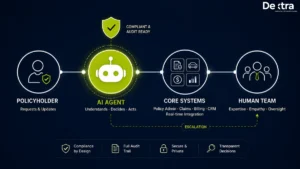
A compliance check ai agent is an autonomous system that does not wait to be asked before acting. It observes live data, reasons against regulatory thresholds, takes a defined action, and documents every step automatically.
This is what separates it from traditional compliance tools, which are fundamentally reactive. Traditional tools flag a transaction after the fact or generate a report when you run it. Meanwhile, a compliance check agent is proactive. It processes data as it arrives, assesses risk in context, and either acts or escalates with a fully documented recommendation ready for the analyst. The architecture of a well-built compliance check agent runs across four layers:
- Perception Layer: The agent ingests continuous data from core banking systems, payment rails, customer databases, and third-party watchlists like OFAC and FATF. Everything gets normalized into a format the reasoning layer can process.
- Reasoning Layer: Using a combination of rule-based logic, machine learning models, and increasing LLM capabilities, the agent evaluates incoming data against compliance thresholds, historical risk patterns, and current regulatory requirements.
- Action Layer: Based on its reasoning, the agent auto-clears low-risk transactions, flags medium-risk ones for analyst review with a pre-built case file, escalates high-risk transactions, or drafts a SAR. Every action sits within your defined governance framework.
- Memory and Audit Layer: Every observation, reasoning step, and action is logged with full timestamps and evidence chains. The audit trail builds itself automatically in the correct regulatory format.
The bigger shift compared to traditional rule-based systems is that compliance check agents improve over time. They learn which patterns indicate genuine risk and which ones are noise, and they get more accurate as they process more resolved cases. This is what makes agentic AI compliance fundamentally different from the automated tools most compliance teams have worked with before.
Why Enterprises Use AI Agents for Compliance and Monitoring in 2026?
The reason enterprises are adopting AI agents in finance for compliance and monitoring is straightforward. The manual compliance model has hit a ceiling that cannot be fixed by hiring more people.
Here is what compliance teams are actually dealing with today:
- Alert Volume is Unmanageable: A mid-sized bank can generate 20,000 to 50,000 AML alerts monthly. But, 95% amongst them are false positives. Analysts spend most of their time ruling out noise while genuine risk investigations sit in the queue.
- Regulatory Change is Accelerating: Institutions operating across multiple jurisdictions are tracking several regulatory bodies simultaneously, each issuing updates on overlapping timelines. Compliance gap detection, identifying which internal policies no longer meet current regulatory requirements, is increasingly difficult to do manually at the pace regulators now move. According to the World Economic Forum, financial institutions face an increasingly complex regulatory landscape, with thousands of regulatory updates issued globally each year across jurisdictions.
- Periodic Compliance is No Longer Enough: Regulators now expect continuous compliance monitoring evidence, not quarterly audit snapshots. The standard has shifted materially in recent examination cycles.
- Talent is Expensive and Hard to Find: Experienced AML analysts are in short supply, and every new hire adds cost without solving the underlying capacity problem. In simple words, scaling compliance by hiring creates a bottleneck that slows down business growth.
- Penalty Exposure is Growing: Global AML fines exceeded $10.4 billion in 2023 alone, and regulators have far less tolerance for compliance gaps than they did five years ago.
An AI agent for compliance addresses all of these challenges directly by automating alert triage, tracking regulatory updates, and enabling continuous monitoring. Alert volume gets handled through intelligent triage. Regulatory change is tracked automatically. Monitoring becomes continuous. The talent bottleneck shifts from routine surveillance to genuine investigation. And consistent, documented monitoring reduces the risk of the manual errors that generate regulatory findings.
How AI Agents Automate Compliance Monitoring in Finance: 6 Core Workflows
AI agents automate compliance monitoring in finance by handling six specific workflows that cover the full scope of what compliance teams manage daily, from transaction screening to audit documentation. Each workflow below shows where a purpose-built compliance agent replaces manual effort with continuous, automated execution.
Workflow 1: Real-Time AML Transaction Monitoring
AI agents for AML compliance ingest transaction data in real time, evaluate each transaction against risk models, and automatically route alerts based on their risk level. This is the most widely deployed compliance agent workflow and the one with the fastest measurable ROI.
Low-risk transactions are auto-cleared. Medium-risk ones are flagged for analyst review with a pre-populated case file. High-risk transactions trigger an immediate escalation with a draft SAR attached.
The critical difference from traditional rule-based AML systems is that an AI agent reduces false positives through pattern learning rather than threshold adjustment. Financial institutions deploying agentic AI for AML compliance report false positive reduction compliance rates of 40% to 70%, freeing substantial analyst capacity for genuine investigation work.
Workflow 2: KYC Compliance Automation and Ongoing Customer Monitoring
Agentic AI for KYC and compliance handles both the initial verification and the continuous monitoring that regulators expect after onboarding. KYC is not a one-time exercise, and this is where many institutions get caught during examinations.
For new customers, the agent automates verifying identity documents, screens against sanctions lists and PEP databases, assesses risk tier, and produces a complete onboarding risk assessment in hours. Manual corporate KYC typically takes 7 to 10 business days, while KYC compliance automation compresses that to 4 to 6 hours.
For existing customers, the agent monitors for trigger events, including sanctions list updates, unusual transaction behavior, and news events linking a customer to financial crime, then flags those requiring enhanced due diligence without waiting for a scheduled review cycle.
Workflow 3: Suspicious Activity Report Automation
A trained analyst gathering transaction evidence, documenting the reasoning chain, writing the narrative, and submitting correctly can spend 4 to 8 hours on a single SAR case. An AI agent for compliance changes this workflow entirely.
When the AML agent escalates a case, the SAR automation agent pulls relevant transaction records, assembles the evidence chain, drafts the narrative in approved regulatory language and pre-fills the FinCEN or equivalent regulatory form for analyst review and submission. What used to take most of a day takes under an hour.
Consistency across filings also improves significantly, which is one of the most common quality issues regulators flag during examinations.
Workflow 4: Regulatory Change Management AI
A regulatory change management AI agent automates the monitoring that compliance teams currently do manually across dozens of regulatory feeds. It ingests updates from regulatory bodies, analyzes new publications, identifies changes material to your operations, and generates a structured impact assessment showing which internal policies or system configurations need updating and by when.
This directly addresses the compliance gap detection problem that grows more difficult as institutions expand across jurisdictions. At Dextra Labs, we configure these agents to monitor jurisdiction-specific feeds relevant to each client, so a FinTech operating across Singapore, the UAE, and the UK is not receiving generic global regulatory alerts but targeted, relevant change notifications tied to their specific operating footprint.
Workflow 5: SOX and Internal Controls Monitoring
For institutions subject to SOX, AI agents provide continuous monitoring of internal controls that previously required periodic manual testing. The agent monitors access logs, transaction approvals, segregation of duties, and exception patterns continuously, flagging control failures in real time.
This gives compliance teams the chance to investigate and remediate before an external auditor arrives, rather than discovering systemic control weaknesses during an examination.
Workflow 6: Audit Trail Automation
Audit trail automation is invisible when it works and very costly when it does not. Incomplete or inconsistent documentation found during a regulatory examination generates fines and remediation requirements entirely separate from any underlying compliance issue.
An AI compliance agent documents every monitoring action, every decision, every escalation, and every resolution automatically in the correct regulatory format. The audit trail builds itself continuously through compliance workflow automation rather than being assembled manually under time pressure ahead of an examination.
Benefits of AI for Compliance Monitoring in Finance
The benefits of an AI agent for compliance become clear when comparing it to manual compliance processes that rely heavily on human effort and periodic reviews. Below, we’ve mentioned some of the benefits of AI compliance monitoring in finance.
1. Continuous Monitoring Over Periodic Reviews
AI agents monitor every transaction as it is processed, around the clock. Manual compliance reviews are periodic by nature – by the time last month’s transactions are reviewed, the action window for suspicious activity has already passed. Continuous compliance monitoring closes that gap entirely.
2. False Positive Reduction
Rule-based systems rely on static thresholds that cannot account for context. AI agents that learn from resolved cases reduce false positives by 40 to 70 percent in documented deployments. To put that in practical terms – approximately 90 percent false positive rates, a 60 percent reduction means analysts spend twice as much time on genuine risk cases as they would have otherwise.
3. Consistent, Audit-ready Documentation
Every action the agent takes is documented automatically in the correct regulatory format. Manual audit trail preparation is time-intensive and error-prone – teams spend weeks assembling documentation before an examination. Continuous, automated documentation removes that pressure entirely.
4. Faster Investigation Cycles
AI agents assemble the evidence, context, and preliminary analysis before an analyst even opens a case. Without this, analysts spend the first hour of every investigation just gathering records and building context manually. Investigation time per case drops by 40 to 60 percent in practice, allowing the same team to handle more complex cases at higher quality.
5. Scale Without Proportional Headcount Growth
A financial institution that doubles its transaction volume does not need to double its compliance team when AI agents handle the monitoring layer. Under a manual model, more transactions mean more analysts – and the cost scales linearly with no efficiency gain. With AI agents handling triage and monitoring, human analysts focus on genuinely complex cases that require judgment.
6. Reduced Regulatory Penalty Risk
Consistent, continuous monitoring reduces the probability of control failures that generate regulatory findings and fines. The cost of one significant AML penalty can exceed the total investment in a compliance AI implementation many times over. Preventing a single regulatory action often justifies the entire deployment.
Real-World Use Cases of AI Agents for Compliance and Monitoring
Real-world use cases of AI agents for compliance and monitoring vary meaningfully across financial services segments because each has different regulatory requirements and operational challenges.

Use-Case #1: Banking
Commercial and retail banks carry the highest AML monitoring burden in financial services. Transaction volumes are enormous, customer bases are diverse, and regulatory expectations around SAR filing, KYC refresh, and sanctions screening are closely examined.
AI compliance agents in banking focus on three high-impact areas. Real-time transaction monitoring catches suspicious activity at origination rather than in batch review cycles. Automated SAR drafting reduces the 4 to 8 hour manual filing process to under an hour per case. Continuous sanctions list monitoring ensures that flagged entities are detected immediately after a list update – not during the next scheduled screening run.
The integration layer matters here. Compliance agents built for banking need to connect directly with core banking systems, payment rails, and existing case management platforms. This is where most generic AI tools fall short and where purpose-built agent development, the kind we focus on at Dextra Labs, makes a measurable difference.
Use-Case #2: Wealth Management
Wealth management compliance involves more complex client profiles than retail banking. Beneficial ownership structures, trust arrangements, source of funds verification, and multi-jurisdiction tax profiles all require monitoring that goes well beyond standard KYC processes.
The core challenge is ongoing risk scoring. A high-net-worth client with holdings across three jurisdictions, a layered corporate ownership structure, and a trust arrangement cannot be adequately monitored through annual review cycles. AI agents for wealth management compliance continuously re-score client risk as trigger events occur – ownership changes, sanctions list updates, adverse media hits, or unusual transaction patterns – and flag cases for enhanced due diligence in real time.
This is one of the more complex compliance agent builds in financial services, requiring deep configuration around entity resolution, corporate hierarchy mapping, and jurisdiction-specific regulatory logic.
Use Case #3: FinTech
FinTechs face a structurally different compliance challenge. They scale rapidly across multiple jurisdictions with limited compliance headcount, subject to the same regulatory requirements as established institutions but without the compliance infrastructure to match.
The priority for FinTech compliance agents is speed to production and scalability. The agent needs to integrate with modern cloud-native tech stacks from day one, handle increasing transaction volumes without architectural rework, and cover AML monitoring, KYC automation, and regulatory change tracking within a single deployable system. Compliance automation that becomes a bottleneck as the business scales defeats the purpose entirely.
This is a segment where we see significant demand – FinTechs that have outgrown their initial compliance setup but are not yet large enough to build a full in-house compliance technology stack.
Use-Case #4: Insurance
Insurance compliance covers a different regulatory surface than banking or wealth management. Policyholder due diligence, claims fraud detection, and capital adequacy reporting under Solvency II or equivalent frameworks are the primary areas where AI agents deliver value.
On the fraud side, AI agents monitor claims patterns for anomalies – duplicate claims across policies, coordinated claim timing, inflated repair or medical cost estimates – and flag cases for investigation before payout. On the regulatory side, agents automate capital adequacy calculations and reporting workflows that are otherwise manual, spreadsheet-driven processes prone to error under time pressure.
Policyholder verification at underwriting is a growing use case as well. AI agents screen applicants against sanctions lists, verify identity documentation, and assess risk profiles at the point of policy issuance rather than relying on post-issuance review.
Key Barriers to Successful Implementation of AI Compliance Monitoring in Finance
Here are the key barriers to successful implementation of AI compliance monitoring in Finance:
1. Data Quality
An agentic AI compliance system is only as reliable as the data it processes. Fragmented core banking systems, inconsistent customer records across business lines, or poor historical transaction data require substantial preparation before any agent can operate reliably. This is frequently the most time-consuming part of a compliance AI implementation and the most underestimated.
2. Explainability Requirements
Financial regulators require that compliance decisions be explainable. If an agent files a SAR or flags a customer for enhanced due diligence, the institution must be able to explain why in terms a regulator will accept. This requires interpretable reasoning chains and configurable decision logic built into the architecture from the start.
3. Legacy System Integration
Most financial institutions run core banking platforms that were not built for modern API connectivity. Integrating a compliance agent with a legacy core system, an older payments platform, and multiple CRM environments is a genuine engineering challenge that requires financial systems integration experience alongside AI development skills.
4. Analyst Adoption
Compliance analysts with years of manual review experience do not automatically trust AI outputs. Successful implementations involve analysts in the design process, train them to supervise and correct the agent, and position the tool as something that makes their work more valuable rather than less secure.
5. Model Governance
A compliance agent deployed without an ongoing governance framework will degrade as fraud patterns evolve, regulations change, and the customer base shifts. Regular performance reviews, scheduled retraining, and formal model drift management are not optional. They are what sustains the returns over time.
The ROI of Implementing Finance AI Agents in 2026
Financial institutions globally spend an estimated $206 billion per year on financial crime compliance, and that number keeps climbing. In the US and Canada alone, compliance costs have reached $61 billion annually, with 99 percent of institutions reporting increased spending year over year. The question is no longer whether AI agents reduce compliance costs – it is how fast the return materializes and how large it compounds over time.
Here is what the data shows across the three areas where ROI is most measurable:
| ROI Category | Manual Baseline | With AI Agents | Impact |
| False positive rate | 90–95% of all AML alerts | 40–70% reduction in false positives | Analyst capacity doubles on genuine risk cases |
| SAR filing time | 4–8 hours per case | Under 1 hour per case | 75–85% time reduction per filing |
| KYC onboarding (corporate) | 7–10 business days | 4–6 hours | 90%+ cycle time compression |
| Investigation time per case | Full manual evidence gathering | Pre-assembled case files | 40–60% reduction in investigation cycles |
| Compliance cost trajectory | Rising 5–10% of revenue annually | Up to 30% reduction in compliance operating costs | Cost structure shifts from linear to scalable |
| Penalty exposure | $4.6 billion in global AML fines in 2024 | Continuous monitoring reduces control failures | One avoided penalty can exceed total AI investment |
According to the Napier AI/AML Index 2025–2026, regulated firms could save as much as $183 billion per year in compliance costs by implementing AI-driven systems. The ROI is not speculative – it is already being documented across production deployments.
We have seen this firsthand. One of our compliance agent deployments for a financial institution managing cross-border AML monitoring delivered measurable results within the first quarter – significant false positive reduction, SAR filing time cut by more than 60 percent, and recovered analyst capacity redirected to complex investigations that had been backlogged for months. You can explore this and other deployment outcomes on our case studies page.
Conclusion
The manual compliance model – periodic reviews, manual alert triage, spreadsheet-driven audit preparation – is no longer sustainable at the scale regulators now expect. AI agents for compliance in finance are handling these workflows in production today, from real-time AML monitoring and automated SAR filing to continuous KYC screening and regulatory change tracking. The institutions already running them are operating with lower costs, fewer regulatory findings, and compliance teams focused on genuine investigation work rather than routine triage.
If you are looking to build AI agents that automate compliance and monitoring for your financial institution, book a free consultation with Dextra Labs. We start with a technical assessment of your regulatory environment, existing systems, and compliance workflows before any code is written.
Frequently Asked Questions (FAQs):
Q1. Where to buy AI agent platforms built for financial compliance?
Specialist RegTech platforms like ZBrain and Akira AI offer pre-built options. For more complex or regulation-specific requirements, custom-built agents from firms like Dextra Labs give you full code ownership and deeper fit to your actual workflows and regulatory context.
Q2. How to evaluate agentic AI platforms for compliance and security?
Check explainability of decisions, integration depth with your core systems, documented false positive reduction from comparable deployments, model governance framework, and whether regulatory coverage matches your specific jurisdiction’s requirements.
Q3. How to choose an AI agents platform for compliance operations?
Map your three highest-volume compliance workflows first. Evaluate platforms on how well they handle those specifically, not on feature breadth. Always run a proof of concept on your own live data before committing.