AI agents will become the primary way we interact with computers in the future. They will be able to understand our needs and preferences, and proactively help us with tasks and decision-making. ~ Satya Nadella, CEO, Microsoft
If your AI can’t connect systems, it’s just another silo. A CIO once said that their ‘smart chatbot’ knew less about their customers than their frontline reps.
Now, for instance: Your company deployed a chatbot two years ago. It handles FAQs, deflects some ticket volume, and occasionally impresses a customer with a quick answer. But it can’t process a refund. It can’t check an order status across your OMS and WMS simultaneously. It can’t remember that this customer called about the same issue last week. And it can’t escalate with context attached.
When the query gets complex, it says, ‘’Let me connect you with a human agent,’’ which is exactly what it was supposed to replace.
Now vendors are pitching AI agents that promise to fix everything the chatbot couldn’t. The question every CTO, CX lead, and head of operations is asking is: Is this a genuine architectural shift, or the same technology with better marketing?
The answer is architectural. And the difference matters.
The distinction becomes especially important in enterprise environments where customer resolution depends on coordinating actions across CRMs, ERPs, billing systems, warehouse platforms, and operational workflows in real time.

In this blog piece, we cut through the hype and look at what AI agent vs chatbot actually means for your business, your operations, and the customer experience you are trying to build. No jargon‑heavy explanations. No vendor‑speak. Just clear, decision‑ready insight for leaders who are evaluating whether their next AI investment is a chatbot refresh or a true AI agent layer that can act across systems.
AI Agent vs Chatbot: The 7 Architectural Differences That Actually Matter in 2026
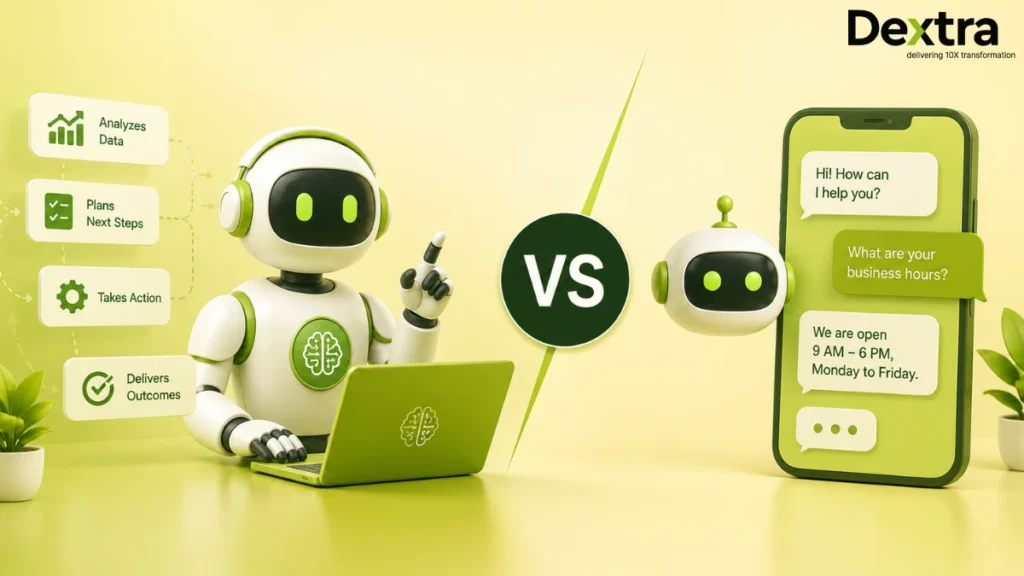
The difference between an AI agent and a chatbot is not about how smart the underlying model is. It is about what the system can actually do with what it knows: whether it can only respond, or whether it can reason, act, and learn.
That distinction sounds simple on paper. In practice, it changes everything about how your business handles customers, resolves problems, and scales operations.
A customer sends this message:
“My last three orders were all delayed. What’s going on and what are you doing about it?”
Two systems receive the same message. Here is what happens next.
Let’s take an example:

The Chatbot responds:
“I’m sorry to hear about the delays. You can track your order status at [link]. Would you like me to connect you with a support representative?”
Polite. Formatted correctly. Completely useless.
The customer already knows their orders were delayed. They are not looking for a link. They are looking for answers, accountability, and resolution. The chatbot gave them none of those things, because it was never built to. Rule-based chatbots handle customer interactions by pattern-matching inputs to pre-written outputs. They do not investigate. They do not act. They redirect.
The AI Agent responds differently, entirely!
It pulls the customer’s last three orders from the order management system. It checks shipment tracking across the carrier API. It notices something: all three orders were shipped from the same warehouse. It cross-references warehouse performance data and finds a three-day fulfillment backlog at that facility. It applies a 15% goodwill credit to the customer’s account, automatically, per policy. It sends the customer a clear, specific message explaining the warehouse issue and confirming their credit. Then it flags the fulfillment backlog to the operations team with a structured summary report.
Same question. One system talked about the problem. The other resolved it, end-to-end, without a human in the loop.
This is the real gap between AI agents vs chatbots in 2026. It is not a feature gap. It is an architectural one. And it has compounding consequences for every customer interaction your business handles at scale.
Self-learning AI agents vs rule-based chatbots are not two points on the same spectrum. They are fundamentally different systems built for fundamentally different purposes. One is a response machine. The other is an action engine.
Understanding exactly where that gap lives, and why it matters for your business, starts with the architecture underneath.
Here are the seven differences that actually separate them.
| Dimension | Chatbot | AI Agent |
| Core architecture | A retrieval system that matches incoming queries to the closest content in a knowledge base using vector search or keyword matching. It finds the best available answer. It does not reason toward one. | A reasoning system that breaks goals into steps, selects the right tools for each step, executes actions, and evaluates outcomes before moving forward. It does not retrieve. It thinks and acts. |
| Data access | Read-only. It pulls information from documents, FAQs, and knowledge articles. It can tell you what a policy says. It cannot do anything about it. | Read and write. It queries databases, updates records, and triggers transactions across connected systems. It does not just surface information. It acts on it. |
| Memory | Session-based. Context resets the moment the conversation ends. Every new interaction starts from zero and the customer repeats their issue every single time. | Persistent. It retains customer history, previous interactions, stated preferences, and resolution patterns across sessions, channels, and time. |
| Reasoning | Single-step. It retrieves the closest match to the query and presents it as the answer. One input, one output, no sequencing. | Multi-step. It breaks complex requests into subtasks, plans the execution sequence, handles exceptions as they arise, and adjusts its approach mid-workflow without stopping to ask for help. |
| System integration | Shallow. It connects to a knowledge base and occasionally pulls context from a CRM. It cannot write back to any system or trigger an action in one. | Deep. It is API-connected to CRM, OMS, ERP, billing, ticketing, and warehouse systems simultaneously. It does not just retrieve from these systems. It executes actions inside them. |
| Learning | Static. Every new product, policy update, or edge case requires a human admin to manually update the knowledge base, rewrite scripts, and rebuild decision trees. | Continuous. It improves from interaction outcomes, analyst corrections, and resolution patterns over time. The system gets better as it works, without requiring manual intervention for every change. |
| Outcome | Deflection. It answers the question if it can, and transfers to a human if it cannot. The resolution rarely happens inside the same conversation. | Resolution. It completes the workflow end to end, including every action a human agent would have performed, without requiring a handoff to get there. |
If the system only talks, it’s a chatbot. If it reasons, acts across systems, and completes workflows – it’s an agent.
In practice, the architectural jump from chatbot to agent usually depends less on the LLM itself and more on the surrounding orchestration layer – memory systems, tool access, workflow coordination, and governance controls.
To understand this distinction in more detail, read our guide on AI Agent vs LLM, which explains what language models can do on their own and what additional architecture is required to turn them into capable AI agents.
The Agent-Washing Problem: Why Most “AI Agents” Are Still Chatbots
Marketing is not about hype. It’s about honest architecture. And, this is nowhere more relevant than in today’s AI agent market. This is why a CTO’s skepticism is not only valid but the most realistic starting point.

The market is flooded with vendors calling every layer of automation an “AI agent,” even when the architecture looks nothing like it. As per Gartner, only around 130 vendors meet any meaningful architectural standard for being genuinely agentic. The rest are chatbots with better language models. They generate more fluent responses, they can paraphrase faster, and they sound more human, but they still cannot act, remember, or reason through complex, multi‑step workflows.
This is an agent‑washing problem. Companies are buying the label, not the capability. Many so‑called AI agent vs chatbot solutions are, in practice, just AI chatbots with a new brand tagline. They defend an LLM wrapped in a conversational UI, not an autonomous system that can execute tasks across your tech stack.
To cut through the noise, CTOs and CX leaders need a simple maturity filter they can apply to their own vendors.
| Read More: Dextra Labs has mapped this into a clear agentic AI vs chatbot diagnostic that you can find in our Agentic AI Maturity Model 2025. |
Here’s a 4-level maturity diagnostic for your own vendor:
| Level | What It Does | What It Actually Is |
| Level 1: Script Bot | This system follows pre-built decision trees and returns scripted responses based on keyword matching. It cannot understand context, interpret intent, or handle anything outside its programmed paths. Every answer was written by a human before the conversation even started. | A basic rule-based chatbot. This is pre-2020 technology that most organisations have already moved past. If your vendor is here, the conversation should end early. |
| Level 2: RAG-Powered Search | This system uses a large language model to search a connected knowledge base and generate natural language answers. It sounds considerably more intelligent than a script bot and handles a wider range of queries. However, it cannot take any action inside your systems. It can tell a customer their refund policy exists. It cannot process the refund. | An advanced chatbot dressed in modern language. This is the level most vendors are actually shipping in 2025 and 2026 while calling it an AI agent. The language is fluent. The architecture is not agentic. If a vendor cannot clearly demonstrate write access to your connected systems, this is where they sit. |
| Level 3: Reasoning Agent | This system understands context across multiple systems, plans multi-step resolutions, and executes actions within defined guardrails. It can escalate with full context attached, maintain persistent memory across sessions, and coordinate across your CRM, OMS, billing, and ticketing platforms within a single resolution flow. It does not just answer. It acts and completes. | A true AI agent with genuine architectural depth. It can read and write across connected systems, reason through complex queries, and deliver outcomes without requiring a human to step in and finish the job. This is the level worth investing in for enterprise customer operations. |
| Level 4: Autonomous Agent | This system does not wait for a customer to raise an issue. It monitors operational signals proactively, identifies problems before they surface, and initiates workflows without any incoming contact. It handles exceptions autonomously, learns continuously from outcomes, and optimises its own decision-making over time across changing business conditions. | A next-generation AI agent operating at the frontier of what is currently possible in production environments. Deployments at this level remain limited in 2026 and are typically scoped to specific, well-governed operational domains within large enterprises. Proceed with a clear governance framework before evaluating vendors here. |
Run this maturity check against your current vendor. If their product sits at Level 2, fluent answers but no actions, you have an advanced chatbot regardless of what the sales deck calls it.
The reason agent-washing became so widespread is straightforward. Most vendors upgraded their conversational interface without upgrading the underlying system architecture. The language got better. The capability did not.
In production environments, deploying a true AI agent requires:
- Persistent state management that retains context across sessions, channels, and agents
- Multi-system orchestration that coordinates actions across your CRM, ERP, OMS, and billing platforms simultaneously
- Tool-calling frameworks that give the agent permission to invoke specific actions in connected systems with defined guardrails
- Workflow execution logic that enables the agent to complete multi-step resolutions without human intervention at every stage
- Approval and escalation layers that bring humans into the loop at the right moments, not as a fallback for every complex query
- Full auditability across every automated action, so every decision the agent makes is traceable, reviewable, and defensible
At Dextra Labs, enterprise AI agent systems are typically evaluated and designed around these operational capabilities rather than conversational fluency alone.
Chatbot or AI Agent: Are You Using the Right Tool or Just the Familiar One?
Not every interaction deserves an AI agent. For many B2B operations, a well-built chatbot is still the right fit for the bulk of routine, low-risk queries. Gartner‑framed customer service trend analysis shows that most generative AI pilots in support focus on simple, repetitive, informational interactions such as FAQs, order status checks, or basic account lookups. That is why many B2B organizations estimate that roughly 40–60% of support tickets fall into this category and are ideal for chatbots. In these cases, a chatbot that can quickly surface the right page or field value, without accessing or changing backend systems, is fast, inexpensive to deploy, and perfectly aligned with the business need.

However, the moment queries cross into billing disputes, multi-system exceptions, warehouse fulfillment issues, or policy-sensitive actions, the expectations change. Customers no longer accept being pointed to an article or transferred to a human. They expect the issue to be resolved in the same conversation, sometimes with compensation, escalation, or cross-department coordination.
Gartner‑framed adoption curves and Forrester’s 2024 “State of AI Agents” report both suggest that by 2028, a large share of leading B2B brands will use agentic AI for these higher-value, action‑based interactions. That is where a true AI agent, not a chatbot, becomes the right architectural choice.
To help you translate this reasoning into concrete choices, here is a practical decision table that maps your business situation to whether a chatbot fits or an AI agent is required.
| Your Situation | Chatbot Fits | Agent Required |
| Query complexity | Your queries are single-step and informational. FAQs, order tracking, store hours, and password resets can be handled without accessing or changing any backend system. | Your queries span multiple steps and require the system to act, not just answer. Billing disputes, workflow execution, and multi-system exception handling fall into this category. |
| System integration needed | The system only needs to read from a knowledge base or perform a basic CRM lookup. No writing back to any system is required. | The system must connect to and act across CRM, OMS, ERP, billing, ticketing, and warehouse platforms. Reading alone is not enough. The agent must also write, update, and trigger actions. |
| Resolution expectation | Your customers are comfortable being directed to an article, a link, or a human agent when their query gets complex. The interaction does not need to end in a resolved outcome. | Your customers expect the issue to be fully resolved within the same conversation. Handoffs to humans for resolvable issues are no longer acceptable and directly impact satisfaction and retention. |
| Interaction volume vs complexity | You are dealing with high volumes of simple, repetitive queries where speed and consistency matter more than depth of resolution. | Your interactions are lower in volume but higher in complexity. Each query requires investigation, judgment, and action across systems before a resolution can be delivered. |
| Memory requirement | Every conversation can stand alone. There is no need for the system to remember previous interactions, past cases, or customer history. | Customer context must carry forward across every session and every channel. Repeat issues, ongoing cases, and relationship history need to be accessible automatically, without the customer repeating themselves. |
| Budget and timeline | You need a working solution within weeks and have limited appetite for deep system integration at this stage. | You are prepared to invest the time and resources required for proper system integration, guardrail configuration, governance setup, and testing before going live. |
| Risk tolerance | The queries being handled are low-risk and informational. A wrong or incomplete answer is a minor inconvenience, not a business liability. | The queries involve transactions, financial decisions, or operational consequences. A wrong automated action carries real risk, and the system must be built with guardrails, escalation paths, and full audit trails. |
Most enterprises in 2026 run both. Chatbots handle 40 to 60% of queries that are informational and low-risk. Agents handle the 20% to 40% that require investigation, action, and resolution. The remaining 10% to 20%, genuinely complex, ambiguous, or emotionally sensitive, still go to humans with a full agent-prepared context. The question is not chatbot or agent. It is which queries go where.
Moving from chatbot systems to production-grade AI agents usually requires more than replacing the interface layer.
In enterprise environments, the complexity often sits beneath the conversation itself:
- integrating fragmented operational systems
- managing persistent memory across workflows
- enforcing approval and governance policies
- coordinating actions safely across multiple platforms
This is why many organizations discover that deploying AI agents is fundamentally an infrastructure and orchestration challenge rather than a conversational AI upgrade.
At Dextra Labs, enterprise AI agent development services & implementations are typically structured around these operational layers first; particularly for organizations integrating agents across CRM, ERP, ticketing, billing, and workflow systems.
The Blueprint for Autonomy: How AI Agents are Changing Enterprise Tech
If you are a CTO evaluating whether to build or buy an agent layer, the capability pitch is only half the story. The architecture is where the real decisions live, and getting it wrong at the design stage is expensive in ways that only show up after you have already committed.

Four layers separate a production-grade AI agent from a chatbot with a smarter interface. Understanding each one changes how you think about deployment, integration, cost, and risk.
Layer 1: Data Architecture – Vector DB vs Knowledge Graph
Chatbots retrieve. They embed a query, find the most semantically similar text chunk, and return it. That works for FAQs. It breaks the moment a response requires connecting data across systems simultaneously, like customer history, order status, and billing records in a single resolution flow.
Agents traverse relationships between entities using knowledge graphs and multi-system API access, not just similarity between text chunks. The architecture decision made here determines whether the agent can actually resolve a problem or just describe it.
| Knowledge Byte: Gartner predicts 40% of enterprise applications will be integrated with task-specific AI agents by the end of 2026, up from less than 5% in 2025. The data architecture underneath those deployments will determine whether they deliver in production or stall at the pilot stage. |
Layer 2: Reasoning Model – Retrieval vs Agentic Loop
A chatbot follows a linear pattern. Query comes in, best match goes out. The loop ends there.
An agent reasons differently. It receives the query, decomposes it into subtasks, selects the right tool for each, executes, evaluates the output, adjusts if needed, and continues until the task is complete. This is the agentic loop, and it is what makes multi-step resolution architecturally possible. Retrieval cannot replicate it because the pattern is structurally different, not just less capable.
| Knowledge Byte: McKinsey estimates agentic AI will power more than 60% of the increased value AI is expected to generate from marketing and sales deployments, with early applications showing potential to unlock $2.6 to $4.4 trillion in annual value. That value comes from systems that reason and act across steps, not systems that return a single best match. |
Layer 3: Action Layer – Read-Only vs Tool-Calling
Chatbots can read from connected systems. Pull an order status. Retrieve a customer record. That is where their capability ends.
Agents can read and write. Process a refund. Update a CRM ticket. Trigger a shipment correction. Schedule a callback. All within a single resolution flow, enabled through tool-calling protocols like function calling and MCP that give the agent permission to invoke specific actions in connected systems with defined guardrails.
| Knowledge Byte: Nearly 8 in 10 companies report using generative AI, yet just as many report no significant bottom-line impact. The gap between deployment and results is almost always an execution gap. Tool-calling is what closes it. Scaled agent deployments could deliver productivity improvements of three to five percent annually and potentially lift growth by 10% or more. |
Layer 4: Memory Architecture – Context Window vs State Management
A chatbot’s memory resets when the session ends. Every new interaction starts from zero with no continuity, no pattern recognition, and no persistent understanding of the customer.
Agents run on state management. Persistent memory that retains customer history, open case context, and resolution patterns across sessions, channels, and agents. This is not a feature. It is what makes an agent useful at scale rather than just impressive in a demo.
In 2026, enterprise applications will move beyond enabling employees with digital tools to accommodating a digital workforce of AI agents. Tech leaders will be forced to decide how far to go in digitizing business processes and orchestrating workflows independent of human workers. Persistent state management is what makes those agents functional members of that workforce rather than single-session tools.
| Knowledge Byte: Forrester forecasts AI will automate more than 20% of enterprise application workflows in 2026, and half of ERP vendors will introduce autonomous governance modules within their suites. The organisations that capture that shift will be the ones that built on the right architectural foundation from the start, not the ones that deployed a smarter chatbot and called it an agent. |
Building for Production, Not for Demos
These four layers are not independent checkboxes. They work together. The gap between a production-grade AI agent and a conversational interface that only simulates intelligence almost always comes down to how well they are designed, integrated, and governed from the start.
Graph-based data access determines what the agent can see. The agentic reasoning loop determines how it thinks. The tool-calling execution layer determines what it can do. Persistent state management determines how it learns across time. Weaken any one of them, and the system starts to behave like a chatbot under pressure.
At Dextra Labs, enterprise AI agent deployments are generally structured around these architectural layers based on the organization’s operational environment:
- Which systems must the agent coordinate across
- What actions can it safely execute
- Where human approvals are required
- and how auditability, policy enforcement, and state management are maintained across workflows
This becomes especially important in enterprise environments where agents interact with customer records, financial systems, operational infrastructure, or regulated workflows.
ROI: What the Shift from Chatbot to AI Agent Actually Delivers
Capability discussions matter. But in the boardroom, the question is always the same: what does it actually deliver?
The shift from chatbot to AI agent is not just an architectural upgrade. It is a measurable operational change. Faster resolutions, fewer escalations, lower cost per interaction, and revenue that does not slip through the cracks of a system that could only respond but never act.
The table below breaks down what that shift looks like across the metrics that matter most.
| Metric | Chatbot Performance | AI Agent Performance | Source |
|---|---|---|---|
| End-to-end resolution rate | Resolves 10 to 20% of queries end-to-end. The majority escalate to a human agent or go unresolved. | Resolves 40 to 80% or more of queries end-to-end through multi-step reasoning and system-level action. | Forethought / DevRev |
| Customer repeat rate | 90% of customers are required to repeat their issue in every new session due to the absence of persistent memory. | Near-zero repetition. The agent retains full interaction history, case context, and resolution status across sessions. | Forethought |
| Abandonment | 45% of customers abandon the interaction after three or more failed attempts to get a resolution. | Significantly reduced. Issues are resolved within the first contact, removing the friction that drives abandonment. | Forethought |
| Productivity impact | Moderate. Deflects simple, informational queries but routes everything complex to human agents, limiting overall productivity gains. | Measurable and significant. 66% of enterprises that have adopted AI agents report a clear productivity increase across support and operations. | PwC |
| Cost savings | Incremental. Reduces average handle time on simple queries but does not address the broader cost of human-handled escalations. | Material and compounding. Over 50% of adopters report significant cost savings driven by reduced escalations and lower cost per resolution. | PwC |
| Implementation time | Deploys in days to weeks. However, every new product, policy change, or edge case requires ongoing manual updates to scripts and decision trees. | Similar initial setup timeline. Requires less ongoing maintenance as agents learn from interactions rather than relying on manually curated scripts. | Salesforce |
| Ongoing maintenance | High. Every new scenario, product launch, or policy update requires manual script creation, utterance mapping, and testing cycles. | Low. Agents adapt to new patterns through interaction learning, reducing the administrative burden of keeping the system current. | Salesforce |
The ROI story is not just about resolution rates. It is about the total cost of ownership. Chatbots are cheap to deploy but expensive to maintain. Every new product, policy change, or edge case requires manual script updates. Agents cost more upfront but require less ongoing maintenance because they learn from interactions instead of relying on manually curated scripts.
In large enterprises, the operational impact often comes less from reducing support headcount and more from eliminating workflow fragmentation across disconnected systems and teams.
CTO Evaluation: 5 Questions to Separate Real AI Agents from Chatbots in Disguise
The hardest part of evaluating AI agents in 2026 is not finding vendors. There are hundreds of them. The hard part is separating the ones that have built a real agent from the ones that have built a chatbot with better copy.
Five questions. Bring them to every demo. The answers will tell you everything the pitch deck was designed to hide.
| # | Question to Ask | Chatbot Answer | Agent Answer |
| Q1 | Can the system take an action in our CRM/ERP/billing system, or does it only retrieve information? | It can pull customer data and suggest next steps for your team. | It can update records, process transactions, and execute workflows across connected systems. |
| Q2 | If a customer contacts us about the same issue they raised last week, what does the system know? | It starts a new conversation. The customer provides the context. | It retrieves the full interaction history, previous case details, and resolution status automatically. |
| Q3 | How does the system handle a query that requires data from three different platforms? | It searches the knowledge base for the most relevant article. | It queries each system via API, synthesizes the data, and presents a unified answer with actions. |
| Q4 | When a new product launches, what do we need to update for the system to handle related queries? | We need to add new articles, utterances, decision trees, and testing for each scenario. | It learns from the first interactions and adapts. We configure guardrails and approval thresholds. |
| Q5 | Can we see the full decision trail for any automated resolution – what data was accessed, what logic was applied, why this action was taken? | We log conversations and the articles were retrieved. | Full audit trail: data sources accessed, reasoning steps, policy thresholds evaluated, actions taken, and why. |
A chatbot passes the demo. An agent passes the audit.
This is increasingly why enterprise AI deployments are being evaluated at the systems architecture level rather than at the conversational interface level alone.
At Dextra Labs, AI agent implementations are typically designed around orchestration depth, integration reliability, governance controls, and long-term operational scalability rather than standalone conversational performance.
Concluding Thoughts
The question most enterprises are still asking is: which AI agent vendor should we choose? The question they should be asking is: are we building on the right architectural foundation to make any of this work?
The chatbot era delivered on a narrow promise. Information, available instantly, at scale. It was valuable. It was also the beginning, not the destination. The agent era is asking something bigger about your organization. Not just what do your systems know, but what can they do, when, for whom, and with what level of accountability.
Those are infrastructure questions. They sit below the interface, below the model, and below the demo. They are the questions that determine whether an AI deployment creates compounding operational value or just a smarter-looking front end on the same old workflow.
For enterprises, the transition from chatbot systems to AI agents is ultimately less about deploying a smarter interface and more about redesigning how operational systems coordinate decisions, actions, and workflows.
If your organization is ready to make that transition, Dextra Labs can help you design and build custom AI agents around your workflows, systems, and business requirements. Explore our AI Agent Development Services to see how we build production-ready agents for enterprise use cases.
Organizations that approach AI agents as infrastructure, with orchestration layers, persistent memory, governance controls, and production-grade integration architecture, will likely see far greater long-term value than those treating agents as conversational upgrades alone.
This is the operational layer Dextra Labs focuses on when designing enterprise AI agent systems for organizations deploying AI across customer operations, internal workflows, and regulated business environments.