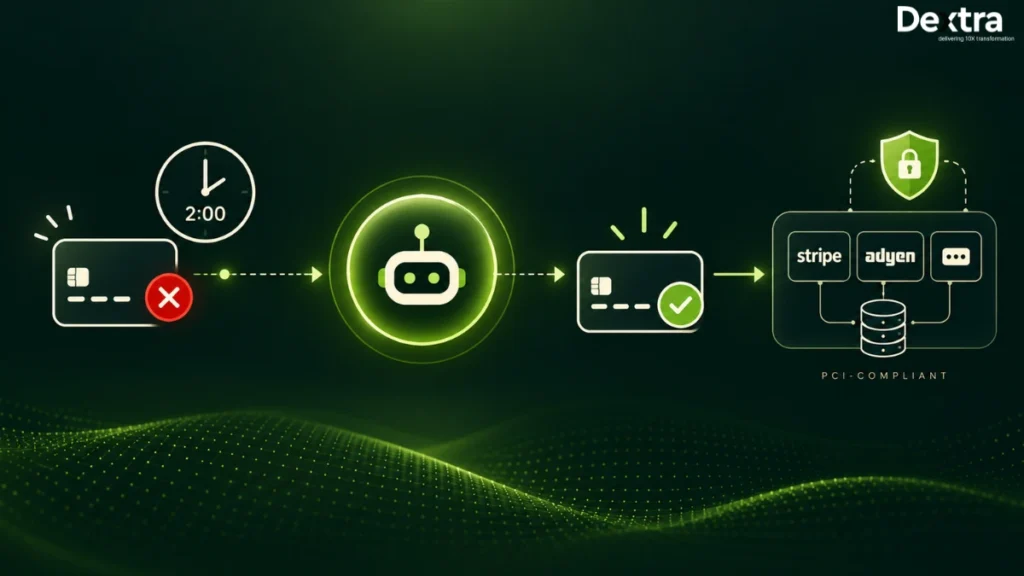
An AI agent for payment processing chatbots is a conversational system that handles payment interactions autonomously. Unlike a scripted support chatbot, it connects directly to your payment gateway, understands payment context, and completes the transaction task instead of just answering a question, all while staying inside PCI DSS and PSD2 guardrails. It can:
- Check payment status
- Explain a decline
- Retry a failed payment
- Process a refund
- Initiate a dispute
And it does all of this across chat and voice.
The need for this is urgent. Industry benchmarks now put mature conversational AI deployments at resolving somewhere in the 60-70% range of payment support queries without human intervention, yet most payment teams still rely on slow, manual support at the exact moment revenue is on the line.
A failed payment is a silent revenue leak. A customer’s card gets declined at 2 AM. They receive a cryptic “payment failed” email. They can’t reach support until morning, and they churn before lunch. That conversation never happened, and the revenue walked out the door. Payments are one of the highest-stakes places to get this right, since a well-built AI agent for customer services has to move from answering to actually resolving, and nowhere is that gap more expensive than at the moment money is on the line.
In this blog, we’ll discuss the following::
- What a payment processing chatbot actually does
- Its highest-value use cases
- The architecture and gateway integration behind it
- The compliance realities unique to payments
- How to decide whether to build or buy
Let’s start with what these agents actually are.
What is an AI Agent for Payment Processing Chatbots?
A payment processing chatbot is a fintech AI agent that connects to your payment infrastructure to handle payment-related interactions end to end. The difference from a standard support chatbot is that it must touch money and payment data, which changes everything about how it’s built.
Let’s check out:
| Dimension | Standard Support Chatbot | Payment Processing Chatbot |
| Data handled | In a typical support setup, it handles general customer queries, FAQs, and basic account information. | When payments are involved, it handles sensitive payment details, transaction records, and other financial data. |
| System connection | From an integration perspective, it usually connects to a knowledge base, CRM, or customer support platform. | For payment-related operations, it connects directly with payment gateways, PSPs, billing systems, and transaction infrastructure. |
| Actions | For most support interactions, it answers questions, provides basic guidance, and may route complex issues to human agents. | When a customer needs payment assistance, it can perform actions such as retrying payments, issuing refunds, and initiating disputes. |
| Compliance | In a general customer-service environment, it primarily needs to follow privacy and data-protection requirements such as GDPR. | Because it operates around financial transactions, it must account for stricter requirements such as PCI DSS, PSD2, SCA, and AML. |
| Authentication | For routine support requests, authentication may not always be necessary, particularly when the chatbot is only providing general information. | Before sensitive payment actions are performed, the chatbot must verify the customer’s identity and enforce appropriate authentication controls. |
| Failure cost | If a standard support chatbot makes a mistake, the immediate impact is usually customer frustration, an unresolved query, or additional support workload. | When a payment-processing chatbot fails, the consequences can extend to financial losses, failed transactions, fraud exposure, and compliance risks. |
A payment chatbot is a conversational agent operating inside a regulated, integrated, money-moving environment. That combination, conversation plus compliance plus payment-system integration, is what makes it a specialized build.
Agentic AI Payments vs Traditional Digital Payment Support vs IVR: What is the Difference?
Before evaluating payment support solutions, fintech teams should understand that IVRs and traditional chatbots mainly answer or route queries, while AI agents can understand intent and take action. This difference is critical when the goal is to resolve payment issues rather than simply provide support. Let’s understand each one of them.
| Capability | Legacy Payment IVR | Rule-Based Payment Chatbot | AI Agent Chatbot |
| Natural language | When interacting through a traditional IVR, customers must follow fixed menus and predefined voice commands to reach the right option. | For text-based interactions, it understands predefined keywords and phrases rather than broader conversational intent. | With conversational AI, it can understand natural language, maintain context, and interpret the customer’s underlying intent. |
| Payment status | For basic payment enquiries, it can provide limited transaction information through predefined menu options or system responses. | When checking a transaction, it can retrieve limited payment details based on the rules and systems it has been configured to access. | When customers need real-time information, it can retrieve current payment status and transaction details directly from connected payment systems. |
| Payment retries | If a payment fails during an IVR interaction, the system generally cannot retry the transaction and instead directs the customer to another channel. | In most rule-based setups, the chatbot can explain failed payments but generally cannot initiate a payment retry on the customer’s behalf. | For eligible failed transactions, the agent can securely initiate a payment retry after checking the required conditions and authorization controls. |
| Refunds and disputes | When a customer requests a refund or dispute, the IVR typically routes the request to a human support team or another service channel. | For refund or dispute requests, it can provide instructions and collect information but rarely completes the entire process independently. | When the workflow permits automation, it can initiate refunds or disputes and move the request through the required steps end to end. |
| Authentication | In a traditional phone workflow, authentication may rely on basic PIN-based verification or other predefined security checks. | For chatbot interactions, authentication is often limited and may depend on the sensitivity of the requested information or action. | Before performing sensitive payment actions, it can support secure authentication and verify that the customer is authorized to proceed. |
| Decline handling | When a payment is declined, the IVR usually provides a generic message or routes the customer to a support representative for further assistance. | For predefined decline scenarios, the chatbot can explain known decline reasons and provide the next steps configured in its rules. | When handling a decline conversationally, the agent can explain the likely reason, access relevant payment context, and guide or execute the appropriate resolution. |
| Audit trail | From an operational perspective, a legacy IVR primarily records call logs and basic interaction details for later reference. | Within a rule-based chatbot, the system generally maintains conversation records and basic details about the customer’s interaction. | For agent-led payment workflows, the system can maintain detailed records of conversations, decisions, system access, and transaction-related actions. |
The key shift is from deflection to resolution: traditional systems answer or route queries, while AI agents can understand, decide, and complete payment-related tasks within the required security and compliance controls. This same shift is playing out across the broader banking stack too, our guide on AI customer service agents for banking and financial services covers how it applies to account servicing, disputes, and KYC beyond payments specifically.
Top 10 Use Cases for AI Agents in Payment Processing Chatbots
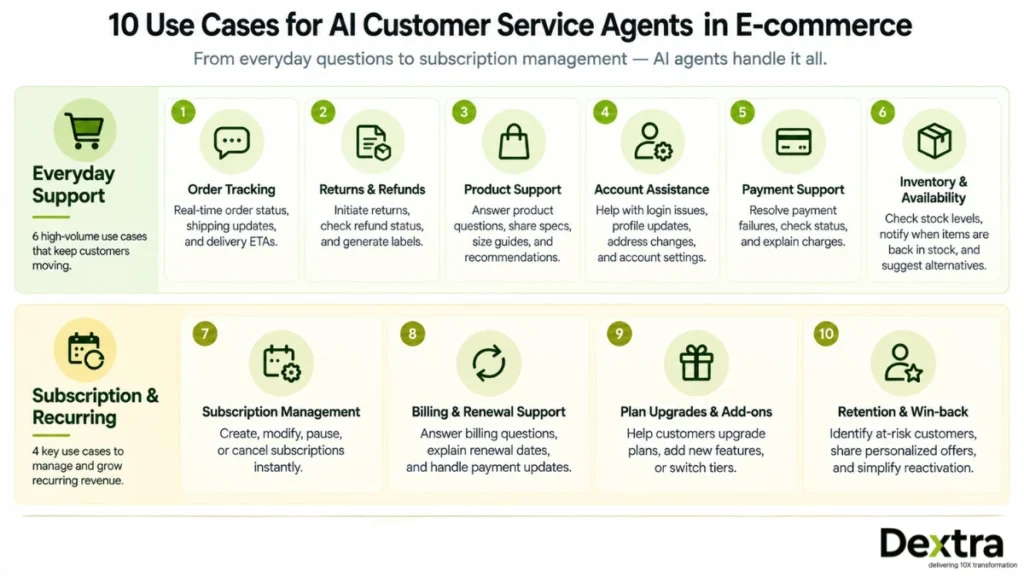
AI agents can transform payment chatbots from basic support tools into systems that understand customer intent, access real-time payment data, and complete eligible tasks. Their use cases span everyday payment support, recurring billing, onboarding, and fraud-related queries. Let’s see all 10 use cases in detail below.
For Everyday Support:
1. Payment Status Inquiries
The chatbot pulls live transaction status directly from the gateway instead of relying on cached or delayed data, so the customer gets an accurate answer on the first ask. This is consistently the highest-volume payment support query across deployments.
Outcome: Deflects the highest-volume payment support query.
2. Failed or Declined Payment Resolution
The agent explains the actual reason behind a decline (insufficient funds, expired card, issuer block) and walks the customer through fixing and retrying it in the same conversation. This closes the loop before they give up or churn.
Outcome: Recovers revenue that a “payment declined” email would have lost.
3. Billing and Invoice Questions
The chatbot breaks down individual charges, explains subscription tiers, and clarifies proration in plain language, grounded in the actual billing record rather than a static FAQ. This prevents confusion from escalating into a formal dispute.
Outcome: Cuts billing-related tickets and disputes at the source.
4. Payment Method Updates
The agent guides customers through updating an expired or changed card using tokenized, PCI-compliant flows, so raw card data never touches the conversation itself. Proactive prompts before expiry improve recovery further.
Outcome: Prevents involuntary churn from card-on-file expiry.
5. Refund Requests
The chatbot verifies refund eligibility against policy, processes the refund through the gateway, and confirms the timeline in the same conversation. What used to take days now resolves in minutes.
Outcome: Resolves refunds in minutes, not days.
6. Dispute and Chargeback Initiation
The agent walks the customer through filing a dispute and gathers the information needed to support the case, assembling evidence from order and delivery records automatically. This improves both dispute quality and win rate.
Outcome: Reduces improper chargebacks and improves dispute quality.
For Subscription and Recurring:
7. Failed Subscription Recovery (Conversational Dunning)
Instead of a generic dunning email most customers ignore, the agent proactively reaches out on a failed recurring payment and recovers it through natural conversation. Published benchmarks put this meaningfully ahead of static retry emails.
Outcome: Recovers 15-25% more failed subscription payments than static retry emails.
8. Subscription Management
The chatbot handles upgrades, downgrades, pauses, and cancellations conversationally, surfacing a retention offer at the exact moment a customer signals intent to cancel. Changes take effect immediately since it’s tied to the billing system directly.
Outcome: Turns cancellation moments into retention opportunities.
9. Payment Onboarding and KYC Support
The agent guides new users through payment setup and document submission conversationally, using adaptive, risk-tiered verification instead of a one-size-fits-all form. AML and KYC checks stay embedded in the flow.
Outcome: Faster activation, fewer drop-offs at the payment step.
10. Fraud and Security Queries
When a customer asks “was this charge real,” the agent checks the transaction against known patterns and answers with real context, flagging genuinely suspicious activity for escalation. This gets a worried customer a fast, informed answer.
Outcome: Faster fraud response, calmer customers.
How AI Payment Processing Chatbots Work
A payment chatbot isn’t one system; it’s five layers working together, each doing a specific job. This is where a payment chatbot earns its keep, and where most generic explanations of “conversational AI” stop short.
Understanding each layer matters because a weakness in any single one undermines the whole system: a great conversational layer with a weak compliance layer is a liability, not an asset.
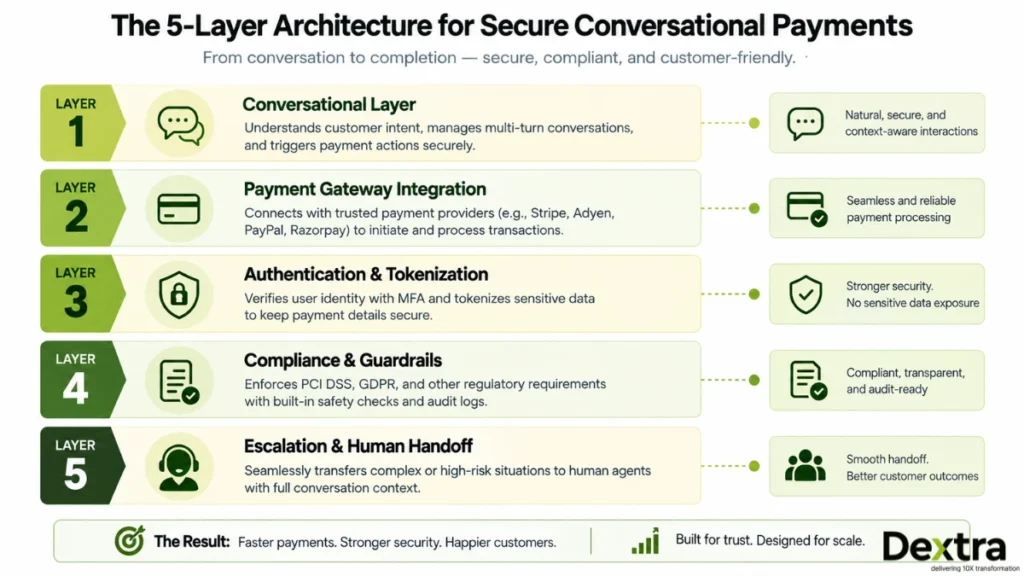
1. Conversational Layer (LLM + NLU)
The reasoning engine that understands what the customer actually wants.
- Interprets payment intent from natural language: “why did my card get declined,” “I want a refund”
- Generates accurate, compliant responses grounded in your billing policies via retrieval-augmented generation (RAG)
- Maps intent to a specific backend action, not just a canned reply
This is the easiest layer to build, and the one every vendor demos first. It’s not the one that actually earns trust.
2. Payment Gateway Integration Layer (the critical differentiator)
This is where a payment chatbot becomes real. Without it, the agent can talk about payments but can’t do anything about them.
- Gateways / PSPs: secure API connections to Stripe, Adyen, Braintree, PayPal, Razorpay, Checkout.com
- Billing systems: integration with subscription and invoicing platforms for real-time account context
- Actions: check status, retry a payment, process a refund, update a payment method (tokenized), initiate a dispute
Deflection versus resolution comes down entirely to whether this layer exists.
3. Authentication and Tokenization Layer
Proves the person is authorized, without ever exposing raw card data.
- Enforces Strong Customer Authentication (SCA) under PSD2 before any action executes
- Uses step-up and contextual verification rather than a single static check
- Keeps the primary account number (PAN) out of chat logs and PCI scope
- Card-on-file operations run on tokens, never raw card numbers
4. Compliance and Guardrails Layer
The compliance and guardrails layer ensures the chatbot operates securely and within regulatory boundaries. It applies PCI DSS, PSD2 SCA, and AML controls while protecting against prompt injection and unauthorized tool use. It also maintains audit trails for every payment action.
5. Escalation and Human Handoff
The chatbot should know when a payment issue requires human intervention. High-value refunds, suspected fraud, complex disputes, or unclear requests can be escalated with the full conversation and transaction context. This ensures a smooth handoff across chat, voice, and WhatsApp.
The conversational layer is the easy part. The gateway integration, tokenization, and compliance layers are where payment chatbots are actually won or lost, and where off-the-shelf chatbot builders fall short. If you’re mapping this against a full implementation timeline rather than just the architecture, our guide on how to build a 24/7 AI customer service agent walks through the end-to-end build process this level of integration requires.
Benefits of AI Agents in Payment Processing Chatbots
Beyond individual use cases, AI customer service agents for fintech can deliver compounding benefits across revenue, cost, compliance, and customer experience.
- Recovered revenue at the moment of failure: The chatbot catches a failed or declined payment in real time and helps the customer fix it, instead of losing them to a cryptic email. That’s revenue that would otherwise be silently lost.
- 24/7 payment resolution: The 2 AM failed payment, the weekend refund request, the midnight billing question, all get resolved instantly. Nothing sits queued until business hours.
- Fewer payment support tickets: Routine queries like payment status, invoice questions, and card updates get handled conversationally. This frees human agents to focus on genuine edge cases.
- Lower involuntary churn: Proactive card-update prompts and conversational retry flows catch customers before they lapse. This targets churn from an expired card or a failed renewal specifically, not churn overall.
- Faster refunds and disputes: Refunds get processed in minutes, and disputes get filed correctly the first time. This reduces both customer frustration and improper chargebacks.
- Consistent, compliant interactions: Every customer gets the same accurate, policy-aligned, audit-logged experience across chat and voice. Volume doesn’t change the quality or consistency of the response.
- Better customer trust: Clear explanations for why a payment failed or what a charge was for changing the tone of the interaction. A moment of anxiety becomes a moment of confidence instead.
- Scalability without headcount: Payment volume spikes from sales, billing cycles, or launches get absorbed automatically. Support capacity no longer has to scale with support staff.
The core benefit ties all of these together: payment problems get resolved at the exact moment they happen, which is the moment that decides whether a customer stays or leaves.
The ROI of AI Agents in Payment Processing Chatbots
The value of AI payment agents goes beyond automation. Their ROI comes from recovering failed transactions, reducing support costs, preventing avoidable churn, and resolving payment issues faster.
The following metrics illustrate where these gains can translate into measurable business value:
| Metric | Impact |
| Payment query deflection | Roughly 60-70% of payment support queries resolved without a human, based on mature 2026 deployment benchmarks |
| Failed-payment recovery | Typically 15-25 percentage points more failed subscription payments recovered vs. static dunning |
| Cost per interaction | Roughly 0.50-0.70 for AI, against 6-25 for a human agent, depending on region and complexity |
| Refund resolution time | Minutes instead of days |
| Involuntary churn | Reduced through proactive card-update and retry flows |
| Dispute quality | Higher win rates, fewer improper chargebacks |
Failed-payment recovery is the real headline here. Involuntary churn from failed subscription payments is a leak most recurring-revenue businesses underestimate, and a conversational agent that recovers meaningfully more of it than a static dunning email converts directly into retained revenue, usually the single largest ROI line in the deployment.
The cost of math reinforces it. At a fraction of the cost per interaction of a human agent, support costs fall substantially even as resolution speed and CSAT rise instead of trading off against each other.
The ROI compounds from there: every recovered failed payment is retained revenue, every deflected query is saved cost, and every faster resolution is a customer who didn’t churn. These deflection and cost-per-interaction patterns show up across customer service broadly, not just payments, our breakdown in The Real ROI of AI Customer Service Agents covers the cross-industry benchmarks if you want the wider picture.
The Future of Verified AI Agent Payments in Banking and Ecommerce
Payment chatbots today are conversational: a person types or speaks, the agent acts on their behalf, inside a session they initiated. The next stage of this shift is agentic commerce, where AI agents transact with less direct, turn-by-turn involvement from the person they represent, and where issuers and networks need a way to verify that the agent making the request is actually authorized to do so.
A few developments worth tracking:
- Agent verification standards: Card networks are building frameworks to register and authenticate AI agents before they can initiate payments, so an issuer can confirm a transaction genuinely reflects the cardholder’s intent rather than a compromised or misconfigured agent.
- Tokenization extended to agents: The same tokenization that protects card-on-file data today is being extended so agents transact with agent-bound credentials rather than raw card numbers, even in fully autonomous flows.
- Growth of the underlying market: Independent market research projects the agentic AI retail and ecommerce market to grow sharply toward the end of the decade, reflecting how fast this shift is moving from experimentation to infrastructure.
- India-specific momentum: With Aadhaar-based e-KYC, UPI’s scale, and RBI’s evolving AI governance framework, India is positioned as an early, high-volume proving ground for verified agent payments, particularly in mobile-first and WhatsApp-native commerce.
For a payment processing chatbot built today, the practical implication is architectural: build the authentication, tokenization, and audit layers to be extensible now, so that as agent-to-agent and fully autonomous payment flows mature, the underlying compliance foundation doesn’t need to be rebuilt from scratch.
Should You Build or Buy a Payment Processing Chatbot?
Not every payment chatbot needs a custom build, and the best AI customer service agents for fintech depend on how deeply they need to connect with the payment stack.
Buy an off-the-shelf chatbot when:
- You need read-only payment support. Status checks and FAQs carry low risk since nothing is being executed. This is the one scenario where a pre-built connector is genuinely sufficient.
- You’re on a standard PSP with a supported connector. The integration work is already done for you, so building it yourself would just be reinventing something that already exists.
- Your compliance needs are met by the vendor’s certifications. If the vendor’s coverage already matches your risk profile, building your own compliance layer adds cost without adding protection.
- Speed to launch beats customization. Some businesses need something live this quarter more than they need it built exactly to their stack. That’s a legitimate trade-off, not a compromise.
Build custom when (the fintech norm at scale):
- The chatbot needs to execute payment actions through your gateway. The moment it moves from answering to acting, off-the-shelf tools generally weren’t built for that level of write access.
- PCI scope, in-conversation SCA, and message-layer tokenization need to be architected in, not layered on. These decisions shape how the chatbot is built from day one; retrofitting them later is far more expensive than designing for them upfront.
- You run multiple PSPs or a customized billing stack. Off-the-shelf tools are built around one standard setup. The more your stack deviates from that, the less a generic connector holds up.
- You operate across regions with different regulatory requirements. A single connector can’t flex per-region on its own; that logic has to be built in.
- Payment CX is core to your product, not a bolt-on. If it’s a differentiator, it deserves the same level of investment as any other core product surface, not a vendor’s default flow.
Payments concentrate on the two hardest problems for a chatbot: regulatory compliance and deep system integration. The real question isn’t whether a chatbot can answer a billing question, it can, but whether it can securely retry a failed Stripe payment while keeping card data out of scope.
Off-the-shelf tools usually can’t. That’s a custom AI agent development problem, and it’s exactly why most fintechs evaluating custom chatbot development services end up building rather than buying once payment actions enter the picture. The underlying economics here follow the same pattern our broader Build vs Buy AI Customer Service Agent guide covers, TCO, break-even points, and vendor lock-in, just with payments’ compliance requirements raising the bar earlier than most industries.
How Dextra Labs Can Help You Build Custom Payment Processing Chatbots
Building a payment processing chatbot is different from building a standard customer-support bot. Because the chatbot may interact with payment gateways, transaction data, refunds, and authentication workflows, the architecture needs to account for security, compliance, and reliable execution from the beginning. The right approach is to design the conversational layer around the payment infrastructure and workflows it needs to operate within.
This is where a custom build can be more suitable than an off-the-shelf chatbot. Dextra Labs is one the top AI Agent Development Company across USA, Singapore, India, UK, and UAE, building conversational AI agents for fintechs and payment companies whose requirements exceed what off-the-shelf chatbot builders deliver. Payments, with its compliance depth and gateway-integration complexity, is exactly that kind of build.
How Dextra approaches payment chatbot builds:
- Gateway integration first: Architected around Stripe, Adyen, Braintree, Razorpay, or your PSP, so the chatbot resolves payment tasks, not just answers questions.
- Compliance by design: PCI scope control, tokenization at the message layer, PSD2 SCA in-conversation, and audit trails from Phase 1.
- Failed-payment recovery flows: Conversational dunning that recovers revenue static emails lose.
- Security-hardened: Prompt-injection and tool-misuse red-teaming, because a chatbot with payment access is an attack surface.
Engagement model:
- Phase 1: Discovery and Scoping (roughly 50,000-100,000, 4 weeks). Use case, gateway, and compliance audit; go/no-go decision.
- Phase 2: Build (roughly 400,000-1.2 million). Conversational layer, gateway integration, compliance and tokenization architecture.
- Phase 3: Deploy and handoff. Graduated rollout, your team takes ownership.
Building a payment chatbot? Schedule a scoping call with our AI Engineers!
Conclusion
AI agents for payment processing move support from simply answering payment questions to actually resolving them. As this guide explains, successful deployment depends on secure payment integrations, compliance controls, authentication, auditability, and workflows for retries, refunds, disputes, and failed payments.
If you’re looking to automate payment support without compromising security or compliance, Dextra Labs’ custom ai agent development service can help you build around your payment infrastructure, workflows, and business requirements.
Frequently Asked Questions:
Q1. What is an AI agent for payment processing chatbots?
An AI agent for payment processing is a conversational system connected to payment and billing infrastructure. Unlike a traditional chatbot, it can understand payment intent and complete eligible actions.
- Checks real-time payment status
- Explains payment declines
- Retries eligible failed payments
- Processes refunds or initiates disputes
Q2. Are payment chatbots PCI DSS compliant?
Yes, payment chatbots can be PCI DSS compliant when security and compliance are built into their architecture. The system should minimize sensitive card-data exposure while securing every payment action.
- Keeps PAN and CVV out of chat and LLM contexts.
- Uses tokenization for secure card operations.
- Applies authentication and PCI DSS controls.
- Maintains audit trails for payment activities.
Q3. Can a chatbot process refunds and retry failed payments?
Yes, if it has secure integration with the payment gateway or PSP and the necessary authorization controls. Without backend integration, a chatbot can only explain the process rather than execute it.
- Checks transaction status through the gateway
- Triggers eligible retries or refunds
- Applies authentication before sensitive actions
- Escalates restricted or high-risk requests
Q4. Which payment gateways do AI chatbots integrate with?
AI payment chatbots can integrate with major payment gateways and PSPs through secure APIs. The right integration depends on the business’s existing payment and billing infrastructure.
- Stripe
- Adyen
- Braintree
- PayPal
- Razorpay
- Checkout.com
Q5. What’s the ROI of a payment processing chatbot?
The ROI comes from combining revenue recovery, lower support costs, and faster resolution. AI can potentially resolve 60–70% of routine payment support queries, while conversational recovery can improve failed-payment recovery compared with static retry approaches.
- Fewer payment support tickets
- More recovered failed payments
- Lower cost per interaction
- Faster refunds and payment resolution
- Reduced payment-related churn
Q6. Should we build or buy a payment chatbot?
The decision depends on how deeply the chatbot needs to interact with your payment infrastructure. Off-the-shelf tools can work well for basic, read-only support, while custom development becomes more valuable when the agent needs to execute payment actions.
- Buy: FAQs, payment-status queries, and standard PSP integrations
- Build: Refunds, retries, disputes, and deeper gateway actions
- Build: Multiple PSPs or complex billing environments
- Build: Advanced PCI scope control, SCA, and regional compliance requirements