A customer service AI agent can look impressive in a demo, answering questions, handling refunds, and resolving test queries with ease. But once it has to deal with real customers, live systems, incomplete data, and thousands of unpredictable support requests, that early promise can quickly fade.
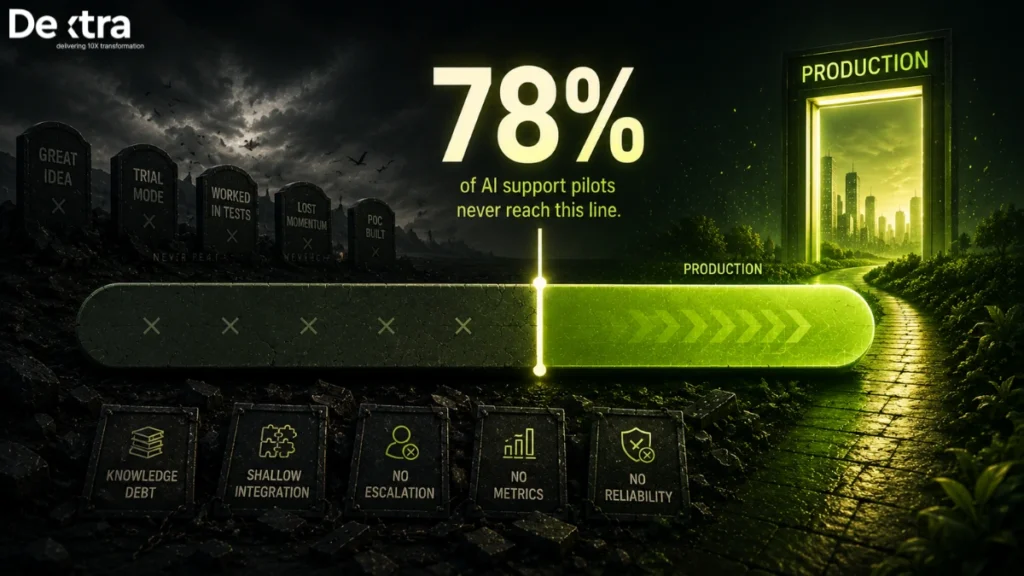
According to Dextra Labs’ analysis of enterprise AI support deployments, 78% of AI support pilots never reach production. This finding aligns with broader industry research: IDC found 88% of AI proof-of-concept (POC) never reach production, while MIT’s research put the ROI-failure rate at 95%. The problem is rarely the AI itself; it is how the AI agent customer service deployment is designed, integrated and prepared for production.
That is why a stalled pilot does not necessarily mean the technology failed. More often, issues with data readiness, knowledge base quality, integration complexity, escalation workflows, governance, and production planning get in the way.
In this blog, we’ll break down the real reasons AI support pilots stall, why how you build matters more than what you build, and what it takes to move from POC to reliable production deployment.
Top 5 Reasons Why 78% of AI Support Pilots Never Reach Production
Here are the five most common reasons customer service AI pilots get stuck between a promising demo and real production deployment. If your pilot has stalled, there is a good chance you will recognize at least one of them.
1. Knowledge Base Debt
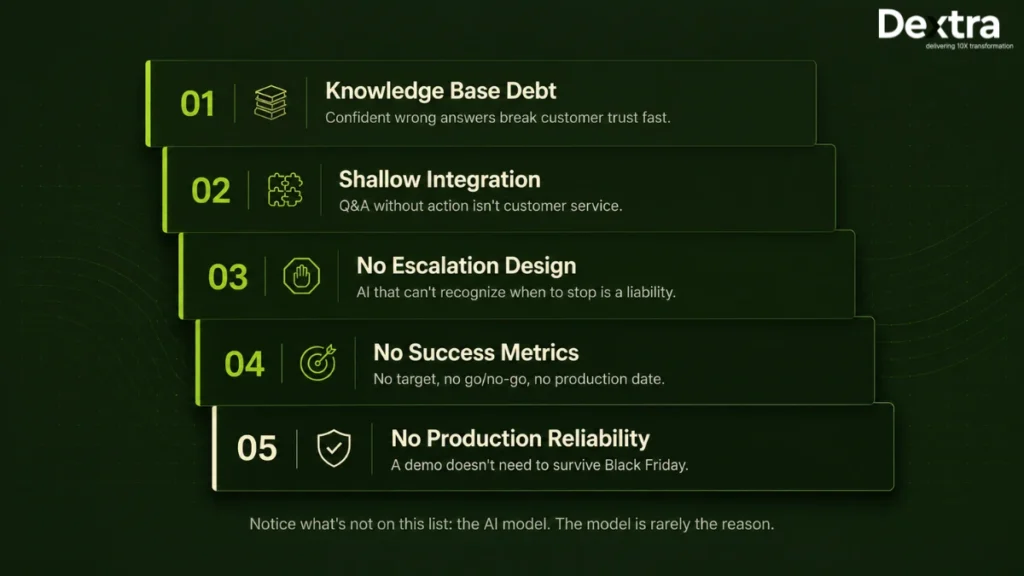
Your pilot may have worked well with a small, clean set of help content, but production exposes every gap in your actual knowledge base. Outdated, conflicting, or missing information leads the agent to give confident but incorrect answers, quickly damaging customer trust. An AI support agent is only as reliable as the knowledge behind it.
2. Shallow Integration
A demo can answer questions, but customers expect an agent to actually solve problems by checking orders, processing refunds, or updating accounts. That expectation is already reflected in customer behavior, with Gartner finding that 58% of customers who use GenAI have used it to complete a task on their behalf. That means your agent needs to be connected to the systems that let it take action and not just provide information. Without deep connections to your CRM, helpdesk, billing, and order systems, the agent remains a Q&A layer instead of a useful AI agent customer service solution and this is one of the most common challenges in deploying AI customer service agents.
3. No Escalation Design
Not every customer request should be handled by AI alone. Angry customers, unusual cases, and compliance-sensitive requests need clear escalation paths as well as a smooth human handoff. Salesforce found that escalations to human agents increased from 22% in Q1 2025 to 32% in Q2 as AI agents became better at identifying when human support was needed. The point is not to eliminate human involvement, but to make sure the AI knows when to bring a human into the conversation and without confidence-based escalation, AI agents customer service implementation can either send too many conversations to human agents or risk handling situations they should not.
4. No Agreed Definition of Success
A pilot needs clear goals before it starts, whether that means a target ticket deflection rate, CSAT score, resolution rate, or first response time and without agreed success metrics, nobody knows when the agent is ready to move forward, and the project can remain in pilot purgatory consuming time and resources without reaching a clear go/no-go decision.
5. No Production-Grade Reliability
A controlled demo does not have to handle a Black Friday surge, a model-provider outage, or a sudden 10x increase in support volume. Production-ready agents need monitoring, fallbacks, guardrails, and graceful degradation so they can keep working when conditions change. Without that reliability, one major failure can be enough to stop the deployment.
Did you notice what is missing from this list? The AI model itself. Most pilot failures come down to data, engineering, integration, governance, and scoping and not whether the underlying model can answer a question. The difference lies in how the pilot is built and prepared to move from testing to production.
How to Know if Your AI Support Pilot Is Production-Ready?
Before you move your customer service AI pilot toward production or decide to shut it down, use these seven checks below. If you cannot answer “yes” to at least five, your AI agents’ customer service implementation may need more work.
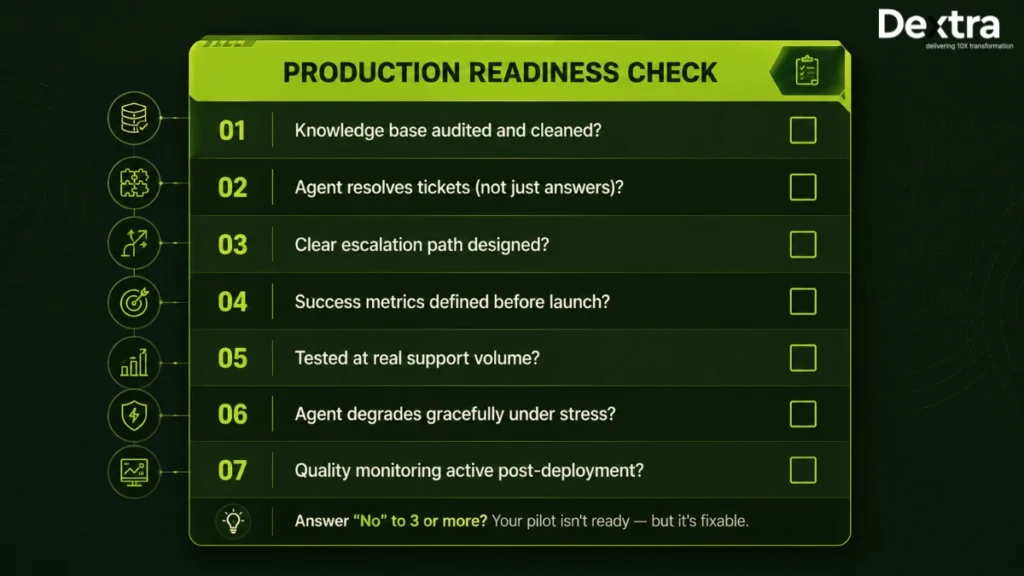
1. Has your knowledge base been audited and cleaned?
Your agent needs accurate, consistent, and up-to-date support content to avoid confidently giving customers outdated or incorrect answers when it moves beyond a controlled pilot.
2. Can the agent actually resolve tickets, not just answer questions?
A production-ready agent should be able to take action through your CRM, helpdesk, order, and billing systems so customers get their issues resolved instead of receiving information they still need to act on.
3. Have you designed a clear escalation path?
Your agent needs defined rules for handing complex, sensitive, or frustrated customer conversations to a human while passing along the relevant context so the customer does not have to repeat everything.
4. Did you define success before launching?
Clear targets for ticket deflection, CSAT, resolution rate, or first response time give you an objective way to decide whether the pilot is ready for production or needs more work instead of letting it remain in pilot purgatory.
5. Have you tested the agent at real support volume?
Testing the agent against realistic conversation volumes and peak demand gives you an idea of whether your infrastructure can handle production traffic without slowing down, failing, or creating a poor customer experience.
6. Does your agent degrade gracefully under stress?
Your agent should have guardrails, fallbacks, and human handoff options for model outages, API failures, and sudden traffic spikes so technical failures do not become customer-service failures.
7. Are you monitoring quality after deployment?
You need to track resolution rates, CSAT, escalations, hallucinations, and other quality signals as customer behavior changes, as it helps catch model drift and declining performance before they start affecting customer trust
If you answered “no” to several of these, your pilot does not necessarily need to be abandoned because these are common challenges in deploying AI customer service agents that can usually be addressed through better data readiness, integration, testing, and production planning.
Why Partner-Built AI Pilots Reach Production Twice as Often?
Partner-built AI pilots reach production about twice as often as internal-only builds, with reported success rates of 67% versus 33%, according to MIT. The main advantage is experience because an experienced AI development partner has already dealt with the same support challenges across previous builds and knows how to design the agent for real production conditions from the start.
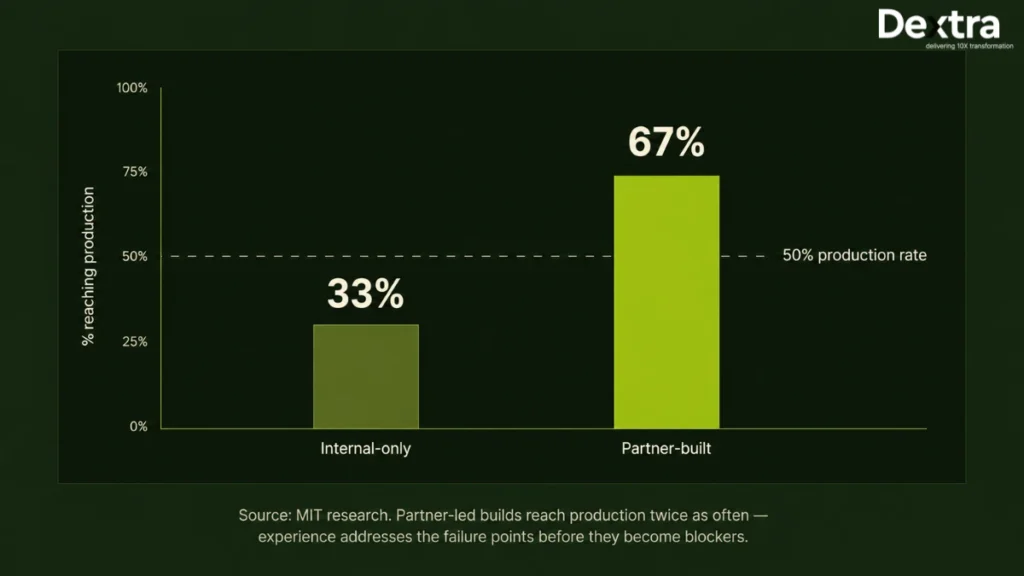
Instead of discovering problems halfway through the pilot, experienced partners clearly know how to address knowledge base quality, integrations, escalation workflows, success metrics, and reliability early which gives the AI support agent a much clearer path from POC to production.
This matters because getting a pilot into production is what turns an AI experiment into real business value, and the difference often comes down to whether the team building it has the experience to turn a promising pilot into a reliable customer service system.
How Dextra Labs Builds AI Support Agents That Reach Production
Dextra Labs builds customer service AI agents for production from the start, rather than treating the pilot as a limited demo that only needs to work in controlled conditions. As a custom AI Agent Development Company serving across USA, Singapore, India, UK & UAE, we design each support agent around your actual knowledge base, systems, workflows, support volume, and customer expectations.
Our approach focuses on the problems that usually stop pilots from moving forward:
- We audit your knowledge base first to remove outdated, conflicting, and missing information so your agent can provide reliable answers from the start.
- We build deep integrations with your CRM, helpdesk, order, and billing systems, including Zendesk and Freshdesk, so your agent can resolve tickets rather than simply answer questions.
- We design escalation into the agent using confidence and sentiment signals to hand complex or sensitive conversations to human agents with the right context.
- We define success metrics upfront around ticket deflection, CSAT, resolution rate, and other support goals so you know exactly when the pilot is ready for a go/no-go decision.
- We engineer for production reliability with monitoring, guardrails, graceful degradation, and scale testing so your agent can handle real support volume without compromising the customer experience.
We have put this approach into practice for a global e-commerce platform handling more than 50,000 monthly support tickets, where we built a custom RAG-powered AI support chatbot integrated with live chat, the mobile app, and CRM. The solution reached production in 60 days and scaled to resolve more than 20,000 tickets every month without human involvement, while reducing response time by 60% and increasing CSAT by 28%.
You can read our full e-commerce AI support case study to see how we built the solution, integrated it into the client’s support ecosystem, and took it from development to production at scale.
If your AI support pilot is facing similar roadblocks, talk to Dextra Labs’ AI Engineers about what it would take to get it production-ready.
Conclusion
Most customer service AI pilots do not fail because the technology is not ready; they fail because the pilot was built to perform well in a demo rather than work reliably in production, with gaps in knowledge, integrations, escalation, and success metrics left unresolved. The pilots that make it to production are the ones that address these issues early and build for real customer support from the start.
At Dextra Labs, we build AI agents for customer service with that production-first mindset as a Custom AI Agent Development Company serving the USA, Singapore, India, UK, and UAE. If your pilot is stuck between testing and deployment, our custom AI agent development services can help you fix the gaps and turn it into a reliable operational system.
Don’t let your AI support pilot become another statistic. Schedule a scoping call with Dextra Labs AI Engineers.
Frequently Asked Questions
Q1. Why do most AI pilots fail to reach production?
The biggest reasons why most AI pilots fail to reach production are poor data readiness, weak system integration, unclear success metrics, limited escalation paths, and lack of production-grade reliability. These are among the common challenges in deploying AI customer service agents, and they often prevent a promising pilot from moving beyond testing even when the underlying AI model performs well.
Q2. What percentage of AI support pilots reach production?
According to Dextra Labs’ analysis of enterprise AI support deployments, about 22% of AI support pilots reach production, while 78% stall before deployment. This gap shows why knowing how to implement AI agents in customer service matters as much as choosing the right technology, because a successful pilot still needs clean data, reliable integrations, clear workflows, defined success metrics, and a realistic plan for production before it can deliver lasting value.
Q3. What is “pilot purgatory” in AI projects?
Pilot purgatory is when an AI pilot keeps running without moving to production or being shut down because there are no clear success metrics or business targets and without knowing whether the ROI of deploying AI agents for customer service is meeting expectations, teams struggle to make a clear go/no-go decision, and the pilot keeps consuming time and resources.
Q4. How long does it take to move an AI support agent from pilot to production?
A custom AI support agent can reach production in as little as 60 days when you plan for production from the beginning. The timeline often gets longer when knowledge base cleanup, system integrations, or escalation workflows are addressed midway through the project, which can also increase the cost of implementing AI agents for customer service. That is why working with the right custom AI agent development and implementation services is important, as it helps you address these requirements early and make the move from pilot to production more predictable.
Q5. Is it better to build an AI support agent in-house or with a partner?
For most businesses, working with an experienced AI agent development partner is the better choice when the goal is to reach production, especially when you need more than a basic support chatbot. Partner-led builds have been reported to reach production roughly twice as often as internal-only builds, at about 67% versus 33%, because experienced teams have already worked through the data, integration, escalation, and reliability issues that often slow down first-time internal builds. Choosing custom AI agent development and implementation services also gives you a solution built around your support workflows and systems rather than forcing your processes into a generic setup.