Automation and artificial intelligence are not the same thing, and treating them as interchangeable is one of the most common reasons enterprise pilots stall before they scale.
Automation executes predefined rules to perform repetitive tasks with minimal human intervention. It doesn’t learn. It doesn’t adapt. A workflow that fires a payment reminder at 30 days overdue runs the same way every time, regardless of context, customer history, or changing conditions.
Artificial intelligence is fundamentally different. AI systems learn from data, recognize patterns, and support decision-making in situations where rigid rules fall short. A machine learning model scoring credit risk in real time, or a large language model summarizing customer-call transcripts to surface emerging complaints, these systems adapt and improve as they process more data.
AI automation combines both into something more powerful than either alone: AI handles the perception, prediction, and natural language processing; automation executes the resulting action at scale. The feedback loop, where outputs become training inputs, is what makes the combined system get measurably smarter over time.
The difference between automation and AI, in a single sentence: automation does exactly what it’s told, every time; AI figures out what should be done, then gets better at figuring it out.
This guide covers how the combined stack works under the hood, where it’s delivering measurable ROI across banking, manufacturing, healthcare, and SME deployments in 2025–2026, and the 90-day roadmap that moves organizations from isolated pilots to production-grade workflows, without the complexity that buries most transformation programmes before they start.
What are automation and artificial intelligence?
Let’s cut through the jargon. Automation is technology that performs repetitive tasks with minimal human intervention. Think of a payroll system that fires off a reminder when an invoice is overdue by 30 days, a manufacturing line that uses quality-control cameras to reject products failing a fixed visual spec, or a thermostat adjusting temperature on a schedule. These systems follow predefined rules and execute the same task the same way, every time.
Artificial intelligence is different. AI systems learn from data, adapt over time, and support decision making in situations where rigid rules fall short. A machine learning model flagging suspicious bank transactions, an AI summarizing customer-call transcripts to surface emerging complaints, or a large language model answering support questions with natural language-these all simulate human intelligence to learn and adapt rather than just follow a script.
So what is ai automation? It combines both. AI provides intelligence while automation provides the operational framework. AI makes sense of messy, unstructured data and context; automation technology executes actions reliably at scale. Together, they create feedback loops that get smarter over time.
Here’s a simple way to think about it:
- Automation: Fixed rules. “If X happens, do Y.” No learning, no adaptation.
- AI: Learning from data. Pattern recognition, prediction, natural language processing. Supports insight but often requires manual effort to act on findings.
- AI automation: Rules + learning + feedback loops. AI identifies what needs attention; automation executes; results feed back into the model to improve future performance.
Dextra Labs works as an AI implementation partner to design this combined stack for SMEs and startups in the USA, UK, UAE, and beyond-helping teams move from isolated scripts to intelligent, scalable business workflows.

How AI automation works under the hood?
Understanding how ai automation actually functions helps you make better decisions about where to invest. Here’s the end-to-end lifecycle, explained without unnecessary jargon:
Data collection and sourcing:
Everything starts with data flowing from CRMs, ERPs, email servers, call transcripts, IoT sensors, and documents. AI can process vast data sets and identify patterns-but only if the data is accessible and well-organized. This is the foundation of data management in any ai automation initiative.
Data processing and preparation:
Raw data is cleaned, deduplicated, and stripped of personally identifiable information through PII masking and encryption. Feature extraction pulls meaning from noise-sentiment from text, vibration frequency from sensor streams, categories from receipts. Poor data quality leads directly to bad decision making. Intelligent document processing and optical character recognition digitize paper-based inputs so they feed into the pipeline automatically.
Model training and fine-tuning
Machine learning algorithms are trained on historical data to perform tasks like demand forecasting, fraud scoring, or defect detection. Large language models are fine-tuned or prompt-engineered for summarization, classification, and generation. For example, a 2024 retail demand forecasting model was trained on point-of-sale, weather, and promotional data, then deployed to adjust stock levels weekly. AI automation adapts and improves over time with data as models learn from new inputs.
Wrapping models into agents or services
Trained models are exposed via APIs, then orchestrated by workflow automation or robotic process automation tools for execution. An ai agent might call a prediction model, then issue commands through RPA to downstream systems-all without manual effort.
Continuous learning and feedback loops
Models are updated monthly or quarterly. Human reviewers provide corrections. A/B tests compare model versions. Workflow optimization involves AI analyzing operational data to suggest improvements, and monitoring catches drift before it causes problems. AI automation can handle tasks requiring perception and reasoning, but only when feedback loops keep models honest.
Deployment and monitoring
Production systems include dashboards tracking latency, error rate, and cost per inference. Thresholds trigger fallback to human judgment when confidence drops. Dextra Labs typically deploys production-ready systems in 3–6 months, including monitoring dashboards, latency and cost benchmarks, and operational runbooks.
AI agents vs traditional automation tools
The gap between traditional automation and ai agents is widening fast, and understanding the difference matters for how you allocate budget and talent.
Traditional automation tools-RPA bots, iPaaS connectors, spreadsheet macros-run on “if-this-then-that” logic. They’re excellent for stable, structured workflows: posting invoices, running nightly backups, transferring data entry between systems. Traditional automation follows predefined rules for task execution, and it works well when the environment doesn’t change. But these tools break when inputs are ambiguous or processes shift.
Autonomous ai agents are goal-directed systems that can plan multi-step actions, call multiple tools and APIs, and adapt to new inputs. An ai agent that triages support tickets, drafts replies using a large language model, and schedules callbacks based on urgency is a fundamentally different tool than a Zendesk macro inserting a canned response.
Consider a concrete 2025 example: a multi-agent customer support copilot coordinating email, chat, and voice channels-deciding which channel to reply on, summarizing conversation history, and scheduling follow-ups. Compare that to a simple macro that inserts a template when it detects “order status” in a query. AI-driven tools can automate complex tasks with minimal human input, while RPA handles the same task the same way regardless of context.
Typical agent architecture includes:
- Reasoning pattern: ReAct, Plan-and-Execute, or function calling-determining how the agent thinks through problems.
- Memory layer: Short-term (conversation context) vs long-term (historical event memory) for continuity across sessions.
- Tool registry: A defined set of APIs, databases, and services the agent can invoke to perform tasks.
According to Dextralabs’ research, RPA implementations typically capture 20–30% of automatable business processes, while AI agents could cover up to 60–80% when architecture supports reasoning and unstructured data handling. Currently, 29% of organizations have adopted agentic AI for autonomous automation, and 38% of organizations plan to roll out agentic AI in the next year. Intelligent automation combines AI and traditional automation for flexible operations, and AI agents can work 24/7 and scale on-demand with minimal oversight.
Dextra Labs designs both single-agent and multi-agent topologies, documenting choices in an Architecture Decision Record so internal engineering teams can own and extend the system long after the engagement ends.

Key components of modern AI and automation stacks
A modern ai and automation stack isn’t a single product-it’s a set of interacting layers. Here’s how they fit together:
Data processing layer
ETL and ELT pipelines move data from source systems into usable formats. Computer vision and OCR handle document capture-scanning invoices, contracts, and forms. Streaming data processing powers real-time decision making, such as fraud alerts triggered within seconds. AI enables faster, more precise data analysis for decision making at this foundational layer.
AI capability layer
This includes ML engines for predictive analytics (fraud scoring, demand forecasting), large language models for natural language tasks (summarization, classification, generation), and domain-specific models for credit risk, medical imaging, or supply chain management forecasting. AI-driven analytics allow businesses to make data-backed decisions swiftly.
Decision making layer
Rules engines handle policy checks (“reject if credit score below X”). Confidence thresholds determine when to escalate to human judgment. Reinforcement learning can optimize sequential decisions like loan approvals with human-in-the-loop gates. This layer is where human intelligence and machine learning automation intersect.
Orchestration and automation tools
Workflow platforms, RPA bots, and serverless functions trigger actions across CRMs, ERPs, and cloud computing services. This is the execution backbone-where decisions become actions across existing systems.
Interface layer
Chatbots, copilots embedded in IDEs, browser extensions, and dashboards expose ai capability to non-technical users. These interfaces let the human workforce interact with AI without needing to understand what’s happening underneath.
Dextra Labs typically deploys these components into the client’s own cloud computing environment-AWS, Azure, or GCP-rather than opaque third-party “black boxes.” This ensures your software developers and IT teams retain full visibility and control.
Business benefits of AI automation across functions
The payoff of ai powered automation shows up differently depending on the function. Here are the areas where business leaders are seeing the clearest returns. Notably, 90% of business leaders report cost and time savings from AI, and 84% of business leaders recognize AI’s potential to disrupt practices.
1. Sales and marketing
AI automation for lead scoring uses machine learning to predict lead quality from behavioral data. Outreach personalization based on customer segments and campaign optimization through generative ai can deliver a 20–40% lift in conversion rates. AI can analyze customer data to predict behavior, and personalized recommendations increase customer satisfaction and loyalty. AI tools can forecast market trends and streamline operations across the sales pipeline.
Customer service
Customer support automation uses AI chatbots to resolve client inquiries quickly. AI-driven chatbots provide 24/7 customer support and AI automation can reduce customer service response times by 67% through automated triage, drafted responses, and knowledge-base search that cut average handle time by 15–30%. AI reduces the risk of human error and bias in decisions that previously relied on individual agent judgment.
Operations and supply chain
Demand forecasting through predictive maintenance and inventory optimization reduce stockouts and holding costs. Manufacturing automation with image recognition and computer vision catches defects in real time. AI automation can save companies millions of hours annually across logistics, warehouse routing, and scheduling. AI automation can handle unstructured data, enhancing decision-making in complex supply chain environments.
Finance and back office
Invoice matching, expense categorization, and reconciliation see 60–80% reduction in manual workload on repetitive checks. AI automation can reduce processing time by 60% in banking through automated KYC, fraud scoring, and compliance workflows. This frees up human resources for higher-value cognitive tasks.
Software development and IT
Code review assistants, test generation, incident summarization, and AI change-risk scoring reduce release bugs by approximately 40%-a result Dextra Labs has delivered in real-world engagements. AI automation can save employees 41% of their time on routine tasks like documentation and testing. And 65% of desk workers believe generative ai will free up their time for more creative work.
The key insight: benefits extend beyond cost savings. AI automation improves efficiency while lowering operational costs, but it also enables faster experimentation cycles, better decision making, and the ability to scale business operations without linear headcount growth. AI can automate complex tasks, improving overall efficiency across the organization. AI automation can reduce operational costs significantly over time.
Real-world examples of AI and automation in 2023–2025
Theory is useful. Results are better. Here’s where ai and automation have delivered measurable outcomes across industries.
- Banking and fintech
AI-driven KYC checks and fraud scoring use transaction histories and device fingerprints to assess risk in real time. Some banks have reduced manual review queues by more than 50%. Early-adopter firms report 40% lower cost of ownership with AI agents versus traditional RPA after one to two years.
- Healthcare
AI assists in diagnosing conditions by analyzing medical images-radiology triage systems flag priority cases so physicians focus where they’re needed most. Automated pre-authorization checks cut MRI approval times from days to hours. Appointment scheduling bots handle routine tasks around the clock.
- Manufacturing and logistics
A US precision parts manufacturer deployed sensors and ML models to predict equipment failures 6–18 hours ahead, reducing unplanned downtime by 67% and saving approximately $4.1 million in the first year across three production lines. Vision systems for defect detection and warehouse routing optimization complement predictive maintenance to form a comprehensive ai solution.
- Retail and ecommerce
Personalized recommendations engines and dynamic pricing have driven 10–20% increases in basket value. In 2024 pilots, AI email personalization increased revenue per send by double digits. Generative ai automation powers automated merchandising and content creation at scale.
- SMEs and startups
A fintech startup in the UAE working with Dextra Labs reported a greater than 30% daily output boost from agent-based workflows. A 20–50 person SaaS company can automate onboarding, billing, and Tier-1 support using ai agents, regaining dozens of staff-hours per week and reducing human labor on low-value tasks.
84% of business leaders recognize AI’s disruptive potential. Dextra Labs typically comes in as an AI implementation partner to scope one or two high-impact use-cases first, then gradually expand the automation footprint as the team builds confidence and data maturity.

Data quality, governance, and risk management in AI automation
Every impressive AI result is built on a foundation of clean data and responsible governance. Without both, automation efforts create risk rather than reduce it. Organizations must prioritize transparency and data privacy in AI.
- Data quality dimensions. Accuracy, completeness, timeliness, and consistency directly impact AI decision making. In lending, inaccurate income data leads to bad credit decisions. In healthcare, missing values risk patient safety. Data quality is the single biggest predictor of whether your ai technology investment pays off.
- Data processing safeguards. PII masking, role-based access control, encryption, and audit logs are standard in modern cloud computing platforms. These protect against data breaches and support compliance with regulations like GDPR and CCPA.
- Handling AI hallucinations. LLMs sometimes generate confident but wrong answers. Retrieval-augmented generation grounds models in factual data. Model evaluation benchmarks (accuracy, precision, recall) and strict tool-calling APIs prevent free-form generation when correctness matters. Ethical ai practices require ongoing evaluation, not one-time testing.
- Governance practices. Model documentation, approval workflows, bias testing, and regular retraining schedules tied to regulatory or business changes keep AI systems trustworthy. Companies must ensure AI algorithms remain impartial and free of biases-especially in hiring, lending, and medical contexts.
Dextra Labs emphasizes transparent, well-documented architectures instead of opaque “magic,” enabling compliance with GDPR, CCPA, and sector-specific regulations. Every architecture decision is recorded so your team can audit, modify, and extend the system.
Getting started: A practical roadmap for AI and automation
Here’s what a manager should literally do in the next 90 days to introduce ai into their organization. No fluff-just steps.
- Step 1 – Map processes. Identify your top 5–10 repetitive workflows: onboarding, reporting, support triage, data entry, invoice processing. Estimate time spent and error rates for each. Focus on where human effort is highest and value-add is lowest. Look for places where people perform repetitive tasks with minimal variation.
- Step 2 – Prioritize use-cases. Rank candidates by business impact versus implementation complexity. Select 1–3 pilot projects with clear ROI and low regulatory risk. Unlike traditional ai approaches that try to boil the ocean, start narrow and prove value fast.
- Step 3 – Prepare data. Catalog relevant data sources. Clean historical datasets. Establish basic data quality checks and access controls. You can’t adopt ai effectively without addressing data processing first.
- Step 4 – Choose automation tools and AI models. Decide between existing RPA and workflow tools versus new platforms. Select LLMs or ML models based on latency, accuracy, and cost. Consider how they’ll integrate with existing systems-CRMs, ERPs, cloud services. Evaluate ai driven tools that match your specific complex workflows.
- Step 5 – Pilot and iterate. Run limited pilots with human-in-the-loop review. Measure concrete KPIs-handle time, error rate, NPS-over 4–8 weeks. Refine prompts, rules, and thresholds. This is where you validate whether automation technologies deliver in your specific context.
- Step 6 – Scale and document. Integrate successful pilots into production workflows. Create SOPs and runbooks. Plan for model monitoring and retraining. Build the foundation for digital transformation that compounds over time rather than stalling after the first project.
Dextra Labs can run this entire cycle-from discovery workshop to production deployment-for businesses, SMEs, and startups in the USA, UK, UAE, and similar markets. Their engagements start with a free strategy session, making it easy to explore whether AI and automation make sense for your specific situation.
How Dextra Labs builds production AI agents and automation for businesses
Dextra Labs positions itself as an execution-first AI consulting and implementation partner. Here’s how a typical engagement works:
- Initial strategy session
A free consultation to assess readiness, identify high-impact use-cases, and set realistic expectations. No commitment required.
- Implementation roadmap (4–6 weeks)
Covers architecture design, ai capability selection, data pipeline setup, and governance framework. Dextra chooses reasoning patterns-ReAct, Plan-and-Execute, or function calling-and picks LLMs based on latency, cost, accuracy, and compliance requirements.
- Architecture documentation
All decisions are recorded: single-agent vs multi-agent topology, memory strategies, tool registries, and integration touchpoints. Your software developers own the system after handoff-no vendor lock-in.
- Staged deployment
Agents are deployed into your cloud computing stack with close monitoring, performance benchmarks, full technical documentation, ops runbooks, and a handoff session.
Measured outcomes from past work include halving chatbot latency through LLM optimization, greater than 30% daily output boost from agentic AI, 40% fewer release bugs using AI QA, and approximately 80% automation of codebase migrations. These aren’t theoretical-they’re results from real engagements with tech companies and startups.
If you’re planning ai and automation initiatives in 2025–2026, reach out to Dextra Labs for an implementation roadmap tailored to your industry and geography.
The future of AI and automation: From task automation to autonomous enterprises
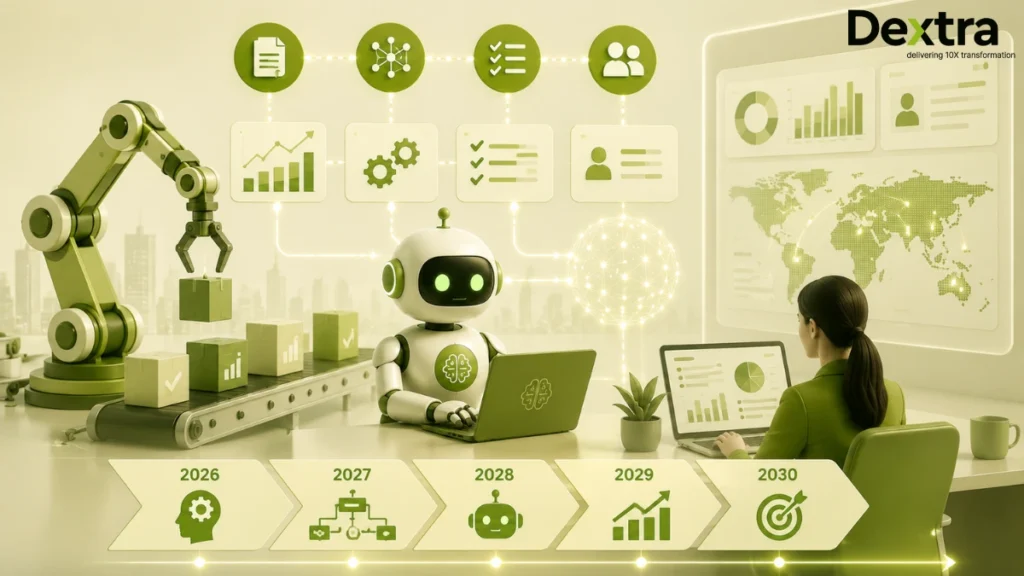
The trajectory from 2025 to 2030 points toward a fundamental shift: from isolated bots handling routine tasks to orchestrated ecosystems of ai agents coordinating processes across sales, service, operations, and IT.
- Multi-agent ecosystems
Executive agents will call specialized subagents for specific functions-customer support, inventory management, compliance monitoring-creating autonomous ai agents that coordinate complex workflows across departments.
- Real-time adaptation
Models will continuously adapt to live data streams and context, enabling self-optimizing workflows. Advances in edge computing and streaming data processing will push decision making closer to the point of action.
- Human oversight and explainability
As AI moves closer to core business decisions, human-in-the-loop oversight, ethical guidelines, and transparent explainability will become non-negotiable. Regulation mandating explainability in ai systems is expected in the EU, UK, and beyond.
- Enterprise AI operating layers
Emerging abstraction layers will sit above existing systems, providing unified reasoning and data processing across departments. These “AI operating layers” will make it possible to reuse agent components, reduce duplication, and accelerate how organizations analyze data across functions.
According to McKinsey’s 2025 State of AI survey, 88% of organizations use AI in at least one function, but fewer than one-third have scaled beyond pilots. AI can theoretically automate up to 57% of U.S. work hours, yet actual adoption lags due to complexity, cost, and change management. The gap between experimenters and leaders is widening.
Organizations that invest now in robust automation tools, clean data foundations, and responsible AI practices-often with partners like Dextra Labs-will be best positioned for the next wave of digital transformation. The question isn’t whether to adopt ai. It’s whether you’ll be ready when your competitors already have.