Identity fraud detection in banking is no longer just about verifying identities. It is about determining whether the identity itself is real.
Banks can validate Social Security numbers, authenticate documents, run biometric checks, and cross-reference credit bureau records within seconds. Yet fraud losses continue to rise because modern fraud is designed to pass those very checks.
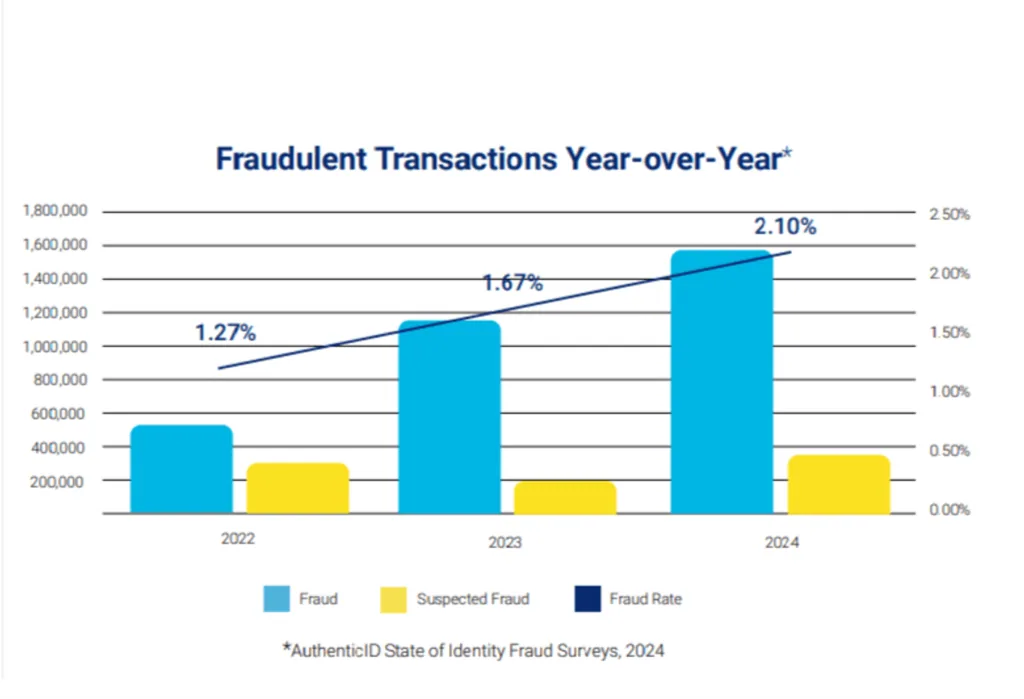
According to AuthenticID, identity fraud accounted for 2.1% of all banking transactions in 2024, up from 1.27% in 2022. The threat is growing rapidly as synthetic identities, deepfakes, and AI-generated documents become easier and cheaper to create.
Consider a typical account application. The SSN is valid. The address exists. The ID passes verification. Every onboarding check returns a green signal.
Months later, the account defaults on a $15,000 credit line and disappears. Investigators discover the applicant never existed. The SSN belonged to a child, the address appeared across multiple applications, and the ID was AI-generated.
This is synthetic identity fraudthe fastest-growing fraud category in banking. The fraud is rarely hidden within individual data points. It exists in the connections between identities, devices, behaviors, and application histories.
That is where AI agents in finance are changing the equation. Instead of verifying signals in isolation, they analyze relationships across thousands of signals simultaneously, uncovering fraud patterns that traditional rule-based systems are structurally unable to see.
3 Identity Fraud Types That Traditional Banking Systems Were Not Built to Catch
Below, we’ve mentioned three identity fraud types that traditional banking systems can not catch. Let’s have a look at them.
1. Synthetic Identity Fraud
Synthetic identity fraud is not about stealing someone’s identity. It is about constructing false identities and fake identity profiles that have never existed. Fraudsters take a real SSN, typically belonging to a child, an elderly person, or a recent immigrant with no credit footprint, and pair it with fabricated personal details. Run each element through a standard KYC check, and every single one passes. The SSN is real. The address exists. The document looks authentic.
Application fraud detection fails here because no individual check is designed to look across applications simultaneously. The fraud only becomes visible at the network level: the same SSN appearing across eight applications, the same device fingerprint connecting five supposedly unrelated applicants, and the same address shared by fifteen bank accounts opened within a 30-day window.
What makes this particularly damaging is the patience involved. According to Datos Insights, synthetic identity fraud increased 311% in North America between Q1 2024 and Q2 2024. These identities age for 12 to 18 months, making on-time payments and gradually building credit limits before busting out simultaneously across every available line. By the time the financial losses become visible, the identity is gone.
2. Deepfake Fraud
Deepfake fraud uses generative AI to create video and audio that impersonates real people convincingly enough to pass biometric verification, voice deepfake detection systems, and even live video KYC calls conducted by human reviewers. The technology is not restricted or expensive. According to Deloitte’s analysis of banking fraud trends, deepfake tools are available on the dark web starting at $20, removing almost every barrier to entry.
The numbers reflect how quickly this has scaled. Deepfake fraud has grown 3,000% since 2023, with attacks occurring every five minutes globally. What makes this structurally difficult to defend against is that human detection accuracy for high-quality deepfake video drops to as low as 25%. Presentation attack detection using traditional liveness checks, the blink, the head turn, and the smile, was built to catch human impostors. It was not built to evaluate generative AI outputs that are specifically trained to pass those exact checks.
Identity document fraud using AI-generated credentials compounds the problem further. A deepfake face matched against an AI-generated passport or driver’s license document is a combination that passes every layer of conventional verification simultaneously.
3. Account Takeover
Account takeover is structurally different from the other two. There is no fabricated identity and no fake document. The attacker gains unauthorized access to a real customer’s existing account using stolen credentials purchased from breach databases, a SIM swap attack that intercepts multi-factor authentication (MFA) codes before they reach the legitimate account holder credential stuffing detection avoidance techniques that test large volumes of credential combinations below alert thresholds or session hijacking that bypasses authentication entirely.
Because the identity is real and every credential input is correct, onboarding-stage verification has no visibility into the attack. The fraud signal exists in behavioral patterns across login timing, navigation behavior, typing cadence, and transaction activity. A login from unfamiliar mobile devices or unrecognized hardware at 3 AM. Immediate contact detail changes. A password reset followed within minutes by a fund transfer to a newly added payee and other fraudulent transactions. Behavioral biometrics banking analysis, including typing cadence, navigation speed, and session behavior patterns, is the only detection layer that catches this.
How AI Agents Detect Identity Fraud That Traditional Systems Miss?
Traditional KYC and rule-based fraud detection systems verify individual data points. While AI agents verify identities. Here’s what that difference looks like for each fraud type.
| Identity Fraud Type | What Traditional Detection Checks | Why It Misses the Fraud | What an AI Agent Checks Instead | Detection Signal |
| Synthetic Identity | Traditional systems confirm the SSN exists and is properly formatted, verify that the applicant name matches the address on file, check that the credit bureau shows a record for this identity, and authenticate the identity document against known formatting standards. Every check runs independently against its own isolated data source. | Every element of a synthetic identity is technically valid on its own. The SSN is real. The address exists. The document passes formatting checks. The fraud does not exist in any single data point. It exists in the combination of data points across multiple applications and accounts, which no individual check has visibility into. | The agent cross-references the SSN issuance date against the stated applicant age through credit bureau cross-referencing, maps device fingerprints across all applications in the system to identify shared devices, detects address clustering where the same address appears across multiple unrelated accounts, and analyzes credit history build-up velocity against statistical baselines for similar demographic profiles. | The same device fingerprint appears across eight supposedly unrelated applications filed within the same month; an SSN with an issuance date indicating it belongs to a minor; a single address registered across fifteen accounts; a credit history growing at a velocity that is statistically inconsistent with the applicant’s stated age and income. |
| Deepfake Video and Voice | Traditional systems run a biometric match comparing the applicant’s live face against their ID photo, conduct a liveness check requiring the applicant to blink or turn their head to confirm a live person is present, and for voice authentication scenarios, compare the voice against a stored voiceprint using standard spectral analysis. | Deepfakes are specifically trained through adversarial learning to pass liveness checks and biometric matching. The deepfake generator runs itself against detection systems repeatedly and refines its output until it consistently passes. Standard voice deepfake detection based on voiceprint matching fails against generative audio that is calibrated to mimic the target’s spectral profile. Human reviewers catch only one in four advanced deepfakes at the 25% accuracy rate documented in academic research. | The agent analyses micro-expression patterns and skin texture inconsistencies at the pixel level that are invisible to human reviewers, evaluates audio spectral patterns for timing mismatches with lip movement, conducts presentation attack detection by identifying injection attack signatures that indicate a synthetic video stream has replaced the live camera feed, and cross-references video metadata for rendering artifacts from the generative model. | Pixel-level skin texture inconsistencies at face boundaries; audio spectral patterns that do not synchronize with lip movement at the millisecond level; video metadata containing frame rendering artifacts; injection signatures confirming that a pre-rendered synthetic stream replaced the live camera input. |
| Account Takeover | Traditional systems verify that the submitted password is correct, confirm that MFA verification passes using the code sent to the registered device, and check that security question answers match stored records. If all three inputs are valid, account access is granted without further evaluation. | Attackers obtain valid credentials from breach databases, intercept MFA codes through SIM swap fraud by redirecting the victim’s phone number to an attacker-controlled SIM, and acquire security answers through targeted social engineering. Every verification input is technically correct. The system has no mechanism to evaluate whether the person submitting correct credentials is the account holder. | The agent evaluates behavioral biometrics banking signals including device fingerprint against historical account device list, login time against the account’s established access pattern, geolocation consistency with prior sessions, session navigation behavior compared to the account holder’s baseline, the first action taken immediately after login, and typing cadence compared to historical input patterns for this account. | A login from an unrecognized device at 3 AM followed within minutes by a contact detail change, a password reset, and a fund transfer to a newly added payee forms a behavioral sequence that identifies account takeover even when every credential input passed successfully. |
The common thread across all three fraud types is this: AI agents detect identity fraud by evaluating the relationship between signals, not the validity of individual signals. When an SSN is valid, the face matches the ID photo, and Credentials are correct, traditional systems register three green checks and approve.
Meanwhile, an AI agent sees the same SSN across eight applications this month, detects the face was generated through a diffusion model at the pixel level, and identifies the login as originating from a device 3,000 miles from the customer’s registered location at an hour never seen in three years of account history. Individually, nothing looks wrong. Together, the pattern is unambiguous.

Identity fraud prevention requires more than alerts
Dextra Labs build AI-powered fraud detection agents that verify identities across banking, KYC, device, and bureau data in real time.
? Talk to our AI Agent Development ExpertArchitecture of an Identity Fraud Detection Agent
An identity fraud detection agent is purpose-built for identity proofing workflows specifically. The architecture runs across four layers, each handling a distinct function, and the entire system is specialized for identity verification rather than general fraud detection.
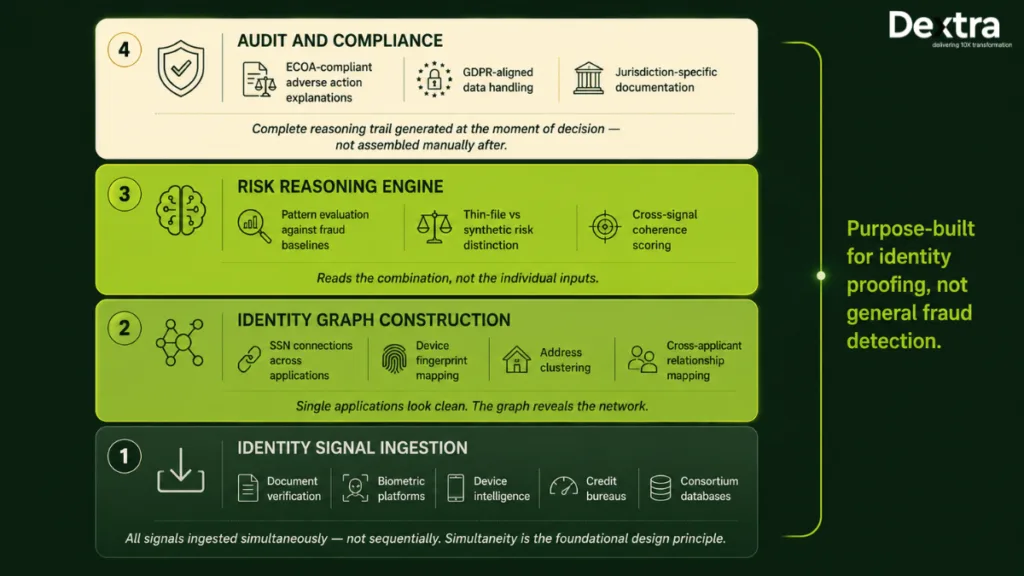
Layer 1: Identity Signal Ingestion
The agent connects simultaneously to document verification systems using OCR and computer vision for identity document fraud analysis, biometric platforms handling facial recognition and liveness detection, device intelligence feeds providing fingerprint and geolocation data, credit bureaus for credit bureau cross-referencing against inquiry patterns and history velocity, and consortium databases containing shared fraud intelligence across institutions linked to money laundering and illicit transactions
Every signal and customer data source is ingested at the same moment rather than sequentially. This simultaneity is the foundational design principle. Traditional verification runs checks one after another, which means cross-signal patterns are never evaluated together. Running everything in parallel is what makes identity graph construction possible at speed.
Layer 2: Identity Graph Construction
Rather than recording an isolated pass or fail against each signal, the agent builds a connected map of every attribute associated with the application under review. The SSN links to every other application in the system using that same SSN. The device fingerprint links to every other session from that device. The address links to every other account registered at that address.
This identity graph analysis layer is where synthetic fraud becomes visible. A single application looks clean. The graph shows that the SSN appears across eight applications, the device connects five supposedly unrelated applicants, and the address is shared across fifteen customer accounts. None of those relationships are visible to individual checks running against isolated data sources.
Layer 3: Risk Reasoning Engine
The reasoning engine evaluates the identity graph against known fraud patterns, suspicious activities, and statistical baselines built from legitimate customer profiles. It distinguishes thin-file applicant risk from synthetic identity risk through pattern density and cross-signal coherence rather than any single disqualifying data point.
An applicant with no social media presence, a device shared across multiple applications, and an address used by more than ten accounts scores fundamentally differently from an applicant with a consistent digital footprint, a unique device, and a unique address, even if both present identical credit histories on paper. The engine reads the combination, not the individual inputs.
Layer 4: Audit and Compliance Layer
Every identity decision the agent makes generates a complete reasoning trail at the moment the decision occurs. Which signals were evaluated, which patterns triggered the risk score, and why the application was approved, flagged, or declined are all documented automatically in a format that satisfies regulatory examination requirements without manual assembly.
This layer varies more than any other by client environment. US banks require ECOA-compliant adverse action explanations for every decline. EU institutions require GDPR-compliant data handling within the identity graph itself. APAC regulators require jurisdiction-specific documentation formats. At Dextra Labs, we architect the compliance layer to match your specific regulatory environment rather than a generic standard that creates its own examination exposure.
The Scale of Identity Fraud in Banking: 2026 Updated Data
Before looking at the numbers below, it helps to understand what they represent collectively. These are not isolated statistics about different fraud types. They are interconnected data points describing a single shift: the tools that create identity fraud are becoming cheaper, faster, and more widely available at exactly the same pace that traditional detection methods are falling behind.
| Metric | Data Point | Source |
| Synthetic identity fraud growth | Synthetic identity fraud cases surged by 311% across North America between the first quarter of 2024 and the second quarter of 2025, making it the fastest-growing fraud category in the region. | Datos Insights |
| Deepfake fraud growth | Since 2023, deepfake fraud incidents have grown by 3,000%, driven by the rapid commoditization of AI-generated media tools that require little technical skill to operate. | Industry data |
| Deepfake attack frequency | AI-driven deepfake attacks are now occurring every five minutes somewhere globally, making it one of the most persistent and continuous fraud threats financial institutions face. | Industry monitoring |
| Human deepfake detection accuracy | When human reviewers assess high-quality deepfake video, their detection accuracy drops to as low as 25%, meaning three out of four advanced deepfakes pass undetected through manual review. | Academic research |
| Financial institutions hit by deepfakes | In the past year alone, 46% of financial institutions reported experiencing at least one deepfake-related fraud incident, reflecting how broadly this threat has spread across the industry. | AuthenticID |
| Identity fraud transaction rate | Identity fraud now affects 2.1% of all banking transactions in 2024, a significant rise from 1.27% in 2022, indicating that the problem is growing materially year over year. | AuthenticID |
| Deepfake incidents in fintech | Deepfake incidents within the fintech sector increased by 700% in 2023 alone, suggesting that digitally-native financial platforms face disproportionately higher exposure to this threat. | Deloitte |
| Cost of dark web fraud tools | The tools required to execute identity fraud, including deepfake software and synthetic identity kits, are available on the dark web for as little as $20, removing the financial barrier that once limited this activity to sophisticated fraud rings. | Deloitte |
| Risk leaders top concern | In a survey of financial services risk leaders, 37% identified AI-generated fraud as their single biggest threat, ranking it above traditional fraud vectors for the first time. | Mitek/Censuswide |
What these numbers mean in practical terms is straightforward. The deepfake tools that required sophisticated technical knowledge two years ago now cost $20 and require almost none. The synthetic identity techniques that once needed organized fraud rings are now available as services. AI fraud detection accuracy in banking needs to keep pace with adversarial tools that are improving on a weekly cycle, not a quarterly retraining cycle.
Banks relying on point-of-application digital identity verification alone are not behind by a small margin. They are operating a detection architecture that was designed for a threat environment that no longer exists. AI fraud detection solutions for financial institutions require a different structural approach, not incremental improvements to the current one.
Is Your Fraud Defense Ready for Modern Identity Threats?
Evaluate your institution’s readiness against synthetic identities, deepfake attacks, account takeovers, and other emerging fraud risks with our comprehensive assessment checklist.
? Download the Identity Fraud Readiness ChecklistHow AI-Powered Fraud Is Changing Identity Detection?
AI-powered fraud is changing identity detection by creating adversarial systems specifically engineered to evade modern fraud prevention models. The same machine learning algorithms and AI capabilities that power fraud detection
This includes pattern recognition, behavioral analysis, language generation, and image synthesis, which are now being used to build fraud that is specifically engineered to evade AI-powered detection. Understanding where this arms race is heading matters as much as understanding where it stands today.
| What Fraudsters Are Building | How It Works | Why Current Detection Struggles | What Detection Must Evolve Toward |
| Agentic Fraud Bots | These are autonomous AI systems that probe institutional defenses continuously without human direction. They test which transaction patterns trigger alerts, which communication approaches succeed with specific victim profiles, and which account types carry the most accessible credit lines. Every interaction teaches the system, and it adapts in real time based on what it learns. | Machine learning detection models are trained against historical fraud patterns. By the time a model has learned to recognize a pattern well enough to flag it reliably, the bot has already moved to a variation the model has not yet encountered. The speed gap between fraud adaptation and model retraining is where these systems operate. | Detection agents that update behavioral baselines and detection thresholds continuously based on live attack patterns rather than scheduled retraining cycles. The detection system needs to adapt at the same speed as the fraud it is tracking, not on a quarterly update schedule. |
| Self-learning Deepfakes | Each new generation of deepfake is trained specifically to bypass the liveness detection and biometric matching models that are currently deployed. The generator runs itself against detection systems repeatedly and refines its output until it passes consistently. This means deepfake quality is improving on a faster cycle than detection model updates. | Liveness detection that worked reliably six months ago may already fail against current generation deepfakes. Voice deepfake detection based on voiceprint matching fails when the synthetic audio is calibrated against the target’s spectral profile. Human deepfake detection accuracy has dropped to 25% for high-quality video, which means human review catches fewer than one in four attacks. | Multi-layered identity verification that goes beyond visual and audio analysis, cross-referencing video metadata, device injection signatures, network behavior, and full session context alongside biometric checks. No single signal is reliable alone against adversarially trained synthetic media. |
| Patient Synthetic Identities | These identities are engineered specifically to pass continuous monitoring as well as onboarding checks. They open small credit lines, make on-time payments, and gradually increase limits over 12 to 18 months. They generate exactly the behavioral signals that legitimate thin-file customers generate, until the moment every available credit line is drawn simultaneously. | Onboarding KYC sees a clean applicant with no fraud indicators. Ongoing risk assessment sees a customer in good standing with a clean payment history. Early detection becomes difficult because the behavioral change that signals bust-out fraud only becomes visible at the exact moment the fraud executes, and by then the funds have already left the institution. | Continuous behavioral monitoring that evaluates behavioral velocity over time: how fast credit utilization is climbing across all lines simultaneously, whether spending patterns shift suddenly after months of stability, whether the digital footprint remains consistent across interactions. Onboarding verification alone cannot catch an identity designed specifically to pass it. |
The pattern across all three is consistent. Each adversarial evolution targets a specific structural limitation in current detection rather than a general technical weakness. Agentic bots exploit the speed gap between fraud adaptation and retraining cycles. Self-learning deepfakes target single-signal biometric verification. Patient synthetic identities target point-in-time risk assessment with no visibility into behavioral velocity.
The response has to match the structure of the attack. Moving from periodic, single-signal, model-dependent detection to continuous, multi-signal, agent-driven detection that adapts in real time is not an improvement to the current architecture. It is a replacement for a structural approach that the current threat environment has already made obsolete.
Conclusion
In summary, identity fraud detection in banking has moved well past the point where better rules or faster verification closes the gap. The fraud being committed today is specifically designed to pass the checks banks traditionally rely on. Synthetic identities are built from valid data. Deepfakes are trained to defeat liveness detection. Account takeovers use credentials that are technically correct in every verifiable way.
The banking institutions that stay ahead of these traditional gaps are the ones that recognize the shift: from verifying individual signals to evaluating the relationships between signals, in real time, across documents, devices, behavior, and application history simultaneously. That is what multi-layered identity verification through AI agents actually means in practice.
So, what does your current identity fraud detection architecture actually evaluate: individual data points in isolation, or the patterns they form together? If the honest answer is the former, that gap is worth addressing before the next bust-out cycle closes.
Dextra Labs builds AI agent systems for identity fraud detection in banking, from document intelligence and biometric analysis through behavioral monitoring and compliance documentation, integrated with existing KYC platforms and core banking infrastructure. Talk to our financial crime team to evaluate what a purpose-built detection architecture would look like for your institution.
Frequently Asked Questions
Q. What is synthetic identity fraud, and how does it differ from traditional identity theft?
Synthetic identity fraud combines a real Social Security number (SSN) with fabricated personal details to create an identity that never actually existed. Traditional identity theft uses a real person’s complete identity without their knowledge.
The critical difference is that synthetic fraud passes every individual verification check because each data point is technically valid. The fraud only becomes detectable through identity graph analysis that cross-references signals across multiple applications simultaneously.
Q. Why do traditional KYC systems fail to detect deepfake fraud?
Traditional liveness detection and biometric matching were designed to catch human impostors, not generative AI. Modern deepfakes are trained through adversarial learning specifically to pass these checks. Voice deepfake detection using standard voiceprint matching fails when synthetic audio is calibrated to match the target’s spectral profile.
Human detection accuracy for high-quality deepfake video is as low as 25%, meaning conventional review catches fewer than one in four advanced attacks.
Q. How do AI agents detect account takeover if the credentials are correct?
AI agents evaluate behavioral biometrics banking signals surrounding a login rather than just verifying credential inputs. A correct password submitted from an unrecognized device at 3 AM, followed immediately by contact detail changes and fund transfers to a new payee, forms a behavioral sequence that identifies account takeover even when every credential check passes. The agent reads the pattern of actions, not just whether each individual input is valid.
Q. What is an identity graph, and why does it matter for fraud detection?
An identity graph is a connected map of every attribute associated with an application or account, linking the current data against all historical data in the system through identity graph analysis.
When an SSN appears across eight applications, a device fingerprint connects five supposedly unrelated applicants, or an address is shared by fifteen accounts, the graph surfaces those relationships immediately. This is the detection layer that application fraud detection through individual verification checks cannot provide.
Q. What is the difference between presentation attack detection and standard liveness detection?
Standard liveness detection checks whether a live person is present by requiring physical responses like blinking or head movement.
Presentation attack detection goes further by analysing the video feed itself for injection attack signatures, rendering artifacts in video metadata, and pixel-level inconsistencies that indicate a synthetic or pre-recorded stream has replaced the live camera input. High-quality deepfakes pass standard liveness checks but fail presentation attack detection at the signal level.