
You found an AI code review tool that your engineering team was ready to roll out. The pilot looked promising, the engineering team liked the tool, and the productivity gains were clear. Then the security and compliance review changed everything. Questions around where your source code would be processed, whether it would leave your environment, and if the vendor could meet your compliance requirements were no longer an option.
This is a familiar situation for CTOs and engineering leaders in regulated organizations. Most AI code review tools are designed for SaaS-first companies, where sending code to a vendor-managed cloud isn’t a concern. But if your organization operates under FedRAMP, HIPAA, CMMC, ITAR, IL5/IL6, or sovereign cloud requirements, the shortlist gets much smaller. What starts as a list of dozens of vendors quickly narrows to a handful that offer credible on-premise AI code review.
This is the CTO’s complete guide to on-premise AI code review in 2026, covering the compliance landscape, vendor comparison, technical architecture, build-vs-buy economics, and TCO modeling for organizations whose compliance, security, or sovereignty requirements eliminate SaaS deployment. Let’s start with the basics!
What is On-Premise AI Code Review?
On-premise AI code review refers to AI-powered code review tools that run entirely within an organization’s own infrastructure whether that’s physical servers, a private cloud environment, or a customer-managed VPC, instead of a vendor’s SaaS platform. Rather than trusting a third party to process sensitive code, the organization maintains full control over the infrastructure, security controls, audit requirements, and data governance policies surrounding the review process.
The category exists because SaaS AI code review tools, while often offering the fastest deployment and advanced capabilities, create challenges that many regulated and security-sensitive organizations cannot ignore:
- Source code is processed outside the organization’s environment: In a SaaS deployment, code typically travels to vendor-managed infrastructure for analysis. For organizations with strict data residency, data sovereignty, or internal security policies, this alone can be enough to eliminate a tool from consideration.
- Third-party processing introduces governance and IP concerns: Once a vendor becomes part of the code review workflow, security and legal teams need clarity around intellectual property protection, audit trails, data retention policies, vendor access controls, and IP indemnification obligations.
- Compliance requirements may limit or prohibit cloud-based processing: Frameworks such as FedRAMP, HIPAA, ITAR, CMMC, IL5/IL6, and certain sovereign cloud mandates often impose restrictions on where sensitive code can be stored, processed, or transmitted, making traditional SaaS deployments difficult or impossible to approve.
The Three Deployment Variants
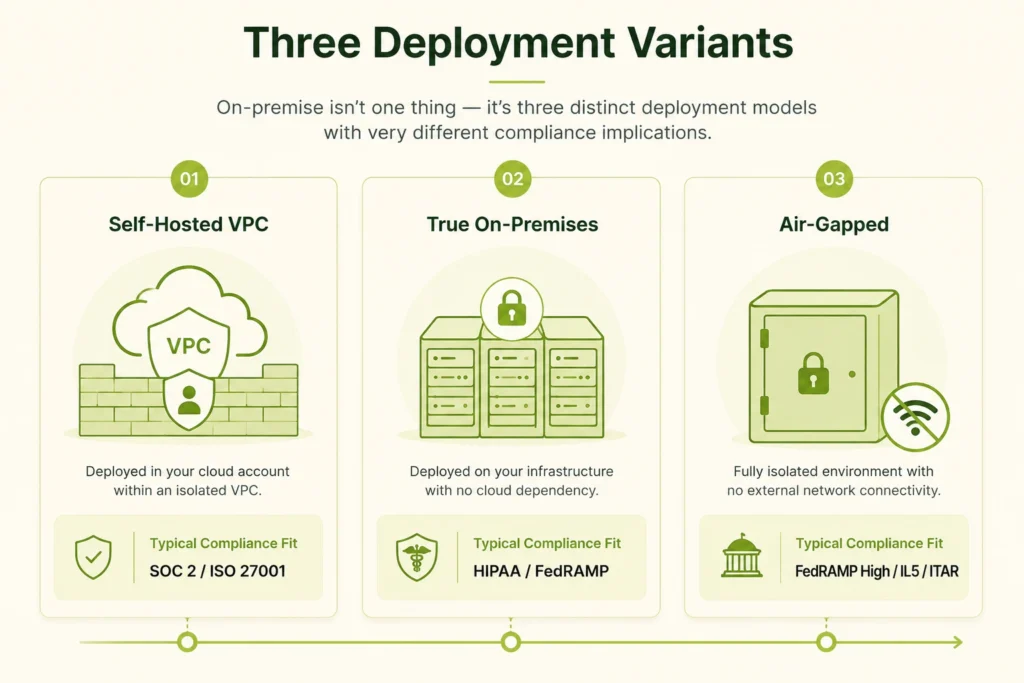
In 2026, “on-premise” describes three distinct deployment models that are often grouped together despite having very different compliance and operational implications.
1. Self-hosted AI Code Review (Single-Tenant Cloud)
Vendor software runs inside a dedicated environment within the customer’s cloud account, typically a Virtual Private Cloud (VPC). Code remains within the customer’s cloud perimeter, but the deployment still relies on cloud infrastructure and network connectivity. This model is commonly used by organizations that require stronger data residency controls than SaaS but do not require complete infrastructure isolation. It is often sufficient for SOC 2 Type II, ISO 27001, and many HIPAA-regulated environments.
2. True On-Premises Deployment
The software runs on customer-controlled infrastructure, including private cloud environments, bare-metal servers, or Kubernetes on-prem clusters. Code never leaves the organization’s network, and model inference occurs locally. Some platforms may require limited outbound connectivity for updates or license verification, but production code remains fully contained within the enterprise environment. This deployment model is common in organizations with stricter governance, audit trail, and compliance requirements.
3. Air-Gapped AI Code Review
The platform operates inside a fully isolated environment with zero internet connectivity and no dependency on external services. Model files, software updates, and configuration changes must be manually transferred and installed. Air-gapped AI code review is typically required in environments governed by FedRAMP High, IL5/IL6, ITAR, sovereign cloud mandates, or other security frameworks where external connectivity is prohibited.
The Compliance Reality
Every step toward greater control, moving from SaaS to self-hosted code review, from self-hosted to on-premises, and from on-premises to air-gapped deployment reduces the number of vendors capable of meeting the requirement. At the same time, it increases operational complexity, infrastructure ownership, and deployment costs.
This is why the decision is rarely a simple choice between SaaS and on-premise AI code review. Most large enterprises operate across multiple risk tiers. Internal business applications may be suitable for SaaS tools, while regulated systems, sensitive intellectual property, government projects, or mission-critical platforms require self-hosted AI code review or fully air-gapped deployments. For CTOs, the real question is not which deployment model is best. It’s determining which deployment model is appropriate for each part of the organization’s codebase.
Why Enterprises Choose On-Premise AI Code Review
Here’s why enterprises end up evaluating on-premise AI code review. Most don’t start their search looking for an on-premise tool. They get there after discovering that a SaaS deployment creates a problem they can’t ignore whether that’s a compliance requirement, sensitive intellectual property, audit and governance obligations, or infrastructure that cannot support external AI services.
The four situations below are the ones that actually drive the final decision:
Situation #1: Your Compliance Team Won’t Approve Cloud-Based Code Processing
Your engineering team was ready to roll out an AI Code Review tool but the deployment stopped when your compliance or security team rejected the idea of source code being processed in vendor managed cloud.
Common examples include:
- HIPAA: Source code, configuration files, logs, or test environments may contain PHI. Once that information is processed in vendor-managed infrastructure, compliance teams need to evaluate Business Associate Agreements (BAAs), data handling controls, and audit requirements.
- FedRAMP / FedRAMP High: Federal agencies and contractors often need approved environments for processing sensitive information. Many AI code review vendors support commercial cloud deployments but not the controls required for higher FedRAMP classifications.
- ITAR: Defense contractors cannot allow export-controlled technical data or code to be processed outside approved US-controlled environments.
- PCI DSS: Payment systems frequently contain references to cardholder data flows, security controls, and transaction processing logic that require tightly controlled environments.
- GDPR and Sovereign Cloud Requirements: Organizations operating in the EU or under strict data residency mandates may need guarantees that code remains within specific geographic boundaries.
Situation #2: Your Source Code Is One of the Company’s Most Valuable Assets
For many organizations, source code is one of their most valuable business assets, containing proprietary algorithms, internal logic, and years of engineering investment. That’s why not every organization adopts on-premise AI code review because of compliance alone. For many, the bigger priority is protecting intellectual property that directly impacts business value.
This is particularly common in industries where software itself is the competitive advantage, such as:
- Proprietary trading algorithms in financial services.
- Manufacturing and optimization systems developed over years of internal research.
- Drug discovery and healthcare platforms built on unique models and workflows.
- Custom AI systems, recommendation engines, and proprietary business logic.
For CTOs, the concern is straightforward: some codebases contain the company’s most valuable intellectual property. Even if a vendor provides strong security assurances, many organizations prefer to keep the review process entirely within the infrastructure they control.
Patent-sensitive projects, acquisition due diligence, and confidential product initiatives often fall into the same category.
Situation #3: Governance, Audit, and Vendor Risk Become Bigger Concerns Than Features
As organizations mature, governance requirements often become as important as security requirements.
Many enterprises want clear answers to questions such as:
- What happens if the vendor is acquired?
- What happens if pricing changes dramatically?
- What happens if the product is discontinued?
- Can we reconstruct every review recommendation during a compliance audit or security investigation?
These concerns become especially important in regulated industries where auditability is a formal requirement rather than a best practice.
Organizations may need to demonstrate exactly how a code review decision was made, what recommendation the AI generated, who approved it, and when it entered production. In highly regulated environments, that level of traceability often requires tight integration with existing audit, logging, and security systems. While some SaaS platforms provide audit capabilities, many enterprises prefer to keep the entire audit trail within the infrastructure they control.
An additional consideration is vendor maturity. Many AI code review vendors are still early-stage companies operating in a rapidly evolving market. On-premise deployments provide a level of operational continuity that reduces dependence on a vendor’s long-term business trajectory.
Situation #4: Your Infrastructure Doesn’t Allow SaaS in the First Place
Sometimes there is no compliance debate, no security review, and no procurement discussion. The organization’s architecture simply doesn’t permit external AI services.
Examples include:
- Air-gapped networks used by defense, intelligence, and critical infrastructure organizations.
- Sovereign cloud environments supporting national security or geopolitically sensitive workloads.
- Restricted-egress environments where outbound connectivity is heavily controlled.
- Financial trading systems with tightly governed network boundaries.
- Edge computing environments supporting industrial systems, IoT platforms, and embedded devices.
In these environments, cloud-based AI code review tools are often eliminated immediately because external connectivity is restricted or prohibited.
For these organizations, on-premise AI code review isn’t a preference or a policy choice. It’s an architectural requirement. In the most restrictive environments, even commercial on-premise platforms may need additional customization or a bespoke AI code review architecture to satisfy operational and security requirements.
Compliance Mapping: Which Frameworks Require On-Premise AI Code Review?
The table below maps major compliance frameworks against deployment requirements, showing where SaaS remains viable, where self-hosted AI code review is preferred, and where on-premise or air-gapped AI code review becomes the practical requirement.
| Compliance Framework | Geography / Industry | SaaS AI Code Review Permitted? | On-Premise Required? | Notes |
| SOC 2 Type II | Global / All | Yes (most cases) | No (but preferred for sensitive data) | Table-stakes; doesn’t typically force on-prem alone |
| ISO 27001 | Global / All | Yes (most cases) | No (but VPC often preferred) | Compatible with vendor SaaS holding ISO 27001 |
| HIPAA | US Healthcare | Yes (with BAA) | Often required | BAA complications make many vendors unsuitable |
| PCI DSS | Global / Payments | Yes (with scoping) | Required for in-scope code | Vendor scoping is complex |
| FedRAMP Moderate | US Federal | Yes (FedRAMP-certified vendors) | Sometimes required | Limits vendor list significantly |
| FedRAMP High | US Federal (sensitive) | Rarely available | Often required | Almost no AI code review vendors hold FedRAMP High |
| DoD IL5 / IL6 | US DoD | Almost never | Required | Custom development frequently the only path |
| ITAR | US Defense exports | Rarely | Required for ITAR-restricted code | Severely restricts vendor options |
| CMMC Level 2-3 | DoD Contractors | Limited | Often required | CMMC drives custom and on-premise adoption |
| GDPR / EU Data Sovereignty | EU operations | Yes (with EU-based vendor) | Sometimes | Depends on data classification |
| CERT-IN | India | Yes (with CERT-IN certified vendor) | Sometimes preferred | Panto holds CERT-IN — narrow vendor list |
| DPDPA | India | Emerging requirements | Increasingly preferred | 2023 act, enforcement evolving |
| NIS2 | EU Critical Infrastructure | Emerging | Often preferred | New regulation, implementation rolling out |
| SOX | US Public Companies | Yes | No (but audit trail matters) | Audit trail completeness is the real concern |
The Compliance-to-Tool Mapping
This is where many enterprise evaluations become much shorter than expected. A vendor may offer excellent AI capabilities, but if it cannot satisfy the organization’s compliance requirements, it is effectively eliminated from consideration.
- FedRAMP / FedRAMP High: This is one of the most restrictive categories. Almost no commercial AI code review vendors currently hold FedRAMP High authorization. While some vendors can support on-premise AI code review deployments in federal environments, such as FedRAMP Moderate is held by Amazon CodeGuru (AWS native), certification coverage remains limited. For many organizations, on-premise or air-gapped deployment becomes the practical path to meeting requirements.
- HIPAA: Organizations handling PHI typically look for vendors that support Business Associate Agreements (BAAs) and enterprise-grade compliance controls. Vendors such as Tabnine and SonarQube Enterprise offer deployment options that align more closely with healthcare requirements than standard SaaS offerings.
- ISO 27001 and SOC 2 Type II: These frameworks provide the broadest vendor choice. Most major enterprise-focused platforms, including Tabnine, SonarQube, Codacy, Panto, and Qodo, maintain ISO 27001 and SOC 2 Type II certifications, making both SaaS and self-hosted AI code review deployments viable in many cases.
- IL5/IL6, ITAR, and CMMC Level 3: This is where commercial options become extremely limited. Requirements around network isolation, data sovereignty, and controlled environments often exceed what most vendors were designed to support. Organizations operating in these environments frequently find themselves evaluating highly customized deployments or purpose-built solutions rather than traditional off-the-shelf products.
The Sovereign Cloud Reality
Sovereign cloud requirements can narrow the vendor landscape just as quickly as compliance requirements. While many vendors support self-hosted AI code review, far fewer support deployments in environments such as AWS GovCloud, Azure Government, OCI Government Cloud, AC2/AC3, Bleu, or sovereign Indian cloud infrastructure.
The challenge is that most AI code review platforms were designed for commercial cloud environments, not sovereign ones. As a result, organizations with strict data sovereignty, network isolation, or government-specific requirements often find that many commercial offerings cannot be deployed without significant modifications, leaving them with a much smaller pool of viable vendors.
For sovereign cloud deployments, custom AI code review agent development is frequently the most operationally rational path. Rather than adapting a commercial platform to fit sovereign cloud requirements, organizations can design an architecture from the outset around the environment’s specific security, compliance, data residency, and infrastructure constraints.
Best On-Premise AI Code Review Tools in 2026: Honest Comparison
This section brings together the most credible on-premise AI code review tools available in 2026. While there are many vendors that exist in the broader market, requirements such as self-hosted deployment, air-gapped support, compliance readiness, and enterprise governance narrow the list. The table below compares the options that remain.
| # | Tool | On-Prem Maturity | Air-Gapped | Compliance Certs | Best For | Pricing |
| 1 | Tabnine | Highest | Yes (full air-gap) | SOC 2 Type II, ISO 27001 | Regulated industries needing IP-safe AI code review | $59/seat/mo (Enterprise custom) |
| 2 | SonarQube Enterprise | High | Yes (with effort) | SOC 2, ISO 27001 | Compliance-grade static analysis baseline | $150K-$300K/yr Enterprise |
| 3 | Panto AI | New (2024-2026) | Yes | SOC 2 Type II, CERT-IN | India-region deployments, regulated industries | Custom Enterprise |
| 4 | Kodesage | Moderate | Yes | SOC 2 Type II | Legacy stack support (COBOL, PL/SQL, PowerBuilder) | Custom Enterprise |
| 5 | Qodo (Enterprise on-prem) | Growing | Yes | SOC 2 Type II | AI-native architecture with on-prem option | Custom Enterprise |
| 6 | Codacy Enterprise | Moderate | Limited | SOC 2 Type II | Quality dashboards + self-hosted option | $50-80/seat/mo Enterprise |
| 7 | CodeAnt AI | Moderate | Yes | SOC 2 Type II | Unified review + security + DORA metrics | Custom Enterprise |
| 8 | Sourcegraph Amp | High (VPC) | Limited (Enterprise) | SOC 2 Type II | Large monorepos with code intelligence | Custom Enterprise |
| 9 | Refact.ai (open-source) | Self-hosted (DIY) | Yes | Self-managed | Open-source flexibility, internal AI team | Free + infrastructure cost |
| 10 | TabbyML (open-source) | Self-hosted (DIY) | Yes | Self-managed | Lightweight, developer-friendly | Free + infrastructure cost |
The Open-Source Reality
Refact.ai and TabbyML deserve separate consideration because they offer something many commercial vendors do not: fully self-hosted, air-gapped deployments with complete control over the stack. For organizations with strong internal engineering teams, they can be a cost-effective way to implement on-premise AI code review without paying enterprise licensing fees.
The trade-off is that you’re no longer just adopting a tool but you’re operating a platform. Model serving, infrastructure management, updates, monitoring, security hardening, and ongoing maintenance become internal responsibilities. The hidden cost is often not software, but the engineering time required to keep the system reliable and compliant.
This is where many CTOs reach an interesting conclusion. Once you’re already investing in the infrastructure and expertise required to run an open-source platform, the gap between “deploying open-source” and “building custom” becomes much smaller than it initially appears. At that point, a custom AI code review agent can be designed around your specific codebase, workflows, compliance requirements, and internal tooling rather than adapting generic review logic built for everyone else. For organizations with unique requirements, that additional investment often delivers significantly more long-term value than operating an open-source platform.
Technical Deployment Architecture: How On-Premise AI Code Review Actually Works
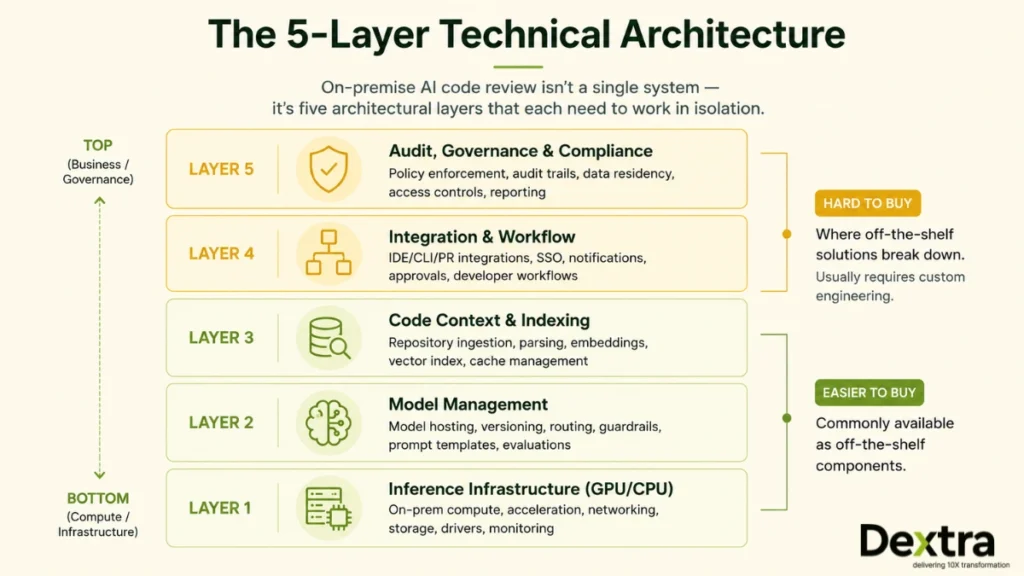
Deploying on-premise AI code review involves five architectural layers, which are listed below that work together to deliver secure, scalable, and compliant code review. So, let’s look at them one by one!
Layer 1: Inference Infrastructure (Model Serving)
Inference Infrastructure (Model Serving) provides the compute resources required to run AI models and generate code review recommendations. A production-grade on-premise AI code analysis deployment typically requires dedicated GPU or CPU infrastructure, with larger deployments often running on 8-16 GPU instances to support 500+ engineers. Common deployment options include bare-metal GPU servers, Kubernetes GPU clusters, and inference platforms such as NVIDIA Triton, TorchServe, and vLLM.
Layer 2: Model Management
Model Management handles the AI models used for code reviews. Organizations can deploy vendor-provided models, open-source models such as CodeLlama, StarCoder, or DeepSeek-Coder, or custom-trained models. In air-gapped AI code review environments, every model update must be manually transferred and validated before deployment.
Layer 3: Code Context and Indexing
Code Context and Indexing gives the AI model the repository-wide context it needs to understand code beyond a single file. It combines code parsing, embedding pipelines, and vector databases so the model understands project structure, dependencies, and relationships across the codebase. For many custom deployments, this is one of the most operationally complex layers.
Layer 4: Integration and Workflow
Integration and Workflow connects the AI code review platform with the engineering tools your teams already use, including version control, CI/CD pipelines, and ticketing systems. While most vendors support standard integrations, proprietary developer platforms and internal engineering workflows often require custom development.
Layer 5: Audit, Governance, and Compliance
Audit, Governance and Compliance ensures the deployment meets enterprise governance and compliance requirements. It includes immutable audit logging, RBAC, SIEM integration, compliance reporting, and complete audit trails. In regulated industries, this is often the layer that requires the highest level of customization.
Air-Gapped Architecture Considerations
Air-gapped deployments introduce additional operational responsibilities that organizations should account for, such as:
- Model Updates Require Manual Transfer: Every model upgrade must be transferred, validated, and approved through established change management processes.
- Vulnerability Patches Require Manual Application: Dependencies and vulnerabilities cannot be updated automatically, increasing operational effort.
- No External Telemetry: Vendor support and troubleshooting rely on manual log sharing rather than live diagnostics.
- Models Age Over Time: Without continuous updates, AI capability gradually falls behind cloud-based offerings, making planned refresh cycles every 6-12 months common.
These aren’t limitations unique to AI but they’re the operational realities of any air-gapped environment and should be considered during planning.
The Architecture Decision: Off-the-Shelf vs Custom-Built
Most Off-the-shelf on-premise AI code review tools do a good job of handling the first three layers, which are the inference infrastructure, model management, and code context. The real challenge usually begins with Layers 4 and 5, where every enterprise has different engineering workflows, security policies, and compliance requirements.
For example, a bank may need integration with proprietary ticketing systems, a healthcare organization may require custom PHI handling and audit workflows, while a defense contractor may need organization-specific RBAC, SIEM integration, and compliance reporting. These are areas where configuration alone often isn’t enough.
This is also the point where many CTOs rethink the build-versus-buy decision. Once your team is building custom integrations for internal identity providers, proprietary developer platforms, governance workflows, and audit pipelines, you’ve already invested significantly in a tailored architecture. Adding a custom AI code review agent that is designed around your codebase, workflows, and compliance requirements becomes a much smaller step than it appears.
Rather than adapting your engineering processes to fit an off-the-shelf platform, a custom AI code review architecture can be built around the way your organization already develops, reviews, and governs code. For enterprises with highly regulated environments or proprietary engineering ecosystems, that often proves to be the more scalable long-term approach.
Where Off-the-Shelf On-Premise AI Code Review Tools Fall Short
Below are the most common limitations CTOs encounter when evaluating off-the-shelf on-premise AI code review tools. The deeper the customization, governance, and integration requirements, the more likely these gaps are to influence the build-versus-buy decision.
1. Codebase Specificity Limitations
Most off-the-shelf on-premise AI code review tools are trained on publicly available code, primarily GitHub. As a result, they perform well on mainstream programming languages, frameworks, and development patterns but they become less effective when reviewing:
- Proprietary Languages: Internal DSLs, custom scripting environments, and language extensions that don’t exist in public training data.
- Legacy Languages with Specialized Usage: COBOL, PL/SQL, or PowerBuilder implementations built around decades of company-specific conventions.
- Industry-Specific Patterns: Financial trading systems, healthcare applications, or defense software with domain-specific architectures.
- Highly Specialized Codebases: Embedded software, real-time systems, or hardware-dependent applications with unique operational constraints.
2. Integration Depth Limitations
Off-the-shelf tools integrate well with standard enterprise tools such as GitHub Enterprise Server, GitLab self-hosted, Bitbucket Data Center, Jira. The limitations usually appear when organizations depend on internal engineering platforms or highly customized workflows, including:
- Proprietary CI systems developed in-house
- Internal ticketing and workflow platforms
- Custom code review processes with organization-specific approval gates
- Compliance workflows requiring multiple stakeholder approvals
- Proprietary deployment and release pipelines
3. Compliance Customization Limitations
Most enterprise platforms support widely adopted compliance frameworks, but compliance implementation is rarely identical across organizations. Areas that often require custom development include:
- Audit trail formats tailored to your SIEM
- Industry-specific compliance evidence and reporting
- Multi-jurisdiction governance across the US, EU, India, and APAC
- Organization-specific data classification policies
- Change management workflows aligned with internal governance processes
Where This Leaves You
For many organizations, off-the-shelf on-premise AI code review platforms address most of the requirements. The challenge is that the remaining requirements are rarely minor and are where the highest business value and the highest complexity exist. That includes custom compliance workflows, proprietary engineering processes, and internal tooling that commercial products aren’t designed to handle. When these become business-critical, organizations often find that custom development delivers a better long-term fit.
At that point, it’s worth asking a different question: Are you extending a commercial platform, or are you already building a custom solution? If your requirements revolve around proprietary engineering workflows, specialized compliance, or unique codebases, a custom AI code review agent can often provide a cleaner long-term architecture than continuously adapting an off-the-shelf platform. With a clearly defined scope, custom AI code review projects are commonly delivered within 6-9 months, with an initial investment of $500K-$1.2M often comparable to the long-term total cost of enterprise licensing at scale.
Build vs Buy: When Custom AI Code Review Agents Beat On-Premise Vendors
This section helps you figure out when an off-the-shelf self-hosted AI code review platform is the right choice and when building a custom AI code review agent makes more sense for your organization’s long-term needs.
When Off-the-Shelf Wins
For organizations whose requirements fit within the off-the-shelf on-premise market’s capabilities, the buy path remains rational for them. Such as in the following cases:
- Your Codebase is Relatively Standard: If your teams primarily work with common programming languages, conventional architectures, and don’t rely on proprietary DSLs or heavily customized frameworks.
- Your Engineering Stack Uses Widely Supported Tools: GitHub Enterprise Server, standard CI/CD pipelines, and common ticketing platforms are already supported by most enterprise vendors.
- Your Compliance Requirements Fit Within Existing Vendor Capabilities: Standards such as SOC 2 Type II, ISO 27001, and HIPAA can typically be met by enterprise-grade commercial platforms.
- Your Engineering Organization Has Fewer Than 1,500 developers: At this scale, per-seat licensing usually remains more cost-effective than building and maintaining a custom platform.
- Your Organization Doesn’t Have a Dedicated AI Engineering Team: Custom AI platforms require long-term ownership, maintenance, and continuous improvement after deployment.
Most regulated enterprises evaluating on-premise AI code review fall into this category, making the buy path the most practical choice.
When Custom AI Code Review Agents Win
Not every organization fits the off-the-shelf model. As compliance requirements become stricter, integrations become more specialized, and codebases become more unique, commercial platforms often require significant customization just to meet core requirements. At that point, building a custom AI code review agent becomes a more practical long-term investment.
Consider the following five scenarios to better understand:
Scenario 1: Your Compliance Requirements Go Beyond What Commercial Vendors Support
If you operate in FedRAMP High, IL5/IL6, ITAR-restricted environments, sovereign cloud deployments, or require organization-specific audit and SIEM integrations, a custom architecture can be built around your exact compliance requirements instead of forcing your processes to fit the platform.
Scenario 2: Your Codebase Doesn’t Look Like Everyone Else’s
If your engineering teams work with proprietary languages, internal DSLs, legacy monorepos, or industry-specific development patterns, a custom AI code review agent can be designed to understand your codebase rather than relying on models optimized for public repositories.
Scenario 3: Your Engineering Workflows are Deeply Customized
If your organization depends on proprietary CI systems, internal ticketing platforms, custom approval workflows, or organization-specific governance processes, custom development allows AI code review to fit naturally into your existing engineering operations.
Scenario 4: Your Engineering Scale Changes the Economics
Once engineering teams grow beyond 1,500 developers, enterprise licensing for an AI code review tool with on-prem deployment can reach $750K-$1.5M per year. A custom platform usually requires $500K-$1.2M upfront and $200K-$400K in annual maintenance, allowing many organizations to recover the investment within 12-18 months while owning the platform and its IP.
Scenario 5: AI is Becoming Part of Your Competitive Advantage
If your business depends on engineering as a strategic differentiator, owning the AI code review agent, its workflows, and its intellectual property can provide long-term value that extends well beyond licensing savings.
The Custom AI Code Review Agent Engagement Model
Building a custom AI code review agent doesn’t have to be a multi-year project with unpredictable costs. When the scope is clearly defined, experienced AI Agent Builders typically follow a structured delivery approach:
Months 1-2: Scoping
Analyze your codebase, review existing integrations, document compliance requirements, and define the success metrics for the project.
Months 3-6: Architecture and Pilot
Select the right foundation model, build the RAG and retrieval architecture, and deploy an initial pilot with measurable performance benchmarks.
Months 7-9: Production Rollout
Expand the platform’s capabilities, deepen integrations with your engineering stack, and prepare internal teams for production use.
Months 10-12+: Operational Ownership
Your engineering team takes over day-to-day operations, while AI Agent Builders continue to support major upgrades, new capabilities, and architectural enhancements as needed.
A production-grade custom AI code review agent typically requires an initial investment of $500K-$1.2M, followed by $200K-$400K in annual operating costs. For organizations with 1,500+ engineers, this is often comparable to or even lower than the long-term cost of enterprise licensing, while providing the additional benefits of IP ownership, complete architectural control, and the flexibility to evolve the platform as your engineering and compliance requirements change.
TCO Modeling: On-Premise Off-the-Shelf vs Custom Development
The table below compares the estimated three-year TCO of enterprise AI code review across different engineering team sizes, helping you understand when buying remains cost-effective and when building starts to deliver both financial and strategic advantages.
| Engineering Headcount | Off-the-Shelf On-Prem ($60/seat/mo avg) | Custom Build (initial + ongoing 3yr) | Break-Even | Strategic Value |
| 500 engineers | $1.08M total | $1.1M-$1.8M total | Roughly equal | Custom only wins on strategic IP grounds |
| 1,500 engineers | $3.24M total | $1.5M-$2.4M total | Custom wins by Year 2 | Cost AND strategic advantages favor custom |
| 3,000 engineers | $6.48M total | $1.8M-$2.8M total | Custom wins within Year 1 | Strong cost + strategic advantages |
| 5,000 engineers | $10.8M total | $2.2M-$3.5M total | Custom wins in months | Off-the-shelf becomes economically irrational |
What the TCO Numbers Include
The estimates are based on the major cost components organizations typically incur for each approach.
Off-the-shelf on-premise includes:
- Per-seat licensing based on engineering headcount.
- Infrastructure costs, including GPU/CPU compute, storage, and networking.
- Administrative overhead for vendor management and license administration.
- Professional services required for enterprise deployment and rollout.
Custom development includes:
- Initial scoping, architecture design, foundation model selection, BYOK setup, deployment, integrations, compliance implementation, and team training.
- Ongoing costs for foundation model licensing or inference, infrastructure operations, platform enhancements, and internal engineering ownership.
Both approaches include:
- Infrastructure costs such as compute, storage, and networking. Whether you buy or build, this investment is required for on-premise AI code review, so it has been included in both models.
The Honest TCO Reality
The figures above compare operational costs, but they don’t capture several factors that often influence enterprise decisions:
- IP Ownership: A custom AI code review platform becomes a long-term technology asset, while commercial licensing does not.
- Vendor Lock-In: Building your own platform reduces dependence on a single vendor’s pricing, roadmap, and long-term business decisions.
- Compliance Customization: Organizations in regulated industries often invest significant time and money in adapting commercial platforms to meet internal governance requirements.
- Operational Continuity: A custom platform continues to evolve on your terms, regardless of vendor acquisitions, licensing changes, or product discontinuation.
For many organizations, these strategic factors shift the economics in favor of custom development earlier than the TCO table alone suggests. If your engineering workflows, compliance requirements, or governance model require significant customization, evaluating the financial impact of your specific environment before making a procurement decision is often worthwhile.
90-Day On-Premise AI Code Review Implementation Roadmap
A successful on-premise AI code review deployment is usually rolled out in phases rather than all at once. Most enterprise implementations follow a roadmap similar to the one below.
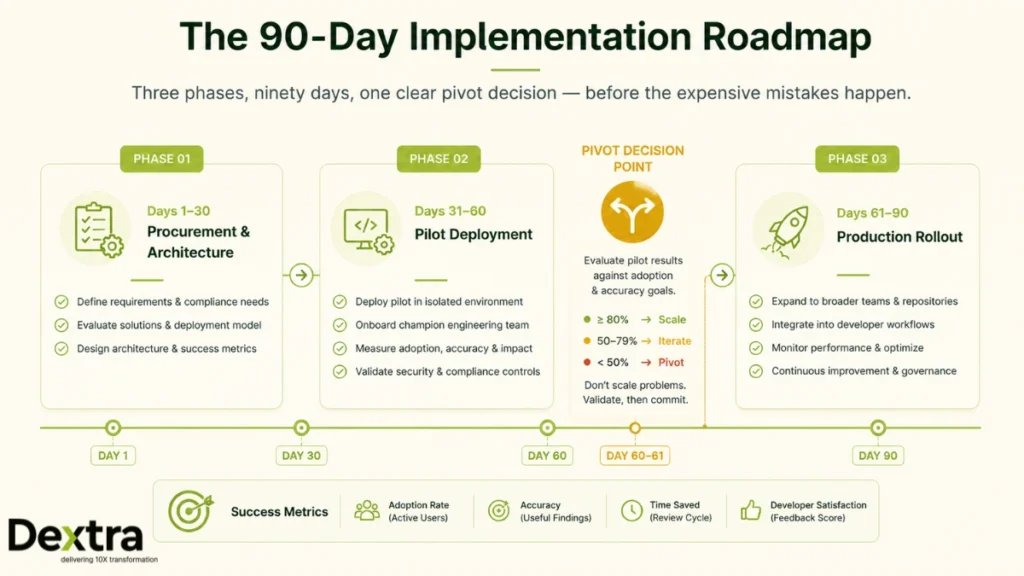
Phase 1: Procurement and Architecture (Days 1-30)
The first month is focused on planning and evaluation. During this phase, your team should:
- Apply the 7-criteria procurement framework to evaluate potential vendors.
- Perform a compliance gap analysis against your organization’s regulatory requirements.
- Shortlist 2-3 vendors for detailed evaluation.
- Design the target architecture, including inference infrastructure, model management, integrations, and audit capabilities.
- Decide whether an off-the-shelf platform, a custom AI code review agent, or a hybrid approach is the best fit.
Phase 2: Pilot Deployment (Days 31-60)
With the architecture in place, the next step is validating it in a real engineering environment. This phase includes:
- Provisioning the required GPU/CPU infrastructure, storage, and networking.
- Running a pilot with 5-15 senior engineers across different repositories and codebases.
- Measuring key metrics such as pull request latency, suggestion acceptance rate, false positives, and developer satisfaction.
- Validating compliance requirements, including audit trails, SIEM integration, and RBAC.
- Identifying any codebase compatibility issues or integration gaps before a broader rollout.
Phase 3: Production Rollout (Days 61-90)
Once the pilot proves successful, the focus then shifts to production adoption.
- Expand deployment across engineering teams based on pilot results.
- Integrate the platform into broader CI/CD pipelines and code review workflows.
- Complete compliance validation and audit readiness.
- Deploy ongoing performance and governance monitoring.
- Decide whether to scale organization-wide, refine the deployment with another pilot, or move toward a custom implementation.
The Pivot Decision
The pilot should provide enough evidence to make an informed decision. If the platform meets 80% or more of your requirements, it’s usually ready for production rollout. If it meets 50-80%, it’s worth refining the configuration and running another pilot. If it satisfies less than 50%, the gaps are often architectural rather than configurable. That’s typically the point where organizations begin evaluating a custom AI code review agent instead of continuing to adapt an off-the-shelf platform.
What Goes Wrong
Most enterprise self-hosted AI code review projects run into the same three challenges:
- Operational overhead is underestimated
Infrastructure management, model serving, monitoring, and ongoing maintenance require more effort than many teams initially expect.
- Compliance capabilities don’t match procurement expectations
Some vendors support certifications in limited deployment scenarios, which may not align with your organization’s actual compliance requirements.
- The tool performs differently on your codebase
Vendor demonstrations are typically based on standard repositories, while proprietary architectures, legacy systems, and internal coding patterns often expose unexpected limitations.
Reviewing your architecture and evaluation plan with experienced AI Agent Builders during the first phase, even if you’re leaning toward an off-the-shelf platform, can help identify these issues before they become expensive surprises during production rollout.
Conclusion
For most enterprises, today’s on-premise AI code review tools are capable of meeting both security and compliance requirements. But if your evaluation points to requirements such as sovereign cloud deployment, FedRAMP High, IL5/IL6, ITAR restrictions, proprietary codebases, deep internal integrations, or engineering scale where long-term economics favor ownership, it’s worth looking beyond commercial platforms. In these situations, a custom AI code review agent often becomes the more practical long-term choice.
If that’s where your organization is, Dextra Labs can help bridge the gap between what’s available and what’s actually required. As AI Agent Builders, we design and build custom AI code review agents around your compliance requirements, engineering workflows, and deployment environment, so your platform fits your business instead of the other way around.
Frequently Asked Questions:
What is air-gapped AI code review?
Air-gapped AI code review runs entirely within an isolated environment with no internet connection. All AI models, software updates, and configuration changes are transferred manually, ensuring that source code never leaves the organization’s network. This deployment model is commonly used in FedRAMP High, IL5/IL6, ITAR-restricted, and sovereign cloud environments where external connectivity is not permitted. Among commercial vendors, Tabnine, Panto AI, and Kodesage are some of the leading options that support full air-gapped deployments.
Which AI code review tools support on-premise deployment?
If your organization has highly specialized compliance, integration, or codebase requirements, a custom AI code review agent may be the best long-term option. For enterprises looking for commercial platforms, leading on-premise AI code review tools include Tabnine, SonarQube Enterprise, Qodo Enterprise, Panto AI, Codacy Enterprise, and Sourcegraph Amp. Open-source alternatives such as Refact.ai and TabbyML also support self-hosted and air-gapped deployments but require in-house operational expertise.
Do all enterprises need on-premise AI code review?
No, not every enterprise needs on-premise AI code review. The decision usually depends on your compliance obligations, intellectual property sensitivity, and security requirements.
On-premise deployment is typically the right choice if your organization operates in highly regulated industries such as finance, healthcare, government, or defense, works with proprietary algorithms or sensitive IP, or needs centralized governance over AI coding tools to meet internal security and compliance policies.
If commercial on-premise platforms still don’t meet your compliance, integration, or codebase requirements, a custom AI code review agent can provide the flexibility and control needed without compromising your organization’s security or governance standards.
How much does on-premise AI code review cost?
An on-premise AI code review platform typically costs $20,000-$80,000+ per year for mid-sized teams, while large enterprise deployments can exceed $250,000 annually. Pricing depends on factors such as engineering headcount, deployment architecture, compliance requirements, infrastructure, and support rather than a simple per-user model. As engineering teams grow, recurring licensing costs increase significantly, making a custom AI code review agent a more cost-effective long-term investment for organizations that need greater control, flexibility, and ownership.
When does custom AI code review agent development make more sense than off-the-shelf?
Custom AI code review development is often the better choice when:
Your compliance requirements exceed what commercial platforms support, such as FedRAMP High, IL5/IL6, ITAR, or sovereign cloud deployments.
Your codebase includes proprietary languages, internal DSLs, or specialized architectures that vendor models aren’t designed to understand.
You need deep integration with proprietary engineering tools, workflows, or governance processes beyond standard vendor integrations.
Your engineering organization has grown beyond 1,500 developers, making long-term licensing costs less economical than owning a custom platform.
AI code review is a strategic capability for your business, and owning the platform and its IP provides long-term operational and competitive advantages.
Can on-premise AI code review be self-hosted in our cloud (VPC)?
Yes, many enterprise AI code review platforms support self-hosted deployment within your own Virtual Private Cloud (VPC), allowing source code, model inference, and review data to remain inside your cloud environment. Depending on your security and compliance requirements, you can choose a private cloud, on-premise, or fully air-gapped deployment, ensuring your source code and intellectual property never leave infrastructure under your control.
What compliance certifications matter for on-premise AI code review tools?
The certifications you should look for depend on your industry and regulatory requirements, but SOC 2 Type II and ISO 27001 are the baseline standards for most enterprise deployments. Organizations in regulated sectors may also require certifications such as HIPAA, PCI DSS, FedRAMP, CMMC, or ITAR, while ISO/IEC 42001 (AI management systems) and ISO/IEC 27701 (privacy management) provide additional assurance around AI governance and data privacy. Always evaluate certifications against your organization’s specific compliance obligations rather than relying on vendor claims alone.
How long does on-premise AI code review deployment take?
An on-premise AI code review deployment typically takes 4-8 weeks for straightforward environments with existing infrastructure and 3-6 months for large enterprise deployments requiring custom integrations, compliance validation, and security reviews. If commercial platforms can’t meet your technical or compliance requirements, investing additional time in a custom AI code review agent often delivers a platform that’s purpose-built for your environment and easier to scale over the long term.
Can AI code review work in fully air-gapped environments?
Yes, AI code review can run in fully air-gapped environments where there is no internet connectivity. The AI models, code analysis, and review process all run locally on your organization’s on-premises infrastructure, ensuring that source code and sensitive data never leave your secure environment. This deployment model is commonly used by organizations in defense, government, healthcare, finance, and other highly regulated industries that require the highest levels of security and compliance.