
Every engineering organization adopting AI code review eventually faces the same question: Should I build or buy AI code review?
It’s not an easy decision because both paths come with very different trade-offs. Buying a commercial platform might get you up and running faster, but building gives you something vendors can’t easily offer such as complete ownership over your review logic, integrations, governance, and future roadmap. Neither option is universally correct, and the right call depends on your engineering scale, internal tooling complexity, and how much control you need over the review pipeline. The question isn’t simply which option costs less today. It’s which one will create the most value for your engineering organization over the next three to five years.
This is the CTO’s complete build vs buy AI code review framework for 2026, covering what each path actually means, when each wins, AI code review TCO at engineering scale, the hybrid approach, and what the build engagement model looks like in practice. Built for the executive making the decision, not the team executing it. No vendor pitch. Just the framework.
What Building a Custom AI Code Review Agent Actually Means in 2026
Before deciding whether to build or buy, it’s important to understand what a modern custom AI code review system actually consists of. This section explains the five architectural layers behind it below and clarifies what building from scratch really means and what it doesn’t.
The Five Architectural Layers of Custom AI Code Review
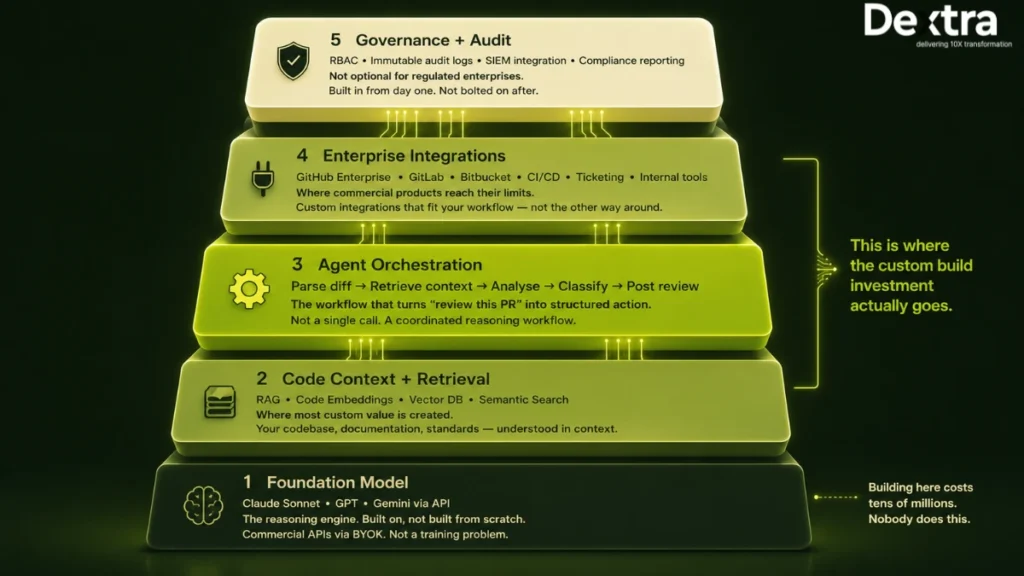
Here are the five architectural layers explained:
Layer 1: Foundation Model
Foundation Model Layer is the underlying LLM that powers the reasoning behind every code review. In 2026, most enterprises should use commercial foundation models like Claude Sonnet, GPT, or Gemini through APIs rather than training their own models. Building an LLM from scratch can cost tens of millions of dollars and isn’t part of a practical AI code review strategy.
Layer 2: Code Context and Retrieval
Code Context and Retrieval Layer gives the AI a deep understanding of your codebase using retrieval-augmented generation (RAG), code embeddings, vector databases, and semantic search. Instead of reviewing code in isolation, the agent can reference your documentation, coding standards, and architectural patterns. This is where much of the value of a custom solution is created.
Layer 3: Agent Orchestration
Agent Orchestration Layer is the logic that turns a simple request like “review this pull request” into a structured workflow. It parses the code changes, retrieves relevant context, performs analysis, classifies issues, generates developer-friendly feedback, and posts the review back into your development workflow.
Layer 4: Enterprise Integrations
Integration Layer connects the AI with your existing engineering ecosystem, including GitHub Enterprise, GitLab, Bitbucket, CI/CD pipelines, ticketing platforms, and internal developer tools. This is where commercial products often reach their limits, while custom development can adapt to the way your teams already work.
Layer 5: Governance and Audit
Governance and Audit Layer layer ensures the system meets enterprise security and compliance requirements through capabilities such as role-based access control (RBAC), immutable audit logs, SIEM integration, and compliance reporting. For regulated industries, it’s not an optional layer but an important one.
What “Building” Doesn’t Mean
One misconception often guides the entire build vs buy AI code review discussion: many CTOs assume that building means creating everything from scratch. In reality, that’s rarely how modern enterprise AI projects work. Let us walk you through some major misconceptions.
- Building doesn’t mean training your own foundation model: That’s an entirely different challenge involving years of research, massive datasets, specialized AI talent, and investments that can easily run into tens of millions of dollars. It’s not what enterprises are evaluating when deciding whether to build or buy an AI code review solution.
- Building also doesn’t mean starting from zero: Modern custom AI code review solutions are built using mature open-source frameworks, commercial foundation models through BYOK (Bring Your Own Key), and existing enterprise infrastructure. The goal isn’t to reinvent AI but to assemble the right components into a solution designed specifically for your engineering organization.
- What building actually means is designing everything around the model: The real work lies in creating the code context layer, orchestration workflows, enterprise integrations, and governance capabilities that make the AI understand your codebase and operate seamlessly within your development environment.
This distinction matters because it completely changes the investment conversation. Building a foundation model from scratch is a multi-million-dollar R&D initiative. Building a custom AI code review tool on top of proven foundation models is a very different undertaking, one that usually requires an initial investment in the range of $500K to $1.5M, while delivering a solution built around your business rather than a vendor’s roadmap.
What Buying an AI Code Review Agent Actually Mean in 2026
If you’re considering buying an AI agent instead of building it, this is what you can or can not realistically expect from commercial AI code review platforms.
What Buy Actually Delivers Well
The buy path offers many clear advantages, particularly for organizations looking to adopt AI quickly, especially at the beginning level. Understanding these strengths is important before evaluating where custom development begins to create greater long-term value.
1. Faster Time to Production
One of the biggest advantages of commercial tools is speed. Most platforms can be evaluated, procured, and rolled out within 30 to 60 days, allowing engineering teams to start using AI without waiting months for development. A custom solution, by comparison, typically requires six to twelve months before it’s production-ready.
2. Vendor-Maintained Model Improvements
Commercial vendors benefit from ongoing advances in foundation models from providers like Anthropic, OpenAI, and Google. As these models improve, vendors may incorporate those capabilities into their products, reducing the need for customers to manage model upgrades themselves.
3. Operational Maturity
Established platforms come with capabilities that take time to build internally, including SLAs, technical support, monitoring, incident response, and regular product updates. For organizations that want a managed service, this can reduce operational overhead in the early stages.
4. Built-In Compliance Readiness
Many vendors already hold certifications such as SOC 2 Type II, ISO 27001, and, in some cases, HIPAA. These certifications may simplify enterprise procurement by satisfying common security and compliance requirements without requiring internal teams to build those processes themselves.
5. Community Knowledge
Commercial platforms have typically been deployed across hundreds or thousands of engineering teams. That means implementation guides, troubleshooting documentation, best practices, and customer support are readily available, helping teams resolve common issues more quickly.
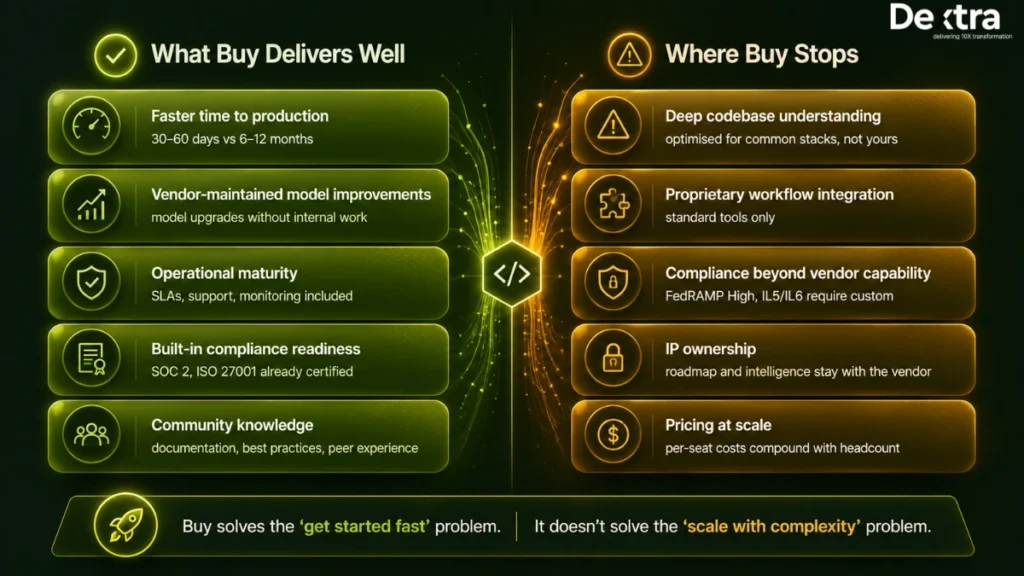
What Buy Doesn’t Deliver
All the above advantages are true, and for many organizations they’re reason enough to choose a commercial solution. But as engineering needs become more specific, you may begin to notice gaps that standard platforms aren’t designed to address, such as:
1. Deep Understanding of Your Codebase
Commercial tools are designed to work well across a wide range of organizations, not one specific engineering environment. They may perform well on common languages and frameworks, but often struggle to fully understand proprietary architectures, custom DSLs, legacy monoliths, or organization-specific coding standards.
2. Deep Integration with Proprietary Engineering Workflows
Most vendors integrate with standard tools like GitHub Enterprise, GitLab, Jira, and common CI/CD platforms. If your organization relies on internally developed tooling, custom approval workflows, or unique engineering processes, those integrations may require compromises rather than fitting naturally.
3. Compliance Beyond Vendor Capability
Vendor certifications cover many common procurement needs, but highly regulated environments often require more. Organizations operating under frameworks such as FedRAMP High, IL5/IL6, ITAR, or sovereign cloud requirements may find that commercial offerings cannot fully satisfy their governance expectations.
4. IP Ownership
When you buy a commercial platform, you’re licensing a product rather than owning the capability. The roadmap, core intelligence, and future direction remain in the vendor’s hands. So, for organizations that view AI-assisted engineering as a source of long-term competitive differentiation, this can become a strategic limitation for them.
5. Pricing at Scale
Per-user pricing often looks reasonable during pilots, but economics change as adoption grows. For engineering organizations with thousands of developers, annual licensing costs can increase significantly over time which makes the long-term AI code review cost much closer to that of a custom solution than it initially appears.
Why Buy Wins for Most Enterprises
If your engineering organization uses standard technology stacks, relies on common development tools, has typical compliance requirements, and isn’t operating at a very large scale, a commercial AI code review tool may be all you need. It can help your teams adopt AI quickly without investing months in building and maintaining a custom solution.
That said, don’t stop the evaluation there. As your engineering organization grows in complexity, the trade-offs begin to change. The next sections will help you understand where the buy path continues to make sense and where investing in a custom AI code review solution starts creating greater long-term value.
If You Build Instead of Buy an AI Code Review Tool: What Does It Actually Involve?
If you decide to build instead of buy, this is what the pattern looks like. While every enterprise has different requirements, most modern AI Agent Builder firms follow a structured approach that moves from understanding your engineering environment to deploying a production-ready AI code review agent.
The Foundational Build Process We Follow At Dextra Labs
A typical custom AI code review agent build for an enterprise client follows this pattern:
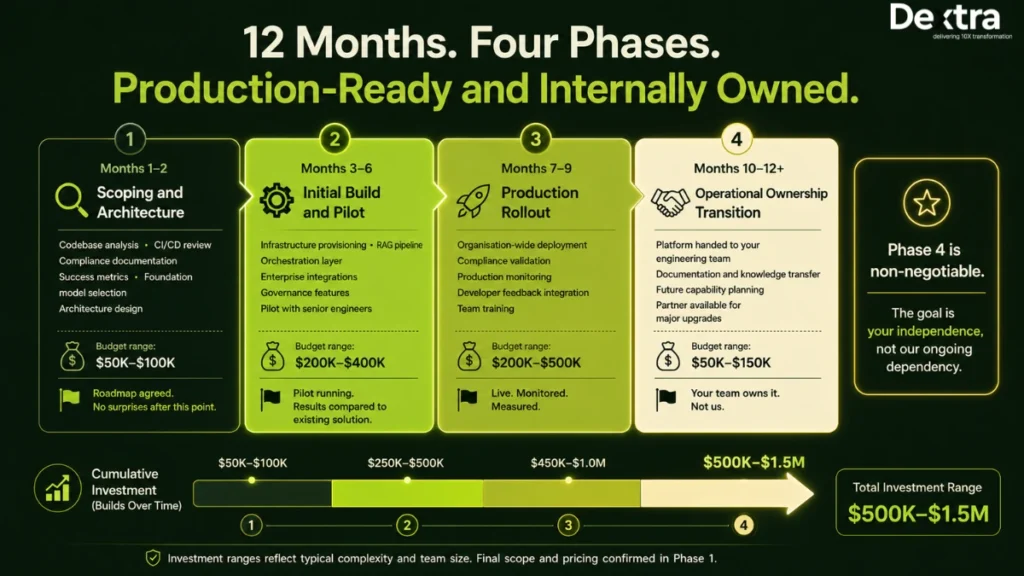
Months 1–2: Scoping and Architecture
Scoping and architecture are about understanding your engineering organization before development begins. During these first few weeks, the AI development partner works with your team to understand your codebase, technical environment, business goals, and compliance requirements. By the end of this phase, you should have a clear roadmap, realistic budget, timeline, and architecture for the project.
During this stage, the team typically:
- Analyzes your codebase to understand the programming languages, frameworks, monorepo structure, and dependencies.
- Reviews your CI/CD pipelines, version control systems, ticketing platforms, and internal developer tools.
- Documents your security, governance, and compliance requirements that the solution must meet.
- Defines success metrics such as pull request review time, developer acceptance rate, and bug escape rate.
- Selects the most suitable foundation model, typically using Claude, GPT, or Gemini through a BYOK approach.
- Designs the overall architecture covering the RAG strategy, context engineering, and agent orchestration framework.
Months 3–6: Initial Build and Pilot
The Initial build and pilot phase is where your custom AI code review platform starts taking shape. Based on the approved architecture, the development team builds the core capabilities, integrates them with your engineering environment, and validates everything with a small group of developers before a wider rollout.
This phase usually includes:
- Provisioning the required infrastructure, including inference environments, vector databases, monitoring, and observability.
- Building the code context and retrieval layer so the agent understands your codebase.
- Developing the orchestration layer, including prompt engineering and review workflows.
- Integrating the platform with your version control, CI/CD pipelines, and internal engineering systems.
- Implementing governance features such as audit logging, access controls, and compliance reporting.
- Running a pilot with a small group of senior engineers across different teams and technology stacks.
- Comparing results with your existing AI code review solution to measure improvements.
Months 7–9: Production Rollout
Production rollout is about moving from a successful pilot to an enterprise-wide deployment. The goal is to ensure the platform works reliably across your engineering organization while meeting performance, security and compliance expectations.
At this stage, the focus is on:
- Rolling out the platform to additional engineering teams.
- Validating compliance controls and audit requirements before wider adoption.
- Deploying production monitoring and performance measurement frameworks.
- Expanding capabilities based on real developer feedback and usage patterns.
- Training internal engineering teams to use and manage the platform effectively.
Months 10–12 and Beyond: Operational Ownership Transition
Operational ownership transition ensures that your team, not the AI Agent development partner, becomes responsible for running and improving the platform. By the end of this phase, your engineering organization should have everything needed to operate, maintain, and continue evolving the platform independently.
This stage includes:
- Transitioning day-to-day platform ownership to your engineering team.
- Completing documentation, knowledge transfer, and technical training.
- Planning future capabilities and major platform enhancements.
- The AI Agent Builder continues supporting major upgrades and new capabilities as needed.
- Reviewing the architecture regularly to keep the platform aligned with your engineering goals.
What Actually Costs Money in a Build
One of the most important concerns of CTOs is, “Where does the investment actually go?” The answer is that you’re not paying to build an AI model from the start. You’re investing in the architecture, integrations, governance, and engineering work needed to turn foundation models into a reliable, enterprise-ready AI code review system.
Initial Build Investment ($500K–$1.5M total)
This is the one-time investment required to design, build, test, and deploy a production-ready solution tailored to your engineering organization.
- Scoping engagement: $50K–$100K to understand your codebase, engineering workflows, and business requirements.
- Architecture design: $80K–$150K to define the overall system architecture, technology stack, and implementation approach.
- Layer 2 development (RAG + code context): $120K–$300K to build the retrieval pipelines that make the AI understand your codebase.
- Layer 3 development (agent orchestration): $80K–$200K to develop the workflows that analyze code changes and generate meaningful reviews.
- Layer 4 development (enterprise integrations): $100K–$300K to connect the agent with your version control, CI/CD pipelines, ticketing systems, and internal tools.
- Layer 5 development (governance and audit): $50K–$200K to implement security controls, audit trails, role-based access, and compliance capabilities.
- Compliance testing and certification support: $40K–$200K to validate the solution against your organization’s regulatory and security requirements.
- Internal training and rollout: $50K–$150K to prepare engineering teams for successful adoption across the organization.
Ongoing Annual Operating Cost ($200K–$700K per year)
Once the platform is in production, the focus shifts from building to operating and continuously improving it.
- Foundation model usage (BYOK): $50K–$300K per year, depending on model choice and review volume.
- Infrastructure: $50K–$150K per year for compute, storage, vector databases, monitoring, and observability.
- Capability expansion and maintenance: $50K–$150K per year to add new features, improve review quality, and adapt to changing engineering needs.
- Internal operations: $50K–$100K per year, typically requiring around 0.5–1 full-time engineer to monitor, maintain, and support the platform.
What Determines Build Cost Variability?
What you end up investing in custom AI code review depends on these three factors that create the wide cost ranges:
- Integration depth: If your teams use standard tools like GitHub Enterprise, common CI/CD platforms, and widely used ticketing systems, development is relatively simple. But if your engineering organization relies on proprietary developer tools, custom approval workflows, or internally built platforms, the effort and the cost naturally increase.
- Compliance scope: Organizations with standard security requirements can usually move faster. However, if your enterprise AI code review build must satisfy regulations such as FedRAMP High, support multiple jurisdictions, or include advanced audit and governance capabilities, additional engineering and validation work is required.
- Codebase complexity: A single-language application built on modern frameworks is much easier to support than a large engineering ecosystem spread across multiple languages, legacy systems, proprietary DSLs, and years of accumulated technical debt. The more context your custom AI code review tool needs to understand, the more sophisticated the architecture behind it becomes.
The key difference is where the investment goes. You’re not buying the tool that thousands of companies share; instead, you’re building it designed specifically for your engineering environment.
As you’ll see in the TCO analysis later, once engineering organizations reach sufficient scale, the economics often begin to shift. Beyond that point, the conversation is no longer just about cost rather about strategic engineering capability that evolves with your business.
When to Buy: The Five Scenarios Where Off-the-Shelf AI Code Review Wins
The five scenarios below cover the situations where an AI code reviewer custom vs off-the-shelf comparison often ends with buying being the more practical choice for some enterprises.
Scenario 1: Standard Codebase + Standard Stack
If your engineering teams work with widely used languages such as Python, Java, Go, or JavaScript, follow common architectural patterns, and don’t rely on proprietary frameworks or legacy code structures, commercial AI code review tools are already optimized for environments like yours. Though a custom development gives you greater control and extensibility, those advantages become far more valuable in organizations with unique engineering requirements than in a standard development environment.
Scenario 2: Standard Integration Requirements
If your engineering environment already runs on widely used platforms like GitHub Enterprise, GitLab, Bitbucket, Jira, and standard CI/CD pipelines, getting started with a commercial AI code review tool is usually straightforward. Since these integrations are already well supported, building custom ones often isn’t necessary.
Scenario 3: Compliance Requirements Covered by Vendor Certifications
Many organizations only need certifications such as SOC 2 Type II, ISO 27001, or HIPAA to satisfy procurement and security reviews. If those requirements are already covered by your chosen vendor, buying can save months of engineering effort that would otherwise go into building and validating compliance capabilities internally.
Scenario 4: Engineering Organization Below 1,500 Developers
For small to mid-sized engineering organizations, commercial licensing is often easier to justify financially. Licensing costs are generally manageable at this scale, which allows teams to adopt AI quickly without a significant upfront investment or the responsibility of managing their own platform while the long-term financial benefits of a custom AI code review solution typically become more noticeable as engineering teams grow larger.
Scenario 5: Limited Internal AI Engineering Capability
Building doesn’t end with deployment. Someone has to operate the platform, monitor performance, manage infrastructure, improve prompts, and expand capabilities over time. If your organization doesn’t have an AI engineering team or can’t dedicate ongoing ownership to the platform, a commercial solution is likely to be more sustainable.
Most enterprises will recognize themselves in one or more of these scenarios. If that’s the case, a commercial AI code review platform is likely to meet your needs. But if your engineering environment is becoming more complex, your teams are growing rapidly, or you’re looking for AI to become a long-term strategic capability, it’s worth considering where the build path starts to offer a stronger advantage.
When to Build: The Five Scenarios Where Custom AI Code Review Agents Beat Off-the-Shelf
If the buying scenarios in the previous section didn’t quite match your organization’s goals and objectives, it’s time to look at the other side of the build vs buy AI code review decision. The following scenarios are where a custom AI code review tool often becomes the stronger long-term investment.
Scenario 1: Your Compliance Requirements Exceed Vendor Capability
If your organization operates under strict regulations such as FedRAMP High, IL5/IL6, ITAR, CMMC Level 3, sovereign cloud requirements, or multiple compliance frameworks across different regions, commercial tools may not be able to meet every requirement. In these situations, a custom AI code review solution gives you the flexibility to design security, governance, deployment, and audit capabilities around your exact compliance needs from the very beginning.
Scenario 2: Your Codebase Has Constraints Vendor Models Don’t Handle
Commercial AI code review tools are built to perform well across the most common programming languages and development environments. But if your engineering teams work with proprietary languages, internal DSLs, heavily customized legacy systems, industry-specific architectures, or large monorepos that have evolved over many years, a generic approach often struggles to understand the context. A custom solution can be designed specifically for the way your codebase is structured, making its reviews far more relevant and reliable.
Scenario 3: Your Engineering Workflow Extends Beyond Standard Integrations
If your operational stack includes proprietary CI/CD systems, internally built developer platforms, custom approval workflows, specialized deployment pipelines, or security processes unique to your organization, standard vendor integrations may only solve part of the problem. A custom AI code review platform can fit naturally into the way your engineering organization already works, instead of requiring teams to adapt their workflows around the capabilities of a commercial product.
Scenario 4: Your Engineering Organization Has Reached a Scale Where Building Starts Making Financial Sense
As engineering teams grow, so do licensing costs. For organizations with 1,500 or more developers, the annual cost of commercial AI code review platforms can quickly reach hundreds of thousands or even millions of dollars. At this point, the economics begin to shift. While a custom solution requires a higher upfront investment, its total cost of ownership often becomes more beneficial over the long term. As your organization continues to scale, you’re investing in a capability your teams own rather than increasing subscription costs year after year. We’ll look at these numbers in more detail in the TCO comparison later in this guide.
Scenario 5: AI Code Review Is Becoming a Strategic Capability for Your Business
For organizations where AI-augmented engineering is strategic for example, this is especially true for industries such as financial services, defense, aerospace, pharmaceuticals, and critical infrastructure, where engineering speed, software quality, and security have a direct impact on business outcomes. In these cases, owning the technology, the workflows, and the intellectual property behind your AI code review capability provides long-term strategic value. Instead of relying on a vendor’s roadmap, your organization can continuously evolve the platform to support its own priorities and future innovation.
The Custom Build Path: What the Engagement Actually Looks Like
If you found yourself relating to one or more of the scenarios above, you don’t need to commit to building right away. The smartest next step is to understand what a custom solution would actually look like for your organization.
A conversation with an experienced AI Agent Builder isn’t about getting a sales pitch but about getting clarity. Together, you can map your engineering environment, identify where commercial platforms are likely to fall short, estimate the investment and timeline, and determine the level of internal ownership required after deployment. In many cases, you’ll also discover opportunities to phase the implementation or adopt a hybrid approach while working toward a fully customized solution.
Most importantly, this process helps you answer the question that matters most: Will a custom AI code review capability create enough long-term value for your engineering organization to justify the investment? If the answer is yes, you’re investing in an engineering capability that your teams own, control, and continuously improve as your business evolves. That’s a very different proposition from licensing software built for everyone else.
Build vs Buy AI Code Review TCO: Honest Economics at Three Engineering Scales
The table below compares the three-year TCO of commercial AI code review platforms and custom AI code review solutions across different engineering team sizes.
| Engineering Headcount | Buy (Off-the-Shelf, $50/seat/mo avg) | Build (Custom AI Code Review Agent) | Break-Even Point | Strategic Considerations |
| 500 engineers | $900K total (3yr) | $1.1M-$1.8M total (3yr) | Buy wins on cost alone | Build becomes the better choice if your organization fits one or more of the scenarios outlined in Section 5. |
| 1,500 engineers | $2.7M total (3yr) | $1.5M-$2.4M total (3yr) | Build wins by Year 2 | Both the financial benefits and long-term strategic value begin to favor building. |
| 3,000 engineers | $5.4M total (3yr) | $1.8M-$2.8M total (3yr) | Build wins by Year 1 | Building offers a strong advantage from both a cost and strategic perspective. |
| 5,000 engineers | $9M total (3yr) | $2.2M-$3.5M total (3yr) | Build wins in months | Buy becomes economically irrational |
What the TCO Numbers Include
The comparison above is based on a realistic set of assumptions. Below, the estimates include the major costs organizations typically incur over a three-year period for both buying and building.
Buy Path (3-Year TCO)
The cost of buying goes beyond the monthly subscription. The three-year estimate includes:
- Per-seat licensing costs based on engineering headcount over 36 months.
- Typical annual price increases, which many vendors introduce over time.
- Enterprise implementation and onboarding services.
- Administrative effort for vendor management, license tracking, renewals, and contract negotiations.
- Migration costs if you’re replacing an existing AI code review platform or developer tool.
Build Path (3-Year TCO)
The cost of building includes both the initial development effort and the ongoing investment required to operate the platform successfully.
- Initial build investment, including architecture, development, integrations, governance, testing, and rollout.
- Foundation model API usage through a BYOK approach, with costs scaling based on adoption and review volume.
- Infrastructure such as compute, storage, vector databases, monitoring, and observability.
- Continuous maintenance, capability expansion, and platform improvements as engineering needs evolve.
- Internal engineering time to operate, monitor, and support the platform after deployment.
What the TCO Numbers Don’t Include
Even a detailed cost model can’t capture every factor that influences a long-term investment decision. Some of the biggest differences between buying and building are strategic rather than financial. So, let’s see a few of them.
- Ownership of Intellectual Property: A custom AI code review capability becomes part of your engineering advantage and evolves with your business.
- Vendor Dependency: Commercial platforms may change pricing, licensing terms, product direction, or even discontinue features over time. Owning the platform gives you far greater control over its future.
- Additional Compliance Work: Organizations with highly regulated environments often need security, governance, or deployment capabilities beyond what commercial vendors provide. These efforts can increase the real AI code review cost of the buy path.
- Operational Flexibility: A custom platform gives your engineering organization the freedom to decide how, where, and when the system evolves without being tied to a vendor’s roadmap.
For organizations where these factors carry significant business value, the financial break-even point often arrives sooner than a standard TCO model suggests.
Engineering Scale Sensitivity Analysis
The break-even point isn’t determined by engineering headcount alone. Three factors mentioned below also have the biggest impact on when building starts becoming the more economical option:
- Codebase complexity: Standard codebases generally reach break-even later, while highly specialized or proprietary codebases often justify custom development much earlier.
- Integration requirements: If your engineering teams rely on proprietary developer tools, internal platforms, or custom workflows, the value of a custom solution increases much faster.
- Compliance requirements: Organizations with advanced regulatory obligations often see the strongest case for building because commercial solutions may require significant workarounds or additional controls.
When two or more of these factors apply to the same organization, the economics can change dramatically. In practice, many enterprises reach the point where building makes financial and strategic sense much earlier than engineering headcount alone would suggest.
The Hybrid Path: Buy Off-the-Shelf Core, Build Custom Layer on Top
For some organizations, the answer isn’t strictly buy or strictly build; the best approach is a mix of both, using a commercial AI code review platform for common use cases while building custom capabilities where they create the most value.
Where the Hybrid Approach Makes Sense
A hybrid approach often works well in these situations:
Situation #1: You Have Mostly Standard Requirements with a Few Unique Needs
If a commercial AI code review tool meets most of your development needs but falls short on areas like proprietary workflows, internal tools, or compliance requirements, you can keep the vendor platform and build only the capabilities that are specific to your organization.
Situation #2: You’re Modernizing an Existing Custom Solution
Some enterprises already have internal AI tools that still solve important business problems. Instead of replacing everything, they move common code review tasks to a commercial platform while continuing to use custom components where they provide a clear advantage.
Situation #3: You Want to Invest Gradually
Building a complete custom platform from day one isn’t the only option. Many organizations start with a commercial solution, learn where the gaps are, and then add custom capabilities over time. As the business grows, they can decide whether expanding the custom layer or eventually replacing the core platform makes sense.
Common Hybrid Architectures
There isn’t a single way to implement a hybrid strategy, but these approaches are commonly seen in enterprise environments:
- Commercial AI Code Review + Custom Compliance Layer: The vendor handles day-to-day code reviews, while a custom layer manages organization-specific compliance checks, audit trails, and security reporting.
- Commercial AI Code Review + Custom Retrieval Layer: The commercial platform performs the review, while a custom RAG layer provides additional context from internal documentation, coding standards, and proprietary codebases.
- Static Analysis + Custom AI code Review: Traditional static analysis tools handle rule-based security and quality checks, while a custom AI agent provides deeper, context-aware code reviews.
- Different Tools for Different Parts of the Codebase: Some organizations use commercial platforms for general application development while deploying custom AI code review capabilities only for business-critical or highly sensitive systems.
When Hybrid Becomes Pure Custom
A hybrid approach doesn’t always stay hybrid. As organizations continue solving more of their unique engineering challenges, many find themselves gradually building more custom capabilities until those become the most valuable part of the solution.
It’s common for organizations to start with a commercial platform and add a custom AI code review layer to fill specific gaps. Over the next 12 to 18 months, that custom layer often expands to support more workflows, deeper integrations, and additional compliance needs. Eventually, it may handle most of the work, while the commercial platform is used much less than before.
There’s nothing wrong with this transition, as long as it’s intentional. The challenge arises when organizations don’t plan for it and end up paying to maintain both systems, even though much of the functionality overlaps.
Hybrid TCO Considerations
A hybrid approach usually falls somewhere between the buy and build paths in terms of investment.
- Initial investment: Typically $200K–$600K, which is lower than building a fully custom solution from day one.
- Ongoing annual cost: Commercial licensing plus approximately $100K–$300K to operate and improve the custom layer.
- Break-even: It generally takes longer to reach than a full custom build, but it can still become more cost-effective than a pure buy approach when your organization has strong custom requirements.
A hybrid approach works best when there’s a clear plan behind it. Instead of trying to balance two solutions forever, use it as a way to meet your immediate needs while gradually building capabilities that are unique to your organization.
The Build Engagement Model: How Custom AI Code Review Development Actually Works
Below is a typical engagement model followed by experienced AI Agent Builders like Dextra Labs to take an enterprise AI code review build from planning to production.
What Properly Scoped Engagement Looks Like
Custom AI code review agent engagements follow predictable patterns, involving the following phases:
Phase 1: Discovery and Scoping (Weeks 1–4 | ~$50K–$100K)
The first phase is about understanding your engineering organization before any development begins. A well-planned discovery phase helps avoid costly changes later and ensures the solution is built around your actual requirements and not assumptions.
Here’s what typically happens during this stage:
- Your engineering, security, and platform teams work with the AI development partner to understand your business goals, technical challenges, and long-term expectations.
- The team reviews your codebase, engineering workflows, and existing tools to identify where a custom AI code review solution can create the most value.
- Compliance, security, and governance requirements are documented to ensure they’re built into the solution from the very beginning.
- Success metrics, priorities, and project scope are agreed upon so everyone is aligned before development begins.
- The engagement concludes with a detailed roadmap covering the recommended architecture, timeline, investment, and clear next steps.
Phase 2: Architecture and Initial Build (Months 2–4 | ~$200K–$400K)
Once the foundation is in place, development begins on the core capabilities of the custom AI code review tool.
Here’s what the initial build typically includes:
- The development team builds the first version of your custom AI code review platform based on the roadmap created during discovery.
- The solution is connected with your primary engineering tools so it fits naturally into your existing development workflow.
- The AI is configured to understand your codebase, review standards, and engineering context.
- A pilot is launched with a small group of experienced engineers to validate performance in real development environments.
- Feedback from the pilot is used to improve the platform before expanding it across the organization.
Phase 3: Production Deployment (Months 5–8 | ~$200K–$500K)
After the pilot proves successful, the focus shifts to making the platform ready for production across the engineering organization.
So, the next step is to prepare the platform for organization-wide adoption by:
- Expanding integrations across your engineering teams and integrating it with the rest of your development ecosystem.
- Implementing governance, audit logging, security controls, and compliance capabilities required for production use.
- Rolling out the platform to additional engineering teams.
- Completing compliance validation where required.
- Deploying monitoring and measurement frameworks to track performance and adoption.
Phase 4: Operational Ownership Transition (Months 9–12 | ~$50K–$150K)
The final phase is about making your team self-sufficient. By the end of this stage, your organization should be able to operate and evolve the platform with confidence.
Before the engagement concludes, the focus is on:
- Training engineering and operations teams to confidently manage the platform day to day .
- Transferring technical documentation, architectural knowledge and operational best practices.
- Handing over platform ownership and future capability planning.
- Defining a long-term engagement model for strategic guidance, major upgrades, and future AI capabilities.
What Total Cost Looks Like
By this stage, you probably have a better idea of whether a custom AI code review solution fits your organization. The next question is just as important: What does the overall investment actually look like?
For a properly scoped enterprise project, you can generally expect:
- Initial Build Investment (Phases 1-4): $500K-$1.5M, which will depend on your engineering complexity, integrations, and compliance requirements.
- Year 1 Operational Costs: Around $200K-$400K, covering foundation model usage, infrastructure, platform operations, and ongoing support.
- Year 2 and Beyond: Typically $150K-$300K per year, as your internal team takes ownership and external support is mainly needed for major upgrades or new capabilities.
One thing to look for is how the project is scoped. Experienced AI Agent Builders usually begin with a dedicated discovery phase instead of asking you to commit to the full project upfront. Once that phase is complete, both sides have a much clearer picture of the timeline, budget, and whether moving forward makes sense.
What Goes Wrong in Build Engagements
Like any enterprise software initiative, a custom AI project succeeds when it’s planned well. Below are the three patterns that derail custom AI code review builds:
- Scope Creep Without Re-Scoping: As development progresses, new requirements often emerge. Without regular re-scoping, budgets and timelines can quickly drift.
- Foundation Model Commitment Without Flexibility: AI models continue to evolve rapidly. Building enough flexibility into the architecture from the beginning makes it easier to adapt as capabilities and pricing change.
- Insufficient Operational Handoff in Phase 4: The long-term value of a custom platform comes from your organization being able to operate and improve it confidently. A structured knowledge transfer should always be part of the engagement.
How Can You Evaluate an AI Agent Builder Firm?
The success of a custom AI code review project depends as much on the delivery partner as it does on the technology. Before making a decision, look for a team that can demonstrate:
- Relevant Project Experience: Look for a partner that has delivered AI code review solutions or similar AI agent projects, not just general AI consulting engagements.
- Model-Agnostic Approach: Choose a team that gives you the flexibility to use or switch foundation models as your requirements and the AI landscape evolve.
- Structured Engagement Model: A reliable AI partner should have clearly defined phases, milestones, timelines, and decision points, so you always know what comes next.
- Operational Handoff: The engagement should include a well-planned knowledge transfer that allows your engineering team to confidently own, operate, and improve the platform after deployment.
- Honest Recommendations: A trustworthy AI partner should be willing to tell you when a commercial solution is the better fit instead of recommending custom development for every situation.
We encourage organizations to evaluate these questions at Dextra Labs before committing to any custom AI project. The right engagement model should give you clarity on scope, investment, and long-term ownership and not just a project estimate.
Frequently Asked Questions
Q1. Should I build or buy AI code review for my enterprise?
The right choice depends on your organization’s needs. Buying may be a practical option for teams with standard codebases, common development tools, and relatively straightforward compliance requirements. However, if your engineering organization has proprietary code, complex internal workflows, strict security or regulatory requirements, or is growing beyond 1,500 developers, building a custom AI code review solution is often the better long-term strategy because it gives you:
– Full control over features, integrations, and deployment.
– Ownership of the AI capability and intellectual property.
– Freedom from vendor lock-in and recurring licensing costs.
– The flexibility to evolve the platform as your engineering organization grows.
Q2. How much does it cost to build a custom AI code review agent?
For an enterprise-grade custom AI code review agent, the initial investment typically ranges from $500K to $1.5M, depending on factors such as codebase complexity, integration requirements, compliance needs, and deployment scope. After deployment, ongoing operating costs generally range between $200K and $700K per year, including foundation model API usage, infrastructure, maintenance, capability enhancements, and the internal engineering effort required to operate and continuously improve the platform.
Q3. How long does it take to build a custom AI code review agent?
A well-planned custom AI code review project typically takes 6 to 12 months from start to finish. The first 1–2 months are spent on discovery, scoping, and architecture. The next 3–6 months focus on building the platform and running a pilot with a small group of engineers. This is followed by production rollout, broader adoption across engineering teams, and at last a structured handover so your internal team can confidently operate and evolve the platform.
Q4. What’s the break-even point for build vs buy AI code review?
The break-even point depends on your engineering team size, code review volume, and the complexity of your development environment. For many organizations spending less than $100,000 per year on commercial AI code review tools, buying is often the more cost-effective option. However, as your engineering organization grows, typically beyond 1,500 developers or when licensing costs increase to hundreds of thousands of dollars annually, the economics begin to shift. At that stage, a custom AI code review solution can often recover its initial investment within 1–2 years while also providing long-term benefits such as IP ownership, deeper integrations, greater flexibility, and freedom from vendor lock-in.
Q5. Can I build AI code review on top of commercial foundation models?
Yes. In fact, most modern enterprise AI code review solutions are built this way. Instead of training a large language model from scratch, organizations use commercial foundation models such as GPT, Claude, or Gemini through their APIs and build custom capabilities around them. This approach significantly reduces development time and cost while allowing you to focus on what creates real value like integrating the AI with your codebase, engineering workflows, compliance requirements, and internal tools. You also pay for model usage as needed, making it a far more practical and cost-effective approach than developing a foundation model yourself.
Q6. What’s the difference between building and buying AI code review?
Buying means licensing a commercial AI code review platform and using the features the vendor provides. Building means creating a custom AI code review solution on top of commercial foundation models, designed specifically for your codebase, workflows, integrations, and compliance needs. The biggest difference is that buying gives you access to a product, while building gives you ownership, flexibility, and long-term control.
Q7. What internal team capability do I need to build custom AI code review?
To build a custom AI code review system, your team should have three core capabilities: AI and LLM orchestration, deep code context and retrieval (RAG), and DevOps and engineering workflow integration. In addition, you’ll need expertise in areas like security, compliance, infrastructure, and ongoing platform operations. If these capabilities don’t exist in-house, many organizations partner with an experienced AI Agent Builder like Dextra Labs for the initial development and gradually transition operational ownership to their internal team after deployment.
Q8. Can I switch from off-the-shelf to custom AI code review later?
Yes, definitely you can. Many organizations start with a commercial AI code review tool and move to a custom solution as their engineering needs become more complex. With an experienced AI Agent Builder, the process can be planned and executed quite easily through a phased approach. This typically includes:
– Assessing your existing setup to identify what should be retained, replaced, or enhanced.
– Designing the custom platform around your codebase, engineering workflows, integrations, and compliance requirements.
– Migrating workflows and integrations while minimizing disruption to development teams.
– Training your internal teams so they can confidently operate and expand the platform over time.
A well-planned transition allows you to continue benefiting from your existing investment while gradually building a custom AI code review capability that your organization fully owns and controls.
Q9. What’s the strategic value of building custom AI code review beyond cost?
Building a custom AI code review solution delivers long-term strategic value beyond reducing licensing costs. The following are some of the advantages:
– Complete ownership of your AI platform and intellectual property.
– Stronger security by keeping sensitive code and engineering workflows within your own environment.
– Custom compliance tailored to your organization’s regulatory and governance requirements.
– Greater flexibility to add new capabilities, integrations, and workflows as your business evolves.
– Freedom from vendor lock-in, giving you full control over your AI roadmap and future investments.
Q10. What’s a hybrid AI code review approach?
A hybrid AI code review approach combines commercial tools with custom development. You use an off-the-shelf platform for general code reviews while building custom capabilities for areas like proprietary integrations, compliance, or complex codebases. It’s a practical way to address immediate needs while creating a path toward greater ownership, and many organizations gradually move to a fully custom solution as their engineering requirements grow.