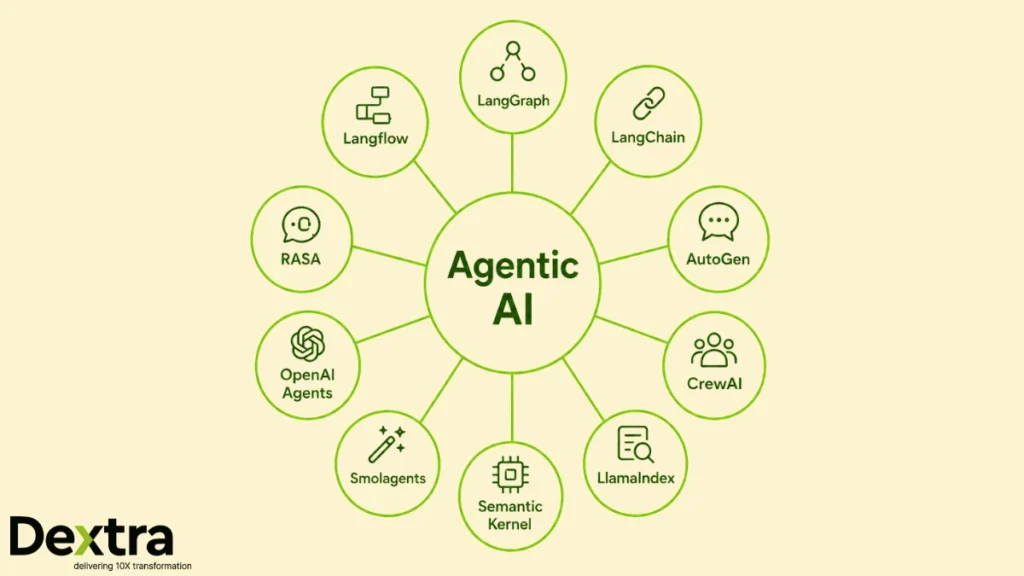
The rise of agentic AI is accelerating faster than most teams can keep up with. According to Precedence Research, the global agentic AI market is valued at $10.86 billion in 2026 and is projected to reach approximately $199.05 billion by 2034, growing at a CAGR of 43.84%. At the same time, Gartner predicts that by the end of 2026, 40% of enterprise applications will include task-specific AI agents—up from less than 5% in 2025. AI agents are rapidly becoming core infrastructure.
This shift has changed the conversation. Businesses are no longer asking whether to adopt AI agents, but which agentic AI frameworks can support production-scale deployment, orchestrate multi-agent systems, and ensure reliable governance of autonomous workflows. Dextra Labs helps organisations navigate this transition by identifying the right frameworks and architectures for scalable, real-world use.
Agentic AI frameworks now form the backbone of modern AI systems. AI agents are the systems, while agentic AI frameworks are the infrastructure used to build and orchestrate them. They enable developers to build, deploy, and manage autonomous agents that execute multi-step tasks with minimal human input. By simplifying prompt management, tool integration, API orchestration, and multi-agent coordination, these frameworks make it possible to scale complex workflows efficiently while improving output quality and reliability. This guide benchmarks the top agentic AI frameworks in 2026 across production readiness, orchestration style, MCP support, and real-world enterprise use.
What Is an Agentic AI Framework?
An agentic AI framework is a software platform that enables developers to build, deploy, and manage autonomous AI agents that can plan, reason, and execute multi-step tasks with minimal human input. It provides core capabilities such as tool integration, memory, state management, and workflow orchestration.
Unlike traditional machine learning frameworks, which focus on training predictive models, agentic AI frameworks focus on execution and decision-making—allowing agents to interact with APIs, databases, and external systems to complete real-world tasks.
Why Agentic AI Frameworks Matter in 2026
Agentic AI frameworks are enabling a new class of software systems, autonomous agents that can plan, make decisions, and execute multi-step tasks with minimal human input. Unlike traditional automation, these agents can dynamically adapt, interact with external systems, and collaborate with other agents to complete complex workflows.
The impact is already measurable. According to McKinsey & Company, organisations implementing AI agents report revenue increases of 3–15% and 10–20% improvements in sales ROI, with some reducing marketing costs by up to 37%. Research from PwC shows that 100% of industries are expanding AI adoption, including traditionally slower sectors like mining and construction. Meanwhile, Gartner predicts that by 2029, agentic AI will autonomously resolve 80% of common customer service issues, highlighting how quickly task-specific automation is scaling. (Source)
A key reason for this acceleration is the emergence of standardisation. The Model Context Protocol (MCP) has become the default method for connecting agents to tools, APIs, databases, and enterprise systems, dramatically reducing integration complexity. In parallel, Google’s Agent-to-Agent (A2A) protocol enables agents built on different frameworks to communicate and collaborate, which is critical as organisations adopt multiple tools across teams and environments.
Modern agentic AI frameworks also support persistent memory and context management, allowing agents to retain information across sessions and improve decision-making over time. This enables more advanced use cases—from personalised customer interactions to long-running enterprise workflows—without requiring constant human oversight.
By providing structured components for orchestration, memory, and tool integration, these frameworks allow organisations to build scalable, reliable AI systems that handle both routine and complex tasks. The result is higher productivity, better decision-making, and the ability to scale operations without proportional increases in headcount.
How to Choose an Agentic AI Framework
Choosing the right agentic AI framework depends on how well it supports production-scale requirements, not just prototyping speed. The most important factors include production readiness (observability, reliability, and error handling), MCP support for seamless integration with tools and APIs, and token economics, since framework design directly impacts latency and cost at scale.
Another key decision factor is orchestration style. Graph-based frameworks like LangGraph are best for structured, stateful workflows with branching logic and strong control over execution flow. Role-based systems such as CrewAI-style architectures focus on collaboration between specialized agents, while conversational frameworks like AutoGen prioritize dialogue-driven coordination. Each approach trades off control, flexibility, and complexity.
Finally, teams should evaluate how well a framework fits their operational environment—whether it supports long-running workflows, multi-agent coordination, and scalable memory management. The best choice is not the most feature-rich framework, but the one whose architecture aligns with the complexity and production demands of your specific use case.
Once you’ve chosen the right framework, the next step is turning that architecture into a production-ready system. If you need help designing, building, and deploying it, explore our AI agent development service.
Top 10 Agentic AI Frameworks in 2026
1. LangGraph
LangGraph has emerged as one of the most important agentic AI frameworks in 2026, particularly for teams building production-grade, stateful AI systems. Developed as part of the LangChain ecosystem, it introduces a graph-based execution model where workflows are defined as nodes and edges—enabling precise control over how agents move between steps, handle errors, and maintain state.
Unlike chain-based architectures, LangGraph operates as a state machine, allowing developers to implement branching logic, retries, checkpointing, and human-in-the-loop interventions with far greater reliability. This makes it especially well-suited for long-running workflows, multi-step reasoning tasks, and systems where auditability and recovery are critical.
Benchmark position: Across standardized evaluations, LangGraph consistently delivers the lowest latency among agentic AI frameworks for complex workflows. Its architecture minimizes unnecessary LLM calls and avoids the overhead of conversational loops, resulting in faster execution and more predictable performance. It also demonstrates strong error recovery behaviour, with agents successfully pivoting to alternative strategies in the majority of failure scenarios.
Use Cases: Complex enterprise workflows, multi-step automation pipelines, AI copilots with memory, decision systems requiring conditional branching, and production environments where reliability and observability are critical.
Best for: Teams moving from prototypes to production; workflows requiring state persistence, checkpointing, and rollback; applications where latency and cost efficiency matter at scale; organisations already using LangChain and needing a robust orchestration layer.
Limitations: Requires a deeper understanding of graph-based logic and workflow design. Initial setup is more complex than plug-and-play frameworks like CrewAI. Not ideal for simple use cases where a linear chain or single-agent setup is sufficient.
2. LangChain
LangChain offers a modular, extensible platform for managing LLM-centric workflows, making it one of the most widely adopted frameworks in the ecosystem. Built around large language models, it supports retrieval-augmented generation (RAG) using vector databases, enabling agents to store, retrieve, and reason over contextual information.
In 2026, LangChain is best understood as the tooling and integration layer of the agentic stack, while LangGraph (covered next) handles stateful, production-grade orchestration. Many teams use both together: LangChain for chaining tools, APIs, and data pipelines, and LangGraph for managing complex workflows, branching logic, and long-running agent execution.
LangChain automates the process of triggering the corresponding API call when an LLM determines which external tool or database to access, streamlining integrations and external interactions based on prompt analysis.
Benchmark position: LangChain has the highest latency and token usage among benchmarked frameworks for complex multi-step tasks, reflecting its sequential AgentExecutor architecture and chain-first design. For simple tool calls, it finishes under 5 seconds with fewer than 900 prompt tokens — comparable to non-agentic code. LangChain is the most token-efficient framework across tasks overall.
Use Cases: A widely cited real-world example: Cisco’s Outshift division leveraged LangChain to develop its AI Platform Engineer, achieving a reported tenfold boost in DevOps productivity and reducing tasks that previously took weeks to just hours. Widely used for chatbots, research assistants, document analysis, and workflow automation in data-heavy sectors.
Best for: Developers needing a modular framework to build custom AI pipelines; teams integrating with multiple LLMs; applications where RAG is the core capability; any workflow requiring broad integration with APIs, databases, and real-time services.
Limitations: LangChain operates primarily through single-agent execution patterns, making it optimized for single agent capabilities. Multi-agent orchestration requires manual setup, and its sequential architecture is not suited for workflows requiring complex branching or parallel execution — use LangGraph for those requirements. Its chain-first design leads to higher latency and token usage compared to other frameworks. Broad integration capacity increases complexity and maintenance overhead. High compute demands for large LLM processes.
3. Microsoft Agent Framework (formerly AutoGen)
AutoGen, created by Microsoft, is an open-source platform for building agentic AI systems and enabling multiple agents to collaborate on complex tasks. Its event-driven architecture allows agents to coordinate via asynchronous messaging, supporting both request/response and event-driven interaction patterns, while orchestration logic manages and coordinates agent activities to ensure reliable and structured workflows.
Microsoft placed AutoGen into maintenance mode — it now receives only bug fixes and security patches, with no new features. Active development has moved to the Microsoft Agent Framework, which merges AutoGen’s multi-agent capabilities with Semantic Kernel’s enterprise features. It supports MCP, A2A, and AG-UI protocols out of the box, with cross-language support for Python and .NET. If you are starting a new project that would have used AutoGen, evaluate the Microsoft Agent Framework instead. Existing AutoGen v0.4 users have a published migration path to the new framework via Microsoft Learn.
AutoGen’s conversational orchestration model, where agents interact through structured dialogue, debate, and delegation — is carried forward in the new framework. AutoGen Studio (a no-code interface for prototyping) continues to be available. For teams already on Azure, the Microsoft Agent Framework adds native identity management, compliance tooling, and optimised inference endpoints, as well as integration with external systems such as databases and APIs for enhanced connectivity and scalability.
Use Cases: Multi-agent research assistants, collaborative workflows requiring human-in-the-loop oversight, enterprise automation in regulated industries (finance, insurance), document classification, data extraction, and compliance reporting.
Limitations: The conversational pattern means every agent turn involves a full LLM call with accumulated conversation history, making it expensive for high-volume, real-time use cases. Teams evaluating this framework today should assess migration implications from AutoGen v0.2/v0.4 to the unified Microsoft Agent Framework. The new framework is still stabilising through its first production cycles.
Best for: Azure-committed enterprises needing multi-agent setups with human-in-the-loop oversight; organisations that need .NET support; teams requiring both conversational flexibility and enterprise compliance features, including monitoring of agent actions for security, governance, and auditability.
4. CrewAI
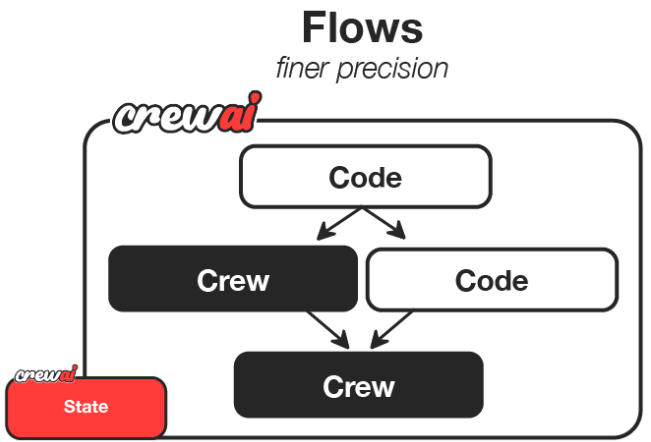
CrewAI is designed for orchestrating real-time collaboration among autonomous agents, making it the most accessible entry point into multi-agent development in 2026. It has surpassed 44,000+ GitHub stars — the most of any framework in this list — driven by its approachable “crew” model where agents are defined by roles, goals, and backstories rather than graph nodes. CrewAI assigns role specific agents, such as ‘Researcher’ or ‘Writer’, each with distinct tools and responsibilities, enabling specialized collaboration within a crew. The framework handles orchestration logic natively, ensuring reliable coordination and execution of agent workflows.
CrewAI has added A2A (Agent-to-Agent) protocol support, enabling crews to interact with agents built on other frameworks. The hosted CrewAI platform now includes a visual editor, built-in tracing, hallucination scoring, and human-in-the-loop guardrails that explicitly involve human agents for oversight, approval, and exception handling. Enterprise pricing includes SOC 2, SSO, and PII masking (SOC 2 certification in progress as of early 2026). MCP support is available — CrewAI connects to MCP servers via URL-based configuration — though it treats MCP tools as callable functions rather than streaming-capable graph nodes.
Real-world outcome: In fintech environments, CrewAI deployments enabled autonomous agents to process tens of thousands of fraud checks per day, reducing manual review loads and minimising false positives through role-specific agent coordination with human oversight gates. (Source: CrewAI Use Cases documentation)
Benchmark position: CrewAI exhibits structural “managerial overhead” — consuming nearly 3× the tokens of LangChain and taking almost 3× longer even for single tool calls. This cost appears regardless of task complexity. For thoroughness-sensitive tasks, this overhead is justified; for high-volume real-time workflows, it is a cost liability. Teams commonly use CrewAI for rapid prototyping, then migrate to LangGraph for production. (Source: AIMultiple Agentic Frameworks Benchmark 2026)
Best for: Teams new to multi-agent development who need fast time-to-demo; content creation, research, and role-based workflow automation; human-AI collaboration scenarios; prototyping before migrating to a production-grade framework.
Limitations: No built-in checkpointing for long-running workflows. Limited control over agent-to-agent communication (mediated through task outputs, not direct messaging). Error handling is coarse-grained for complex multi-step failures. Not the right choice for workflows requiring audit trails or precise state rollback.
5. LlamaIndex
LlamaIndex has become a core component of the agentic AI stack in 2026, particularly for applications that rely heavily on data retrieval, indexing, and context management. Originally built for retrieval-augmented generation (RAG), it has evolved into a full-fledged framework for connecting LLMs with structured and unstructured data sources at scale.
LlamaIndex specialises in data orchestration—handling ingestion, indexing, retrieval, and query pipelines across documents, databases, APIs, and knowledge bases. In modern agent architectures, it is often used alongside LangChain or LangGraph, acting as the data layer while those frameworks handle reasoning and workflow execution.
A key strength of LlamaIndex is its ability to maintain high-quality context retrieval, which directly impacts agent accuracy, hallucination rates, and response relevance. It supports advanced retrieval strategies, hybrid search, and integration with vector databases—making it essential for enterprise-grade knowledge agents.
Use Cases: Enterprise search, document intelligence, knowledge assistants, RAG pipelines, financial and legal document analysis, and any workflow where agents must reason over large, evolving datasets.
Best for: Teams building data-heavy AI systems; applications where retrieval quality is critical; organisations implementing RAG at scale; systems that require tight control over indexing and context flow.
Limitations: Not a full orchestration framework on its own—requires pairing with frameworks like LangGraph for complex workflows. Setup and tuning of indexing pipelines can be complex for first-time users.
6. Semantic Kernel
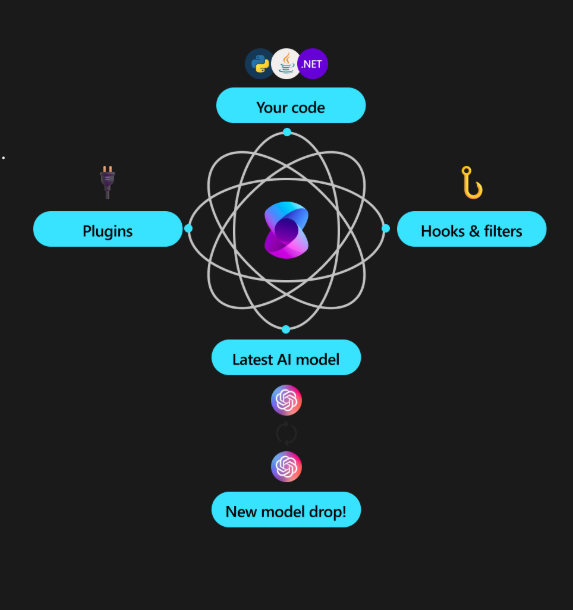
Semantic Kernel is Microsoft’s open-source framework for integrating AI into commercial applications. It supports Python, C#, and Java — making it one of the few frameworks accessible to enterprise teams not working exclusively in Python. It is designed for safe, large-scale automation and works seamlessly with existing business logic and external enterprise systems, enabling integration with third-party tools and data sources such as vector databases, Redis, Postgres, and in-memory caches.
Semantic Kernel is being merged into the new Microsoft Agent Framework alongside AutoGen, where it contributes its enterprise-grade session management, type safety, telemetry, and MCP/A2A interoperability. Teams already using Semantic Kernel will find their expertise directly applicable to the new unified framework. Semantic Kernel’s persistent memory capabilities — including support for long-term memory by integrating with external systems like vector stores (e.g., Redis and Postgres) — allow agents to retrieve and utilize information across sessions, facilitating advanced context-aware interactions. These features are carried forward into the merged framework.
A notable case study: ServiceNow and Microsoft demonstrated how Semantic Kernel enabled multi-agent AI collaboration to manage P1 incident management processes, significantly enhancing context retention, documentation speed, and resolution efficiency. (Source: Microsoft Customer Case Study)
Best for: Developers integrating AI into existing enterprise systems, particularly those working across multiple programming languages; workflows requiring persistent memory, long-term memory, and context retention over extended sessions; organisations already committed to the Microsoft technology stack.
Limitations: More suited to large technical teams with C# or Python expertise. Complexity and the learning curve can slow deployment for smaller firms. The ongoing integration into the Microsoft Agent Framework means the standalone roadmap for Semantic Kernel is now secondary to the unified framework’s development.
7. Smolagents (Hugging Face)
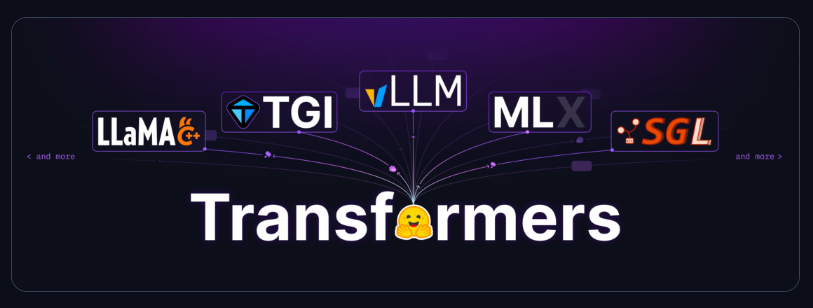
Hugging Face remains a leader in open-source AI, and its Smolagents framework, launched in 2025 — has emerged as the fastest-growing framework entrant in 2026, crossing 30 million model downloads shortly after release.
Smolagents takes a fundamentally different approach from other frameworks. Rather than calling predefined tool functions, it writes and executes Python code as its primary action mechanism. This makes it uniquely suited for local LLM deployments, research environments, and teams in the HuggingFace ecosystem. Smolagents supports a wide range of AI models, enabling the deployment and orchestration of multiple specialized agents for different tasks within a single workflow. This allows collaborative workflows where multiple specialized AI agents, each with distinct roles and expertise, can be coordinated to handle complex processes. A simple agent takes approximately 40 lines in Smolagents — compared to 120 in LangGraph — giving it the lowest barrier to entry among code-execution frameworks.
The Stanford AI Index Report 2024 recognises Hugging Face Transformers as setting industry benchmarks for open-source language models, noting widespread adoption across question answering, translation, and summarisation tasks. Research published in Nature Medicine demonstrated significant improvements in clinical text mining for patient diagnosis and outcome prediction using Hugging Face tools. (Source: Stanford AI Index 2024; Nature Medicine)
Best for: Developers and researchers working with pre-trained models; local LLM deployments where no HuggingFace adapter is needed; text generation, translation, summarisation; teams wanting maximum flexibility through code-execution rather than function-calling.
Limitations: Resource-heavy at scale — requires serious compute budgets for best performance. Advanced error handling is needed in production to ensure reliability. Less suited to complex stateful workflows where LangGraph’s explicit state management is required.
8. OpenAI Agents SDK
Following its April 2026 update, OpenAI Agents SDK has rapidly entered mainstream comparisons due to its tight model-native orchestration and production simplicity. OpenAI Agents SDK is a production-focused framework designed for building and deploying autonomous AI agents within the OpenAI ecosystem. It provides native support for tool use, structured reasoning, and workflow orchestration, allowing developers to build agents that can execute multi-step tasks with minimal external scaffolding.
Following its April 2026 updates, the framework has gained strong visibility in search results due to its tight integration with OpenAI models and simplified deployment workflow. It is increasingly used for applications that require reliable tool calling, model-native orchestration, and fast time-to-production without managing complex external infrastructure.
Best for: Teams building directly on OpenAI models, production-grade tool-using agents, and applications where simplicity and tight model integration are more important than deep custom orchestration.
Limitations: Less flexible than open graph-based systems like LangGraph for highly complex branching workflows or multi-agent stateful systems across heterogeneous environments.
9. RASA
RASA remains the leading open-source platform for building conversational AI with robust intent recognition, context management, and flexible dialogue design. It processes natural language input from users, allowing LLMs to interpret instructions and drive decision points within conversations. RASA provides built-in state management and memory features, enabling the storage, persistence, and organisation of information throughout conversational workflows, and manages data flows between components to ensure efficient and predictable operations.
RASA’s position has remained stable in the conversational AI niche. For businesses needing full source code control, on-premises deployment for compliance, and structured intent-driven dialogue (as opposed to open-ended LLM reasoning), RASA remains one of the only enterprise-grade open-source options. In enterprise deployments, RASA can integrate with external systems such as vector databases, Redis, or Postgres for data storage and retrieval, supporting scalable and compliant solutions.
RASA powers customer support bots for companies like N26 and Lemonade, automating thousands of conversations daily. Organisations using RASA have documented automation of 60–80% of incoming user requests, with measurable increases in engagement and satisfaction scores. (Source: N26 RASA case study; RASA public showcase)
Best for: Enterprises needing open-source conversational AI with strong natural language understanding; organisations requiring on-premises deployment for data privacy compliance; building customisable chatbots with well-defined intent structures.
Limitations: Demands a specialised setup and is best managed by technically experienced teams. In high-volume deployments, advanced retry mechanisms are required to maintain consistent performance. Less suited to open-ended generative tasks or complex reasoning workflows where LLM-native frameworks are better positioned.
10. Langflow
Langflow offers a low-code, visual interface for building AI workflows and agents. Users can drag and drop modular components, such as chains, tools, memory, retrieval systems, and workflow orchestration—without deep programming knowledge, dramatically reducing technical barriers for prototyping. This modular approach allows users to flexibly assemble and reconfigure workflows to suit evolving business needs. In 2026, it reached 130,000+ GitHub stars and continues to grow as one of the most accessible tools for business users building agent workflows without dedicated engineering resources.
Langflow now integrates directly with tools like Slack, Google Drive, YouTube, and a broad range of SaaS APIs, making it viable for more complex workflow automation than simple prototyping. It supports multi agent scenarios and enables multi agent workflows through its visual editor, allowing users to coordinate, communicate, and manage multiple agents collaboratively within a single, integrated system.
A real-world example: a retail company used Langflow to build an AI-powered recommendation engine in under two weeks, improving conversion rates by 15%. A Harvard Business Review analysis found that low-code tools can accelerate time-to-market by up to 25%. (Source: Langflow case studies; Harvard Business Review)
Best for: Teams with limited engineering resources needing rapid workflow prototyping; non-technical stakeholders who need to build and test AI workflows; quick deployment for well-defined, moderate-complexity use cases.
Limitations: Less equipped for highly specialised, large-scale, or diagnostically complex ML applications. Production deployments requiring audit trails, conditional state management, or complex error recovery will eventually exceed Langflow’s ceiling and require migration to a code-first framework.
Thinking About Building Your Own AI Agents
Partner with Dextralabs for getting custom design & deployment of Agentic Systems that work
AI Agents Development ServicesAI Frameworks Comparison Table:
| Framework | Ease of Use | Coding Required | Team Size | Key Strength | MCP Support | License |
| AutoGen / Microsoft Agent Framework | Moderate | Python / .NET | Small to medium | Multi-agent conversation, Azure enterprise integration | Mature (new framework) | Open Source (MIT) |
| LangChain | Easy to Moderate | Basic Python | Small to large | Modular pipelines, RAG, broad integrations | Available | Open Source (MIT) |
| LangGraph | Moderate | Python | Medium to large | Stateful orchestration, low latency, production workflows | Available | Open Source |
| LlamaIndex | Moderate | Python | Small to large | Data indexing, RAG, context retrieval | Available | Open Source |
| Semantic Kernel | Moderate | C# or Python | Small to medium | Enterprise integration, persistent memory | Available | Open Source (MIT) |
| CrewAI | Easy | Minimal | Small teams | Fastest prototyping, role-based crews, 44k+ GitHub stars | Available (URL-based) | Proprietary |
| Smolagents (HuggingFace) | Easy to Moderate | Python | Small to medium | Code-execution agents, local LLMs, 30M+ downloads | Available | Open Source |
| OpenAI Agents SDK | Easy | Minimal Python | Small to medium | Native OpenAI integration, fast agent deployment, tool calling, production-ready orchestration | Available | Proprietary |
| RASA | Moderate | Python | Medium to large | Conversational AI, intent recognition, on-premises | Limited | Open Source (Apache 2.0) |
| Langflow | Easy | Minimal | Small teams | Visual interface, 130k+ GitHub stars | Available | Open Source |
2026 Benchmark Summary
Across a standardized agentic AI frameworks benchmark of five tasks and 2,000 runs—including data analysis scenarios (AIMultiple Agentic Frameworks Benchmark 2026)—the results highlight how framework architecture and state management impact performance. As discussed earlier, LangGraph consistently delivers the lowest latency among agentic AI frameworks, particularly for complex multi-step workflows.
- LangGraph consistently delivers the lowest latency among agentic AI frameworks according to benchmarking data. Its graph-based framework architecture minimizes LLM involvement, resulting in faster execution times for complex multi-step tasks with explicit state management.
- LangChain exhibits the highest latency and token usage compared to other frameworks, primarily due to its chain-first design. While it is the most token-efficient across all tasks, this comes at the cost of speed.
- AutoGen / Microsoft Agent Framework sits slightly above LangChain and LangGraph in latency and token usage for simple tasks, reflecting its multi-agent conversation loop overhead.
- CrewAI exhibits the highest structural overhead—nearly 3× the tokens and time of LangChain—regardless of task complexity, due to its managerial coordination process.
Memory management capabilities vary significantly across agentic AI frameworks, directly affecting their ability to handle complex workflows and maintain operational efficiency.
For error recovery specifically: LangGraph’s state machine nudges agents to find alternative strategies with a 90% probability of pivoting on error. LangChain’s sequential structure means it occasionally waits for tool recovery rather than pivoting—a wait/solution ratio of around 35%. CrewAI handles errors through a managerial process arc that trades token efficiency for thoroughness.
Real-World Use Cases of Agentic AI Frameworks by Industry
Agentic AI frameworks are already being deployed across industries to automate complex workflows, reduce operational overhead, and improve decision-making at scale. Below are real-world applications showing how these systems are being used in production environments.
1. Technology & DevOps
Cisco’s Outshift team built an AI Platform Engineer called JARVIS using a multi-agent system architecture to automate platform engineering workflows.
This system reduced CI/CD setup time from several days to under an hour and improved infrastructure provisioning from hours to seconds, delivering an estimated 10x productivity improvement in platform engineering workflows.
JARVIS uses agent orchestration to handle developer requests such as access provisioning, infrastructure setup, and debugging, significantly reducing manual intervention and operational bottlenecks.
2. Enterprise IT & Operations
In large-scale enterprise systems, Semantic Kernel has been used in combination with multi-agent systems to streamline incident management. In a Microsoft–ServiceNow collaboration, agent-based workflows helped accelerate P1 incident resolution by improving context retention, automation of documentation, and coordination across IT operations teams.
3. Financial Services & Fraud Detection
In fintech environments, frameworks like CrewAI-style multi-agent systems have been deployed to automate fraud detection workflows. For example, agents can independently analyse transactions, flag anomalies, and escalate high-risk cases. In production deployments, this has enabled organisations such as N26 to process large volumes of transactions while reducing manual review workload and improving detection accuracy.
4. Customer Support & Automation
Agentic AI frameworks are increasingly used in customer service automation to resolve high volumes of support queries. Gartner predicts that by 2029, up to ~80% of routine customer service issues will be resolved autonomously through AI agents and agentic automation systems.
5. Supply Chain & Logistics
In supply chain management, agentic AI systems are being used to coordinate distributed operations such as inventory tracking, demand forecasting, and automated replenishment. Multi-agent frameworks enable dynamic task allocation between forecasting agents, procurement agents, and logistics agents, improving responsiveness and reducing delays in complex supply networks.
Best Practices for Deploying Agentic AI Frameworks
Start with a specific, measurable use case — not a broad mandate. The organisations seeing the strongest returns from AI agents focus on two to three high-impact, well-defined problems. McKinsey’s research consistently shows that focused deployments achieve 3× higher ROI compared to running multiple simultaneous pilots without defined outcomes.
Build governance from day one: Gartner warns that over 40% of agentic AI projects are at risk of cancellation by 2027 if governance, observability, and ROI clarity are not established. (Gartner) Robust monitoring and observability are essential for tracking agent activities, workflow progress, and performance metrics in real time. Effective governance features help ensure agents operate within defined ethical, compliance, and operational boundaries while protecting against misuse. Monitoring, audit trails, and human-in-the-loop checkpoints must be part of the initial architecture — not retrofitted after deployment.
Plan for MCP from the beginning: The Model Context Protocol is now the standard for tool integration. Choosing frameworks with mature MCP support significantly reduces the integration overhead of connecting agents to your business systems — databases, CRMs, ticketing platforms, and APIs. When selecting a framework, prioritize open standards, well-defined protocols, and APIs to avoid vendor lock in, ensuring flexibility, interoperability, and future-proofing of your agentic AI systems.
Manage context windows deliberately: Implement context window management, memory pruning, and selective retention. As workflows scale in complexity, context management becomes the primary driver of both cost and reliability.
Budget for token costs: Agentic systems consume API tokens at a rate that surprises most first-time builders. A framework that is more token-efficient is not just a performance choice — it directly affects monthly operational costs, particularly at production scale.
Invest in scalable data infrastructure: Agentic AI frameworks require a robust data infrastructure to support real-time data ingestion, processing, and storage at scale. Real-time data ingestion is crucial for autonomous agents operating in dynamic environments, such as customer service bots or supply chain agents. Well-designed data flows facilitate the structured movement of information between prompts, tools, APIs, and workflows, enabling efficient and predictable AI operations.
Ensure production readiness: Scalable agentic AI frameworks should provide mechanisms for task prioritization, error handling under load, and monitoring resource utilization to ensure performance at scale. These features are critical for maintaining reliability and efficiency as agent workloads grow. Agentic AI frameworks can also automate business tasks, such as reordering stock when inventory is low, by making decisions based on real-time data.
The Future of Agentic AI Frameworks
Looking ahead, Gartner predicts that by 2028, 33% of enterprise software applications will include agentic AI, enabling 15% of daily business decisions to be executed autonomously. By 2029, AI agents will autonomously resolve 80% of common customer service issues without human help. By 2030, 60% of enterprises using supply chain management software will have adopted agentic AI features, up from 5% in 2025. (Source: Gartner Press Release, April 2026)
The convergence on open protocols — MCP for tool integration, A2A for cross-framework agent communication — means the winners in this space will be frameworks that enable interoperability, not those that lock users in. Avoiding vendor lock-in by adhering to open standards, well-defined protocols, and APIs ensures flexibility, ease of integration, and future-proofing of agentic AI systems. Frameworks embracing these open standards are better positioned for the next phase of multi-agent systems, where agents built on different frameworks need to work together across distributed enterprise environments.
Looking to the future, multi agent scenarios—where coordination, communication, and collaboration between multiple agents are essential—represent a key area of growth and innovation for agentic AI frameworks.
Final Words:
Agentic AI frameworks are essential tools for building autonomous AI systems that can plan, execute, and adapt across complex business workflows. The data for 2026 is clear: adoption is accelerating, markets are growing at over 40% CAGR, and the organisations deploying governed, observable agent systems are pulling ahead competitively.
By starting with small-scale prototypes to validate core architecture choices and refine agent workflows, incorporating human oversight at critical decision points, optimising memory management, and ensuring robust monitoring, organisations can realise the full potential of agentic AI while maintaining reliability, transparency, and compliance. Creating effective agent workflows from the outset helps manage multi-agent systems efficiently and avoids unnecessary complexity.
Choose your framework based on your team’s skills, use case, and production requirements. The key decision factors in 2026 are not just features — they are production readiness, MCP support, token cost efficiency, and whether the framework’s architecture matches the complexity of your actual workflow.
Agentic AI frameworks empower developers to build agentic AI systems for complex scenarios, such as autonomous coding assistants and intelligent security operations centers. These frameworks facilitate efficient task delegation and enable the creation of scalable, reliable, and integrated solutions.
With the right framework and best practices in place, the opportunity to automate complex tasks, reduce operational costs, and build genuinely scalable AI-powered systems is real and accessible today.
Need Help Navigating AI Agent Frameworks?
With deep expertise in AI agent architecture, Dextralabs empowers businesses to implement, optimize, and scale AI-powered systems.
Book Your Free AI ConsultationFAQs:
How big is the AI agent market in 2026?
The agentic AI market is valued at $10.86 billion in 2026, up from $7.55 billion in 2025, and is projected to reach approximately $199.05 billion by 2034 at a CAGR of 43.84%. (Source: Precedence Research)
What is an AI agent framework?
An AI agent framework is a collection of tools and components that enable developers to build intelligent systems capable of autonomous planning, decision-making, and action. In 2026, frameworks provide pre-built components for tool use, memory management, state persistence, error recovery, and multi-agent coordination — significantly accelerating development compared to building from scratch. Many frameworks now include agents SDKs that support deterministic, reliable, and production-ready agent execution, often integrating with orchestrators and offering robust observability and failure handling. These frameworks are designed to support both single agent and multi agent scenarios, providing versatility for a wide range of deployment needs.
What happened to AutoGen in 2026?
As of February 2026, Microsoft placed AutoGen into maintenance mode — it receives only bug fixes and security patches, with no new features. Microsoft merged AutoGen and Semantic Kernel into a unified Microsoft Agent Framework, which reached Release Candidate in February 2026. Teams starting new projects should evaluate the Microsoft Agent Framework rather than AutoGen. Teams on AutoGen v0.2 may consider the community-maintained AG2 fork (ag2ai/ag2), which maintains the original API.
Which agentic AI framework is best for production?
There is no single “best” framework for all cases, but production-ready systems typically rely on graph-based or enterprise-grade orchestration tools. LangGraph is often preferred for stateful, low-latency workflows, while frameworks like the OpenAI Agents SDK are strong for fast deployment within the OpenAI ecosystem. The right choice depends on scalability, observability, and workflow complexity.
What is the difference between LangChain and LangGraph?
LangChain is designed for building modular LLM applications using chains and integrations, while LangGraph focuses on stateful workflow orchestration using a graph-based architecture. In simple terms, LangChain handles tool and pipeline construction, whereas LangGraph manages execution flow, branching logic, and long-running agent states.
Is AutoGen still being developed?
AutoGen is no longer under active feature development. Microsoft has shifted focus toward the unified Microsoft Agent Framework, which combines AutoGen and Semantic Kernel capabilities. Existing AutoGen users can still run and maintain their systems, but new development and enhancements are happening in the successor framework.
Which agentic AI framework supports MCP?
Most major frameworks in 2026 support the Model Context Protocol (MCP), including LangChain, LangGraph, CrewAI, and the OpenAI Agents SDK. MCP acts as a standard interface for connecting agents to tools, APIs, and databases, reducing custom integration work across systems.
What is the most token-efficient agentic AI framework?
Token efficiency depends on architecture rather than brand. Graph-based frameworks like LangGraph are typically more efficient for complex workflows because they minimize redundant LLM calls. In contrast, chain-based or conversational systems may consume more tokens due to repeated context passing and multi-turn reasoning.
Can I use multiple agentic AI frameworks together?
Yes, modern systems often combine frameworks for different roles. For example, LlamaIndex is used for data ingestion and retrieval, while LangGraph handles workflow execution. With protocols like A2A (Agent-to-Agent), agents built on different frameworks can also communicate directly, enabling hybrid multi-framework architectures.