If you’ve ever sat through a Friday afternoon code review, you already know the problem.
A senior engineer is squinting at someone’s pull request. They’ve been on it for forty minutes. Half the comments are about missing semicolons, the other half are real architectural concerns that nobody has time to write up properly. Everyone wants to get the merge done before the weekend. Something gets shipped. On Monday, the bug report comes in.
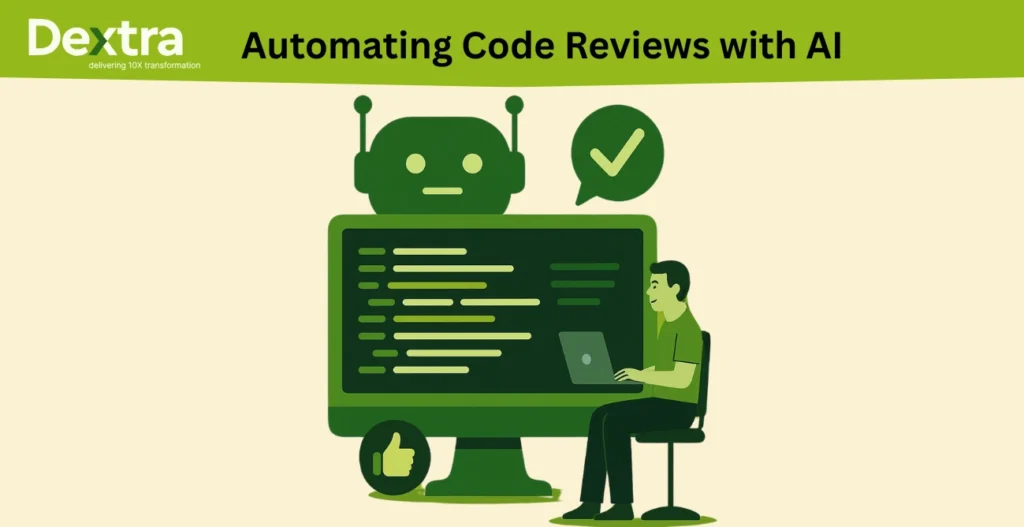
This is the gap that AI code review tools are designed to close. Not the dramatic, replace-your-engineers gap that the marketing copy promises. The smaller, more useful one: catching the boring stuff before a human ever looks at the diff, so the human can focus on the things that actually need a human.
For startup CTOs and dev leads running small or growing engineering teams, this category has gone from ‘nice to have‘ to ‘genuinely useful‘ in about eighteen months. The free tiers are real. The pricing is reasonable. And the tools have stopped hallucinating fixes that don’t compile, mostly.
This guide is the practitioner’s view: what the best AI code review tools for startups & SMEs under 50 engineers, what they cost in 2026, and how to pick one without burning a quarter on evaluation.

Say Goodbye to Manual Reviews
Automate code quality with Dextralabs – your AI consulting partner for smarter development.
Book a Free ConsultationWhy AI Code Review Actually Matters for Small Teams
There’s a fair assumption that AI code review is an enterprise problem. Big codebase, hundreds of engineers, expensive review bottlenecks. And yes, the enterprise procurement story is real. But the case for startups is actually clearer in some ways.
When you have three engineers, one of them is your CTO. The CTO is supposed to be designing systems, talking to customers, and thinking about the next 18 months. Instead, they’re often the person reviewing every pull request, because nobody else has the context, and the alternative is shipping unreviewed code.
An automated code review tool for startups doesn’t replace that CTO. It just makes sure the obvious stuff is already flagged before they open the PR, missing null checks, hard-coded secrets, unused imports, the SQL query that’s about to do a full table scan. The CTO gets to spend their attention on the architectural decision, not the lint.
That’s a different value proposition than the enterprise one, but it’s the right one for small teams.
What’s changed in 2026
Three things have shifted in the last twelve months that make this category much more usable for startups:
The signal-to-noise is better. Eighteen months ago, AI reviewers flagged everything and nothing. They’re still imperfect, but the false positive rate has dropped enough that engineers stop ignoring the comments after the first week.
Free tiers are genuinely usable now. CodeRabbit’s free plan covers unlimited public repos and unlimited reviews. GitHub Copilot Code Review is included in any Copilot subscription. You can run a real pilot without a PO.
Pricing has compressed. Most dedicated AI code review tools sit between $10 and $30 per user per month. Sourcery starts at $10 if you’re a Python shop. CodeRabbit Pro and CodeAnt AI both sit around $24.
The 5 Best AI Code Review Tools for Startups in 2026
This isn’t a comprehensive ranking, those exist elsewhere, and they’re mostly written by the vendors themselves. This is a focused list of five tools that small and growing engineering teams should actually consider in 2026, with the kind of detail you need to make a decision without scheduling six demos.
1. CodeRabbit: The default starting point
CodeRabbit is the tool that most startups should try first. There’s no philosophical reason for this, it just happens to have the cleanest combination of free tier, platform coverage, and review depth in the category.
What it does well: Posts AI-generated comments directly on your pull requests. Generates a plain-English summary of what the PR changes. Suggests fixes you can apply with one click. Works on GitHub, GitLab, Bitbucket, and Azure DevOps, which matters more than it sounds, because most other tools in this list are GitHub-only or GitHub-plus-one.
What it doesn’t: Security scanning is shallow compared to a dedicated SAST tool. If you’re regulated, this isn’t your stack on its own.
Pricing (June 2026): Free tier covers unlimited reviews on public and private repos with the standard model. Pro plan starts at $24/user/month. Enterprise pricing on request.
Best for: Any startup or SME under 50 engineers that wants to start with AI code review this week. Especially good if you’re on Bitbucket or Azure DevOps and most tools don’t support your platform.
2. GitHub Copilot Code Review: The zero-friction option
If your team is already paying for GitHub Copilot, you already have AI code review. You don’t need to buy anything else. You just assign Copilot as a reviewer on a pull request, and it does the rest.
What it does well: Setup is essentially nothing. The integration with GitHub PRs is native, comments, suggestions, and the conversation thread all live where your team already lives. For teams already running on Copilot, this is the lowest-effort possible way to add automated code review to your workflow.
What it doesn’t: Independent testing has consistently found that a meaningful chunk of Copilot’s review suggestions are things a basic linter would catch — and a small percentage are factually wrong. The depth is genuinely shallower than dedicated tools like CodeRabbit or Greptile. You also can’t customise the review rules or teach it your team’s conventions; it’s a black box.
Pricing (June 2026): Included in any GitHub Copilot plan. Copilot Pro at $10/month, Business at $19/user/month, Enterprise at $39/user/month. Note: GitHub Copilot switched to usage-based billing in June 2026, so heavy users may see higher real-world costs than the flat rate suggests.
Best for: Teams already on GitHub Copilot who want review coverage without adding another vendor. Lower-volume teams where the cost-per-review economics don’t justify a dedicated tool. A reasonable starting point that you can outgrow when you need to.
3. CodeAnt AI: When you need security alongside review
CodeAnt sits in a slightly different place from CodeRabbit. Instead of being a pure pull request reviewer, it bundles AI review with static application security testing (SAST), secrets detection, and infrastructure-as-code scanning into a single subscription. For a startup that doesn’t want to buy three tools, this is a real consolidation play.
What it does well: Genuinely covers code review, security, and code quality from one platform. Detects AI-generated code specifically and applies tighter scanning to it, which matters more in 2026 than it did a year ago, given how much code is now AI-assisted. Supports all four major Git platforms (GitHub, GitLab, Bitbucket, Azure DevOps).
What it doesn’t: Pure review depth can feel less LLM-native than CodeRabbit or Greptile, because the platform is doing more things at once. If you only want PR reviews and don’t care about security, you’re paying for capability you won’t use.
Pricing (June 2026): 14-day free trial. Basic plan starts at $10/user/month for AI Code Reviews; Premium from $20/user/month. Code Quality tier from $150 for 10 developers per month. Enterprise pricing for security-heavy environments.
Best for: Fintech, healthtech, or any startup with compliance pressure where you need security scanning alongside code review. Also good for teams that prefer one bill to three.
4. Sourcery: The Python specialist
Sourcery is narrower than the rest of this list, and that’s the point. If your stack is Python-heavy, most early-stage data, ML, and AI startups, Sourcery does refactoring suggestions and code review with a depth that general-purpose tools can’t match. It knows Python idioms. It catches patterns that generic LLM tools miss.
What it does well: Python refactoring suggestions are genuinely useful and idiomatic. Pricing is the cheapest in this category. Quiet, focused tool that doesn’t try to do everything.
What it doesn’t: Limited to Python, JavaScript, TypeScript, and Go. If your stack is broader than that, you’ll need something else. It’s also less full-context than tools like Greptile or CodeRabbit when reviewing multi-file PRs.
Pricing (June 2026): Free tier for individual use. Team plans from $10/user/month. Genuinely the cheapest option for Python shops.
Best for: Python-first startups, ML and data teams, and any small engineering organisation where 70%+ of the code is Python.
5. Cursor BugBot: For teams already living in Cursor
Cursor has become the AI-first IDE of choice for a lot of fast-moving startup teams. BugBot is its in-PR review companion, designed to catch the bugs that get introduced when developers ship a lot of AI-assisted code at speed.
What it does well: Tightly integrated with the Cursor workflow. If your team is already writing code with Cursor agents, BugBot is the natural review counterpart. Designed specifically for the failure modes of AI-generated code, the ‘almost right but not quite’ problem that 66% of developers say is their biggest frustration.
What it doesn’t: The cost adds up. BugBot is an add-on at $40/user/month on top of a required Cursor Business subscription. That’s $80/user/month total, meaningfully more than CodeRabbit or CodeAnt at full price. Only supports GitHub and GitLab. No security scanning bundled.
Pricing (June 2026): $40/user/month on top of Cursor Business ($40/user/month). Effective cost $80/user/month.
Best for: Teams already standardised on Cursor who want AI review aligned to their AI development workflow. Less defensible as a primary review tool for teams that aren’t on Cursor.
Quick Comparison: Best AI Code Review Tools (2026)
If you only have 90 seconds to make a shortlist, this table covers what matters most.
| Tool | Starting Price | Free Tier | Best For |
|---|---|---|---|
| CodeRabbit | $24/user/mo | Yes — unlimited | Most startups; multi-platform |
| GitHub Copilot Review | From $10/mo (Copilot) | Limited | Teams already on Copilot |
| CodeAnt AI | $10/user/mo | 14-day trial | Security + review in one tool |
| Sourcery | $10/user/mo | Yes — individual | Python-first teams |
| Cursor BugBot | $40 + $40 Cursor/mo | No | Teams already on Cursor |
How to Pick the Right AI Code Review Tool for Your Team
Most startup engineering leaders spend too long evaluating tools in this category. Here’s a four-question framework that should narrow your shortlist in about ten minutes.
1. What Git platform are you on?
This is the fastest filter. If you’re on Bitbucket or Azure DevOps, your options narrow to CodeRabbit and CodeAnt AI — most other tools are GitHub-only or GitHub-plus-GitLab. If you’re on GitHub, you have the full menu.
2. Are you already paying for an AI tool that does this?
If you’re on GitHub Copilot, try Copilot Code Review first. It’s already paid for. If you’re on Cursor, try BugBot. There’s no need to add a vendor relationship for something you can get for free or near-free with your existing stack. You can always graduate to a dedicated tool when you’ve proven the value.
3. Do you have security or compliance requirements?
If you’re in fintech, healthtech, or any regulated space, you need security scanning alongside code review. CodeAnt AI bundles both. CodeRabbit is review-only. Don’t try to glue together a review tool and a separate SAST tool unless you’re already running a security stack.
4. What does your codebase actually look like?
If your stack is 70%+ Python, Sourcery is genuinely better than the general-purpose tools for that specific language. If you’re polyglot, you need broader language coverage — CodeRabbit supports 30+ languages, CodeAnt supports the major ones. Match the tool to the codebase, not the marketing.
| ? DECISION SHORTCUT GitHub team, no Copilot yet, want to try AI code review: → CodeRabbit free tier Already paying for GitHub Copilot: → Enable Copilot Code Review first Need security scanning bundled: → CodeAnt AI Python-heavy stack: → Sourcery Living in Cursor: → BugBot |
For enterprise procurement frameworks and build-vs-buy analysis, see our CTO’s Complete Guide to AI Code Review.
“My Team Is Five People — Do I Really Need This?”
This is the most honest question in this whole space, and it deserves an honest answer.
If you’re a five-person team with one product, one repo under 50,000 lines of code, and a CTO who knows every line of it personally — you probably don’t need a dedicated AI code review tool yet. The overhead of configuring it, tuning the false positive filters, and getting the team to actually read the AI comments is real. At small scale, the cost of that overhead can exceed the value the tool delivers.
Here’s the threshold worth watching for:
- Your codebase passes 50,000 linesor your team passes 8–10 engineers
- Your CTO is the bottleneckon every pull request
- You’ve shipped a bug to productionthat a basic check would have caught
- You’re hiring an engineer per monthand onboarding is slowing down review velocity
- You’re using a lot of AI-generated codeand your team isn’t sure what’s been carefully reviewed and what hasn’t
If any two of those are true for you, it’s time. If none of them are, save the subscription cost and revisit the question in six months.
Getting Your Team to Actually Use It
The hardest part of adopting an AI code review tool isn’t picking the tool. It’s getting the team to take the comments seriously instead of mass-dismissing them after a week.
Three things matter more than the tool choice:
Start small, not company-wide
Pick one repository. Ideally, your most active service. Let it run there for two weeks before rolling it out further. Watch which suggestions actually get accepted and which get ignored. Tune the rules.
Tune false positives down before doing anything else
Every tool ships with defaults that are too loud. The first thing your team will do is start dismissing comments because there are too many of them. That habit is hard to break later. Spend the first week tuning the rules so the signal-to-noise is high before you expand.
Have your most senior engineer use it first
If the CTO or lead engineer is openly engaging with the AI’s comments, accepting some, rejecting some with thoughtful reasoning, the rest of the team follows. If the senior engineer ignores it, everyone ignores it. AI adoption is more cultural than technical.
What Actually Changes When It Works
One Singapore-based edtech SME we worked with adopted an AI code review tool across their 12-engineer team in early 2025. By the end of Q3, they were running 40% faster release cycles and seeing 65% fewer post-release bugs.
Most of that wasn’t because the AI was smarter than their engineers. It was because their engineers had stopped spending two hours a day reviewing each other’s formatting and small mistakes. They got those two hours back. They used them to ship features and fix the bugs that actually mattered.
That’s the realistic outcome. Not the marketing claim of ’10x productivity.’ The actual outcome of giving senior engineers their focus back.
Dextra Labs’ Approach: AI-Driven Code Review for Startups
Most startup teams don’t need a consultancy to help them install CodeRabbit or turn on Copilot Code Review. The free tiers are good, the documentation is solid, and you can get the basics running in an afternoon.

Where it gets more interesting is when off-the-shelf tools stop being enough. Highly specialised codebases. Air-gapped compliance environments. Polyglot stacks where vendor tools struggle with your internal DSLs. Teams that need AI review wired into proprietary CI/CD pipelines or internal developer platforms.
In those cases, the answer often isn’t another off-the-shelf tool, it’s a custom AI code review agent designed for your specific environment. That’s the kind of work we do at Dextra Labs, alongside our broader AI agent development practice.
If you’re past the off-the-shelf stage and thinking about something more bespoke, we’re happy to talk through what that looks like.
At Dextralabs, we don’t just provide tools, we craft solutions.
From the best AI code analysis for tech businesses in the USA to automated code review tools tailored for SMEs in Singapore and the UAE, our consultants help teams
- Automate quality checks without disrupting workflow
- Integrate AI seamlessly into your CI/CD pipeline
- Optimize code security with secure code review
Request your personalized AI code review demo from Dextralabs and see how we tailor solutions that match your region, scale, and growth plan.
Smarter Code. Faster Releases
Let Dextralabs help you implement AI-driven code reviews that scale with your team.
Book a Free AI ConsultationFAQs:
What is the best free AI code review tool for startups?
CodeRabbit’s free tier is the strongest option for most startups. It covers unlimited public and private repository reviews using the standard model, works across GitHub, GitLab, Bitbucket, and Azure DevOps, and doesn’t require a credit card to start. If your team is already paying for GitHub Copilot, Copilot Code Review is also included at no extra cost and is the easiest possible on-ramp.
Can a 5-person dev team benefit from AI code review tools?
Possibly, but not always. Teams under 8 engineers with a codebase under 50,000 lines often find that the setup and tuning overhead exceeds the value. If your team has fewer than 5 active engineers and the CTO knows every line of code personally, you may not need a dedicated AI code review tool yet. Revisit the question when you cross 8–10 engineers or 50K lines of code.
How much do AI code review tools cost for a startup?
Most dedicated AI code review tools for startups cost between $10 and $30 per user per month in 2026. Sourcery starts at $10/user/month, CodeAnt AI Basic at $10/user/month, CodeRabbit Pro at $24/user/month, and Greptile at $30/user/month. GitHub Copilot (which includes Code Review) starts at $10/month. Free tiers and trials are available for almost every tool, so you can pilot without committing budget.
Which AI code review tool works best with GitHub?
If you’re a small team already paying for GitHub Copilot, Copilot Code Review is the lowest-friction option and is included in your existing subscription. For deeper analysis, CodeRabbit and Greptile both integrate cleanly with GitHub and offer significantly more thorough reviews. CodeAnt AI also supports GitHub and bundles security scanning into the same tool.
How do I convince my team to adopt an AI code review tool?
Start with one repository, tune the false positives down before expanding, and have your most senior engineer use it visibly first. Adoption is more cultural than technical, if the CTO or lead engineer engages with the AI’s comments, the team follows. If they ignore it, the team ignores it. Avoid rolling it out company-wide on day one; that’s the fastest way to kill adoption.
Do AI code review tools work for AI-generated code?
Yes, and this is actually where they’re becoming most valuable in 2026. With around 20–30% of code at major tech companies now being AI-generated, reviewing that code for quality, security, and maintainability has become its own challenge. Tools like CodeAnt AI specifically detect AI-generated code and apply tighter scanning to it. Cursor BugBot is built around this exact problem.
What’s the difference between AI code review and a regular linter?
Linters like ESLint, Pylint, or RuboCop catch syntax errors and style violations based on predefined rules. AI code review tools go further — they understand context across files, identify potential logic bugs, suggest fixes with reasoning, and flag security risks that don’t map cleanly to a single rule. Modern AI code review tools often build on top of linter output rather than replacing it.
Can AI code review tools replace human reviewers?
No, and treating them that way is the fastest path to shipping bad code. AI code review tools are excellent at catching mechanical issues, null pointer risks, missing input validation, style inconsistencies, and basic security patterns. They struggle with business logic, architectural decisions, and domain-specific concerns that depend on context only a human reviewer has. The right approach is hybrid: AI handles the boring stuff, humans focus on the things that need judgment.