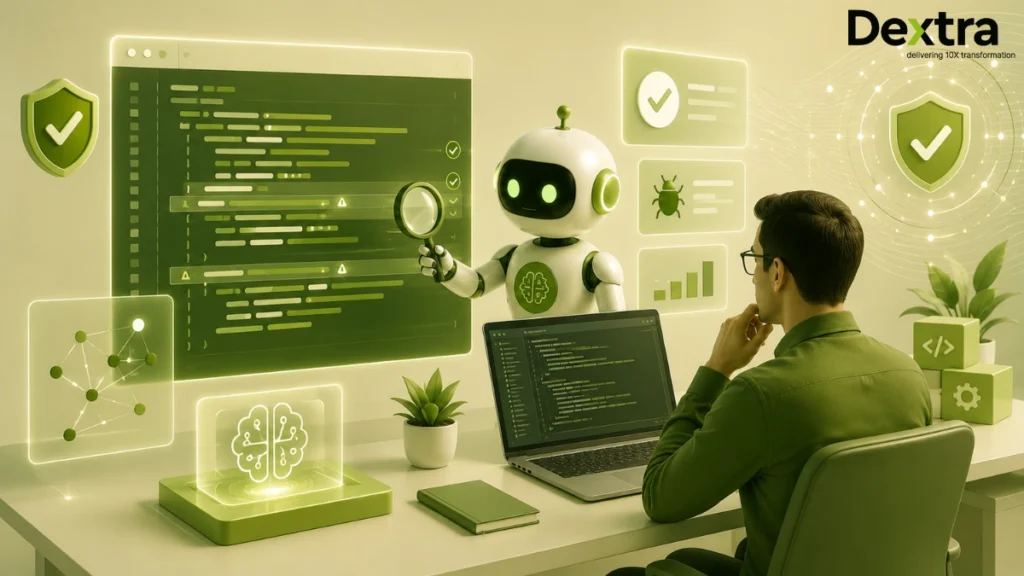
According to Stack Overflow 2025 Developer Survey, 84% respondents are using or planning to use AI tools in the development process. This year, 51% of professional developers use AI tools on a daily basis.
Yet a recent METR randomized controlled trial found AI tools made experienced developers 19% slower on complex tasks, while earlier studies from GitHub, Google, and Microsoft reported productivity gains of around 55% with AI assistance.
Both findings are true. But the difference lies in which AI code review tool is being used, how it’s deployed, and the type of codebase it’s reviewing.
The challenge doesn’t stop at productivity. AI-generated code is becoming a larger part of enterprise codebases. Major technology companies like Microsoft and Google have publicly stated that AI now generates around 20–30% of their code. As that share grows, reviewing AI-assisted code for quality, security, compliance, and maintainability becomes a business-critical responsibility rather than just another step in the development workflow.
That shift also changes how enterprises evaluate their options. The question is no longer just which AI code review tool to choose, but whether an off-the-shelf tool or a custom approach is the better long-term fit. This pillar is the CTO’s complete guide to AI code review in 2026, covering what it is, how it works, the tools landscape, procurement framework, build-vs-buy economics, compliance considerations, implementation patterns, and measurement framework.
What Is AI Code Review?
AI code review is the use of artificial intelligence to automatically analyze source code for bugs, security vulnerabilities, code quality issues, style violations, and architectural concerns before or during the review process. Unlike traditional static analysis tools that rely on fixed rules, modern AI code review tools use machine learning and large language models (LLMs) to understand code context and provide more intelligent, context-aware feedback.
The Evolution from Static Analysis to AI-Native
Code review tooling has gone through three distinct generations and understanding where today’s tools sit in that arc matters for procurement decisions, so let’s look at the three generations below:
The first generation (pre-2020) was rule-based static analysis tools like ESLint, Pylint, and SonarQube, which checked code against predefined rules but often lacked context and produced high false positive rates.
The second generation (2020–2023) introduced machine learning to improve pattern recognition. Tools such as Amazon CodeGuru and Snyk Code combined AI with traditional rule engines to identify issues more accurately while reducing manual effort, but they were still fundamentally static analysis tools with ML bolted on.
The third generation and where AI code review stands today, is LLM-native from the ground up. Tools like CodeRabbit, Greptile, and Qodo don’t just scan for patterns; they understand repository context, reason across entire pull requests, and surface findings in plain language that a developer can act on immediately. The architecture is fundamentally different, which is why the procurement questions are different too.
What Makes AI Code Review Different from AI Code Generation
One of the biggest misconceptions is that AI code review and AI code generation are the same thing. They aren’t. AI code generation tools, such as GitHub Copilot and Cursor, help developers write code faster by suggesting or generating new code. AI code review tools, on the other hand, analyze existing code to identify bugs, security risks, maintainability issues, and quality concerns before it reaches production.
For most enterprises in 2026, these technologies work best together. AI code generation and AI code review are complementary categories rather than competing ones. One accelerates software development by helping developers write code faster, while the other evaluates that code for bugs, security vulnerabilities, maintainability issues, and overall quality. Together, both enable teams to build software more quickly without compromising engineering standards.
How Does AI Code Review Work?
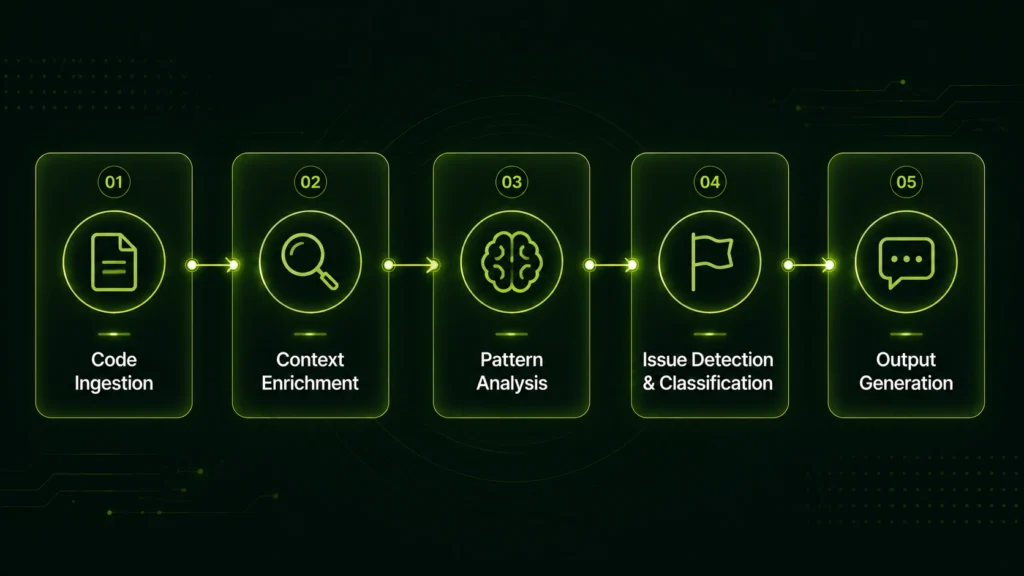
The exact workflow varies from one platform to another, but most modern AI code review tools follow a similar process. Here’s a step-by-step look at how AI code review works in practice:
The 5-Step AI Code Review Process:
Step 1: Code Ingestion and Parsing
This step begins when the AI code review tool receives a code file, pull request (PR), commit, or even an entire repository. It then parses the code into structured formats such as tokens, Abstract Syntax Trees (ASTs), or vector embeddings so that machine learning models can interpret it more effectively.
Step 2: Context Enrichment
The tool doesn’t just look at the changed lines. It collects additional context by examining surrounding files, repository structure, dependencies, coding standards, previous pull requests, and existing architectural patterns. This broader understanding helps produce more relevant reviews.
Step 3: Pattern Analysis
Next, the system analyzes the code using a combination of static analysis engines, machine learning models, and LLMs. Instead of relying only on predefined rules, it compares the code against learned patterns from large codebases and evaluates whether it follows good engineering practices.
Step 4: Issue Detection and Classification
Once potential problems are identified, they are categorized based on their type such as bugs, security vulnerabilities, code quality issues, style violations, or architectural concerns and assigned a severity and confidence level to help developers prioritize fixes.
Step 5: Output Generation
The last step involves presenting the findings through pull request comments, IDE suggestions, dashboards, or APIs. Many modern AI code review tools also recommend fixes and explain the reasoning behind each suggestion in natural language, making reviews faster and easier to understand.
The Two Architectural Paradigms
Although vendors differ in implementation, most AI code review platforms in 2026 fall into one of two architectural approaches, which are as follows:
Paradigm A: Static Analysis with AI Augmentation
This model builds on traditional static analysis engines and enhances them with AI capabilities. Tools like SonarQube, Snyk Code, and Codacy primarily rely on predefined rules to detect issues, while AI helps reduce false positives, improve recommendations, and explain findings in natural language.
The biggest advantage of this approach is consistency. Because rule engines produce deterministic results, they are easier to audit and often fit well into enterprise compliance requirements. However, they may struggle to identify entirely new coding patterns or complex architectural issues that aren’t already covered by existing rules.
Paradigm B: AI-Native LLM-Based Review
AI-native platforms such as CodeRabbit, Greptile, Qodo, and Sourcegraph Amp take a different approach. Here, large language models act as the primary reasoning engine, reading code semantically and understanding developer intent instead of simply matching rules.
This allows them to identify more contextual issues, generate natural-language explanations, and detect patterns that traditional tools might miss. The trade-off is that LLM outputs can be non-deterministic, may require higher compute resources, and often depend on the capabilities and policies of the underlying model provider.
Repository Context: The Critical Differentiator
When discussing how AI code review works, one capability increasingly separates leading platforms from the rest: repository-wide context. Earlier generations of code review AI tools focused mainly on analyzing the lines changed in a pull request. Today’s most advanced systems understand the broader codebase before making any recommendations.
Tools with strong repository context can recognize shared design patterns, dependencies between modules, historical implementation choices, and conventions followed across hundreds of files. This enables them to catch architectural risks that simple diff-based reviews often miss, such as a seemingly harmless change that breaks another service or introduces inconsistencies elsewhere in the project.
As enterprise codebases continue to grow in size and complexity, repository-level understanding is becoming one of the most important factors when evaluating modern AI code review tools.
What the 2026 Research Actually Says About AI Code Review
Before committing to any tool, it’s worth understanding what independent research has found about AI code review in practice. The findings below cover three areas that matter most to engineering leaders: productivity, developer trust, and what happens to code quality over time.
The Productivity Paradox
One of the biggest debates around AI code review and developer productivity comes from two widely discussed studies.
A randomized controlled trial by METR (July 2025) found that experienced developers using AI tools were 19% slower on complex open-source tasks. Researchers suggested that developers spend extra time verifying AI-generated suggestions, especially when working on large and architecturally complex codebases.
On the other hand, the GitHub Copilot study found that developers using the tool completed coding tasks 55.8% faster than those without it but only when the work was well-defined, the tool matched the programming language or framework, and developers carefully reviewed the AI’s output instead of accepting it blindly.
These findings aren’t contradictory. They show that AI code review tools don’t automatically improve productivity. Their impact depends on implementation, workflow, and how effectively teams use them.
The Trust Trend
Developer adoption of AI continues to rise, but confidence in its output is moving in the opposite direction.
According to the Stack Overflow 2025 Developer Survey:
- Only 33% of developers fully trust AI-generated code.
- 66% say “almost right” AI output is their biggest frustration.
- Positive sentiment has dropped to 60%, down from more than 70% in previous years.
- The remaining respondents are presumably neutral or uncertain.
The trend is clear: adoption is increasing, but blind trust is quietly fading. Teams are treating AI as an assistant that requires verification rather than an autonomous decision-maker, making AI-powered code review an increasingly important part of the development process.
The Code Quality Reality
Faster code generation doesn’t always translate into better software quality. GitClear’s 2024 analysis of 153 million changed lines of code found several concerning trends as AI coding assistants became mainstream.
The study reported that code churn more than doubled, meaning developers rewrote much of their newly written code within just three weeks. It also found that code duplication nearly quadrupled, suggesting AI often repeats existing patterns instead of creating cleaner abstractions. At the same time, test coverage trends declined, indicating that code was being produced faster than it was being properly tested.
For CTOs, the takeaway is straightforward. The success of AI code review shouldn’t be measured by development speed alone. Metrics such as code churn, duplication, test coverage, and defect rates provide a much clearer picture of whether AI is actually improving engineering outcomes.
Benefits of AI Code Review for Enterprise Engineering Teams
This section has covered the key benefits of AI code review, including its measurable impact, strategic advantages beyond productivity, and the situations where its value may be limited.
So, let’s dive right in!
Quantified Benefits
| Benefit | Quantified Impact | Source |
| PR review time reduction | Teams cut their initial review cycles by 30 to 50 percent, since routine checks are handled before a human reviewer opens the PR. | Industry benchmarks (CodeRabbit, Greptile case studies) |
| Bug escape rate reduction | Between 25 and 40 percent fewer bugs reach production, because issues are flagged at the pull request stage rather than in QA or post-release. | DORA metrics for AI-augmented teams |
| Mean time to PR merge | Pull requests merge 40 to 60 percent faster, as reviewers spend less time waiting on back-and-forth clarification. | Multiple vendor benchmarks |
| Reviewer fatigue reduction | Developer NPS improves measurably once engineers are no longer stuck on repetitive, low-value review work. | Internal team surveys |
| Security vulnerability detection | Teams catch two to three times more vulnerabilities before merge than they would through manual review alone. | Snyk Code published data |
| Style/standards enforcement | Enforced coding rules are applied with near-100 percent consistency across every pull request, with no reviewer drift. | Static analysis baseline |
| Code documentation generation | PR summaries and change logs are generated automatically, giving reviewers and stakeholders context without extra effort. | LLM-native tools |
Strategic Benefits Beyond Productivity
The value of AI code review extends far beyond productivity metrics. For enterprise engineering teams, it can improve how people collaborate, share knowledge, and scale development without compromising quality. Let’s see some additional benefits.
- Reviewer Capacity Reallocation: Senior engineers reclaim 6 to 10 hours a week previously spent on mechanical review, redirecting that time to architecture and mentorship.
- Knowledge Transfer Acceleration: AI-generated PR summaries cut onboarding time for new engineers and reduce friction in cross-team collaboration.
- Compliance Evidence Generation: Automated audit trails of review decisions support SOC 2, ISO 27001, and regulated-industry compliance requirements.
- Engineering Velocity at Scale: Teams once bottlenecked at 5 to 10 reviewers per 100 engineers can scale review capacity without adding headcount at the same rate.
- Cultural Shift Toward Quality: When AI catches the obvious issues, human review focuses on the architectural and domain concerns that actually need human judgment.
Where the Benefits Don’t Materialize
Despite its advantages, AI-powered code review isn’t the right fit for every situation. Below, we’ve mentioned where the value falls shortly.
- Small Codebases (under 50K lines): For smaller codebases, the setup and maintenance effort may outweigh the productivity gains.
- Highly Specialized Codebases: Such projects are built with proprietary languages or custom domain-specific languages (DSLs) often fall outside the training data of most AI models, reducing their effectiveness.
- Teams Without Review Discipline: Organizations with weak code review practices may also see limited results. AI code review tools tend to reinforce existing workflows rather than fix broken ones, so teams without a disciplined review culture are unlikely to experience significant improvements.
- Compliance-Restrictive Environments: Companies operating in highly regulated environments may face deployment restrictions that limit the value of SaaS-based solutions. In these cases, compliance requirements or the lack of suitable on-premises options can introduce enough operational complexity to offset the expected benefits.
Although the value of AI code review is real, it depends on choosing the right implementation strategy for your environment. You’ll learn how to get the most out of these tools in the later sections on implementation best practices and success measurement.
Categories of AI Code Review Tools in 2026
Not all AI code review tools are built the same way. The sections below cover the five major categories in 2026, explain what differentiates them, and help you understand where each one fits.
The 5 Categories of AI Code Review Tools
Category 1: AI-Native PR Review Platforms
These tools are built with large language models (LLMs) at their core and are designed specifically for the pull request workflow. They analyze code changes, provide contextual feedback, suggest fixes, and generate natural-language explanations directly within pull requests. Popular examples include CodeRabbit, Greptile, Qodo, Bito, and What the Diff.
Best fit: For AI-forward engineering teams, GitHub-centric organizations, and enterprises moving toward agent-based review workflows.
Category 2: AI-Augmented Static Analysis
The second category combines traditional static analysis with machine learning and AI capabilities. Instead of replacing rule-based engines, AI enhances them by improving issue detection, reducing false positives, and providing clearer explanations. SonarQube with SonarLint AI, Codacy, Snyk Code (formerly DeepCode), and Amazon CodeGuru are some of the examples.
Best fit: Enterprises with existing static analysis investment, mature engineering operations, and compliance-heavy environments where audit trail completeness is non-negotiable.
Category 3: IDE-Integrated AI Assistants with Review Features
Some AI coding assistants now include code review capabilities alongside code generation. Rather than acting as standalone review platforms, they help developers identify issues as well as improve code directly within their IDE. Examples include GitHub Copilot Chat, Cursor with Bugbot, and JetBrains AI.
Best fit: Teams already using the assistant at scale who want review coverage without adding another vendor relationship.
Category 4: Enterprise Code Intelligence Platforms
Enterprise code intelligence platforms combine advanced code search with AI-powered review and reasoning across entire repositories. Instead of analyzing only a pull request, they understand relationships between files, services, and dependencies, making them particularly valuable for large monorepos and complex microservices environments. Sourcegraph Amp and Augment Code are leading examples in this category.
Best fit: Monorepo organizations and large polyrepo estates where context window limitations make standard AI review tools structurally insufficient.
Category 5: On-Premise / Air-Gapped Specialists
For organizations with strict security or regulatory requirements, some AI code review tools support fully self-hosted or air-gapped deployments. These tools keep code within the organization’s own infrastructure while still providing AI-assisted analysis. Platforms such as Tabnine, Tabby, and the on-premises edition of SonarQube are commonly used in sectors like defense, financial services, healthcare, and other industries with stringent data residency and compliance requirements.
Best fit: Enterprises with stringent security, privacy, and regulatory requirements that cannot rely on cloud-hosted AI services.
Category Comparison
If you’re evaluating multiple approaches, the table below offers a high-level comparison of the main AI code review tool categories and where each one fits best.
| Category | Typical Pricing | Deployment | Strength | Best Fit |
| AI-Native PR Review | $15–$30 per seat/month | Primarily offered as SaaS solutions | Delivers contextual, LLM-powered reasoning and pull request analysis | Teams adopting AI-first development and review workflows |
| AI-Augmented Static Analysis | $15–$50 per seat/month | Available as both SaaS and on-premises deployments | Combines rule-based analysis with AI to improve accuracy and compliance | Large enterprises and organizations in regulated industries |
| IDE Coding Assistant + Review | $20–$50 per seat/month | Mostly cloud-based SaaS platforms | Integrates code generation and review directly into the developer workflow | Teams already standardized on a coding assistant |
| Code Intelligence Platforms | Custom enterprise pricing | Supports SaaS, VPC, and on-premises deployment | Provides repository-wide understanding for large and complex codebases | Organizations managing monorepos or large microservices architectures |
| On-Premises / Air-Gapped Solutions | $30–$80 per seat/month | Fully self-hosted or air-gapped environments | Offers maximum control over security, privacy, and data sovereignty | Enterprises with strict compliance, security, or data residency requirements |
How to Use This Landscape?
There’s no single AI code review tool that fits every enterprise. In practice, many organizations combine tools from two or more categories to balance developer productivity, code quality, and compliance requirements.
A common approach in 2026 is to use:
- AI-augmented static analysis for compliance checks, policy enforcement, and consistent code quality standards.
- AI-native PR review platforms for reviewing pull requests, providing contextual feedback, and improving the developer experience.
- On-premises or air-gapped solutions for sensitive projects where security, regulatory compliance, or data sovereignty requirements prevent the use of cloud-based tools.
The right mix depends on your engineering workflows, security requirements, and existing technology stack. In the next section, we’ll look at a practical procurement framework to help you evaluate AI code review tools and choose the approach that best fits your organization.
The CTO Procurement Framework for AI Code Review
Before shortlisting vendors, evaluate them against the core criteria below. Looking beyond feature lists and pricing helps choose an AI code review tool that fits your engineering workflows, compliance needs, and long-term business goals perfectly.
The 7 Procurement Criteria
| # | Criterion | The Question CTOs Must Answer |
| 1 | Capability Coverage | Does the tool identify the types of issues your team actually struggles with such as security vulnerabilities, architectural problems, performance bottlenecks, or coding standards? |
| 2 | False Positive Rate | How often does the tool flag issues that aren’t actually problems? If false positives become too frequent, developers may start ignoring its recommendations altogether. |
| 3 | Repository Context | Can the tool understand the broader codebase instead of reviewing only the pull request diff? This is especially important for monorepos and large, interconnected systems. |
| 4 | Deployment & Compliance | Does the deployment model whether it is SaaS, VPC, on-premises, or air-gapped align with your organization’s actual security and compliance requirements, such as SOC 2, ISO 27001, HIPAA, or FedRAMP? |
| 5 | IP Indemnity | Does the vendor provide legal protection for AI-generated suggestions, and does that coverage apply to your intended enterprise use cases? |
| 6 | Integration Depth | How well does the tool integrate with your existing development ecosystem, including GitHub, GitLab, Bitbucket, IDEs, CI/CD pipelines, SSO/SCIM, and audit logging? |
| 7 | Total Cost of Ownership (TCO) | Beyond the per-seat license, what will the tool cost at enterprise scale when you factor in usage-based charges, administration, and ongoing operational overhead? |
The Three-Stakeholder Reality
Selecting an AI code review tool is rarely a decision made by the engineering team alone. In most enterprises, the final procurement decision involves the CTO, the CISO, and the CFO where each evaluates the tool from a different perspective.
The CTO is primarily concerned with whether the tool delivers the required capabilities. That means assessing its ability to detect meaningful issues, minimize false positives, and integrate seamlessly into existing engineering workflows.
The CISO focuses on risk. Deployment options, compliance certifications, data handling practices, and IP indemnity all play a major role in determining whether a tool can be approved for enterprise use.
The CFO, meanwhile, looks at the long-term financial impact. Beyond the initial license cost, they evaluate the total cost of ownership, including scaling expenses, operational overhead, and ongoing maintenance.
The best AI code review platform is the one that satisfies all three stakeholders. A tool with excellent features but poor compliance may never make it through procurement, while one that meets security requirements but disrupts developer workflows is unlikely to succeed after deployment.
Applying the Framework
The most effective way to evaluate AI code review tools is to filter step by step instead of comparing every feature from the start, such as:
Step1: Start with compliance requirements. If a tool’s deployment model or certifications don’t meet your organization’s policies, remove it from consideration immediately. This often reduces a long list of options to just a handful.
Step 2: Next, evaluate capability. Focus on whether the remaining tools can identify the types of issues your team actually struggles with rather than relying on generic feature checklists.
Step 3: After that, verify integration depth. Confirm that the tool works efficiently with your existing repositories, CI/CD pipelines, identity management systems, and audit processes.
Step 4: At last, model the total cost of ownership at your expected engineering scale, including licensing, usage-based costs, migration effort, and administrative overhead.
This filtering pattern surfaces 2-3 tools that fit all dimensions, pilot those in parallel; this way it will be easier to compare real-world performance before committing to a long-term investment.
For tool-by-tool application of this framework, see our Best AI Code Review Tools for Developers comparison guide.
Automating Code Reviews With AI: Implementation Approach for Enterprise Teams
Once you’ve chosen the right AI code review tool, the next challenge is implementation. The sections below explain how enterprise teams successfully roll it out, integrate it into existing workflows, and avoid common mistakes that can limit adoption and long-term value.
The Pilot-to-Rollout Pattern
Organizations that successfully implement AI code follow a four phase patter, which is as follows:
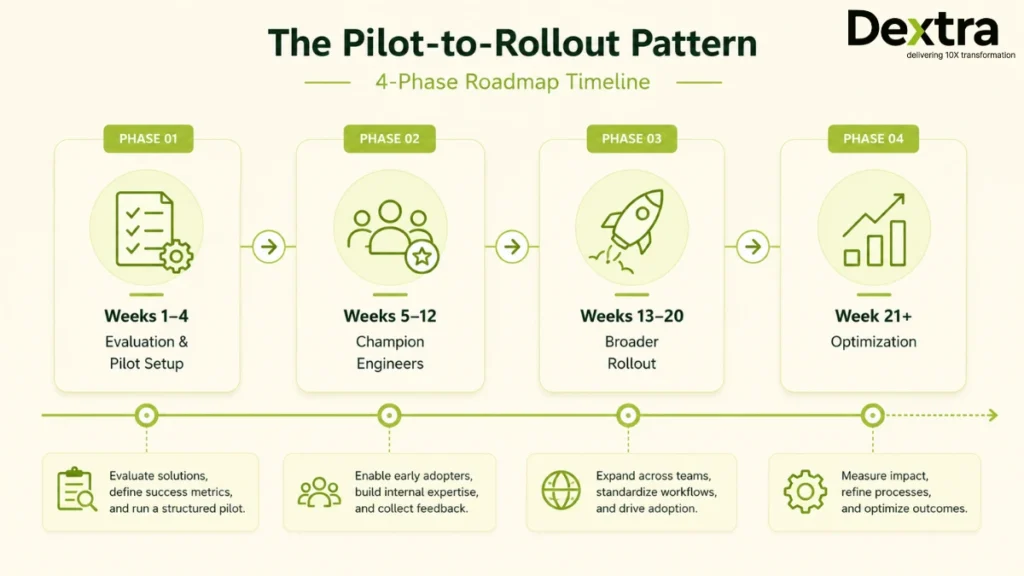
Phase 1 (Weeks 1–4): Vendor evaluation and pilot setup
Start by shortlisting two or three tools using the procurement framework, then configure them carefully before testing, as default settings often generate unnecessary alerts. Disable low-priority rules, adjust severity levels, and fine-tune false positive filters.
Phase 2 (Weeks 5–12): Pilot with champion engineers
Deploy the tool with a small group of senior engineers across diverse stacks. During this phase, track metrics such as code acceptance rate, pull request latency, false positive rate, and developer satisfaction.
Phase 3 (Weeks 13–20): Broader rollout with measurement
Expand the deployment across the full engineering organization while continuing to monitor performance. It’s normal to see a temporary productivity dip as teams adapt to new workflows and review processes.
Phase 4 (Week 21 onwards): Optimization and integration
Refine rule configurations, integrate the tool more deeply into CI/CD pipelines and review workflows, and establish a regular process for reviewing key performance metrics.
The Hybrid Review Workflow
The most effective enterprise teams don’t replace human reviewers with AI but in reality they combine both. A proven production pattern looks like this:
(i) AI reviews every pull request first, identifying potential issues and generating a summary of the changes.
(ii) Human reviewers focus on what AI can’t easily judge, such as business logic, architectural decisions, domain-specific requirements, and edge cases.
(iii) AI improves over time through feedback, with supported platforms learning from accepted or rejected suggestions to provide more relevant recommendations.
(iv) Routine issues are handled before human review, preventing reviewers from spending time on formatting, syntax errors, known security patterns, or dependency-related problems.
By letting AI handle repetitive tasks and humans handle strategic decisions, organizations can accelerate reviews without sacrificing quality.
Common Implementation Pitfalls
Even the best AI code review tool can underperform if it’s implemented poorly. Three mistakes are especially common, such as:
1. Default Configuration Trap: Relying on default configurations. Tools shipped with default settings often produce far more alerts than engineering teams can realistically manage, making early customization essential.
2. Measurement Gap: The second is deploying without a measurement baseline. If you don’t record metrics like pull request latency, bug escape rate, or developer satisfaction before rollout, it’s difficult to prove whether the investment delivered meaningful value.
3. Cultural Deployment Without Leadership: The third is treating deployment as only a tooling change. AI adoption requires leadership support and buy-in from senior engineers. When senior engineers actively use and trust the system, broader adoption across the organization becomes much more likely.
For deep-dive on AI prompt design that improves AI code review tool effectiveness, see our AI-Driven Code Reviews: Prompts Guide
Build vs Buy AI Code Review: The Strategic Question for Engineering Leaders
The sections below explains when off-the-shelf tools are the practical choice and when investing in a custom AI code review system makes more sense, so let’s get into it:
When Off-the-Shelf Tools Win
For the majority of enterprises, buying an existing AI code review may be a befitting option but let’s understand who should buy an-off shelf tool:
The biggest advantage is speed to deployment. Most off-the-shelf tools deploy in weeks, whereas custom development realistically takes nearly 6–12 months before it’s production-ready.
Off-the-shelf platforms also benefit from continuous improvements to the underlying AI models. Vendors like Anthropic and OpenAI invest billions of dollars into model capability that no internal team can replicate at any reasonable budget.
Moreover, established vendors already provide mature operational capabilities such as technical support, service-level agreements (SLAs), and incident response processes. Many also offer compliance certifications that simplify enterprise procurement and reduce the burden on internal security teams.
When Custom AI Code Review Agents Win
While off-the-shelf tools work well for most organizations, they aren’t always the right fit for every environment.
Custom AI code review becomes a strong option when compliance requirements go beyond what vendors can support. Organizations operating under strict government regulations, sovereign cloud mandates, or fully air-gapped environments may require capabilities that standard SaaS platforms cannot provide.
It can also make sense for companies with highly specialized codebases as some codebases built on custom languages, internal DSLs, or decades-old monorepos simply don’t behave well under vendor models trained on public code patterns; the agents become brittle and unreliable.
Another common reason is deep integration. Some enterprises rely on custom CI/CD pipelines, internal developer platforms, or proprietary review workflows that off-the-shelf integrations don’t fully support.
And then there’s scale. For organizations with thousands of engineers, the long-term total cost of ownership of a custom-built system may become more attractive than recurring per-seat licensing.
At that point, many enterprises choose to work with AI Agent Builders who specialize in designing and operating custom AI code review systems tailored to their infrastructure, compliance requirements, and engineering workflows.
The Decision Framework
If you’re unsure whether to build or buy, start by asking these four questions that settle most build-vs-buy debates:
- Can an off-the-shelf tool meet your organization’s deployment and compliance requirements?
- Can it accurately understand and review your codebase, including any proprietary languages or internal patterns?
- Does it integrate well with your existing developer tools, CI/CD pipelines, and internal workflows?
- At your engineering scale, is building a custom solution more cost-effective than paying for commercial licensing over the long term?
If your answer to any of these questions is “no,” it’s worth seriously evaluating a custom AI code review approach. For full TCO modeling at 500, 2,000, and 5,000-engineer scales.
AI Code Review Compliance, Security, and On-Premise Deployment Considerations
Choosing an AI code reviewer often comes down to more than features or pricing for regulated industries, it’s a compliance and security decision first. The sections below outline the key standards and deployment considerations that organizations should evaluate before moving forward.
The Compliance Posture Landscape
In 2026, enterprise AI code review tools are expected to meet a wide range of security and regulatory requirements. The exact certifications you need will depend on your specific industry, customers, and deployment environment, but these are some of the most important ones to evaluate:
- SOC 2 Type II: Considered a baseline requirement for most enterprise software. Make sure the certification is current and that it covers the vendor’s AI processing environment.
- ISO 27001: A globally recognized information security standard that is often required for multinational organizations and enterprise deployments.
- HIPAA: Essential for healthcare organizations and any environment where protected health information (PHI) may be processed or exposed through code or supporting systems.
- FedRAMP and FedRAMP High: Critical for U.S. federal agencies and government contractors. These requirements significantly reduce the number of vendors that qualify for procurement.
- PCI DSS: Relevant for organizations that develop or maintain payment systems and need to protect cardholder data throughout the software lifecycle.
- GDPR and Data Residency Requirements: Particularly important for organizations operating in the European Union or other regions with strict data protection laws, as they directly influence where code is processed and stored.
So, whether you adopt an off-the-shelf platform or invest in a custom AI code review system, these compliance and security requirements should be part of your evaluation from the very beginning. Enterprises building custom agents often work with AI Agent Development services to ensure the architecture aligns with their regulatory, security, and data governance obligations from day one.
IP Indemnity for AI-Generated Code
When evaluating AI code review tools, one legal question often gets overlooked: If an AI-generated suggestion infringes on someone else’s intellectual property, who is responsible?
The answer depends on the vendor. In 2026, IP indemnity policies vary significantly:
- Strong indemnity: Vendors such as Microsoft (GitHub Copilot), Anthropic (Claude Code), and OpenAI (Codex) offer indemnification for eligible IP claims related to AI-generated code, subject to their terms and conditions.
- Limited indemnity: Tools like CodeRabbit, Greptile, and Qodo may provide indemnification, but it is often subject to usage restrictions, exclusions, or financial caps.
- No indemnity: Many smaller vendors do not offer IP protection, meaning the legal responsibility remains with the customer.
Therefore, procurement teams must verify whether the indemnity clause explicitly covers AI-suggested code. Some agreements only address the vendor’s own intellectual property and do not extend protection to code produced by the AI itself.
On-Premise and Air-Gapped Deployment Options
For organizations that cannot use cloud-hosted AI services, deployment choices become much more limited. Security policies, regulatory requirements, or data sovereignty concerns often make on-premises or air-gapped environments the only viable option.
Some vendors address these needs by offering self-hosted deployments. Tabnine is one of the more established options for on-premises and air-gapped environments, while SonarQube Enterprise provides on-premises static analysis with AI-enhanced capabilities. Sourcegraph Amp Enterprise also supports enterprise deployment models, including VPC and on-premises environments for large-scale code intelligence and review.
When commercial tools cannot satisfy security, compliance, or customization requirements, some organizations choose to build custom AI code review agents tailored to their internal infrastructure and governance policies.
If you’re evaluating deployment models in more detail, see our On-Premise AI Code Review: Security, Compliance, Air-Gapped Deployment guide.
Measuring AI Code Review ROI and Avoiding Common Failure Modes
Deploying an AI code review tool is only the beginning. To understand whether it’s actually improving your engineering organization, you need to measure outcomes consistently and watch for warning signs that can undermine adoption and ROI.
The Measurement Framework
A balanced framework should track four metric categories as follows:
1. Code Quality Metrics
These metrics show whether AI is helping your team write and maintain better software over time.
- Bug escape rate: The number of defects that still reach production despite going through review. This is one of the strongest indicators of real code quality.
- Code churn: The percentage of code that is rewritten shortly after being merged. High churn often signals low-quality initial changes.
- Code duplication: AI-generated code can unintentionally repeat existing patterns instead of reusing abstractions, making duplication an important metric to monitor.
- Test coverage trends: Faster code generation should not come at the cost of fewer or weaker tests.
- Cyclomatic complexity: Track whether new code is becoming easier or harder to understand and maintain over time.
2. Developer Productivity Metrics
These metrics help you understand whether AI code review is improving engineering efficiency without compromising quality, so focus on:
- PR review time: Measure how long it takes for the initial review to be completed, as this reflects the direct impact of AI on the review process.
- PR throughput: Track the number of pull requests each engineer completes over a given period to assess overall productivity.
- Review round trips: Monitor how many revision cycles a pull request goes through before approval. Fewer round trips generally indicate better first-pass quality.
- Developer satisfaction: Regularly survey engineers to understand whether the tool is improving their workflow and reducing friction. Quarterly feedback is often more actionable than annual surveys.
3. Security Metrics
AI code review should strengthen your security posture by identifying issues early while maintaining developer trust. Below are some of the key metrics:
- Vulnerabilities caught before production: Compare the number of security issues detected during review with those that still make it into production.
- False positive rate: Excessive incorrect alerts can cause developers to ignore warnings, making this one of the most important metrics to monitor.
- Time to remediate: Measure how quickly developers resolve security issues flagged by the tool to evaluate both efficiency and effectiveness.
4. Business Metrics
Beyond engineering improvements, AI code review should deliver measurable business outcomes that justify the investment. These are some useful indicators:
- Mean time to merge (MTTM): Track how quickly pull requests move from creation to merge.
- Engineering hours saved: Estimate the amount of review time reclaimed through AI-assisted workflows.
- Compliance and audit findings: Monitor whether automated reviews contribute to fewer compliance issues and smoother audit outcomes over time.
Looking at these metrics together helps determine whether your AI code review investment is creating meaningful long-term value.
The 5 Failure Modes
Even well-designed AI code review deployments can fail if teams don’t monitor how they’re being used. Here are the patterns that consistently undermine AI code review deployments:
- Alert fatigue occurs when developers are overwhelmed with low-value warnings and eventually begin ignoring the tool altogether.
- Over-reliance on AI happens when engineers stop applying their own judgment simply because the code has already been reviewed by AI.
- Context blindness remains another challenge. While AI can identify many technical issues, it may still miss business logic, domain-specific requirements, or architectural decisions that require human understanding.
- Technical debt accumulation can also increase if teams prioritize generating code quickly without spending enough time on refactoring or long-term maintainability.
- Then there’s security theater, where a tool catches minor syntax or dependency issues but fails to identify deeper architectural or design-level vulnerabilities.
The good news is that each of these risks can be detected early by tracking the metrics discussed above and acting before they become organization-wide problems.
The Honest ROI Reality
AI adoption doesn’t automatically make engineering teams more productive. Industry analysis suggests that teams with high AI adoption opened 98% more pull requests, while code reviews became 91% longer, indicating that faster code generation can shift effort from writing code to reviewing it if review workflows don’t evolve alongside it.
That’s why ROI should never be measured using a single metric like code generation speed. A tool that helps developers write code faster but significantly increases review effort or maintenance costs isn’t creating real value; it’s simply moving work from one stage of the software development lifecycle to another.
The most successful enterprise teams evaluate AI code review across the entire pull request lifecycle, balancing speed, quality, security, and long-term maintainability instead of optimizing for velocity alone.
Future Trends in AI Code Review for 2026 and Beyond
The trends below highlight where the technology is headed and what engineering leaders should prepare for over the next few years.
Predictive Code Analysis
Today’s AI code review tools analyze code after it’s written. The next generation AI code review is expected to become more proactive by identifying risky patterns as developers write code and recommending improvements before a pull request is even created.
Instead of simply catching bugs during review, these tools could predict error-prone areas, suggest safer implementations, and help developers avoid common mistakes in real time. This shift has the potential to move code quality further left in the development lifecycle and reduce issues before they ever reach production.
Explainable AI for Code Review
One of the biggest challenges with AI-assisted development is understanding ‘why’ the model made a recommendation. Future AI code review tools are expected to focus heavily on explainability to build greater trust among developers and enterprise stakeholders.
Rather than providing generic suggestions, they will increasingly include:
- Clear, human-readable explanations for each recommendation.
- References to coding standards, security best practices, or known vulnerabilities.
- Side-by-side comparisons that demonstrate why the proposed approach is better than the original implementation.
This level of transparency will also make AI-assisted reviews easier to audit in regulated industries.
Continuous Learning and Custom Models
Another major trend is the move toward AI systems that continuously improve based on organizational feedback.
Over the next few years, many AI code review tools are expected to learn from accepted and rejected suggestions, allowing recommendations to become more aligned with a team’s coding standards and development practices. Some enterprises may also train models using their own repositories so the AI better understands internal architectures, frameworks, and engineering conventions.
As a result, AI code review is likely to become more personalized and context-aware over time. For organizations with highly specialized codebases or strict operational requirements, these capabilities may increasingly come from custom AI agents designed specifically for their engineering environment rather than generic off-the-shelf tools.
Conclusion
AI code review in 2026 is no longer a question of whether to adopt it; the data has already settled that. The real decision is choosing the right category, applying a rigorous procurement framework, and deploying with enough discipline that the tool earns its place rather than becoming another ignored dashboard. For tool-by-tool comparison, see our Best AI Code Review Tools for Enterprise guide.
For most enterprises, an off-the-shelf AI code review tool will be the right choice. But if your framework analysis keeps landing on “no” and if your organization has highly specialized codebases, strict compliance requirements, unique internal workflows, or integration needs that commercial tools can’t fully address, custom development may be worth considering.
In those situations, partnering with experienced AI agent builders like Dextra Labs can help you design and develop custom AI code review enterprise agents tailored to your engineering environment, security requirements, and long-term business goals.
Frequently Asked Questions (FAQs):
How does AI code review work?
AI code review works by analyzing your source code using machine learning models and large language models to identify bugs, security risks, and code quality issues. It follows a five-step process as follows: code parsing, context gathering, pattern analysis, issue detection, and generating suggestions as pull request comments or IDE annotations. Modern AI code review tools also consider the broader repository context.
What is the best AI code review tool in 2026?
If off-the-shelf AI code review tools don’t meet your organization’s security, compliance, or workflow requirements, a custom AI code review agent may be the right option for you. Otherwise, the best tool depends on your specific needs. CodeRabbit is a popular option for pull request reviews, Greptile excels at repository-wide context, and Qodo is well suited for enterprise governance and large engineering teams.
Can AI replace human code reviewers?
No, AI cannot completely replace human code reviewers. While AI is excellent at identifying syntax errors, enforcing coding standards, and automating repetitive checks, it still lacks the contextual understanding and business judgment that are needed to evaluate architecture, domain-specific logic, and complex design decisions. The most effective approach combines AI with human expertise.
What are the benefits of AI code review?
AI code review helps teams detect bugs earlier, improve code quality, reduce pull request review time, strengthen security checks, and enforce consistent coding standards. For organizations with unique workflows or compliance requirements, custom AI code review agents can also be developed to deliver tailored recommendations and integrate with internal engineering processes.
Are there on-premise AI code review tools?
Yes, several AI code review tools offer on-premise or self-hosted deployment options for organizations with strict security and data privacy requirements. Popular choices include Qodo (Qodo PR-Agent), TabbyML, and Greptile, allowing teams to review code within their own infrastructure without relying entirely on cloud-based services.
How much do AI code review tools cost?
AI code review tools usually cost between $15 and $60 per user per month for dedicated per-seat subscriptions, although pricing varies by vendor and deployment model. Some tools, such as CodeRabbit, Greptile, Codacy, and CodeAnt AI, use per-user pricing, while others offer team-based or enterprise plans. Many platforms also support Bring Your Own Key (BYOK), allowing organizations to use their own AI API keys and potentially reduce costs to just a few cents per pull request review.
Should we build custom AI code review or buy off-the-shelf?
The right choice depends on your organization’s requirements, but if you have proprietary codebases, strict compliance needs, or unique internal workflows, building a custom AI code review agent is often the better long-term investment. Off-the-shelf tools work well for standard use cases, while custom solutions provide greater flexibility, deeper integrations, and control tailored to your engineering environment.
What’s the difference between AI code review and AI code generation?
AI code generation uses tools like ChatGPT, Claude, or GitHub Copilot to create code from prompts or instructions, while AI code review analyzes existing code to identify bugs, security vulnerabilities, style issues, and quality concerns. In short, one helps write code, and the other helps verify and improve it before deployment.
How do I measure AI code review ROI?
Measure AI code review ROI by tracking four metric categories such as code quality, developer productivity, security outcomes, and business impact. Key metrics include bug escape rate, code churn, PR review time, developer satisfaction, vulnerabilities caught before production, false positive rate, and mean time to merge. Also, evaluate performance across the entire pull request lifecycle rather than focusing only on coding speed.