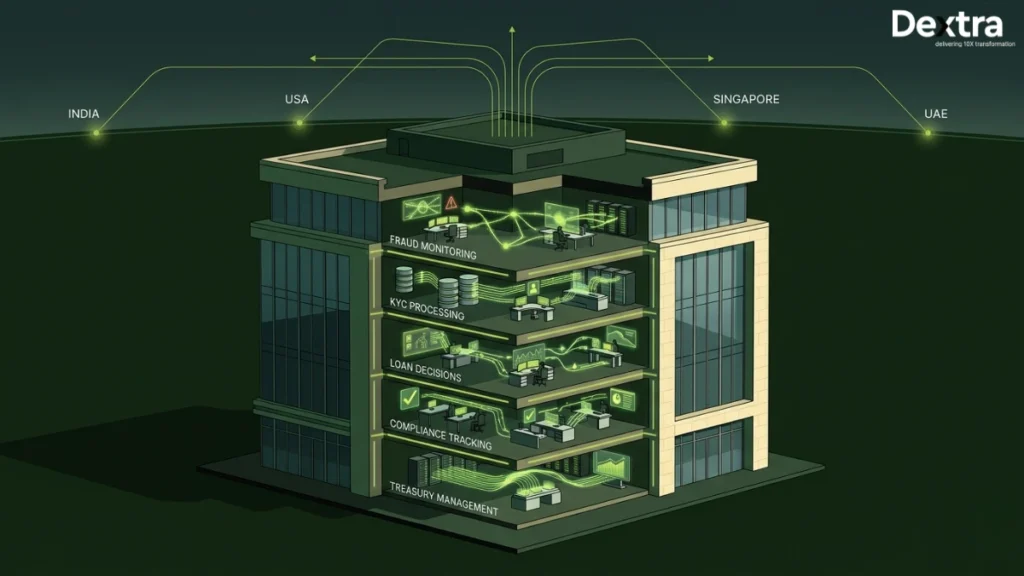
Most banks no longer have a fraud detection problem, but they’re struggling to handle the overwhelming number of alerts generated every day.
Fraud teams still spend hours pulling transaction histories, reviewing device signals, cross-referencing customer activity across systems and documenting case narratives before a decision is made. According to McKinsey & Company, more than 90% of transaction monitoring alerts in most banks are false positives, creating a significant operational burden.
This is where AI agents for fraud detection are changing fraud operations. Instead of only generating alerts, they help banks move from manual investigations to investigation-ready workflows by accelerating evidence collection, risk analysis and case preparation. By reducing repetitive manual work, AI agents allow fraud teams to focus more on high-risk decision-making and faster fraud resolution.
In this blog, we explore how AI agents for fraud detection work, their underlying architecture, key banking use cases and the ROI financial institutions can expect.
What AI Agents Actually Do in Fraud Operations (And What They Don’t)
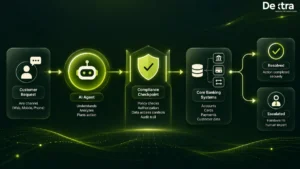
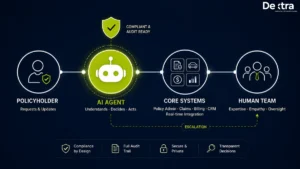
AI agents for fraud detection operate between alert generation and final decision-making. They investigate alerts by gathering evidence, connecting risk signals and preparing case context before escalation. What they do not do is replace fraud analysts, override compliance workflows, or independently make final decisions without human oversight.
Let me help you understand why traditional automation methods are no longer effective for banks and how agentic AI outshines them.
Most banks already use fraud detection using AI in banking through rule engines, machine learning models and transaction monitoring systems. Rules identify transactions that break predefined conditions, while ML models analyze behavioral patterns and assign transaction risk scores. The real operational bottleneck begins after the alert is generated.
Fraud analysts still spend hours reviewing transaction histories, checking device intelligence signals, cross-referencing customer activity across systems and documenting investigation findings. In many institutions, false positives consume a major share of investigation capacity, even though most reviewed alerts never become confirmed fraud cases. According to the 2025 transaction monitoring report from EY, traditional rule-based monitoring frameworks rely on fixed thresholds and conditions, making it difficult for them to adapt to constantly evolving financial crime strategies. As banks respond by adding more rules, alert volumes continue to grow while investigation teams remain overloaded.
This is where agentic AI-based fraud detection in banking steps in that evolves beyond traditional dashboards and static models. This shift becomes clearer when you compare how traditional methods (rules-based systems), ML models and AI agents in finance contribute across different stages of the fraud operations workflow.
So, let’s thoroughly understand what traditional rule-based agents and ML models does and how AI agents can actually replace them for you:
| Fraud Workflow Stage | What Rules Handle | What ML Models Handle | What AI Agents Add |
| Detection | Rules flag transactions that violate predefined conditions such as transaction limits, geographic restrictions, or velocity thresholds. | ML models analyze customer behavior and transaction patterns to estimate the likelihood of fraud. | AI agents correlate signals across transaction systems, device intelligence feeds, customer identities and counterparties to build investigation context in real time. |
| L1 Triage | Rules categorize alerts and route them into queues based on alert type or severity. | ML models prioritize alerts using transaction risk scoring so analysts can review the highest-risk cases first. | Fraud detection ai agents automate alert triage by retrieving transaction history, reviewing device fingerprinting AI signals, checking customer activity and generating investigation-ready summaries with recommended next steps. |
| Deep Investigation | Traditional rule systems typically have no role once a case moves into manual review. | ML models surface anomaly indicators and behavioral analytics fraud signals for analysts to interpret. | AI agents perform graph analysis across linked accounts, identify fraud ring detection patterns, connect cross-system evidence and assemble investigation packages for analysts. |
| Final Decision | Rules stop at alert generation and do not participate in final fraud decisions. | ML models provide confidence scores that support analyst judgment. | AI agents recommend possible dispositions with explainable AI fraud decisions and reasoning trails, while final approval and escalation remain under human control. |
AI agents are more effective than standalone rules or ML models because they not only detect risk signals but also investigate, connect context across systems and prepare actionable case insights for analysts. However, they still assist fraud operations, rather than replace fraud analysts or risk teams. Fraud decisions carry regulatory, financial and customer consequences that still require human judgment and oversight.
Why Fraud Investigation Is an Infrastructure Problem – Not Just a Model Problem
Fraud investigation is fundamentally an infrastructure coordination problem, not just a detection problem. The challenge is rarely identifying suspicious activity; rather, it is about gathering enough cross-system context quickly enough for analysts to make confident decisions.
Investigation workflows often require teams to move across disconnected systems, including transaction monitoring platforms, device intelligence tools, customer databases, sanctions feeds, SAR systems and internal case management workflows. This fragmented process slows investigations, increases analyst workload and makes false positive reduction difficult at scale.
This is where agentic systems differ from traditional fraud tooling. At Dextra Labs, fraud detection agents are typically designed as orchestration layers that coordinate data retrieval, evidence assembly, risk analysis and case preparation across existing banking infrastructure. The objective is not replacing fraud models or analysts, but reducing the operational overhead between alert generation and decision-making.
6 Use Cases: How Banks Deploy AI Agents for Fraud Detection and Prevention
Here are some key use cases that showcase how banks deploy AI agents for fraud detection and prevention across payment monitoring, account security, AML investigations, identity verification and internal risk operations.

1. Real-Time Payment Fraud Prevention
AI-based monitoring systems have been shown to reduce false positives by up to 60% while improving detection accuracy, making them significantly more effective than traditional rule-based fraud detection frameworks.
AI agents monitor card transactions, P2P payments and wire transfers in real time by analyzing transaction amount, merchant category, device fingerprint, geolocation and customer behavior against historical activity patterns. Unlike traditional rule-based systems that depend on fixed thresholds, agents continuously correlate multiple contextual signals to identify abnormal behavior before funds leave the account.
This makes AI for financial fraud detection more effective against increasing payment fraud patterns and card-not-present fraud. HSBC reported reducing false positive cases by 60% while identifying 2–4x more suspicious activity across nearly 980 million monitored transactions per month using AI-driven financial crime monitoring systems.
2. Account Takeover Detection
AI agents monitor login behavior, session activity, device changes, IP reputation and authentication patterns to detect unauthorized access even when credentials are correct. Unlike traditional systems that rely mainly on static rules, agents evaluate behavioral signals such as typing cadence, mouse movement and session navigation patterns.
Advanced implementations use behavioral biometrics and sequence modeling to distinguish between legitimate users and impersonation attempts in real time.
This strengthens fraud detection in the banking sector against phishing, SIM swapping and credential stuffing while reducing friction for genuine users.
3. Synthetic Identity Fraud
AI agents cross-reference identity attributes such as name, address, date of birth and SSN with credit bureau data, device history and application behavior to detect fabricated identities. Traditional systems often validate each attribute independently, which allows synthetic identities to pass initial checks undetected.
Modern systems apply probabilistic identity resolution and clustering models to detect inconsistencies across identity fragments that appear legitimate in isolation.
By using anomaly detection banking techniques and relationship analysis, agents identify inconsistencies across identity networks, helping banks stop long-term fraud buildup before accounts become active for large-scale abuse.
4. Money Mule Detection and AML Monitoring
AI agents analyze transaction flows, account relationships and behavioral patterns to detect money mule networks and suspicious laundering activity. They track rapid fund movements, layered transfers and burst-and-dormancy patterns that are difficult to identify using rule-based AML systems.
According to the Financial Action Task Force (FATF), global AML compliance costs exceed $180 billion annually, with a significant share driven by manual investigation of false positives rather than actual financial crime prevention. Banks further dedicate up to 10–15% of total FTEs to AML and KYC workflows due to their investigation-heavy nature, according to McKinsey & Company.
Modern fraud agents increasingly use graph neural networks and entity resolution systems to identify indirect relationships between accounts, devices, IP addresses and counterparties that rule-based systems typically miss.
This improves anti-money laundering detection by allowing early identification of fraud rings and strengthening suspicious activity reports (SAR) generation with clearer network-level insights.
5. Check and Document Fraud
AI agents evaluate check images, deposit behavior and document metadata to detect forgery, duplication and alteration across physical and digital channels. Traditional systems often rely on manual review or basic image validation, which limits scalability and accuracy.
Modern systems use computer vision models and deep image forensics to detect micro-level inconsistencies such as pixel-level tampering, font mismatches and duplicated deposit artifacts.
By applying computer vision and pattern recognition, agents identify inconsistencies such as altered amounts, duplicate deposits, or tampered documents before settlement, reducing operational losses.
6. Insider Fraud and Employee Misconduct
AI agents monitor employee activity across banking systems, including transaction overrides, account access and policy exceptions. They detect deviations from normal work patterns such as unusual approvals, off-hour activity, or access to unrelated customer accounts.
Advanced systems apply behavioral anomaly detection models across time-series activity logs to identify gradual privilege misuse that static audit rules typically miss.
Unlike static audit rules, agentic AI continuously learns behavioral baselines to identify subtle insider threats early, improving fraud detection and prevention in the banking industry while strengthening internal compliance controls.
Architecture: How a Fraud Detection Agent System Works in Banking
Here are the four core layers that define how modern AI-based fraud detection in banking systems operates, moving from data ingestion to investigation-ready decisions with full regulatory traceability.

1. Data Ingestion Layer
The first layer is the Data Ingestion layer, where the system continuously connects to multiple banking and financial data sources, including core banking systems (Temenos, FIS, Finastra), card networks (Visa, Mastercard), digital banking apps, device intelligence providers and external intelligence feeds such as credit bureaus and sanctions databases. Every transaction, login attempt, beneficiary update and account change is streamed into the system in real time using an event-driven architecture.
This real-time transaction monitoring layer ensures that no behavioral signal is processed in isolation which allows the system to build a continuous view of customer activity across channels and touchpoints.
2. Detection & Analysis Layer
Once data is ingested, the system evaluates risk through three parallel detection mechanisms working together rather than in isolation. Rule-based engines handle known fraud patterns such as velocity breaches, geographic anomalies and transaction threshold violations. Machine learning models perform anomaly detection banking tasks by learning behavioral baselines and assigning dynamic risk scores to transactions and users.
Alongside this, graph neural networks finance techniques map relationships between accounts, devices and counterparties to detect hidden fraud rings, mule networks and coordinated attack patterns. The fraud detection agent then synthesizes outputs from all three layers into a unified risk decision rather than treating them as separate signals.
3. Investigation & Decision Layer
When a transaction or behavior is flagged, the system moves beyond alert generation into active investigation. The agent automatically pulls historical transaction data (often up to 90 days or more), validates device fingerprints against known fraud indicators, evaluates counterparty risk using consortium intelligence and reconstructs a chronological timeline of activity.
Instead of handing over a raw alert, it generates a structured investigation package that includes evidence, contextual analysis and a recommended disposition. This significantly reduces L1 analyst workload and improves consistency in fraud review decisions.
4. Audit & Compliance Layer
Every decision made by the system is recorded in a detailed audit trail that captures data inputs, model contributions, rule evaluations and reasoning behind the final recommendation. This ensures explainable AI fraud decisions that meet regulatory scrutiny across jurisdictions.
In addition to auditability, the system can automatically generate draft Suspicious Activity Reports (SAR) when predefined risk thresholds are met, reducing manual compliance effort and accelerating reporting timelines.
This four-layer architecture is generally how fraud detection agents are set up in real banking environments. But in practice, things don’t look identical across every institution.
At Dextra Labs, the largest implementation differences usually emerge at the governance and compliance layer rather than the detection layer itself. US financial institutions often require SAR-ready evidence packaging and explainable decision trails, while EU institutions prioritize DORA-aligned auditability and policy traceability. APAC deployments frequently involve jurisdiction-specific reporting and cross-border transaction controls.
As a result, the orchestration, audit and escalation layers are usually customized around the institution’s operational and regulatory environment rather than deployed as fixed templates.
ROI of AI Agents for Fraud Detection in Banking
Below is a comparison of key operational and financial metrics showing the impact of AI agents on fraud detection and investigation workflows in banking.
| Metric | Before AI Agents | After AI Agents | Source |
| False positive rate | Traditional transaction monitoring and risk-rating systems in banking can generate false positive rates exceeding 90% and in certain cases over 98%, due to rule-based limitations and conservative risk thresholds. | With AI-assisted fraud detection, false positive rates are reduced to approximately 40–60%. | McKinsey & Company, Unit21 |
| L1 triage time per alert | Analysts spend around 15–30 minutes manually reviewing and triaging each alert. | With agent-prepared summaries, triage time reduces to about 2–5 minutes per case. | Industry data |
| Analyst capacity | A typical analyst handles around 40–60 alerts per day in manual workflows. | With AI agent assistance, capacity increases to 150–200+ alerts per analyst per day. | Industry estimates |
| Investigation time per case | Manual investigation and evidence gathering typically takes 2–4 hours per case. | Teams report 40–60% reductions in false positives and investigation times dropping from 30+ minutes to under 5 minutes per alert in mature deployments, depending on integration depth and automation level. | Industry benchmarks |
| SAR filing preparation | Preparing a Suspicious Activity Report takes around 4–8 hours manually. | AI-generated drafts reduce preparation time to under 1 hour with analyst review. | Industry data |
| Fraud detection rate | Rule-based systems operate at baseline detection efficiency with high noise levels. | AI agents improve suspicious activity detection by 2–4x. | HSBC case study |
| Global fraud losses | Global fraud losses exceed $485B annually under current systems. | AI agents are projected to reduce losses by 25–40% in adopting institutions. | Nasdaq Verafin / projections |
The ROI of fraud detection agents isn’t just about catching more fraud but it’s about freeing analyst capacity.
As automation and AI agents take over evidence gathering and case preparation, fraud teams can significantly improve operational throughput without proportional increases in headcount. Industry research from McKinsey shows that leading institutions achieve substantial efficiency gains through automation and straight-through processing, particularly in reducing manual case handling effort.
In practice, the largest operational gains usually come from reducing manual evidence gathering and context switching across systems rather than replacing analysts entirely.
After deployment, you should track these four KPIs to measure agent impact:
| KPI | What It Measures | Target Benchmark |
| MTTR (Mean Time to Resolution) | Average time from alert creation to final case disposition, including investigation and review cycles. | 70–80% reduction from manual baseline in mature deployments |
| False Positive Resolution Rate | Percentage of alerts resolved by the agent without requiring manual analyst intervention. | 60–75% auto-resolved at L1 in optimized workflows |
| Analyst Throughput | Number of alerts reviewed per analyst per day across fraud operations teams. | 3–4x increase compared to pre-agent baseline, depending on integration depth |
| Monetary Loss Prevention | Total value of fraud prevented that would have otherwise gone undetected or delayed in manual queues. | Tracked monthly against pre-agent baseline loss rates for ROI benchmarking |
AI Agents vs Rules vs ML Models: Why You Need All Three
It is best to use all three because no single layer can fully cover the fraud lifecycle from detection to decision-making. Each system solves a different bottleneck and removing any one of them creates blind spots in fraud coverage, accuracy, or investigation speed.
Rules are necessary to catch known and well-defined fraud patterns quickly and consistently. ML models are needed to detect unknown or evolving patterns by scoring behavioral risk and identifying anomalies that rules cannot capture. AI agents are needed to investigate the alerts produced by these systems, turning raw signals into structured, evidence-backed cases that analysts can actually act on.
Together, they form a complete fraud defense system: rules detect, ML prioritizes and agents investigate. Without all three working in sequence, banks either miss new fraud patterns, overwhelm analysts with alerts, or fail to convert signals into actionable decisions.
The table below breaks down the key differences between rules, ML models and AI agents across core fraud detection functions.
| Capability | Rules | ML Models | AI Agents |
| What it answers | Rule-based systems determine whether a transaction violates predefined conditions such as velocity limits, geo-restrictions, or amount thresholds. | ML models determine whether a transaction is statistically unusual compared to historical behavioral patterns and learned risk signals. | AI agents determine what happened, why it happened and what action should be taken by building a full investigative context. |
| Speed to deploy | Rules can be deployed quickly, often within hours, because they rely on predefined logic and thresholds. | ML models require weeks to deploy due to data preparation, training cycles, validation and tuning requirements. | AI agents typically take weeks to months to deploy depending on system integration, workflow design and data connectivity. |
| Handles unknown fraud patterns | Rules cannot detect unknown fraud patterns and only work for scenarios explicitly defined in advance. | ML models can detect anomalies but often lack full contextual understanding of why the behavior is unusual. | AI agents can identify and investigate unknown patterns by correlating signals across multiple systems and reconstructing context. |
| False positive management | Rules tend to generate a high volume of false positives due to rigid condition-based logic. | ML models reduce false positives by improving scoring accuracy and prioritization of alerts. | AI agents reduce false positives further by investigating alerts and resolving or escalating them with evidence-backed context. |
| Explainability | Rules are fully explainable since every decision is based on transparent logic. | ML models have limited explainability due to black-box scoring structures. | AI agents provide high explainability through evidence-based reasoning chains across multiple data sources. |
| Adapts to new patterns | Rules do not adapt automatically and require manual updates when fraud patterns change. | ML models adapt gradually through retraining cycles based on new data. | AI agents adapt continuously by learning from analyst feedback and investigation outcomes. |
| Best for | Rules are best suited for detecting known, repeatable fraud patterns with clear thresholds. | ML models are best suited for scoring, prioritization and risk ranking of transactions. | AI agents are best suited for investigation, evidence assembly and case preparation. |
One reason many early fraud AI initiatives struggled is that organizations tried to replace existing fraud systems instead of building AI as an additional operational layer. This often weakened proven controls, created workflow gaps and reduced trust in AI-driven outputs.
The most effective fraud operations in 2026 use all three layers together: rules to detect known fraud patterns, ML models to prioritize risk and AI agents to investigate alerts and assemble evidence-backed case summaries. Removing any one layer creates gaps in detection accuracy, prioritization, or investigation efficiency.
At Dextra Labs, deployments are designed as complementary orchestration layers that sit on top of existing rules engines, ML scoring systems and case management workflows. The focus is not replacement, but improving coordination between detection, scoring and investigation so each layer strengthens the others rather than competing with them.
Challenges of Using AI for Fraud Detection in Financial Services
Below are some key challenges that financial institutions face when implementing AI for fraud detection in real-world banking environments. These go beyond model performance and include operational, regulatory and infrastructure constraints that directly impact deployment at scale.
1. Accuracy and False Positive Trade-offs
AI fraud systems improve detection accuracy, but there is always a trade-off between catching more fraud and avoiding false declines of legitimate transactions. Tightening detection logic improves fraud capture, but increases customer friction, while loosening it improves experience but allows risky cases to pass through. In practice, maintaining AI fraud detection accuracy in banking is an ongoing calibration challenge rather than a one-time model decision.
2. Adversarial AI and Deepfake Fraud
Fraud is increasingly evolving alongside the technology designed to stop it. Generative tools are now being used to create synthetic identities, deepfake voices and AI-generated documents that can bypass traditional verification checks. This has turned fraud prevention into a continuous arms race, where generative AI in banking fraud detection needs to constantly adapt to new and more sophisticated attack patterns.
3. Regulatory and Legal Uncertainty
Regulatory compliance is a key challenge for AI fraud detection systems, as financial institutions must balance strict data privacy and consumer protection requirements with effective fraud prevention. AI-driven decisions operate in a highly sensitive environment, particularly when transactions are declined or accounts are flagged. Frameworks such as the EU AI Act and US fair lending laws require decisions to remain explainable, auditable and defensible, placing clear pressure on how AI is deployed in fraud detection systems.
4. Data Quality and Integration Constraints
The effectiveness of AI systems is heavily dependent on the quality and completeness of underlying data. Many banks still operate with fragmented systems across payments, cards and digital banking channels, which limits the system’s ability to build a unified view of risk. Financial institutions also face significant challenges in integrating AI with legacy systems, which often involve siloed data, incompatible formats and batch processing delays that make real-time fraud detection difficult. Without strong data integration, even advanced models struggle to connect related signals across different fraud surfaces.
Safe Deployment and Operational Control
Before full deployment, AI fraud systems typically run in shadow mode alongside existing workflows to validate performance without impacting live decisions. This allows institutions to compare outputs with analyst decisions and identify gaps early. Equally important is having rollback mechanisms in place so the system can be safely disabled if model drift, data issues, or unexpected behavior occurs, ensuring continuity of fraud operations.
CTO/CRO Checklist: Before You Deploy AI Agents for Fraud Detection
Before you bring AI agents into your fraud stack, it’s important to align internally on what’s really changing and this does not mean just in technology, but in workflows, ownership and compliance. This checklist is designed to help you validate readiness across data, operations and governance before moving into deployment.
| Action Item | Owner | Purpose | |
| 1 | Quantify current alert volume, false positive rate and average triage time per alert | Fraud Ops Lead | Set a clear starting point so you can accurately measure whether AI agents are actually improving efficiency or not. |
| 2 | Map the investigation workflow, including how many systems an analyst touches per alert and how much time is spent in each | Fraud Ops Lead + IT | Reveal operational friction points and identify where an agent can realistically reduce manual effort. |
| 3 | Check data accessibility across core banking, card systems, device intelligence and case management tools via real-time APIs | CTO/Enterprise Architecture | Understand whether your infrastructure can support real-time agent execution or needs integration work first. |
| 4 | Define human-in-the-loop boundaries, which decisions must always stay with human analysts, regardless of model confidence | CRO/Chief Compliance Officer | Ensure compliance clarity and avoid over-automation in high-risk or regulated decisions. |
| 5 | Select a narrow pilot scope (one fraud type, one product line, or one geography) | CTO + Fraud Ops Lead | Keep the rollout focused so results are measurable and learnings are actionable. |
| 6 | Define explainability requirements for every agent decision from a regulatory standpoint | Compliance/Legal | Make sure outputs are audit-ready for SAR filings, regulatory reviews and internal governance. |
| 7 | Plan budget for data engineering and integration, not just AI development | CTO/CFO | Most of the real effort sits in connecting and cleaning data, not building the agent itself. |
| 8 | Lock success metrics before deployment (MTTR, false positives, analyst throughput, fraud loss reduction) | CRO + Fraud Ops Lead | Avoid post-pilot confusion by defining what “success” actually means upfront. |
Conclusion
AI Agents for Fraud detection in banking is no longer just about identifying suspicious transactions. The real challenge has shifted to whether financial institutions can investigate and resolve fraud at the speed and scale required by modern digital banking.
For most banks, the key decision now is not whether AI can detect fraud, but how to operationalize it across fragmented systems, regulatory constraints and real-time transaction environments without adding operational complexity. This is where architecture, governance and orchestration matter as much as the underlying models.
At Dextra Labs, the focus is on building production-grade fraud systems that integrate into existing banking infrastructure, helping institutions move from detection-focused setups to investigation-led, AI-assisted fraud operations.

Detect Fraud Faster. Investigate Smarter With AI Agents.
Reduce false positives, accelerate alert triage, and automate investigation workflows using enterprise-grade AI agents built for modern banking infrastructure and compliance environments.
? Explore AI Agent Development ServicesFAQs:
Q1. How are AI fraud detection systems used to stop fraudulent transactions in real time?
AI fraud detection systems monitor transactions as they happen and compare them against patterns of legitimate behavior. Because AI-powered fraud detection systems can process millions of transactions simultaneously, they are able to analyze activity in real time and flag suspicious transactions within milliseconds. This speed is critical in preventing fraudulent transactions before they are completed and strengthening banking fraud protection at the point of payment.
Q2. How does AI help banks detect identity theft more accurately?
AI-powered fraud detection identifies identity theft by analyzing behavioral signals such as login patterns, device usage and account activity consistency. It detects subtle mismatches that traditional checks may miss, such as synthetic identities or stolen credentials being used. This improves fraud risks detection by linking identity data with real user behavior.
Q3. Why are AI models important for identifying emerging fraud patterns?
AI models continuously learn from large volumes of banking data, allowing them to detect emerging fraud patterns that are not yet defined in rule-based systems. They adapt to new fraud risks as they evolve, including shifts in attacker behavior. This helps banks stay ahead of emerging threats instead of reacting after losses occur.
Q4. How does real-time detection impact customer experience and trust in banking?
Real-time fraud detection ensures that suspicious activity is stopped quickly without interrupting legitimate behavior. This reduces unnecessary transaction declines while maintaining strong banking fraud protection. When customers experience fewer false alarms and faster responses, it significantly improves customer trust in digital banking systems.
Q5. How does human-AI collaboration improve fraud risk decision-making?
Human-AI collaboration combines the speed of AI models with human judgment in complex fraud risks cases. AI handles large-scale monitoring and detection, while analysts validate and make final decisions. This balance ensures better accuracy, fewer errors and more reliable fraud prevention across banking systems.
Q6. How do AI fraud detection systems distinguish between legitimate customers and actual fraud?
AI fraud detection systems analyze historical patterns of customer behavior to understand what normal activity looks like for each user. When a transaction deviates significantly from these patterns, it may indicate fraudulent activity. By continuously learning from both past behavior as well as new signals, AI models help banks prevent fraud while ensuring legitimate customers are not unnecessarily blocked.