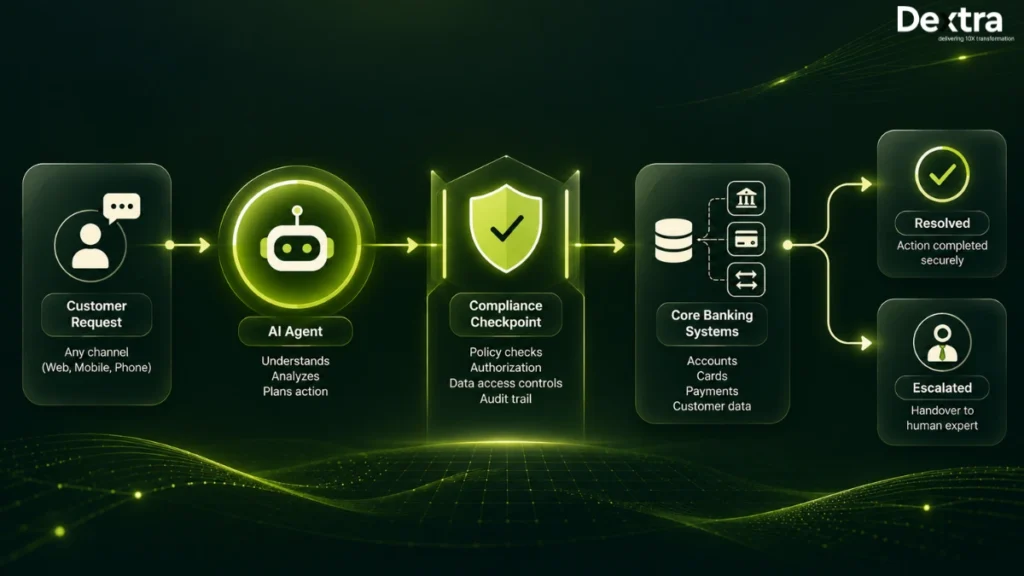
AI customer service agents for banking and financial services are AI systems that can understand customer requests, find the right information, and take approved actions across chat and voice. Instead of stopping at FAQs, these agents can handle tasks such as account servicing, card issues, disputes, onboarding, and loan-related queries.
Banking, however, puts a higher bar on what these agents need to do. They must work within regulatory boundaries, protect sensitive financial data, connect with core banking systems, and keep interactions accurate, compliant, auditable, and explainable, which are requirements that generic customer service isn’t built to handle.
So, with those requirements in mind, banks are already investing in AI for their customer service operations. Deloitte research found that 37% of banking executives surveyed were already using generative AI in their contact centers, while another 37% planned to use it in 2026. At the same time, 77% identified integrating new technology with existing systems as a major challenge, showing why simply adding an AI tool isn’t enough for banking.
In this guide, we’ll cover:
- How AI customer service agents work in banking
- The key use cases, technologies, and compliance requirements
- Where off-the-shelf tools fit and where custom AI agents for financial services make more sense
What Are AI Customer Service Agents in Banking & Financial Services?
An AI customer service agent in banking is an autonomous system that understands customer requests, retrieves relevant information, and takes approved actions through chat or voice. They can handle tasks such as account queries, disputes, KYC onboarding, and loan servicing by working directly with the bank’s systems and compliance rules.
It’s different from generic customer service because banking AI agents have to work within stricter rules and systems. Here’s how they differ:
| Generic CS Agent | Banking CS Agent |
| Focuses on accurate and brand-safe responses | Delivers responses that are accurate, compliant, auditable as well as explainable |
| Primarily answers common customer questions | Resolves regulated workflows such as disputes and KYC |
| Follows standard data-handling practices | Must meet requirements such as GLBA, PCI DSS, and data residency rules |
| Relies mainly on a knowledge base | Connects with core banking and other financial systems |
| Escalates when it cannot confidently answer | Refuses regulated advice when necessary and escalates the customer appropriately |
All these differences highlight how agentic AI customer service banking has evolved from traditional reactive chatbots. These agents can understand the request, decide what needs to happen, and take action within defined limits because in banking, every action must follow the right rules for authorization, compliance, data access, and auditability.
For a broader look at how agentic AI works in banking and where it can be used, read our guide on Agentic AI in Banking: Use Cases & Architecture
The Current State of AI in Banking Customer Service 2026
AI customer service agents for banking and financial services have moved beyond the testing stage. Banks are already using them to handle routine requests, support service teams, and automate parts of the customer journey. The financial case is clear too, with banking chatbots estimated to generate $7.3 billion in operational cost savings globally.
The numbers behind the shift:
- The market is growing: The global AI agents in the financial services market is projected to reach $6.54 billion by 2035, with customer service making up the largest application segment in 2025.
- Costs impact: Financial-services companies that measured operational costs reported an average 29% decrease after implementing AI.
- Customer engagement is improving: Around one in five financial-services firms have seen a 20-40% increase in customer engagement.
- The bigger change is what AI can do: Banking customer service is moving beyond chatbots that simply answer questions or route customers. The newer approach is agentic AI, where an agent can understand a request, decide what needs to happen, and take an approved action.
For banks, adopting AI is just the starting point. Accenture found that 61% of companies are not fully data-ready for generative AI, which points to how many organizations still need to fix the data and infrastructure AI depends on. In banking, that foundation matters even more because your agent needs to work with real customer data and core systems while staying within strict security and compliance requirements.
Key AI Technologies in Banking Customer Support Automation [2026 Updated!]
AI agents for customer service in banking don’t rely on one technology. Several technologies work together to understand the customer, find the right answer, take action, and know when a human should step in.
Here’s a quick look at the technologies that work together to resolve issues while staying compliant:
| Technology | What it does in banking |
| Large Language Models (LLMs) | Understand customer questions in natural language and generate accurate, context-aware responses in banking terminology. |
| Natural Language Understanding (NLU) | Identifies what the customer wants, such as disputing a charge, checking a loan status, or reporting a declined card and routes it to the right workflow across chat and voice. |
| Retrieval-Augmented Generation (RAG) | Pulls information from your bank’s policies, product documents, and knowledge base to keep responses accurate as well as relevant. |
| Conversational & Voice AI | Lets customers interact naturally through chat or phone instead of navigating rigid IVR menus. |
| Core System Integration (APIs) | Connects the agent with core banking, card, payment, and other systems so it can complete actions instead of just giving information. |
| Compliance Guardrails | Controls what the agent can say and do, protects sensitive data, and records actions for audits. |
| Sentiment & Escalation Logic | Recognizes when a customer is frustrated or a request is too complex and brings in a human with the conversation context intact. |
This is what makes AI customer service agents for banking and financial services different from basic automation. The value of agentic AI customer service banking comes from how well all these technologies work together with your core systems and compliance controls.
Consider reading this guide on build vs buy AI customer service agent to determine what’s best for your business.
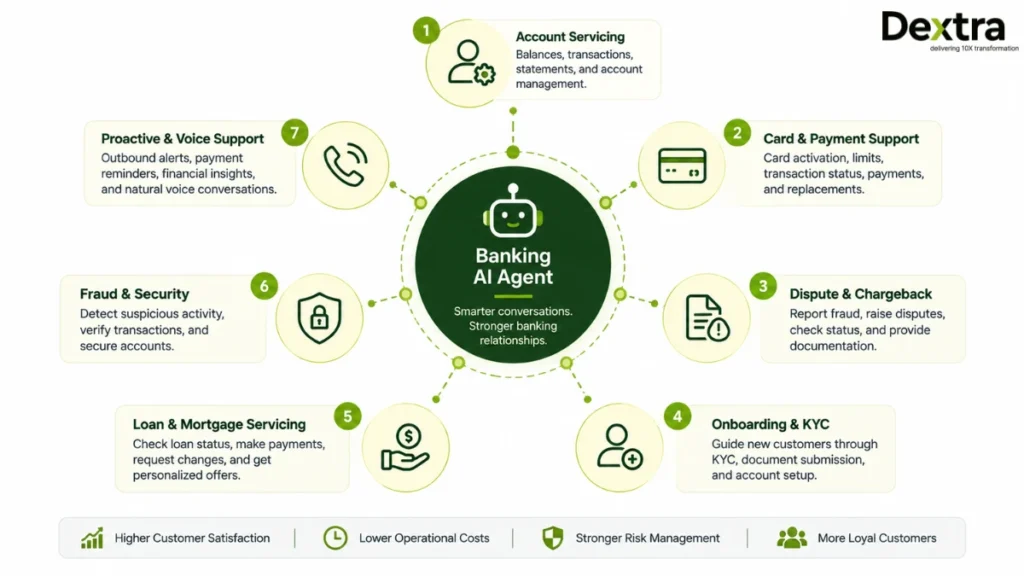
Top 7 Use Cases for AI Customer Service Agents in Banking
Below are some of the most useful AI agents customer service financial services use cases:
1. Account Servicing
Customers can use an AI agent to check their balance, review transactions, request statements, or lock and unlock a card. Since these are frequent requests, handling them through AI gives customers 24/7 access while taking pressure off your support team.
2. Card & Payment Support
When a card is declined or a payment fails, customers most of the time want to know what happened and what they should do next. So, in this scenario, an AI agent can check payment status, trace transactions, and provide the relevant information that helps resolve common card and payment issues without a lengthy support interaction.
3. Dispute & Chargeback Initiation
Disputing a transaction can involve several steps but an AI agent can guide customers through the process from the start. It can ask the required questions, collect transaction details, and initiate the appropriate workflow, making disputes easier to file correctly while keeping a clear record of what was submitted and when.
4. Onboarding & KYC
An onboarding AI agent can guide customers through account opening, explain which documents are needed, collect information, and provide updates on their application. This keeps customers moving through the process and can reduce unnecessary delays and drop-offs.
5. Loan & Mortgage Servicing
Customers can ask about application status, required documents, payment details, and other servicing needs without having to wait for a representative, while the agent handles these straightforward requests without crossing into regulated financial advice and leaves your team more time for cases that need human judgment.
6. Fraud & Security Queries
When a customer notices a transaction they don’t recognize, speed matters the most in this case. Therefore, an AI agent in this situation can help identify the issue, guide the customer through the next steps, freeze a card where authorized, and escalate suspected fraud with the relevant context. This helps customers get support quickly when their trust is at risk.
7. Proactive & Voice Support
Not every customer interaction has to start with a question always, AI agents can send payment reminders, provide timely updates, and handle natural voice conversations instead of making customers work through rigid IVR menus. This gives you another way to provide 24/7 support while making common interactions easier to complete.
Across these AI agents in banking customer service specific use cases benefits, the common thread is resolution. The more an agent can safely complete within your existing workflows, the more value it can deliver beyond just deflecting customer questions.
Benefits of AI Customer Support Automation in Banking
Here are the key benefits you can expect from using AI agents in banking customer service:
- Lower cost to serve: Automating repetitive requests reduces the amount of agent time needed for routine support and helps you serve more customers without increasing costs at the same pace.
- 24/7 support: Your customers can check balances, manage cards, track payments, and get help with common issues whenever they need it, without waiting for business hours.
- Faster resolution: AI agents can find information and complete straightforward tasks in seconds, so customers spend less time waiting for an answer or moving between teams.
- Higher customer satisfaction: Faster responses, fewer handoffs, and more consistent support can make everyday interactions easier and less frustrating for your customers.
- Stronger fraud and security support: AI can monitor transactions, identify unusual activity, and help customers respond to suspicious charges quickly. For example, AI-powered payment validation at JPMC reduced account-validation rejection rates by 20%, according to EY.
- Easier scaling during spikes: When fraud alerts, outages, payment issues, or other events suddenly increase support volume, AI agents can handle more requests without requiring you to immediately expand your team.
- More time for your support team: Your agents can spend less time answering repetitive questions and more time handling complex disputes, sensitive cases, and situations that need human judgment.
- Better customer insights: Every interaction can help you spot recurring problems, common questions, and gaps in your support process, giving you a clearer view of what customers need.
For banks, the value isn’t just about automating more conversations. It’s about resolving more customer needs without compromising the security, compliance, and human oversight your service operation depends on.
Why Does Core Banking Integration Decide Everything?
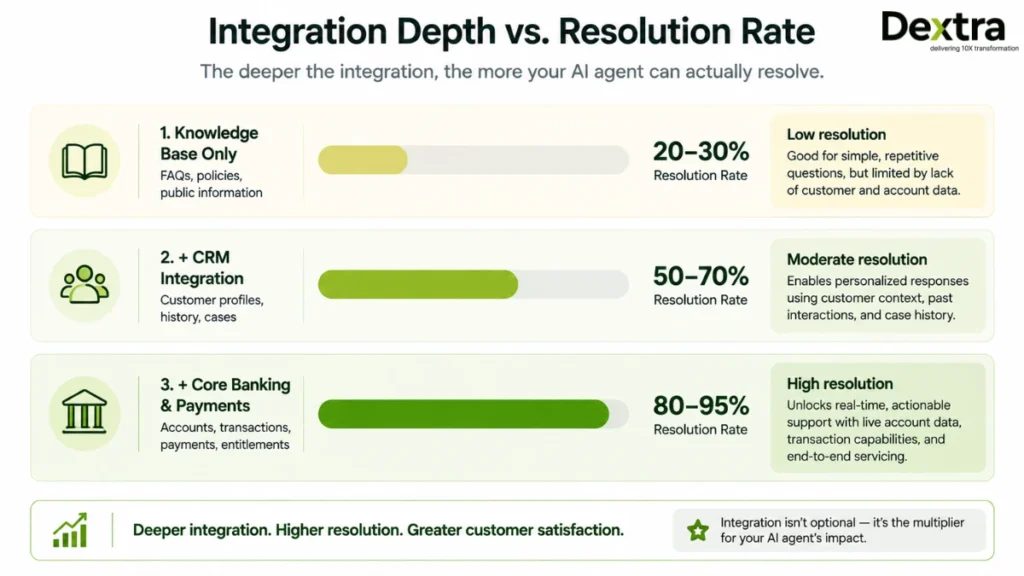
An AI customer service agent for banking and financial services is only useful if it moves from giving customers information to actually getting things done. If it can’t access the systems that hold account, transaction, and payment data, the agent is limited to answering questions rather than resolving them.
The systems it needs to connect with:
- Core banking platforms: Temenos, Finacle, FIS, Fiserv, Jack Henry
- Card and payment processors: For transaction details, payment status, disputes, and related actions
- CRM and customer data platforms: For customer history and personalized support
- Identity and authentication systems: Okta, Microsoft Entra ID, and similar systems for secure access
What integration changes:
The depth of integration directly affects what your agent can do:
- Knowledge base only: It can answer questions and explain policies, but it cannot take action.
- Knowledge base + CRM: It can use customer information to give more relevant and personalized responses.
- Core banking + payments: It can go further by tracing payments, servicing accounts, and initiating disputes.
The difference becomes more clear in a real situation. If your agent can’t read a transaction in Fiserv or file a dispute in the relevant banking system, it can only tell the customer that the issue is being reviewed. Deep integration is what turns an AI agent from a support layer into a system that can actually resolve banking issues.
| Integration Depth | What the Agent Can Do | Resolution |
| KB only | Answer FAQs | Low |
| + CRM | Personalized answers | Moderate |
| + Core banking + payments | Resolve disputes, trace payments, service accounts | High |
And this is where generic tools can run into a limit: banks often work with customized or legacy systems that don’t have simple, ready-made connectors. Connecting an agent deeply to your actual banking stack usually requires custom development rather than a few configuration changes.
You may also read “How to Build a 24/7 AI Customer Service Agent” for a deeper understanding of building an agent for the BFSI sector.
How Dextra Labs Builds Custom AI Customer Service Agents for Banking and Financial Institutions?
AI customer service agents in banking need to do more than answer customer questions. They need to work within strict compliance requirements, connect with core banking systems, understand when a request requires human intervention, and complete service workflows securely. That makes the approach to building them very different from deploying a general-purpose chatbot.
For banks, credit unions, and fintechs, the goal is not simply to automate conversations but to build an agent that can operate reliably within existing systems, policies, and regulatory boundaries. Dextra Labs is a Custom AI Agent Development Company in USA, Singapore, India, UK, and UAE. We build custom AI agents for financial services for banks, credit unions, and fintechs that need deeper compliance controls, system integrations, and workflows than off-the-shelf tools can provide.
Here’s how we approach a banking customer service build:
- We build compliance in from the start: We map your compliance requirements, add regulated-refusal logic, and create audit trails so you can see what the agent said, accessed, and did.
- We start with your core systems: We design the agent around your existing systems, whether you use Temenos, Finacle, FIS, Fiserv, or another core, so it can work with real customer and transaction data.
- We put clear limits around regulated advice: Your agent can handle defined service requests while knowing when it should refuse a financial recommendation, avoid unsupported answers, or bring in a human.
- We focus on resolution, not just deflection: Instead of stopping at an answer, we connect the agent to the workflows it needs to complete tasks such as disputes, KYC, and account servicing.
How we work with you
We take you through the build in three clear phases:
- Phase 1: Discovery & Scoping: We start by reviewing your compliance requirements, core systems, and priority use cases to define what the agent should handle and whether the build is feasible for your specific case.
- Phase 2: Architecture & Build: We then design the architecture, connect the required systems, add compliance guardrails, and build the workflows around your requirements.
- Phase 3: Deployment & Handover: At last, we deploy the agent, test it in your environment, monitor its performance, and hand over the system to your team with the knowledge needed to manage it.
If this approach sounds like what you need, schedule a 1:1 consultation call with Dextra Labs’ AI Engineers to talk through your banking use case, systems, and requirements and see where a custom AI agent could fit.
The Future of AI Customer Support Automation in Banking
Banking customer service is heading toward agents that can do more on their own, work across more channels, and handle more of the actual resolution process. Here’s what that looks like:
- From reactive to proactive: Rather than waiting for customers to report a problem, agents can flag a suspicious transaction, remind someone about a missed payment, or warn about a low balance before an issue occurs.
- Deeper resolution: Agents will handle more defined workflows from start to finish, such as disputes, account servicing, and simple onboarding, while more complex cases still go to human teams.
- More personalized support: By using a customer’s history and current context, agents can make interactions more relevant instead of giving everyone the same generic response, while also staying within regulatory boundaries.
- Voice becomes more useful: Natural voice conversations will take the place of rigid IVR menus for more banking interactions which will make it easier for customers to explain an issue and get help without navigating multiple options.
- Stronger compliance and explainability: As banks rely more on AI, they will need clearer records of what an agent did, why it did it, and when a human stepped in. Compliance and auditability will become part of how these systems are built.
The real win for banks won’t come from having the most impressive chatbot. It will come from building agents that can actually resolve customer issues, follow banking regulations, and work with your core systems and when those requirements go beyond what a standard setup can handle, how you build the agent becomes the deciding factor.
Conclusion
AI agents are bringing a different level of automation to banking customer service because they can do more than provide information. They can understand a customer’s request, work with core banking and payment systems, complete approved tasks, and know when to hand a case to a human. However, in banking, that ability has to come with strong compliance, security, auditability, and clear limits on what the agent can do.
If you need that level of integration and control, our AI agent development services in USA can give you more flexibility than fitting your banking workflows into a standard setup. Dextra Labs can help you build agentic AI customer service banking around your systems, use cases, and compliance requirements.
Frequently Asked Questions:
Q1. What are AI customer service agents in banking and financial services?
AI agents banking customer service are like digital support agents that can understand customer questions and their intent, provide quick answers, and handle everyday banking requests. They can work across chat and voice channels, take action through connected banking systems, and can also hand over complex issues to human agents when needed.
Q2. Are banking AI customer service agents secure and compliant?
Yes, they can be, when they’re built with strong security and compliance measures from the start. Features like encryption, access controls, audit trails, and data protection help keep customer information secure while meeting financial regulations.
For fintech companies with unique security and compliance needs, custom development can be a better way to build the best AI customer service agents for fintech around their specific requirements.
Q3. Can AI agents handle sensitive account information and transactions?
Yes, AI agents can securely handle sensitive account information and even carry out approved transactions when they’re connected to banking systems with the right permissions and security controls. For more complex banking needs, custom AI agent development services can seriously help build agents with strict access controls, approval workflows, and audit trails.
Q4. What happens when a banking AI agent can’t answer or the question needs regulated advice?
When an AI agent can’t confidently answer a question or the request involves regulated financial advice, it shouldn’t guess. Instead, it follows a standard handover process, passing the conversation and relevant customer context to a human agent. Custom AI agents have a clear edge here because they can integrate directly with your CRM, core banking systems, and agent desktop which makes the handover smoother and ensures human teams have the right information without asking customers to repeat themselves.
Q5. Should banks build custom AI agents or buy off-the-shelf tools?
It depends on the bank’s needs. Off-the-shelf tools can work well for simple, standardized support, while custom AI agents give banks more control when they need deeper integrations, stronger compliance controls, and workflows built around their own processes. Custom development can also help build the best AI virtual agents for banking customer service as their operations and automation needs grow.