If you sat through a Cognition demo and watched Devin write, test, and ship code end-to-end, the appeal was obvious. The challenge usually starts later, when you try to justify the cost of rolling it out across an entire engineering organization instead of a small pilot team. That’s usually the moment CTOs start searching for Devin AI alternatives.
At that point, the question is no longer whether Devin can do the job but whether it still makes sense for your organization at scale. What looks like a straightforward investment during a pilot can become a much bigger conversation once you factor in enterprise wide adoption, governance requirements, and long-term costs. That’s when the focus shifts from capability alone to overall operational fit.
Whatever reason brought you here, you don’t need another developer-focused feature roundup. In this blog, you’ll find ten enterprise-grade Devin AI alternatives, evaluated against seven procurement criteria for autonomous coding agents built for the executive making the decision, not the developer using the tool.
How We Evaluated These Devin AI Alternatives for CTOs?
Before we get into the ten alternatives, here’s the lens we used and why it’s different from the lens used in most “Devin AI alternatives” roundups.
Most comparisons rank these tools on developer-experience factors: autocomplete quality, IDE integration, response speed, and free tier. Those criteria matter for individual developer adoption but they don’t matter for enterprise procurement.
So we ran every Devin AI alternative through seven criteria below, the same ones your CISO, CFO, and procurement team will apply. Go through them in order, weighted by your organization’s hardest constraint.

Criterion 1: Autonomy Level
The first factor we evaluated was autonomy level: how much of the actual work can the AI software engineer complete without much human involvement?
On one end sit inline-suggestion tools, the AI pair programming evolution that started with Copilot, where the model proposes a line and you accept or reject it in real time. While on the other sits a fully autonomous coding agent like Devin, which can take a ticket, runs its own agentic loop of planning, task decomposition, execution, and self-correction, and return with a finished pull request. Most Devin alternatives fall somewhere between these two ends.
This is important because it changes how you supervise the work. With tools like Cursor or Windsurf, a person is watching every move as it happens, so the review is happening in real time. With a fully autonomous agent like Devin, Claude Code in headless mode, or OpenHands, the work gets done first and review happens afterward. That’s a completely different way of managing risk, not just a different feature. In our evaluation, autonomy level was a key differentiator because it directly impacts productivity gains, workflow design, and the role humans play in the development process.
Criterion 2: Oversight Model
The second factor we evaluated was oversight: how easily your team can monitor, review, and audit an autonomous agent’s action.
Once you understand how independently an AI agent can operate, the next question is simple: can you see exactly what it did afterward?
An autonomous agent doesn’t make one decision per task; it makes hundreds: editing files, running commands, installing packages, calling external services, running tests, often with nobody watching live. Each action is a small risk on its own, and they add up fast.
The real question is whether you can reconstruct what happened afterward. Does the tool keep a detailed log of every action? Can your security team pull that log into the systems they already use to monitor everything else? Claude Code and Sourcegraph Amp treat this as a core feature. Other tools barely log anything, and that gap alone is often enough to get a deal stopped during security review.
Criterion 3: Codebase Compatibility
The third factor we evaluated was codebase compatibility because no AI coding agent performs in your environment the same way it performs in a polished demo. Every demo runs on clean, tidy code. Almost nobody’s actual codebase looks like that.
If your code has millions of lines, years of accumulated shortcuts, an in-house framework nobody fully wrote down, and CI pipelines held together with hope, that’s the real test. Devin’s struggles with messy, unstructured legacy code are well documented at this point, and most autonomous coding agents hit a similar wall, just at different thresholds. The only reliable way to evaluate this criterion is to pilot each tool on your own repositories and your own tickets before you commit to anything.
Criterion 4: Governance & Compliance
The fourth factor we evaluated was governance and compliance because autonomous code generation creates responsibilities that go far beyond traditional coding assistants.
When an agent is writing entire pull requests on its own, the question of who owns that code and who’s liable if something goes wrong gets a lot more complicated than it ever was with a tool that just autocompletes a line.
Two things to verify before shortlisting any vendor: does the vendor hold the certifications your industry actually requires such as SOC 2 Type II, ISO 27001, HIPAA, FedRAMP, or FedRAMP High and does their indemnity explicitly cover autonomously generated code, not just human-assisted suggestions. The major players, Cognition (Devin), Anthropic (Claude Code), and OpenAI (Codex), all offer IP indemnification. Many small vendors don’t, and that single gap is often enough to end the conversation for a lot of enterprises.
Criterion 5: Deployment & Model Isolation
The fifth factor we evaluated was deployment and model isolation because where your code goes and how it is processed can be just as important as the agent’s capabilities.
This one question alone tends to cut a ten-tool shortlist down to two or three: where does your code actually go once the agent starts working on it?
For many enterprise teams, this question becomes one of the first topics raised during a CISO review. To evaluate an enterprise Devin alternative, focus on three areas:
Deployment model: Is the tool SaaS-only, does it support deployment in your own VPC, or can it run as a self-hosted or on-premises AI coding agent? Organizations with strict security policies may also require air-gapped environments with no external connectivity.
Code data flow: Find out what happens to your source code after it’s processed. Does the vendor use customer code for model training? What is the data retention policy? Which third-party services or sub-processors can access your code?
Model flexibility: Check whether the platform locks you into a single AI model or supports multiple models with BYOK (Bring Your Own Key) capabilities. Greater model flexibility gives enterprises more control over security, cost, and vendor dependence.
For regulated enterprises, deployment and model isolation requirements often eliminate many Devin AI alternatives before technical capabilities are even evaluated.
Criterion 6: TCO at Engineering Scale
The sixth factor we evaluated was total cost of ownership because the economics of a successful pilot can look very different at enterprise scale.
What will your chosen AI coding agent actually cost when it’s deployed across your entire engineering organization?
Looking at the monthly subscription alone doesn’t give you the full picture. A pricing model that works for a small pilot may not make financial sense when it’s extended to hundreds or thousands of engineers.
To calculate the true total cost of ownership, consider more than just the license fee. Factor in your total headcount, usage-based charges, administrative effort, training and onboarding costs, and the expense of running multiple tools during migration.
For enterprise buyers, TCO is often one of the biggest deciding factors. Comparing these costs side by side makes it easier to determine whether an off-the-shelf solution is the right choice or whether investing in custom AI coding agent development would deliver better long-term value.
Criterion 7: Operational Maturity
The seventh factor we evaluated was operational maturity because adopting an autonomous coding agent also means evaluating the company behind it.
How confident are you that the company behind this tool will still be supporting it two years from now?
Most companies building autonomous coding agents are still young startups, somewhere between Series A and Series C. Cognition, the company behind Devin, has the highest profile but is also spending aggressively to grow. Anthropic and OpenAI have much deeper financial backing by comparison. Smaller players like Cline, OpenHands, and Continue.dev carry the most uncertainty about whether they’ll still be around in a couple of years.
Before letting an autonomous agent run unsupervised in your production environment, check the vendor’s financial health, how good their customer references really are, what their support response times look like, and how they’ve handled incidents in the past. A tool can be technically impressive and still be a bad bet if the company behind it isn’t stable.
The Three-Stakeholder Reality
One more thing worth flagging before you get into the actual tool comparisons: autonomous coding agent procurement rarely comes down to one person’s judgment.
In most enterprise buying decisions, three executives are evaluating the same shortlist with completely different priorities. The CTO is focused on capability and wants to know whether this agent actually works at the right autonomy level, on their codebase, with a vendor that’s going to be around. The CISO is focused on risk and wants to know whether the team can see what the agent did, whether it passes compliance review, and where the code actually goes. The CFO is focused on one number and wants to know what this costs when you multiply it across the whole engineering org.
The Devin AI alternative that wins your procurement must pass all three stakeholder priorities. The comparison table in the next section is structured to make that joint evaluation possible without having to read every tool writeup in full.
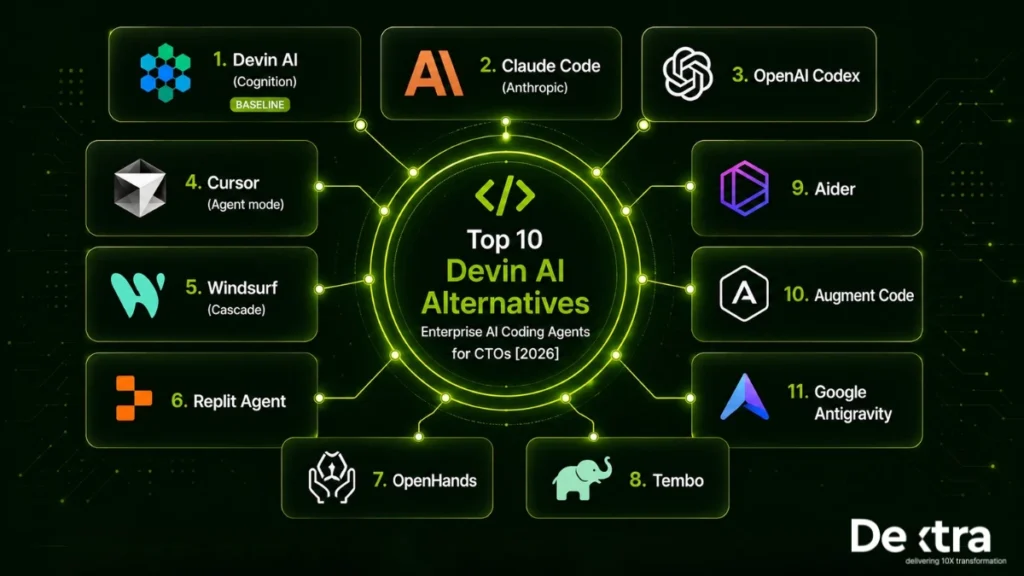
10 Devin AI Alternatives Evaluated: Enterprise AI Coding Agents Quick Comparison [2026]
Here is how each tool on this list stacks up across the seven procurement criteria before we get into the full breakdown:
| # | Tool | Autonomy Level | Oversight Model | Deployment | Compliance | Multi-Model | SWE-bench (Verified) | Pricing | Best For (CTO Lens) |
| — | Devin AI (Cognition)(baseline) | Full agent | Async review | SaaS | SOC 2 Type II | No (Cognition models) | ~71% | $500+/mo; Enterprise custom | Mature engineering ops, well-structured codebases, premium budget |
| 1 | Claude Code (Anthropic) | Full agent (terminal) | Real-time visibility | SaaS + Local | SOC 2 Type II | No (Anthropic only) | 71–73% | $150/seat/mo Team | Senior teams comfortable with terminal-first workflows |
| 2 | OpenAI Codex | Full agent | Real-time + async | SaaS | SOC 2, HIPAA | No (OpenAI only) | ~69% | $30/seat/mo Business | OpenAI-stack shops, deep GitHub integration |
| 3 | Cursor (Agent mode) | Semi-agent (IDE) | Real-time | SaaS | SOC 2 Type II | Yes (Claude, GPT, Gemini) | 65.2% | $40/seat/mo Teams | Direct Copilot replacement with model flexibility |
| 4 | Windsurf (Cascade) | Semi-agent (IDE) | Real-time | SaaS + VPC | SOC 2, HIPAA, FedRAMP | Yes | Not published | $30/seat/mo Teams | FedRAMP-required deployments, regulated enterprises |
| 5 | Replit Agent | Full agent (cloud) | Async review | SaaS | SOC 2 Type II | No (Replit-managed) | Not published | $25/mo Core; Teams custom | Greenfield projects, prototypes, self-contained apps |
| 6 | Tembo | Multi-agent orchestration | Async review | SaaS | SOC 2 Type II | Yes (Claude, Codex, Cursor, Gemini) | Not published | Custom | Multi-repo parallel agent workflows |
| 7 | OpenHands | Full agent (open-source) | Configurable | Self-hosted | Self-managed | Yes (any LLM) | ~66% | Free plus infrastructure cost | OSS-first teams, research environments, full control |
| 8 | Aider | CLI agent | Real-time + Git | Local or CLI | Self-managed | Yes (BYOK) | Not published | Free plus LLM cost | Senior engineers, individual workflows, full transparency |
| 9 | Augment Code | Semi-agent | Real-time | SaaS + VPC | SOC 2 Type II | Yes | Not published | Credit-based | Large monorepos, deep codebase context |
| 10 | Google Antigravity | Full agent (IDE) | Real-time | Google Cloud | SOC 2, HIPAA | No (Gemini only) | Not published | Freemium plus Enterprise | Google Cloud ecosystem, BigQuery integration |
A few things stand out when you look at this shortlist as a whole. The tools closest to Devin on autonomy, Claude Code and OpenAI Codex, are both locked into single model families, which becomes a problem the moment your CISO raises model isolation. The tools with the most deployment flexibility, OpenHands and Aider, come with the most internal operational overhead. And the tools that look cheapest per seat almost always have usage-based billing underneath that closes the gap at scale.
No single tool on this list wins across all seven criteria. The right call depends entirely on which constraint your organization hits first.
Now, let’s get into each tool individually and evaluate them category by category:
Category 1: Fully Autonomous AI Coding Agents Comparable to Devin
These are the tools that operate closest to Devin’s model: take a task, execute it end-to-end, return finished output. If your team ran a Devin pilot and liked the autonomous execution model but hit walls on cost, compliance, or codebase fit, this is where you start evaluating.
1. Claude Code (Anthropic)
Claude Code is Anthropic’s terminal-native autonomous coding agent. It runs locally alongside any IDE, executes directly in your development environment, and handles the full agentic loop such as planning, multi-file edits, terminal execution, test runs, and iteration without needing a sandboxed cloud environment to operate in.
Why it’s one of the best Devin AI alternatives for senior engineering teams: Claude Code currently holds the highest published SWE-bench Verified score in this category, putting it on par with or marginally ahead of Devin, depending on the task type. More practically, senior engineers tend to adopt it because it fits how they already work like terminal-first, local execution, no new UI to learn, and full visibility into every action the agent takes in real time. That real-time visibility also matters for procurement; every file edit, shell command, and test run is visible as it happens, which makes the oversight conversation with your CISO considerably easier than it is with Devin’s async review model.
The honest gap: Two constraints worth naming upfront. First, Claude Code is locked into Anthropic’s model family and there is no BYOK, no model switching, and no path to running it on your own infrastructure if model isolation is a hard requirement. Second, for large engineering organizations buying through Team plans, Claude Code requires Premium seats which are the most expensive per-seat option in this category, which compounds quickly at engineering scale. Weigh that against Devin’s custom enterprise quotes, but don’t skip the math.
Who is it best for: Organizations where senior engineers are the primary users, where terminal-native workflows are already the norm, and where Anthropic’s compliance posture (SOC 2 Type II, IP indemnification) clears your CISO’s bar without needing on-premises deployment.
2. OpenAI Codex
OpenAI Codex is OpenAI’s agent-first coding platform, backed by GPT-5 and built around deep GitHub integration. It operates as a cloud-based autonomous agent that handles ticket-to-PR workflows, runs tasks asynchronously, and plugs into Slack so engineering teams can delegate work without ever leaving their existing tools.
Why it stands out among Devin alternatives and competitors: The GitHub integration is genuinely deep, not just repo access, but native understanding of PR history, branch structure, and issue context, which makes ticket-to-PR automation more reliable than tools that bolt GitHub access on as an afterthought. For organizations already running on OpenAI’s stack, the model consistency and familiar API surface also reduce integration overhead considerably.
The honest gap: Codex moved to token-based pay-as-you-go billing in April 2026, replacing fixed per-seat pricing. The base ChatGPT Business seat starts at $20 per seat per month, but that number is misleading, OpenAI’s own published estimate puts real-world Codex spend at $100 to $200 per developer per month once token consumption is factored in. That makes forecasting total cost at scale harder than it looks on the pricing page. Budget accordingly and run a tracked pilot before committing to an organization-wide rollout.
Who is it best for: Engineering organizations already invested in the OpenAI ecosystem, teams running GitHub-centric workflows where ticket-to-PR automation would create the most immediate productivity lift, and buyers where per-seat cost is a primary constraint.
3. Replit Agent
Replit Agent is a cloud-native autonomous coding agent built directly into Replit’s browser-based IDE. It takes a natural language description of what you want to build, plans the architecture, writes the code, installs dependencies, and deploys the application, entirely in the cloud, with no local environment setup required.
Where it fits in the Devin comparison: Of all the best Devin AI alternatives in 2026, Replit Agent is the closest match to Devin’s end-to-end autonomous ambition in terms of what the workflow actually feels like. You describe the outcome, the agent handles the execution, and you review the result. The cloud-native execution model also means there’s no infrastructure to manage on your side, the agent builds in the cloud and deploys in the cloud which makes it the fastest path from idea to working application in this category.
The honest gap: Replit Agent’s autonomy holds up well on greenfield projects and self-contained applications. It starts to show real strain on complex enterprise codebases with deep dependency chains, custom CI pipelines, or multi-service architectures. If your evaluation involves running the agent on an existing production codebase rather than starting fresh, set realistic expectations before the pilot.
Who is it best for: Teams prototyping new products, building internal tools, or running net-new greenfield projects where the cloud-native execution model is an advantage rather than a constraint. Less suited to regulated enterprises with strict data residency requirements, since code executes on Replit’s infrastructure.
Category 2: IDE-Based Devin Alternatives with Human-in-the-Loop Agentic Workflows
Not every CTO who evaluates Devin comes away wanting full autonomy. For many organizations, the real need is a significant step up from autocomplete but with a human still in the loop on every meaningful decision. These three tools serve that model well, and collectively they represent the most widely adopted Devin alternatives in production engineering teams today.
4. Cursor (Agent Mode)
Cursor is a VS Code-based AI code editor with an Agent mode that handles multi-file autonomous execution. In its standard form it provides codebase-aware chat, inline editing, and multi-file Composer sessions. In Agent mode, it plans and executes changes across the repository autonomously while keeping the developer in the editor, watching every step as it happens.
Why it’s one of the most adopted Devin alternatives in production: Cursor’s adoption among professional engineering teams is the highest of any tool in this category, and the reason is straightforward: it closes the gap between AI pair programming and genuine agentic execution without asking teams to abandon their existing workflow or trust an agent they can’t watch. The real-time human oversight model, where every file edit and terminal command is visible as it happens, also makes the governance conversation considerably simpler than with fully async agents. Model flexibility is another genuine differentiator: Cursor supports Claude, GPT, and Gemini, so teams aren’t locked into a single provider.
The honest gap: Cursor’s Agent mode is VS Code only. If your backend engineering teams run on JetBrains, common in Java and Kotlin-heavy organizations then Cursor’s absence from that ecosystem is a hard blocker, not a minor inconvenience.
Who is it best for: Engineering organizations looking for a direct replacement for GitHub Copilot that offers genuine agentic capability, model flexibility, and real-time oversight. Strong fit for teams that want to move toward autonomous execution gradually rather than switching overnight.
5. Windsurf (Cascade)
Windsurf, formerly Codeium, is a VS Code-based agentic editor powered by Cascade, its proprietary multi-step execution engine. Cascade breaks complex tasks into sequential steps like reading files, making edits, running commands, validating results and maintains context across the entire chain, producing more coherent multi-file changes than single-turn AI tools.
Why regulated enterprises should pay attention: Windsurf is the most complete compliance stack of any tool on this list as it holds SOC 2 Type II, FedRAMP High, HIPAA, DoD IL5, and ITAR certifications. For CTOs operating in federal, defense, or heavily regulated industries where FedRAMP is a hard procurement requirement, Windsurf is often the only viable shortlist candidate. That compliance posture, combined with VPC deployment support and HIPAA certification, makes it the clearest enterprise Devin alternative for regulated environments that can’t route code through a standard SaaS vendor.
The honest gap: Windsurf’s agentic capability is real but still maturing relative to Claude Code or Devin in terms of how far the agent can run unsupervised on complex tasks before it needs reorientation. Teams expecting Devin-level autonomous execution should calibrate expectations accordingly and plan for a more active oversight role during the initial rollout.
Who is it best for: Regulated enterprises in federal, defense, healthcare, or financial services where FedRAMP, HIPAA, or DoD compliance is a non-negotiable procurement requirement. Also a strong fit for organizations that want Cascade’s structured agentic execution with VPC deployment and without Devin’s pricing.
6. Augment Code
Augment Code is a semi-autonomous coding agent built specifically for large, complex codebases. Its core differentiator is depth of codebase context, it indexes entire monorepos, understands cross-repository dependencies, and maintains that context across agentic sessions in a way that most tools struggle to sustain at scale.
Where it fits: Most autonomous coding agents are designed and benchmarked against reasonably clean, well-structured codebases. Augment Code is specifically built for the opposite: the kind of sprawling monorepos with millions of lines, tangled dependencies, and years of undocumented decisions that describe most mature engineering organizations. The repository-wide context engine is the genuine differentiator here, and it’s most valuable precisely in the situations where Devin and most of its alternatives start to break down.
The honest gap: Augment Code is a smaller vendor in a market where vendor stability is a real procurement consideration. Its credit-based pricing model can also be difficult to forecast accurately at scale, as usage patterns in autonomous agents are harder to predict than per-seat tools, and credit overruns can quietly push TCO above initial estimates.
Who is it best for: Large engineering organizations running significant monorepos where repository-wide context is the primary bottleneck, and where the alternatives’ struggles with legacy codebase complexity have already shown up in pilots.
Category 3: Open-Source Devin AI Alternatives for Self-Hosted Enterprise Deployment
For organizations where the fundamental constraint isn’t price or features but control over the model, the data, the infrastructure, and the audit trail, open-source self-hosted agents represent a genuinely different path. These are the two most mature Devin AI open source alternatives available today.
7. OpenHands (Formerly OpenDevin)
OpenHands is the open-source autonomous coding agent built by All Hands AI. Architecturally, it is the closest conceptual match to Devin in this list: sandboxed execution environment, plan-execute-debug agentic loop, multi-step task handling, and support for any LLM backend you point it at. It replicates what Devin does, but as a self-hosted, fully configurable platform you own and operate.
Why it belongs on every enterprise shortlist that has hit a compliance wall: OpenHands is the most credible answer when the CISO has blocked Devin on data residency or vendor stability grounds. Self-hosted deployment means your code never leaves your infrastructure. BYOK model support means you’re not locked into any vendor’s model family. And because it’s open source, the audit trail is the source code itself and there’s no black box to interrogate during a security review.
The honest gap: OpenHands carries more operational overhead than any SaaS option on this list. Setup is non-trivial, guardrails for production use are less mature than commercial alternatives, and the polish of the developer experience reflects its research-grade origins. Teams adopting it should budget for a meaningful internal engineering effort to stand it up and maintain it properly.
Who is it best for: Engineering organizations with strong platform engineering capacity, OSS-first cultures, or hard compliance constraints that eliminate every SaaS option. Plus, this is also a strong fit for organizations who want to evaluate the autonomous agent architecture before committing to a commercial vendor.
8. Aider
Aider is a CLI-based autonomous coding agent that runs entirely locally, integrates directly with Git, and works with any LLM you provide via your own API keys. Every change the agent proposes goes through a Git difference before it’s committed, giving you a complete, reviewable record of exactly what changed and why before anything is merged.
Why senior engineers trust it: Aider’s transparency model is the most rigorous of any tool in this category. Because every action surfaces as a Git commit with a clear difference, there’s no ambiguity about what the agent did, which matters both for day-to-day code review and for the kind of incident reconstruction your security team might need after the fact. BYOK support means you control which model runs, what it costs, and what your data agreements look like.
The honest gap: Aider is designed for individual engineers or small teams, not for organizational rollouts. There’s no shared admin layer, no centralized usage visibility, and no team management interface. For a CTO trying to standardize tooling across hundreds of engineers, those gaps create real operational friction.
Who is it best for: Senior individual contributors and small high-trust engineering teams where transparency, Git integration, and full local control matter more than organizational management features. I It is less suited to large-scale standardized rollouts.
Category 4: Specialized Devin Coding Agent Alternatives for Enterprise Workflows
The final category covers two tools that don’t fit neatly into the autonomous versus semi-autonomous split because they’re solving a slightly different problem. One orchestrates multiple agents simultaneously across an organization; the other is a deep-platform play for a specific cloud ecosystem.
9. Tembo
Tembo is a multi-agent orchestration platform that runs Claude Code, Codex, Cursor, and Gemini-backed agents in parallel across multiple repositories simultaneously. Rather than replacing Devin with a single alternative agent, Tembo sits above the agent layer and coordinates multiple specialized agents working on different parts of an engineering organization at the same time.
Why it belongs on every enterprise shortlist: Most of the tools on this list are direct one-for-one replacements for what Devin does. Tembo is asking a different question: what if instead of one powerful autonomous agent, you ran several coordinated agents in parallel, each suited to the task at hand? For organizations with multiple active codebases, parallel development tracks, or diverse tech stacks that no single agent handles well, that architecture can be more productive than concentrating on a single tool.
The honest gap: Tembo is the newest and least field-tested vendor on this list. Custom pricing without published benchmarks makes TCO modeling difficult upfront, and the multi-agent orchestration model introduces coordination complexity that simpler deployments won’t encounter.
Who is it best for: Large engineering organizations already running multiple AI coding tools that need a coordination layer, or organizations with highly parallel development workflows where single-agent approaches have created bottlenecks.
10. Google Antigravity
Google Antigravity is Google’s agentic development platform powered by Gemini. It handles autonomous multi-file editing, terminal execution, and agentic coding workflows natively within the IDE, with particularly strong integration with BigQuery, Cloud Run, and the broader Google Cloud developer toolchain.
Why it’s one of the most adopted Devin alternatives: Among the best Devin AI alternatives 2026 for organizations already using Google’s developer ecosystem, Antigravity offers a tightly integrated experience with Gemini and Google’s broader AI tooling. Teams invested in Google technologies may find it easier to incorporate into existing workflows than platforms built around other model providers.
The honest gap: Antigravity is a relatively new entrant in the AI coding-agent market where most competitors such as Claude Code or Devin have had more time to mature. Although Antigravity offers advanced agentic features, its long-term enterprise track record is still developing. Official benchmark results place Antigravity around 76% on SWE-bench verified, which is competitive but generally trails the latest Claude Code models by a small margin, making real-world workflow fit more important than benchmark scores alone.
Who is it best for: Engineering teams that are already committed to Google’s AI ecosystem and want an agent-first development environment powered primarily by Gemini.
A Note on the 11th Option Most Devin Alternative Comparisons Miss
Most articles comparing Devin AI alternatives stop at listing SaaS tools. But there’s another stronger option that rarely gets discussed: building a custom AI coding agent tailored to your organization’s needs.
For many teams, one of the ten tools covered above might be a fit. However, there are enterprises with requirements that off-the-shelf products simply aren’t designed to handle. In those cases, custom development can be a more practical long-term solution.
You may want to consider a custom AI coding agent if:
- You have a very large engineering organization. As your developer count grows, licensing and usage costs can increase significantly, making a custom solution more cost-effective over time.
- Your compliance or security requirements go beyond what vendors currently support. This could include fully air-gapped environments, sovereign cloud deployments, or other highly regulated infrastructure requirements.
- Your codebase is highly specialized. If you’re working with proprietary programming languages, custom DSLs, or complex legacy monoliths, many off-the-shelf agents may struggle to perform reliably.
- Your development process depends on internal tools and workflows. Custom CI/CD pipelines, in-house ticketing systems, or organization-specific review processes often require integrations that standard products don’t provide.
If your evaluation points to any of these challenges, it’s worth comparing custom AI agent development alongside the available SaaS options instead of limiting your search to existing Devin alternatives and competitors.
This is where Dextra Labs positions itself differently. Rather than offering another SaaS product, Dextra works as an AI Agent Builder, helping enterprises design and develop custom AI coding agents for environments where off-the-shelf solutions are not the right fit.
When Should Enterprises Build Custom AI Coding Agents Instead of Buying Devin AI Alternatives?
The callout above introduced custom AI coding agent development as the 11th category. This section is the procurement-grade economics of when that path actually wins by looking at the total cost of ownership, enterprise requirements, and the practical trade-offs between building and buying.
Many enterprises may find the right tool amongst ten tools evaluated above. The framework, comparison table, and tool breakdowns would have surfaced two or three tool shortlists, you’ll run a pilot, and you’ll deploy. That might be a right path for many organizations evaluating autonomous coding agents today.
But there are specific enterprise scenarios where every off-the-shelf Devin AI alternative hits a structural ceiling and where the question stops being which tool to buy and starts being whether buying is the right move at all. Here’s how to think through that.
When Off-the-Shelf Devin Alternatives Win
The honest acknowledgment before the build case: buying beats building more often than not, and the reasons are worth naming clearly.
- You get to production faster: Off-the-shelf agents deploy in weeks. Custom builds take six to twelve months minimum to reach production, with full operational maturity often closer to eighteen. If your organization needs autonomous coding capability this year, that timeline shapes the decision before anything else does.
- You’re not funding the model research: Anthropic, OpenAI, and Cognition are compounding model capability at a pace no internal team matches. Every SWE-bench improvement, every reliability gain, every new capability ships to you automatically on a vendor subscription. That’s an R&D advantage you inherit without paying for it directly.
- Vendor operational maturity took years to build: The SLAs, incident response, support tiers, and uptime guarantees on vendor platforms represent years of operational investment. A custom build starts at zero on all of those; your platform team owns every failure until you’ve rebuilt those layers from scratch.
- Standard workflows fit standard tools: If your engineering org runs on GitHub, Linear, and conventional CI pipelines, off-the-shelf agents were designed for exactly this environment. The integration work is done, the edge cases are documented, and you’re not the first customer to hit the problems you’ll encounter
- Most compliance requirements are already covered: SOC 2 Type II, HIPAA, and FedRAMP certification handle the procurement gates most enterprises actually face. If vendors on this list clear your CISO’s requirements, there’s no compliance reason to build.
If certified vendors meet your requirements and your per-seat economics work at your headcount, off-the-shelf is the rational choice. The rest of this section is for organizations where those conditions don’t hold.
When Building a Custom AI Coding Agent Wins
There are four scenarios where no off-the-shelf tool structurally fits your organization and where building isn’t a workaround but the procurement decision that actually solves the problem:
Scenario 1: Your Compliance Requirements Go Beyond What Any Vendor Offers
Every vendor on this list has a compliance page. The question isn’t whether they have certifications but it’s whether those certifications actually cover what your CISO needs.
If you’re dealing with FedRAMP High, IL5 or IL6 environments, sovereign cloud mandates, fully air gapped deployments, or highly specific audit trail requirements, you’ll find that most vendors simply don’t support them. These aren’t edge cases for your organization, but they are often edge cases for the vendor.
At that point, you’re no longer comparing tools. You’re waiting for a vendor roadmap that may never align with your requirements. A custom build gives you the freedom to design the deployment model your security team approves, rather than adapting your requirements to fit a vendor’s limitations.
Scenario 2: Your Codebase Is Outside What Vendor Agents Were Built For
Most AI coding agents are trained on public, well-structured code, so if your codebase is highly proprietary or complex, even extensive configuration may not deliver the results you need.
Maybe you’re working with proprietary languages, internal DSLs, a monorepo that’s been evolving for fifteen years, industry-specific architectures in sectors like financial services, defense, or healthcare, or custom build and deployment systems. These are the kinds of environments where many vendor agents start to struggle.
The brittleness you see in these pilots usually isn’t a prompt engineering problem. It’s a reflection of what the agent was designed and optimized for. Vendor agents are built to perform well across the broadest range of customer codebases. If your codebase sits far outside that range, the gap doesn’t necessarily close with more configuration. A custom agent, by contrast, can be designed around your codebase, your workflows, and the constraints your engineering organization works with every day.
Scenario 3: Your Internal Tooling Goes Beyond Standard Vendor Integrations
Off the shelf agents work best when your engineering stack looks like everyone else’s. They integrate well with popular repositories, ticketing platforms, CI systems, and review workflows because those are the environments vendors build for first.
But if your organization runs on proprietary CI systems, internal ticketing platforms, custom approval workflows, or governance processes built around your specific compliance requirements, the experience can look very different. These are often the systems that sit at the center of your engineering operations, yet they are rarely a priority on a vendor’s integration roadmap.
The challenge is that the integration work doesn’t disappear just because you bought a SaaS tool. Your team still has to bridge those gaps, maintain workarounds, and adapt internal processes to fit the product. When a large part of your workflow is unique to your organization, building around your stack can become more practical than continuously working around a vendor’s constraints.
Scenario 4: Your Engineering Scale Changes the Economics
This is the scenario many procurement teams don’t fully model until they’re already eighteen months into a contract. At a certain size, paying per engineer can become more expensive than building your own solution and that point often arrives sooner than expected.
With off the shelf tools, costs increase every time you add engineers. A custom build is different. While the upfront investment is higher, the ongoing costs usually stay relatively stable no matter how many engineers use it.
For organizations with 2,000+ engineers, a custom build can often become more cost effective within one to two years. At 5,000+ engineers, the cost advantage can appear much sooner. At that scale, the decision is no longer just about features. It’s also about whether the pricing model still makes financial sense for your organization.
If any of these four scenarios describe your organization’s actual constraints, custom AI coding agent development isn’t a fallback. It’s the procurement path that fits your situation better than anything available off the shelf. Dextra Labs designs and builds custom enterprise AI coding agents specifically for organizations where the SaaS alternatives have a structural ceiling and where the build path needs a team that’s done it before.
Now, let’s see how these costs compare at different engineering scales below.
Build vs Buy TCO at Engineering Scale
The following estimates provide a high-level comparison and actual costs may vary based on usage, licensing terms, infrastructure, and implementation requirements.
| Engineering Headcount | Devin Enterprise (est. annual) | Off-the-Shelf Alternative ($50/seat/mo avg) | Custom Build (initial) | Custom Build (ongoing/yr) | Break-Even Point |
| 500 engineers | $1.2M–$2M+ | $300K | $400K–$800K | $200K–$300K | Off-the-shelf wins through Year 3+ |
| 2,000 engineers | $4.8M–$8M+ | $1.2M | $500K–$1.2M | $300K–$500K | Custom break-even Year 1–2 |
| 5,000 engineers | $12M–$20M+ | $3M | $800K–$1.5M | $500K–$700K | Custom break-even in months |
The table above is best viewed as a guide to when buying makes sense and when building starts becoming a strategic advantage:
- Around 500 engineers: An off-the-shelf solution is usually the smarter financial choice unless strict compliance requirements or a highly specialized codebase make custom development necessary.
- Around 2,000 engineers: This is the point where you should evaluate both paths carefully. A custom AI coding agent can start delivering better long-term value while also giving you full ownership and control over the platform.
- At 5,000+ engineers: Building often becomes the stronger strategic option, as the savings from licensing costs can outweigh the upfront investment while reducing vendor lock-in and giving you greater flexibility over future capabilities.
These estimates focus only on operational costs and do not account for the long-term strategic advantages of owning your AI platform, such as IP ownership, reduced vendor lock-in, and greater control over future development.
The Build Path Engagement Model
Many procurement teams assume custom AI coding agent development means long timelines, unpredictable costs, and significant operational overhead. In reality, when the engagement is properly scoped from the start, enterprise builds follow a structured process with defined milestones, measurable outcomes, and clear ownership at every stage.
When enterprises partner with AI Agent Builders to scope, architect, and deploy these systems, the engagement is structured honestly from month one, and the build path follows a predictable pattern. Here’s what that looks like in practice.
- Months 1–2: Codebase assessment, workflow analysis, and requirement planning.
- Months 3–6: Agent development and pilot deployment with benchmarking against leading tools like Devin, Claude Code, or Cursor.
- Months 7–12: Production rollout, workflow integration, and team enablement.
- Year 2+: Ongoing optimization and capability expansion as business needs evolve.
For CTOs evaluating whether this path makes sense for their organization, the right first conversation isn’t about cost or timeline in the abstract; it’s about whether your constraints are the kind that scoping can define clearly. If they are, the rest of the engagement follows a structure that’s been done before.
Adopting a Devin AI Alternative: Migration and Deployment Considerations for Enterprise Teams
Choosing a Devin AI alternative is only the first step. The real challenge begins when you start rolling it out across your engineering organization. This section covers the key migration and deployment considerations CTOs should plan for:
1. The Realistic Migration Timeline: 4–6 Months End to End
Most enterprises initially view migration as a 30 day pilot. But, moving to a new autonomous coding platform is usually a four to six month process once vendor evaluation, security reviews, pilot testing, rollout, and license overlap are factored in. Here’s how that typically breaks down:
Weeks 1 to 4: The first month is focused on evaluation and alignment. During this period, engineering, security, legal, and procurement teams assess vendors, review security and compliance requirements, and finalize contract terms.
Weeks 5 to 12: With the groundwork complete, the platform is piloted with 10-20% of your engineering organization, specifically your champion engineers. This phase helps validate how the tool performs against your actual codebase, workflows, and development standards, while also identifying the teams that can champion adoption during the broader rollout.
Weeks 13 to 20: Once the pilot proves successful, the rollout expands to the remaining engineering organization, with your previous tool still running in parallel. This transition period gives teams time to adopt new workflows and build confidence in the platform. It also introduces a temporary but important cost that many organizations overlook that is license overlap. If you’re migrating from Devin or another Devin AI alternative, plan for three to four months of dual licensing as part of the migration budget rather than treating it as an unexpected expense.
Weeks 21 to 24: The final phase focuses on consolidating adoption and completing the migration. By this stage, your teams should be operating comfortably on the new platform, workflows should be established, and the organization can confidently retire the previous tool and standardize on the new environment.
Beyond the timeline, below are a few additional factors that can have a major impact on pilot results, adoption, and the overall success of your rollout.
2. Plan for the Productivity Dip
Most engineering teams experience a temporary dip in productivity after adopting a new autonomous coding agent as developers adjust to new workflows. During this transition, code acceptance rates and pull requests may slow before improving again. Rather than judging the tool too early, evaluate its performance after the team has had enough time to adapt and incorporate it into their daily development process.
3. Codebase Indexing Takes Longer Than You Expect
Tools like Augment Code and Tembo need time to index your repositories before they can perform at their best. For large codebases, this process can take up to one or two weeks. To get accurate pilot results, start indexing before the pilot begins instead of waiting until day one. Otherwise, you may end up evaluating the tool before it has full visibility into your codebase.
4. The Champion Engineer Pattern
Choose your pilot team carefully. Instead of testing with junior engineers, pilot with five to fifteen senior engineers from different teams and technology stacks. These are your champions. They’ll hit the real edges such as the integration friction, the codebase compatibility limits, the workflow gaps, before those issues become rollout blockers for the rest of the organization. What your champion cohort surfaces in weeks five through twelve is your most valuable evaluation data.
5. Migration Checklist
Before moving into production, work through the following checklist to make sure your migration is technically, operationally, and financially prepared:
| Checklist Item | Status |
| Confirm IP indemnity in new vendor contract (covers autonomous-generated code specifically) | □ |
| Audit data handling against existing Devin DPA (if migrating from Devin) | □ |
| SSO/SCIM integration tested with your IdP | □ |
| Budget approved including 3-4 month license overlap | □ |
| Pilot cohort selected (5-15 senior engineers, diverse stacks) | □ |
| Success metrics defined (PR throughput, acceptance rate, autonomous-task success rate, developer NPS) | □ |
| Codebase indexing completed (if applicable) | □ |
| Rollback plan documented and tested | □ |
The CTO’s Verdict: Best Devin AI Alternatives 2026 by Procurement Scenario
After comparing the tools and working through the procurement framework, the final step is matching your organization’s biggest constraint to the right solution. Use the table below to identify the option that best aligns with your primary procurement requirement:
| If your hardest constraint is… | Primary Pick | Backup Pick | Rationale |
| Closest functional match to Devin at lower cost | Claude Code | OpenAI Codex | Claude Code offers similar autonomous capabilities at a significantly lower published entry price. Codex is the budget alternative if Anthropic lock-in is a concern. |
| Autonomous capability at Copilot-tier pricing | OpenAI Codex | Cursor (Agent mode) | Codex at $30/seat/mo delivers genuine autonomy. Cursor is the fallback if OpenAI ecosystem alignment doesn’t fit. |
| Practical middle ground — autonomy with human oversight | Cursor (Agent mode) | Windsurf (Cascade) | Cursor is the most adopted production deployment of Devin-class capability with real-time visibility. Windsurf is the FedRAMP variant. |
| FedRAMP / DoD-compliant autonomous capability | Windsurf (Cascade) | Custom build | Windsurf is the only autonomous-capable tool with FedRAMP. For FedRAMP High or DoD IL5/IL6, custom build is the only honest path. |
| HIPAA + multi-cloud autonomous workflows | Windsurf | OpenAI Codex | Windsurf has HIPAA + multi-model. Codex covers HIPAA but locks you to OpenAI. |
| Greenfield projects, prototypes, MVPs | Replit Agent | Claude Code | Replit Agent excels at end-to-end greenfield. Claude Code wins if you need flexibility to move to production codebases later. |
| Multi-agent parallel orchestration across repos | Tembo | Custom build | Tembo is the only platform running heterogeneous agents in coordinated workflows. At enterprise scale, custom orchestration often beats Tembo’s pricing. |
| Large monorepo (5M+ lines) with audit-trail maturity | Sourcegraph Amp | Augment Code | Amp’s Deep Search + audit architecture is unmatched. Augment is the credit-based pricing alternative. |
| Open-source autonomous agent, self-hosted | OpenHands | Aider | OpenHands is closest to Devin in open-source form. Aider for individual senior engineers or CLI-first teams. |
| CLI-first autonomous workflows | Aider | Claude Code (CLI) | Aider’s Git transparency wins for individual senior engineers. Claude Code’s CLI mode wins for team rollouts. |
| Google Cloud + BigQuery agentic workflows | Google Antigravity | Gemini Code Assist | Antigravity for autonomous workflows. Gemini Code Assist for assistive coding alongside BigQuery. |
| Engineering scale ≥2,000 with strategic differentiation needs | Custom AI coding agent development | — | At this scale, build economics typically beat licensing and IP ownership becomes a competitive moat. No off-the-shelf backup applies. |
| Codebase with proprietary languages or DSLs | Custom AI coding agent development | OpenHands (with custom model) | Vendor agents optimize for the median codebase, which isn’t yours. Custom builds train on your specific patterns. |
| Devin pilot didn’t deliver — codebase too unstructured | Cursor (Agent mode) | Claude Code | Both keep humans in the loop while delivering autonomous capability, the oversight model Devin’s brittleness exposed as necessary. |
| Currently happy with Devin, just doing diligence | Stay on Devin | Add Claude Code | Not every Devin pilot ends in switching. For mature engineering ops with well-structured codebases, Devin’s positioning is genuine. |
Key takeaway for CTOs: Don’t start by asking which tool has the most features. Start by identifying the one constraint your organization cannot compromise on, whether it’s compliance, deployment flexibility, codebase compatibility, or long term cost. Once that priority is clear, narrowing down the right Devin AI alternative becomes much simpler and leads to a procurement decision that aligns with both your technical and business goals.
Still, if you find yourself making too many compromises to fit an off-the-shelf tool into your environment, then that may be a sign that custom AI coding agent development is worth considering for your organization.
Four Honest Realities Every CTO Should Know
Reality 1: There is no single “best” Devin AI alternative
Every enterprise has different priorities, and every procurement decision involves tradeoffs. The right choice depends on your biggest constraint, whether that’s governance, compliance, deployment flexibility, cost, or codebase compatibility. Any recommendation that ignores these factors is unlikely to hold up in a real enterprise environment. If no off-the-shelf option fits your requirements, custom AI coding agent development can be built around the constraints and needs of your organization.
Reality 2: You may not end up standardizing on just one AI coding agent
Many organizations are adopting different tools for different use cases. For example, one agent may be rolled out across the broader engineering team for day to day development, while another is reserved for senior engineers handling complex autonomous workflows. In practice, a multi agent strategy is often more effective than forcing a single platform across every team.
Reality 3: The cost of change goes beyond licensing
When evaluating Devin AI alternatives, most teams focus on subscription costs. In practice, migration, onboarding, workflow changes, training, and temporary license overlap often have just as much impact on the total investment. That’s why lowest priced tool isn’t always the lowest-cost decision. For some organizations, especially those with complex requirements or large engineering teams, custom AI coding agent development may deliver better long-term value despite a higher upfront investment.
Reality 4: Today’s best choice may not be the best choice a year from now
The autonomous coding agent landscape is evolving rapidly, with major capability updates arriving every few months. Instead of treating procurement as a one time decision, build regular reassessments into your roadmap so you can adapt as the technology and your business needs change. This is also where custom AI coding agent development can offer a strategic advantage, giving you the flexibility to evolve capabilities, integrations, and governance requirements without waiting for a vendor’s product roadmap.
The Procurement Decision Format Your Committee Will Actually Use
Once you’ve shortlisted the best Devin AI alternatives 2026 has to offer, compare them using a weighted scorecard rather than feature lists or vendor demos. Below is the format proven to work for autonomous coding agent decisions:
| Evaluation Dimension | Weight (Your Org) | Tool A Score | Tool B Score | Tool C Score |
| Autonomy fit (Criterion 1) | 15% | – | – | – |
| Oversight & audit (Criterion 2) | 20% | – | – | – |
| Codebase compatibility (Criterion 3) | 25% | – | – | – |
| Governance & compliance (Criterion 4) | 15% | – | – | – |
| Deployment & isolation (Criterion 5) | 10% | – | – | – |
| TCO at scale (Criterion 6) | 10% | – | – | – |
| Operational maturity (Criterion 7) | 5% | – | – | – |
The weights shown above are purely illustrative and should be adjusted to reflect your organization’s priorities. In most cases, the single most important constraint should carry 25–35% of the total score, with the remaining weight distributed across the other evaluation criteria so that the final total equals 100%.
Score each tool using data from your own pilot rather than vendor demos or marketing claims. If the weighted scores of your top two options are very close, it usually means either choice is valid and the final decision should be based on broader strategic considerations rather than minor feature differences.
Conclusion
For many enterprises, one of the Devin AI alternatives covered in this guide might be a right fit. By evaluating each option against your organization’s biggest procurement constraint, whether that’s governance, deployment, compliance, or cost, you can make a decision with greater confidence.
If your evaluation surfaces proprietary codebase constraints, regulated compliance requirements beyond vendor capability, deep internal tooling integration, or engineering scale where build economics beat licensing, that’s when strategic AI consulting and custom AI coding agent development become paths worth evaluating alongside the alternatives in this guide. For those scenarios, Dextra Labs is the AI Agent Builders team that designs and builds the autonomous coding agents off-the-shelf alternatives can’t.