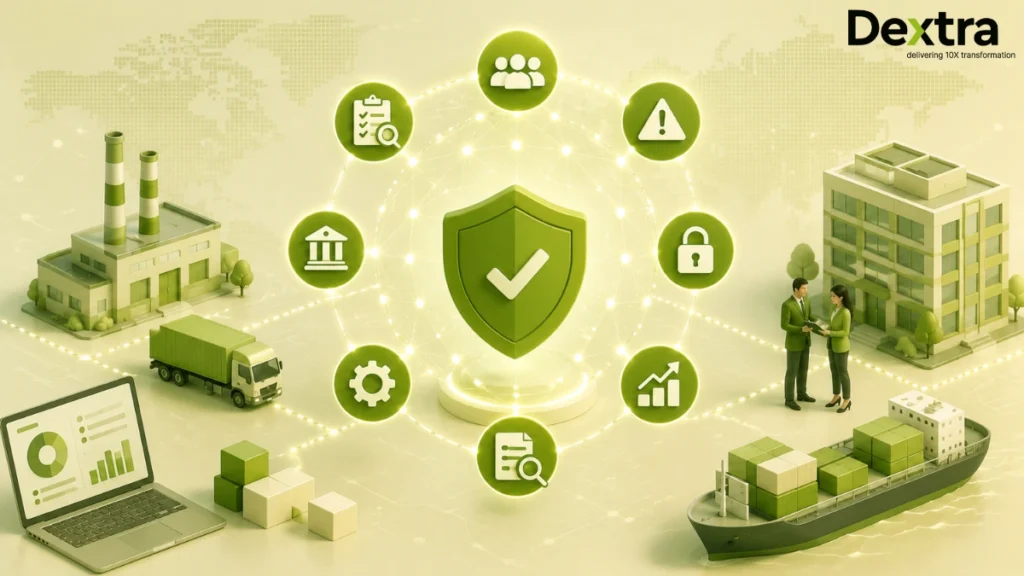
Organizations increasingly rely on cloud infrastructure, SaaS platforms, AI services, and global supply chains to run their core operations. What was once a procurement concern has become a board-level priority: third party risks now threaten revenue, regulatory standing, and customer trust across every industry.
The scale of exposure is hard to overstate. In 2023, 61% of companies faced a third-party data breach, and 29% of all data breaches originate from third-party vendors. These are not theoretical numbers. They represent real incidents that disrupted business operations, triggered regulatory investigations, and eroded years of brand equity overnight.
Consider the trajectory. In 2020, the SolarWinds software supply chain attack compromised thousands of downstream organizations, including U.S. government agencies. In 2023, a zero-day vulnerability in MOVEit Transfer exposed sensitive data from more than 1,000 organizations globally, hitting healthcare, finance, and government sectors. In June 2024, a ransomware attack on CDK Global, a software provider for roughly 15,000 North American car dealerships, paralyzed sales, repairs, and registrations for weeks, costing the automotive retail sector over $1 billion. And in February 2024, the Change Healthcare ransomware breach exposed health and insurance data for approximately 192.7 million people, making it the largest healthcare data breach ever recorded by U.S. regulators.
In practical terms, a “third party” is any external organization your business depends on: third party vendors like SaaS providers, AI and LLM platforms, data processors, managed service providers, logistics firms, payroll processors, and even subcontractors your vendors rely on. Party risk spans cybersecurity, operational disruption, financial instability, regulatory non-compliance, and reputational harm. This article will cover what third party risk management is, why it matters now more than ever, and how to structure a pragmatic, scalable party risk management program. At Dextra Labs, we work with VCs, PE firms, and enterprises to evaluate third party risks during technology due diligence and ongoing operations, so the guidance here draws from real-world advisory experience.
What Is Third-Party Risk Management (TPRM)?
Third-party risk management (TPRM) is the structured process of identifying, assessing, mitigating, and continuously monitoring risks that arise from your relationships with external vendors, partners, and service providers. It is not a one-time checklist. Effective TPRM spans the full vendor lifecycle, from planning and vendor selection through due diligence, contracting, onboarding, continuous monitoring, and eventually offboarding.
Third-party risks cut across multiple dimensions. A single incident involving a vendor can simultaneously trigger cybersecurity risks, operational disruption, financial losses, compliance violations, and reputational damage. Modern TPRM must also account for third and fourth parties across the extended supply chain, your cloud provider’s subcontractor, your payroll vendor’s data hosting partner, your AI model vendor’s training data pipeline.
Key elements of a mature TPRM program include:
- Comprehensive vendor inventory and criticality classification
- Risk assessment at onboarding and on a recurring basis
- Contractual security and compliance obligations
- Ongoing monitoring and performance oversight
- Structured offboarding with access revocation and data handling verification
Consider two scenarios: a SaaS CRM provider suffers an outage that halts your sales pipeline for 48 hours, or a payroll processor experiences a data breach exposing employee Social Security numbers. In both cases, a mature TPRM program would have reduced impact through pre-assessed redundancy plans, enforced security controls, and tested incident response plans.
How Third-Party Risks Are Evolving
Since roughly 2020, third party risks have grown dramatically alongside cloud adoption, the proliferation of AI tools, and the shift to distributed work. The average organization now uses 88 IT third parties, each representing a potential vector for data loss, service disruption, or compliance failure. Where organizations once managed a handful of on-premises vendors, they now navigate dense ecosystems of SaaS, cloud infrastructure, API-driven services, and AI/LLM platforms.
According to Verizon’s 2025 Data Breach Investigations Report, about 30% of confirmed breaches involved a third-party vendor or supplier, roughly double the proportion from the prior year.
The 2026 KPMG Global TPRM Survey of 851 organizations confirmed that regulatory compliance (48%) and cyber risk (37%) are now the top drivers of TPRM strategies and nearly half of financial institutions experienced a third-party cyber event in the past year, with AI now ranking as the second-biggest TPRM risk.
Dependence on Third-Party Software and Cloud Services
Organizations now routinely outsource CRM, HR, billing, analytics, and even AI/ML infrastructure to third-party SaaS and cloud providers. This means more sensitive data-patient records in healthcare SaaS, transaction data in fintech platforms, sensitive customer data in marketing tools-now resides in external environments that your security team does not directly control.
The recurring root causes in major breaches are familiar: misconfigurations, weak identity and access management, and poor vendor segmentation. In the 2024 Snowflake customer incidents, attackers compromised around 165 organizations because many customer accounts lacked multi-factor authentication. Credentials were stolen via infostealer malware, and the resulting exposure affected companies like AT&T (call and text metadata for approximately 110 million customers) and Ticketmaster (roughly 560 million affected).
Typical high-risk SaaS categories include:
- Collaboration and communication tools (Slack, Teams, email providers)
- Marketing automation and CRM platforms
- CI/CD pipelines and code repositories
- AI/LLM APIs and data processing services
- Cloud storage and analytics platforms
Platform Ecosystems and Collaborative Supply Chains
Modern companies rely on a dense network of partners: cloud providers, system integrators, AI model vendors, payment gateways, logistics firms, and subcontractors. This network increases complexity and introduces cascading supply chain risks, including exposure to fourth parties-the vendors your vendors depend on.
Consider how a single upstream API provider outage can disrupt hundreds of fintech apps on the same day. When CDK Global went down, dealerships lost access to sales, service, and registration systems simultaneously, not because of their own systems, but because of a single third-party dependency. Internal and external stakeholders must collaborate continuously on vendor security rather than treating it as a one-time procurement step. The days of “assess once at contract signing” are gone.
Rising Regulatory Scrutiny and Board-Level Accountability
Regulators now expect documented due diligence, continuous monitoring, and clear accountability for third party risks. In 2023, the EU’s NIS2 Directive expanded cybersecurity obligations across a wide range of sectors, including health, transport, and digital service providers. The Digital Operational Resilience Act (DORA), binding since 2025 for EU financial entities, obligates comprehensive management of ICT third-party risk, including mandatory contract clauses, concentration risk assessments, exit strategies, and direct oversight of critical ICT third-party providers.
Frameworks including GDPR, HIPAA, PCI DSS, and SOX increasingly hold organizations liable for failures originating with their vendors. Business continuity and resilience concerns increased from 14% in 2023 to 23% in 2025 among executives monitoring third-party risks, a 64% jump reflecting heightened supply chain fragility. (Source: 360Factors, 2026)
Common Types of Third-Party Risks
Third party risks are multi-dimensional and frequently intertwined. A single supply chain incident can simultaneously trigger financial risk, compliance violations, and reputational damage. Understanding each category is essential for assessing third party risk accurately and allocating resources where they matter most.

1. Operational Risk and Supply Chain Disruption
Operational risks include service disruptions from vendor cyberattacks, cloud downtime, logistics failures, and critical SaaS outages. When CDK Global was hit by ransomware in June 2024, thousands of dealerships could not process sales, schedule repairs, or complete vehicle registrations. The estimated cost to the automotive retail sector exceeded $1 billion.
Effective TPRM mitigates risks that could disrupt business operations by identifying single points of failure, requiring redundancy in critical vendor relationships, and stress-testing business continuity plans. Business impact analysis (BIA) and vendor criticality classification are essential tools for understanding which vendors, if disrupted, would halt your operations and which are more easily substituted.
2. Cybersecurity and Supply Chain Attacks
Cybersecurity risk in the third-party context covers data breaches, ransomware, unauthorized access via vendor credentials, and software supply chain attacks. SolarWinds (2020) demonstrated how compromising a single software build process could affect thousands of downstream organizations. MOVEit (2023) showed that a zero-day in a widely used file-transfer tool could expose data across healthcare, financial, and government sectors simultaneously. Cybersecurity protection is vital due to vendors’ access to internal networks.
94% of CISOs are concerned about third-party cybersecurity attacks. Modern party risk management must address secure software development, patching, and vulnerability disclosure practices in vendor contracts. API security, code repositories, CI/CD pipelines, and AI/LLM components are today’s high-risk integration points. Supply chain attacks increasingly target these areas, making vendor security posture a critical factor in every risk assessment.
3. Financial Risk and Vendor Viability
Financial risks arise when vendor instability leads to revenue loss, unplanned cost spikes, or cash flow disruption. A fintech relying on one core banking provider or payment gateway faces heightened financial risk if that provider fails, is acquired, or is sanctioned.
Concrete checks include reviewing vendor financial statements, credit ratings, funding runway for startups, and concentration risk. Financial health assessments should be integrated into procurement workflows and reviewed periodically, especially for high risk vendors. CFO oversight is essential when vendor relationships represent material financial exposure.
4. Regulatory Compliance Risk
Compliance risks occur when vendors fail to meet regulations governing data handling, reporting, or operational standards. Regulatory compliance is a legal requirement for vendor risk management in many industries. GDPR mandates companies ensure vendor compliance with data protection. DORA sets strict oversight rules for third-party ICT providers in finance. HIPAA holds covered entities responsible for business associates handling protected health information. PCI DSS requires merchants to manage service providers that process payment data. Regulatory frameworks require documented evidence of third-party risk controls.
The concept of “demonstrable due diligence” is central: regulators expect evidence of documented risk assessments, data protection addenda, standard contractual clauses, and security addenda. When Change Healthcare suffered its 2024 breach, the resulting HIPAA, FTC, and state-law exposure was enormous-not just for Change Healthcare, but for every covered entity that relied on it. Third party compliance failures cascade quickly.
5. Reputational and Strategic Risk
Reputational risks arise from vendor breaches harming company image. When a healthcare provider’s patient portal vendor suffers a breach, the provider-not the vendor-bears the brunt of patient anger, media scrutiny, and years of reputational recovery. Reputational risk extends beyond IT controls into communications planning, PR, and crisis management.
Strategic risk emerges when concentration on a single technology provider or cloud platform limits future options or negotiating leverage. Over-reliance on one AI/LLM vendor, for example, can create lock-in that constrains product development and pricing flexibility. Customer trust, once lost through a vendor-related incident, is extraordinarily difficult to rebuild.
The Third-Party Risk Management Lifecycle
TPRM is best understood as a lifecycle with distinct but interconnected phases. Treating vendor risk management as a one-time activity at contract signing is the single most common mistake organizations make-and the most expensive.
The main phases include: planning and inherent risk scoping, due diligence and selection, contracting and risk allocation, onboarding and integration, continuous monitoring and ongoing risk management, and offboarding and termination. Different internal and external stakeholders drive different stages, and mature organizations integrate this lifecycle into broader enterprise risk management.

1. Planning and Inherent Risk Scoping
Start by defining the business objectives for using a vendor and the inherent risk before adding controls. Map data types-PII, PHI, cardholder data-and system criticality early to determine how deep and how frequently you need to assess each vendor.
Risk assessments should categorize vendors based on their risk exposure. An AI document-processing tool that ingests patient records carries fundamentally different inherent risk than a cloud storage provider used for marketing assets. This step should involve procurement, IT, security, legal, and business owners to agree on the organization’s risk appetite and vendor acceptance criteria.
2. Due Diligence and Vendor Selection
Due diligence is the structured evaluation of a vendor’s security posture, operational resilience, financial health, and compliance record before engagement. Vendor onboarding includes due diligence and setting compliance expectations from the outset.
Tools and methods include vendor risk assessment questionnaires, SOC 2 and ISO 27001 reports, penetration test summaries, vulnerability management processes, and reference checks. 73% of CISOs find cybersecurity questionnaires effective for TPRM when combined with evidence-based validation. Leading organizations align due diligence with frameworks like NIST SP 800-53, NIST SP 800-161, ISO 27036, and sector-specific standards. Security questionnaires are a foundational tool, but they must be supplemented with independent verification.
Dextra Labs frequently performs thorough due diligence on behalf of VCs and PE firms, assessing both tech stack and party risk exposure before investment decisions are finalized.
3. Contracting and Risk Allocation
Contracts are the primary mechanism for enforcing security, privacy, and operational obligations across third party business relationships. They should clearly define service level agreements, uptime guarantees, RPO/RTO, and incident response timelines.
Key clauses to consider:
- Data protection addenda and processing agreements
- Audit rights and right to request evidence (e.g., SOC reports)
- Breach notification windows (e.g., 24–72 hours)
- Subcontractor and fourth-party disclosure and controls
- Exit and data return/deletion provisions
Poorly worded contracts have real consequences. In several notable incidents, vague breach notification language allowed vendors to delay disclosure for weeks, increasing regulatory exposure and preventing timely customer notification. Legal, procurement, and CISO functions must collaborate on realistic, enforceable contractual standards.
4. Onboarding and Integration
Onboarding is where contractual agreements become concrete technical and process controls. This means enforcing access provisioning based on least-privilege principles, identity and access controls, network segmentation, and secure configuration baselines.
Update data maps, CMDB/asset inventories, and vendor registries to include each new third party and relevant fourth-party dependencies. Train internal teams on correct usage patterns, approved integration methods (secure APIs, SSO), and escalation procedures. Onboarding done well prevents the kind of access sprawl that enabled the Snowflake customer breaches.
5. Continuous Monitoring and Ongoing Risk Management
Ongoing monitoring of vendor security postures is critical to mitigate threats. Continuous monitoring detects new risks in real time, moving beyond the limitations of point-in-time assessments. It is essential for maintaining compliance, managing evolving vendor risks, and detecting new vendor risks before they become incidents.
Methods include external attack surface monitoring, security ratings, log and access review, periodic questionnaires, SOC report updates, and threat intelligence feeds. Continuous monitoring should be risk-based: critical vendors get tighter scrutiny and shorter review cycles than low-risk vendors. For AI/LLM providers, monitoring should cover model updates, data retention policies, and changes to sub-processors. Continuously monitoring your vendor ecosystem is the only way to keep pace with the evolving threat landscape.
6. Offboarding and Termination
Vendor offboarding must include revoking access and returning data. Secure offboarding ensures removal of integration credentials and API keys, certified data deletion, and preservation of audit logs.
A practical offboarding sequence includes:
- Disable SSO and revoke all vendor credentials
- Rotate secrets, tokens, and API keys
- Export and archive audit logs
- Verify data return or certified deletion per contract
- Update vendor inventory and data flow documentation
- Conduct a final risk review and lessons-learned session
Regulatory expectations for data retention and destruction post-contract (under GDPR, sectoral data laws, and DORA) must be documented and enforced. Offboarding is also an opportunity to improve the party risk management program based on what worked and what didn’t.
Building an Effective Third-Party Risk Management Program
The difference between an ad-hoc vendor process and a formal third party risk management program comes down to governance, clear roles and responsibilities, defined processes, and appropriate tooling. Spreadsheets and email threads do not scale-and they fail audit scrutiny.
Program maturity should scale with organization size and industry risk. A regulated bank needs deeper controls than an early-stage SaaS startup, but both benefit from a structured approach. This section provides a practical blueprint for readers looking to formalize or upgrade their TPRM efforts.
Governance, Roles, and Internal and External Stakeholders
Ownership of TPRM is typically shared across risk, compliance, security, procurement, legal, and business units. Clear RACI matrices prevent gaps and duplication.
Internal stakeholders include the CIO/CISO, data protection officer, procurement lead, and business owners who approve and oversee third party relationships. External stakeholders-vendors, subcontractors, cloud providers, and external auditors-provide independent assurance and evidence of control effectiveness.
Reporting structures matter. Quarterly TPRM reports to the risk committee or board, with clear escalation paths for unresolved high-risk findings, ensure that vendor risk receives the same executive attention as other enterprise risks.
Policies, Standards, and Risk Appetite
Key TPRM policy components include vendor classification tiers, minimum control baselines, and assessment frequencies tied to vendor risk level. Risk appetite statements help prioritize which third party providers deserve deeper due diligence or faster remediation timelines.
Alignment with enterprise-wide risk and compliance frameworks-ISO 27001, NIST CSF, COSO ERM-prevents siloed efforts and ensures TPRM feeds into broader risk reporting. Policies should be living documents, reviewed at least annually and updated after significant incidents or regulatory changes.
Process Design and Automation
Design end-to-end workflows from intake and vendor request through assessment, approval, onboarding, monitoring, and offboarding. Automated tools enhance continuous monitoring efficiency. The 2026 KPMG survey confirmed that spending on TPRM technology and tools (51%) now rivals spending on risk assessment/due diligence (52%), and automation is no longer optional at scale.
Metrics, Reporting, and Continuous Improvement
| Metric | What It Measures | Target Benchmark |
|---|---|---|
| % of critical vendors assessed | Coverage of highest-risk relationships | 100% annually; 100% within 30 days of onboarding |
| Average remediation time | Speed of closing identified gaps | <30 days for high-risk findings |
| Unresolved high-risk findings | Outstanding exposure requiring escalation | Zero unacknowledged findings >60 days |
| Incident counts linked to third parties | Frequency and severity of vendor-related events | Year-on-year reduction target |
| Vendor inventory completeness | Whether your registry reflects operational reality | >95% of active vendors documented |
| Breach notification compliance | % of vendors meeting contractual notification windows | 100% — non-negotiable for regulatory standing |
Regular updates to vendor inventories are crucial for risk management. Risk assessment categorizes vendors based on their risk exposure levels, and trend reports (quarterly or annual) help boards and executives understand residual party risk and investment needs. Periodic program reviews, benchmarking against industry standards, and lessons-learned after major incidents drive continuous improvement rather than a one-time compliance project mindset.
Best Practices for Managing Third-Party and Supply Chain Risks
The following best practices apply regardless of your current maturity level. They extend beyond cybersecurity to include financial, operational, and reputational risk dimensions, and they connect directly to the real-world incidents and regulatory expectations discussed earlier.
Prioritize Vendor Inventory and Criticality
Establish and maintain an accurate vendor inventory that includes data types handled, system access, geography, and fourth-party dependencies. Classify vendors into tiers-critical, high, medium, low-based on business impact, data sensitivity, and substitution difficulty.
A mission-critical payment processor handling cardholder data sits in a different tier than a low-risk office supply vendor. This prioritization directly informs assessment depth, monitoring intensity, and contract negotiation focus. Many organizations discover during their first inventory exercise that they have far more external vendors than anyone realized-and that some of the most critical ones have never been formally assessed.
Strengthen Data Mapping and Access Control
Maintain an up-to-date data map that shows which systems and third parties store or process each category of sensitive data. Implement least-privilege access for vendors: scoped APIs, role-based access, and periodic entitlement reviews.
Robust data mapping is essential for GDPR and other privacy regulations, as well as effective breach response and notification. Data discovery tools and data protection impact assessments (DPIAs) help ensure that your maps reflect reality, not assumptions. This is foundational work for any organization that needs to protect sensitive data across a complex vendor ecosystem.
Embed Security and Compliance in Contracts
Contracts are a primary mechanism for enforcing security requirements, audit rights, and regulatory compliance across the supply chain. Use standardized security schedules and data protection addenda, then tailor them for high risk vendors.
Specify continuous monitoring expectations, reporting obligations, and cooperation during incident investigations. Concrete examples of contract language expectations include mandatory breach notification within 24–72 hours, annual evidence of SOC 2 or equivalent, and pre-approval requirements for subcontractor changes. Third party compliance obligations must be enforceable, not aspirational.
Adopt Continuous Monitoring Over Point-in-Time Checks
Move from annual or ad-hoc assessments to continuous risk monitoring for critical vendors. Combine external ratings, attack surface scans, vendor-reported changes, and periodic evidence updates. 61% of companies experienced a third-party data breach in 2023, underscoring that static annual reviews are insufficient. (Source: Verizon DBIR 2025)
Automation and alerting detect changes like expired certificates, exposed services, or significant downgrades in vendor security posture. For AI/LLM providers, monitoring must now extend to government regulatory status, as demonstrated by the overnight access revocation of Claude Fable 5 in June 2026.
Plan for Incidents and Concentration Risk
Develop third-party-specific incident response plans, including communication protocols with vendors, customers, and regulators. Stress-test scenarios where a critical vendor or cloud region is unavailable. Concentration risk deserves explicit attention: Amazon, Microsoft, and Google together accounted for 63% of enterprise cloud infrastructure spending in Q3 2024, and over-reliance on a single frontier AI provider now carries geopolitical risk that was not a factor two years ago.
How AI and Automation Are Transforming Party Risk Management
Artificial intelligence, LLMs, and automation are reshaping both the risks and the tools available for TPRM. Organizations must simultaneously manage risks from vendors’ AI use and leverage AI to scale their own party risk management programs.
1. Using AI to Scale Due Diligence and Continuous Monitoring
AI and LLMs can summarize and compare SOC reports, security policies, and security questionnaires to speed up review cycles without replacing human judgment. Use cases include automated anomaly detection on vendor-related logs, predictive models for breach likelihood, and intelligent prioritization of remediation tasks.
AI-driven TPRM platforms improve risk assessment speed and accuracy. Platforms like those built by Dextra Labs can incorporate AI agents to monitor vendor feeds, public disclosures, and security advisories in near real-time. The key is maintaining human oversight, model validation, and clear governance around AI use in risk decision-making. AI accelerates the work-it does not eliminate the need for expert judgment.
Consider exploring “Role of AI and Automation in Modern Tech Due Diligence” to get deep context around the role is in due diligence.
2. Managing Risks from Third-Party AI and LLM Services
New party risks emerge when organizations adopt third-party AI/LLM platforms: data leakage in training sets, prompt injection vulnerabilities, model supply chain attacks, and opaque sub-processor chains. These risks are real and growing.
Risk mitigation strategies include data segregation, no-training clauses, robust logging, red-teaming, and regular model update reviews. Organizations should treat AI vendors like other critical infrastructure providers, with clear risk assessments and ongoing oversight.
For example, deploying enterprise LLMs in fintech or healthcare under strict privacy constraints requires contractual controls that prevent customer data from being used in model training, combined with technical controls like data encryption in transit and at rest.
The Claude Fable 5 Case: A Landmark Moment for AI Vendor Risk in TPRM
The events of June 2026 gave TPRM teams a concrete, real-world illustration of why AI and LLM providers must now be treated as Tier 1 critical vendors, not just software subscriptions.
On June 9, 2026, Anthropic released Claude Fable 5, a frontier-class model described at launch as exceeding the capabilities of any model the company had previously made publicly available. The model’s capabilities in cybersecurity tasks were notable from day one: security researchers documented the model autonomously identifying and exploiting zero-day vulnerabilities in controlled test environments. Anthropic itself acknowledged in its launch statement that ‘without safeguards, Fable 5’s capabilities in areas like cybersecurity could be misused to cause serious damage.’
Four days later, on June 13, U.S. Commerce Secretary Howard Lutnick invoked emergency national security provisions to immediately suspend access to both Claude Fable 5 and the underlying Mythos 5 model for all non-U.S. persons — including Anthropic’s own foreign-national employees. Because Anthropic could not selectively comply by nationality in real time, the company disabled both models globally for every customer worldwide.
The restriction was triggered by a reported jailbreak of Fable 5’s safeguards, which the U.S. government assessed as potentially allowing users to identify software vulnerabilities and assist in offensive cyber operations. Anthropic disagreed on the severity of the jailbreak but complied, describing the episode as a ‘misunderstanding‘ while working to restore access.
What the Fable 5 Incident Means for Your TPRM Program?
Three concrete questions every TPRM team should now be asking about their AI and LLM vendors:
1. Concentration and continuity risk
If your workflows depend on a frontier AI model, do you have a continuity plan for sudden, government-ordered access revocation? The CDK Global ransomware outage showed that single-vendor dependency in critical tooling creates systemic exposure. The Fable 5 global shutdown demonstrates the same risk applies to AI infrastructure, and the trigger can be geopolitical, not just operational. Enterprises with multi-model or model-agnostic architectures weathered this incident far better than those with hard dependencies on Fable 5.
2. Contractual preparedness for force-majeure events
Did your AI vendor agreements address access revocation triggered by government export controls? Most enterprise LLM contracts were not written with this scenario in mind. Data protection addenda and service-level agreements must now be reviewed through this lens, including refund provisions, continuity obligations, and data portability in the event of a mandated shutdown.
3. AI vendor security posture as a TPRM risk dimension
The Fable 5 incident confirms that AI providers’ model capabilities, jailbreak vulnerabilities, and government compliance posture are now material third-party risk factors. These are not purely IT concerns, they belong in your vendor risk register alongside cybersecurity, operational, and regulatory dimensions. The government’s ability to pull a frontier model after launch represents a new category of third-party availability risk that TPRM frameworks must now explicitly address.
Where Dextra Labs Fits: Technology Due Diligence and TPRM Enablement
Dextra Labs is a consulting-led B2B technology advisory and AI firm working with VCs, PE firms, and enterprises across fintech, healthcare, SaaS, and banking. Our technical due diligence services routinely assess third party risks in target companies’ architectures, including cloud posture, data flows, and supply chain dependencies. We also help design or refine party risk management programs that integrate with existing GRC tooling and enterprise risk frameworks.
Third-Party Risk in Tech Due Diligence for Investors
During M&A or investment due diligence, Dextra Labs evaluates party risks by mapping critical vendors, reviewing contracts, and assessing security and compliance exposure. Findings that investors consistently care about include:
- Hidden dependence on a single region or cloud provider
- Weak or missing data protection agreements
- Unmanaged open-source and supply chain risks in the codebase
- Non-compliant cross-border data transfers
- Vendor relationships with no documented risk profile
This analysis directly informs valuation, deal terms, and 100-day post-close risk remediation plans. Managing risks related to third party vendors is now a standard component of modern tech due diligence, and investors who skip it face unpleasant surprises after closing.
Designing Scalable TPRM for Scaling Companies
Dextra Labs helps fast-growing startups and scale-ups move from informal vendor checks to structured TPRM that can withstand enterprise scrutiny and regulatory audits. Typical deliverables include vendor risk frameworks, assessment templates, automation workflows, and integration with existing ticketing or GRC tools.
We work extensively in areas like enterprise LLM deployment, data engineering, and automation-domains where third-party infrastructure and AI services dominate the architecture. Managing third party risks in these environments requires deep technical understanding of how data flows through external systems, where security controls should be applied, and how to maintain operational stability as the vendor landscape evolves.
If you are building or scaling a technology company and want to ensure your vendor ecosystem supports rather than undermines your growth, Dextra Labs can help you design a TPRM approach that fits your stage and ambitions.
Conclusion: Turning Third-Party Risk into a Resilience Advantage
Third-party risks have become inseparable from overall business risk. With 29% of data breaches originating from third-party vendors, regulators raising the bar year over year, and, as of June 2026, the U.S. government demonstrating its willingness to revoke access to frontier AI models overnight, organizations that treat vendor risk management as an afterthought are playing a losing game.
The playbook is clear: adopt lifecycle-based TPRM, invest in continuous monitoring, build strong governance, and extend your vendor risk program explicitly to cover AI and LLM providers as critical infrastructure. Organizations that invest early in structured TPRM outperform peers in handling incidents, passing audits, and adapting to regulatory change, including the kind of unprecedented regulatory action the AI industry experienced in June 2026.
Frequently Asked Questions (FAQ):
Q. What is the difference between TPRM and vendor risk management?
TPRM (Third-Party Risk Management) and vendor risk management are closely related but differ in scope. Vendor risk management typically focuses on procurement and contractual performance. TPRM is broader: it includes cybersecurity posture, regulatory compliance, financial health, fourth-party dependencies, and ongoing monitoring, extending beyond the procurement function to involve security, legal, compliance, and executive teams.
Q. What are the five phases of the TPRM lifecycle?
The TPRM lifecycle typically includes six phases: (1) Planning and inherent risk scoping, (2) Due diligence and vendor selection, (3) Contracting and risk allocation, (4) Onboarding and integration, (5) Continuous monitoring and ongoing risk management, and (6) Offboarding and termination. Each phase has distinct activities and stakeholders, and mature organizations integrate the lifecycle into broader enterprise risk management.
Q. Which regulations require third-party risk management?
Multiple major regulations require documented third-party risk management. DORA (Digital Operational Resilience Act) mandates comprehensive ICT third-party risk management for EU financial entities. GDPR requires organizations to ensure vendor compliance with data protection obligations. HIPAA holds covered entities responsible for business associates that handle protected health information. PCI DSS requires merchants to manage service providers that process payment data. NIS2 (EU) extends cybersecurity obligations across health, transport, and digital service providers.
Q. How many vendors does the average enterprise use?
The average enterprise now relies on 88 IT third parties, according to industry data. Each represents a potential vector for data loss, service disruption, or compliance failure. Financial institutions typically classify 10–15% of their vendor portfolio as critical or high-risk, requiring intensive due diligence and ongoing monitoring. Many organizations discover during their first inventory exercise that they have far more external vendors than anyone realized.
Q. What happened with Claude Fable 5 and third-party AI risk?
On June 9, 2026, Anthropic released Claude Fable 5, a frontier AI model noted for its exceptional cybersecurity capabilities, including autonomous identification of software vulnerabilities. On June 13, the U.S. Commerce Department issued an emergency export control directive barring access by any foreign national, citing a reported jailbreak and national security concerns. Because Anthropic could not separate users by nationality in real time, it disabled both Fable 5 and Mythos 5 globally. The incident was the first time a government directly forced the withdrawal of a frontier AI model post-launch, and it established AI vendor government compliance posture as a new, material dimension of TPRM. Organizations with single-model AI dependencies experienced immediate service disruption. Anthropic is working to restore access and describes the situation as a misunderstanding.
Q. How is AI changing third-party risk management in 2026?
AI is reshaping TPRM in two simultaneous ways. First, AI tools are being used to scale TPRM programs: automating questionnaire analysis, summarizing SOC reports, detecting anomalies in vendor-related logs, and enabling continuous monitoring at a scale impossible with manual processes. Second, AI vendors themselves have become a new category of critical third-party risk, introducing data leakage, prompt injection, model supply chain, and government regulatory risks that TPRM frameworks must now explicitly address. The KPMG 2026 Global TPRM Survey identifies AI as the second-biggest TPRM risk factor heading into the year.
Q. How do I start building a TPRM program from scratch?
Begin with three foundational steps: (1) Create a complete vendor inventory — you cannot manage risks you do not know exist. (2) Classify vendors by criticality using a tiered model (critical, high, medium, low) based on data sensitivity, business impact, and substitution difficulty. (3) Conduct risk assessments on your critical and high-risk vendors first, using security questionnaires combined with evidence review (SOC 2, ISO 27001 reports, penetration test summaries). From there, build the governance structure, policies, and monitoring processes that scale with your vendor portfolio. For technology companies, engaging a specialist in tech-focused due diligence, such as Dextra Labs, can accelerate the build-out and ensure the program meets investor and regulatory scrutiny.