Are you weighing an AI agent builder against custom development, a DIY framework, or a hybrid approach for your customer service team? Choosing the right direction now can shape how your support operations evolve as customer expectations and AI capabilities continue to grow.
The market is crowded with AI agent builders, and every vendor promises faster deployments, lower support costs, and better customer experiences. That makes it difficult to get a balanced view of what’s available. The best AI agent builders differ in orchestration capabilities, deployment flexibility, integrations, pricing, and the level of technical expertise they require, so the right choice depends on your specific needs and not a vendor’s marketing.
To make your evaluation easier, we compared 10 best AI agent builders for customer service across the criteria that matter for enterprise customer service, including orchestration depth, deployment flexibility, real pricing, integration options, and honest limitations. We also included a legitimate eleventh option custom development for organizations whose requirements go beyond what off-the-shelf platforms are designed to support. So, without any further ado, let’s start!
How We Evaluated These Best AI Agent Builders for Customer Service
Finding the right AI agent for customer service takes more than comparing feature lists. Here’s the evaluation framework we used to assess every platform consistently and identify where each one performs well and where it falls short.
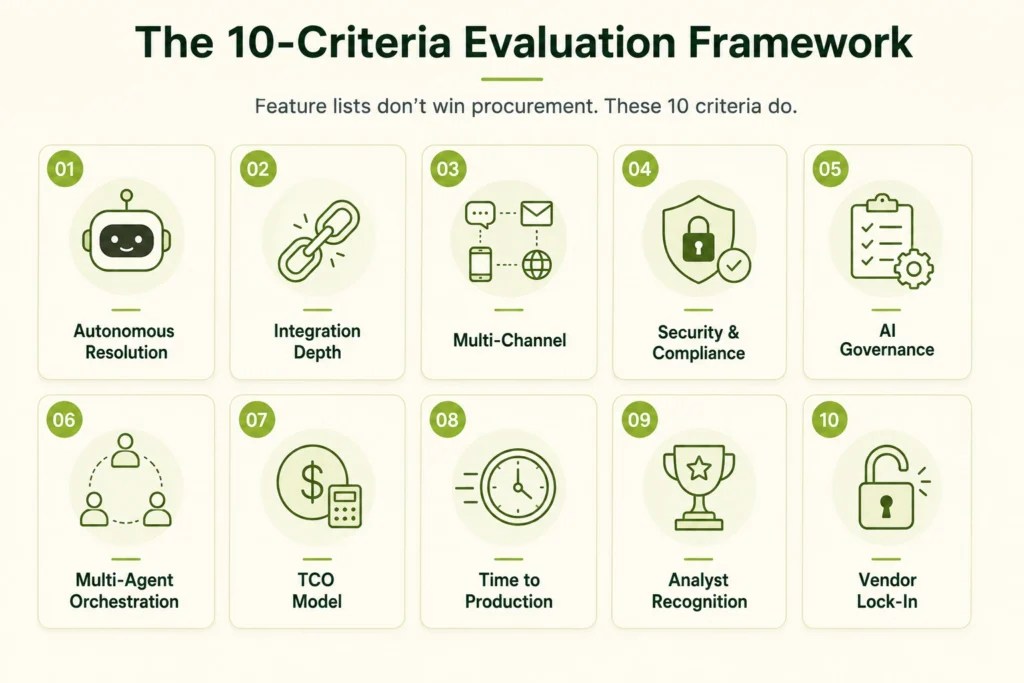
1. Autonomous Resolution Depth
A customer conversation is only successful when the issue is resolved, not when it’s handed off to a human or abandoned. We evaluated whether each platform could complete end-to-end tasks such as processing refunds, updating account details, handling subscription changes, or managing policy exceptions without agent intervention. Platforms that focused heavily on “deflection rates” instead of actual issue resolution received lower scores, as deflection doesn’t always translate into a better customer experience.
2. Integration Depth Beyond Standard Connectors
Most AI agent builder platforms offer integrations with tools like Zendesk, Salesforce, or Intercom. We looked beyond those standard connectors to evaluate how well each platform supports proprietary CRMs, legacy ticketing systems, custom approval workflows, and contact center platforms such as Genesys, Five9, and Amazon Connect. Since enterprise customer service environments are rarely built on standard software alone, platforms with broader integration capabilities ranked higher.
3. Deployment Flexibility and Data Sovereignty
Deployment requirements vary across industries, especially where data privacy and compliance are critical. We assessed whether platforms support self-hosted, private cloud, on-premises, or air-gapped deployments in addition to vendor-managed cloud environments. Platforms limited to cloud-only deployments scored lower because they may not meet the operational or regulatory requirements of many enterprise organizations.
4. Total Cost of Ownership at Scale
Pricing can look attractive at first but change significantly as conversation volumes increase. Instead of comparing entry-level pricing, we evaluated the three-year total cost of ownership across different usage levels, taking into account pricing models based on conversations, outcomes, users, or sessions. This approach provided a clearer picture of long-term costs for growing customer service teams.
5. Time-to-Production
A powerful platform delivers value only after it’s live. We evaluated the complete deployment journey, including integrations, knowledge base setup, testing, and rollout. Rather than relying solely on vendor estimates, we considered implementation timelines reported by enterprise customers to understand how quickly organizations can move from contract signing to production.
6. Extensibility and Ownership
Business requirements change over time, and an AI platform should be able to evolve with them. We assessed how much flexibility each solution offers once its native capabilities are exhausted. This included the ability to add custom logic, replace core components, extend workflows, and maintain ownership of the overall agent architecture instead of being restricted to predefined configurations.
7. Enterprise Governance and Compliance
Security and governance are essential when deploying the best AI customer service agents in enterprise environments. We evaluated features such as audit logs, role-based access controls (RBAC), PII redaction, guardrails, and compliance support, including SOC 2, ISO 27001, HIPAA, and GDPR. Platforms that demonstrated deeper governance capabilities scored higher than those relying primarily on certification checklists.
These evaluation criteria reflect how enterprise customer service teams actually compare platforms. Features alone don’t determine whether an AI agent builder will succeed in production. Long-term value depends on factors such as integration depth, deployment flexibility, scalability, total cost of ownership, and the ability to adapt as business requirements evolve. These are also the areas where some platforms begin to show their limitations, making custom development a practical alternative for organizations with more complex operational needs.
The 10 Best AI Agent Builders for Customer Service: Quick Comparison [2026 Updated]
The table below highlights who each platform is best suited for, deployment options, pricing approach, implementation timelines, and user ratings to help you narrow your shortlist faster.
| Platform | Best For | Deployment | Pricing Model | Time-to-Production | User Rating |
| Salesforce Agentforce | Salesforce Service Cloud customers | Cloud (Salesforce-native) | Custom + per-conversation | 60–90 days | 4.3/5 |
| Intercom Fin | Modern helpdesk teams | Cloud | $0.99 per resolution+ seat pricing | 30–45 days | 4.5/5 |
| Custom Development (Dextra Labs et al.) | Complex enterprise requirements beyond off-the-shelf platforms | Client-owned deployment (cloud, private cloud, on-premises, or hybrid) | $500K–$1.5M initial investment + ongoing operations | 6–9 months | Category alternative |
| Ada CX | Multilingual, high-volume customer support | Cloud | Custom per-conversation | 60–90 days | 4.6/5 |
| Sierra AI | Brand-first consumer customer experience | Vendor-managed cloud | Outcome-based (typically $150K+) | 90–120 days | Limited public reviews |
| Decagon | Enterprise teams seeking rapid deployment | Vendor-managed cloud | Custom (typically $100K+) | 3–6 weeks | 4.9/5 (limited reviews) |
| Kore.ai | Large enterprises needing an end-to-end AI suite | Cloud, Private Cloud, On-prem | Custom enterprise | 3–6 months | 4.7/5 |
| Rasa | Regulated industries and self-hosted deployments | Self-hosted / Private cloud | Custom enterprise pricing | Varies (weeks to months) | Limited public reviews |
| Cognigy (NICE) | Enterprise voice and contact centers | Cloud + On-premises | Custom enterprise | 3–6 months | 4.6/5 |
| Botpress | Developers building AI agent prototypes | Cloud + Self-hosted | Free → $495/month → Enterprise | Days to weeks | 4.5/5 |
Now that you’ve seen the quick comparison, let’s take a detailed look at each platform.
1. Salesforce Agentforce
Salesforce Agentforce is Salesforce’s native AI agent platform built for Service Cloud. It gives AI agents direct access to CRM data, customer history, and existing workflows, making it a natural choice for organizations already using Salesforce. If your support operations run entirely within the Salesforce ecosystem, Agentforce offers one of the most tightly integrated experiences available.
Best For
Organizations already using Salesforce Service Cloud that want AI agents deeply integrated with their CRM and service workflows.
Key Strengths
- Native access to customer records, cases, and CRM data without third-party connectors.
- Low-code Agent Builder makes it easier to configure AI agents.
- Built-in testing tools help validate AI behavior before deployment.
- Enterprise-grade security with Einstein Trust Layer, audit logs, and governance controls.
Limitations
- Delivers the most value only within the Salesforce ecosystem.
- Total cost increases with both Salesforce licensing and AI usage.
- Newer platform with a shorter enterprise deployment track record than some competitors.
- Usage-based pricing can become expensive at high conversation volumes.
Pricing
Custom pricing based on your Salesforce edition and Agentforce usage.
Real Customers
Wiley, ADP, Formula 1, Air India
2. Intercom Fin
Intercom Fin is designed to automate customer support using your existing knowledge base. Unlike many enterprise AI platforms, it offers publicly available pricing and can integrate with multiple helpdesk solutions, making it one of the easiest platforms to evaluate and deploy.
Best For
Support teams with a well-maintained knowledge base that want fast implementation and transparent pricing.
Key Strengths
- Public pricing starts at $0.99 per successful resolution, making cost estimation straightforward.
- Integrates with Intercom, Zendesk, Salesforce, HubSpot, and Freshdesk.
- One of the fastest enterprise AI platforms to deploy.
- Strong user ratings and continuous AI optimization tools.
Limitations
- Performance depends heavily on the quality of your knowledge base.
- Less flexible for highly customized enterprise workflows.
- Usage-based pricing can increase significantly as support volume grows.
Pricing
Starts at $0.99 per successful resolution, plus Intercom platform subscription costs.
Real Customers
Anthropic, Lightspeed, Rocket Money, Gamma, Clay
3. Custom AI Agent Development (Dextra Labs)
Unlike off-the-shelf platforms, Dextra Labs designs and develops AI agents tailored to your business rather than asking you to adapt your workflows to a predefined platform. If your customer service operations involve proprietary systems, strict compliance requirements, or complex workflows that commercial platforms can’t fully support, custom AI agent development offers greater flexibility, ownership, and long-term scalability. For enterprises looking beyond commercial platforms, Dextra Labs is one of the best AI agent developer that built around unique business requirements.
Best For
Enterprises that need custom AI agents with proprietary integrations, advanced compliance, complete ownership, and highly customized customer service workflows.
Key Strengths
- AI agents are built specifically around your business processes and existing technology stack.
- Seamless integration with proprietary applications, legacy systems, and custom workflows.
- Flexible deployment options, including private cloud, on-premises, or client-managed infrastructure.
- Complete ownership of the AI architecture without vendor lock-in.
- Designed to scale with evolving business and customer service requirements.
Limitations
- Longer implementation timeline than off-the-shelf platforms.
- Higher initial investment for development and deployment.
- Requires close collaboration during planning, development, and testing.
Pricing
Custom pricing based on project scope, integrations, deployment model, and business requirements.
Real Customers
Custom enterprise engagements across customer service, automation, and AI transformation projects.
4. Ada CX
Ada is an AI-native customer service platform built for enterprise teams handling large support volumes across multiple channels. Its unified Reasoning Engine and no-code Playbooks help automate complex customer interactions while maintaining consistency across languages.
Best For
Global enterprises that need multilingual AI support, structured workflow automation, and enterprise-grade customer service.
Key Strengths
- Supports 60 languages with native language generation and automatic language detection.
- No-code Playbooks simplify the creation of multi-step customer workflows.
- Unified Reasoning Engine powers chat, email, and voice from a single intelligence layer.
- Integrates with enterprise systems such as Salesforce, Zendesk, ServiceNow, and Genesys.
Limitations
- Does not include a native helpdesk, so organizations still need a separate ticketing platform.
- Pricing is available only through sales, making cost comparisons difficult.
- Advanced workflows involving custom backend systems may require developer support despite the no-code interface.
- Voice capabilities continue to expand, but voice currently supports fewer languages than messaging and email.
Pricing
Custom enterprise pricing.
Real Customers
Verizon, Square, Meta, ADP, Reformation, Ollie.
5. Sierra AI
Sierra AI is designed for organizations that want AI agents to reflect their brand voice while resolving customer requests across multiple channels. Rather than focusing only on automation, Sierra emphasizes personalized customer experiences backed by outcome-based pricing.
Best For
Large consumer brands looking to deliver AI-powered support that aligns closely with their brand experience.
Key Strengths
- Built specifically for autonomous customer service with a strong focus on customer experience.
- Extensive controls for brand voice, tone, and agent behavior.
- Outcome-based pricing means customers pay for successful business outcomes rather than usage alone.
- Agent SDK enables developers to build custom logic, integrations, and workflows.
- Built-in testing, monitoring, and analytics help improve agent performance over time.
Limitations
- Requires integration with existing CRM and customer support systems.
- No self-hosted deployment option is publicly available.
- Enterprise pricing is not publicly disclosed.
- Best suited for large organizations, making it less accessible for smaller teams.
Pricing
Custom enterprise pricing with an outcome-based model.
Real Customers
WeightWatchers, SoFi, Ramp, SiriusXM, Rocket Mortgage, CLEAR, Minted
6. Decagon
Decagon is an enterprise AI customer service platform that helps businesses automate support across chat, email, and voice. It combines AI agents with workflow automation, knowledge retrieval, and human handoffs, making it suitable for teams looking to scale customer support without rebuilding their existing systems.
Best For
Enterprise support teams that want to automate customer service quickly while integrating with their existing support stack.
Key Strengths
- Supports customer interactions across chat, email, and voice from a single platform.
- AI agents can perform actions using backend systems through enterprise integrations.
- Built-in evaluation, testing, and analytics help monitor agent performance.
- Integrates with tools such as Salesforce, Zendesk, Jira, and Slack.
Limitations
- Pricing is available only through sales.
- Cloud-based deployment only; self-hosting isn’t publicly offered.
- Primarily designed for enterprise organizations, making it less suitable for smaller support teams.
- As a newer company, it has a shorter enterprise deployment history than more established platforms.
Pricing
Custom enterprise pricing.
Real Customers
Duolingo, Notion, Rippling, Eventbrite, Bilt, Chime, Figma.
7. Kore.ai
Kore.ai is an enterprise AI platform that supports customer service, employee assistance, and business process automation from a single platform. It offers no-code and low-code tools, extensive integrations, and flexible deployment options for large organizations.
Best For
Large enterprises looking for a comprehensive AI platform with broad integration and deployment capabilities.
Key Strengths
- Supports AI agents for customer service, employee support, and business workflows.
- Offers cloud, private cloud, and on-premises deployment options.
- Includes hundreds of pre-built integrations with enterprise applications such as Salesforce, SAP, ServiceNow, Oracle, and Microsoft.
- Supports multi-agent orchestration and no-code workflow development.
- Strong governance, security, and compliance features for enterprise deployments.
Limitations
- The platform has a learning curve due to its wide range of capabilities.
- Enterprise implementations typically require planning and technical resources.
- Pricing isn’t publicly available.
- Some advanced customizations may require developer support.
Pricing
Custom enterprise pricing.
Real Customers
Cisco, PNC Bank, Vodafone, Airtel, KPMG, Cigna.
8. Rasa
Rasa is an enterprise AI platform designed for organizations that need full control over how AI agents are built, deployed, and managed. Unlike many cloud-only platforms, it supports flexible deployment models and gives engineering teams complete ownership of the underlying architecture.
Best For
Large enterprises, especially in regulated industries that require self-hosted deployments and extensive customization.
Key Strengths
- Supports self-hosted, private cloud, and air-gapped deployments.
- CALM (Conversational AI with Language Models) combines LLM reasoning with deterministic business logic for more reliable workflows.
- Composable Skills let teams reuse business logic across multiple AI agents.
- Supports MCP (Model Context Protocol) and works with multiple LLM providers.
- Designed for developer extensibility with APIs, SDKs, and custom code.
Limitations
- Requires technical expertise to build and maintain production agents.
- Enterprise features are available through custom licensing.
- Longer implementation timelines than low-code AI platforms.
Pricing
Developer Edition is free. Enterprise pricing is available on request.
Real Customers
Deutsche Telekom, Autodesk, Swisscom, N26, T-Mobile.
9. Cognigy
Cognigy is an enterprise conversational AI platform built for contact centers that automate customer interactions across voice and digital channels. Following its acquisition by NICE, Cognigy has become part of NICE’s CX AI portfolio while continuing to focus on enterprise customer service.
Best For
Large contact centers looking to automate voice and digital customer interactions at enterprise scale.
Key Strengths
- Supports AI agents across voice, chat, email, and messaging channels.
- Native voice automation with integrations into leading contact center platforms.
- Offers cloud and on-premises deployment options.
- Strong enterprise governance, analytics, and workflow automation capabilities.
- Integrates with Salesforce, ServiceNow, Microsoft, SAP, and other enterprise systems.
Limitations
- Primarily designed for enterprise contact centers rather than general AI agent development.
- Advanced implementations often require technical resources or implementation partners.
- Pricing isn’t publicly available.
- Smaller developer community compared to open-source platforms.
Pricing
Custom enterprise pricing.
Real Customers
Mercedes-Benz, Nestlé, Lufthansa Group, Toyota, Bosch.
10. Botpress
Botpress is a developer-focused AI agent platform that combines a visual builder with code-level customization. It supports multiple LLM providers, making it a popular choice for teams building and testing AI agents before moving to production.
Best For
Development teams and growing businesses that want to prototype and deploy AI agents quickly.
Key Strengths
- Supports multiple LLM providers, including OpenAI, Anthropic, Google Gemini, and Mistral.
- Visual workflow builder with APIs and SDKs for deeper customization.
- Extensive integration library for business applications.
- Free plan available for learning and prototyping.
- Active documentation and developer community.
Limitations
- Enterprise governance features are more limited than dedicated enterprise platforms.
- Advanced production deployments may require additional engineering effort.
- AI model usage may generate separate LLM costs.
- Large enterprise implementations often require custom architecture.
Pricing
Free plan available. Paid plans start at $89/month, with Team and Enterprise plans available.
Real Customers
Botpress showcases customer success stories across healthcare, education, SaaS, and ecommerce, but does not publicly highlight many large enterprise reference customers.
When Custom AI Customer Service Agent Development Wins Over Off-the-Shelf
Here are the scenarios where building a custom enterprise AI customer service agent becomes the smarter long-term decision.
Scenario 1: Your Compliance Requirements Exceed Vendor Capability
Most AI vendors support common compliance standards, but some organizations operate under far stricter regulatory frameworks.
Custom development is the right choice if your organization requires:
- FedRAMP High for federal contracts, which most AI customer service platforms don’t currently support.
- IL5/IL6 compliance for Department of Defense environments.
- HIPAA deployments with strict sub-processor restrictions that exceed a vendor’s standard BAA.
- PCI DSS requirements where customer conversations may include cardholder data and require custom PII redaction pipelines.
- Sovereign cloud deployments driven by national security or data residency requirements.
- Compliance across multiple regions, such as the US, EU, India, and APAC, each with different regulatory obligations.
Why custom wins: Instead of waiting for a vendor’s product roadmap to support your compliance needs, you can design the platform around your organization’s security architecture from day one.
Scenario 2: Your Business Doesn’t Operate Like Everyone Else
Off-the-shelf platforms are designed to work for thousands of businesses. If your products, customer journeys, or support policies are highly specialized, you’ll eventually run into limitations.
Custom development makes sense if your organization has:
- A large or technically complex product catalog, such as industrial equipment or specialized manufacturing products.
- Customer segments with contract-specific pricing, SLAs, or support policies.
- Industry-specific terminology, such as medical coding, legal language, engineering documentation, or financial regulations.
- Multiple brands, product lines, or business units with different support processes and policies.
Why custom wins: Off-the-shelf AI is optimized for general use cases. A custom AI solution can use a Retrieval-Augmented Generation (RAG) architecture built specifically around your product taxonomy, documentation, and business rules, allowing it to deliver more accurate and context-aware responses.
Scenario 3: Your Operational Stack Goes Beyond Standard Integrations
Leading AI vendors offer hundreds of integrations, but enterprise environments are rarely limited to standard software. If your customer support relies on proprietary systems or heavily customized applications, integration often becomes the biggest challenge.
Custom development is the better choice if your support operations depend on:
- A heavily customized Salesforce Service Cloud environment with custom objects, workflows, or validation rules.
- Proprietary CRM or ERP systems built specifically for your business.
- Contact center infrastructure with deeply customized IVR workflows, such as Genesys deployments.
- Internal approval workflows involving multiple departments and compliance checkpoints.
- Legacy applications such as mainframes or AS/400 systems that require custom middleware.
Why custom wins: Instead of stopping at standard integrations, a custom solution becomes part of your operational ecosystem, allowing the AI to work across every system your support team relies on.
Scenario 4: Your Support Operation Is Growing at Enterprise Scale
Pricing that looks reasonable today may become significantly more expensive as conversation volumes increase. That’s why it’s important to evaluate long-term costs, not just implementation costs.
A custom solution deserves consideration if you:
- Handle very high customer conversation volumes.
- Expect rapid growth over the next few years.
- Want greater control over long-term operating costs.
Why custom wins: As conversation volumes increase, the economics often shift from subscription costs to ownership costs. A custom solution gives you predictable long-term economics while allowing you to scale without paying for every additional conversation.
Scenario 5: Customer Experience Is a Strategic Differentiator
If customer service is one of the reasons people choose your business, using the same AI platform as everyone else may limit how much you can differentiate.
Custom development is the better choice if you are:
- A DTC brand where customer experience directly influences customer loyalty.
- A B2B SaaS company where support quality impacts renewals, expansions, and Net Revenue Retention (NRR).
- A business operating in regulated industries where every customer interaction must be accurate and compliant.
- Building products in emerging markets where customer experience defines your brand.
Why custom wins: You own the workflows, business logic, and innovation roadmap, giving your team the flexibility to improve the customer experience without waiting for vendor updates or feature releases.
Scenario 6: Your Business Can’t Afford Downtime
For most businesses, a standard enterprise SLA is more than enough. But if your customer support operations are mission-critical, even a few minutes of downtime can have serious operational, financial, or regulatory consequences.
Custom development is the best option if you require:
- 99.99% or higher availability for customer-facing operations.
- Multi-region deployments with automated failover.
- Redundant AI models and infrastructure for uninterrupted service.
- Reliability requirements for industries such as financial services, emergency healthcare, or critical infrastructure.
Most off-the-shelf vendors offer 99.9% availability, which meets the needs of many organizations. However, businesses with stricter uptime requirements often need an architecture built specifically for resilience.
Why custom wins: A custom architecture gives you the flexibility to design reliability around your business needs instead of relying on the limitations of a shared platform.
Which Category of AI Agent Builder Fits Your Team?
Instead of comparing platforms one by one, you can start by understanding the different categories they fall into. This makes it easier for you to identify which type of AI agent builder aligns with your existing systems and long-term plans.
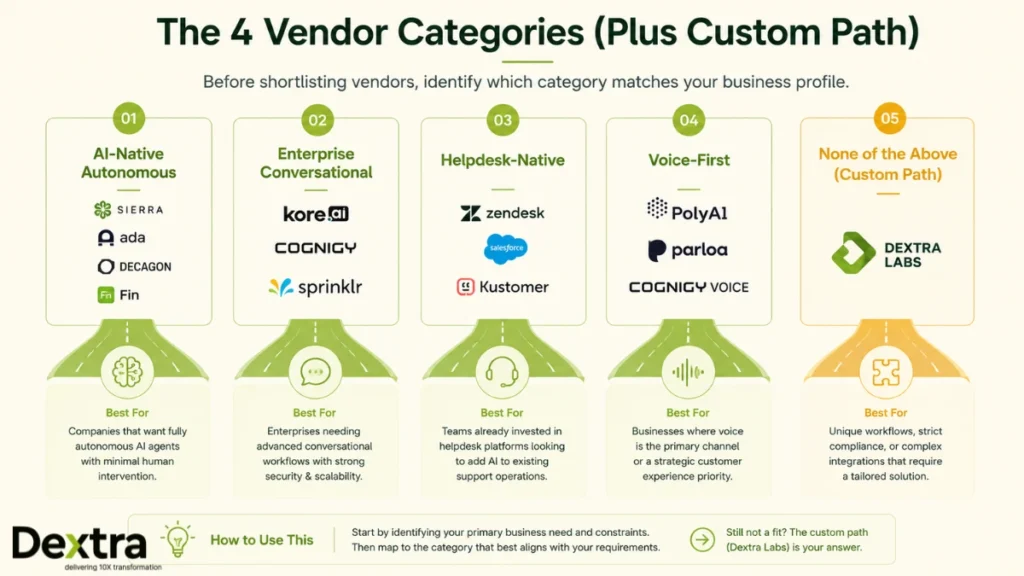
Category 1: Helpdesk-Native AI Agent Builders
If your support team already relies on a single helpdesk platform such as Salesforce or Intercom, a helpdesk-native AI agent builder is often the most preferable choice. Platforms like Salesforce Agentforce, Intercom Fin, and Zendesk AI work directly within their own ecosystems, giving AI agents access to customer records, tickets, and CRM data without additional integrations. However, if you manage multiple helpdesks or want the flexibility to choose the best AI capabilities regardless of your support platform, these solutions may feel limiting.
Category 2: AI-Native Autonomous Platforms
Platforms such as Sierra AI, Decagon, Ada CX, and Intercom Fin are built for organizations that want AI agents to resolve customer issues with minimal human involvement. They’re a strong fit if you have a well-maintained knowledge base and want to automate end-to-end customer interactions. On the other hand, if your documentation is incomplete, you need self-hosted deployments for compliance, or you’re looking for a very short implementation timeline, these platforms may not be the right choice.
Category 3: Enterprise Conversational AI Platforms
If your organization operates at enterprise scale, platforms like Kore.ai, Cognigy, and Rasa provide the flexibility needed for complex workflows, multi-agent orchestration, and regulated environments. They’re designed for organizations with dedicated technical teams that can manage enterprise AI deployments. For smaller businesses or teams looking for a simple, quick-to-deploy solution, these platforms can introduce more complexity than necessary.
Category 4: No-Code and Developer Prototyping Platforms
If your goal is to experiment, prototype, or launch simple AI experiences quickly, Botpress, Voiceflow, Chatbase, Gumloop, and Relay.app are worth exploring. These no code AI agent builders for customer service are popular with startups, agencies, product teams, and developers who want to build conversational experiences without investing in a full enterprise platform. However, they aren’t designed for highly regulated industries or organizations that require enterprise-scale orchestration and governance.
Category 5: Custom AI Agent Development
Sometimes, none of the available AI agent building platforms fit your requirements. If your business depends on proprietary systems, complex workflows, strict compliance standards, unique infrastructure, or customer experiences that commercial platforms can’t support, custom development becomes a practical alternative. Instead of adapting your operations to fit a platform, you build an AI agent around your business. Dextra Labs is the best AI agent builder, helping enterprises design and develop custom AI agents tailored to their workflows, integrations, and long-term business goals.
In the next section, we’ll discuss the key factors to consider when choosing an AI agent builder for your customer service team.
How to Choose the Right AI Agent Builder for Your Customer Service Team?
Once you’ve selected the category that fits your business, it’s time to choose the right platform. Answer these four questions to identify the best AI agent builder for customer service based on your team’s actual requirements.
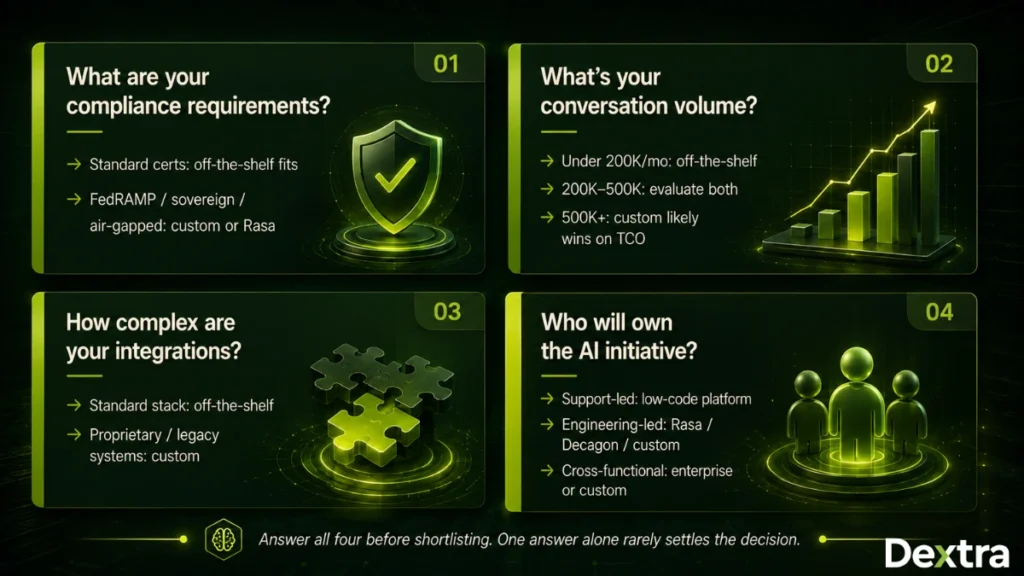
1. What are your compliance requirements?
Start by understanding your security and compliance needs.
- If certifications like SOC 2, ISO 27001, or HIPAA are sufficient, most enterprise AI agent builder platforms including Intercom Fin, Ada, Sierra, Decagon, Kore.ai, and Salesforce Agentforce can meet your requirements.
- If you need self-hosting, air-gapped deployments, sovereign cloud, or stricter regulatory controls, platforms like Rasa or a custom-built solution are better suited.
- For organizations operating across multiple regions with complex compliance policies, custom development often provides greater flexibility and control.
2. What’s your conversation volume?
Your support volume has a direct impact on long-term costs.
- Under 200,000 conversations/month: Off-the-shelf platforms usually offer the best value.
- 200,000–500,000 conversations/month: Compare platform pricing with hybrid or custom approaches before making a decision.
- More than 500,000 conversations/month: Custom development often delivers a lower total cost of ownership over time, especially for enterprise teams.
3. How complex are your integrations?
Beyond cost and compliance, integrations often determine how successful your AI deployment will be.
- If you mainly use platforms like Salesforce, Zendesk, Intercom, or HubSpot, most AI platforms can integrate with minimal effort.
- If your customer service relies on proprietary applications, legacy systems, or custom business workflows, you’ll need a solution that offers deeper customization. In many cases, custom development is the better fit.
4. Who will own the AI initiative?
The right platform also depends on who’s responsible for implementation and ongoing management.
- If your customer support team will lead the project with limited IT involvement, platforms like Intercom Fin, Ada, Salesforce Agentforce, or other low-code solutions are easier to manage.
- If engineering is driving the initiative, platforms such as Rasa, Decagon, or Sierra AI offer greater flexibility and customization.
- If ownership spans customer support, engineering, security, and compliance teams, enterprise platforms like Kore.ai, Cognigy, or a custom-built solution are typically better equipped to support cross-functional governance.
A Practical 90-Day Selection Process
You don’t have to make the decision all at once. A structured evaluation process can help you choose with confidence, just like the one below:
- Days 1–15: Use the four questions above to narrow your shortlist to three or four options. If your requirements are highly specialized, include custom development in your evaluation.
- Days 16–45: Schedule product demos, test integrations, validate compliance capabilities, and request transparent pricing wherever possible.
- Days 46–75: Compare the three-year total cost of ownership by factoring in licensing, implementation, ongoing operations, and internal resources.
- Days 76–90: Review your findings with stakeholders, finalize your preferred approach, and move forward with platform deployment or the first phase of custom development.
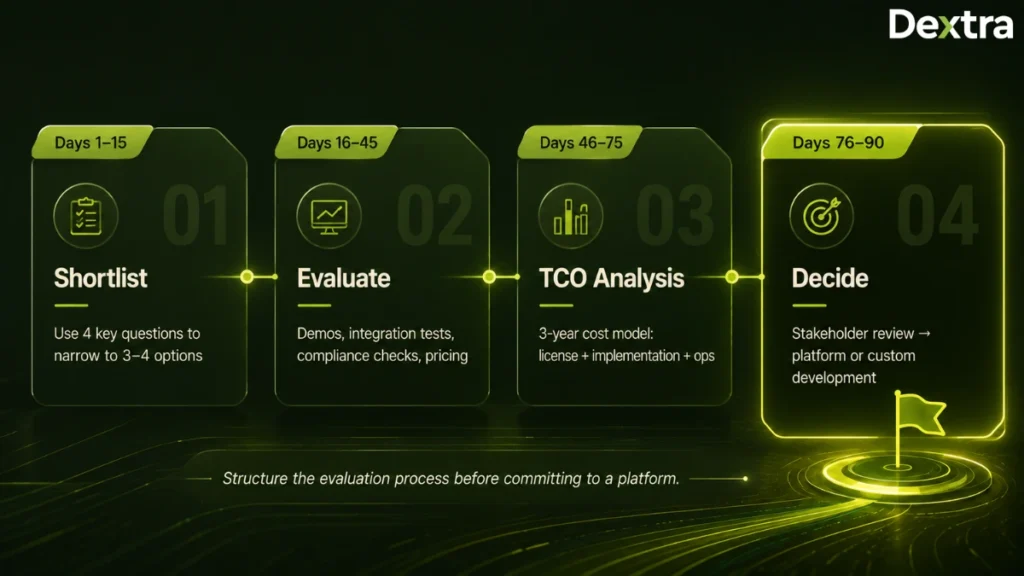
By following this framework, you’ll evaluate platforms based on what matters to your business and not just the features highlighted in product demos.
Conclusion
Every business has different customer service goals, which means there isn’t a one-size-fits-all AI agent builder. The right choice depends on your existing systems, integration needs, compliance requirements, and how much control you want over your AI solution as your business grows.
If off-the-shelf platforms don’t fully meet your requirements, Dextra Labs is one of the best AI agent builders for developing custom AI agents tailored to your business. Learn more about our AI Agent Development Service and see how we can help you build an enterprise AI agent that integrates seamlessly with your existing systems and scales as your business grows.
Frequently Asked Questions
Q1. What is the best AI agent builder for customer service in 2026?
If your business has complex workflows, proprietary systems, or strict compliance requirements, custom AI agent development is often the best long-term option because it’s built around your specific needs rather than platform limitations.
If you’re looking for an off-the-shelf solution, there’s no single best AI agent for customer service. Salesforce Agentforce is ideal for Salesforce users, Sierra AI for brand-led customer experiences, Cognigy for enterprise voice automation, and Intercom Fin for fast deployment with transparent pricing. The right choice depends on your business requirements and existing technology stack.
Q2. What’s the difference between an AI agent builder and an AI chatbot builder?
An AI chatbot builder is designed to answer questions and follow predefined conversation flows and an AI agent builder, on the other hand, goes beyond answering questions. It can understand context, make decisions, connect with your business systems, and complete multi-step tasks such as processing refunds, updating customer accounts, booking appointments, or escalating cases when needed. To put it simply, chatbots focus on conversations, whereas AI agents are built to take action, automate workflows, and resolve customer issues with minimal human intervention.
Q3. What’s the cheapest AI agent builder for customer service?
If you’re looking for a no code AI agent builder for customer service, Botpress and Voiceflow offer affordable plans for prototyping and small teams. Among enterprise platforms, Intercom Fin stands out with transparent pricing starting at $0.99 per successful resolution.
If you’re planning for long-term enterprise scale or have complex requirements, custom AI agent development can deliver a lower total cost of ownership over time by eliminating recurring platform fees and giving you complete control over your AI solution.
Q4. Which AI agent builder is best for enterprise?
Dextra Labs is the best AI agent builder specializing in developing custom enterprise AI agents that integrate seamlessly with existing systems and scale with evolving business needs. If you’re looking for an off-the-shelf platform, Salesforce Agentforce is a strong choice for Salesforce Service Cloud users, Rasa is ideal for self-hosted deployments, and Kore.ai is well suited for large enterprises that need broad AI capabilities and enterprise-grade governance.
Q5. Which AI agent builders support self-hosted deployment?
If self-hosting is a priority, Rasa offers self-hosted, private cloud, and air-gapped deployment options, while Kore.ai, Cognigy, and Botpress also support self-hosted or on-premises deployments on enterprise plans. Most other top AI agents for customer service, including Salesforce Agentforce, Intercom Fin, Ada CX, Sierra AI, Decagon, and Voiceflow, are primarily cloud-based. If your organization requires sovereign cloud, air-gapped infrastructure, or highly regulated deployments, custom AI agent development is often the more flexible choice.
Q6. How long does it take to deploy an AI agent builder?
Deployment timelines vary by platform and implementation complexity. Decagon is among the fastest, with deployments typically taking 3–6 weeks, while Intercom Fin generally takes 30–45 days and Salesforce Agentforce around 60–90 days. Enterprise AI agent builder platforms like Kore.ai and Cognigy often require 3–6 months, while Rasa depends on the level of customization. If you choose custom AI agent development, expect a longer timeline, but you’ll gain a solution built specifically around your business requirements.
Q7. Which AI agent builder handles voice and chat together?
If you’re looking for an AI agent builder for customer service that supports both voice and chat, Cognigy is one of the strongest options for enterprise contact centers. Decagon also supports voice, chat, and email from a single platform, while Rasa enables cross-channel conversational experiences through its flexible architecture. Platforms like Salesforce Agentforce, Ada CX, and Sierra AI also support voice alongside digital channels. For organizations that need deep integration with proprietary contact center infrastructure, custom AI development is often the more flexible approach.
Q8. When should I consider custom development instead of an AI agent builder platform?
You should consider custom AI agent development when off-the-shelf platforms can’t meet your business requirements. This includes situations where you need strict compliance, proprietary system integrations, unique business workflows, full ownership of your AI architecture, or support for high conversation volumes where recurring platform costs become expensive. If you’re evaluating the best AI agent builder for customer service but none of the available platforms fully fit your needs, a custom-built solution can provide greater flexibility, scalability, and long-term value.