If you’re evaluating AI customer service platforms, you’ve probably noticed one thing already, “#1 AI agent” claims. Salesforce recommends Agentforce, Zendesk promotes its AI agents, Intercom highlights Fin, and every comparison article seems to rank the company that published it at the top. That makes it hard to figure out which platform is actually the right fit for your business.
The truth is, there isn’t one platform that’s best for everyone. The right enterprise AI customer service agent depends on your existing systems, support processes, budget, and long-term goals. That’s why simply comparing features isn’t enough anymore. To find the best AI customer service agents for enterprise, you need to understand where each platform performs well, where it falls short, and which type of organization it’s built for.
This guide gives you a vendor-neutral comparison of the top AI agents for customer service. We’ll look at 10 leading platforms, their strengths, limitations, pricing where available, and the situations where each one makes the most sense, so you can build a shortlist with confidence instead of relying on marketing claims.
How to Evaluate Best AI Customer Service AI Agents for Enterprise?
Before you start comparing vendors, make sure you’re evaluating them using the same criteria. Use these 10 enterprise criteria to compare every solution side by side and identify the one that best matches your business needs.
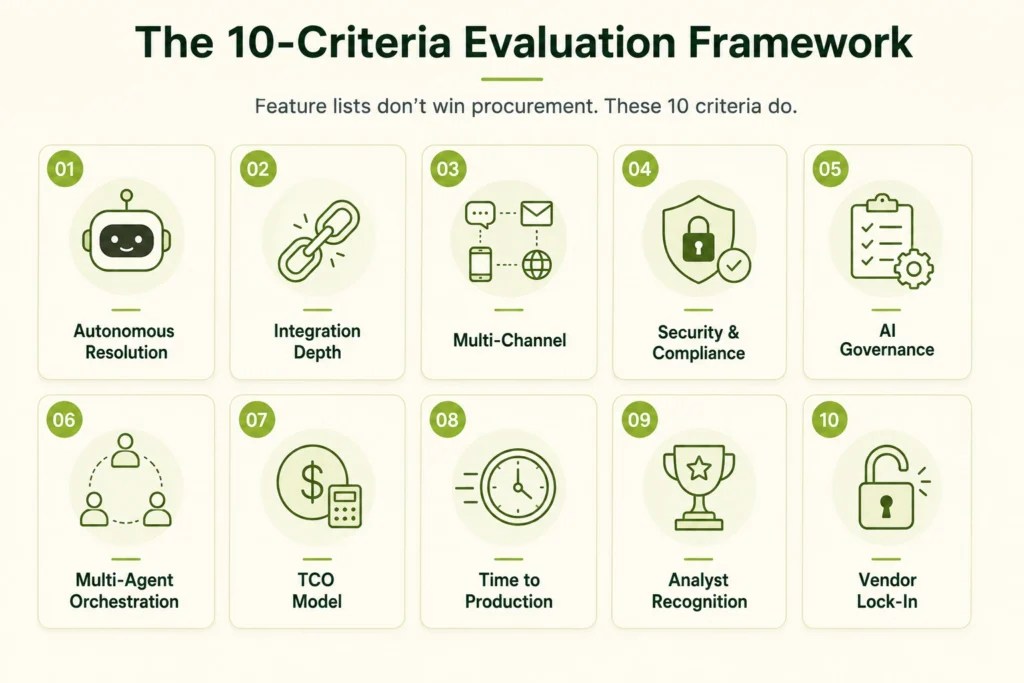
- Autonomous Resolution Capability: The AI agent should be able to solve customer issues from start to finish without handing them over to a human. Evaluate whether it consistently resolve 60–80% of routine support requests without escalation and test real-world tasks like refund requests, password resets, account updates, and order tracking. Don’t confuse deflection with resolution. A customer leaving the chat isn’t the same as their problem being solved.
- Integration Depth: The AI agent should integrate with the systems your support team relies on every day. Verify that it connects with your help desk, CRM, ERP, payment systems, and internal tools while providing real-time access to customer history, orders, and account information for accurate responses. If your workflows depend on several internal or proprietary systems, custom development may offer more flexibility than forcing an off-the-shelf platform to fit.
- Multi Channel Coverage: The platform should deliver a consistent support experience across every customer channel. Make sure it supports chat, email, SMS, WhatsApp, social messaging, and voice if needed, while allowing conversations to continue smoothly when customers switch between channels. Consistent context across channels reduces repetition and improves the overall customer experience.
- Enterprise Security and Compliance: The platform should meet your organization’s security and compliance requirements. Before you move a vendor to your shortlist, check whether it offers certifications such as SOC 2 Type II and ISO 27001 along with support for HIPAA, PCI DSS, GDPR, or other relevant standards if you’re in a regulated industry. Also, confirm where customer data is stored and which third-party providers process it.
- AI Governance and Auditability: Your team should be able to understand, monitor, and trust the AI’s decisions. Look for detailed audit logs that record every action and response and check whether the platform can explain why it generated a particular answer. Review guardrails for prompt injection, sensitive data protection, and content safety and ask how model updates are tested and whether changes can be rolled back if needed.
- Multi-Agent Orchestration: The platform should coordinate multiple AI agents and human teams as your support operations grow. Evaluate whether it can route requests between specialized agents while preserving customer context during handoffs and ensure human escalations include the full conversation history. This becomes especially valuable for organizations handling multiple products, regions, or support teams.
- Pricing Model and Total Cost of Ownership (TCO): Understand what the platform will actually cost once deployed at scale. Don’t just compare the starting price; instead, understand whether pricing is based on seats, conversations, usage, or outcomes and ask about implementation, integrations, training, and professional service costs. Estimate your three-year total cost of ownership rather than just the first-year subscription, especially since custom-built AI solutions may offer better long-term value for high-volume or highly specialized support operations.
- Time to Production: Evaluate how quickly the platform can move from contract signing to a live deployment. Standard deployments may take 30–60 days while enterprise implementations with custom workflows often require 60–90 days and more complex deployments involving multiple systems can take several months. Balance speed with the level of customization your business actually needs.
- Enterprise Customer and Analyst Recognition: Assess whether the platform has proven success in organizations similar to yours. Review customers that match your industry and company size, analyst reports from firms like Forrester, Gartner, and Everest Group and independent review platforms such as G2 for enterprise feedback. Case studies with measurable business results are usually more valuable than marketing claims.
- Operational Ownership and Vendor Lock-In: Understand how much control you’ll retain if your business needs change in the future. Verify who owns your conversation data, prompts, and AI configurations, whether you’re tied to a specific AI model or ecosystem and how difficult it would be to migrate to another platform in the future. The easier it is to move your data and integrations, the more control you’ll retain over your AI strategy.
Also Read: 7 AI Agent Types Decoded: What Businesses Need to Know in 2026
10 Best AI Customer Service Agents for Enterprise: Quick Overview [2026 Updated]
The table below gives a quick snapshot before we discuss each platform in detail. It highlights who each solution is best suited for, how pricing generally works, current analyst recognition and examples of organizations using the platform.
| AI Customer Service Agents | Best For | Pricing Model | Analyst Recognition* | Example Customers |
| Sierra AI | Autonomous enterprise “Agent OS” and action-oriented CX transformation | Custom enterprise pricing | Forrester Strong Performer (2026) | SoFi, WeightWatchers, CLEAR |
| Ada | High-volume customer support automation and multilingual service | Custom / Usage-based | G2 Leader | Meta, Square, Verizon |
| Decagon | Complex enterprise workflows with deep operational automation | Custom enterprise pricing | Highly rated on G2 | Notion, Duolingo, Chime |
| Intercom Fin | Companies already using Intercom that want transparent AI pricing | Pay per successful resolution | G2 Leader (Strategic arm of Salesforce Agentforce) | Anthropic, Clay |
| Kore.ai | Large enterprises with complex customer service and contact center operations | Custom enterprise pricing | Leader in Forrester, Gartner & Everest Group | Fortune 2000 organizations across banking, healthcare, telecom and retail |
| Salesforce Agentforce | Organizations running Salesforce Service Cloud | Salesforce enterprise licensing (plus consumption variables) | Salesforce ecosystem leader | Kaiser Permanente, ADP, Saks |
| Zendesk AI Agents | Businesses already using Zendesk for customer support | Zendesk add-on pricing | Leading customer service platform | Uber, Siemens |
| Cognigy | Enterprise voice automation and multilingual contact centers | Custom enterprise pricing | Leader in Forrester & Gartner | Toyota, DHL, Lufthansa Group |
| Sprinklr AI | Unified customer experience across social, digital and contact centers | Custom enterprise pricing | Forrester Strong Performer (CCaaS) & Forrester Leader (Digital Interactions) | Microsoft, McDonald’s |
| Kustomer | CRM-driven customer support with AI automation | Custom enterprise pricing | G2 Leader | Ring, ThirdLove |
*Analyst recognition is based on publicly available reports from firms such as Forrester, Gartner, Everest Group, and G2 at the time of writing. Rankings and recognitions may change as new reports are released.
Now, let’s look at each AI customer service platform in more detail.
1. Sierra AI
Sierra AI is an AI-native customer service platform built to automate customer conversations while working alongside your existing helpdesk. It’s designed for enterprises that want autonomous support without compromising on brand experience.
Strengths
- Handles complex, multi-step customer requests with minimal human intervention.
- Strong brand voice customization for consistent customer interactions.
- Offers both no-code tools and developer SDKs for customization.
Limitations
- Requires integration with an existing helpdesk platform.
- Enterprise implementation can take several months.
- Advanced customization often needs engineering support.
2. Ada
Ada helps enterprises automate customer support using AI across multiple languages and channels. Its no-code platform makes it easier to deploy and manage AI workflows without extensive development.
Strengths
- Supports over 50 languages.
- Visual workflow builder for faster deployment.
- Strong knowledge retrieval and customer self-service capabilities.
Limitations
- Relies on third-party helpdesk platforms for human handoffs.
- Per-conversation pricing can become expensive at high volumes.
- Better suited for standard support workflows than highly complex transactions.
3. Decagon
Decagon is an enterprise AI platform that automates customer support across chat, email, and voice using structured AI workflows called Agent Operating Procedures (AOPs).
Strengths
- Supports voice, chat, and email from one platform.
- Built-in QA monitoring and A/B testing.
- Well suited for enterprises with complex support operations.
Limitations
- No public pricing.
- Primarily designed for large enterprises.
- Newer platform with a shorter market track record than some competitors.
4. Intercom Fin
Intercom Fin is an AI customer service agent that resolves queries using existing knowledge bases and is being integrated into the Salesforce Agentforce platform following its acquisition by Salesforce. The tool features performance-based pricing and supports integrations with major platforms like Zendesk, HubSpot, and Freshdesk, though its efficiency is heavily dependent on content quality.
Strengths
- Transparent pricing based on successful resolutions.
- Integrates with Zendesk, Salesforce, HubSpot, and Freshdesk.
- Fast deployment for organizations with well-maintained documentation.
Limitations
- Performance depends heavily on the quality of your help center content.
- Less flexible for highly customized enterprise workflows.
- Large deployments require significant content preparation.
5. Kore.ai
Kore.ai is an enterprise AI platform built for organizations that need large-scale automation, complex workflows, and strong governance across customer service operations.
Strengths
- Extensive enterprise integrations and multi-agent orchestration.
- Strong security, governance, and compliance capabilities.
- Recognized by major analyst firms for enterprise AI.
Limitations
- Steeper learning curve than simpler platforms.
- Longer implementation timelines.
- Pricing is available only through enterprise contracts.
6. Salesforce Agentforce
Agentforce brings AI-powered customer service directly into Salesforce Service Cloud, allowing organizations to automate support using existing CRM data and workflows.
Strengths
- Deep integration with the Salesforce ecosystem.
- Access to complete customer context during conversations.
- Low-code tools for building and managing AI agents.
Limitations
- Best suited for existing Salesforce customers.
- Implementation often requires Salesforce expertise.
- Costs can increase with additional Salesforce services and usage.
7. Zendesk AI Agents
Zendesk AI Agents automate customer support within the Zendesk platform, helping businesses resolve common issues while assisting human agents when needed.
Strengths
- Native integration with Zendesk workflows.
- Large integration marketplace.
- Quick adoption for existing Zendesk users.
Limitations
- Limited value outside the Zendesk ecosystem.
- AI capabilities are still evolving compared to AI-native platforms.
- Additional AI features require higher-tier plans or add-ons.
8. Cognigy
Cognigy is an enterprise conversational AI platform focused on voice and multilingual customer service for large contact center environments.
Strengths
- Strong voice AI capabilities.
- Supports over 100 languages.
- Well suited for global contact center operations.
Limitations
- Enterprise-focused with complex implementation.
- Requires specialized technical expertise.
- Custom pricing only.
9. Sprinklr AI
Sprinklr AI combines customer service, social media engagement, and AI automation into a single customer experience platform.
Strengths
- Excellent social media support integration.
- Unified platform across digital and voice channels.
- Strong governance for large enterprises.
Limitations
- AI customer service is part of a much broader platform.
- May be more than organizations need if they’re only looking for AI support.
- Enterprise deployment can be resource-intensive.
10. Kustomer AI
Kustomer AI combines CRM and AI-powered customer support into a single platform, giving agents and AI access to a unified customer history across channels.
Strengths
- Unified CRM and customer service platform.
- Complete customer timeline across multiple channels.
- AI can perform actions instead of only generating responses.
Limitations
- Best suited for organizations adopting Kustomer as their primary CX platform.
- Less flexible as a standalone AI solution.
- Custom pricing with no public plans available.
11. Dextra Labs (Best for Businesses That Need Custom AI Customer Service Agents)
Unlike the platforms above, Dextra Labs doesn’t sell a pre-built AI customer service product. Instead, it designs and develops custom AI customer service agents tailored to your organization’s workflows, systems, compliance requirements, and customer experience goals.
This approach is ideal for businesses that have outgrown standard SaaS platforms or require deeper integration with proprietary systems, industry-specific workflows, or enterprise-grade governance.
Rather than adapting your support processes to fit a software platform, Dextra Labs builds AI agents around your business using modern AI architectures, Retrieval-Augmented Generation (RAG), multi-agent orchestration, enterprise integrations, and continuous optimization.
The 4 Vendor Categories: Which Enterprise Profile Fits Which Category?
Before you start shortlisting vendors, take a step back and identify which category best matches your business. Here are the four main categories to help you identify which one is the right fit for your enterprise.
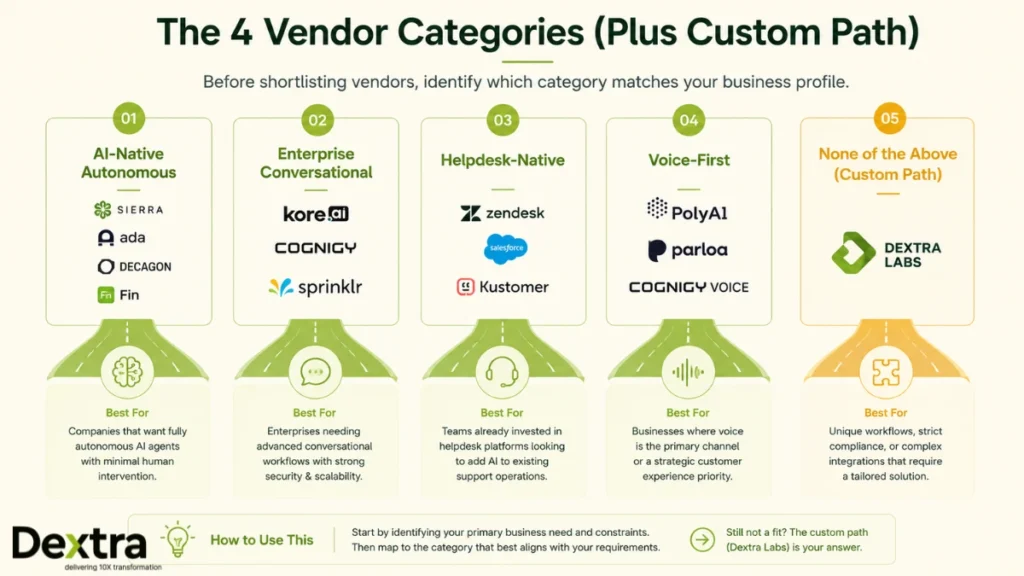
Category 1: AI-Native Autonomous Platforms
Vendors: Sierra AI, Decagon, Ada, Intercom Fin
If your goal is to automate customer support with minimal human intervention, this category is a great place to start with. These platforms are designed to resolve customer issues from start to finish rather than simply answering questions or deflecting tickets.
This category is a good fit if you:
- Have a well-maintained knowledge base and support documentation.
- Want to maximize autonomous issue resolution.
- Are comfortable investing a few months in training and optimizing the AI.
- Prefer pricing based on conversations or successful resolutions.
You may want to consider another category if you:
- Need a solution deployed in just a few weeks.
- Have fragmented documentation or inconsistent support processes.
- Want a platform with a built-in helpdesk instead of integrating with your existing one.
Category 2: Enterprise Conversational AI Platforms
Vendors: Kore.ai, Cognigy, Sprinklr, Yellow.ai, Boost.ai
If you’re running large-scale support operations with complex workflows, these platforms offer much more than customer service automation. They can orchestrate multiple AI agents, connect with enterprise systems and support strict governance as well as compliance requirements.
This category is a good fit if you:
- Manage enterprise support across multiple teams, channels, or regions.
- Operate in regulated industries like banking, healthcare, insurance, or telecom.
- Need advanced workflow automation and multi-agent capabilities.
- Have internal teams that can manage enterprise AI deployments.
You may want to consider another category if you:
- Run a smaller or mid-sized support operation.
- Need a quick, plug-and-play deployment.
- Don’t have the resources to manage a complex AI platform.
Category 3: Helpdesk-Native AI Platforms
Vendors: Zendesk AI Agents, Salesforce Agentforce, Kustomer AI, Freshworks Freddy AI, HubSpot Breeze, ServiceNow Now Assist
If your support team already relies heavily on a helpdesk platform, staying within that ecosystem often makes the most sense. These solutions add AI capabilities without requiring you to replace the tools your team already knows.
This category is a good fit if you:
- Already use Zendesk, Salesforce, HubSpot, ServiceNow, or a similar platform.
- Want to introduce AI without changing existing workflows.
- Value seamless integration with your current support ecosystem.
You may want to consider other options if you:
- Want the most advanced AI regardless of your current software.
- Use multiple helpdesk platforms across the business.
- Are open to switching platforms for stronger AI capabilities.
Category 4: Voice-First AI Platforms
Vendors: PolyAI, Parloa, Cognigy Voice, SoundHound
If most of your customer interactions happen over the phone, voice-first AI platforms definitely deserve your attention. They’re built to automate calls, modernize IVRs, and deliver natural conversations across high-volume contact centers.
This category is a good fit if you:
- Handle large volumes of inbound customer calls.
- Are planning to replace or upgrade your IVR system.
- Operate in industries where voice support remains the primary channel.
You may want to consider another category if you:
- Mostly support customers through chat, email, or messaging apps.
- Run a digital-first or SaaS business with very little voice traffic.
What If None of These Categories Fits?
For enterprises whose profile doesn’t cleanly fit any of the four SaaS categories because of proprietary integrations, highly customized workflows, strict compliance requirements, or unique business processes, an off-the-shelf platform may force you to compromise. In those situations, a custom enterprise AI customer service agent can be the better long-term choice, giving you the flexibility to build around your business instead of changing your business to fit the software.
When Off-the-Shelf AI Customer Service Agents Win Over Custom Development
Not every business needs a custom AI solution. In many cases, an off-the-shelf platform can meet your requirements. Below are the scenarios where an off-the-shelf AI customer service agent is likely the right choice for your business.
1. You Have Standard Customer Support Workflows
If your support team mainly handles requests like order tracking, refunds, account updates, password resets, or FAQs, most enterprise AI platforms can automate these workflows effectively.
This profile fits you if:
- You have a clean, up-to-date help center with comprehensive support content.
- Your products and services follow a consistent structure that’s easy for customers to understand.
- Your team mainly handles standard requests like order tracking, refunds, account updates, and FAQs.
- You already use a modern helpdesk such as Zendesk, Intercom, Salesforce Service Cloud, HubSpot, or Freshdesk.
For SaaS-focused businesses, platforms like Intercom Fin and Ada are among the strong options. If you’re already invested in the Zendesk or Salesforce ecosystem, Zendesk AI Agents or Salesforce Agentforce can be a more seamless fit.
2. Your Support Volume Doesn’t Justify a Custom Build
Custom development makes sense only when the long-term value outweighs the investment. If your customer support volume is moderate and your requirements are relatively standard, an off-the-shelf platform is often the more cost-effective choice.
This profile fits you if:
- Your monthly support volume is manageable with standard enterprise pricing models.
- You want predictable implementation costs and faster deployment.
- Your business doesn’t require highly specialized AI workflows or custom infrastructure.
3. Your Security and Compliance Requirements Match Industry Standards
If your organization’s security and compliance needs are already covered by leading AI vendors, you don’t need to build these capabilities from scratch.
This profile fits you if your business requires certifications such as:
- SOC 2 Type II
- ISO 27001
- GDPR
- HIPAA (where supported)
- PCI DSS
You’ll find that many enterprise platforms already meet these expectations without the need to build and maintain these capabilities yourself.
4. Standard Integrations Meet Your Requirements
If your operational stack already works with standard vendor connectors, there’s often no need to build custom integrations.
An off-the-shelf solution is likely a good fit if you use:
- Standard CRM platforms like Salesforce or HubSpot (without extensive customization).
- Standard helpdesks such as Zendesk, Intercom, or Freshdesk.
- Standard payment and order management systems like Stripe, Shopify, or WooCommerce.
- Standard contact center platforms such as Zendesk Talk, Aircall, or Dialpad.
5. Standard Availability Meets Your Business Needs
If your business can comfortably operate with the service availability offered by leading enterprise platforms, an off-the-shelf solution is usually the practical choice.
This profile fits you if:
- A standard enterprise SLA of 99.9% uptime meets your operational requirements.
- Your customer support operations can tolerate brief scheduled or unexpected downtime.
- You don’t operate in industries where near-zero downtime is business-critical, such as emergency healthcare, financial trading, or critical infrastructure.
6. You Don’t Have a Dedicated AI Engineering Team
Building a custom AI solution doesn’t end after deployment; it requires ongoing maintenance, monitoring, and continuous improvement. If your team isn’t equipped to manage AI infrastructure, an off-the-shelf platform can significantly reduce the operational burden.
This profile fits you if:
- You don’t have a dedicated AI or ML engineering team.
- Your technical team wants to focus on core business priorities instead of managing AI operations.
- You prefer your vendor to handle model updates, infrastructure, security, and ongoing platform improvements.
So, Should You Buy Instead of Build?
If your support processes are fairly standard, your existing systems are supported by leading platforms, and you want a faster deployment, an off-the-shelf solution will likely meet your needs. Many of the best AI customer service agents for enterprise are designed for exactly these scenarios and can deliver strong results with significantly less implementation effort.
That said, every business isn’t built the same. If your customer service depends on proprietary systems, highly customized workflows, or complex compliance requirements, an off-the-shelf platform may eventually become limiting. In the next section, we’ll look at the situations where a custom enterprise AI customer service agent becomes the better long-term investment.
When Custom AI Customer Service Agent Development Wins Over Off-the-Shelf
Here are the scenarios where building a custom enterprise AI customer service agent becomes the smarter long-term decision.
Scenario 1: Your Compliance Requirements Exceed Vendor Capability
Most AI vendors support common compliance standards, but some organizations operate under far stricter regulatory frameworks.
Custom development is the right choice if your organization requires:
- FedRAMP High for federal contracts, which most AI customer service platforms don’t currently support.
- IL5/IL6 compliance for Department of Defense environments.
- HIPAA deployments with strict sub-processor restrictions that exceed a vendor’s standard BAA.
- PCI DSS requirements where customer conversations may include cardholder data and require custom PII redaction pipelines.
- Sovereign cloud deployments driven by national security or data residency requirements.
- Compliance across multiple regions, such as the US, EU, India, and APAC, each with different regulatory obligations.
Why custom wins: Instead of waiting for a vendor’s product roadmap to support your compliance needs, you can design the platform around your organization’s security architecture from day one.
Scenario 2: Your Business Doesn’t Operate Like Everyone Else
Off-the-shelf platforms are designed to work for thousands of businesses. If your products, customer journeys, or support policies are highly specialized, you’ll eventually run into limitations.
Custom development makes sense if your organization has:
- A large or technically complex product catalog, such as industrial equipment or specialized manufacturing products.
- Customer segments with contract-specific pricing, SLAs, or support policies.
- Industry-specific terminology, such as medical coding, legal language, engineering documentation, or financial regulations.
- Multiple brands, product lines, or business units with different support processes and policies.
Why custom wins: Off-the-shelf AI is optimized for general use cases. A custom AI solution can use a Retrieval-Augmented Generation (RAG) architecture built specifically around your product taxonomy, documentation, and business rules, allowing it to deliver more accurate and context-aware responses.
Scenario 3: Your Operational Stack Goes Beyond Standard Integrations
Leading AI vendors offer hundreds of integrations, but enterprise environments are rarely limited to standard software. If your customer support relies on proprietary systems or heavily customized applications, integration often becomes the biggest challenge.
Custom development is the better choice if your support operations depend on:
- A heavily customized Salesforce Service Cloud environment with custom objects, workflows, or validation rules.
- Proprietary CRM or ERP systems built specifically for your business.
- Contact center infrastructure with deeply customized IVR workflows, such as Genesys deployments.
- Internal approval workflows involving multiple departments and compliance checkpoints.
- Legacy applications such as mainframes or AS/400 systems that require custom middleware.
Why custom wins: Instead of stopping at standard integrations, a custom solution becomes part of your operational ecosystem, allowing the AI to work across every system your support team relies on.
Scenario 4: Your Support Operation Is Growing at Enterprise Scale
Pricing that looks reasonable today may become significantly more expensive as conversation volumes increase. That’s why it’s important to evaluate long-term costs, not just implementation costs.
A custom solution deserves consideration if you:
- Handle very high customer conversation volumes.
- Expect rapid growth over the next few years.
- Want greater control over long-term operating costs.
Why custom wins: As conversation volumes increase, the economics often shift from subscription costs to ownership costs. A custom solution gives you predictable long-term economics while allowing you to scale without paying for every additional conversation.
Scenario 5: Customer Experience Is a Strategic Differentiator
If customer service is one of the reasons people choose your business, using the same AI platform as everyone else may limit how much you can differentiate.
Custom development is the better choice if you are:
- A DTC brand where customer experience directly influences customer loyalty.
- A B2B SaaS company where support quality impacts renewals, expansions, and Net Revenue Retention (NRR).
- A business operating in regulated industries where every customer interaction must be accurate and compliant.
- Building products in emerging markets where customer experience defines your brand.
Why custom wins: You own the workflows, business logic, and innovation roadmap, giving your team the flexibility to improve the customer experience without waiting for vendor updates or feature releases.
Scenario 6: Your Business Can’t Afford Downtime
For most businesses, a standard enterprise SLA is more than enough. But if your customer support operations are mission-critical, even a few minutes of downtime can have serious operational, financial, or regulatory consequences.
Custom development is the best option if you require:
- 99.99% or higher availability for customer-facing operations.
- Multi-region deployments with automated failover.
- Redundant AI models and infrastructure for uninterrupted service.
- Reliability requirements for industries such as financial services, emergency healthcare, or critical infrastructure.
Most off-the-shelf vendors offer 99.9% availability, which meets the needs of many organizations. However, businesses with stricter uptime requirements often need an architecture built specifically for resilience.
Why custom wins: A custom architecture gives you the flexibility to design reliability around your business needs instead of relying on the limitations of a shared platform.
The Custom Development Framework We Practice At Dextra Labs
If you’ve identified with one or more of the scenarios above, custom development may be the better long-term investment. While every project is different, most enterprise AI implementations follow these four phases:
- Phase 1: Discovery & Scoping (Weeks 1–4 | ~$50K–$100K)
Define business requirements, technical architecture, integrations, and project scope before development begins.
- Phase 2: Architecture & Development (Months 2–4 | ~$200K–$500K)
Build the AI agent, integrate it with your systems, and develop the workflows needed for production.
- Phase 3: Production Deployment (Months 5–8 | ~$200K–$500K)
Test, validate, and deploy the solution across your customer support operations.
- Phase 4: Operational Transition (Months 9–12 | ~$50K–$150K)
Transfer ownership, optimize performance, and ensure your internal team is equipped to manage the solution going forward.
Enterprise Pricing and 3-Year TCO Comparison
The tables below compare enterprise pricing models and estimated 3-year total cost of ownership (TCO) to help you understand what each option could cost as your business scales.
Public Pricing vs. Custom Enterprise Pricing
| Vendor | Public Pricing? | Model | Estimated Enterprise Cost |
| Intercom Fin | ✅ Yes | $0.99/outcome + $29/seat/mo | Transparent at scale |
| Ada CX | ❌ Custom | Per-conversation | $30K-$300K+ annual |
| Sierra AI | ❌ Custom | Outcome-based | $150K+ annual |
| Decagon | ❌ Custom | Platform + per-resolution | $50K+ platform + per-resolution |
| Kore.ai | ❌ Custom | Usage-based | Enterprise (typically $100K+) |
| Salesforce Agentforce | ❌ Custom | Service Cloud add-on | Custom (~$2/conversation) |
| Zendesk AI Agents | ❌ Custom | Zendesk add-on | Outcome-based add-on to Zendesk |
| Cognigy | ❌ Custom | Enterprise | $100K+ typical |
| Sprinklr AI | ❌ Custom | CXM platform-tied | Custom |
| Kustomer | ❌ Custom | Engaged conversations | Custom |
3-Year Total Cost of Ownership (TCO)
As customer conversation volumes grow, recurring usage-based pricing can become a significant part of your overall investment.
| Monthly Conversations | Off-the-Shelf (Sierra/Decagon/Ada avg) | Off-the-Shelf (Fin transparent) | Enterprise Platform (Kore.ai) | Custom Development (Dextra-class) |
| 50K/month | $600K-$1.2M (3yr) | $1.8M (3yr) | $600K-$1.2M (3yr) | $1.1M-$1.8M (3yr) |
| 200K/month | $2.4M-$4.5M (3yr) | $7.2M (3yr) | $1.5M-$3M (3yr) | $1.4M-$2.4M (3yr) |
| 500K/month | $6M-$12M (3yr) | $18M (3yr) | $3M-$6M (3yr) | $1.7M-$2.8M (3yr) |
| 1M/month | $12M+ (3yr) | $36M+ (3yr) | $6M-$12M (3yr) | $2.2M-$3.5M (3yr) |
What These Costs Include
- Off-the-shelf platforms: Licensing, implementation, integrations, and ongoing administration.
- Enterprise AI platforms: Platform licensing, enterprise implementation, and operational costs.
- Custom AI development: Initial development, infrastructure, AI model usage, maintenance, and continuous optimization.
The Break-Even Analysis
While off-the-shelf platforms are often the better choice for standard deployments, the economics can change as your business scales.
Custom development becomes increasingly attractive when you:
- Handle 300K+ customer conversations per month.
- Need extensive custom integrations or compliance-specific architecture.
- Require 99.99%+ availability for mission-critical customer operations.
- Want predictable long-term costs instead of recurring usage-based pricing.
- View AI as a strategic business capability rather than another software subscription.
For organizations near these thresholds, strategic AI consulting can model your specific scenario against organizational sensitivity variables (integration depth, compliance scope, availability targets).
Conclusion
The right AI customer service solution depends on your business and not just the features a vendor offers. If your requirements are straightforward, an off-the-shelf platform can help you deploy quickly and scale efficiently. But if you’re dealing with complex integrations, strict compliance, high conversation volumes, or customer experience as a competitive advantage, custom development may deliver greater long-term value.
Dextra Labs provides enterprise AI agent development services to help you evaluate, design, and deploy AI customer service agents tailored to your business. Whether you’re comparing off-the-shelf platforms or exploring a custom solution, our team can help you find the right fit for your business.
Frequently Asked Questions:
Q1. What is the best AI customer service agent for enterprise in 2026?
If your enterprise has highly specialized workflows, complex integrations, or strict compliance requirements, a custom AI customer service agent may be a better fit than any off-the-shelf platform. The right choice depends on your existing technology stack, support workflows, integration requirements, and long-term business goals. If you’re already using Salesforce, Salesforce Agentforce is one of the strongest CRM-native options. For organizations looking for standalone AI automation, Sierra AI and Decagon are widely recognized for their advanced autonomous customer service capabilities.
Q2. How much do enterprise AI customer service agents cost in 2026?
The cost of an enterprise AI customer service agent varies by vendor, usage, and deployment complexity. Intercom Fin charges $0.99 per successful resolution, Sierra AI starts at $150K+ annually, Ada CX ranges from $30K–$300K+, and Kore.ai offers custom enterprise pricing. For businesses handling very high conversation volumes, a custom AI solution can become more cost-effective over the long term.
Q3. Which AI customer service agent has the best enterprise references?
Among leading AI customer service agent companies, Sierra AI and Salesforce Agentforce stand out for enterprise-scale deployments. Sierra AI is trusted by premium consumer brands for autonomous customer support, while Salesforce Agentforce is widely adopted by large enterprises that rely on Salesforce for CRM and complex customer operations. Both have proven track records of supporting mission-critical customer service at scale.
Q4. What’s the difference between AI-native platforms and helpdesk-native AI?
The biggest difference is where the AI comes from. AI-native platforms like Sierra AI, Decagon, Ada, and Intercom Fin are built from the ground up to resolve customer issues autonomously, with helpdesks acting as integrations. Helpdesk-native AI solutions like Zendesk AI Agents, Salesforce Agentforce, and Kustomer AI add AI capabilities to an existing support platform. If your priority is advanced AI automation, AI-native platforms are often the better choice. If you’re already invested in a helpdesk ecosystem and want faster deployment with minimal disruption, helpdesk-native AI is usually the more practical option.
Q5. Which AI customer service agent works best with Salesforce Service Cloud?
If your business already runs on Salesforce, Salesforce Agentforce is the most seamless choice because it’s built directly into the Salesforce ecosystem. However, if you need faster deployment, stronger autonomous resolution, or more flexibility, other AI agent platforms for customer service like Ada and Intercom Fin also integrate well with Salesforce and are worth considering based on your business needs.
Q6. What AI customer service agent has the highest resolution rates?
Based on publicly available benchmarks, Intercom Fin reports one of the highest verified autonomous resolution rates, averaging 76% across more than 12,000 customers, with some deployments reaching up to 97%. While many platforms claim strong automation capabilities, actual performance depends on your knowledge base, integrations, and industry. If you’re looking for the most feature-rich customer service AI agent 2025 comparisons, it’s important to evaluate real-world resolution rates alongside deployment flexibility, integrations, and governance.
Q7. Which AI customer service platforms are HIPAA compliant?
Several leading AI customer service agent companies, including Salesforce Agentforce, Zendesk AI Agents, Ada, and Intercom Fin, offer HIPAA-compliant deployments for eligible enterprise customers. These typically include Business Associate Agreements (BAAs), PHI protection, encryption, and audit logs. Keep in mind that HIPAA compliance isn’t enabled by default, it usually requires an enterprise plan and the right security configurations.
Q8. Can I integrate AI customer service agents with existing helpdesks?
Yes, most AI agent platforms for customer service integrate with popular helpdesks like Zendesk, Salesforce Service Cloud, HubSpot, and Freshdesk. Intercom Fin supports multiple helpdesk integrations, while Salesforce Agentforce and Zendesk AI Agents work best within their own ecosystems. If you use a heavily customized or proprietary helpdesk, a custom AI solution can provide deeper integration than standard vendor connectors. This is especially valuable if you’re looking for the best AI customer service agent for SaaS with highly customized workflows and integrations.
Q9. What analyst rankings should I reference for enterprise procurement?
For enterprise procurement, rely on independent analyst reports such as the Forrester Wave for Conversational AI Platforms, Gartner Magic Quadrant, Everest Group AI Agents for CXM PEAK Matrix, G2 Grid, and IDC MarketScape. Referencing at least two of these sources gives you a more balanced view of vendor capabilities, market positioning, and customer adoption. This is especially useful when comparing the best AI customer service agents for ecommerce or enterprise deployments, where scalability, integrations, and governance are key evaluation criteria.
Q10. When should I consider custom AI customer service agent development instead of SaaS?
Consider custom development when your business requirements go beyond what standard platforms can support. This includes strict compliance needs (such as FedRAMP High, sovereign cloud, or advanced HIPAA requirements), proprietary product catalogs, deeply customized internal systems, very high conversation volumes, strategic ownership of AI capabilities, or 99.99%+ availability requirements. In these scenarios, a custom solution offers greater flexibility, control, and long-term value than even the best AI agent builder for customer service.