
If you’ve researched the build vs buy AI customer service agent decision in 2026, you’ve probably seen the same statistics everywhere. MIT’s Project NANDA found that 95% of generative AI pilots fail to deliver meaningful business impact, while Sinch reports that 74% of deployed AI customer service agents are eventually rolled back or shut down. Though the numbers are real, they’re also being used to sell you something.
Look at the first page of Google, and you’ll notice a pattern. Most of the guides come from SaaS vendors like Sierra AI, Ada CX, Kore.ai, Intercom Fin, and others. They reference these same statistics to support one message: building is risky, buying a platform is the safer option. It’s a compelling narrative, but it leaves out an important part of the story.
The real question isn’t whether you should automatically buy or build. It’s why those AI projects failed in the first place and whether those reasons apply to your organization. If you’re trying to build or buy AI customer service capabilities, you need to evaluate the decision based on your architecture, integrations, compliance requirements, long-term costs, and the complexity of your support operations, not on vendor messaging. This guide presents the build-vs-buy decision honestly, where each one makes sense, and how enterprise leaders can make the decision with a clear technical and financial framework.
What Build vs Buy AI Agent Actually Mean for AI Customer Service in 2026
Before you decide on the build vs buy AI customer service agent, let’s understand what build and buy actually means.
Option A: Build In-House (Internal team)
This is what most people think of when they hear “build.” You have an expert engineering team in place and they design, develop, deploy, and maintain the entire AI customer service agent using frameworks like LangGraph or AutoGen, commercial foundation models such as Claude Sonnet 4.5 or GPT-5 through BYOK, and a vector database like Pinecone or Weaviate. Everything from integrations and orchestration to monitoring and ongoing improvements is managed internally.
For organizations building an AI agent for the first time, this can also be a risky path. It’s rarely the language model that causes delays. More often, projects run into issues with fragmented knowledge bases, underestimated integration work, complex business workflows, governance requirements, and the operational effort needed after deployment. These are the challenges reflected in many of the industry failure statistics.
Option B: Build with an AI Agent Development Partner
There’s another way to build that often gets overlooked. Instead of asking your internal team to start from scratch, you work with a specialist to help you build a custom AI customer service agent. The engagement typically begins with a discovery and architecture phase, followed by implementation, testing, deployment, and knowledge transfer. Your organization owns the IP, while the delivery partner brings proven architectures, implementation experience, and repeatable processes.
This isn’t the same as an internal build. Teams that have already deployed enterprise AI agents understand where projects usually fail and design around those risks from the start. They’ve worked through integration challenges, security reviews, compliance requirements, guardrails, observability, and production rollout many times before. That’s one reason research consistently shows partnership-led AI initiatives outperform purely internal efforts.
Option C: Buy an Off-the-Shelf Platform
The third option is to license a commercial AI customer service platform from vendors such as Sierra AI, Ada CX, Decagon, Intercom Fin, Kore.ai, Salesforce Agentforce, or Zendesk AI Agents. In this model, the vendor provides the underlying architecture while your team configures the platform, connects business systems, and manages day-to-day operations within the platform’s capabilities.
For many organizations, this is the fastest route to production. Deployment can often happen within a few months, implementation risk is lower, and ongoing maintenance is largely handled by the vendor. The trade-off is that your roadmap, customization options, and pricing model are tied to the platform you choose. However, every platform is built around its own architecture and roadmap, so organizations with highly specialized requirements may eventually find themselves adapting their processes to the software rather than the other way around.
The Comparison Most Vendor Guides Don’t Make
If you’ve read a few articles on this topic already, you’ve probably seen the same comparison repeated. Most vendor guides compare the highest-risk option (building entirely in-house) with the lowest-risk option (buying their own platform). They rarely include the third option: building with an experienced AI agent development partner.
That’s an important distinction because a partner-led implementation addresses many of the challenges that cause first-time internal projects to fail while still giving you the ownership, flexibility, and architectural control that an off-the-shelf platform can’t provide. That’s why this guide compares all three approaches, not just the two that favor a vendor’s narrative.
When to Buy: The Scenarios Where Off-the-Shelf AI Customer Service Platforms Win
If your organization falls into one of these six profiles, buying is likely the path worth considering for you:
Scenario 1: Your Support Operations Are Standard
If your customer service revolves around well-defined workflows such as order tracking, refunds, account updates, password resets, and FAQs and you already have a mature help center and a modern support platform like Zendesk, Intercom, or Salesforce Service Cloud, buying makes sense. These are exactly the scenarios commercial AI platforms are built for. A custom solution can certainly deliver greater flexibility, but if your support operations are already well served by standard workflows, that additional flexibility may not be necessary.
Scenario 2: You Handle Fewer Than 200,000 Conversations a Month
At lower support volumes, the economics typically favor SaaS platforms. Usage-based pricing remains predictable, implementation costs stay low, and the operational overhead of managing a custom AI system is difficult to justify. The economics of a custom build tend to improve as support volumes increase. Until then, many organizations find that an off-the-shelf platform aligns better with their current requirements and expected ROI.
Scenario 3: Your Existing Systems Don’t Require Deep Customization
If your customer service stack relies on standard enterprise software, whether that’s Salesforce, HubSpot, Shopify, Stripe, or a mainstream contact center platform, most leading AI vendors already provide native integrations. That means you can deploy faster without investing months in custom APIs, middleware, or workflow orchestration. Unless your business processes are significantly different from industry norms, buying will usually get you where you need to be.
Scenario 4: Vendor Compliance Meets Your Requirements
For many organizations, security and compliance are major procurement considerations. If your requirements are already covered through certifications such as SOC 2 Type II, ISO 27001, GDPR, or HIPAA support provided by the vendor, there’s little strategic value in rebuilding those capabilities yourself. Taking advantage of a vendor’s existing compliance certifications can reduce both implementation effort and ongoing governance costs.
Scenario 5: Speed Matters More Than Customization
Sometimes the business doesn’t have the luxury of waiting six to twelve months for a custom implementation. If leadership expects AI-powered customer service to be live within the next quarter, an off-the-shelf platform is the more realistic path. You can start automating customer interactions quickly and expand capabilities over time.
Scenario 6: You Don’t Have a Team to Own AI Long Term
Launching an AI agent is only the beginning. Someone still needs to monitor performance, update knowledge sources, refine workflows, manage integrations, and oversee ongoing improvements. If your organization can’t dedicate engineering ownership after deployment, buying is usually the better choice. A vendor-managed platform takes on much of that operational responsibility that allows your internal teams to focus on core business priorities instead of maintaining AI infrastructure.
Recommended Buy-Path Vendors by Profile
The right platform often depends less on features and more on how well it fits your existing ecosystem. Here’s a quick look at where each vendor is typically the strongest fit:
| Enterprise Profile | Recommended Vendor |
| Organizations already using Salesforce Service Cloud | Salesforce Agentforce |
| Organizations running Zendesk for customer support | Zendesk AI Agents |
| Teams looking for transparent pricing and fast deployment | Intercom Fin |
| High-volume, multilingual customer support operations | Ada CX |
| Enterprises with complex customer service workflows that need rapid deployment | Decagon |
| Large enterprises looking for a broad AI automation platform | Kore.ai |
| Voice-first contact centers with significant call volumes | Cognigy (with NICE) |
Most enterprises will relate with one or more of these scenarios. Many off-the-shelf AI customer service platforms are mature, feature-rich, and capable of handling a wide range of standard support operations and if your requirements closely align with these scenarios, buying is likely the right path.
However, that doesn’t make custom development the alternative; it becomes the strategic choice when your customer service operations go beyond what a standard platform is designed to support. As complexity increases, so does the value of owning the architecture, integrating deeply with your business systems, and building around your unique workflows rather than adapting them to a vendor’s platform. That’s where the case for a custom AI customer service agent becomes compelling, and it’s what we’ll explore next.
When to Build: The Six Enterprise Scenarios Where Custom AI Customer Service Agents Win
The following scenarios are where a custom AI customer service agent becomes the architecture that best aligns with your business, technology as well as long-term goals.
Scenario 1: Your Compliance Requirements Go Beyond Standard Vendor Certifications
Most commercial platforms support common enterprise certifications such as SOC 2, GDPR, and HIPAA. However, some organizations operate in environments where compliance extends well beyond what vendors currently offer.
This is often the case if you need:
- FedRAMP High authorization for government workloads.
- HIPAA deployments with strict sub-processor restrictions.
- Sovereign cloud infrastructure for country-specific data residency.
- Compliance across multiple regulatory frameworks such as the US, EU, India, and APAC.
- PCI DSS controls for conversations containing payment information.
Why custom wins: Instead of adapting your security and governance model to a vendor’s roadmap, a custom architecture is designed around your compliance requirements from day one.
Scenario 2: Your Business Doesn’t Follow Standard Customer Service Patterns
Commercial AI platforms are trained to handle common customer support scenarios. If your products, terminology, or customer policies are unique, generic models quickly reach their limits.
You may fall into this category if you have:
- More than 100,000 technical SKUs.
- Industry-specific terminology such as healthcare, legal, or financial services.
- Contract-specific support policies for enterprise customers.
- Multiple brands with different service rules and workflows.
Why custom wins: A custom RAG architecture is built around your documentation, terminology, product taxonomy, and business rules, resulting in more accurate responses and higher resolution rates.
Scenario 3: Your Customer Service Depends on Proprietary Systems
Integrations are one of the biggest reasons enterprise AI projects become more complex than expected. While vendors connect well with standard applications, many enterprises rely on years of customization that standard connectors simply don’t support.
This usually includes:
- Highly customized Salesforce environments with proprietary objects.
- Internal CRM or ERP systems built in-house.
- Legacy contact center infrastructure with custom routing logic.
- Multi-stage approval and compliance workflows.
- Mainframe or other legacy systems requiring custom middleware.
Why custom wins: This is where AI agents for customer service with custom workflows create real business value. Rather than asking you to change existing processes, custom AI agent development services build around the systems your teams already use every day.
Scenario 4: Your Conversation Volume Changes the Economics
Subscription pricing works well at lower volumes, but the economics begin to shift as customer interactions grow. For example:
- Around 300,000 conversations per month, usage-based licensing can cost millions over a three-year period.
- A custom implementation has higher upfront investment but relatively predictable operating costs.
- Beyond this point, organizations often reach a break-even where owning the platform becomes more economical than paying per interaction.
Why custom wins: At enterprise scale, the discussion moves beyond deployment costs to long-term total cost of ownership. As volumes continue to grow, the financial case for building becomes increasingly compelling.
Scenario 5: Customer Experience Is Part of Your Competitive Advantage
For some organizations, customer service isn’t just a support function but a core part of how they compete in the market. This often applies to:
- Premium direct-to-consumer brands.
- B2B SaaS companies where support impacts retention and expansion.
- Highly regulated industries where response accuracy carries compliance risk.
- Emerging markets where customer experience defines brand perception.
Why custom wins: A vendor platform can automate customer interactions, but it can’t become your competitive advantage. A custom solution gives you ownership of the architecture, business logic, and customer experience while reducing dependence on vendor pricing, product roadmaps, and licensing decisions.
Scenario 6: Your AI Strategy Requires Multiple Agents Working Together
Modern enterprise customer service rarely ends with a single chatbot. Many organizations are now orchestrating multiple AI agents across different business functions.
The examples include:
- A triage agent routing requests to specialist agents.
- Shared workflows across voice, chat, and email channels.
- Agent-assist copilots working alongside autonomous AI agents.
- Customer service agents coordinating with billing, compliance, or operations agents.
Why custom wins: Most commercial platforms focus on a single AI agent with limited orchestration capabilities. If your business depends on multiple AI customer service agents with custom workflows operating across departments and systems, a custom architecture gives you the flexibility to design those interactions around your business instead of adapting to platform limitations.
The Build Path with Experienced AI Agent Builders
If your organization fits one or more of these scenarios, the next step isn’t committing to a custom build but validating whether one is actually the right choice. An experienced AI agent development partner can assess your architecture, integrations, compliance needs, and long-term business goals to determine whether a custom solution, a hybrid approach, or an off-the-shelf platform is the best fit.
Build vs Buy AI Customer Service Agent: Honest TCO at Three Conversation Volumes
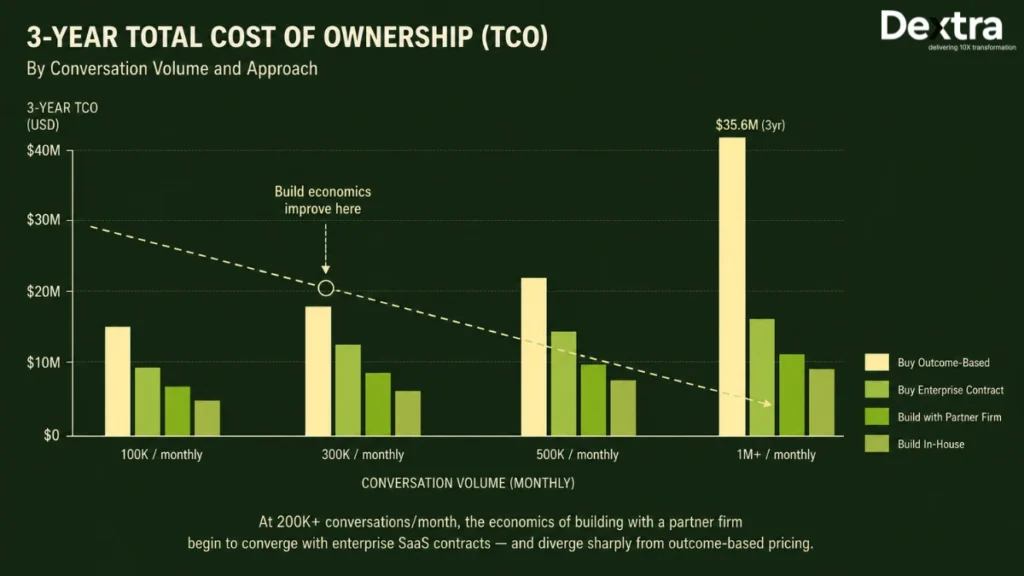
Below is a three-year total cost of ownership (TCO) comparison showing how the economics of buying and building change as monthly conversation volumes increase:
| Monthly Conversations | Buy (Outcome-Based, ~$1/resolution avg) | Buy (Enterprise Contract, negotiated) | Build with AI Agent Builder Firm | Build In-House (Internal Team) |
| 100K/month | $3.6M (3yr) | $1.2M-$2.4M (3yr) | $1.1M-$1.8M (3yr) | $1.5M-$2.5M (3yr) |
| 300K/month | $10.7M (3yr) | $3M-$5M (3yr) | $1.5M-$2.5M (3yr) | $2M-$3.5M (3yr) |
| 500K/month | $17.8M (3yr) | $5M-$8M (3yr) | $1.8M-$2.8M (3yr) | $2.5M-$4M (3yr) |
| 1M+/month | $35.6M+ (3yr) | $10M+ (3yr) | $2.2M-$3.5M (3yr) | $3M-$5M+ (3yr) |
What the TCO Numbers Include
If you’re evaluating the build vs buy AI customer service agent decision, it’s important to understand what each estimate includes.
- Buy (Outcome-Based): Includes per-resolution pricing, implementation, ongoing price increases, and additional integration work needed for non-standard systems.
- Buy (Enterprise Contract): Includes negotiated enterprise pricing, implementation costs, and ongoing vendor management. This model is usually more cost-effective than outcome-based pricing at higher volumes.
- Build with an AI Agent Builder Firm: Includes solution design and development, foundation model API costs, cloud infrastructure, ongoing platform operations, and post-deployment support.
- Build In-House: Includes engineering salaries, infrastructure and compute costs, ongoing maintenance, and the additional time and resources needed to build, deploy, and operate the platform internally.
The Break-Even Analysis
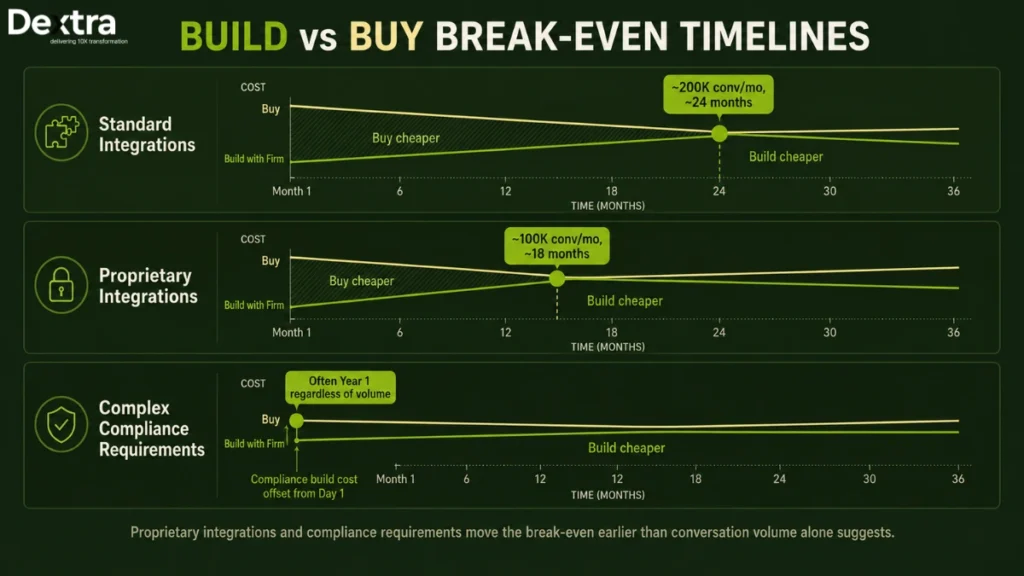
Here is an estimated break-even analysis showing the point at which building typically becomes more cost-effective than buying under different enterprise scenarios:
| Scenario | Break-Even Point (Build with Firm vs Buy Outcome-Based) | Break-Even (Build vs Buy Enterprise) |
| Standard Integrations | ~200K conversations/month | ~400K conversations/month |
| Proprietary Integrations | ~100K conversations/month | ~200K conversations/month |
| Complex Compliance | Often Year 1 regardless of volume | Often Year 1 regardless of volume |
What the AI Customer Service Agent Cost Comparison Doesn’t Capture
The build vs buy AI customer service agent decision isn’t based on cost alone. Some long-term factors are difficult to reflect in a TCO model but can have a significant impact over time.
- IP ownership: A custom AI agent becomes a business asset that you own and continue to improve, while a SaaS platform remains a licensed product.
- Vendor lock-in: Changes in pricing, product direction, or licensing terms can increase costs and make switching platforms difficult.
- Compliance needs: Organizations with complex regulatory requirements often spend more on configuring and extending commercial platforms than the baseline TCO suggests.
- Declining AI model costs: Foundation model pricing continues to fall over time, allowing custom deployments to benefit directly, while SaaS pricing doesn’t always decrease at the same pace.
The 5-Question Decision Framework for Build vs Buy
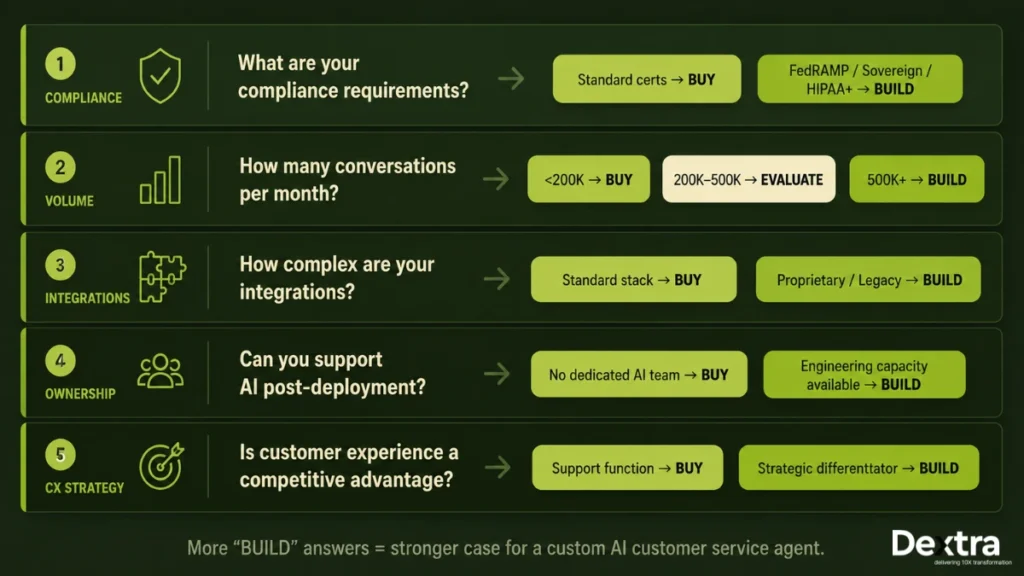
If you’re still figuring out, “should I build AI customer service agent capabilities or buy a platform?” These five questions will help you evaluate the build vs buy AI customer service agent decision from a business and technology perspective.
Question 1: What are your compliance requirements?
Start by looking at your regulatory obligations. If vendor certifications such as SOC 2, ISO 27001, GDPR, or HIPAA satisfy your compliance needs, an off-the-shelf platform is often enough. However, if your organization requires FedRAMP, sovereign cloud deployments, strict HIPAA controls, or operates across multiple regulatory frameworks, a custom solution is the better fit because it can be designed around your compliance requirements from the start.
Question 2: How many customer conversations do you handle each month?
Your support volume has a direct impact on long-term costs. So, if you’re handling fewer than 200,000 conversations a month, buying generally may make better financial sense. When the conversation surpasses 200,000 to 500,000 every month, it’s worth comparing the long-term TCO of both approaches. But once you move beyond that scale, the economics often begin to shift in favor of a custom implementation.
Question 3: How complex are your integrations?
Consider the systems your AI agent needs to work with. If you’re using standard CRMs, helpdesks, and business applications with minimal customization, most commercial platforms can integrate with them easily. But if your customer service depends on proprietary systems, heavily customized applications, legacy infrastructure, or unique workflows, a custom implementation will give you much greater flexibility.
Question 4: Can your organization support AI after deployment?
Building an AI agent doesn’t end when it goes live. Someone still needs to monitor performance, update knowledge sources, improve workflows, and maintain integrations. If you don’t have a dedicated AI team or can’t allocate engineering resources for ongoing ownership, buying is usually the more practical option. If you do have that capability, building becomes a much more realistic choice.
Question 5: Is customer experience a competitive advantage?
Finally, ask yourself what role customer service plays in your specific business. If it’s primarily a support function, a commercial platform can deliver the capabilities you need. But if customer experience directly influences customer retention, revenue, or brand differentiation, owning your AI architecture can become a strategic advantage rather than just a technology decision.
The more times you answer “build” to these questions, the stronger the case for a custom AI solution becomes. If most of your answers point toward “buy,” an off-the-shelf platform will likely meet your current needs. The goal should not be to force one approach over the other but to choose the option that best aligns with your business, technical requirements, and long-term growth.
How Dextra Labs Builds Custom AI Customer Service Agents
If your evaluation points toward a custom approach, the next step is understanding what a successful implementation actually looks like. At Dextra Labs, we don’t sell another AI platform; rather, we design, build, deploy, and transfer ownership of enterprise AI customer service agents that fit your architecture, workflows, and long-term business goals.
Here’s how we take a custom AI customer service agent from strategy to production:
Phase 1: Discovery & Scoping (Weeks 1–4)
Before you commit to a custom build, we make sure it’s the right decision for you and your business. We evaluate your customer service operations, review your knowledge base, assess integrations, and map your compliance requirements. By the end of this phase, you’ll have a clear roadmap, realistic timelines, and a go/no-go recommendation. If an off-the-shelf platform better fits your needs, we’ll recommend that instead.
Phase 2: Architecture & Development (Months 2–8)
Once you’ve validated the business case, we build an AI customer service agent around your business. Your solution is designed to fit your workflows, integrate with your existing systems, use the right foundation models, and include the governance, security, and scalability needed for production.
Phase 3: Production Rollout (Months 5–8)
Rather than switching everything on at once, you move into production in controlled stages. Your teams start by using the AI in agent-assist mode before expanding to autonomous workflows as performance is validated. Throughout the rollout, you gain visibility into quality, compliance, and business outcomes before scaling further.
Phase 4: Operational Ownership (Months 9–12)
The goal isn’t to keep you dependent on us, rather, it’s to put you in control. Your team receives the documentation, runbooks, training, and knowledge needed to confidently manage and evolve the platform. As your requirements grow, we’re available to support major enhancements while you retain ownership of the solution.
Typical investment: $500K–$1.5M for the initial implementation, with ongoing operating costs typically ranging between $250K and $500K per year, depending on scale and complexity.
Why the failure data doesn’t apply to Dextra’s model:
The failure rates often quoted in AI discussions largely reflect organizations attempting to build enterprise AI systems for the first time without a proven delivery model. Dextra’s phased approach is designed to reduce those risks before they become expensive problems.
- Knowledge quality issues: We audit and validate your knowledge base before development begins.
- Integration surprises: Critical integration challenges are identified during discovery, not halfway through implementation.
- Scope creep: Every phase has defined outcomes and decision points, so projects stay focused and measurable.
- Operational readiness: Ownership, documentation, and training are planned from the beginning and are not left until deployment.
- Implementation risk: Rather than starting from scratch, we apply proven architectures and enterprise delivery experience gained across previous AI deployments.
The result is a structured implementation process that reduces uncertainty, keeps projects aligned with business objectives, and gives your team long-term ownership of an AI customer service platform built specifically for your enterprise.
Conclusion
The build-versus-buy decision doesn’t have a universal answer, but it does have a clear framework and it starts with moving past one of the biggest misconceptions in this debate. Building isn’t inherently riskier, slower, or more expensive; that perception largely comes from first-time internal AI projects, not custom implementations delivered by experienced AI partners. If your customer service needs are straightforward, buying is a practical choice.
But if your business has outgrown the limitations of off-the-shelf platforms, explore our Custom AI Agent Development Services for Customer Service to see how Dextra Labs designs, builds, and deploys enterprise AI agents tailored to your workflows, integrations, and compliance requirements, giving you a solution built to scale with your business.
Frequently Asked Questions:
Q1. What percentage of AI customer service agent builds fail?
MIT’s Project NANDA found that 95% of generative AI pilots never reach production. However, these figures primarily reflect first-time internal AI initiatives and not custom implementations delivered by experienced AI agent builders. In fact, MIT found that organizations working with vendors or implementation partners achieved roughly twice the success rate (67% vs. 33%) compared to purely internal teams. So, the takeaway isn’t that custom AI customer service agents fail but it’s that experienced execution significantly improves the chances of success.
Q2. How much does it cost to build a custom AI customer service agent?
Building a custom AI customer service agent with an experienced AI development partner costs around $500K–$1.5M for the initial implementation, with $250K–$500K in annual operating costs, depending on the complexity of your requirements. Unlike a first-time internal build, you don’t have to commit to the entire project upfront. Most experienced AI agent builders like Dextra Labs begin with a 4-week discovery and scoping phase, giving you a clear roadmap, budget, and a go/no-go recommendation before moving into full development. This phased approach helps reduce risk while ensuring you only invest further if a custom solution is genuinely the right fit.
Q3. How much does it cost to buy an AI customer service agent?
The cost of buying an AI customer service agent depends on the vendor and pricing model. Many enterprise platforms charge per resolved conversation, with prices starting at around $0.99 per outcome, while others use custom enterprise contracts based on your support volume and requirements. You’ll also need to account for implementation, integrations, and any additional platform or seat fees. Buying is often the lower-cost option for organizations with straightforward support needs, but as conversation volumes and complexity increase, ongoing subscription costs can grow quickly which makes a custom AI customer service agent a more cost-effective investment over the long term.
Q4. When does building make more financial sense than buying?
Building starts to make more financial sense when your AI customer service needs go beyond what a standard platform is designed to handle. Such as:
High conversation volumes: Around 200,000+ conversations per month, ongoing subscription costs can increase significantly, making a custom solution more cost-effective over time.
Proprietary integrations: If your AI agent needs to connect with custom CRMs, internal systems, or legacy infrastructure, building avoids expensive workarounds and platform limitations.
AI customer service agents custom workflows: If your support operation depends on unique approval processes, industry-specific policies, or multi-step automations, a custom AI agent can be designed around your exact workflows instead of forcing you to adapt to a vendor platform.
Long-term ownership: A custom AI customer service agent gives you full control over your architecture, roadmap, and data while reducing dependence on vendor pricing and product decisions.
Q5. How long does it take to build vs buy AI agent?
Buying an AI customer service platform is usually the fastest way to get started and can often be deployed within 30–90 days, especially if you’re already using platforms like Zendesk, Intercom, or Salesforce. However, speed isn’t always the same as long-term fit. Building a custom AI customer service agent with an experienced AI agent builder like Dextra Labs usually takes 6–12 months, but that time is spent designing a solution around your business, integrations, and compliance needs. You’ll also receive a clear roadmap and a go/no-go recommendation after the initial 4-week discovery phase, so you can validate the business case before committing to full development.
Q6. Can I switch from an off-the-shelf platform to a custom AI agent later?
Yes, many organizations start with an off-the-shelf platform to get AI into production quickly and move to a custom solution as their requirements become more complex. The transition typically takes 6–12 months, during which both systems may run in parallel for a short period. While this can temporarily increase licensing costs and require some team adjustment, it allows you to migrate gradually without disrupting customer support.
Q7. What’s the difference between building in-house and building with a partner firm?
The biggest difference is experience. With an in-house build, your team is responsible for everything from planning and architecture to development, deployment, and ongoing maintenance. For organizations building AI for the first time, this often means higher risk, longer timelines, and a greater chance of project delays. Building with an experienced AI partner gives you access to proven architectures, predictable delivery, and a structured implementation process. Your business still owns the final solution, but you avoid many of the challenges that first-time internal teams typically face.
Q8. What’s the hybrid approach to build vs. buy?
The best AI customer service agents often follow a hybrid approach rather than relying entirely on either building or buying. Enterprises use off-the-shelf platforms for routine support tasks such as order tracking, FAQs, and account updates, while building custom AI agents for complex workflows involving compliance, proprietary integrations, or multi-agent orchestration. This allows you to launch quickly where standard platforms work well, while investing in custom development only where it delivers clear business value.