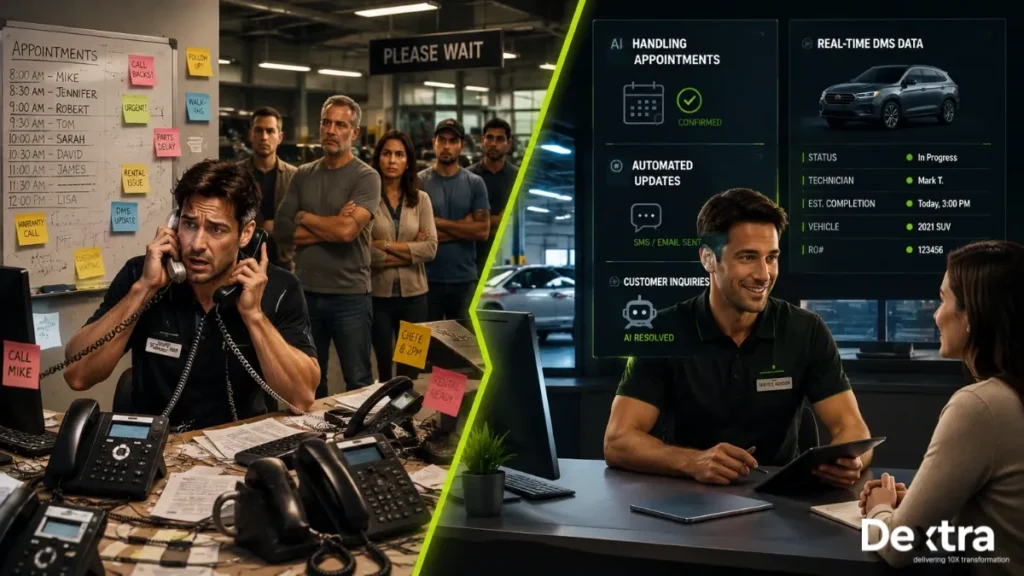
What if your service advisors could spend less time answering routine calls and more time helping customers who actually need their expertise? For many dealerships, the service BDC handles hundreds of inquiries every day, while advisors lose valuable hours to appointment scheduling, repair status updates, and follow-ups. Dealerships are now turning to AI agents for customer service to eliminate these operational bottlenecks, automating appointment scheduling, repair status updates, and follow-ups through intelligent automotive-specific workflows without disrupting existing operations.
The challenge, however, goes beyond answering customer queries. Every interaction depends on data inside the Dealer Management System (DMS), whether it’s CDK Global, Reynolds & Reynolds, or Tekion. While general-purpose AI platforms can automate common support tasks, they aren’t designed to work natively with dealership systems, service workflows, or the operational complexity of modern dealer groups.
This guide explains what AI agents actually do in an automotive environment, discusses 12 practical use cases across the vehicle ownership journey, architecture behind DMS-integrated deployments, examines costs and ROI, and explains why many dealerships rely on custom AI solutions rather than off-the-shelf platforms.
What Are AI Agents for Automotive Customer Service?
An AI agent for automotive customer service is an intelligent system that integrates with dealership and OEM platforms including the Dealer Management System (DMS), CRM, scheduling software, OEM portals, and connected vehicle systems, to manage customer interactions across the entire vehicle ownership lifecycle.
It can handle everything from pre-sale inquiries and vehicle purchases to service scheduling, repair status updates, recall notifications, warranty claims, and post-service follow-ups, while accessing real-time data and completing actions without constant human intervention.
What makes automotive AI agents different from generic AI customer service agents:
- DMS integration is foundational: The Dealer Management System (CDK Global Fortellis, Reynolds & Reynolds ERA/POWER, Tekion, or DealerSocket) stores customer records, repair orders, appointments, and service history. Without direct DMS integration, AI agents for automotive customer service can answer questions but can’t complete dealership tasks.
- Every interaction depends on vehicle data: The AI agent needs access to the customer’s VIN, service history, warranty status, open recalls, and upcoming maintenance. This information comes from the DMS and OEM systems, not a standard knowledge base.
- Each OEM has different compliance requirements: Toyota, Ford, GM, Honda, BMW, and other manufacturers have their own rules for customer communication, warranty handling, and recalls. AI agents must follow these requirements during every interaction.
- Most dealer groups manage multiple locations: Different dealerships may use different DMS platforms, represent different OEM brands, and follow different service processes. An automotive AI agent must work across all of these systems while delivering a consistent customer experience.
Chatbot vs AI Agent in Automotive: What is the Difference Between Them?
Many dealerships still compare an automotive chatbot vs AI agent as if they serve the same purpose but in reality, they solve very different problems. The table below outlines how an automotive AI agent differs from a traditional chatbot across core dealership workflows, integrations, and operational capabilities.
| Capability | Automotive Chatbot | Automotive AI Agent |
| Primary Role | An automotive chatbot answers predefined questions using scripted responses. | An automotive AI agent understands customer requests, retrieves real-time data, and completes dealership workflows autonomously. |
| DMS Integration | It has no direct DMS access and is limited to FAQs and static information. | It integrates with CDK, Reynolds & Reynolds, Tekion, or DealerSocket to read and update customer, appointment, and repair order data. |
| Vehicle Context | Customer conversations remain generic because the chatbot cannot identify the vehicle or access its service history. | AI agent uses VIN-specific data, including service history, warranty status, recalls, maintenance schedules, and repair progress. |
| Task Execution | Automotive chatbot cannot schedule appointments or perform actions. | AI agent can book service appointments, update repair orders, check parts availability, and send customer notifications. |
| Customer Memory | Conversation context is generally limited to the current interaction, if memory is available at all. | Customer context can carry across service visits, allowing the AI agent to provide a more personalized experience over time. |
| Real-Time Information | Responses are based on predefined answers that can become outdated. | It retrieves live information from dealership and OEM systems before responding. |
| OEM Compliance | Chatbot doesn’t understand manufacturer-specific communication requirements. | Configurable OEM rules allow the AI agent to follow requirements for recalls, warranty processes, and customer communications. |
| Multi-Dealership Support | They support a single dealership or website. | It orchestrates customer interactions across multiple rooftops, brands, and DMS environments from a single platform. |
| Business Impact | Automotive chatbot reduces basic FAQ volume. | AI agent automates operational workflows, reduces advisor workload, improves response times, and enhances the overall customer experience. |
12 Use Cases for AI Agents in Automotive Customer Service
Here are 12 real-world use cases, grouped into Pre-Sale, Service Lifecycle, and Post-Service categories, to show how AI agents support dealerships throughout the entire customer lifecycle:
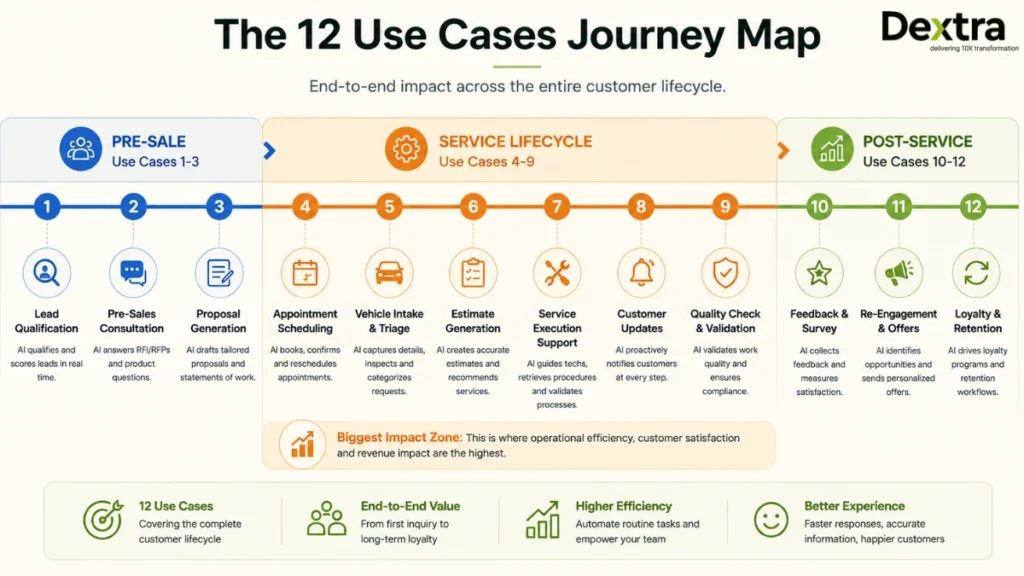
Category 1: Pre-Sale Use Cases
The pre-sale stage is where AI agents help dealerships engage prospects faster and convert more inquiries into opportunities.
Use Case #1: Lead Response Automation (BDC)
Lead response automation instantly engages new prospects across website forms, emails, chats, and phone inquiries, even after hours. It qualifies leads by vehicle interest, budget, trade-in intent, and purchase preference before scheduling test drives or routing high-intent leads to sales.
Use Case #2: Vehicle Recommendation Engine
Vehicle recommendations become more personalized when customer needs such as family size, daily commute, budget, lifestyle, towing needs, and preferred features are considered. AI agent matches these preferences with live dealership inventory and can also factor in trade-in values and answer financing pre-qualification questions, giving customers relevant options without waiting for a salesperson.
Use Case #3: F&I Product Explanation
F&I product explanations give customers a much easier way to understand warranty plans, GAP insurance, service contracts, and vehicle protection packages. AI agent answers common comparison questions in simple language, helping customers arrive better informed and making conversations with the F&I team more productive without extending the buying process.
Category 2: Service Lifecycle (Highest Value)
The service lifecycle is where AI agents create the biggest operational impact by automating high-volume customer interactions.
Use Case #4: Service Appointment Scheduling
AI agent automates service appointment scheduling by checking real-time availability through the DMS or platforms such as Xtime, booking appointments, sending reminders, and managing cancellations or rescheduling. By taking these routine interactions off the BDC’s plate, dealerships can reduce advisor workload, improve show rates, and make scheduling more convenient for customers.
Use Case #5: Service Status Updates
One of the most common questions dealerships receive is, “Is my car ready?” Instead of relying on service advisors to answer every single one of the call, AI agent retrieves real-time repair order (RO) updates from the DMS and proactively notifies customers when the vehicle enters the workshop, parts arrive, repairs are completed, or the vehicle is ready for pickup. This significantly reduces inbound status inquiries while improving communication and Customer Satisfaction Index (CSI) scores.
Use Case #6: Recall Campaign Management
Managing recall campaigns manually can be time taking, especially for dealerships with a large customer base. By using OEM data to automatically identify vehicles with open recalls, AI agent proactively contact affected customers through their preferred channels and schedule service appointments. It can also track recall completion rates for compliance reporting, helping dealerships increase recall participation while reducing the need for manual outreach.
Use Case #7: Warranty Claims Support
Warranty support can be streamlined with an AI agent that checks VIN, mileage, and service history to determine eligibility, explains coverage, initiates claims in the DMS, and keeps customers updated on claim status. This reduces service delays and customer confusion while making the warranty process faster and more transparent.
Use Case #8: Predictive Maintenance Notifications
Predictive maintenance notifications allow an AI agent to monitor service history, manufacturer-recommended maintenance schedules, and available vehicle mileage to identify when a customer is due for service and send a timely reminder. This proactive outreach helps dealerships retain more service customers, improve satisfaction, and drive repeat service revenue.
Use Case #9: Loaner Vehicle Management
Loaner vehicle management can be streamlined with an AI agent that checks availability, reserves vehicles, coordinates pickup and return times, and keeps customers updated throughout the process. Integration with fleet management systems can also capture returns and damage reports, reducing administrative work while improving fleet utilization and the customer experience.
Category 3: Post Service
The post-service stage helps dealerships strengthen customer relationships, improve retention, and generate repeat business through proactive engagement.
Use Case #10: Post-Service Follow-Up and CSI Management
After a service visit, an AI agent can automatically follow up within 24 hours to capture customer feedback before the official OEM CSI survey is sent. It can identify dissatisfied customers and alert the service manager early, giving the dealership an opportunity to resolve issues, improve CSI scores, and strengthen customer relationships.
Use Case #11: Service-to-Sales Handoff
Service visits can also create sales opportunities when an AI agent identifies customers whose vehicles are nearing lease expiration, have high mileage, or have available trade-in equity. These opportunities can be shared with the sales team along with relevant customer details and estimated appraisal information, creating a seamless path from service to sales.
Use Case #12: Customer Retention and Conquest Engagement
When customers stop returning for service, an AI agent can proactively identify them and send personalized reminders, service offers, or maintenance recommendations to bring them back. It can also identify customers servicing their vehicles at competing dealerships, helping the dealership win back customers, strengthen retention, and generate additional service revenue.
Architecture: How AI Agents Integrate with DMS, CRM, and OEM Systems
The five layers below show what it takes to connect an AI agent to the systems, data, and communication channels that power automotive customer service:
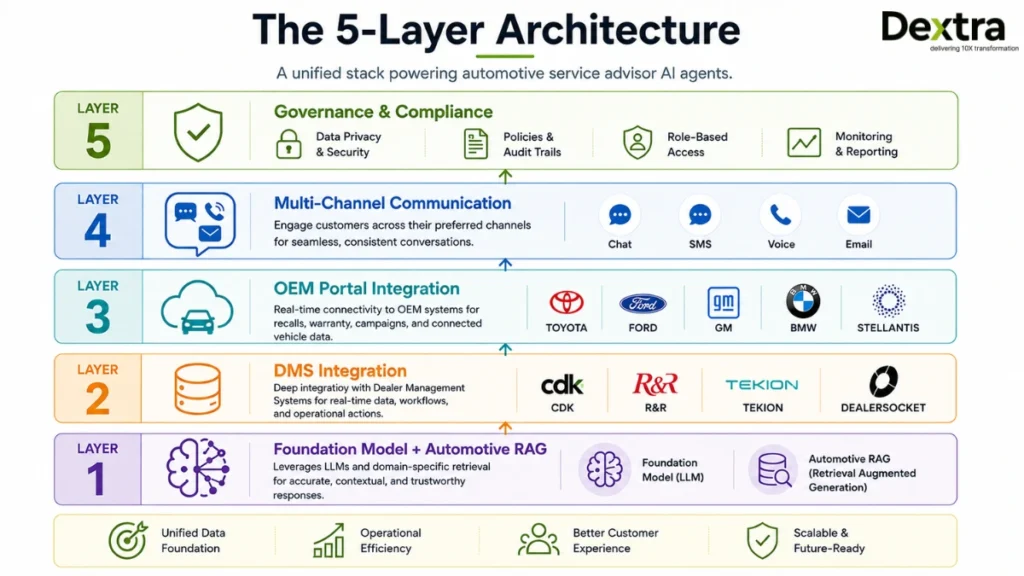
Layer 1: Foundation Model + Automotive RAG
At the core of every automotive AI agent is a foundation model such as Claude Sonnet 4.5 or GPT-5, paired with a Retrieval-Augmented Generation (RAG) system.
Instead of relying on general knowledge, the agent retrieves dealership and OEM-specific information, including service pricing, warranty policies, recall bulletins, technical service bulletins (TSBs), parts catalogs, and dealership procedures.
This means you can give customers more accurate answers to VIN-specific questions, such as upcoming maintenance for a particular vehicle, using the latest information available to the dealership and OEM.
Layer 2: DMS Integration Layer
DMS Integration Layer is what separates a generic AI platform from a dealership-ready solution. With dealer management system AI integration, you can securely connect the agent to customer records, repair orders, appointments, service history, and parts inventory, allowing it to not just answer questions but also take action.
Since every DMS platform has a different integration approach, you typically need:
- CDK Global (Fortellis): Integration through Fortellis APIs with partner certification for accessing and updating dealership data.
- Reynolds & Reynolds: Custom integration through the Reynolds Certified Interface (RCI) program, with different approaches for ERA and POWER.
- Tekion: Modern REST APIs that enable faster and more flexible cloud-based integrations.
- DealerSocket (Solera): Partner APIs that simplify integration across both CRM and DMS workflows.
Layer 3: OEM Portal Integration
Beyond dealership systems, you also need secure access to OEM platforms. This includes vehicle recall feeds, warranty claim systems, connected vehicle platforms such as GM OnStar, Ford SYNC, Toyota Connected, and Stellantis Uconnect, along with OEM compliance portals. These integrations give the AI agent access to the latest manufacturer data, so you can provide customers with more accurate information about recalls, warranties, connected vehicles, and other OEM-specific services. At the same time, your dealership can automate manufacturer-specific workflows and communications while staying aligned with brand requirements, reducing manual work and helping teams respond faster.
Layer 4: Multi-Channel Communication
Customers expect to communicate through the channel that’s most convenient for them. The Multi-Channel Communication Layer connects these channels so you can give customers one consistent experience, regardless of where the conversation starts. This allows you to automate more customer interactions while making the experience feel continuous and connected.
Layer 5: Governance and Compliance
Governance and Compliance layer ensures that your AI agent can automate customer interactions while keeping sensitive customer and vehicle data protected and staying within the rules that apply to your dealership. AI deployments should include controls for TCPA compliance, OEM communication policies, protection of customer and financial information, state-specific dealership regulations, and data residency requirements where manufacturers require customer data to remain within specific regions.
Together, these five layers give an AI agent the connectivity, automotive context, communication capabilities, and governance needed to operate within a dealership environment. This is also where the difference between a generic AI customer support platform and a purpose-built automotive AI agent becomes clear.
Why Generic AI Customer Support Platforms Fall Short in Automotive
| Capability | Ada / Sierra / Fin / Decagon | Custom Automotive AI Agent |
| DMS read access (RO status, service history) | ❌ No native DMS connector | ✅ Custom integration via DMS APIs/middleware |
| DMS write access (create appointments, update ROs) | ❌ | ✅ |
| VIN-specific knowledge retrieval | ❌ Generic KB only | ✅ VIN decode + service history + warranty + recalls |
| OEM recall data integration | ❌ | ✅ NHTSA + OEM-specific feeds |
| Connected vehicle data pipeline | ❌ | ✅ Via OEM connected services APIs |
| Multi-rooftop orchestration (different DMS instances) | ❌ | ✅ Custom routing and data federation |
| OEM compliance per manufacturer | ❌ Generic compliance | ✅ Configurable per OEM framework |
| TCPA-compliant outbound communication | ⚠️ Limited | ✅ Built into communication layer |
ROI of AI Agents in Automotive Customer Service
The following tables illustrate the potential ROI of AI agents by comparing key service and BDC metrics before and after implementation.
Service Department ROI Before and After AI
| Metric | Before AI Agent | After AI Agent | Business Impact |
| Service appointment show rate | Only 65-70% of customers typically arrive for their scheduled service appointments. | Around 80-85% of customers show up as scheduled with the help of AI powered reminders and follow-ups. | After implementing AI agents, automated reminders and easy rescheduling can improve service appointment show rates by 15-20%. |
| Inbound status calls per day | Service advisors spend a significant part of the day answering 150-200 calls asking for repair updates. | Status calls drop to around 50-70 per day as AI proactively updates customers. | With AI proactively handling service updates, dealerships can reduce inbound status inquiries by 60-65%, freeing advisors to focus on in-person customers. |
| Average time to schedule an appointment | Booking a service appointment over the phone usually takes 8-12 minutes. | Customers can schedule an appointment in less than a minute through an AI agent. | AI-powered scheduling can make appointment booking around 90% faster, improving convenience for both customers and staff. |
| Service advisor time spent on administrative work | Advisors often spend around 40% of their day handling scheduling, follow-ups, and routine customer questions. | Administrative work drops to 15-20% of the day as AI handles repetitive tasks. | By automating routine tasks with AI, dealerships can reduce advisor workload by nearly 50%. |
| Customer Satisfaction Index (CSI) | CSI scores depend largely on manual follow-ups and response times. | Customer communication improves with faster updates and proactive AI follow-ups. | Dealerships can see 10-15 point improvements in CSI through better communication and faster issue resolution with the help of an AI agent. |
| 12-month service retention rate | Around 45-55% of customers return for their next scheduled service. | After implementing AI agent service retention increased to 60-70%. | Using AI-powered predictive reminders and personalized follow-ups, dealerships can improve service retention and generate more repeat service revenue. |
BDC / Lead Management ROI Before and After AI
| Metric | Before AI Agent | After AI Agent | Business Impact |
| Lead response time | Customers typically wait 30-60 minutes to receive a response after submitting an inquiry. | Every new lead receives an initial response in less than 60 seconds, regardless of business hours. | Responding almost instantly due to adopting AI agents makes the dealership nearly 98% faster, significantly increasing the chances of engaging prospects before competitors. |
| Lead-to-appointment conversion | Only 15-20% of qualified leads usually book a test drive or dealership visit. | Conversion rates increase to 25-35% as leads receive immediate responses and personalized follow-ups. | Dealerships can see improvements by 50-75% after adopting AI for faster responses and personalized follow-ups. |
| After-hours lead capture | Most inquiries received after business hours remain unanswered until the next day, leading to missed opportunities. | Every after-hours inquiry is handled automatically, with customers receiving immediate assistance and appointment options. | Adopting AI for after-hours lead engagement can help dealerships capture nearly 100% of inquiries and reduce missed sales opportunities. |
| BDC calls handled per agent per day | BDC agents typically manage 80-100 calls daily, many of which involve repetitive questions and routine tasks. | AI handles routine inquiries, allowing each agent to effectively manage 120-150 customer interactions focused on higher-value conversations. | AI-powered automation can increase BDC productivity by 30-50% by taking routine inquiries off agents’ plates. |
Revenue Impact Model (Single Dealership)
A realistic estimate of the first-year revenue impact for a mid-size dealership after implementing AI agents:
| Revenue Line | Annual Impact |
| Incremental service ROs from better scheduling + retention | $180K-$350K |
| Incremental vehicle sales from faster lead response | $100K-$250K |
| Reduced BDC labor cost (reallocation, not elimination) | $60K-$120K |
| Recall campaign revenue (higher completion rates) | $40K-$80K |
| Estimated Total Year 1 Impact | $380K-$800K per dealership |
For a 20-dealership group, the AI agents could generate an estimated $7.6M-$16M in additional annual revenue, compared with an upfront investment of $500K-$1.5M and ongoing operating costs of $250K-$500K per year.
Implementation Challenges for AI Agents in Automotive Customer Service
Here are some of the most common challenges dealerships should plan for before implementation:
- DMS API access can take time: Access to platforms like CDK Global and Reynolds & Reynolds often requires certification, which can take several months. So, you should start the approval process early to avoid delays.
- Multiple DMS platforms add complexity: If your dealer groups uses different DMS platforms across locations, a unified data layer can help keep customer, vehicle, and repair order information consistent across all systems.
- OEM requirements vary by brand: Since every manufacturer has its own guidelines for customer communications, recalls, and warranty processes, your AI workflows should be flexible enough to support different OEM requirements.
- Service advisor adoption is essential: Advisors are more likely to use AI when it reduces routine tasks like scheduling and status updates, allowing them to spend more time helping customers.
- Outbound communication must stay compliant: When AI makes calls or sends texts, you still need proper customer consent, opt-out options, and compliance with communication regulations.
- Legacy data often needs cleanup: Duplicate records, missing vehicle information, and inconsistent data can affect AI performance so cleaning up dealership data before deployment helps make sure more accurate results.
How Dextra Labs Builds Custom AI Agents for Automotive Customer Service
For dealer groups, OEMs, and automotive enterprises with complex customer service operations, Dextra Labs works as an experienced AI Agent builder, designing custom AI agents that integrate with dealership systems, support OEM requirements, and scale across multi-location operations.
Here’s what makes our automotive AI agent builds different from generic customer service AI implementations:
- We Build Around the DMS, Not the Helpdesk: Unlike generic customer service solutions that treat the helpdesk as the primary system, we build AI agents around the dealership’s DMS, whether it’s CDK Global, Reynolds & Reynolds, or Tekion. This allows the agent to securely access and update customer records, repair orders, appointments, and service history where the data actually lives.
- VIN-Specific Intelligence, not Generic Answers: Dextra’s Retrieval-Augmented Generation (RAG) architecture retrieves information based on a customer’s specific VIN. Instead of providing general maintenance advice, the agent can answer questions about that customer’s vehicle, including service history, warranty coverage, recalls, and upcoming maintenance.
- Compliance Built for Every OEM: Different manufacturers have quite different requirements for customer communication, warranty processes, and recalls. Rather than relying on fixed workflows, Dextra builds configurable compliance rules that allow dealer groups to manage multiple OEM brands from a single AI platform.
- Designed for Multi-Dealership Operations: Many dealer groups operate multiple rooftops with different DMS platforms, OEM brands, and service processes. We design AI agents to orchestrate customer interactions across all locations from day one, providing consistent experiences, centralized reporting as well as seamless data flow across the entire dealership network.
Engagement Model for Automotive AI Agents
To deliver a production-ready automotive AI agent, we follow a structured four-phase approach in our custom AI agent development services.
Phase 1: Automotive Discovery
We assess DMS APIs, document OEM compliance requirements, map multi-rooftop operations, audit data quality, prioritize high-impact use cases, and define a clear go/no-go decision so you know what to prioritize and address before moving forward.
Phase 2: Architecture & Build
Next, we build the DMS integration layer, VIN-indexed RAG architecture, agent orchestration, OEM compliance engine, multi-channel communication layer, and governance framework so your AI is built around your dealership systems and workflows.
Phase 3: Pilot & Rollout
We first run a single dealership pilot, validate performance in advisor-assist mode, and then gradually expand the deployment across multiple rooftops, allowing you to validate results before scaling.
Phase 4: Operational Handoff
At last, we transfer day-to-day operations to your team while continuing to support DMS API updates, OEM compliance changes, and future capability enhancements, giving you long-term ownership with ongoing support as your needs evolve.
Typical Investment: $500K-$1.5M for implementation, plus $250K-$500K in annual operations. For a 20-dealership group, this investment can often be recovered within the first year through the operational efficiencies and revenue gains discussed earlier.
Conclusion
If you’re considering AI for your dealership or automotive business, don’t focus only on automation; instead, focus on solving the operational challenges that have the biggest impact. The right AI agent should fit seamlessly into your existing systems, support your teams, and create a better experience for every customer from the first inquiry to long-term service.
Dextra Labs specializes in building custom AI agents for complex enterprise workflows. Book a call with our team to discuss your requirements and explore our AI Agent Development Service to see how we build AI agents for automotive customer service tailored to your operations.
Frequently Asked Questions:
Q1. When should an automotive business build custom vs. buy off-the-shelf?
If your needs are just limited to basic FAQs and standard customer support, an off-the-shelf solution may be enough but if your business relies on DMS integrations, OEM compliance, VIN-specific workflows, or operates across multiple dealerships, a custom AI agent is usually the better long-term choice for flexibility, scalability, and ROI.
Q2. How do AI agents integrate with DMS platforms like CDK Global?
AI agents integrate with Dealer Management Systems (DMS) like CDK Global through secure APIs, middleware, and real-time data connections. This allows them to access customer records, repair orders, service history, appointments, and parts information.
Q3. What’s the ROI of AI agents for a mid-size dealership?
For a mid-size dealership, a custom AI agent can deliver measurable operational and financial benefits by working directly with dealership systems and workflows. It can reduce service status calls by 60–65%, improve appointment show rates by 15–20%, increase service retention by 15–25%, and boost lead-to-appointment conversions by 50–75%. Because it integrates with your DMS, OEM systems, and existing processes, a custom solution can generate stronger long-term ROI through lower operating costs, higher productivity, and increased service and sales revenue.
Q4. Can AI agents handle recall campaign management?
Yes, AI agents can identify vehicles with open recalls, proactively notify affected customers, schedule recall appointments, send reminders, and track completion status by integrating with OEM and dealership systems.
Q5. Do AI agents work across multiple dealerships with different DMS platforms?
Yes, modern AI for dealership customer service can be built to work across multiple dealerships, even when each location uses a different DMS. With a unified integration layer, the AI agent can access and manage customer, vehicle, and service data across all dealerships while maintaining consistent workflows.
Q6. What’s the difference between an automotive chatbot and an AI agent?
An automotive chatbot is basically designed to answer FAQs and to guide customers through basic conversations. An AI agent goes much further by integrating with dealership systems to book appointments, check repair order status, access vehicle-specific information, send service updates, and complete tasks without human intervention.
Q7. How long does it take to deploy an AI agent in automotive customer service?
The timeline depends on your dealership’s requirements, including the number of DMS integrations, OEM systems, locations, and workflows involved. Book a free consultation with our team and we’ll provide an implementation timeline based on your specific business needs.