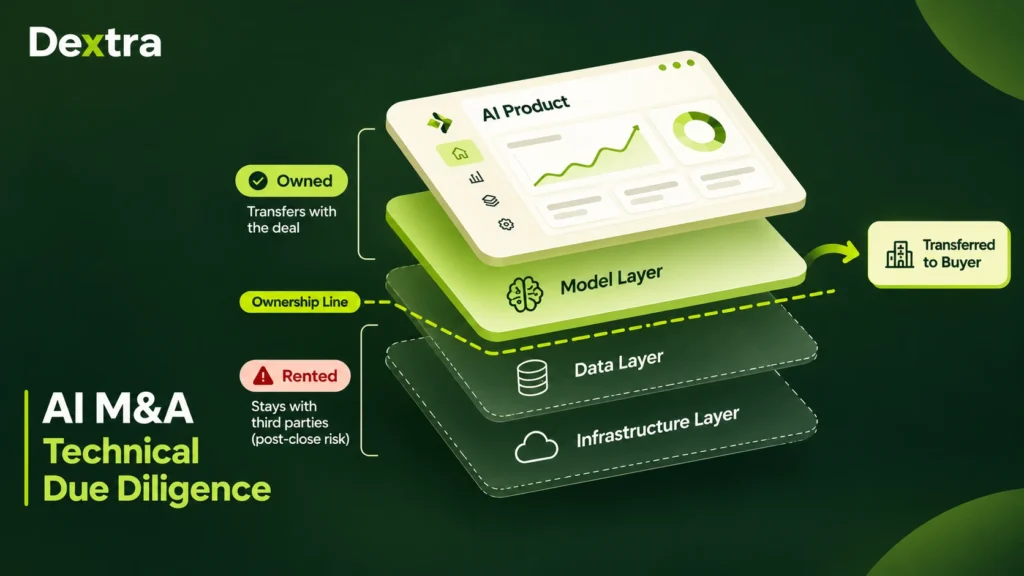
Buying an AI company is not the same as buying a software company, and the difference is easy to miss. The target can have a working product, benchmarks that look excellent, and a pipeline of interested customers, and still not own a defensible model, transferable data rights, sustainable inference economics, or an architecture that will survive contact with the buyer’s environment. What looks like an asset in the data room can turn out to be a licence to someone else’s technology.
That is the gap AI M&A technical due diligence exists to close. Conventional software diligence still matters, but it was never built to answer the questions that decide an AI acquisition. The central one is simple to state and hard to answer without looking under the hood: what AI capabilities and defensible business value will the acquirer actually own the day after closing?
The pressure to get this right has grown. In its 2026 technology deals outlook, PwC describes AI as having moved from investment thesis to revenue test, with diligence shifting toward monetisation, infrastructure access, and defensible workflows, while deal and integration timelines compress. For an acquirer, that means less room to discover after close what should have been validated before it.
At Dextra Labs, we run independent technical due diligence for acquisitions that answers the buyer’s question directly. This guide covers why AI M&A diligence differs from the software playbook, the eight areas a buyer must validate, how findings translate into deal decisions, what a rigorous report should contain, and when to bring in a specialist partner.
Why AI M&A Technical Due Diligence Differs from Traditional Software Due Diligence
A software acquisition asks whether the code is sound, the architecture scales, and the team can maintain it. Those questions still apply. AI acquisitions add three more that a traditional review will not catch, and each one can change what the buyer is really getting.
The product may depend on technology the target does not own
Many AI products are built on third-party foundation models, licensed datasets, external retrieval systems, and hosted infrastructure. The genuinely proprietary part may be a thin layer of application logic, with most of the perceived capability supplied by providers the target does not control. A buyer needs to know which parts of the value transfer with the deal and which are rented from someone who can change the terms.
Product demonstrations do not establish production readiness
A benchmark result or a controlled demo says little about how the system behaves across real customer segments, edge cases, and sustained load. Quietly, the product may lean on human intervention, manual exception handling, and ad hoc model evaluation to hold its quality together. The buyer is acquiring the production reality, not the demo.
AI economics can change as usage scales
Inference and GPU spend, model hosting, data processing, monitoring, and human review all move with volume, and not always in the buyer’s favour. Margins that look healthy at pilot scale can compress sharply under higher usage, longer context windows, and more complex workloads. The cost to serve is part of what is being acquired, and it deserves the same scrutiny as the revenue.
The takeaway is not that software diligence is obsolete. It is that AI-specific performance, dependencies, data rights, and cost to serve sit on top of it. Our technical due diligence process covers the conventional ground in depth, and this guide concentrates on the AI layer the buyer cannot afford to skip.
What Buyers Must Validate Before Acquiring an AI Company
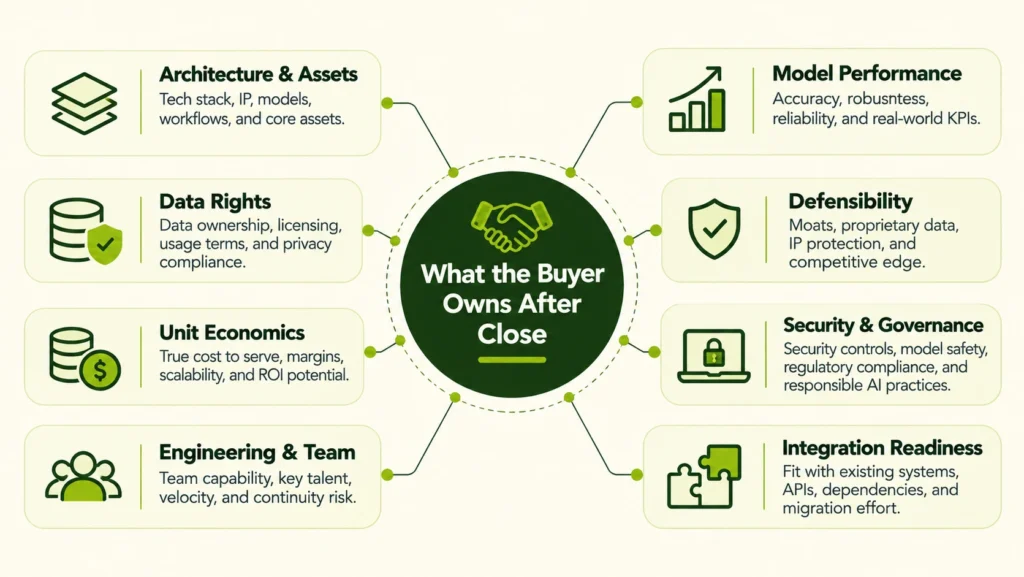
This is the core of the work. Each area below follows the same shape: what to inspect, what evidence to request, the red flag that should give a buyer pause, and why it matters to the deal. The buyer lens runs through all eight, because the question is never just whether the technology is good. It is whether the buyer will own something valuable, transferable, and operable after close.
1. AI Architecture and the Assets Being Acquired
Map the complete system: the application, the model layer, orchestration, retrieval, data pipelines, APIs, and infrastructure. Establish whether the target runs proprietary models, fine-tuned open-source models, third-party foundation models, or a hybrid, and mark which components create differentiated value and which could be replaced or replicated. A control-based framework published by Matchpoint Partners for diligence on AI targets captures the discipline well: separate the durable assets, proprietary data, workflow integration, evaluation capability, and genuine know-how, from the rented capability any competitor can license too.
Evidence to request: Architecture documentation, deployment configurations, model registries, and a full dependency inventory.
Red flags: Unclear system ownership, undocumented dependencies, or a product whose primary capability is largely supplied by an external model provider.
Buyer implication: The architecture determines what is actually transferable, what is replaceable, and what is strategically valuable in the acquisition.
2. Model Performance, Evaluation, and Production Reliability
Verify the performance claims against representative production workloads rather than curated demos. Review the evaluation datasets, baselines, acceptance thresholds, and whether the tests can be reproduced, and look hard at hallucination rates, failure modes, latency, consistency, and degradation over time. Check that monitoring, model versioning, regression testing, and drift detection exist. For agentic products, examine tool-use accuracy, task completion, permission enforcement, and recovery from failed actions.
Evidence to request: Evaluation reports, test datasets where access is permitted, production metrics, incident records, and model release histories.
Red flags: Selective benchmark results, missing baselines, undocumented evaluations, or performance claims that cannot be reproduced.
Buyer implication: Unverified performance undermines the target’s product differentiation, its customer retention assumptions, and the revenue forecast the buyer is paying for.
3. Data Ownership, Provenance, and Usage Rights
Trace the origin and ownership of training, fine-tuning, retrieval, and evaluation data, and validate licences, contractual restrictions, consent requirements where they apply, and permitted commercial uses. Review how customer data is handled, retained, deleted, and isolated. Above all, establish whether the data assets and their rights transfer to the acquirer and stay usable after close, and whether any claimed data moat is genuinely exclusive and relevant to performance. Reporting in the Wall Street Journal on how acquirers now scrutinise data provenance put the stake plainly: as one strategic transactions lawyer framed it, if a court orders a model trained on tainted data to be deleted or retrained, the acquirer is left holding an asset it cannot use.
Evidence to request: Data licences, provenance records, data-processing agreements, model and software licences, and IP assignment documentation.
Red flags: Unclear data provenance, restrictive licences, missing lineage, or customer data reused beyond its permitted purpose.
Buyer implication: Data restrictions can shrink the value of the acquired assets or limit the buyer’s ability to operate and develop the product at all.
4. AI Defensibility and Dependence on Third-Party Providers
Separate proprietary value from capability that is readily available through commercial or open-source models. Assess differentiation across workflows, domain-specific data, fine-tuning, integrations, feedback loops, and distribution, and examine the model-provider contracts, API limits, pricing exposure, service continuity, and migration options. Test whether switching models would take serious engineering effort or degrade the product, and whether a competent competitor could rebuild the core product with similar tools and comparable data. KPMG’s AI defensibility work offers a useful lens here, testing a business against the risk of revenue compression, margin erosion, disintermediation, obsolescence, and whether it has the competitive velocity to keep improving. Notably, the two factors dealmakers most agree create durable differentiation are regulatory or compliance barriers and deep workflow integration, rather than the model itself.
Evidence to request: Model-provider contracts, competitor benchmarks, substitution analysis, and documented sources of differentiation.
Red flags: A thin application layer, weak differentiation, dependence on a single provider, or no viable fallback strategy.
Buyer implication: Weak defensibility can challenge the strategic rationale for the acquisition, or the premium the buyer is paying for the target’s AI.
5. AI Unit Economics, Inference Costs, and Scalability
Rebuild the real cost to serve a customer, a transaction, a workflow, or a completed task. Work through inference, hosting, retrieval, data processing, monitoring, and human-review costs, compare them across models, workload types, and usage levels, and test the gross-margin assumptions under higher volume, longer context windows, and more complex tasks. Review capacity constraints, latency requirements, and any infrastructure commitments the buyer would inherit.
Evidence to request: Cloud invoices, model-provider bills, workload metrics, customer-level usage data, and cost forecasts.
Red flags: Margin projections built on incomplete usage data, costs rising faster than revenue, or scaling assumptions never tested against real workloads.
Buyer implication: Hidden AI operating costs change the expected margins, the capital the buyer will need, and the economics of the deal itself.
6. Security, Privacy, and AI Governance
Assess access controls, secrets management, tenant isolation, and data protection, and review exposure to prompt injection, sensitive-data leakage, model abuse, and retrieval security. For AI agents, validate tool permissions, approval gates, action boundaries, logging, and rollback. Inspect incident response, auditability, vulnerability management, and model-related controls, and identify the regulatory and contractual obligations with qualified legal and compliance specialists.
Evidence to request: Security assessments, access policies, incident records, threat models, and governance documentation.
Red flags: Excessive agent permissions, inadequate isolation, limited audit trails, or no documented process for responding to AI-related incidents.
Buyer implication: Material security and governance gaps may require remediation, constrain deployment, or create operational exposure that follows the asset after close.
7. Engineering Maturity, Technical Debt, and Team Dependencies
Review code quality, test coverage, CI/CD, deployment processes, and environment management, and inspect model and data versioning, reproducibility, observability, and rollback. Find the undocumented systems and the single points of failure in engineering knowledge, and assess whether key employees hold essential architectural or model expertise. Then estimate the effort to stabilise, secure, maintain, and scale the platform after close.
Evidence to request: Code review, development workflows, team structure, the backlog, model and data versioning, and technical documentation.
Red flags: Fragile deployments, manual model updates, missing tests, undocumented pipelines, or critical knowledge concentrated in one person.
Buyer implication: Technical debt and talent dependencies raise integration costs and push back the point at which the buyer realises the expected value.
8. Integration Readiness and Post-Acquisition Compatibility
Evaluate how well the target fits the acquirer’s cloud, identity, data, API, and security environments, and assess migration requirements, data residency, access controls, and integration dependencies. Decide whether the target must run independently or can be consolidated into the buyer’s platform, and identify dependencies on founder-led decisions, specialist vendors, or infrastructure that will not transfer. Then build a prioritised post-close remediation and integration roadmap.
Evidence to request: Target and acquirer architecture, infrastructure inventories, data migration terms, interface documentation, and integration dependency maps.
Red flags: Incompatible infrastructure, unclear data migration rights, undocumented interfaces, or an integration plan with no cost and ownership estimates.
Buyer implication: An attractive target can still deliver poor returns if integration takes longer or costs more than the deal model assumed.
How Technical Due Diligence Findings Affect AI M&A Deal Decisions
The point of the review is not to catalogue risk. It is to help the buyer decide: proceed, reprice, restructure, or walk. Each material finding maps to a deal consequence, and naming that consequence is what turns a technical observation into something the deal team can act on.
| Findings | Potential deal implications |
| AI performance claims cannot be reproduced | Reassess product value and revenue assumptions |
| Significant third-party model dependency | Evaluate replacement cost and strategic dependence |
| Data rights are restricted | Reassess asset usability and the acquisition thesis |
| Inference costs exceed forecasts | Recalculate margins and future capital requirements |
| Major security or reliability gaps | Scope remediation and evaluate deployment constraints |
| Integration complexity is underestimated | Revise integration timelines, budgets, and synergy assumptions |
| Critical knowledge rests with a few employees | Assess retention needs and continuity risk |
A finding rarely forces a buyer to abandon a deal on its own. Depending on severity and strategic importance, it may instead lead to a revised valuation, a funded remediation plan, a change in transaction scope, or, where the risk genuinely undermines the thesis, a decision not to proceed. Legal deal protections such as warranties, indemnities, and holdbacks should be coordinated with the buyer’s legal counsel. The discipline is to weigh each finding on four dimensions: how severe it is, how likely it is to bite, what remediation would cost and take, and how directly it threatens the reason for the deal.
What Should an AI M&A Technical Due Diligence Report Include?
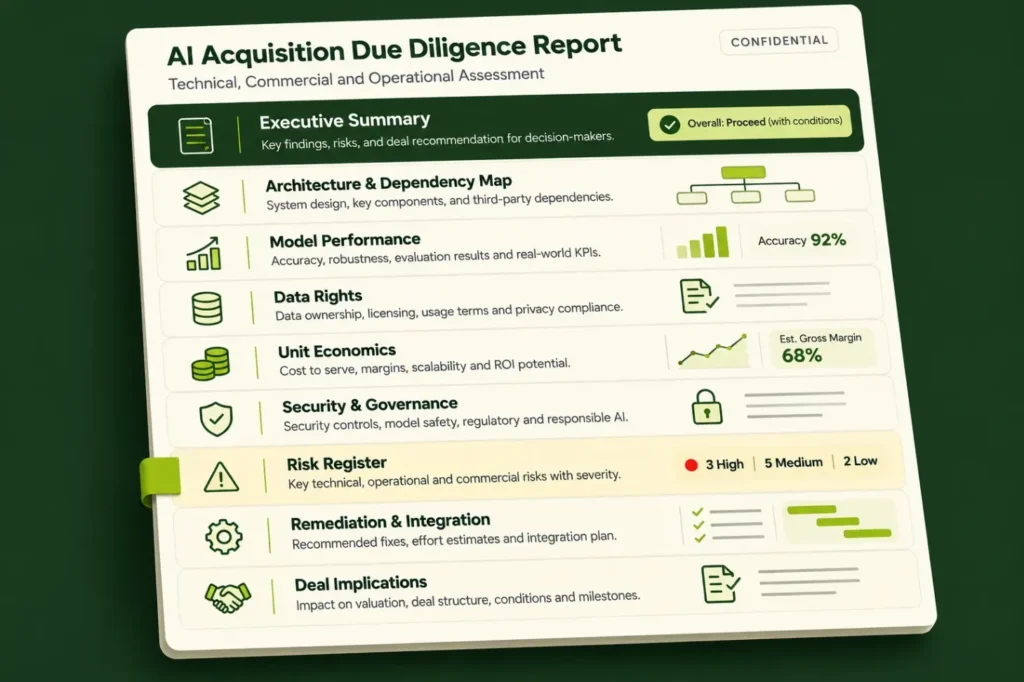
A rigorous assessment is a decision-support document, not an engineering audit. A pile of technical observations helps nobody in a deal room. What a buyer needs is a report that connects each finding to the value of the asset, the cost of operating it, and the work required to integrate it. The sections below are what a thorough AI M&A technical due diligence report should contain, and what each one is for.
1. Executive summary and headline risk view
A short, plain-language summary written for the deal lead and the investment committee, not the engineering team. It states the material risks, their likely impact on the transaction, and a clear overall read: proceed, proceed with conditions, reprice, or reconsider. If a decision-maker reads only one page, this is the page, so it leads with consequences rather than technical detail.
2. AI architecture and dependency map
A clear picture of the system as it actually runs: the application layer, the models, orchestration, retrieval, data pipelines, and infrastructure, with every external dependency marked. This map is what separates the assets the buyer will own from the capability the target merely rents, and it is the reference the rest of the report builds on.
3. Model performance and evaluation findings
An evidence-backed view of whether the product performs as claimed, covering the evaluation methodology, reproducibility, failure modes, and production behaviour. Where claims could not be reproduced, the report says so plainly, because an unverified performance claim is a direct risk to the revenue the buyer is paying for.
4. Data ownership, provenance, and dependency findings
A record of where the data comes from, who owns it, what the licences and consents permit, and critically whether those rights survive the change of ownership. This is also where any concentration risk in third-party models and providers is documented, since both data and model dependencies shape what the buyer can legally and practically do after close.
5. AI unit economics and scalability assessment
The real cost to serve, rebuilt from invoices and usage data rather than the target’s model, with gross margins stress-tested under higher volume and more complex workloads. This section is where an attractive-looking margin is either confirmed or corrected, and it feeds straight into the buyer’s financial model.
6. Security, governance, and operational maturity findings
An assessment of access controls, isolation, agent permissions, logging, incident response, and the AI-specific attack surface, alongside the engineering maturity that determines how safely the platform can be run and scaled. Material gaps here usually translate into remediation cost and deployment constraints the buyer inherits.
7. Risk register ranked by severity, likelihood, and impact
Every material finding in one place, scored for severity, likelihood, and business impact, so the deal team can see at a glance which issues are deal-shaping and which are routine. This is the backbone that turns a long review into a short list of things that actually matter.
8. Remediation estimate and integration roadmap
For the findings that need fixing, an estimate of the effort, the cost drivers, and the dependencies, followed by an integration readiness assessment and a prioritised post-close roadmap. This is what lets the buyer put a number on the work ahead and plan the first hundred days before signing, rather than discovering the bill afterwards.
9. Implications for the thesis and the deal
Finally, the report ties the findings back to the acquisition thesis and the assumptions in the deal model, and sets out the options: a revised valuation, specific protections, a funded remediation plan, or a change in scope. This is the section that makes the whole report a decision tool rather than a technical artefact.
The difference that matters is interpretation. Every finding is tied to what it means for the asset’s value, its operating requirements, and the integration plan, so the buyer reads consequences and recommended actions rather than raw observations.
AI M&A Technical Due Diligence Checklist for Buyers
A compact ai m&a technical due diligence checklist to keep beside you while evaluating a target. It is a prompt for the right questions, not a substitute for a full review, and each item carries a short note on what a confident yes actually looks like.
- Have we mapped the AI system and identified what the target actually owns?
You can point to a current architecture diagram and name which components are proprietary and which are rented.
- Can the target substantiate its performance claims with reproducible evidence?
The key numbers were reproduced on representative data, not taken from a deck or a single demo.
- Are the data rights and model dependencies understood and transferable?
Licences, consents, and provenance are documented, and you know the rights survive the change of ownership.
- Is the product’s differentiation sustainable against a capable competitor?
You can explain what a well-resourced competitor could not easily copy, beyond access to the same foundation model.
- Have we validated cost to serve and the scalability assumptions?
Margins were rebuilt from real invoices and usage, and stress-tested at higher volume and heavier workloads.
- Are security, privacy, and agent permissions appropriate for the intended use?
Isolation, access controls, and agent action boundaries have been reviewed, with the regulatory obligations checked by qualified specialists.
- Have we estimated technical debt and the remediation effort?
The work needed to stabilise, secure, and scale the platform is costed, not left as a vague concern.
- Are the critical engineering dependencies and retention needs understood?
You know which people hold essential knowledge and what it would take to keep or replace them.
- Is the technology compatible with our intended operating environment?
You know whether it slots into your cloud, identity, data, and security stack, or must run standalone, and at what cost.
- Have material findings been translated into deal assumptions and post-close actions?
Each significant finding maps to a valuation input, a protection, a remediation item, or a hundred-day action.
When Should Buyers Engage an AI Technical Due Diligence Partner?
Not every deal needs an independent specialist, but several situations make one worth the investment. The common thread is uncertainty that the internal team cannot resolve on its own and that could move the valuation or the decision.
Before a binding acquisition decision
The natural point to engage is after initial interest and before anything binding, while findings can still shape the price, the structure, and the conditions. Brought in too late, a review can only confirm or regret a decision already made. Brought in on time, it becomes a negotiating input.
When AI capability is central to the valuation
If a meaningful part of the price reflects the target’s AI, that premium deserves independent validation. The more the thesis leans on proprietary models, autonomous agents, or a claimed data moat, the more a buyer needs to know those claims hold before paying for them.
When the target leans on proprietary data or third-party models
Heavy dependence in either direction is a reason to look closely. A claimed data advantage needs its ownership and transferability confirmed, and a heavy reliance on a single external model provider needs its pricing exposure, continuity, and switching cost understood before close.
When performance or economics cannot be verified internally
If the reported accuracy, reliability, or unit economics cannot be reproduced by the buyer’s own team, that gap is exactly what an independent reviewer exists to close. Unverifiable claims are not automatically false, but they are not something to underwrite on trust either.
When the buyer needs a credible remediation and integration estimate
When the question is not just whether to buy but what it will cost to run and integrate afterwards, a specialist can turn vague concerns into costed workstreams. That estimate feeds both the deal model and the post-close plan.
When the internal team lacks specialist AI or MLOps depth
Many capable corporate development and deal teams are not set up to probe model evaluation, inference economics, or agentic failure modes. Bringing in that expertise for the length of the deal is usually faster and more reliable than stretching an internal team into unfamiliar territory.
Scope and depth should be proportionate to the target’s AI dependence, the size of the transaction, the technical complexity, and the time available. A tight review ahead of a smaller deal concentrates on the few assumptions most likely to change the decision. A deep review for a material acquisition goes wider and further into validation.
How Dextra Labs Runs AI M&A Technical Due Diligence
Dextra Labs works as an independent technical due diligence consultant for investors, private equity firms, corporate acquirers, and M&A advisers. Our approach is built around one principle: a review exists to reduce the uncertainty in an acquisition decision, not to produce an engineering audit nobody in the deal room can use. We validate the acquisition thesis with technical evidence and report in the language of the deal. The engagement moves through five phases.
Phase 1: Deal screening
We start with the transaction, not the codebase. Working with the deal team, we map the business model, the acquisition thesis, the AI claims that underpin the valuation, and the transaction structure, then agree which of those claims actually need independent validation. This keeps the work pointed at what could change the price or the decision.
Phase 2: Evidence collection
We request and review the technical evidence: architecture diagrams, source code where access is authorised, model evaluations, cloud and model-provider invoices, data licences, security reports, product analytics, and engineering documentation. How completely a target can produce this is itself an early read on its engineering maturity.
Phase 3: Technical validation
This is where claims are tested rather than taken on trust. We interview the CTO and engineering team, reproduce the performance claims that matter where it is feasible, inspect the model and data dependencies in practice, assess production behaviour, and probe the failure scenarios that would actually hurt after close. We separate the durable assets, the proprietary data, the workflow integration, the evaluation capability, and the genuine know-how, from the rented capability any competitor could license too.
Phase 4: Acquisition risk assessment
We classify every material finding by severity, likelihood, financial impact, and remediation effort, quantify the risks that matter, and challenge the assumptions underlying the deal. Each finding is translated into an acquisition consequence: a valuation input, a protection to negotiate, a remediation cost, or a post-close milestone.
Phase 5: Decision-ready report and integration roadmap
We deliver a report written for the investment committee and the deal team, with an executive summary, evidence-backed findings, a ranked risk register, the implications for the acquisition thesis, and a prioritised post-close plan. Typical deliverables include an AI architecture and dependency assessment, a model and data dependency register, an AI risk matrix, a unit-economics analysis, a remediation cost estimate, and a hundred-day post-acquisition technology and integration roadmap.
We run this in two formats depending on the deal. A rapid review suits smaller or earlier-stage acquisitions and tight transaction deadlines, concentrating on the few assumptions most likely to change the decision. A deep review suits material acquisitions, regulated applications, and complex AI infrastructure, going wider across the system and further into independent validation. Either way, the output is the same in spirit: a clear, evidence-backed answer to what the buyer is acquiring, what it is worth, and what it will take to own and integrate it.
Validate the AI Asset Before Committing to the Acquisition
Three points are worth carrying into any AI acquisition. Validate the AI capability and the underlying assets, not just the product demonstration. Translate the technical findings into business implications, remediation requirements, and an integration plan. And use evidence-backed diligence to make the acquisition decision, because the alternative is discovering after close what should have shaped the price before it.
If you are evaluating an AI company and are weighing the technical investment that comes with it, this is exactly where an investor-side review and a buyer-side review diverge. For the earlier-stage, investment-led version of this work, see our guide to AI startup technical due diligence.
| Evaluating an AI acquisition? Talk to Dextra Labs about independent AI M&A technical due diligence before you commit, so you know what you are buying and what it will take to integrate it. |
Frequently Asked Questions:
What is AI M&A technical due diligence?
It is the technical assessment of an AI company’s architecture, models, data, performance, dependencies, economics, security, and integration readiness before an acquisition, carried out so the buyer can decide on evidence rather than the pitch.
How is AI technical due diligence different from traditional software due diligence?
It adds validation of model performance, data rights, external model dependencies, inference costs, and AI-specific operational risks on top of the usual code, architecture, and security review.
What documents should buyers request from an AI acquisition target?
Architecture diagrams, model and data documentation, evaluation results, infrastructure and inference-cost records, security documentation, dependency inventories, and engineering roadmaps.
How long does AI M&A technical due diligence take?
It depends on system complexity, the quality of the evidence, access to technical staff, the agreed scope, and the deal deadline. A rapid review is far quicker than a deep assessment of a complex platform.
Can technical due diligence affect an AI company’s acquisition valuation?
Yes. Findings can change assumptions about differentiation, operating margins, remediation spend, scalability, and integration cost, all of which feed the valuation and the deal structure.
What happens when an AI target has significant technical risks?
The options are further validation, revised assumptions, a funded remediation plan, an altered transaction scope, or withdrawal if the risks genuinely undermine the deal thesis.